Submitted To: Submitted By:
T sujatha mam G Revanth (17kp1a0536)
Content
 Introduction
 What is a Firewall
 Applications of Firewall
 Software Firewall vs Hardware Firewall
 History
 Design goals for Firewall
Content….
 Types
 Basic Concepts of Firewall
 Role of Firewall
 Advantages
 Disadvantages
 Conclusion
INTRODUCTION
 The Internet has made large amount of information available to
the average computer user at home, in business and education.
 For many people, having access to this information is no longer
just an advantage; it is essential.
 Therefore, security of network is the main criteria here and
firewalls provide this security.
What is a Firewall?
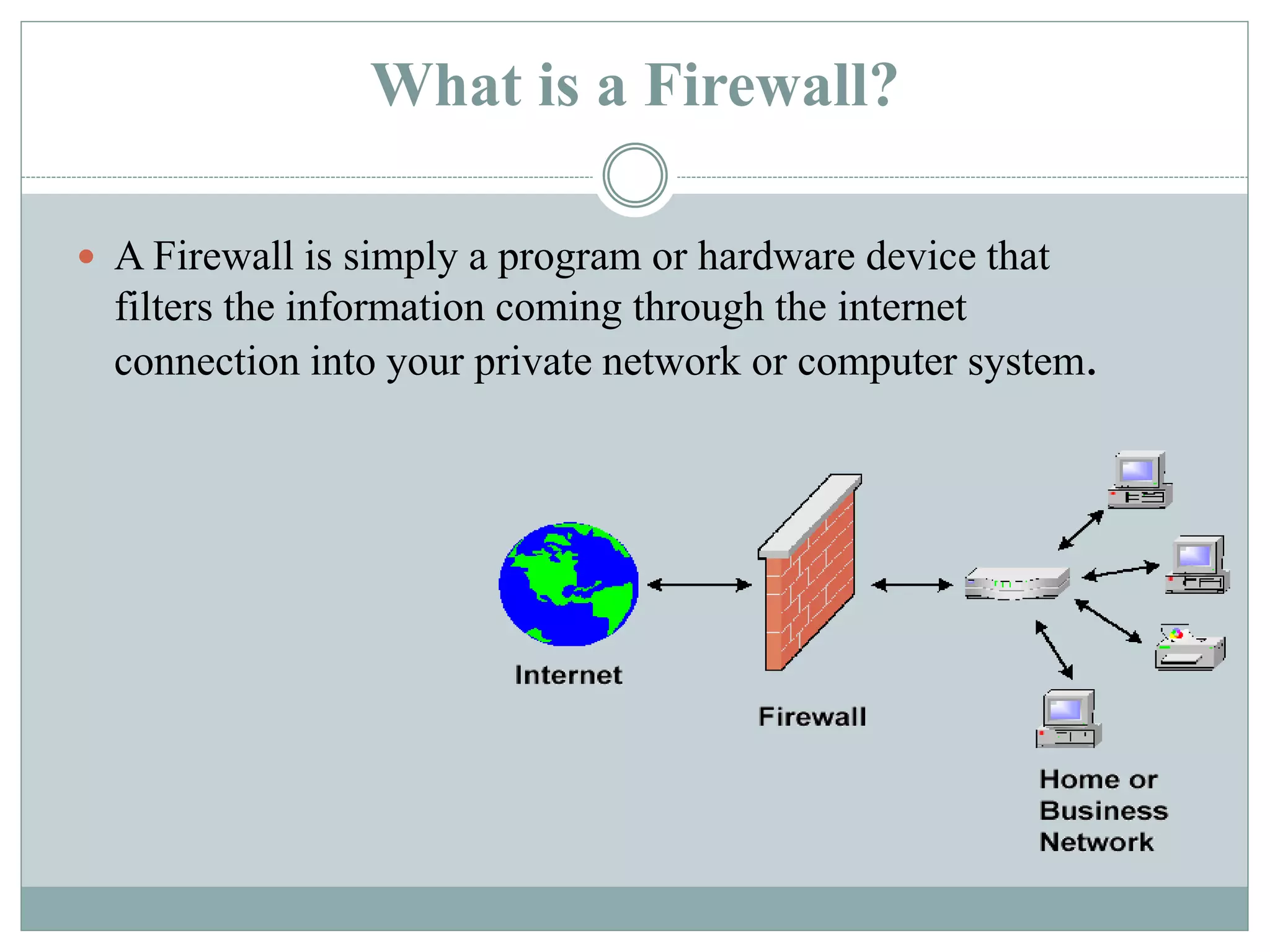
 A Firewall is simply a program or hardware device that
filters the information coming through the internet
connection into your private network or computer system.
What is an application firewall?
 An application firewall is a special firewall that is specifically
coded for the type of traffic it is inspecting.
 The most widely developed application firewall is the web
application firewall.
What is the difference between a host-based firewall
and a network-based firewall?
 A host-based firewall is installed on an individual computer to
protect it from activity occurring on its network.
 A network-based firewall is implemented at a specified point in
the network path and protects all computers on the “internal” side
of the firewall from all computers on the “external” side of the
firewall.
Hardware firewall vs Software firewall
 Hardware firewalls are integrated into the router that sits
between a computer and the Internet.
 Software firewalls are installed on individual servers. They
intercept each connection request and then determine whether the
request is valid or not.
History of Firewalls
 Firewall technology first began to emerge in the late 1980s.
Internet was still a fairly new technology in terms of its global
usage and connectivity.
 In 1988 an employee at the NASA Ames Research Center in
California sent a memo by email to his colleagues that read, "We
are currently under attack from an Internet VIRUS!
Design goals for a firewall
 The first design goal for a firewall is that collectively
the sum of all the network traffic from internal to
external must go through the firewall physically
cutting off all access to the local network except via
the firewall.
 The second design goal would be only authorized
traffic which is delineated by the local security policy
will be allowed to proceed.
 Finally the last design goal is that the firewall itself is
resistant to penetration inclusive is a solid trustworthy
system with a protected operating system.
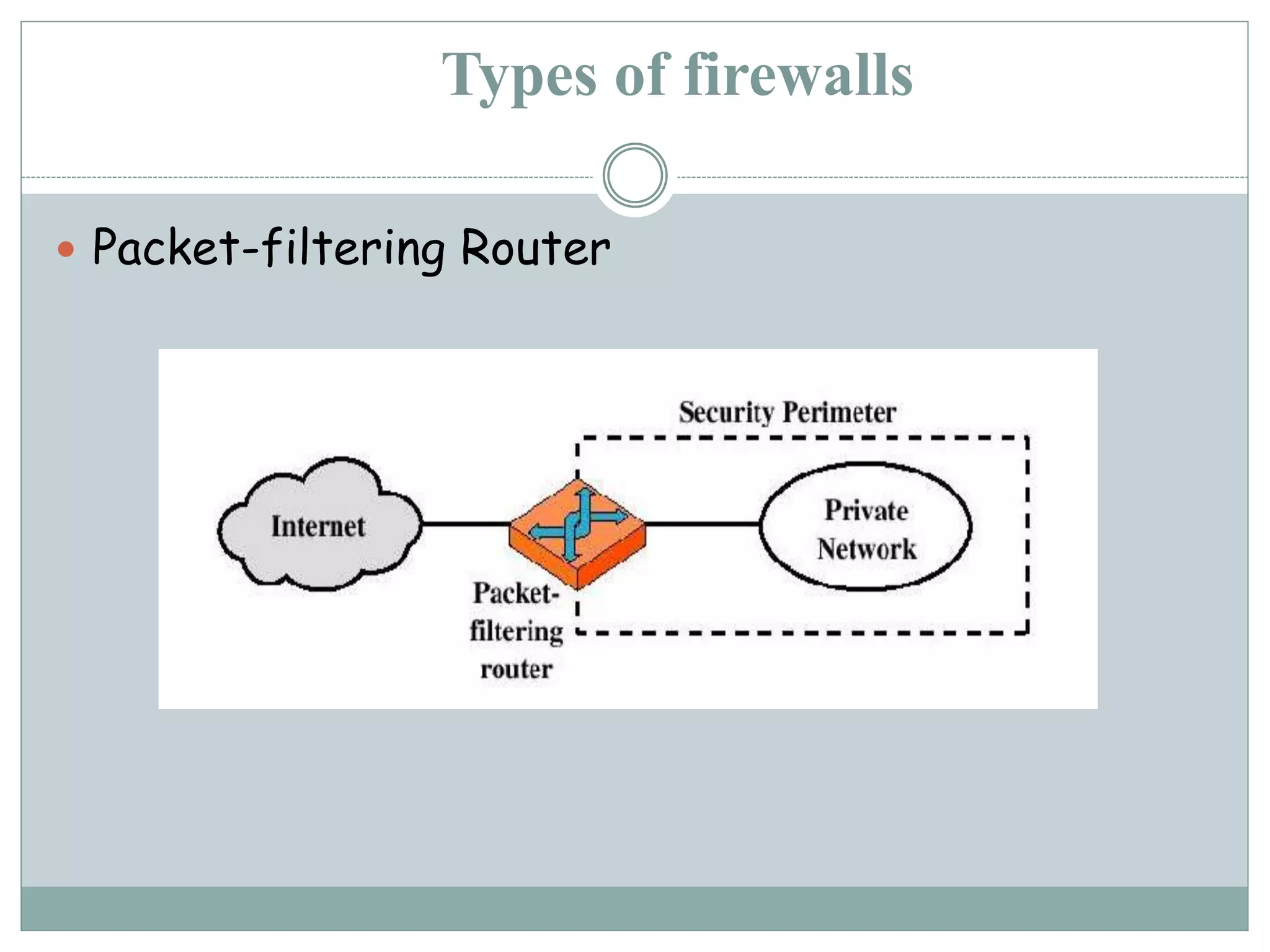
Types of firewalls
 Packet-filtering Router
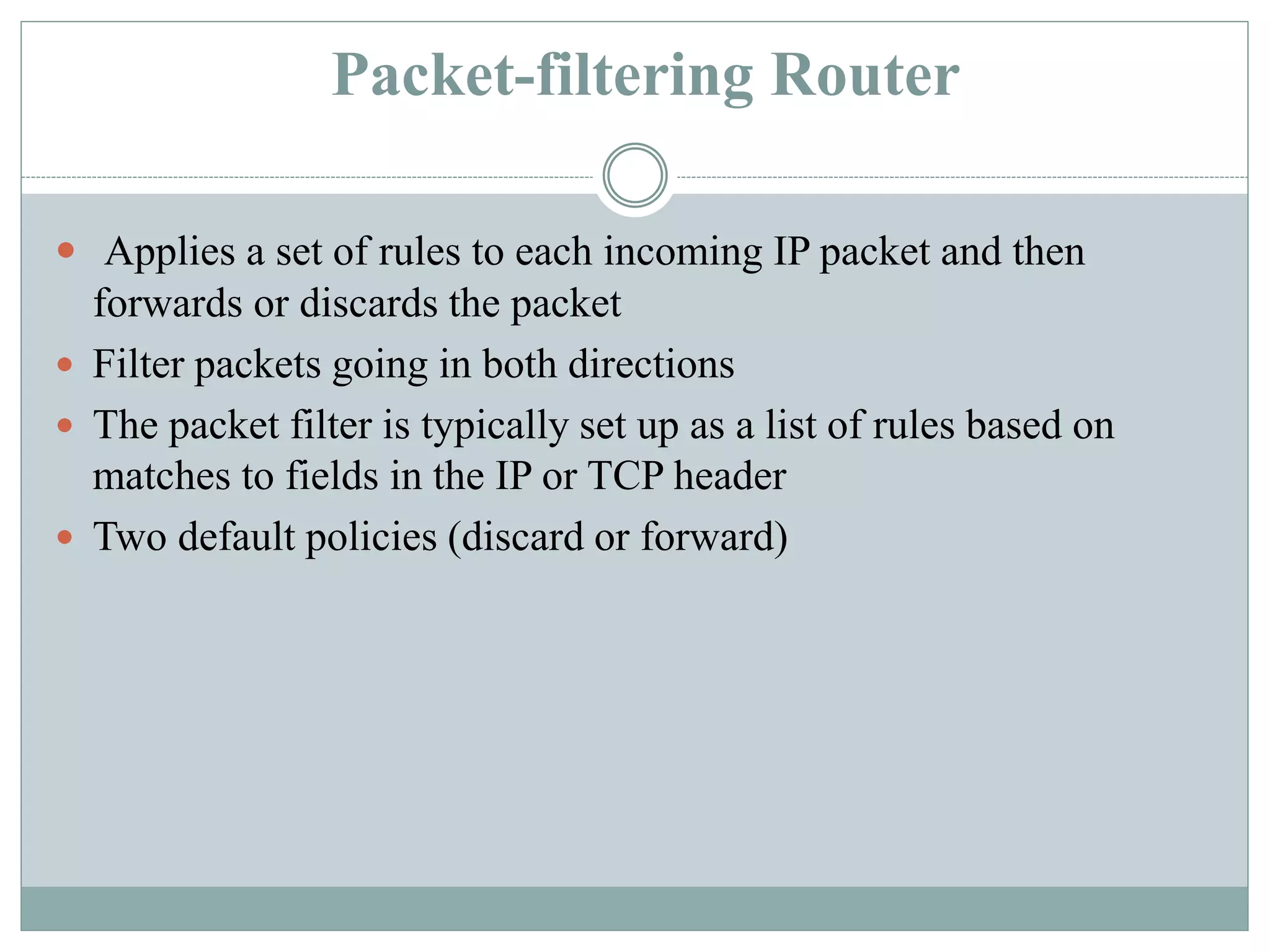
Packet-filtering Router
 Applies a set of rules to each incoming IP packet and then
forwards or discards the packet
 Filter packets going in both directions
 The packet filter is typically set up as a list of rules based on
matches to fields in the IP or TCP header
 Two default policies (discard or forward)
Types of firewalls…
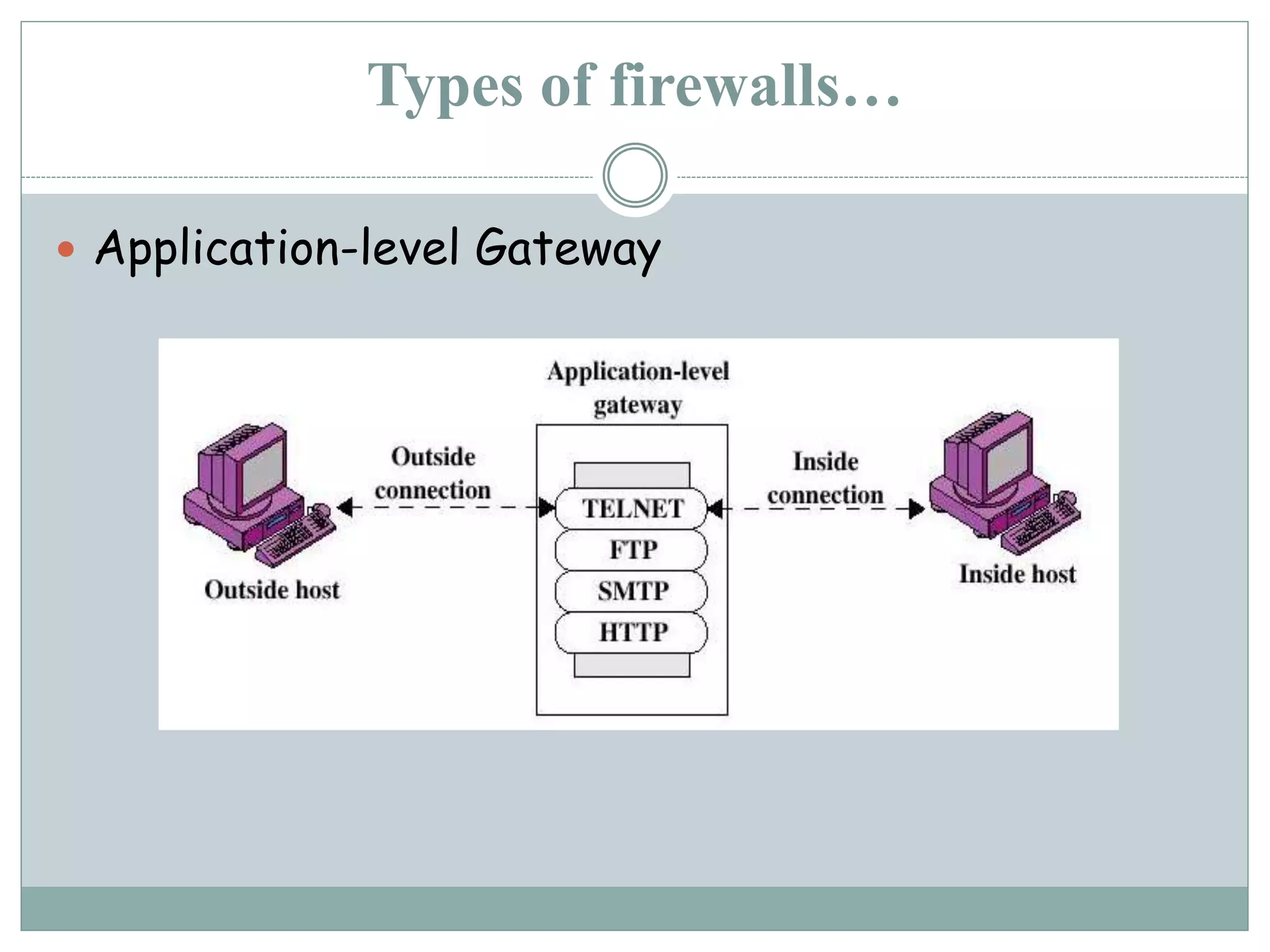
 Application-level Gateway
Application-level Gateway
 Also called proxy server
 Acts as a relay of application-level traffic
Types of firewalls…
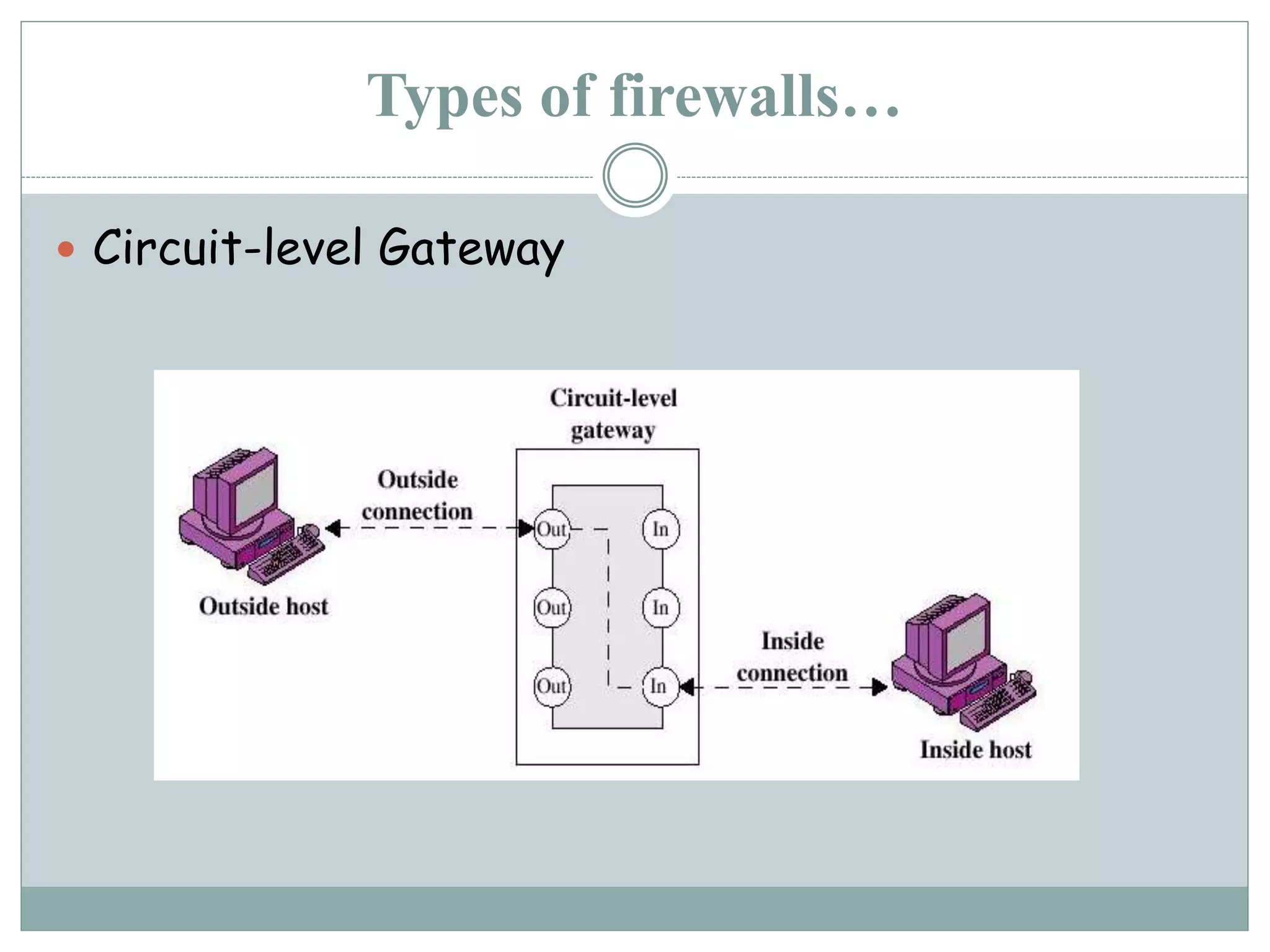
 Circuit-level Gateway
Circuit-level Gateway
 Stand-alone system or
 Specialized function performed by an Application-level
Gateway
 Sets up two TCP connections
 The gateway typically relays TCP segments from one
connection to the other without examining the contents
 The security function consists of determining which
connections will be allowed
Basic concepts of a firewall
 Source
 Destination
 Service
 Action
Advantages of firewall
 Concentration of security all modified software and logging is
located on the firewall system as opposed to being distributed on
many hosts;
 Protocol filtering, where the firewall filters protocols and services
that are either not necessary or that cannot be adequately secured
from exploitation;
 Information hiding, in which a firewall can ``hide'' names of
internal systems or electronic mail addresses, thereby revealing
less information to outside hosts;
 Application gateways, where the firewall requires inside or
outside users to connect first to the firewall before connecting
further, thereby filtering the protocol;
Disadvantages of firewall
 The most obvious being that certain types of network access may
be hampered or even blocked for some hosts, including telnet,
ftp, X Windows, NFS, NIS, etc.
 A second disadvantage with a firewall system is that it
concentrates security in one spot as opposed to distributing it
among systems, thus a compromise of the firewall could be
disastrous to other less-protected systems on the subnet.
Conclusion
 One of the best things about a firewall from a security standpoint
is that it stops anyone on the outside from logging onto a
computer in your private network.
 While this is a big deal for businesses, most home networks will
probably not be threatened in this manner. Still, putting a firewall
in place provides some peace of mind.
Thanks..!!!

Firewall ppt

  • 1.
    Submitted To: SubmittedBy: T sujatha mam G Revanth (17kp1a0536)
  • 2.
    Content  Introduction  Whatis a Firewall  Applications of Firewall  Software Firewall vs Hardware Firewall  History  Design goals for Firewall
  • 3.
    Content….  Types  BasicConcepts of Firewall  Role of Firewall  Advantages  Disadvantages  Conclusion
  • 4.
    INTRODUCTION  The Internethas made large amount of information available to the average computer user at home, in business and education.  For many people, having access to this information is no longer just an advantage; it is essential.  Therefore, security of network is the main criteria here and firewalls provide this security.
  • 5.
    What is aFirewall?  A Firewall is simply a program or hardware device that filters the information coming through the internet connection into your private network or computer system.
  • 6.
    What is anapplication firewall?  An application firewall is a special firewall that is specifically coded for the type of traffic it is inspecting.  The most widely developed application firewall is the web application firewall.
  • 7.
    What is thedifference between a host-based firewall and a network-based firewall?  A host-based firewall is installed on an individual computer to protect it from activity occurring on its network.  A network-based firewall is implemented at a specified point in the network path and protects all computers on the “internal” side of the firewall from all computers on the “external” side of the firewall.
  • 8.
    Hardware firewall vsSoftware firewall  Hardware firewalls are integrated into the router that sits between a computer and the Internet.  Software firewalls are installed on individual servers. They intercept each connection request and then determine whether the request is valid or not.
  • 9.
    History of Firewalls Firewall technology first began to emerge in the late 1980s. Internet was still a fairly new technology in terms of its global usage and connectivity.  In 1988 an employee at the NASA Ames Research Center in California sent a memo by email to his colleagues that read, "We are currently under attack from an Internet VIRUS!
  • 10.
    Design goals fora firewall  The first design goal for a firewall is that collectively the sum of all the network traffic from internal to external must go through the firewall physically cutting off all access to the local network except via the firewall.  The second design goal would be only authorized traffic which is delineated by the local security policy will be allowed to proceed.  Finally the last design goal is that the firewall itself is resistant to penetration inclusive is a solid trustworthy system with a protected operating system.
  • 11.
    Types of firewalls Packet-filtering Router
  • 12.
    Packet-filtering Router  Appliesa set of rules to each incoming IP packet and then forwards or discards the packet  Filter packets going in both directions  The packet filter is typically set up as a list of rules based on matches to fields in the IP or TCP header  Two default policies (discard or forward)
  • 13.
    Types of firewalls… Application-level Gateway
  • 14.
    Application-level Gateway  Alsocalled proxy server  Acts as a relay of application-level traffic
  • 15.
    Types of firewalls… Circuit-level Gateway
  • 16.
    Circuit-level Gateway  Stand-alonesystem or  Specialized function performed by an Application-level Gateway  Sets up two TCP connections  The gateway typically relays TCP segments from one connection to the other without examining the contents  The security function consists of determining which connections will be allowed
  • 17.
    Basic concepts ofa firewall  Source  Destination  Service  Action
  • 18.
    Advantages of firewall Concentration of security all modified software and logging is located on the firewall system as opposed to being distributed on many hosts;  Protocol filtering, where the firewall filters protocols and services that are either not necessary or that cannot be adequately secured from exploitation;  Information hiding, in which a firewall can ``hide'' names of internal systems or electronic mail addresses, thereby revealing less information to outside hosts;  Application gateways, where the firewall requires inside or outside users to connect first to the firewall before connecting further, thereby filtering the protocol;
  • 19.
    Disadvantages of firewall The most obvious being that certain types of network access may be hampered or even blocked for some hosts, including telnet, ftp, X Windows, NFS, NIS, etc.  A second disadvantage with a firewall system is that it concentrates security in one spot as opposed to distributing it among systems, thus a compromise of the firewall could be disastrous to other less-protected systems on the subnet.
  • 20.
    Conclusion  One ofthe best things about a firewall from a security standpoint is that it stops anyone on the outside from logging onto a computer in your private network.  While this is a big deal for businesses, most home networks will probably not be threatened in this manner. Still, putting a firewall in place provides some peace of mind.
  • 21.