Objectives:
• Define a Firewall
• Identify the different types of a firewall and its
purpose
• Configure the Firewall
WHAT IS A ?
https://www.youtube.com/watch?v=x1YLj06c3hM
A firewall is a piece of software that stands
between a computer or network and the Internet. A
firewall serves to block these unauthorized
requests, passing through only designated traffic.
The Firewall
Firewall Design Principles
• Aims:
– Establish a controlled link
– Protect the premises network from Internet-based attacks
– Provide a single choke point
9
Four general techniques of a
Firewall :
1. Service control
– Determines the types of Internet services that can be accessed,
inbound or outbound
2. Direction control
– Determines the direction in which particular service requests are
allowed to flow
3. User control
– Controls access to a service according to which user is attempting
to access it
4. Behavior control
– Controls how particular services are used (e.g. filter e-mail)
10
• Application level Gateway Firewalls (Proxy)
• Stateful Multilayer Inspection Firewalls
• Packet Filtering Firewalls
• Circuit Level Gateway Firewalls
Types of Firewalls
PROXY FIREWALL
• A proxy firewall serves as the gateway from one
network to another for a specific application.
13
Types of Firewalls
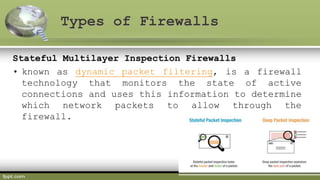
Stateful Multilayer Inspection Firewalls
• known as dynamic packet filtering, is a firewall
technology that monitors the state of active
connections and uses this information to determine
which network packets to allow through the
firewall.
14
Types of Firewalls
15
Packet Filtering Firewalls
• Packet filtering
firewalls work at levels 3
and 4 of the
TCP/IP protocol stack,
filtering TCP and UCP
packets based on any
combination of source IP
address, destination IP
address, source port,
or destination port.
Types of Firewalls
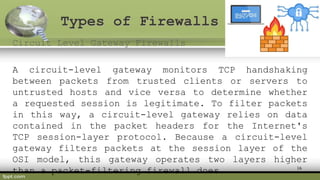
Circuit Level Gateway Firewalls
A circuit-level gateway monitors TCP handshaking
between packets from trusted clients or servers to
untrusted hosts and vice versa to determine whether
a requested session is legitimate. To filter packets
in this way, a circuit-level gateway relies on data
contained in the packet headers for the Internet's
TCP session-layer protocol. Because a circuit-level
gateway filters packets at the session layer of the
OSI model, this gateway operates two layers higher
than a packet-filtering firewall does. 16
Types of Firewalls
THREAT-FOCUSED NGFW
• These firewalls include all the capabilities of a traditional NGFW and
also provide advanced threat detection and remediation.
• Know which assets are most at risk with complete context awareness
• Quickly react to attacks with intelligent security automation that sets
policies and hardens your defenses dynamically
• Better detect evasive or suspicious activity with network and endpoint
event correlation
• Greatly decrease the time from detection to cleanup with retrospective
security that continuously monitors for suspicious activity and behavior
even after initial inspection
• Ease administration and reduce complexity with unified policies that
protect across the entire attack continuum
17
IN ADDITION TO THE USE OF SIMPLE CONFIGURATION OF A SINGLE
SYSTEM (SINGLE PACKET FILTERING ROUTER OR SINGLE GATEWAY),
MORE COMPLEX CONFIGURATIONSARE POSSIBLE
THREE COMMON CONFIGURATIONS
QUIZ:
1. The purpose of a firewall on computer networks is to -
a. Prevent computers from overheating
b. Prevent unwanted network connections from being made
c. Allow more than 4 computers to share the same Internet connection
d. Allow pictures and video to be downloaded from a camera to a computer
2. Which one of the following can be considered to be a hardware firewall?
a. Router
b. Hub
c. Bridge
d. Switch
3. Which of the following are true about Firewalls?
a. Filters network traffic
b. Can be either a hardware or software device
c. Follows a set of rules
d. All the above
4. Which one of the following is a key function of a firewall?
a. Monitoring
b. Copying
c. Deleting
d. Moving
5. What is "phishing?
a. "Spoofed" e-mails and fraudulent websites designed to fool recipients
into divulging personal financial data such as credit card numbers, account
usernames and passwords
b. A type of computer virus
c. An example of a strong password
d. None of the above
6. What are some of the benefits of using a firewall for your LAN?
a. Increased access to Instant Messaging
b. Stricter access control to critical resources
c. Greater security to your LAN
d. Both 2 and 3
7. VIRUS stands for
a. Very Important Resource Under Search
b. Virtual Information Resource Under Resize
c. Verify Interchange Result Until Source
d. Very Important Record User Searched
8. Most enterprises implement several basic security
measures. Which of the following is NOT a common security
practice?
a. Content monitoring
b. Fault tolerance
c. Firewall
d. Intrusion-detection system
Resources:
https://www.cisco.com/c/en/us/products/security/firewalls/what-is-a-firewall.html
https://community.windows.com/en-us/videos/firewall-network-protections-keep-
unwanted-online-traffic-out/pfyyc9XdT5M
Firewall

Firewall

  • 3.
    Objectives: • Define aFirewall • Identify the different types of a firewall and its purpose • Configure the Firewall
  • 4.
    WHAT IS A? https://www.youtube.com/watch?v=x1YLj06c3hM
  • 6.
    A firewall isa piece of software that stands between a computer or network and the Internet. A firewall serves to block these unauthorized requests, passing through only designated traffic. The Firewall
  • 9.
    Firewall Design Principles •Aims: – Establish a controlled link – Protect the premises network from Internet-based attacks – Provide a single choke point 9
  • 10.
    Four general techniquesof a Firewall : 1. Service control – Determines the types of Internet services that can be accessed, inbound or outbound 2. Direction control – Determines the direction in which particular service requests are allowed to flow 3. User control – Controls access to a service according to which user is attempting to access it 4. Behavior control – Controls how particular services are used (e.g. filter e-mail) 10
  • 12.
    • Application levelGateway Firewalls (Proxy) • Stateful Multilayer Inspection Firewalls • Packet Filtering Firewalls • Circuit Level Gateway Firewalls
  • 13.
    Types of Firewalls PROXYFIREWALL • A proxy firewall serves as the gateway from one network to another for a specific application. 13
  • 14.
    Types of Firewalls StatefulMultilayer Inspection Firewalls • known as dynamic packet filtering, is a firewall technology that monitors the state of active connections and uses this information to determine which network packets to allow through the firewall. 14
  • 15.
    Types of Firewalls 15 PacketFiltering Firewalls • Packet filtering firewalls work at levels 3 and 4 of the TCP/IP protocol stack, filtering TCP and UCP packets based on any combination of source IP address, destination IP address, source port, or destination port.
  • 16.
    Types of Firewalls CircuitLevel Gateway Firewalls A circuit-level gateway monitors TCP handshaking between packets from trusted clients or servers to untrusted hosts and vice versa to determine whether a requested session is legitimate. To filter packets in this way, a circuit-level gateway relies on data contained in the packet headers for the Internet's TCP session-layer protocol. Because a circuit-level gateway filters packets at the session layer of the OSI model, this gateway operates two layers higher than a packet-filtering firewall does. 16
  • 17.
    Types of Firewalls THREAT-FOCUSEDNGFW • These firewalls include all the capabilities of a traditional NGFW and also provide advanced threat detection and remediation. • Know which assets are most at risk with complete context awareness • Quickly react to attacks with intelligent security automation that sets policies and hardens your defenses dynamically • Better detect evasive or suspicious activity with network and endpoint event correlation • Greatly decrease the time from detection to cleanup with retrospective security that continuously monitors for suspicious activity and behavior even after initial inspection • Ease administration and reduce complexity with unified policies that protect across the entire attack continuum 17
  • 19.
    IN ADDITION TOTHE USE OF SIMPLE CONFIGURATION OF A SINGLE SYSTEM (SINGLE PACKET FILTERING ROUTER OR SINGLE GATEWAY), MORE COMPLEX CONFIGURATIONSARE POSSIBLE THREE COMMON CONFIGURATIONS
  • 30.
    QUIZ: 1. The purposeof a firewall on computer networks is to - a. Prevent computers from overheating b. Prevent unwanted network connections from being made c. Allow more than 4 computers to share the same Internet connection d. Allow pictures and video to be downloaded from a camera to a computer 2. Which one of the following can be considered to be a hardware firewall? a. Router b. Hub c. Bridge d. Switch 3. Which of the following are true about Firewalls? a. Filters network traffic b. Can be either a hardware or software device c. Follows a set of rules d. All the above
  • 31.
    4. Which oneof the following is a key function of a firewall? a. Monitoring b. Copying c. Deleting d. Moving 5. What is "phishing? a. "Spoofed" e-mails and fraudulent websites designed to fool recipients into divulging personal financial data such as credit card numbers, account usernames and passwords b. A type of computer virus c. An example of a strong password d. None of the above 6. What are some of the benefits of using a firewall for your LAN? a. Increased access to Instant Messaging b. Stricter access control to critical resources c. Greater security to your LAN d. Both 2 and 3
  • 32.
    7. VIRUS standsfor a. Very Important Resource Under Search b. Virtual Information Resource Under Resize c. Verify Interchange Result Until Source d. Very Important Record User Searched 8. Most enterprises implement several basic security measures. Which of the following is NOT a common security practice? a. Content monitoring b. Fault tolerance c. Firewall d. Intrusion-detection system
  • 34.

Editor's Notes

  • #7 Any request will pass through to vulnerable systems, allowing unscrupulous third parties to exploit your computers for their own gain. It monitors and restricts the information that travels between your computer and a network such as the internet. Windows firewall helps to provide a line of defense against someone who might try to access your computer over a network without your permission. It also helps block malicious software and worms and provides a means to log security events. Firewall helps to protect your computer by blocking unsolicited traffic. Unsolicited traffic is any attempt to communicate with your computer over a network connection that was not specifically requested by programs running on your computer. What is firewall? Firewalls protect a Network of Computers from being Compromised, Denial of Service and other Attacks from Hackers trying to Intrude the network from outside. A Firewall can be in the form of a Hardware or a Software on a Computer, as well. A Firewall needs to be connected to a minimum of two Network Interfaces, one which is supposed to be protected (Your Internal Network) and other which is Exposed to Attacks (Generally Internet). A Firewall can also be considered as a Gateway deployed between the two Networks.
  • #8 How Firewalls work? Firewall examine all the data packets passing through them to see if they meet the rules defined by the ACL (Access Control List) made by the administrator of the network. Only, If the Data Packets are allowed as per ACL, they will be Transmitted over the Connection. Firewalls generally also maintain a log of Important Activities in Inside the Network. A Network Administrator can define what is important for him and configure the Firewall to make the Logs accordingly. Firewall can filter contents on the basis of Address, Protocols, Packet attributes and State. Firewalls generally only Screen the Packet Headers.
  • #9 How Firewalls work? Firewall examine all the data packets passing through them to see if they meet the rules defined by the ACL (Access Control List) made by the administrator of the network. Only, If the Data Packets are allowed as per ACL, they will be Transmitted over the Connection. Firewalls generally also maintain a log of Important Activities in Inside the Network. A Network Administrator can define what is important for him and configure the Firewall to make the Logs accordingly. Firewall can filter contents on the basis of Address, Protocols, Packet attributes and State. Firewalls generally only Screen the Packet Headers.
  • #10 Information systems undergo a steady evolution (from small LAN`s to Internet connectivity) Strong security features for all workstations and servers not established The firewall is inserted between the premises network and the Internet Design goals: All traffic from inside to outside must pass through the firewall (physically blocking all access to the local network except via the firewall) Only authorized traffic (defined by the local security police) will be allowed to pass The firewall itself is immune to penetration (use of trusted system with a secure operating system)
  • #14 Proxy servers can provide additional functionality such as content caching and security by preventing direct connections from outside the network. However, this also may impact throughput capabilities and the applications they can support. Proxy firewalls are considered to be the most secure type of firewall because they prevent direct network contact with other systems. (Because a proxy firewall has its own IP address, an outside network connection will never receive packets from the sending network directly.) 
  • #15 It monitors all activity from the opening of a connection until it is closed. Filtering decisions are made based on both administrator-defined rules as well as context, which refers to using information from previous connections and packets belonging to the same connection. Monitors communications packets over a period of time and examines both incoming and outgoing packets. Outgoing packets that request specific types of incoming packets are tracked and only those incoming packets constituting a proper response are allowed through the firewall.
  • #16 Packet-filtering firewalls are very fast because there is not much logic going behind the decisions they make. They do not do any internal inspection of the traffic. They also do not store any state information. You have to manually open ports for all traffic that will flow through the firewall. Packet-filtering firewalls are considered not to be very secure. This is because they will forward any traffic that is flowing on an approved port. So there could be malicious traffic being sent, but as long as it’s on an acceptable port, it will not be blocked.
  • #31 A A D A A D B B