

आग की रोकथाम
और नियंत्रण
विषय की प्रस्तुतत कर रहे
हैं
नंद लाल चौबे
(सहायक प्रबंधक- सुरक्षा)
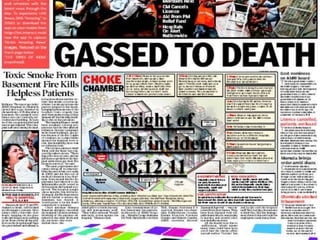
Insight of
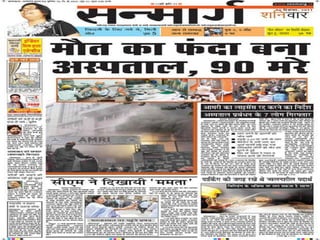
AMRI incident
08.12.11
4/6/2022 11:06 AM Fire Safety & Emergency Evacuation
Training By N.L.Choubey
7
Fire Safety & Emergency Evacuation
4/6/2022 11:06 AM Fire Safety & Emergency Evacuation
Training By N.L.Choubey
8
It is kind request to please keep your
mobile on SILENT MODE
4/6/2022 11:06 AM Fire Safety & Emergency Evacuation
Training By N.L.Choubey
9
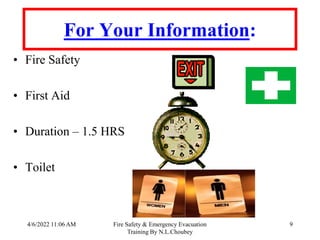
For Your Information:
• Fire Safety
• First Aid
• Duration – 1.5 HRS
• Toilet
4/6/2022 11:06 AM Fire Safety & Emergency Evacuation
Training By N.L.Choubey
10
Overview - Theory
Legislation & Responsibilities
The Chemistry of Fire
Types of Fires
Fire Safety Management
Emergency Evacuation Procedure
4/6/2022 11:06 AM Fire Safety & Emergency Evacuation
Training By N.L.Choubey
11
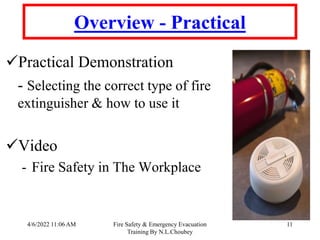
Overview - Practical
Practical Demonstration
- Selecting the correct type of fire
extinguisher & how to use it
Video
- Fire Safety in The Workplace
4/6/2022 11:06 AM Fire Safety & Emergency Evacuation
Training By N.L.Choubey
12
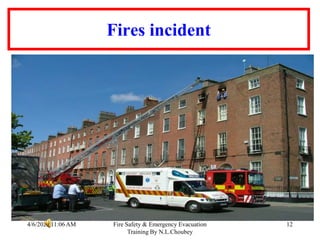
Fires incident
4/6/2022 11:06 AM Fire Safety & Emergency Evacuation
Training By N.L.Choubey
13
VISION
To raise the level of Prevention
and Preparedness, so as to
minimize loss of life and
property in the factory from fire
and non-fire emergencies and to
inculcate safety consciousness
among the general public.
4/6/2022 11:06 AM Fire Safety & Emergency Evacuation
Training By N.L.Choubey
14
MISSION
Fulfilling the main objectives of fire
prevention, fire protection, fire fighting
and rescue. The department generally
attends emergency calls which are not
directly connected with fire, in order to
help the people in distress. The
department is being developed to
provide effective fire and emergency
cover to the people and property in the
factory.
4/6/2022 11:06 AM Fire Safety & Emergency Evacuation
Training By N.L.Choubey
15
Developing Fire and Emergency
Service as a Service Provider for
reaching help to the people in
distress, for all hazard purposes;
Ensuring community safety and
enriching the members of the
profession through training and
education for preventing and
mitigating the Fire loss to facilitate
improve public safety.
4/6/2022 11:06 AM Fire Safety & Emergency Evacuation
Training By N.L.Choubey
16
OBJECTIVES OF THE FIRE TRAINING
1. To prevent and suppress unwanted fires
by rendering prompt and efficient services
so as to keep the loss of life and property to
the minimum.
2. To conduct fire safety awareness , method
of inspection in hazardous occupancies and
to advise Management so as to reduce risk
by fire.
3. To impart training in Fire Prevention, Fire
Fighting and Fire Protection.
4/6/2022 11:06 AM Fire Safety & Emergency Evacuation
Training By N.L.Choubey
17
4. To implement fire safety regulatory measures
under Fire Service Rules for uses of places and
trades for purpose involving risk from fire.
5. To provide standby protection at large
gatherings and important public and private
functions.
6. To provide Ambulance services to rush the
effected person and sick to the hospital during
accidents.
OBJECTIVES OF THE FIRE TRAINING
4/6/2022 11:06 AM Fire Safety & Emergency Evacuation
Training By N.L.Choubey
18
OBJECTIVES OF THE FIRE TRAINING
7. To check installation of Fire Protection measures and carry
out Fire Fighting and responding to non-fire emergencies due
to natural and manmade disasters.
8. To prevent loss of life and property from fire and non-fire
emergencies like highway motor accidents, building collapse,
landslides, still water rescue, Industrial hazards, spillage and
toxic release, inter-alia technological hazards and to render
humanitarian services and special services.
9. To promote Community based preventive and coping
strategies for all kinds of emergencies including fire.
4/6/2022 11:06 AM Fire Safety & Emergency Evacuation
Training By N.L.Choubey
19
Policy
• The policy of any Factory about fire safety is to
prevent fires/emergency situations from
occurring , and to evacuate all persons to a
place of safety as quickly as possible in the
event of such occurrences.
4/6/2022 11:06 AM Fire Safety & Emergency Evacuation
Training By N.L.Choubey
20
Legal Background
• Fire Services Act 1981
• Safety, Health, and Welfare at Work Act 2005
– Employers duties
– Employees duties
• Safety, Health, and Welfare at Work (General
Application) (Amendment No.2) Regulations 2003
– To provide the necessary measures for fire fighting & evacuation
of employees
– To contact appropriate emergency services
4/6/2022 11:06 AM Fire Safety & Emergency Evacuation
Training By N.L.Choubey
21
FIRE SAFETY
TIPS
( VIDEO CLIP )
4/6/2022 11:06 AM Fire Safety & Emergency Evacuation
Training By N.L.Choubey
22
Responsibilities For Fire Safety:
• All staff should:
– Ensure that ones acts /omissions do not
create a fire or other hazard
– Observe all policies & procedures in
relation to fire safety
– Follow the Evacuation Procedure
– Report fire hazards
– Undertake fire safety training
4/6/2022 11:06 AM Fire Safety & Emergency Evacuation
Training By N.L.Choubey
23
Risks of Fire
Impact on the organisation:
• Structural damage to buildings
• Loss – financial, reputation, facilities, research,
expertise, and lost work
Impact on the environment:
• Pollution – water, air, soil, flora & fauna.
4/6/2022 11:06 AM Fire Safety & Emergency Evacuation
Training By N.L.Choubey
24
Risks of Fire
Impact on human life:
• Physical injuries e.g. burns, smoke inhalation!
• Psychological effects e.g. post traumatic stress
syndrome
• Occupational issues e.g. loss of earnings,
unemployment, work related stress.
• Loss of life
4/6/2022 11:06 AM Fire Safety & Emergency Evacuation
Training By N.L.Choubey
25
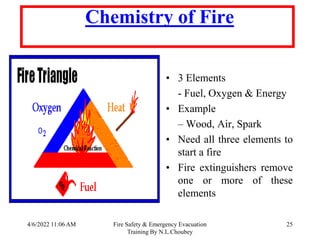
Chemistry of Fire
• 3 Elements
- Fuel, Oxygen & Energy
• Example
– Wood, Air, Spark
• Need all three elements to
start a fire
• Fire extinguishers remove
one or more of these
elements
4/6/2022 11:06 AM Fire Safety & Emergency Evacuation
Training By N.L.Choubey
26
Sources of Ignition
 Chemical Ignition oily rags by oxidation, flammable
liquids.
 Electrical Insulation breakdown – short circuits, over
loading circuits, connections too tight or
too loose
 Mechanical Sparks generated by friction or welding ,
overheating, dust-covered motors
 Others Sources: Smoking, hot surfaces, articles placed on
heating appliances, arson
4/6/2022 11:06 AM Fire Safety & Emergency Evacuation
Training By N.L.Choubey
27
Sources of Fuel
• Solids – e.g. paper, cloth, wood, textiles,
dust, packaging materials etc.
• Gases e.g. LPG, welding gases
• Flammable liquids – e.g. petrol, oil, paint,
cleaning fluids, chemicals etc.
4/6/2022 11:06 AM Fire Safety & Emergency Evacuation
Training By N.L.Choubey
28
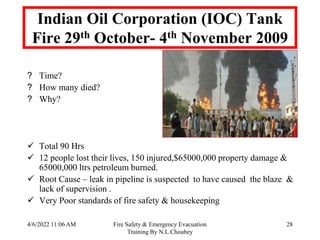
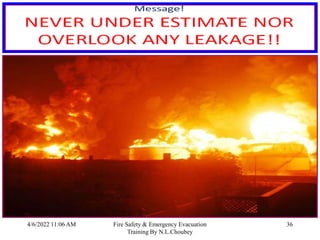
Indian Oil Corporation (IOC) Tank
Fire 29th October- 4th November 2009
? Time?
? How many died?
? Why?
 Total 90 Hrs
 12 people lost their lives, 150 injured,$65000,000 property damage &
65000,000 ltrs petroleum burned.
 Root Cause – leak in pipeline is suspected to have caused the blaze &
lack of supervision .
 Very Poor standards of fire safety & housekeeping
4/6/2022 11:06 AM Fire Safety & Emergency Evacuation
Training By N.L.Choubey
29
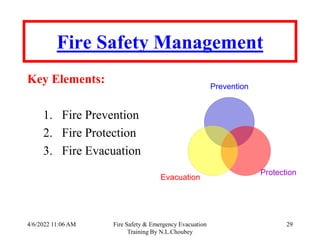
Fire Safety Management
Key Elements:
1. Fire Prevention
2. Fire Protection
3. Fire Evacuation
Prevention
Protection
Evacuation
4/6/2022 11:06 AM Fire Safety & Emergency Evacuation
Training By N.L.Choubey
30
Fire Prevention
The elimination of risks by controlling sources of ignition and management of
combustible and flammable fuels.
Necessary to:
– Recognise all possible risks associated with an activity / process
– Evaluate the risks and their likely impact on the process
– Control of risks to ensure that ignition does not occur
– Implement controls identified in the Risk Assessment / Safety Statement
4/6/2022 11:06 AM Fire Safety & Emergency Evacuation
Training By N.L.Choubey
31
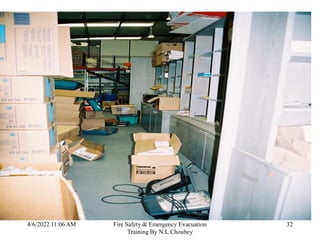
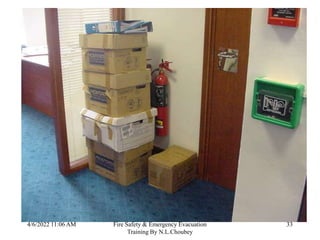
Fire Prevention
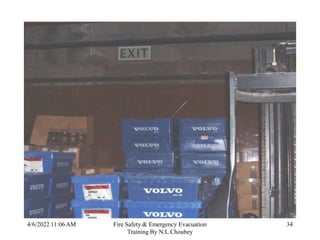
• No Smoking Policy:
– Smoking is prohibited in all internal buildings and near
entrances/exits/window openings.
• Housekeeping:
– We all must keep our work areas clean and tidy as
possible as & dispose of all waste appropriately.
– Access to escape routes, exit doors or fire extinguishers
should be kept clear.
– Remember corridors are your route to safety - so keep
them clear!
4/6/2022 11:06 AM Fire Safety & Emergency Evacuation
Training By N.L.Choubey
32
4/6/2022 11:06 AM Fire Safety & Emergency Evacuation
Training By N.L.Choubey
33
4/6/2022 11:06 AM Fire Safety & Emergency Evacuation
Training By N.L.Choubey
34
4/6/2022 11:06 AM Fire Safety & Emergency Evacuation
Training By N.L.Choubey
35
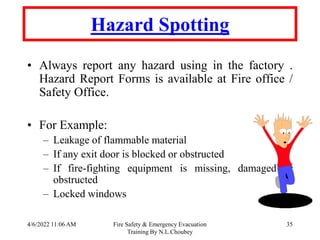
Hazard Spotting
• Always report any hazard using in the factory .
Hazard Report Forms is available at Fire office /
Safety Office.
• For Example:
– Leakage of flammable material
– If any exit door is blocked or obstructed
– If fire-fighting equipment is missing, damaged or
obstructed
– Locked windows
4/6/2022 11:06 AM Fire Safety & Emergency Evacuation
Training By N.L.Choubey
36
4/6/2022 11:06 AM Fire Safety & Emergency Evacuation
Training By N.L.Choubey
37
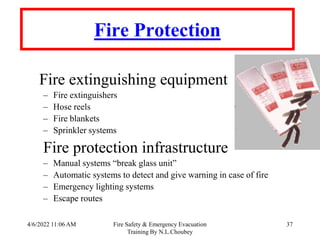
Fire Protection
Fire extinguishing equipment
– Fire extinguishers
– Hose reels
– Fire blankets
– Sprinkler systems
Fire protection infrastructure
– Manual systems “break glass unit”
– Automatic systems to detect and give warning in case of fire
– Emergency lighting systems
– Escape routes
4/6/2022 11:06 AM Fire Safety & Emergency Evacuation
Training By N.L.Choubey
38
Types of Fires
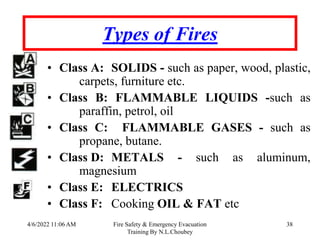
• Class A: SOLIDS - such as paper, wood, plastic,
carpets, furniture etc.
• Class B: FLAMMABLE LIQUIDS -such as
paraffin, petrol, oil
• Class C: FLAMMABLE GASES - such as
propane, butane.
• Class D: METALS - such as aluminum,
magnesium
• Class E: ELECTRICS
• Class F: Cooking OIL & FAT etc
4/6/2022 11:06 AM Fire Safety & Emergency Evacuation
Training By N.L.Choubey
39
Types of FireExtinguishers
– Each type of extinguisher has a specific use!
– Important to consider the nature of the fire risk
before deciding on which type to use.
4 Most Common Types:
• Water
• Carbon Dioxide Gas
• Foam
• Dry Powder
4/6/2022 11:06 AM Fire Safety & Emergency Evacuation
Training By N.L.Choubey
40
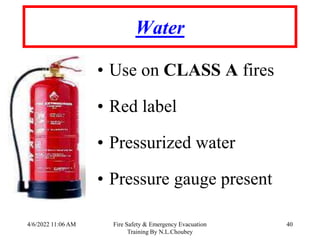
Water
• Use on CLASS A fires
• Red label
• Pressurized water
• Pressure gauge present
4/6/2022 11:06 AM Fire Safety & Emergency Evacuation
Training By N.L.Choubey
41
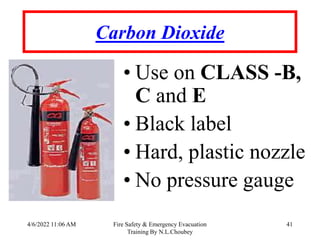
Carbon Dioxide
• Use on CLASS -B,
C and E
• Black label
• Hard, plastic nozzle
• No pressure gauge
4/6/2022 11:06 AM Fire Safety & Emergency Evacuation
Training By N.L.Choubey
42
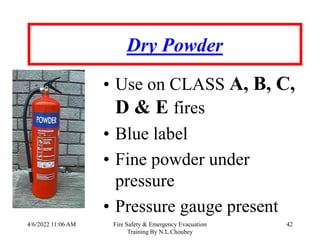
Dry Powder
• Use on CLASS A, B, C,
D & E fires
• Blue label
• Fine powder under
pressure
• Pressure gauge present
4/6/2022 11:06 AM Fire Safety & Emergency Evacuation
Training By N.L.Choubey
43
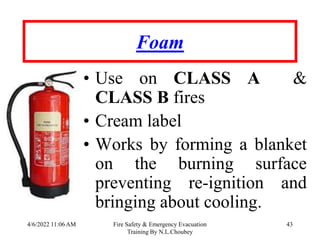
Foam
• Use on CLASS A &
CLASS B fires
• Cream label
• Works by forming a blanket
on the burning surface
preventing re-ignition and
bringing about cooling.
4/6/2022 11:06 AM Fire Safety & Emergency Evacuation
Training By N.L.Choubey
44
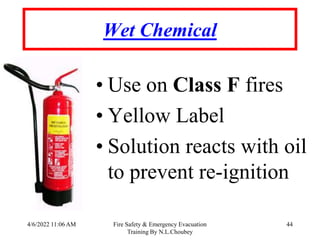
Wet Chemical
• Use on Class F fires
• Yellow Label
• Solution reacts with oil
to prevent re-ignition
4/6/2022 11:06 AM Fire Safety & Emergency Evacuation
Training By N.L.Choubey
45
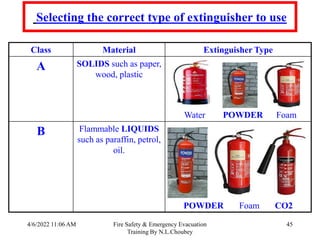
Selecting the correct type of extinguisher to use
Class Material Extinguisher Type
A SOLIDS such as paper,
wood, plastic
Water POWDER Foam
B Flammable LIQUIDS
such as paraffin, petrol,
oil.
POWDER Foam CO2
4/6/2022 11:06 AM Fire Safety & Emergency Evacuation
Training By N.L.Choubey
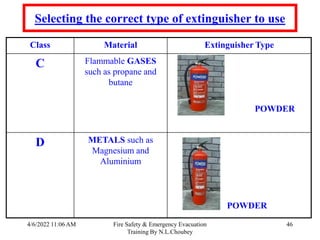
46
Selecting the correct type of extinguisher to use
Class Material Extinguisher Type
C Flammable GASES
such as propane and
butane
POWDER
D METALS such as
Magnesium and
Aluminium
POWDER
4/6/2022 11:06 AM Fire Safety & Emergency Evacuation
Training By N.L.Choubey
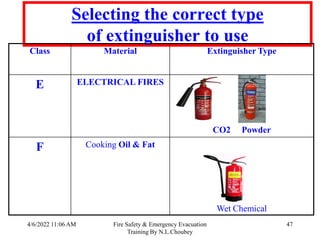
47
Selecting the correct type
of extinguisher to use
Class Material Extinguisher Type
E ELECTRICAL FIRES
CO2 Powder
F Cooking Oil & Fat
Wet Chemical
4/6/2022 11:06 AM Fire Safety & Emergency Evacuation
Training By N.L.Choubey
48
4/6/2022 11:06 AM Fire Safety & Emergency Evacuation
Training By N.L.Choubey
49
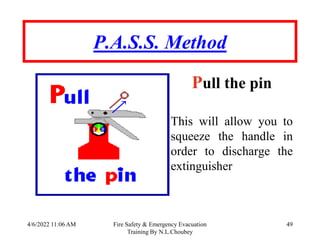
P.A.S.S. Method
Pull the pin
This will allow you to
squeeze the handle in
order to discharge the
extinguisher
4/6/2022 11:06 AM Fire Safety & Emergency Evacuation
Training By N.L.Choubey
50
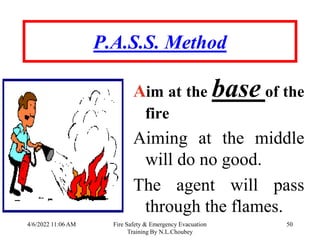
P.A.S.S. Method
Aim at the base of the
fire
Aiming at the middle
will do no good.
The agent will pass
through the flames.
4/6/2022 11:06 AM Fire Safety & Emergency Evacuation
Training By N.L.Choubey
51
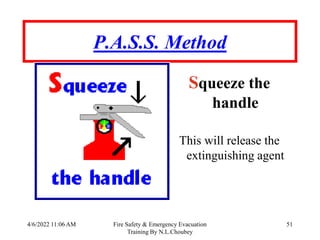
P.A.S.S. Method
Squeeze the
handle
This will release the
extinguishing agent
4/6/2022 11:06 AM Fire Safety & Emergency Evacuation
Training By N.L.Choubey
52
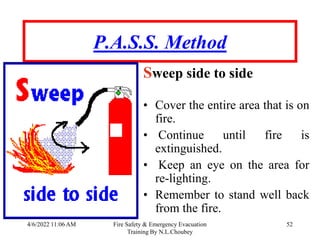
P.A.S.S. Method
Sweep side to side
• Cover the entire area that is on
fire.
• Continue until fire is
extinguished.
• Keep an eye on the area for
re-lighting.
• Remember to stand well back
from the fire.
4/6/2022 11:06 AM Fire Safety & Emergency Evacuation
Training By N.L.Choubey
53
EMERGENCY
ACTION PLAN
( VIDEO CLIP )
4/6/2022 11:06 AM Fire Safety & Emergency Evacuation
Training By N.L.Choubey
54
Points to Remember
• Before attempting to use any fire extinguisher
always check the label to ensure it is suitable and
safe to use.
• In fires involving electrical equipment and gaseous
fires, the prime need is to SWITCH THE
SUPPLY OFF !
• Extinguishing before the supply is off may cause
an explosion or electric shock.
4/6/2022 11:06 AM Fire Safety & Emergency Evacuation
Training By N.L.Choubey
55
Fighting a Fire!
Only fight a fire …..
• when an exit is to your back
• when it is small and in the early stages
• when you have the correct fire
equipment & you know how to use it
• when the equipment is depleted leave
the area as quickly as possible.
Remember - if in doubt get out!
4/6/2022 11:06 AM Fire Safety & Emergency Evacuation
Training By N.L.Choubey
56
Indications of Fire/Emergency
• Fire alarm sounder &/or strobe lights (main indication)
Other indications may be….
• Flickering lights / power failure
• Smoke/dust– smell &/or sight
• Unusual sounds e.g. glass shattering
• Unexplained spark generation
• Smell of fuels e.g. gas
• Unexplained heat levels
4/6/2022 11:06 AM Fire Safety & Emergency Evacuation
Training By N.L.Choubey
57
If you hear an alarm
DO NOT
assume it is a drill,
Your life may depend on it!
If You Discover A Fire:
• Activate the alarm by operating the
nearest “break glass unit”
• If it is safe to do so, extinguish the fire
using the equipment provided
• Leave the building promptly – do not use
the lift!
4/6/2022 11:06 AM Fire Safety & Emergency Evacuation
Training By N.L.Choubey
58
Emergency Evacuation Procedure
(all staff, workers, visitors, contractors)
• Evacuate the building using the nearest and
safest exit, ensuring the safe shutdown of
equipment/electricity/gas.
• All workers should be led by supervisors /
technicians / engineers.
• Visitors should be escorted to safety by the
person they are visiting.
4/6/2022 11:06 AM Fire Safety & Emergency Evacuation
Training By N.L.Choubey
59
Emergency Evacuation Procedure
• Form a single file on both sides of the
corridor or stairway and leave the centre
passageway clear.
• Any person in common areas or moving
between areas, should join the lines of people
exiting the area.
• The last person in the line closes the door.
• Evacuation marshals will sweep/search their
designated areas.
4/6/2022 11:06 AM Fire Safety & Emergency Evacuation
Training By N.L.Choubey
60
Emergency Evacuation Procedure
• Disperse from the building and go to the
nearest assembly point.
• The Incident Controller will provide the
emergency services with details of casualties
or persons needing assistance with
evacuation
• No person shall re-enter the building until the
all clear has been given by the Incident
Controller.
4/6/2022 11:06 AM Fire Safety & Emergency Evacuation
Training By N.L.Choubey
61
Evacuation Marshals / Sweepers
Evacuation Marshals / Sweepers are
designated for planned evacuations.
It is the responsibility of each evacuation marshal / sweeper:
 To “sweep/search” all rooms in their designated area to ensure
that everyone is evacuated and directed to the nearest available
exit (only if it is safe to do so).
 To exit via the nearest available escape route, once the search is
complete.
 To assemble at a designated point, informing the Incident
Controller present of any persons in need of assistance. This
information is then relayed to the Emergency Services by the
Incident Controller.
4/6/2022 11:06 AM Fire Safety & Emergency Evacuation
Training By N.L.Choubey
62
Evacuation Marshals/Sweepers
General Rule of Thumb –
• Everyone should act as an evacuation
marshal/sweeper “sweeping/searching” the areas
as they evacuate and directing people to the
nearest escape routes.
• This is of particular importance during holiday
periods etc, whereby the designated evacuation
marshals may not be onsite.
4/6/2022 11:06 AM Fire Safety & Emergency Evacuation
Training By N.L.Choubey
63
Evacuation for People with Disabilities
• If a staff member / workers with a disability
requires assistance with evacuation, the Emergency
Egress Questionnaire must be completed as soon as
possible.
• A Personal Emergency Egress Plan (PEEP) is then
prepared.
• All people with disabilities should contact their
local OHC to ensure this is put in place.
4/6/2022 11:06 AM Fire Safety & Emergency Evacuation
Training By N.L.Choubey
64
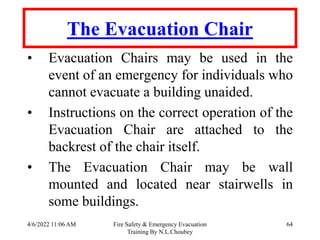
The Evacuation Chair
• Evacuation Chairs may be used in the
event of an emergency for individuals who
cannot evacuate a building unaided.
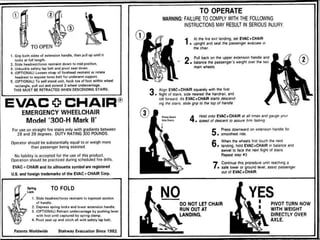
• Instructions on the correct operation of the
Evacuation Chair are attached to the
backrest of the chair itself.
• The Evacuation Chair may be wall
mounted and located near stairwells in
some buildings.
4/6/2022 11:06 AM Fire Safety & Emergency Evacuation
Training By N.L.Choubey
65
4/6/2022 11:06 AM Fire Safety & Emergency Evacuation
Training By N.L.Choubey
66
Evacuation – Do’s & Don’ts
DO
When you hear the alarm, remain calm!
Ensure the safe shutdown of equipment /
electricity / gas if time permits
Follow any instructions given to you by a person
in authority e.g. Evacuation Marshall / safety
Officials.
4/6/2022 11:06 AM Fire Safety & Emergency Evacuation
Training By N.L.Choubey
67
Evacuation – Do’s & Don’ts
DON’T
х Take risks
х Run or cause an obstruction
х Use the lift
х Congregate outside main entrances; move away to
assembly points
х Return for personal belongings
х Re-enter the building until the “all clear” has been
given
4/6/2022 11:06 AM Fire Safety & Emergency Evacuation
Training By N.L.Choubey
68
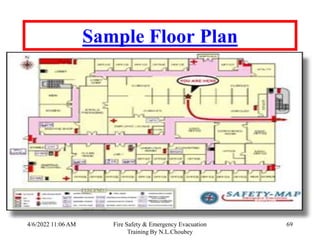
Floor Plans
• Floor Plans indicate the following:
- An indicator point on the map to
identify where you are located in the
building
– Location of nearest Staircases and
Escape Routes
– Location of Fire Fighting Equipment.
4/6/2022 11:06 AM Fire Safety & Emergency Evacuation
Training By N.L.Choubey
69
Sample Floor Plan
4/6/2022 11:06 AM Fire Safety & Emergency Evacuation
Training By N.L.Choubey
70
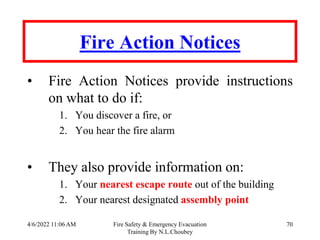
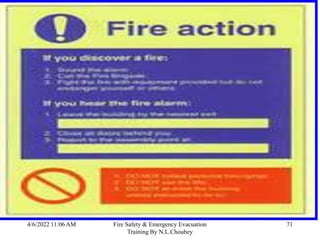
Fire Action Notices
• Fire Action Notices provide instructions
on what to do if:
1. You discover a fire, or
2. You hear the fire alarm
• They also provide information on:
1. Your nearest escape route out of the building
2. Your nearest designated assembly point
4/6/2022 11:06 AM Fire Safety & Emergency Evacuation
Training By N.L.Choubey
71
4/6/2022 11:06 AM Fire Safety & Emergency Evacuation
Training By N.L.Choubey
72
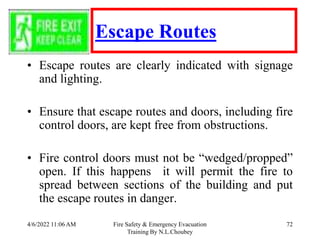
Escape Routes
• Escape routes are clearly indicated with signage
and lighting.
• Ensure that escape routes and doors, including fire
control doors, are kept free from obstructions.
• Fire control doors must not be “wedged/propped”
open. If this happens it will permit the fire to
spread between sections of the building and put
the escape routes in danger.
4/6/2022 11:06 AM Fire Safety & Emergency Evacuation
Training By N.L.Choubey
73
Fire Drills
• Fire Evacuation Drills will be held periodically to
ensure all staff and workers are familiar with the
evacuation procedure.
• The Local Fire Authority and concerns will be
informed of the intention to operate a fire drill.
• All staff, workers ,contractors and visitors must
partake in and co-operate with fire drills.
4/6/2022 11:06 AM Fire Safety & Emergency Evacuation
Training By N.L.Choubey
74
Evacuation Evaluation
• An Evacuation Evaluation Form is available to provide
feedback on the evacuation drill, so as to allow for future
improvements to be made.
• It is very important to complete the Evacuation
Evaluation Form , particularly if:
– You could not hear the fire alarm
– You encountered any difficulties/problems during a fire
drill
– You encountered any obstructions during the evacuation
4/6/2022 11:06 AM Fire Safety & Emergency Evacuation
Training By N.L.Choubey
75
Emergency Numbers
• If you discover a fire, an injured or seriously ill
person, or another situation you consider to be an
emergency, go to the nearest office and dial 0 for
an outside line and then:
08982073703 or 2200
/ 8982073706
4/6/2022 11:06 AM Fire Safety & Emergency Evacuation
Training By N.L.Choubey
76
Emergency First Aid Procedure
If you require first aid treatment:
1. Contact your nearest departmental first-aider
2. In the event that your departmental first-aider cannot
be contacted or is unavailable, then contact:
(i) All the staff & workers should be report to The
Occupational Health Officer between 9am-6pm
(ii) The Emergency Services ( 2200 or 1100 &
08782073706 , 8982073646
4/6/2022 11:06 AM Fire Safety & Emergency Evacuation
Training By N.L.Choubey
77
Emergency First Aid Procedure
• Familiarise yourself with the location of
your nearest first aid kit.
• An emergency first aid kit and Incident
Report Book are available at all HODs /
Department desks / Fire Station.
• The Incident Report Form must be
completed and forwarded to the Health and
Safety Officer / Security officer as soon as
practicable.
4/6/2022 11:06 AM Fire Safety & Emergency Evacuation
Training By N.L.Choubey
78
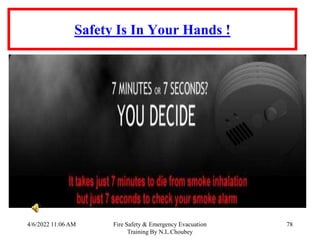
Safety Is In Your Hands !
4/6/2022 11:06 AM Fire Safety & Emergency Evacuation
Training By N.L.Choubey
79
ESCAPE PLAN
DURING
EMERGENCY
(VIDEO CLIP )
4/6/2022 11:06 AM Fire Safety & Emergency Evacuation
Training By N.L.Choubey
80
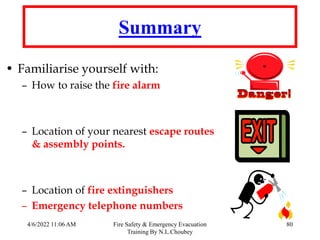
Summary
• Familiarise yourself with:
– How to raise the fire alarm
– Location of your nearest escape routes
& assembly points.
– Location of fire extinguishers
– Emergency telephone numbers
4/6/2022 11:06 AM Fire Safety & Emergency Evacuation
Training By N.L.Choubey
81
Closing of Fire
Training With
VIDEO CLIP
4/6/2022 11:06 AM Fire Safety & Emergency Evacuation
Training By N.L.Choubey
82
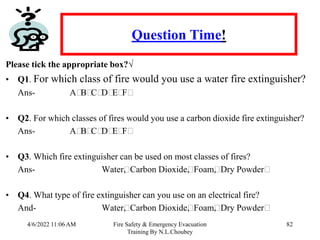
Question Time!
Please tick the appropriate box?√
• Q1. For which class of fire would you use a water fire extinguisher?
Ans- A
B
C
D
E
F
• Q2. For which classes of fires would you use a carbon dioxide fire extinguisher?
Ans- A
B
C
D
E
F
• Q3. Which fire extinguisher can be used on most classes of fires?
Ans- Water
, Carbon Dioxide
, Foam
, Dry Powder
• Q4. What type of fire extinguisher can you use on an electrical fire?
And- Water
, Carbon Dioxide
, Foam
, Dry Powder
4/6/2022 11:06 AM Fire Safety & Emergency Evacuation
Training By N.L.Choubey
83
Any Questions?
Thank You for
Your Participation
Please complete your feedback form.

fire safety training

  • 2.
    आग की रोकथाम औरनियंत्रण विषय की प्रस्तुतत कर रहे हैं नंद लाल चौबे (सहायक प्रबंधक- सुरक्षा)
  • 5.
  • 7.
    4/6/2022 11:06 AMFire Safety & Emergency Evacuation Training By N.L.Choubey 7 Fire Safety & Emergency Evacuation
  • 8.
    4/6/2022 11:06 AMFire Safety & Emergency Evacuation Training By N.L.Choubey 8 It is kind request to please keep your mobile on SILENT MODE
  • 9.
    4/6/2022 11:06 AMFire Safety & Emergency Evacuation Training By N.L.Choubey 9 For Your Information: • Fire Safety • First Aid • Duration – 1.5 HRS • Toilet
  • 10.
    4/6/2022 11:06 AMFire Safety & Emergency Evacuation Training By N.L.Choubey 10 Overview - Theory Legislation & Responsibilities The Chemistry of Fire Types of Fires Fire Safety Management Emergency Evacuation Procedure
  • 11.
    4/6/2022 11:06 AMFire Safety & Emergency Evacuation Training By N.L.Choubey 11 Overview - Practical Practical Demonstration - Selecting the correct type of fire extinguisher & how to use it Video - Fire Safety in The Workplace
  • 12.
    4/6/2022 11:06 AMFire Safety & Emergency Evacuation Training By N.L.Choubey 12 Fires incident
  • 13.
    4/6/2022 11:06 AMFire Safety & Emergency Evacuation Training By N.L.Choubey 13 VISION To raise the level of Prevention and Preparedness, so as to minimize loss of life and property in the factory from fire and non-fire emergencies and to inculcate safety consciousness among the general public.
  • 14.
    4/6/2022 11:06 AMFire Safety & Emergency Evacuation Training By N.L.Choubey 14 MISSION Fulfilling the main objectives of fire prevention, fire protection, fire fighting and rescue. The department generally attends emergency calls which are not directly connected with fire, in order to help the people in distress. The department is being developed to provide effective fire and emergency cover to the people and property in the factory.
  • 15.
    4/6/2022 11:06 AMFire Safety & Emergency Evacuation Training By N.L.Choubey 15 Developing Fire and Emergency Service as a Service Provider for reaching help to the people in distress, for all hazard purposes; Ensuring community safety and enriching the members of the profession through training and education for preventing and mitigating the Fire loss to facilitate improve public safety.
  • 16.
    4/6/2022 11:06 AMFire Safety & Emergency Evacuation Training By N.L.Choubey 16 OBJECTIVES OF THE FIRE TRAINING 1. To prevent and suppress unwanted fires by rendering prompt and efficient services so as to keep the loss of life and property to the minimum. 2. To conduct fire safety awareness , method of inspection in hazardous occupancies and to advise Management so as to reduce risk by fire. 3. To impart training in Fire Prevention, Fire Fighting and Fire Protection.
  • 17.
    4/6/2022 11:06 AMFire Safety & Emergency Evacuation Training By N.L.Choubey 17 4. To implement fire safety regulatory measures under Fire Service Rules for uses of places and trades for purpose involving risk from fire. 5. To provide standby protection at large gatherings and important public and private functions. 6. To provide Ambulance services to rush the effected person and sick to the hospital during accidents. OBJECTIVES OF THE FIRE TRAINING
  • 18.
    4/6/2022 11:06 AMFire Safety & Emergency Evacuation Training By N.L.Choubey 18 OBJECTIVES OF THE FIRE TRAINING 7. To check installation of Fire Protection measures and carry out Fire Fighting and responding to non-fire emergencies due to natural and manmade disasters. 8. To prevent loss of life and property from fire and non-fire emergencies like highway motor accidents, building collapse, landslides, still water rescue, Industrial hazards, spillage and toxic release, inter-alia technological hazards and to render humanitarian services and special services. 9. To promote Community based preventive and coping strategies for all kinds of emergencies including fire.
  • 19.
    4/6/2022 11:06 AMFire Safety & Emergency Evacuation Training By N.L.Choubey 19 Policy • The policy of any Factory about fire safety is to prevent fires/emergency situations from occurring , and to evacuate all persons to a place of safety as quickly as possible in the event of such occurrences.
  • 20.
    4/6/2022 11:06 AMFire Safety & Emergency Evacuation Training By N.L.Choubey 20 Legal Background • Fire Services Act 1981 • Safety, Health, and Welfare at Work Act 2005 – Employers duties – Employees duties • Safety, Health, and Welfare at Work (General Application) (Amendment No.2) Regulations 2003 – To provide the necessary measures for fire fighting & evacuation of employees – To contact appropriate emergency services
  • 21.
    4/6/2022 11:06 AMFire Safety & Emergency Evacuation Training By N.L.Choubey 21 FIRE SAFETY TIPS ( VIDEO CLIP )
  • 22.
    4/6/2022 11:06 AMFire Safety & Emergency Evacuation Training By N.L.Choubey 22 Responsibilities For Fire Safety: • All staff should: – Ensure that ones acts /omissions do not create a fire or other hazard – Observe all policies & procedures in relation to fire safety – Follow the Evacuation Procedure – Report fire hazards – Undertake fire safety training
  • 23.
    4/6/2022 11:06 AMFire Safety & Emergency Evacuation Training By N.L.Choubey 23 Risks of Fire Impact on the organisation: • Structural damage to buildings • Loss – financial, reputation, facilities, research, expertise, and lost work Impact on the environment: • Pollution – water, air, soil, flora & fauna.
  • 24.
    4/6/2022 11:06 AMFire Safety & Emergency Evacuation Training By N.L.Choubey 24 Risks of Fire Impact on human life: • Physical injuries e.g. burns, smoke inhalation! • Psychological effects e.g. post traumatic stress syndrome • Occupational issues e.g. loss of earnings, unemployment, work related stress. • Loss of life
  • 25.
    4/6/2022 11:06 AMFire Safety & Emergency Evacuation Training By N.L.Choubey 25 Chemistry of Fire • 3 Elements - Fuel, Oxygen & Energy • Example – Wood, Air, Spark • Need all three elements to start a fire • Fire extinguishers remove one or more of these elements
  • 26.
    4/6/2022 11:06 AMFire Safety & Emergency Evacuation Training By N.L.Choubey 26 Sources of Ignition  Chemical Ignition oily rags by oxidation, flammable liquids.  Electrical Insulation breakdown – short circuits, over loading circuits, connections too tight or too loose  Mechanical Sparks generated by friction or welding , overheating, dust-covered motors  Others Sources: Smoking, hot surfaces, articles placed on heating appliances, arson
  • 27.
    4/6/2022 11:06 AMFire Safety & Emergency Evacuation Training By N.L.Choubey 27 Sources of Fuel • Solids – e.g. paper, cloth, wood, textiles, dust, packaging materials etc. • Gases e.g. LPG, welding gases • Flammable liquids – e.g. petrol, oil, paint, cleaning fluids, chemicals etc.
  • 28.
    4/6/2022 11:06 AMFire Safety & Emergency Evacuation Training By N.L.Choubey 28 Indian Oil Corporation (IOC) Tank Fire 29th October- 4th November 2009 ? Time? ? How many died? ? Why?  Total 90 Hrs  12 people lost their lives, 150 injured,$65000,000 property damage & 65000,000 ltrs petroleum burned.  Root Cause – leak in pipeline is suspected to have caused the blaze & lack of supervision .  Very Poor standards of fire safety & housekeeping
  • 29.
    4/6/2022 11:06 AMFire Safety & Emergency Evacuation Training By N.L.Choubey 29 Fire Safety Management Key Elements: 1. Fire Prevention 2. Fire Protection 3. Fire Evacuation Prevention Protection Evacuation
  • 30.
    4/6/2022 11:06 AMFire Safety & Emergency Evacuation Training By N.L.Choubey 30 Fire Prevention The elimination of risks by controlling sources of ignition and management of combustible and flammable fuels. Necessary to: – Recognise all possible risks associated with an activity / process – Evaluate the risks and their likely impact on the process – Control of risks to ensure that ignition does not occur – Implement controls identified in the Risk Assessment / Safety Statement
  • 31.
    4/6/2022 11:06 AMFire Safety & Emergency Evacuation Training By N.L.Choubey 31 Fire Prevention • No Smoking Policy: – Smoking is prohibited in all internal buildings and near entrances/exits/window openings. • Housekeeping: – We all must keep our work areas clean and tidy as possible as & dispose of all waste appropriately. – Access to escape routes, exit doors or fire extinguishers should be kept clear. – Remember corridors are your route to safety - so keep them clear!
  • 32.
    4/6/2022 11:06 AMFire Safety & Emergency Evacuation Training By N.L.Choubey 32
  • 33.
    4/6/2022 11:06 AMFire Safety & Emergency Evacuation Training By N.L.Choubey 33
  • 34.
    4/6/2022 11:06 AMFire Safety & Emergency Evacuation Training By N.L.Choubey 34
  • 35.
    4/6/2022 11:06 AMFire Safety & Emergency Evacuation Training By N.L.Choubey 35 Hazard Spotting • Always report any hazard using in the factory . Hazard Report Forms is available at Fire office / Safety Office. • For Example: – Leakage of flammable material – If any exit door is blocked or obstructed – If fire-fighting equipment is missing, damaged or obstructed – Locked windows
  • 36.
    4/6/2022 11:06 AMFire Safety & Emergency Evacuation Training By N.L.Choubey 36
  • 37.
    4/6/2022 11:06 AMFire Safety & Emergency Evacuation Training By N.L.Choubey 37 Fire Protection Fire extinguishing equipment – Fire extinguishers – Hose reels – Fire blankets – Sprinkler systems Fire protection infrastructure – Manual systems “break glass unit” – Automatic systems to detect and give warning in case of fire – Emergency lighting systems – Escape routes
  • 38.
    4/6/2022 11:06 AMFire Safety & Emergency Evacuation Training By N.L.Choubey 38 Types of Fires • Class A: SOLIDS - such as paper, wood, plastic, carpets, furniture etc. • Class B: FLAMMABLE LIQUIDS -such as paraffin, petrol, oil • Class C: FLAMMABLE GASES - such as propane, butane. • Class D: METALS - such as aluminum, magnesium • Class E: ELECTRICS • Class F: Cooking OIL & FAT etc
  • 39.
    4/6/2022 11:06 AMFire Safety & Emergency Evacuation Training By N.L.Choubey 39 Types of FireExtinguishers – Each type of extinguisher has a specific use! – Important to consider the nature of the fire risk before deciding on which type to use. 4 Most Common Types: • Water • Carbon Dioxide Gas • Foam • Dry Powder
  • 40.
    4/6/2022 11:06 AMFire Safety & Emergency Evacuation Training By N.L.Choubey 40 Water • Use on CLASS A fires • Red label • Pressurized water • Pressure gauge present
  • 41.
    4/6/2022 11:06 AMFire Safety & Emergency Evacuation Training By N.L.Choubey 41 Carbon Dioxide • Use on CLASS -B, C and E • Black label • Hard, plastic nozzle • No pressure gauge
  • 42.
    4/6/2022 11:06 AMFire Safety & Emergency Evacuation Training By N.L.Choubey 42 Dry Powder • Use on CLASS A, B, C, D & E fires • Blue label • Fine powder under pressure • Pressure gauge present
  • 43.
    4/6/2022 11:06 AMFire Safety & Emergency Evacuation Training By N.L.Choubey 43 Foam • Use on CLASS A & CLASS B fires • Cream label • Works by forming a blanket on the burning surface preventing re-ignition and bringing about cooling.
  • 44.
    4/6/2022 11:06 AMFire Safety & Emergency Evacuation Training By N.L.Choubey 44 Wet Chemical • Use on Class F fires • Yellow Label • Solution reacts with oil to prevent re-ignition
  • 45.
    4/6/2022 11:06 AMFire Safety & Emergency Evacuation Training By N.L.Choubey 45 Selecting the correct type of extinguisher to use Class Material Extinguisher Type A SOLIDS such as paper, wood, plastic Water POWDER Foam B Flammable LIQUIDS such as paraffin, petrol, oil. POWDER Foam CO2
  • 46.
    4/6/2022 11:06 AMFire Safety & Emergency Evacuation Training By N.L.Choubey 46 Selecting the correct type of extinguisher to use Class Material Extinguisher Type C Flammable GASES such as propane and butane POWDER D METALS such as Magnesium and Aluminium POWDER
  • 47.
    4/6/2022 11:06 AMFire Safety & Emergency Evacuation Training By N.L.Choubey 47 Selecting the correct type of extinguisher to use Class Material Extinguisher Type E ELECTRICAL FIRES CO2 Powder F Cooking Oil & Fat Wet Chemical
  • 48.
    4/6/2022 11:06 AMFire Safety & Emergency Evacuation Training By N.L.Choubey 48
  • 49.
    4/6/2022 11:06 AMFire Safety & Emergency Evacuation Training By N.L.Choubey 49 P.A.S.S. Method Pull the pin This will allow you to squeeze the handle in order to discharge the extinguisher
  • 50.
    4/6/2022 11:06 AMFire Safety & Emergency Evacuation Training By N.L.Choubey 50 P.A.S.S. Method Aim at the base of the fire Aiming at the middle will do no good. The agent will pass through the flames.
  • 51.
    4/6/2022 11:06 AMFire Safety & Emergency Evacuation Training By N.L.Choubey 51 P.A.S.S. Method Squeeze the handle This will release the extinguishing agent
  • 52.
    4/6/2022 11:06 AMFire Safety & Emergency Evacuation Training By N.L.Choubey 52 P.A.S.S. Method Sweep side to side • Cover the entire area that is on fire. • Continue until fire is extinguished. • Keep an eye on the area for re-lighting. • Remember to stand well back from the fire.
  • 53.
    4/6/2022 11:06 AMFire Safety & Emergency Evacuation Training By N.L.Choubey 53 EMERGENCY ACTION PLAN ( VIDEO CLIP )
  • 54.
    4/6/2022 11:06 AMFire Safety & Emergency Evacuation Training By N.L.Choubey 54 Points to Remember • Before attempting to use any fire extinguisher always check the label to ensure it is suitable and safe to use. • In fires involving electrical equipment and gaseous fires, the prime need is to SWITCH THE SUPPLY OFF ! • Extinguishing before the supply is off may cause an explosion or electric shock.
  • 55.
    4/6/2022 11:06 AMFire Safety & Emergency Evacuation Training By N.L.Choubey 55 Fighting a Fire! Only fight a fire ….. • when an exit is to your back • when it is small and in the early stages • when you have the correct fire equipment & you know how to use it • when the equipment is depleted leave the area as quickly as possible. Remember - if in doubt get out!
  • 56.
    4/6/2022 11:06 AMFire Safety & Emergency Evacuation Training By N.L.Choubey 56 Indications of Fire/Emergency • Fire alarm sounder &/or strobe lights (main indication) Other indications may be…. • Flickering lights / power failure • Smoke/dust– smell &/or sight • Unusual sounds e.g. glass shattering • Unexplained spark generation • Smell of fuels e.g. gas • Unexplained heat levels
  • 57.
    4/6/2022 11:06 AMFire Safety & Emergency Evacuation Training By N.L.Choubey 57 If you hear an alarm DO NOT assume it is a drill, Your life may depend on it! If You Discover A Fire: • Activate the alarm by operating the nearest “break glass unit” • If it is safe to do so, extinguish the fire using the equipment provided • Leave the building promptly – do not use the lift!
  • 58.
    4/6/2022 11:06 AMFire Safety & Emergency Evacuation Training By N.L.Choubey 58 Emergency Evacuation Procedure (all staff, workers, visitors, contractors) • Evacuate the building using the nearest and safest exit, ensuring the safe shutdown of equipment/electricity/gas. • All workers should be led by supervisors / technicians / engineers. • Visitors should be escorted to safety by the person they are visiting.
  • 59.
    4/6/2022 11:06 AMFire Safety & Emergency Evacuation Training By N.L.Choubey 59 Emergency Evacuation Procedure • Form a single file on both sides of the corridor or stairway and leave the centre passageway clear. • Any person in common areas or moving between areas, should join the lines of people exiting the area. • The last person in the line closes the door. • Evacuation marshals will sweep/search their designated areas.
  • 60.
    4/6/2022 11:06 AMFire Safety & Emergency Evacuation Training By N.L.Choubey 60 Emergency Evacuation Procedure • Disperse from the building and go to the nearest assembly point. • The Incident Controller will provide the emergency services with details of casualties or persons needing assistance with evacuation • No person shall re-enter the building until the all clear has been given by the Incident Controller.
  • 61.
    4/6/2022 11:06 AMFire Safety & Emergency Evacuation Training By N.L.Choubey 61 Evacuation Marshals / Sweepers Evacuation Marshals / Sweepers are designated for planned evacuations. It is the responsibility of each evacuation marshal / sweeper:  To “sweep/search” all rooms in their designated area to ensure that everyone is evacuated and directed to the nearest available exit (only if it is safe to do so).  To exit via the nearest available escape route, once the search is complete.  To assemble at a designated point, informing the Incident Controller present of any persons in need of assistance. This information is then relayed to the Emergency Services by the Incident Controller.
  • 62.
    4/6/2022 11:06 AMFire Safety & Emergency Evacuation Training By N.L.Choubey 62 Evacuation Marshals/Sweepers General Rule of Thumb – • Everyone should act as an evacuation marshal/sweeper “sweeping/searching” the areas as they evacuate and directing people to the nearest escape routes. • This is of particular importance during holiday periods etc, whereby the designated evacuation marshals may not be onsite.
  • 63.
    4/6/2022 11:06 AMFire Safety & Emergency Evacuation Training By N.L.Choubey 63 Evacuation for People with Disabilities • If a staff member / workers with a disability requires assistance with evacuation, the Emergency Egress Questionnaire must be completed as soon as possible. • A Personal Emergency Egress Plan (PEEP) is then prepared. • All people with disabilities should contact their local OHC to ensure this is put in place.
  • 64.
    4/6/2022 11:06 AMFire Safety & Emergency Evacuation Training By N.L.Choubey 64 The Evacuation Chair • Evacuation Chairs may be used in the event of an emergency for individuals who cannot evacuate a building unaided. • Instructions on the correct operation of the Evacuation Chair are attached to the backrest of the chair itself. • The Evacuation Chair may be wall mounted and located near stairwells in some buildings.
  • 65.
    4/6/2022 11:06 AMFire Safety & Emergency Evacuation Training By N.L.Choubey 65
  • 66.
    4/6/2022 11:06 AMFire Safety & Emergency Evacuation Training By N.L.Choubey 66 Evacuation – Do’s & Don’ts DO When you hear the alarm, remain calm! Ensure the safe shutdown of equipment / electricity / gas if time permits Follow any instructions given to you by a person in authority e.g. Evacuation Marshall / safety Officials.
  • 67.
    4/6/2022 11:06 AMFire Safety & Emergency Evacuation Training By N.L.Choubey 67 Evacuation – Do’s & Don’ts DON’T х Take risks х Run or cause an obstruction х Use the lift х Congregate outside main entrances; move away to assembly points х Return for personal belongings х Re-enter the building until the “all clear” has been given
  • 68.
    4/6/2022 11:06 AMFire Safety & Emergency Evacuation Training By N.L.Choubey 68 Floor Plans • Floor Plans indicate the following: - An indicator point on the map to identify where you are located in the building – Location of nearest Staircases and Escape Routes – Location of Fire Fighting Equipment.
  • 69.
    4/6/2022 11:06 AMFire Safety & Emergency Evacuation Training By N.L.Choubey 69 Sample Floor Plan
  • 70.
    4/6/2022 11:06 AMFire Safety & Emergency Evacuation Training By N.L.Choubey 70 Fire Action Notices • Fire Action Notices provide instructions on what to do if: 1. You discover a fire, or 2. You hear the fire alarm • They also provide information on: 1. Your nearest escape route out of the building 2. Your nearest designated assembly point
  • 71.
    4/6/2022 11:06 AMFire Safety & Emergency Evacuation Training By N.L.Choubey 71
  • 72.
    4/6/2022 11:06 AMFire Safety & Emergency Evacuation Training By N.L.Choubey 72 Escape Routes • Escape routes are clearly indicated with signage and lighting. • Ensure that escape routes and doors, including fire control doors, are kept free from obstructions. • Fire control doors must not be “wedged/propped” open. If this happens it will permit the fire to spread between sections of the building and put the escape routes in danger.
  • 73.
    4/6/2022 11:06 AMFire Safety & Emergency Evacuation Training By N.L.Choubey 73 Fire Drills • Fire Evacuation Drills will be held periodically to ensure all staff and workers are familiar with the evacuation procedure. • The Local Fire Authority and concerns will be informed of the intention to operate a fire drill. • All staff, workers ,contractors and visitors must partake in and co-operate with fire drills.
  • 74.
    4/6/2022 11:06 AMFire Safety & Emergency Evacuation Training By N.L.Choubey 74 Evacuation Evaluation • An Evacuation Evaluation Form is available to provide feedback on the evacuation drill, so as to allow for future improvements to be made. • It is very important to complete the Evacuation Evaluation Form , particularly if: – You could not hear the fire alarm – You encountered any difficulties/problems during a fire drill – You encountered any obstructions during the evacuation
  • 75.
    4/6/2022 11:06 AMFire Safety & Emergency Evacuation Training By N.L.Choubey 75 Emergency Numbers • If you discover a fire, an injured or seriously ill person, or another situation you consider to be an emergency, go to the nearest office and dial 0 for an outside line and then: 08982073703 or 2200 / 8982073706
  • 76.
    4/6/2022 11:06 AMFire Safety & Emergency Evacuation Training By N.L.Choubey 76 Emergency First Aid Procedure If you require first aid treatment: 1. Contact your nearest departmental first-aider 2. In the event that your departmental first-aider cannot be contacted or is unavailable, then contact: (i) All the staff & workers should be report to The Occupational Health Officer between 9am-6pm (ii) The Emergency Services ( 2200 or 1100 & 08782073706 , 8982073646
  • 77.
    4/6/2022 11:06 AMFire Safety & Emergency Evacuation Training By N.L.Choubey 77 Emergency First Aid Procedure • Familiarise yourself with the location of your nearest first aid kit. • An emergency first aid kit and Incident Report Book are available at all HODs / Department desks / Fire Station. • The Incident Report Form must be completed and forwarded to the Health and Safety Officer / Security officer as soon as practicable.
  • 78.
    4/6/2022 11:06 AMFire Safety & Emergency Evacuation Training By N.L.Choubey 78 Safety Is In Your Hands !
  • 79.
    4/6/2022 11:06 AMFire Safety & Emergency Evacuation Training By N.L.Choubey 79 ESCAPE PLAN DURING EMERGENCY (VIDEO CLIP )
  • 80.
    4/6/2022 11:06 AMFire Safety & Emergency Evacuation Training By N.L.Choubey 80 Summary • Familiarise yourself with: – How to raise the fire alarm – Location of your nearest escape routes & assembly points. – Location of fire extinguishers – Emergency telephone numbers
  • 81.
    4/6/2022 11:06 AMFire Safety & Emergency Evacuation Training By N.L.Choubey 81 Closing of Fire Training With VIDEO CLIP
  • 82.
    4/6/2022 11:06 AMFire Safety & Emergency Evacuation Training By N.L.Choubey 82 Question Time! Please tick the appropriate box?√ • Q1. For which class of fire would you use a water fire extinguisher? Ans- A B C D E F • Q2. For which classes of fires would you use a carbon dioxide fire extinguisher? Ans- A B C D E F • Q3. Which fire extinguisher can be used on most classes of fires? Ans- Water , Carbon Dioxide , Foam , Dry Powder • Q4. What type of fire extinguisher can you use on an electrical fire? And- Water , Carbon Dioxide , Foam , Dry Powder
  • 83.
    4/6/2022 11:06 AMFire Safety & Emergency Evacuation Training By N.L.Choubey 83 Any Questions? Thank You for Your Participation Please complete your feedback form.