Presented by
Er. EHS & Fire
Syed Najaf Ali
INDUSTRIAL FIRE SAFETY AND LOSS
CONTROL
 Causalities and Health Hazard.
 Loss of property/product.
 Shut down of processing units causing casual
unemployment.
 Rise in temperature of the locality .
 Pollution.
 Global warming due to release of Green-
house gases.
LOSSES / HAZARDS FROM FIRE
Fire is an oxidation process.
 Emits heat and lights.
 Emits smoke and toxic gases.
Three factors required to intimate a fire such as :- Heat, Oxygen and
Fuel .
 Fuel:-
Solid:-Wood, paper, Cloth, Coal, Plastic etc.
Liquid :-Diesel, Petrol, kerosene, Naphtha etc.
Gaseous :- L.P.G, Acetylene, Methane, propane, Butane etc.
 Oxygen:-
 Atmospheric oxygen.
 Oxidizing Agents
WHAT IS FIRE ?
1. Open flames
2. Smoking
3. Static electricity
4. Friction
5. Faults in electrical system
6. Welding and cutting
7. Lighting
8. Hot surfaces /Hot pipes
9. Spontaneous heating
10. Sub-versive activities
HEAT
 Conduction:-Solid medium
 Convection:-Liquid/ Gaseous.
 Radiation ;-No medium
TRANSMISSION OF HEAT DURING FIRE
AND SPREADING OF FIRE
Glowing mode :-No flame
 Burning of metals charcoal, coke etc.
 No vapour formation
Flaming mode :-With flame
 Burning of Paper, wood, coal, Diesel, Petrol,
Gases etc.
 Formation of vapour
 Vapour Air mixture should remain in
flammable range
MODES OF FIRE
1. Cooling:-
• Flame cooling
• Fuel cooling
• Inserting
2. Smothering:-
• Cut off Air /Oxygen supply
• Dilution of oxygen
3. Starvation :-
• Limited fuel supply
• Pumping out of flammable liquids
• Shutting off gas valves.
• Separation
METHOD OF FIRE EXTINCTION
Four classes:-
Class A Fires:-Fires involving solid combustible materials of organic
nature such as wood paper, rubber, cloth, plastic where the cooling
effect is essential for extinction.
Class B Fires:-Fires involving flammable liquids, liquid hydrocarbons like
Diesel, Petrol ,kirosine, Naptha where a blanketing effect is essential
for fire extinction.
Class C Fires :-Flammable gases under including liquefied gases where
inert gas, D.C.P required for extinction.
Class D Fire:- Fires involving metals and other combustible materials
those are reactive to water ,water containing agents and in certain
cases reactive to co2 and general D.C.P Fires require special media
and technique for extinction.
CLASSIFICATION OF FIRE
Smoke
Direct body burning
Heat
Toxic gases
Panic /Nervous ness
PERSONAL HAZARDS FROM
FIRE
Burning of carboneous and hydrocarbons produce smoke.
Unbrunt carbon particles produced during Fire/ paralysis suspended in hot gases.
Size- less than 1 micron
Effects
1 Reduction of visibility and blocking of exit path .
Obstruction in Fire fighting and rescue operation.
Obstruction in evacuation of occupants.
Difficulty in finding seat of fire.
2. Bunning sensation in eyes.
3. suffocation.
4. Damage of respiratory System:-
Smoking and aerosols can be harmful when inhaled and the respiratory track and lungs.
SMOKE
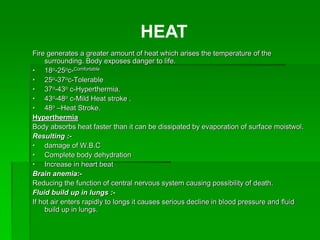
Fire generates a greater amount of heat which arises the temperature of the
surrounding. Body exposes danger to life.
• 18o-25oc-Comfortable
• 25o-37oc-Tolerable
• 37o-43o c-Hyperthermia.
• 43o-48o c-Mild Heat stroke .
• 48o –Heat Stroke.
Hyperthermia
Body absorbs heat faster than it can be dissipated by evaporation of surface moistwol.
Resulting :-
• damage of W.B.C
• Complete body dehydration
• Increase in heart beat
Brain anemia:-
Reducing the function of central nervous system causing possibility of death.
Fluid build up in lungs :-
If hot air enters rapidly to longs it causes serious decline in blood pressure and fluid
build up in lungs.
HEAT
Skin tissue burns:-
 First degree burn :-
 Outer layer of skin affected
 Redness of skin pain
 Small accumulation of fluid below skin.
 Second Degree burn :-
 More deep in skin
 Skin is moist and pink
 Skin Blisters
 Third Degree burn:-
 Burn area dry, charred ,or white
 Extremely critical
 Often death
BODY BURNING
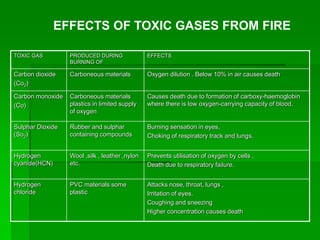
TOXIC GAS PRODUCED DURING
BURNING OF
EFFECTS
Carbon dioxide
(Co2)
Carboneous materials Oxygen dilution . Below 10% in air causes death
Carbon monoxide
(Co)
Carboneous materials
plastics in limited supply
of oxygen
Causes death due to formation of carboxy-haemoglobin
where there is low oxygen-carrying capacity of blood.
Sulphar Dioxide
(So2)
Rubber and sulphar
containing compounds
Burning sensation in eyes,
Choking of respiratory track and lungs.
Hydrogen
cyanide(HCN)
Wool ,silk , leather ,nylon
etc.
Prevents utilisation of oxygen by cells ,
Death due to respiratory failure.
Hydrogen
chloride
PVC materials some
plastic
Attacks nose, throat, lungs ,
Irritation of eyes.
Coughing and sneezing
Higher concentration causes death
EFFECTS OF TOXIC GASES FROM FIRE
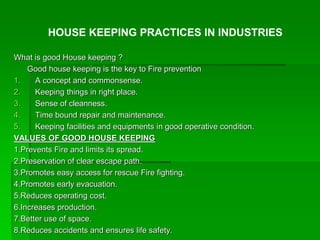
What is good House keeping ?
Good house keeping is the key to Fire prevention
1. A concept and commonsense.
2. Keeping things in right place.
3. Sense of cleanness.
4. Time bound repair and maintenance.
5. Keeping facilities and equipments in good operative condition.
VALUES OF GOOD HOUSE KEEPING
1.Prevents Fire and limits its spread.
2.Preservation of clear escape path.
3.Promotes easy access for rescue Fire fighting.
4.Promotes early evacuation.
5.Reduces operating cost.
6.Increases production.
7.Better use of space.
8.Reduces accidents and ensures life safety.
HOUSE KEEPING PRACTICES IN INDUSTRIES
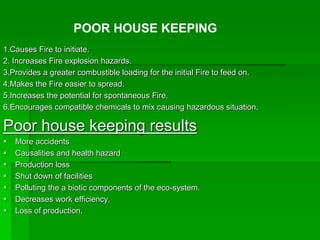
1.Causes Fire to initiate.
2. Increases Fire explosion hazards.
3.Provides a greater combustible loading for the initial Fire to feed on.
4.Makes the Fire easier to spread.
5.Increases the potential for spontaneous Fire.
6.Encourages compatible chemicals to mix causing hazardous situation.
Poor house keeping results
 More accidents
 Causalities and health hazard
 Production loss
 Shut down of facilities
 Polluting the a biotic components of the eco-system.
 Decreases work efficiency.
 Loss of production.
POOR HOUSE KEEPING
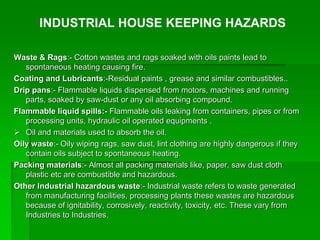
Waste & Rags:- Cotton wastes and rags soaked with oils paints lead to
spontaneous heating causing fire.
Coating and Lubricants:-Residual paints , grease and similar combustibles..
Drip pans:- Flammable liquids dispensed from motors, machines and running
parts, soaked by saw-dust or any oil absorbing compound.
Flammable liquid spills:- Flammable oils leaking from containers, pipes or from
processing units, hydraulic oil operated equipments .
 Oil and materials used to absorb the oil.
Oily waste:- Oily wiping rags, saw dust, lint clothing are highly dangerous if they
contain oils subject to spontaneous heating.
Packing materials:- Almost all packing materials like, paper, saw dust cloth
plastic etc are combustible and hazardous.
Other Industrial hazardous waste:- Industrial waste refers to waste generated
from manufacturing facilities, processing plants these wastes are hazardous
because of ignitability, corrosively, reactivity, toxicity, etc. These vary from
Industries to Industries.
INDUSTRIAL HOUSE KEEPING HAZARDS
Special consideration is given to
1. Disposal of rubbish
2. Control of ignition sources
3. Inspection .
4. Training of personnel.
5. Protection of environmental.
6. Repair and maintenance.
7. Correct materials handling and storage.
8. Cleanliness and order.
9. Labeling with materials safety data sheet.
HOUSE KEEPING METHODS
Receptacles:-Non-combustible containers should
be used for disposal of rubbish.
Segration of waste:-waste of different nature
should not be mixed together.
Treatment of waste and Reuse:-
• Physical treatment
• Chemical treatment
• Thermal treatment
• Biological treatment
Land burial :-Ash.
Ocean dumping .
DISPOSAL OF RUBBISH
Control of Electrical Hazards:-
 Periodical inspection of overloaded electrical circuits.
 Damage of insulation.
 Appropriate rating fuse protection.
 Good continuity of ear thing of electrical apparatus.
Control of friction :-
 Lubrication of parts .
 Proper alignment .
 Use of safety shoes.
 Use of spark- proof tools.
Control of static electricity :-
 Proper ear thing and bonding of machinery.
 Reducing velocity of liquid flow. (One meter per second )
 Provision of lightning arrestors.
Restriction of hot works:-
 Cutting and welding works restricted in hazardous area (Zone-o)
 Control of smoking:-
 Clear marking of “Smoking prohibited”
CONTROL OF IGNITION SOURCE
Objectives of safety Inspection programme.
 Maintain a safe work environment .
 Control unsafe action of employees.
 Timely maintenance of equipments as per standard.
 All equipments are in working order.
INSPECTIONS
Grass and weed control :-
 Cutting, dumping and burning of tall grass, dry weeds,
bushes around the building
 Destroying vegetation by using common herbicides
Out door storage:-
 Good stored outdoor should be properly separated from
building of combustible construction.
 Smoking in outdoor stor
 age areas be prohibited with signs.
Out door Rubbish disposal :-
 Outdoor rubbish disposal area should be enclosed with a
non combustible fence of adequate height.
OUT DOOR HOUSE KEEPING
 Cleaning of respective work area.
 Employees trained on different ways to
eliminate hazards and improve working
conditions.
TRAINING OF PERSONNEL
 Electrical wiring
 No twisted joints in wiring
 Motors and tools free of dirt and grease.
 Lights clear of combustibles.
 Circuits properly fused and protected
 Equipment approved for use in hazardous
area .
INDUSTRIAL FIRE SAFETY CHECK
LIST
1. Machinery properly lubricated .
2. Machinery properly adjusted
are aligned .
3. Free moving
FRICTION
1. Combustibles removed or
covered.
2. Permit issued.
3. Fire brigade stand by.
WELDING AND CUTTING
1.Hot pipes clear of combustibles
2. Sufficient clearance around boilers and
furnaces.
3.Ashes in metal containers.
HOT SURFACES
1. No smoking area clearly marked.
2. Smoking prohibited in hazardous areas.
NON SMOKING AREAS
1. Flammable waste material in closed
metal containers.
2. Piled material cool ,dry and well
ventilated
3. Flammable waste material containers
emptied frequently.
4. Long time stacking avoided.
5. Isolation of mutually reactive material .
SPONTANEOUS HEATING
1. Flammable liquid dispensing
vessels/pipes properly grounded.
2. Moving machinery grounded
STATIC ELECTRICITY
1. No gas leak
2. Flammable vapor monitors.
OPEN FLAMES
1. No accumulation of rubbish .
2. Safe storage of flammable.
3. Passageways clear of obstacles.
4. Premises free of necessary combustible
materials.
5. Floor free of spills.
HOUSE KEEPING
1. Good working condition .
2. Timely inspected .
FIRE DETECTION AND ALARM
SYSTEM
1. Proper type /approved .
2. In working order .
3. In proper location.
4. Service date current.
5. Easy access.
6. Personnel trained in use of equipments.
7. Clearly marked.
EXTINGUISHING EQUIPMENTS
MOTTO:-
Increases the confidence and ability to deal with
most emergency situations .
Increases potential for saving life and property .
Greater efficiency in resource utilization .
Doing things in a systematic manner.
Early evacuation of employees /occupants for the
scene of incident those are not related to operational
activities .
Less response time.
Minimizes threat to employees
PRE-INCIDENT PLANNING FOR INDUSTIRAL
FACILITIES
Before an incident
 Consult with others
 Survey site
 Hazard Identification
 Resource Management
 Evaluate data
 Develop plan
During incident
 Size up
 Establish strategy
 Implement tactic
 Rein enforcement
After an incident
 Analyse the incident
 Data keeping
 Modify plan
 Review of the facility layout and evacuation routes for each area.
 Facility construction features and their reaction during fire .
 Review of fire protection system
 Water sources
 Fire pumps
 Automatic sprinkler system
 Water hydrants
 Water monitas
 Water curtain
 Special fire fighting installation
 Review of fire detection and Alarm system
 Description of communication facility
 Requirement of Mutual Aids (out side assistance )
 Information on ventilation system to limit smoke spread
 Evaluation of chemical hazards and methods to handle leaking or spillage.
 Requirement for portable and mobile fire fighting units
 Requirement for P.P.E.
REVIEW OF COMPONENT IN PRE-
INCIDENT PLAN
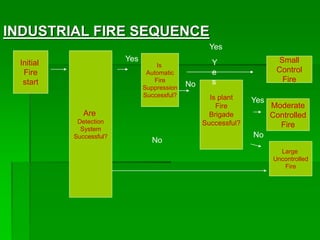
INDUSTRIAL FIRE SEQUENCE
Initial
Fire
start
Are
Detection
System
Successful?
Is
Automatic
Fire
Suppression
Successful? Is plant
Fire
Brigade
Successful?
Small
Control
Fire
Moderate
Controlled
Fire
Large
Uncontrolled
Fire
Yes Y
e
s
Yes
No
Yes
No
No
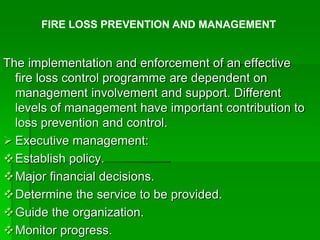
The implementation and enforcement of an effective
fire loss control programme are dependent on
management involvement and support. Different
levels of management have important contribution to
loss prevention and control.
 Executive management:
Establish policy.
Major financial decisions.
Determine the service to be provided.
Guide the organization.
Monitor progress.
FIRE LOSS PREVENTION AND MANAGEMENT
Middle Management:
 Overall supervision: Clarifying responsibilities,
ensuring that all procedures are properly
carried out.
 Planning: Anticipating hazards, formulate
plans and procedures for fire prevention and
plant safety.
 Education & Training: Providing employees
training in Fire prevention.
 Assignment:Delegating specific maintenance
and emergency duties to employees.
 Coordination:Liason with all sections relating
to Fire safety,
 Review :conducting Drills and classes to
maintain employees prepardness.
 Line management Supervisory)
1. Training personnel to carry out individual duties.
2. Liaison with middle management to establish
priority for inspection, testing and maintenance of
Fire protection equipments.
3. Inspiring employees to develop fire- conscious
attitude.
4. Ensure that access to equipment areas are open.
5. Fire exit Drills are held regularly.
6. Reporting all occupancy changes relating to
safety.
PROTECTION OF
EMPLOYEES
ENVIRONMENT
AND
PROPERTY
IS THE KEY FOR
A GOOD MANAGEMENT
********* THANKS ********

Fire safety

  • 1.
    Presented by Er. EHS& Fire Syed Najaf Ali INDUSTRIAL FIRE SAFETY AND LOSS CONTROL
  • 2.
     Causalities andHealth Hazard.  Loss of property/product.  Shut down of processing units causing casual unemployment.  Rise in temperature of the locality .  Pollution.  Global warming due to release of Green- house gases. LOSSES / HAZARDS FROM FIRE
  • 3.
    Fire is anoxidation process.  Emits heat and lights.  Emits smoke and toxic gases. Three factors required to intimate a fire such as :- Heat, Oxygen and Fuel .  Fuel:- Solid:-Wood, paper, Cloth, Coal, Plastic etc. Liquid :-Diesel, Petrol, kerosene, Naphtha etc. Gaseous :- L.P.G, Acetylene, Methane, propane, Butane etc.  Oxygen:-  Atmospheric oxygen.  Oxidizing Agents WHAT IS FIRE ?
  • 4.
    1. Open flames 2.Smoking 3. Static electricity 4. Friction 5. Faults in electrical system 6. Welding and cutting 7. Lighting 8. Hot surfaces /Hot pipes 9. Spontaneous heating 10. Sub-versive activities HEAT
  • 5.
     Conduction:-Solid medium Convection:-Liquid/ Gaseous.  Radiation ;-No medium TRANSMISSION OF HEAT DURING FIRE AND SPREADING OF FIRE
  • 6.
    Glowing mode :-Noflame  Burning of metals charcoal, coke etc.  No vapour formation Flaming mode :-With flame  Burning of Paper, wood, coal, Diesel, Petrol, Gases etc.  Formation of vapour  Vapour Air mixture should remain in flammable range MODES OF FIRE
  • 7.
    1. Cooling:- • Flamecooling • Fuel cooling • Inserting 2. Smothering:- • Cut off Air /Oxygen supply • Dilution of oxygen 3. Starvation :- • Limited fuel supply • Pumping out of flammable liquids • Shutting off gas valves. • Separation METHOD OF FIRE EXTINCTION
  • 8.
    Four classes:- Class AFires:-Fires involving solid combustible materials of organic nature such as wood paper, rubber, cloth, plastic where the cooling effect is essential for extinction. Class B Fires:-Fires involving flammable liquids, liquid hydrocarbons like Diesel, Petrol ,kirosine, Naptha where a blanketing effect is essential for fire extinction. Class C Fires :-Flammable gases under including liquefied gases where inert gas, D.C.P required for extinction. Class D Fire:- Fires involving metals and other combustible materials those are reactive to water ,water containing agents and in certain cases reactive to co2 and general D.C.P Fires require special media and technique for extinction. CLASSIFICATION OF FIRE
  • 9.
    Smoke Direct body burning Heat Toxicgases Panic /Nervous ness PERSONAL HAZARDS FROM FIRE
  • 10.
    Burning of carboneousand hydrocarbons produce smoke. Unbrunt carbon particles produced during Fire/ paralysis suspended in hot gases. Size- less than 1 micron Effects 1 Reduction of visibility and blocking of exit path . Obstruction in Fire fighting and rescue operation. Obstruction in evacuation of occupants. Difficulty in finding seat of fire. 2. Bunning sensation in eyes. 3. suffocation. 4. Damage of respiratory System:- Smoking and aerosols can be harmful when inhaled and the respiratory track and lungs. SMOKE
  • 11.
    Fire generates agreater amount of heat which arises the temperature of the surrounding. Body exposes danger to life. • 18o-25oc-Comfortable • 25o-37oc-Tolerable • 37o-43o c-Hyperthermia. • 43o-48o c-Mild Heat stroke . • 48o –Heat Stroke. Hyperthermia Body absorbs heat faster than it can be dissipated by evaporation of surface moistwol. Resulting :- • damage of W.B.C • Complete body dehydration • Increase in heart beat Brain anemia:- Reducing the function of central nervous system causing possibility of death. Fluid build up in lungs :- If hot air enters rapidly to longs it causes serious decline in blood pressure and fluid build up in lungs. HEAT
  • 12.
    Skin tissue burns:- First degree burn :-  Outer layer of skin affected  Redness of skin pain  Small accumulation of fluid below skin.  Second Degree burn :-  More deep in skin  Skin is moist and pink  Skin Blisters  Third Degree burn:-  Burn area dry, charred ,or white  Extremely critical  Often death BODY BURNING
  • 13.
    TOXIC GAS PRODUCEDDURING BURNING OF EFFECTS Carbon dioxide (Co2) Carboneous materials Oxygen dilution . Below 10% in air causes death Carbon monoxide (Co) Carboneous materials plastics in limited supply of oxygen Causes death due to formation of carboxy-haemoglobin where there is low oxygen-carrying capacity of blood. Sulphar Dioxide (So2) Rubber and sulphar containing compounds Burning sensation in eyes, Choking of respiratory track and lungs. Hydrogen cyanide(HCN) Wool ,silk , leather ,nylon etc. Prevents utilisation of oxygen by cells , Death due to respiratory failure. Hydrogen chloride PVC materials some plastic Attacks nose, throat, lungs , Irritation of eyes. Coughing and sneezing Higher concentration causes death EFFECTS OF TOXIC GASES FROM FIRE
  • 14.
    What is goodHouse keeping ? Good house keeping is the key to Fire prevention 1. A concept and commonsense. 2. Keeping things in right place. 3. Sense of cleanness. 4. Time bound repair and maintenance. 5. Keeping facilities and equipments in good operative condition. VALUES OF GOOD HOUSE KEEPING 1.Prevents Fire and limits its spread. 2.Preservation of clear escape path. 3.Promotes easy access for rescue Fire fighting. 4.Promotes early evacuation. 5.Reduces operating cost. 6.Increases production. 7.Better use of space. 8.Reduces accidents and ensures life safety. HOUSE KEEPING PRACTICES IN INDUSTRIES
  • 15.
    1.Causes Fire toinitiate. 2. Increases Fire explosion hazards. 3.Provides a greater combustible loading for the initial Fire to feed on. 4.Makes the Fire easier to spread. 5.Increases the potential for spontaneous Fire. 6.Encourages compatible chemicals to mix causing hazardous situation. Poor house keeping results  More accidents  Causalities and health hazard  Production loss  Shut down of facilities  Polluting the a biotic components of the eco-system.  Decreases work efficiency.  Loss of production. POOR HOUSE KEEPING
  • 16.
    Waste & Rags:-Cotton wastes and rags soaked with oils paints lead to spontaneous heating causing fire. Coating and Lubricants:-Residual paints , grease and similar combustibles.. Drip pans:- Flammable liquids dispensed from motors, machines and running parts, soaked by saw-dust or any oil absorbing compound. Flammable liquid spills:- Flammable oils leaking from containers, pipes or from processing units, hydraulic oil operated equipments .  Oil and materials used to absorb the oil. Oily waste:- Oily wiping rags, saw dust, lint clothing are highly dangerous if they contain oils subject to spontaneous heating. Packing materials:- Almost all packing materials like, paper, saw dust cloth plastic etc are combustible and hazardous. Other Industrial hazardous waste:- Industrial waste refers to waste generated from manufacturing facilities, processing plants these wastes are hazardous because of ignitability, corrosively, reactivity, toxicity, etc. These vary from Industries to Industries. INDUSTRIAL HOUSE KEEPING HAZARDS
  • 17.
    Special consideration isgiven to 1. Disposal of rubbish 2. Control of ignition sources 3. Inspection . 4. Training of personnel. 5. Protection of environmental. 6. Repair and maintenance. 7. Correct materials handling and storage. 8. Cleanliness and order. 9. Labeling with materials safety data sheet. HOUSE KEEPING METHODS
  • 18.
    Receptacles:-Non-combustible containers should beused for disposal of rubbish. Segration of waste:-waste of different nature should not be mixed together. Treatment of waste and Reuse:- • Physical treatment • Chemical treatment • Thermal treatment • Biological treatment Land burial :-Ash. Ocean dumping . DISPOSAL OF RUBBISH
  • 19.
    Control of ElectricalHazards:-  Periodical inspection of overloaded electrical circuits.  Damage of insulation.  Appropriate rating fuse protection.  Good continuity of ear thing of electrical apparatus. Control of friction :-  Lubrication of parts .  Proper alignment .  Use of safety shoes.  Use of spark- proof tools. Control of static electricity :-  Proper ear thing and bonding of machinery.  Reducing velocity of liquid flow. (One meter per second )  Provision of lightning arrestors. Restriction of hot works:-  Cutting and welding works restricted in hazardous area (Zone-o)  Control of smoking:-  Clear marking of “Smoking prohibited” CONTROL OF IGNITION SOURCE
  • 20.
    Objectives of safetyInspection programme.  Maintain a safe work environment .  Control unsafe action of employees.  Timely maintenance of equipments as per standard.  All equipments are in working order. INSPECTIONS
  • 21.
    Grass and weedcontrol :-  Cutting, dumping and burning of tall grass, dry weeds, bushes around the building  Destroying vegetation by using common herbicides Out door storage:-  Good stored outdoor should be properly separated from building of combustible construction.  Smoking in outdoor stor  age areas be prohibited with signs. Out door Rubbish disposal :-  Outdoor rubbish disposal area should be enclosed with a non combustible fence of adequate height. OUT DOOR HOUSE KEEPING
  • 22.
     Cleaning ofrespective work area.  Employees trained on different ways to eliminate hazards and improve working conditions. TRAINING OF PERSONNEL
  • 23.
     Electrical wiring No twisted joints in wiring  Motors and tools free of dirt and grease.  Lights clear of combustibles.  Circuits properly fused and protected  Equipment approved for use in hazardous area . INDUSTRIAL FIRE SAFETY CHECK LIST
  • 24.
    1. Machinery properlylubricated . 2. Machinery properly adjusted are aligned . 3. Free moving FRICTION
  • 25.
    1. Combustibles removedor covered. 2. Permit issued. 3. Fire brigade stand by. WELDING AND CUTTING
  • 26.
    1.Hot pipes clearof combustibles 2. Sufficient clearance around boilers and furnaces. 3.Ashes in metal containers. HOT SURFACES
  • 27.
    1. No smokingarea clearly marked. 2. Smoking prohibited in hazardous areas. NON SMOKING AREAS
  • 28.
    1. Flammable wastematerial in closed metal containers. 2. Piled material cool ,dry and well ventilated 3. Flammable waste material containers emptied frequently. 4. Long time stacking avoided. 5. Isolation of mutually reactive material . SPONTANEOUS HEATING
  • 29.
    1. Flammable liquiddispensing vessels/pipes properly grounded. 2. Moving machinery grounded STATIC ELECTRICITY
  • 30.
    1. No gasleak 2. Flammable vapor monitors. OPEN FLAMES
  • 31.
    1. No accumulationof rubbish . 2. Safe storage of flammable. 3. Passageways clear of obstacles. 4. Premises free of necessary combustible materials. 5. Floor free of spills. HOUSE KEEPING
  • 32.
    1. Good workingcondition . 2. Timely inspected . FIRE DETECTION AND ALARM SYSTEM
  • 33.
    1. Proper type/approved . 2. In working order . 3. In proper location. 4. Service date current. 5. Easy access. 6. Personnel trained in use of equipments. 7. Clearly marked. EXTINGUISHING EQUIPMENTS
  • 34.
    MOTTO:- Increases the confidenceand ability to deal with most emergency situations . Increases potential for saving life and property . Greater efficiency in resource utilization . Doing things in a systematic manner. Early evacuation of employees /occupants for the scene of incident those are not related to operational activities . Less response time. Minimizes threat to employees PRE-INCIDENT PLANNING FOR INDUSTIRAL FACILITIES
  • 35.
    Before an incident Consult with others  Survey site  Hazard Identification  Resource Management  Evaluate data  Develop plan During incident  Size up  Establish strategy  Implement tactic  Rein enforcement After an incident  Analyse the incident  Data keeping  Modify plan
  • 36.
     Review ofthe facility layout and evacuation routes for each area.  Facility construction features and their reaction during fire .  Review of fire protection system  Water sources  Fire pumps  Automatic sprinkler system  Water hydrants  Water monitas  Water curtain  Special fire fighting installation  Review of fire detection and Alarm system  Description of communication facility  Requirement of Mutual Aids (out side assistance )  Information on ventilation system to limit smoke spread  Evaluation of chemical hazards and methods to handle leaking or spillage.  Requirement for portable and mobile fire fighting units  Requirement for P.P.E. REVIEW OF COMPONENT IN PRE- INCIDENT PLAN
  • 37.
    INDUSTRIAL FIRE SEQUENCE Initial Fire start Are Detection System Successful? Is Automatic Fire Suppression Successful?Is plant Fire Brigade Successful? Small Control Fire Moderate Controlled Fire Large Uncontrolled Fire Yes Y e s Yes No Yes No No
  • 38.
    The implementation andenforcement of an effective fire loss control programme are dependent on management involvement and support. Different levels of management have important contribution to loss prevention and control.  Executive management: Establish policy. Major financial decisions. Determine the service to be provided. Guide the organization. Monitor progress. FIRE LOSS PREVENTION AND MANAGEMENT
  • 39.
    Middle Management:  Overallsupervision: Clarifying responsibilities, ensuring that all procedures are properly carried out.  Planning: Anticipating hazards, formulate plans and procedures for fire prevention and plant safety.  Education & Training: Providing employees training in Fire prevention.  Assignment:Delegating specific maintenance and emergency duties to employees.  Coordination:Liason with all sections relating to Fire safety,  Review :conducting Drills and classes to maintain employees prepardness.
  • 40.
     Line managementSupervisory) 1. Training personnel to carry out individual duties. 2. Liaison with middle management to establish priority for inspection, testing and maintenance of Fire protection equipments. 3. Inspiring employees to develop fire- conscious attitude. 4. Ensure that access to equipment areas are open. 5. Fire exit Drills are held regularly. 6. Reporting all occupancy changes relating to safety.
  • 41.
    PROTECTION OF EMPLOYEES ENVIRONMENT AND PROPERTY IS THEKEY FOR A GOOD MANAGEMENT ********* THANKS ********