FIRE PREVENTION AND
SAFETY MANAGEMENT
SYSTEM
PRESENTER:
AMOGH P. DANDEKAR
REG.NO: NH0117005
M.PHARM FIRST YEAR(II SEM)
DEPT: PHARMACEUTICAL QUALITY ASSURANCE
11/19/2018
1
CONTENTS
 Introduction
 What is fire?
 Types of Fire
 Causes of fire
 Fire suppression system
 Fire triangle
 Fire extinguisher and Types of Fire
extinguisher
 Fire hazard management system
 References
11/19/2018
2
INTRODUCTION
 Fire Prevention —Covering aspects of fire prevention
pertaining to design and construction of buildings on
passive fire protection measures, also describing the
various types of building materials and their fire rating
 Life Safety —Covering life safety provisions in the event
of fire and similar emergencies, also addressing
construction and occupancy features that are necessary to
minimize danger to life from fire, smoke, fumes or panic.
 Fire Protection —covering the significant appurtenances
and their related components and guidelines for selecting
the correct type of equipment and installation meant for
fire protection of the building , depending upon the
classification and type of the building.
11/19/2018
3
WHAT IS FIRE?
 Fire is basically a chemical reaction combining
three elements: Fuel, Heat and Oxygen.
11/19/2018
4
TYPES OF FIRE
 Class A – Normal Combustibles
 Class B – Flammable Liquids
 Class C – Electrical Circuits, switchboards, office
equipment
 Class D – Combustible Metals such as sodium, potassium
and magnesium
 Class E –Class F / k – Cooking fats and oils
11/19/2018
5
11/19/2018
6
CAUSES OF FIRE
 Common Causes
 Spark from oven
 Naked lamp
 Electric short circuit
 Burning charcoal
 Smoldering fuel
 Chimney or exhaust pipe
 Misfiring of engine
 Over-heating of electric appliances
11/19/2018
7
CAUSES OF FIRE IN INDUSTRIES
 Dust explosions
 Gas and vapour explosions
 Mechanical friction and over-heated bearings
 Electrical defects
 Chemical reaction
 Conduction of heat
 Radiation
11/19/2018
8
COMMON REASONS FOR ELECTRICAL FIRE
Overloaded Plug point Short circuit Unorganized cabling
Pest Intervention
11/19/2018
9
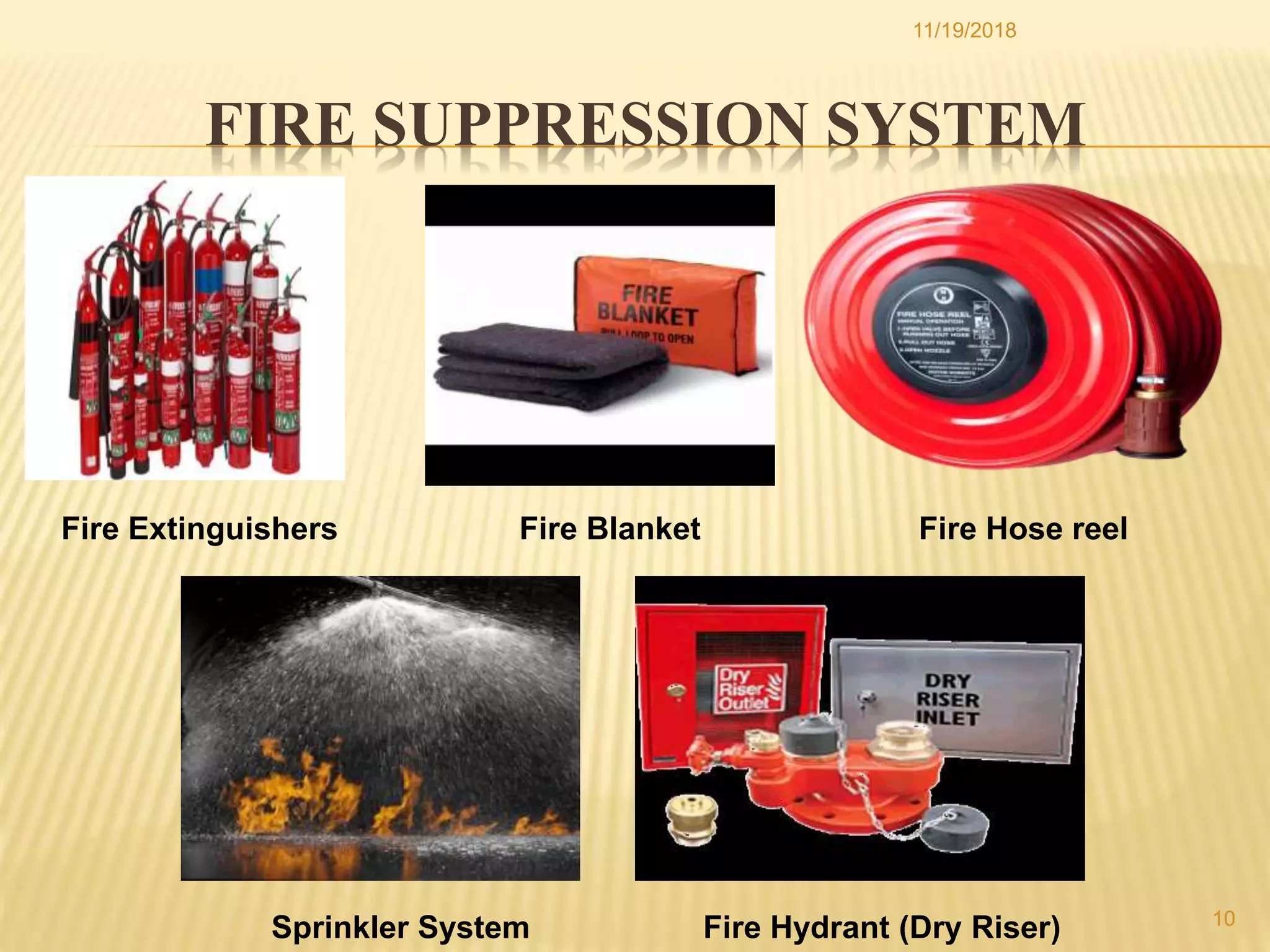
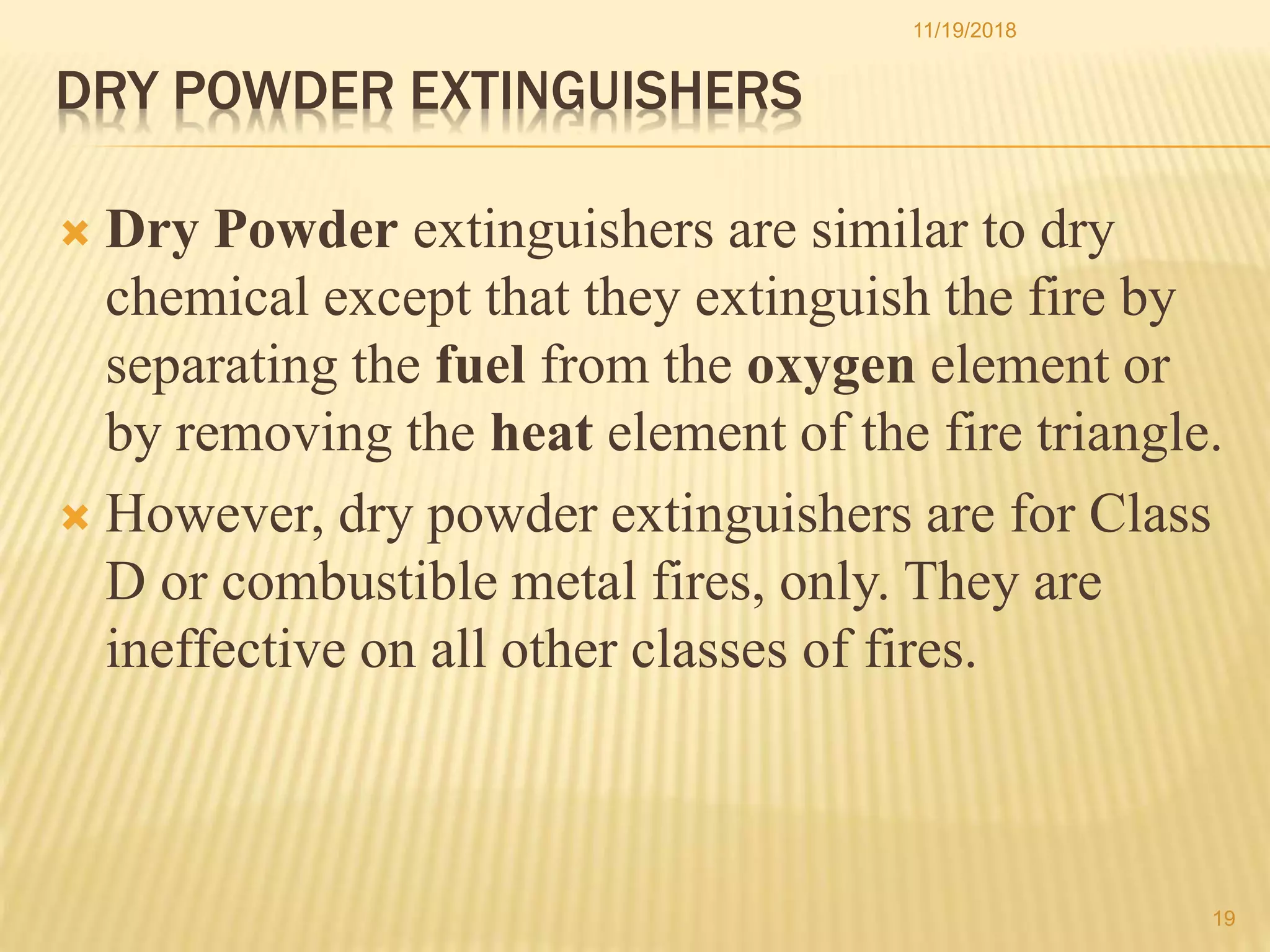
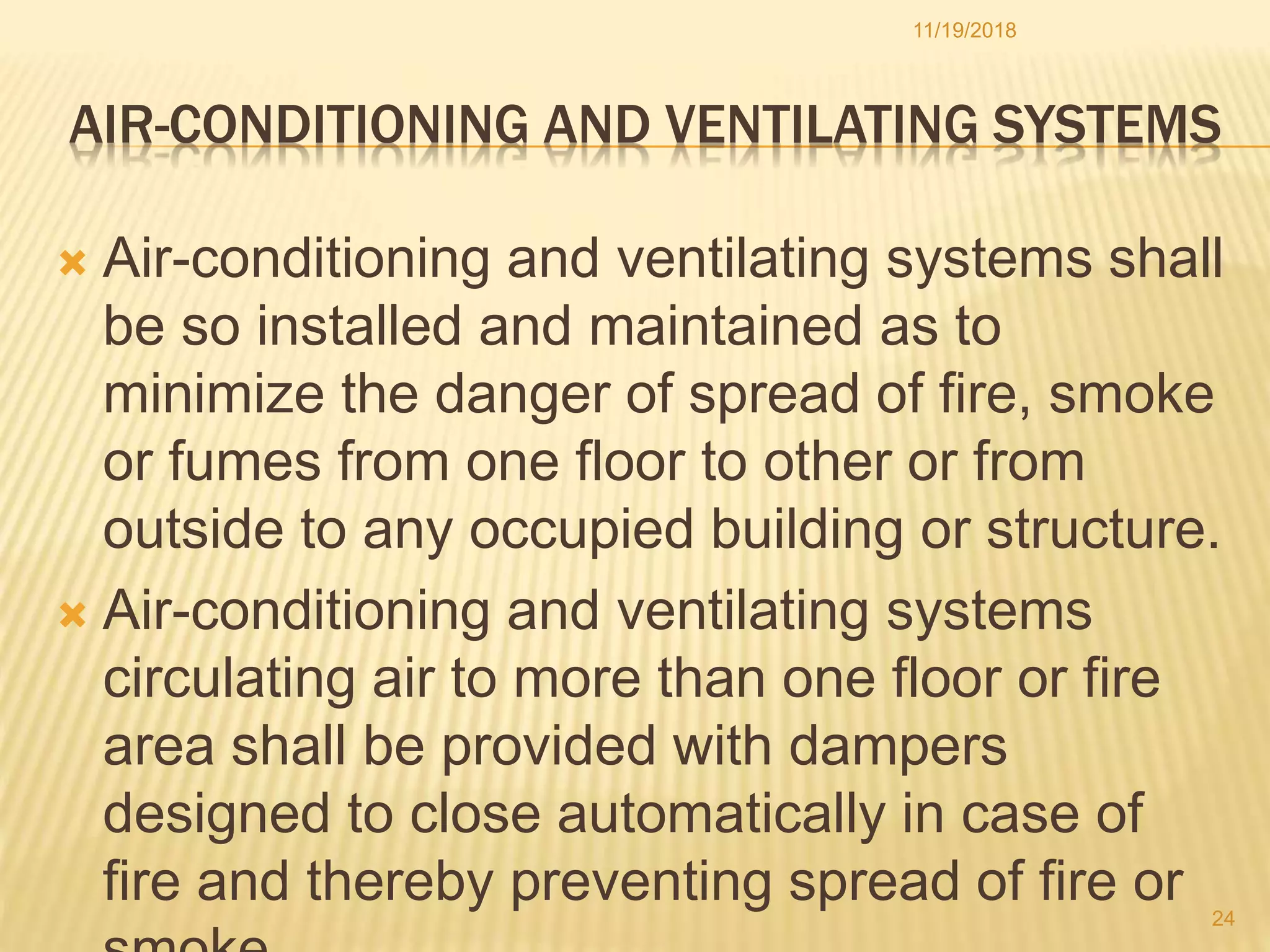
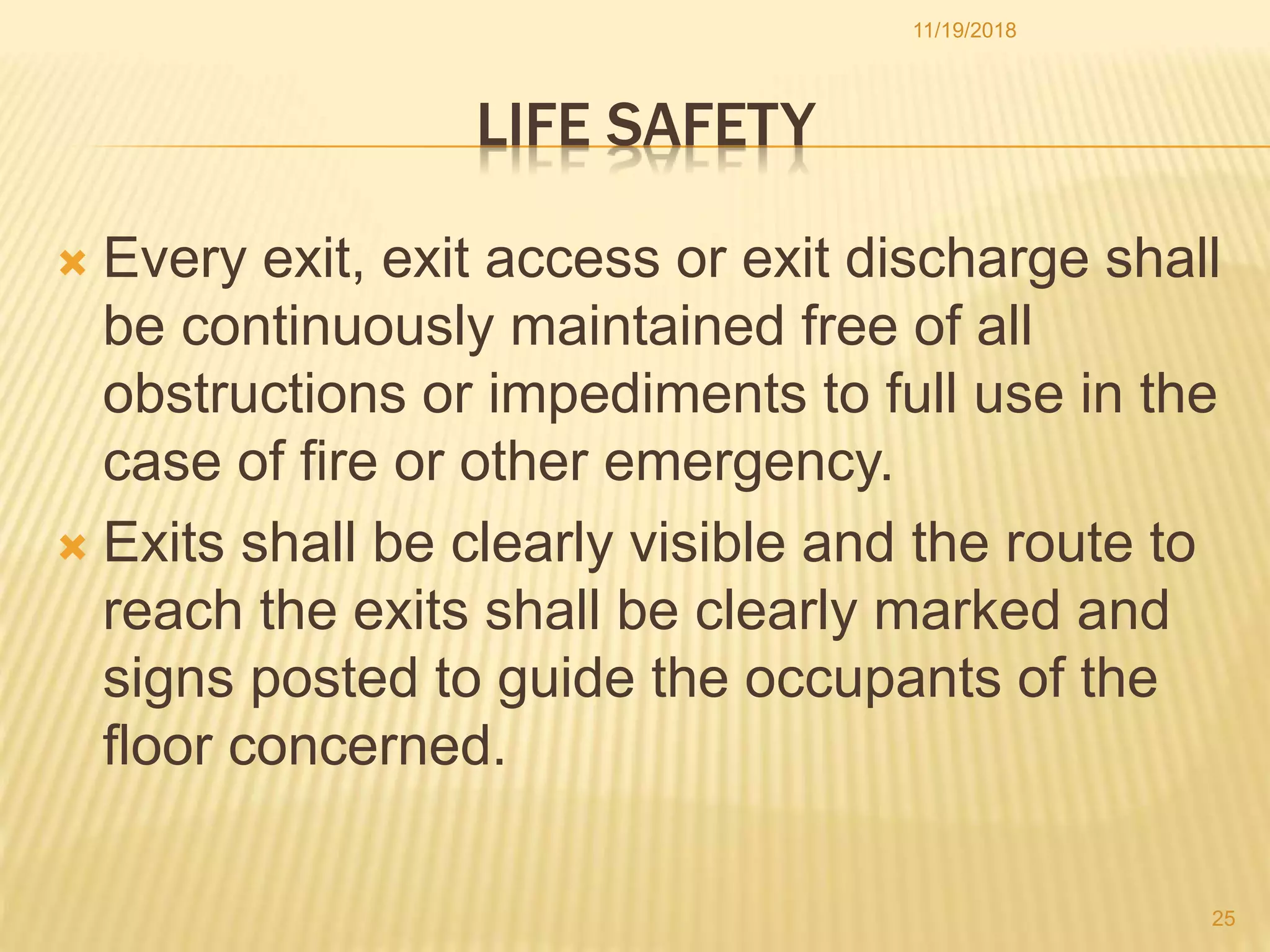
FIRE SUPPRESSION SYSTEM
Fire Extinguishers Fire Blanket Fire Hose reel
Sprinkler System Fire Hydrant (Dry Riser)
11/19/2018
10
EVACUATION BAG
 IT CONTAINS:
• HELMET
• LOUDHAILER
• BARRIER TAPE
• CROWBAR
• GLOVES
• TORCH
• DUST MASK
• RADIO
• WHISTLE
11/19/2018
11
FIRE TRIANGLE
Essentially, fire extinguishers put out fire by taking away
one or more elements of the fire triangle.
11/19/2018
12
FIRE TRIANGLE
 There are four elements that must be present
for a fire to exist.
 There must be oxygen to sustain
combustion, heat to raise the material to its
ignition temperature, fuel to support the
combustion and a chemical reaction between
the other three elements.
11/19/2018
13
11/19/2018
14
FIRE EXTINGUISHER
 A fire extinguisher can emit a solid, liquid, or a
gas, depending on the class of the fire.
 Fire extinguishers are designed specially for these
different classes of fires. Often times because of
chemical reactions within the fire more then one
type of extinguisher is effective.
11/19/2018
15
TYPES OF FIRE EXTINGUISHERS
 Water and Foam Extinguishers
 Dry Powder Extinguishers
 CO2 extinguishers
 Wet Chemical Extinguishers
11/19/2018
16
11/19/2018
17
WATER AND FOAM EXTINGUISHERS
 Water and Foam fire extinguishers extinguish
the fire by taking away the heat element of the
fire triangle. Foam agents also separate
the oxygen element from the other elements.
 Water extinguishers are for Class A fires only -
they should not be used on Class B or C fires.
The discharge stream could spread the flammable
liquid in a Class B fire or could create a shock
hazard on a Class C fire.
11/19/2018
18
DRY POWDER EXTINGUISHERS
 Dry Powder extinguishers are similar to dry
chemical except that they extinguish the fire by
separating the fuel from the oxygen element or
by removing the heat element of the fire triangle.
 However, dry powder extinguishers are for Class
D or combustible metal fires, only. They are
ineffective on all other classes of fires.
11/19/2018
19
CO2 EXTINGUISHERS
 Carbon Dioxide fire extinguishers extinguish
fire by taking away the oxygen element of
the fire triangle and also be removing
the heat with a very cold discharge.
 Carbon dioxide can be used on Class B & C
fires. They are usually ineffective on Class A
fires.
11/19/2018
20
WET CHEMICAL EXTINGUISHERS
 Wet Chemical is a new agent that extinguishes
the fire by removing the heat of the fire triangle
and prevents re-ignition by creating a barrier
between the oxygen and fuel elements.
 Wet chemical of Class K extinguishers were
developed for modern, high efficiency deep fat
fryers in commercial cooking operations. Some
may also be used on Class A fires in commercial
kitchens.
11/19/2018
21
11/19/2018
22
FIRE HAZARD MANAGEMENT SYSTEM
 A building or portion of the building may be
occupied during construction, repairs, alterations
or additions only if all means of exit and fire
protection measures are in place and continuously
maintained for the occupied part of the building.
 Adequate passageway and clearances required for
fire fighting vehicles to enter the premises shall
be provided at the main entrance; the width of
such entrance shall be not less than 4.5 m.
11/19/2018
23
AIR-CONDITIONING AND VENTILATING SYSTEMS
 Air-conditioning and ventilating systems shall
be so installed and maintained as to
minimize the danger of spread of fire, smoke
or fumes from one floor to other or from
outside to any occupied building or structure.
 Air-conditioning and ventilating systems
circulating air to more than one floor or fire
area shall be provided with dampers
designed to close automatically in case of
fire and thereby preventing spread of fire or
11/19/2018
24
LIFE SAFETY
 Every exit, exit access or exit discharge shall
be continuously maintained free of all
obstructions or impediments to full use in the
case of fire or other emergency.
 Exits shall be clearly visible and the route to
reach the exits shall be clearly marked and
signs posted to guide the occupants of the
floor concerned.
11/19/2018
25
FIRE LIFTS
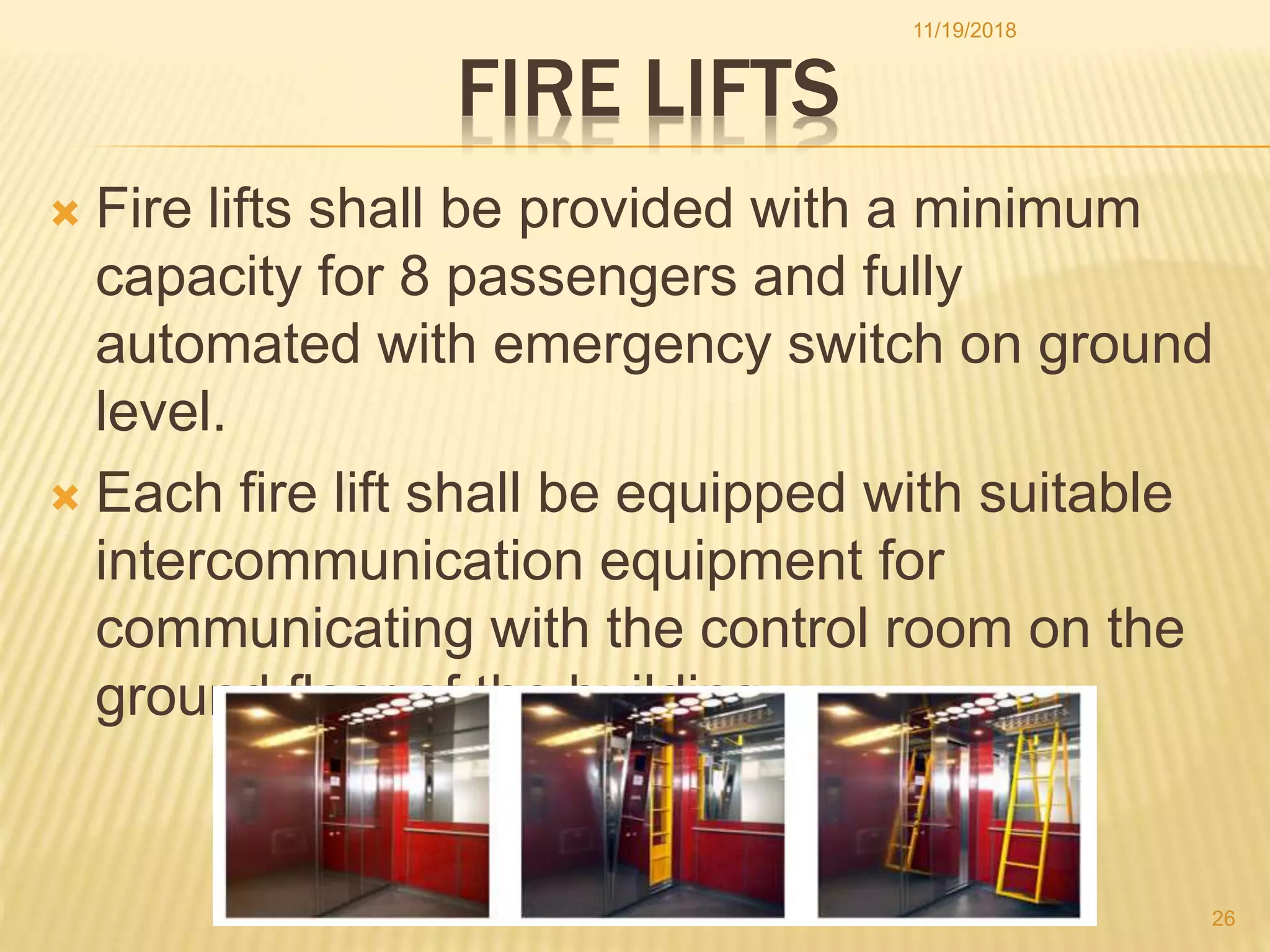
 Fire lifts shall be provided with a minimum
capacity for 8 passengers and fully
automated with emergency switch on ground
level.
 Each fire lift shall be equipped with suitable
intercommunication equipment for
communicating with the control room on the
ground floor of the building.
11/19/2018
26
EMERGENCY AND ESCAPE LIGHTING
 Emergency lighting shall be powered from a
source independent of that supplying the normal
lighting.
 Escape lighting shall be capable of:
 Indicating clearly and unambiguously the
escape routes
 Providing adequate illumination along such
routes to allow safe movement of persons
towards and through the exits
 Ensuring that fire alarm call points and fire
fighting equipment provided along the escape
11/19/2018
27
EMERGENCY AND ESCAPE LIGHTING
 The emergency lighting shall be provided to be
put on within 1 s of the failure of the normal
lighting supply.
 It is essential that the wiring and installation of
the emergency lighting systems are of high
quality so as to ensure their perfect
serviceability at all times.
 The emergency lighting system shall be capable
of continuous operation for a minimum duration
of 1 h and 30 m even for the smallest premises.
 Emergency lighting luminaires and their fittings
shall be of nonflammable type.
11/19/2018
28
EMERGENCY AND ESCAPE LIGHTING
11/19/2018
29
REFERENCES
 Fire Safety Management and Emergency Plan | County Durham and
Darlington Fire and Rescue Service . Ddfire.gov.uk. Available from:
https://www.ddfire.gov.uk/fire-safety-management-and-emergency-plan
 Andrew Furness & Martin Muckett - Introduction to Fire Safety
Management.pdf [Internet]. Docdroid.net. 2018 Available from:
https://www.docdroid.net/q79q/andrew-furness-martin-muckett-
introduction-to-fire-safety-management.pdf
 Fire extinguishers - Marsden Fire Safety . Marsden-fire-safety.co.uk.
2018 Available from: https://www.marsden-fire-
safety.co.uk/resources/fire-extinguishers
 The 9 Types of Fire Extinguishers and How To Use Them - Fireline
[Internet]. Fireline. Available from: https://www.fireline.com/blog/the-9-
types-of-fire-extinguishers-and-how-to-use-them/
11/19/2018
30
11/19/2018
31

Fire prevention and safety management system

  • 1.
    FIRE PREVENTION AND SAFETYMANAGEMENT SYSTEM PRESENTER: AMOGH P. DANDEKAR REG.NO: NH0117005 M.PHARM FIRST YEAR(II SEM) DEPT: PHARMACEUTICAL QUALITY ASSURANCE 11/19/2018 1
  • 2.
    CONTENTS  Introduction  Whatis fire?  Types of Fire  Causes of fire  Fire suppression system  Fire triangle  Fire extinguisher and Types of Fire extinguisher  Fire hazard management system  References 11/19/2018 2
  • 3.
    INTRODUCTION  Fire Prevention—Covering aspects of fire prevention pertaining to design and construction of buildings on passive fire protection measures, also describing the various types of building materials and their fire rating  Life Safety —Covering life safety provisions in the event of fire and similar emergencies, also addressing construction and occupancy features that are necessary to minimize danger to life from fire, smoke, fumes or panic.  Fire Protection —covering the significant appurtenances and their related components and guidelines for selecting the correct type of equipment and installation meant for fire protection of the building , depending upon the classification and type of the building. 11/19/2018 3
  • 4.
    WHAT IS FIRE? Fire is basically a chemical reaction combining three elements: Fuel, Heat and Oxygen. 11/19/2018 4
  • 5.
    TYPES OF FIRE Class A – Normal Combustibles  Class B – Flammable Liquids  Class C – Electrical Circuits, switchboards, office equipment  Class D – Combustible Metals such as sodium, potassium and magnesium  Class E –Class F / k – Cooking fats and oils 11/19/2018 5
  • 6.
  • 7.
    CAUSES OF FIRE Common Causes  Spark from oven  Naked lamp  Electric short circuit  Burning charcoal  Smoldering fuel  Chimney or exhaust pipe  Misfiring of engine  Over-heating of electric appliances 11/19/2018 7
  • 8.
    CAUSES OF FIREIN INDUSTRIES  Dust explosions  Gas and vapour explosions  Mechanical friction and over-heated bearings  Electrical defects  Chemical reaction  Conduction of heat  Radiation 11/19/2018 8
  • 9.
    COMMON REASONS FORELECTRICAL FIRE Overloaded Plug point Short circuit Unorganized cabling Pest Intervention 11/19/2018 9
  • 10.
    FIRE SUPPRESSION SYSTEM FireExtinguishers Fire Blanket Fire Hose reel Sprinkler System Fire Hydrant (Dry Riser) 11/19/2018 10
  • 11.
    EVACUATION BAG  ITCONTAINS: • HELMET • LOUDHAILER • BARRIER TAPE • CROWBAR • GLOVES • TORCH • DUST MASK • RADIO • WHISTLE 11/19/2018 11
  • 12.
    FIRE TRIANGLE Essentially, fireextinguishers put out fire by taking away one or more elements of the fire triangle. 11/19/2018 12
  • 13.
    FIRE TRIANGLE  Thereare four elements that must be present for a fire to exist.  There must be oxygen to sustain combustion, heat to raise the material to its ignition temperature, fuel to support the combustion and a chemical reaction between the other three elements. 11/19/2018 13
  • 14.
  • 15.
    FIRE EXTINGUISHER  Afire extinguisher can emit a solid, liquid, or a gas, depending on the class of the fire.  Fire extinguishers are designed specially for these different classes of fires. Often times because of chemical reactions within the fire more then one type of extinguisher is effective. 11/19/2018 15
  • 16.
    TYPES OF FIREEXTINGUISHERS  Water and Foam Extinguishers  Dry Powder Extinguishers  CO2 extinguishers  Wet Chemical Extinguishers 11/19/2018 16
  • 17.
  • 18.
    WATER AND FOAMEXTINGUISHERS  Water and Foam fire extinguishers extinguish the fire by taking away the heat element of the fire triangle. Foam agents also separate the oxygen element from the other elements.  Water extinguishers are for Class A fires only - they should not be used on Class B or C fires. The discharge stream could spread the flammable liquid in a Class B fire or could create a shock hazard on a Class C fire. 11/19/2018 18
  • 19.
    DRY POWDER EXTINGUISHERS Dry Powder extinguishers are similar to dry chemical except that they extinguish the fire by separating the fuel from the oxygen element or by removing the heat element of the fire triangle.  However, dry powder extinguishers are for Class D or combustible metal fires, only. They are ineffective on all other classes of fires. 11/19/2018 19
  • 20.
    CO2 EXTINGUISHERS  CarbonDioxide fire extinguishers extinguish fire by taking away the oxygen element of the fire triangle and also be removing the heat with a very cold discharge.  Carbon dioxide can be used on Class B & C fires. They are usually ineffective on Class A fires. 11/19/2018 20
  • 21.
    WET CHEMICAL EXTINGUISHERS Wet Chemical is a new agent that extinguishes the fire by removing the heat of the fire triangle and prevents re-ignition by creating a barrier between the oxygen and fuel elements.  Wet chemical of Class K extinguishers were developed for modern, high efficiency deep fat fryers in commercial cooking operations. Some may also be used on Class A fires in commercial kitchens. 11/19/2018 21
  • 22.
  • 23.
    FIRE HAZARD MANAGEMENTSYSTEM  A building or portion of the building may be occupied during construction, repairs, alterations or additions only if all means of exit and fire protection measures are in place and continuously maintained for the occupied part of the building.  Adequate passageway and clearances required for fire fighting vehicles to enter the premises shall be provided at the main entrance; the width of such entrance shall be not less than 4.5 m. 11/19/2018 23
  • 24.
    AIR-CONDITIONING AND VENTILATINGSYSTEMS  Air-conditioning and ventilating systems shall be so installed and maintained as to minimize the danger of spread of fire, smoke or fumes from one floor to other or from outside to any occupied building or structure.  Air-conditioning and ventilating systems circulating air to more than one floor or fire area shall be provided with dampers designed to close automatically in case of fire and thereby preventing spread of fire or 11/19/2018 24
  • 25.
    LIFE SAFETY  Everyexit, exit access or exit discharge shall be continuously maintained free of all obstructions or impediments to full use in the case of fire or other emergency.  Exits shall be clearly visible and the route to reach the exits shall be clearly marked and signs posted to guide the occupants of the floor concerned. 11/19/2018 25
  • 26.
    FIRE LIFTS  Firelifts shall be provided with a minimum capacity for 8 passengers and fully automated with emergency switch on ground level.  Each fire lift shall be equipped with suitable intercommunication equipment for communicating with the control room on the ground floor of the building. 11/19/2018 26
  • 27.
    EMERGENCY AND ESCAPELIGHTING  Emergency lighting shall be powered from a source independent of that supplying the normal lighting.  Escape lighting shall be capable of:  Indicating clearly and unambiguously the escape routes  Providing adequate illumination along such routes to allow safe movement of persons towards and through the exits  Ensuring that fire alarm call points and fire fighting equipment provided along the escape 11/19/2018 27
  • 28.
    EMERGENCY AND ESCAPELIGHTING  The emergency lighting shall be provided to be put on within 1 s of the failure of the normal lighting supply.  It is essential that the wiring and installation of the emergency lighting systems are of high quality so as to ensure their perfect serviceability at all times.  The emergency lighting system shall be capable of continuous operation for a minimum duration of 1 h and 30 m even for the smallest premises.  Emergency lighting luminaires and their fittings shall be of nonflammable type. 11/19/2018 28
  • 29.
    EMERGENCY AND ESCAPELIGHTING 11/19/2018 29
  • 30.
    REFERENCES  Fire SafetyManagement and Emergency Plan | County Durham and Darlington Fire and Rescue Service . Ddfire.gov.uk. Available from: https://www.ddfire.gov.uk/fire-safety-management-and-emergency-plan  Andrew Furness & Martin Muckett - Introduction to Fire Safety Management.pdf [Internet]. Docdroid.net. 2018 Available from: https://www.docdroid.net/q79q/andrew-furness-martin-muckett- introduction-to-fire-safety-management.pdf  Fire extinguishers - Marsden Fire Safety . Marsden-fire-safety.co.uk. 2018 Available from: https://www.marsden-fire- safety.co.uk/resources/fire-extinguishers  The 9 Types of Fire Extinguishers and How To Use Them - Fireline [Internet]. Fireline. Available from: https://www.fireline.com/blog/the-9- types-of-fire-extinguishers-and-how-to-use-them/ 11/19/2018 30
  • 31.