• Fire Hazards
•
•
Fire is one of the most common hazards in the workplace.
Statistics from the Seattle Fire Department Fire Prevention
Division indicate that close to 80,000 workplace fire incidents
occur annually in the United States.
• Fire hazards in the workplace include overloaded sockets,
dysfunctional fire alarms, improper storage of flammables, faulty
electrical appliances and blocked fire exits.
Employees must understand all the escape routes in their
workplaces.
They must also undergo fire drills in preparation to evacuate the
building when a fire occurs.
•
•
Fire Hazards
• On an average, in India, every year, about 25,000 persons die
due to fires and related causes.
Female accounts for about 66% of those killed in fire accidents.
Estimated that about 42 females &21 males die every day in
India due to fire.
According to statistics released by National Crime Records
Bureau, fire accounts for about 5.9% of the total deaths
reported due to natural and un-natural causes during the year
2012.
Could have been prevented, had we taken enough fire
protection measures.
No comprehensive data available in India on economic losses
suffered on account of fires. However, (estimate) major losses
•
•
•
•
•
reported by the Indian Insurance Companies year 2007-08
indicate, that about 45% of the claims are due to fire losses.
• According to Fire Risk Survey (FRS) 2013, carried out by
Pinkerton & Federation of Indian Chambers and Industry,
in India, fire accounted for 8.45% of the overall ranking of
risks.
FRS also revealed that fires has been rated as the 5th highest
risk in industry in 2013.
FRS also revealed that in industry wise risk ranking, fire take
2nd place in hospitality, 4th place in IT, Manufacturing,
Security Service Providers and 6th place in infrastructure.
leading cause for fire - electric defaults are regarded as the
major cause of fires.
In Mumbai about 75% of fire-related incidents occur because
of short circuit caused by loose wiring.
•
•
•
•
• Fires are caused almost entirely by people, either through
their actions, which may be accidental or deliberate and
malicious or through their failure to make appropriate
precautions such as, for example,
– regular inspection, maintenance & repair of
defective equipment.
– Inadequately maintained machines can be fire
prone.
– The overheating of bearing, due to insufficient
lubrication or the presence of dust, and
– heat caused by friction are common causes of fire.
• Fires start when source of ignition comes into contact with
combustible material.
• If we can control all sources of ignition and combustible
material, you can greatly reduce the potential for fire.
• Waste and rubbish are friends of fire.
• Major fires start in storage area and warehouses than production
areas.
• Poorly stored goods, even though they are not flammable, may
help to spread fire and hinder fire fighters gaining access to the
seat of the fire or reduce the effectiveness of sprinkler systems.
• Goods neatly stored with gangways may help to inhibit the
spread of fire.
Prevention Strategy
• An effective fire prevention strategy is an essential feature of
fire protection. However, regardless of the efficiency of a fire
prevention strategy, some fires inevitably occur.
There exists large number of different types of firefighting
equipment and suppression systems like CO2 to suit specific
requirements.
Automatic fire sprinklers coupled with detection are the most
effective fire protection system found in High Rise buildings
which can, not only detect the fires, but also extinguish the fires
in the initial stage itself.
Application of Water Mist in various situations is gaining
momentum every day.
It is estimated that a fire discovered within two or three minutes
of its outbreak may be extinguished with less than 1000 litres of
water.
•
•
•
•
Prevention Strategy
• However, if the water is not applied until 5 to 10 minutes later,
which is probably the shortest time in which a fire brigade may
reach the scene of the fire, the fire will have grown to such
proportions that between 50 to 100 times as much water may be
needed for extinguishing the fire.
The successful use of any type of fire equipment depends upon
the elements such as equipment, maintenance and training.
It is vital that an occupier ensures, its employees are trained for
and understand what is required during an outbreak of fire.
It is observed that lack of knowledge in the area of fire and
inadequate training in emergency drills, delay the firefighting
operations.
Probably adequate fire safety training and periodic emergency
drills can make the emergency response more effective.
•
•
•
•
RECOGNIZING
AND
PREVENTING
FIRE HAZARD
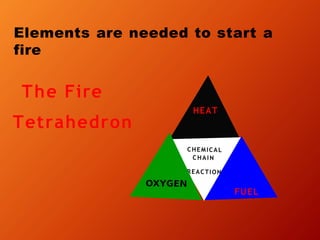
HEAT
FUEL
The Fire
Tetrahedron
Elements are needed to start a
fire
Oxygen
The air we
breathe is
about 21%
oxygen – fire
needs only
16% oxygen
The energy
necessary to
increase the
temperature of fuel
to where sufficient
vapors are given
off for ignition to
occur
the same
Each of these three elements must
time to have a fire. A fire
be present at
will burn until
one or more of the elements is removed.
Fuel
Any combustible material – solid, liquid or gas
Heat
Fire Science…
FUEL CAN BE
❑ LIQUID
❑ SOLID
:Grease, Oil, Fuel;
:Wood, Paper, Metal;
❑ GAS :Natural Gas, Propane, Acetylene.
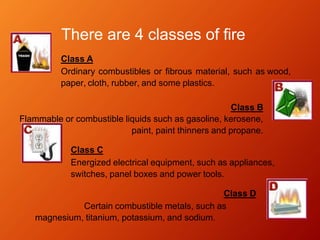
There are 4 classes of fire
Class A
Ordinary combustibles or fibrous material, such as wood,
paper, cloth, rubber, and some plastics.
Class B
Flammable or combustible liquids such as gasoline, kerosene,
paint, paint thinners and propane.
Class C
Energized electrical equipment, such as appliances,
switches, panel boxes and power tools.
Class D
Certain combustible metals, such as
magnesium, titanium, potassium, and sodium.
CLASS “A” FIRES-Ordinary
combustibles such as wood, paper, cloth.
CLASS “B” FIRES - Flammable
liquids such as oil, grease
CLASS “C” FIRES -
Energized electrical equipment
CLASS “D” FIRES -
Flammable Metals
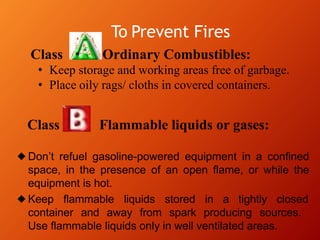
To Prevent Fires
Class Ordinary Combustibles:
• Keep storage and working areas free of garbage.
• Place oily rags/ cloths in covered containers.
Class Flammable liquids or gases:
◆ Don’t refuel gasoline-powered equipment in a confined
space, in the presence of an open flame, or while the
equipment is hot.
◆ Keep flammable liquids stored in a tightly closed
container and away from spark producing sources.
Use flammable liquids only in well ventilated areas.
Class Electrical Equipment:
• Never install a fuse rated higher than specified for the
circuit.
• Investigate any appliance or electrical equipment that
smells strange. Unusual odors can be the first sign of a
potential fire.
• Utility lights should always have some type of wire
guard over them.
To Prevent Fires…
•
•
•
Check the location of fire alarms and know how they work.
Learn your building evacuation plan.
Know where your two nearest exits are located.
Learn how doors swing and where stairs lead.
Make sure nothing blocks fire pulls, extinguishers
and emergency exits.
Learn the sound of your building fire alarm.
Post emergency numbers (including security
and first aid) near your telephone.
Make sure you know what to do if the fire alarm sounds.
Plan your escape.
•
•
•
•
Be prepared for a fire emergency
 Do not assume that anyone else has already called
the fire department.
 Stay calm and be prepared to answer the
operator’s questions regarding the emergency.
 EVACUATE !
Dial 100?
Emergency Number OR Alternate
Emergency Number
When you notice a fire
 Pull the nearest fire alarm “pull station” while exiting
the floor.
 If there is no pull station:
When you hear the fire alarm
 Leave at once, taking direction from
the emergency warden.
 Do not delay yourself by gathering
personal items. Your safety always comes first.
 Before you open any door, feel the door with the
back of your hand. If the door is cold, slowly open
it a crack.
 If there is no smoke in hallways or stairwells,
follow your building’s evacuation plan. Get out
quickly using designated fire exits.
fire department’s search and rescue
efforts.
 The stairway will be your primary escape
route. Never, never use elevators under
any circumstances.
 Once in the stairway, proceed down to the
first floor and out of the building. Never go
up.
When you hear the fire alarm (contd)..
 Close doors behind you, however do NOT
lock the door. Locking the door hinders the
 Before you open any door, feel the door with the back of
your hand. If the door is warm to the touch, DO NOT
attempt to open the door.
 Stuff the cracks around doors with towels, rags, clothing
or tape, and cover vents to keep out smoke.
 Stay low to the floor, and if possible, cover your mouth
and nose with a damp cloth or dust mask to help you
breathe.
 If there is a phone in the room where
you are trapped, call the fire department
to tell them exactly where you are located.
Do this even if you see fire apparatus
on the street below.
If you are trapped in smoke or heat
Wait at a window and signal for help. Do not
panic or jump!! WAIT!
If possible, open the window at the top
or bottom, but do not break it, you may
need to close the window if smoke rushes in.
Be patient. Rescuing all the occupants
of a building can take several hours.
If you are trapped
After a fire
emergency
 Once you are out of the building, STAYOUT!
Do not go back inside for any reason.
 Report to your warden for roll call at your
designated assembly point.
 Tell the fire department via your warden if you
know of anyone trapped inside the building.
 Only re-enter if and when the fire department
tells you it is safe to do so.
In the event of a fire, your personal safety
is your most important concern.
Remember – you are
not required to fight a fire.
BEFORE you consider fighting a fire . . .
❖ Call the fire department.
❖ Confirm that the fire is small and is not
spreading.
❖ Confirm you have a safe path to an exit not
threatened by the fire.
❖ You know what kind of
extinguisher is required
and the correct extinguisher
is immediately at hand.
NEVER fight a fire if . . .
❖ The fire is spreading beyond the immediate
area in which it started, or if it is already a large
fire.
❖ The fire could block your escape route.
❖ You are unsure of the proper operation of the
extinguisher.
❖ You doubt that the extinguisher you are holding
is designed for the type of fire at hand or is
large enough to fight the fire.
Fire Extinguishers
Fire Extinguishers
Extinguisher Rating System
IMPORTANT TO REMEMBER
Ensure that each area has
the proper type fire
extinguisher!
• This label shows that this
extinguisher can be used on
ordinary combustibles (A) or
flammable liquids (B).
• The red slash through the last
symbol tells you that the
extinguisher cannot
be used on electrical fires (C).
Multi-Class Ratings
New Style of Labeling
Old Style of Labeling
Be advised that most fire
extinguishers will function for
less than 40 seconds.
• Many extinguishers available today can be used on different
types of fires and will be labeled with more than one
designator, e.g. A-B, B-C, or A-B-C.
10 Tips on How and When to Use a
Fire Extinguisher
Most fires start small. Except for explosions,
fires can usually be brought under control if
they are attacked correctly with the right type
and size of extinguisher within the first 2
minutes!
A fire extinguisher should be "listed and
labeled" by an independent testing laboratory.
The higher the rating number on an A or B
extinguisher, the more fire it can put out. Be
careful, high-rated units are often heavier
models. Make sure you can hold and operate
the model you are using.
1
2
The operator must know how to use the
extinguisher quickly without taking time to
read directions during an emergency.
Remember that the extinguishers need care
and must be recharged after every use.
3
4
Before attempting to fight a small
fire, be sure everyone is out of the area.
Ensure someone has called the fire
department.
If the fire starts to spread or threatens
your escape path, get out immediately!
IF YOU FI
IGHT A FI
IRE, REMEMBER THE WORD
P A S S
PULL . . . AIM . . . SQUEEZE . . . SWEEP
AIM... low, pointing the 6
extinguisher nozzle (or it's horn
or hose) at the base of the fire.
PULL... the pin. Some extinguishers
require releasing a lock latch,
pressing a puncture lever or other
motion.
5
Read and follow the directions on
your extinguisher. If you have the
slightest doubt about whether or not to
fight a fire – DON’T! Get out and close
the door behind you.
SQUEEZE... the handle. This
releases the extinguishing
agent.
7
8
9
SWEEP... from side to side at the
base of the fire until it appears to be out.
Watch the fire area in case fire breaks
out again, and repeat use of extinguisher
if necessary.
Remember!
•Your Safety Comes First,
When in doubt, leave the fire
fighting to the professionals
Fire Evacuation Plan
WHAT TO D O IN CASE OF FIRE
FOLLOW YOUR AGENCY’S FIRE
EVACUATION PLAN
Fire Evacuation Plan
WHAT TO DO IF YOU ARE TRAPPED
IN A BUILDING
• Don’t panic
• Try to find a secondary exit
• Feel doors for heat with your hand
• If the door is hot, don’t open it!
• If you can’t find another exit, stay where you are
• Seal doors and vents to prevent smoke penetration.
• Stay low to avoid smoke and heat.
Evacuation Plan…
The plan should be reviewed and, if possible,
approved by:
•
•
Fire officials (either State or Local officials)
Office of State Buildings.
Fire Drills…are conducted at least once each
year, but some agencies may require them
more frequently.
Fire Extinguishers
• Know where fire extinguishers are located in your workplace
• Learn how to use them effectively
• Never leave an extinguished fire unattended
• INSPECTIONS:
•The National Fire Protection Association (NFPA) defines
an inspection as a “quick check” that the extinguisher is
available and will function
▪NFPA requires extinguishers be inspected monthly, or more
frequently if circumstances require it.
Fire Extinguishers
•
•
•
Extinguisher located in designated place?
Obstructions to access or visibility?
Operating Instructions on nameplate legible
& facing outward?
Seals & tamper indicators in place & intact?
•
Inspection Procedures

new fire hazard.pptx

  • 2.
    • Fire Hazards • • Fireis one of the most common hazards in the workplace. Statistics from the Seattle Fire Department Fire Prevention Division indicate that close to 80,000 workplace fire incidents occur annually in the United States. • Fire hazards in the workplace include overloaded sockets, dysfunctional fire alarms, improper storage of flammables, faulty electrical appliances and blocked fire exits. Employees must understand all the escape routes in their workplaces. They must also undergo fire drills in preparation to evacuate the building when a fire occurs. • •
  • 3.
    Fire Hazards • Onan average, in India, every year, about 25,000 persons die due to fires and related causes. Female accounts for about 66% of those killed in fire accidents. Estimated that about 42 females &21 males die every day in India due to fire. According to statistics released by National Crime Records Bureau, fire accounts for about 5.9% of the total deaths reported due to natural and un-natural causes during the year 2012. Could have been prevented, had we taken enough fire protection measures. No comprehensive data available in India on economic losses suffered on account of fires. However, (estimate) major losses • • • • • reported by the Indian Insurance Companies year 2007-08 indicate, that about 45% of the claims are due to fire losses.
  • 4.
    • According toFire Risk Survey (FRS) 2013, carried out by Pinkerton & Federation of Indian Chambers and Industry, in India, fire accounted for 8.45% of the overall ranking of risks. FRS also revealed that fires has been rated as the 5th highest risk in industry in 2013. FRS also revealed that in industry wise risk ranking, fire take 2nd place in hospitality, 4th place in IT, Manufacturing, Security Service Providers and 6th place in infrastructure. leading cause for fire - electric defaults are regarded as the major cause of fires. In Mumbai about 75% of fire-related incidents occur because of short circuit caused by loose wiring. • • • •
  • 5.
    • Fires arecaused almost entirely by people, either through their actions, which may be accidental or deliberate and malicious or through their failure to make appropriate precautions such as, for example, – regular inspection, maintenance & repair of defective equipment. – Inadequately maintained machines can be fire prone. – The overheating of bearing, due to insufficient lubrication or the presence of dust, and – heat caused by friction are common causes of fire.
  • 6.
    • Fires startwhen source of ignition comes into contact with combustible material. • If we can control all sources of ignition and combustible material, you can greatly reduce the potential for fire. • Waste and rubbish are friends of fire. • Major fires start in storage area and warehouses than production areas. • Poorly stored goods, even though they are not flammable, may help to spread fire and hinder fire fighters gaining access to the seat of the fire or reduce the effectiveness of sprinkler systems. • Goods neatly stored with gangways may help to inhibit the spread of fire.
  • 7.
    Prevention Strategy • Aneffective fire prevention strategy is an essential feature of fire protection. However, regardless of the efficiency of a fire prevention strategy, some fires inevitably occur. There exists large number of different types of firefighting equipment and suppression systems like CO2 to suit specific requirements. Automatic fire sprinklers coupled with detection are the most effective fire protection system found in High Rise buildings which can, not only detect the fires, but also extinguish the fires in the initial stage itself. Application of Water Mist in various situations is gaining momentum every day. It is estimated that a fire discovered within two or three minutes of its outbreak may be extinguished with less than 1000 litres of water. • • • •
  • 8.
    Prevention Strategy • However,if the water is not applied until 5 to 10 minutes later, which is probably the shortest time in which a fire brigade may reach the scene of the fire, the fire will have grown to such proportions that between 50 to 100 times as much water may be needed for extinguishing the fire. The successful use of any type of fire equipment depends upon the elements such as equipment, maintenance and training. It is vital that an occupier ensures, its employees are trained for and understand what is required during an outbreak of fire. It is observed that lack of knowledge in the area of fire and inadequate training in emergency drills, delay the firefighting operations. Probably adequate fire safety training and periodic emergency drills can make the emergency response more effective. • • • •
  • 9.
  • 10.
  • 11.
    Oxygen The air we breatheis about 21% oxygen – fire needs only 16% oxygen The energy necessary to increase the temperature of fuel to where sufficient vapors are given off for ignition to occur the same Each of these three elements must time to have a fire. A fire be present at will burn until one or more of the elements is removed. Fuel Any combustible material – solid, liquid or gas Heat
  • 12.
    Fire Science… FUEL CANBE ❑ LIQUID ❑ SOLID :Grease, Oil, Fuel; :Wood, Paper, Metal; ❑ GAS :Natural Gas, Propane, Acetylene.
  • 13.
    There are 4classes of fire Class A Ordinary combustibles or fibrous material, such as wood, paper, cloth, rubber, and some plastics. Class B Flammable or combustible liquids such as gasoline, kerosene, paint, paint thinners and propane. Class C Energized electrical equipment, such as appliances, switches, panel boxes and power tools. Class D Certain combustible metals, such as magnesium, titanium, potassium, and sodium.
  • 14.
    CLASS “A” FIRES-Ordinary combustiblessuch as wood, paper, cloth. CLASS “B” FIRES - Flammable liquids such as oil, grease CLASS “C” FIRES - Energized electrical equipment CLASS “D” FIRES - Flammable Metals
  • 15.
    To Prevent Fires ClassOrdinary Combustibles: • Keep storage and working areas free of garbage. • Place oily rags/ cloths in covered containers. Class Flammable liquids or gases: ◆ Don’t refuel gasoline-powered equipment in a confined space, in the presence of an open flame, or while the equipment is hot. ◆ Keep flammable liquids stored in a tightly closed container and away from spark producing sources. Use flammable liquids only in well ventilated areas.
  • 16.
    Class Electrical Equipment: •Never install a fuse rated higher than specified for the circuit. • Investigate any appliance or electrical equipment that smells strange. Unusual odors can be the first sign of a potential fire. • Utility lights should always have some type of wire guard over them. To Prevent Fires…
  • 17.
    • • • Check the locationof fire alarms and know how they work. Learn your building evacuation plan. Know where your two nearest exits are located. Learn how doors swing and where stairs lead. Make sure nothing blocks fire pulls, extinguishers and emergency exits. Learn the sound of your building fire alarm. Post emergency numbers (including security and first aid) near your telephone. Make sure you know what to do if the fire alarm sounds. Plan your escape. • • • • Be prepared for a fire emergency
  • 18.
     Do notassume that anyone else has already called the fire department.  Stay calm and be prepared to answer the operator’s questions regarding the emergency.  EVACUATE ! Dial 100? Emergency Number OR Alternate Emergency Number When you notice a fire  Pull the nearest fire alarm “pull station” while exiting the floor.  If there is no pull station:
  • 19.
    When you hearthe fire alarm  Leave at once, taking direction from the emergency warden.  Do not delay yourself by gathering personal items. Your safety always comes first.  Before you open any door, feel the door with the back of your hand. If the door is cold, slowly open it a crack.  If there is no smoke in hallways or stairwells, follow your building’s evacuation plan. Get out quickly using designated fire exits.
  • 20.
    fire department’s searchand rescue efforts.  The stairway will be your primary escape route. Never, never use elevators under any circumstances.  Once in the stairway, proceed down to the first floor and out of the building. Never go up. When you hear the fire alarm (contd)..  Close doors behind you, however do NOT lock the door. Locking the door hinders the
  • 21.
     Before youopen any door, feel the door with the back of your hand. If the door is warm to the touch, DO NOT attempt to open the door.  Stuff the cracks around doors with towels, rags, clothing or tape, and cover vents to keep out smoke.  Stay low to the floor, and if possible, cover your mouth and nose with a damp cloth or dust mask to help you breathe.  If there is a phone in the room where you are trapped, call the fire department to tell them exactly where you are located. Do this even if you see fire apparatus on the street below. If you are trapped in smoke or heat
  • 22.
    Wait at awindow and signal for help. Do not panic or jump!! WAIT! If possible, open the window at the top or bottom, but do not break it, you may need to close the window if smoke rushes in. Be patient. Rescuing all the occupants of a building can take several hours. If you are trapped
  • 23.
    After a fire emergency Once you are out of the building, STAYOUT! Do not go back inside for any reason.  Report to your warden for roll call at your designated assembly point.  Tell the fire department via your warden if you know of anyone trapped inside the building.  Only re-enter if and when the fire department tells you it is safe to do so.
  • 24.
    In the eventof a fire, your personal safety is your most important concern. Remember – you are not required to fight a fire.
  • 25.
    BEFORE you considerfighting a fire . . . ❖ Call the fire department. ❖ Confirm that the fire is small and is not spreading. ❖ Confirm you have a safe path to an exit not threatened by the fire. ❖ You know what kind of extinguisher is required and the correct extinguisher is immediately at hand.
  • 26.
    NEVER fight afire if . . . ❖ The fire is spreading beyond the immediate area in which it started, or if it is already a large fire. ❖ The fire could block your escape route. ❖ You are unsure of the proper operation of the extinguisher. ❖ You doubt that the extinguisher you are holding is designed for the type of fire at hand or is large enough to fight the fire.
  • 27.
  • 28.
  • 29.
    IMPORTANT TO REMEMBER Ensurethat each area has the proper type fire extinguisher!
  • 30.
    • This labelshows that this extinguisher can be used on ordinary combustibles (A) or flammable liquids (B). • The red slash through the last symbol tells you that the extinguisher cannot be used on electrical fires (C). Multi-Class Ratings New Style of Labeling Old Style of Labeling Be advised that most fire extinguishers will function for less than 40 seconds. • Many extinguishers available today can be used on different types of fires and will be labeled with more than one designator, e.g. A-B, B-C, or A-B-C.
  • 31.
    10 Tips onHow and When to Use a Fire Extinguisher Most fires start small. Except for explosions, fires can usually be brought under control if they are attacked correctly with the right type and size of extinguisher within the first 2 minutes! A fire extinguisher should be "listed and labeled" by an independent testing laboratory. The higher the rating number on an A or B extinguisher, the more fire it can put out. Be careful, high-rated units are often heavier models. Make sure you can hold and operate the model you are using. 1 2
  • 32.
    The operator mustknow how to use the extinguisher quickly without taking time to read directions during an emergency. Remember that the extinguishers need care and must be recharged after every use. 3 4 Before attempting to fight a small fire, be sure everyone is out of the area. Ensure someone has called the fire department. If the fire starts to spread or threatens your escape path, get out immediately!
  • 33.
    IF YOU FI IGHTA FI IRE, REMEMBER THE WORD P A S S PULL . . . AIM . . . SQUEEZE . . . SWEEP AIM... low, pointing the 6 extinguisher nozzle (or it's horn or hose) at the base of the fire. PULL... the pin. Some extinguishers require releasing a lock latch, pressing a puncture lever or other motion. 5
  • 34.
    Read and followthe directions on your extinguisher. If you have the slightest doubt about whether or not to fight a fire – DON’T! Get out and close the door behind you. SQUEEZE... the handle. This releases the extinguishing agent. 7 8 9 SWEEP... from side to side at the base of the fire until it appears to be out. Watch the fire area in case fire breaks out again, and repeat use of extinguisher if necessary.
  • 35.
    Remember! •Your Safety ComesFirst, When in doubt, leave the fire fighting to the professionals
  • 36.
    Fire Evacuation Plan WHATTO D O IN CASE OF FIRE FOLLOW YOUR AGENCY’S FIRE EVACUATION PLAN
  • 37.
    Fire Evacuation Plan WHATTO DO IF YOU ARE TRAPPED IN A BUILDING • Don’t panic • Try to find a secondary exit • Feel doors for heat with your hand • If the door is hot, don’t open it! • If you can’t find another exit, stay where you are • Seal doors and vents to prevent smoke penetration. • Stay low to avoid smoke and heat.
  • 38.
    Evacuation Plan… The planshould be reviewed and, if possible, approved by: • • Fire officials (either State or Local officials) Office of State Buildings. Fire Drills…are conducted at least once each year, but some agencies may require them more frequently.
  • 39.
    Fire Extinguishers • Knowwhere fire extinguishers are located in your workplace • Learn how to use them effectively • Never leave an extinguished fire unattended • INSPECTIONS: •The National Fire Protection Association (NFPA) defines an inspection as a “quick check” that the extinguisher is available and will function ▪NFPA requires extinguishers be inspected monthly, or more frequently if circumstances require it.
  • 40.
    Fire Extinguishers • • • Extinguisher locatedin designated place? Obstructions to access or visibility? Operating Instructions on nameplate legible & facing outward? Seals & tamper indicators in place & intact? • Inspection Procedures