PERSONAL PROTECTIVE EQUIPMENT
Syed Najaf Ali
METHODS OF CONTROLLING HAZARDS
• ENGINEERING CONTROLS – redesigning
equipment, installation of guards, barriers or shields,
substitution of less hazardous materials or physically
altering mechanical processes to eliminate hazards.
• ADMINISTRATIVE CONTROLS – worker
rotation to minimize exposure, implementing proper
house keeping like 5-S & TPM, devising appropriate
training.
• PERSONAL PROTECTIVE EQUIPMENT-
will be used to ensure worker health and safety when
other two methods cannot eliminate work hazards. It is
the least desirable method of controlling hazard.
Personal Protective Equipment
• Definition: Devices used to protect
employees from injury or illness resulting
from contact with chemical , radiological,
physical, electrical, mechanical, or other
workplace hazards.
STPES TO BE FOLLOWED
• THERE SHOULD BE A POLICY ON PPE
USAGE FOR EMPLOYEES AND
VISITORS.
• SELECTION OF PROPER EQUIPMENT
FOR EXISTING HAZARDS.
• IMPLEMENT A TRAINING
PROGRAMME
• ENFORCE THE USE OF PPE
PERSONAL PROTECTIVE EQUIPMENT
• Suitable PPE should be kept in readiness at all times while
handling dangerous cargo or to meet / handle any emergency
due to leakage or spillage or fire.
• PPEs must fulfill the following requirements:
1. Acceptable national or international standards.
2. Lightness and comforts to wear it.
3. Freeness to move or taking any posture.
4. Easiness of its maintenance and replacement of parts.
5. Good looking while using.
PPEs do not eliminate hazard. These devices are designed to
interpose an effective barrier between a person and harmful
object, substances or radiaton.
LEGAL REQUIREMENTS
.
In the Factories Act 1948 there are specific provisions
for providing the PPE to the workers who are exposed
to unsafe and unhealthy environment. The provisions
of law relating to use of PPE in different operations
processes are formed in such a spirit that the workers
working on the operations and in the processes are
protected against possible hazards. It is also the
intension of the law that these PPE shall be of such
type and made of such materials that it withstands to
such specific hazards for which it is actually being
used.
SELECTION OF P.P.E.
• NATURE OF THE HAZARD
• SEVERITY OF THE HAZARD.
• TYPE OF CONTAMINANT.
• CONCENTRATION OF THE CONTAMINANTS.
• DURATION OF WORK.
• LOCATION OF THE CONTAMINATED AREA WITH
RESPECT TO A SOURCE OF RESPIRABLE AIR.
• EXPECTED ACTIVITY OF THE WEARER.
• RELIABILITY OF THE EQUIPMENT.
• OPERATING CHARACTERISTIC AND LIMITATIONS
OF THE EQUIPMENT.
• ACCEPTANCE OF THE WEARER.
• COST OF THE EQUPMENT.
TYPES OF P.P.E.
• NON-RESPIRATORY P.P.E. (BODY PROTECTIVE)
• RESPIRATORY P.P.E.
PPE
• Head protection
• Eye and Face protection
• Hearing protection
• Respiratory protection
• Arm and Hand protection
• Foot and Leg protection
• Protective clothing
Selecting the Right Hard Hat
Class A
• General service (building construction, shipbuilding, lumbering)
• Good impact protection but limited voltage protection
Class B
• Electrical / Utility work
• Protects against falling objects and high-voltage shock and burns
Class C
• Designed for comfort, offers limited protection
• Protects against bumps from fixed objects, but does not protect
against falling objects or electrical shock
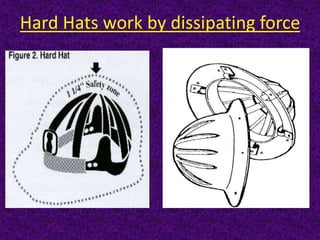
Hard Hats work by dissipating force
Eye & Face Protection - Selection
• Safety goggles are used to protect the eyes
from flying objects (no face protection)
• Face shields provide highest level of
protection
• Dust goggles is used in dusty atomsphere.
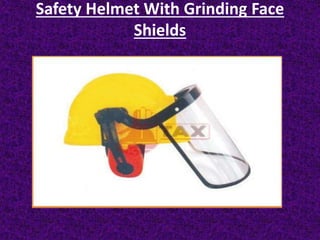
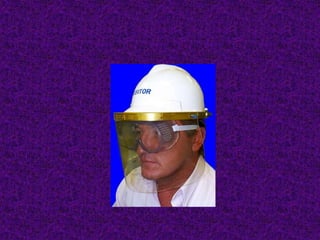
Safety Helmet With Grinding Face
Shields
When must Eye Protection be
Provided?
When any of these hazards are present:
• Dust and other flying particles, such as metal
shavings or sawdust
• Corrosive gases, vapors, and liquids
• Molten metal that may splash
• Potentially infectious materials such as blood
or hazardous liquid chemicals that may splash
• Intense light from welding and lasers
Eye Protection
Criteria for Selection
• Protects against specific hazard(s)
• Comfortable to wear
• Does not restrict vision or movement
• Durable and easy to clean and disinfect
• Does not interfere with the function of other
required PPE
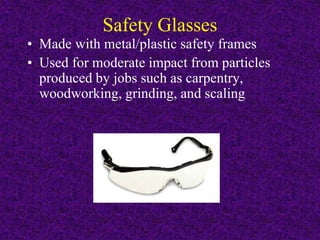
Safety Glasses
• Made with metal/plastic safety frames
• Used for moderate impact from particles
produced by jobs such as carpentry,
woodworking, grinding, and scaling
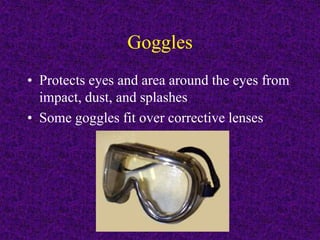
Goggles
• Protects eyes and area around the eyes from
impact, dust, and splashes
• Some goggles fit over corrective lenses
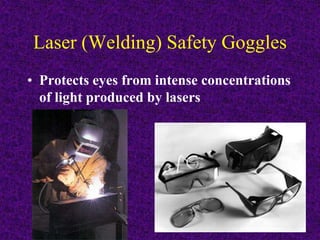
Laser (Welding) Safety Goggles
• Protects eyes from intense concentrations
of light produced by lasers
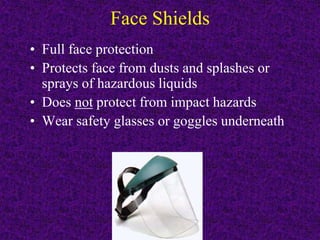
Face Shields
• Full face protection
• Protects face from dusts and splashes or
sprays of hazardous liquids
• Does not protect from impact hazards
• Wear safety glasses or goggles underneath
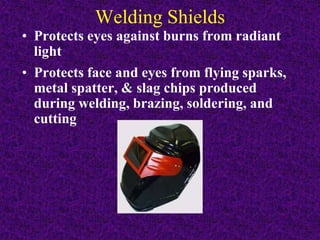
Welding Shields
• Protects eyes against burns from radiant
light
• Protects face and eyes from flying sparks,
metal spatter, & slag chips produced
during welding, brazing, soldering, and
cutting
Hearing Protection Basics
• Noise induced hearing loss can occur with
exposures >90 dBA
• A hearing conservation program becomes a
requirement at exposures >80dBA
• Higher levels of noise exposure have shorter
allowable exposure times
Hearing Protection - Types
• Ear Plugs - less expensive, disposable, good
ones have fairly high NRRs
• Ear Muffs - more expensive, more durable,
typically higher NRRs (Noise Reduction
Rating ) than plugs, more obvious
• Can be used together in very high noise
areas
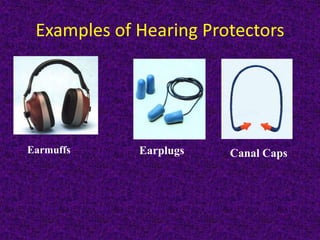
Examples of Hearing Protectors
Earmuffs Earplugs Canal Caps
When Must Foot Protection be
Provided?
When any of these are present:
• Heavy objects such as barrels or tools that
might roll onto or fall on employees’ feet
• Sharp objects such as nails or spikes that
might pierce ordinary shoes
• Molten metal that might splash on feet
• Hot or wet surfaces
• Slippery surfaces
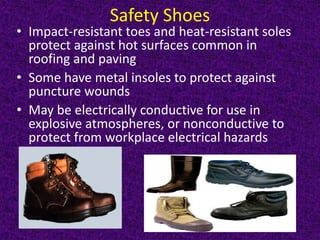
Safety Shoes
• Impact-resistant toes and heat-resistant soles
protect against hot surfaces common in
roofing and paving
• Some have metal insoles to protect against
puncture wounds
• May be electrically conductive for use in
explosive atmospheres, or nonconductive to
protect from workplace electrical hazards
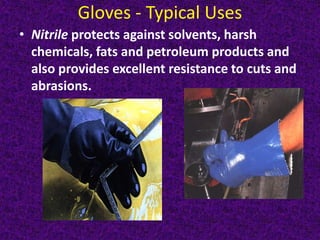
Gloves - Typical Uses
• Nitrile protects against solvents, harsh
chemicals, fats and petroleum products and
also provides excellent resistance to cuts and
abrasions.
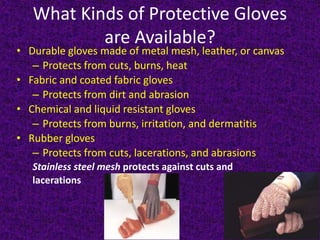
What Kinds of Protective Gloves
are Available?
• Durable gloves made of metal mesh, leather, or canvas
– Protects from cuts, burns, heat
• Fabric and coated fabric gloves
– Protects from dirt and abrasion
• Chemical and liquid resistant gloves
– Protects from burns, irritation, and dermatitis
• Rubber gloves
– Protects from cuts, lacerations, and abrasions
Stainless steel mesh protects against cuts and
lacerations
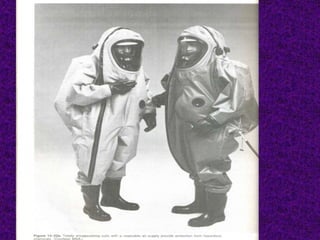
Body protection
• Body Protection Suits made of fire retardant
fabric shall be used in the high heated areas
to protect the wearer from heat and fire. The
suits shall be light in weight and comfortable
while wearing.
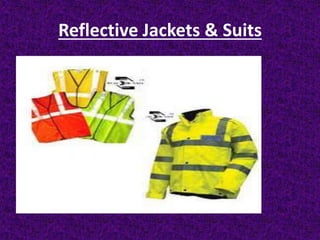
Reflective Jackets & Suits
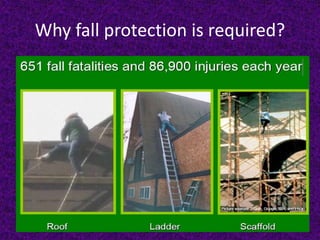
Why fall protection is required?
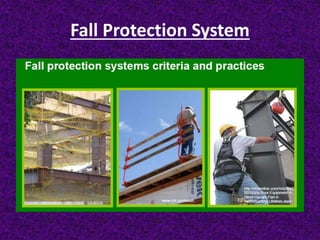
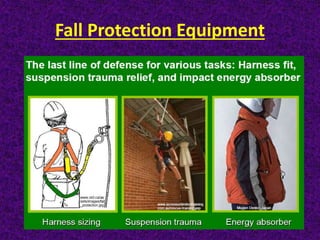
Fall protection
• Fall Protection Equipment of light weight and
high durability made of quality raw material.
• Advanced techniques shall be used for
preventing hazards that are related with the
working at a height or in a position risking of
fall in the industries like construction, mining,
oil rigging, maintenance and
telecommunication.
• Safety Belt , Rope Ladder, Safety Net , Tongue
Buckle, Full-support body harness etc are being
used.
Fall Protection System
Fall Protection Equipment
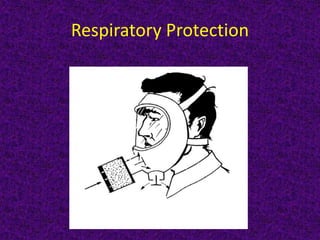
Respiratory Protection
RESPIRATORY P.P.E.
• Oxygen Deficiency : Self Contained Breathing
Apparatus, Hose mask with blower.
• Toxic Contaminants :
1. Gaseous Contaminants Immediately Dangerous to Life – SCBA,
Hose mask, Gas Mask etc
2. Gaseous Contaminants not Immediately Dangerous to Life – Air
Line Respirator, Hose Mask with blower, Chemical cartridge
respirator etc.
3. Particulate Contaminants (Dusts, Fumes, Smokes, Mists, Fogs) –
Dust/mist collecting filter, air line respirator
4. Combination of Gaseous and Particulate Contaminants
• Immediately Dangerous to Life
• Not Immediately Dangerous to Life
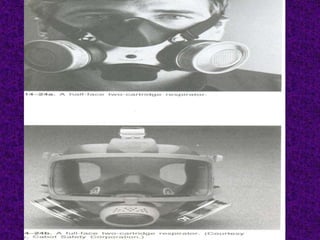
RESPIRATORY P.P.E
RESPIRATORY P.P.E :
• AIR PURIFYING RESPIRATORS.
• AIR SUPPLYING RESPIRATOS.
• SELF CONATAINED BREATHING APPARATUS.
AIR PURIFYING RESPIRATORS :
• DUST RESPIRATOR
• CANISTER GAS MASK
• CHEMICAL CARTRIDGE RESPIRATOR
• SELF- RESCUE TYPE RESPIRATOR
• COMBINATION OF CHEMICAL AND MECHANICAL
FILTER
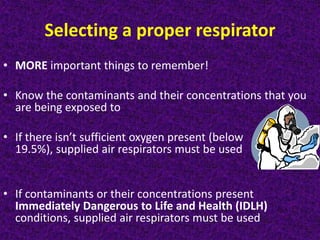
Selecting a proper respirator
• MORE important things to remember!
• Know the contaminants and their concentrations that you
are being exposed to
• If there isn’t sufficient oxygen present (below
19.5%), supplied air respirators must be used
• If contaminants or their concentrations present
Immediately Dangerous to Life and Health (IDLH)
conditions, supplied air respirators must be used
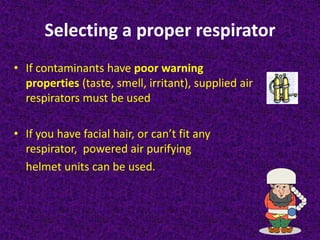
Selecting a proper respirator
• If contaminants have poor warning
properties (taste, smell, irritant), supplied air
respirators must be used
• If you have facial hair, or can’t fit any
respirator, powered air purifying
helmet units can be used.
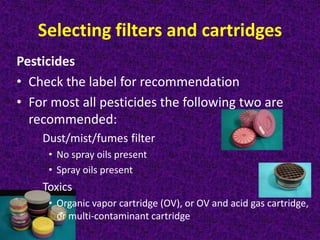
Selecting filters and cartridges
Pesticides
• Check the label for recommendation
• For most all pesticides the following two are
recommended:
– Dust/mist/fumes filter
• No spray oils present
• Spray oils present
– Toxics
• Organic vapor cartridge (OV), or OV and acid gas cartridge,
or multi-contaminant cartridge
Classes of Nonpowered
Air-Purifying Particulate Filters
• Classes of Non-powered Air-Purifying Particulate Filters
• Three categories of resistance to filter efficiency degradation
due to the presence of oil aerosols
• N R P
• N for Not resistant to oil
• R for Resistant to oil
• P for oil Proof
• If no oil particles are present, use any series (N, R, or P)
• If oil particles are present, use only R or P series
• Follow the respirator filter manufacturer’s service-time-limit
recommendations
Using your respirator properly Before
you use your respirator, be sure you understand:
1. Inspections (Review Respirator Inspection presentation)
2. Donning and doffing (on and off)
3. Maintenance
4. Changing cartridges and filters
5. What to do when things go wrong
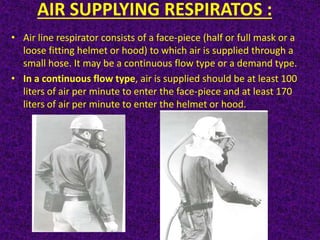
AIR SUPPLYING RESPIRATOS :
• Air line respirator consists of a face-piece (half or full mask or a
loose fitting helmet or hood) to which air is supplied through a
small hose. It may be a continuous flow type or a demand type.
• In a continuous flow type, air is supplied should be at least 100
liters of air per minute to enter the face-piece and at least 170
liters of air per minute to enter the helmet or hood.
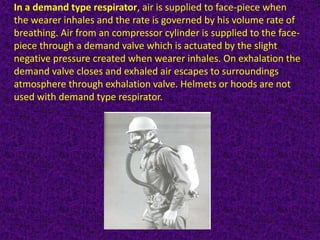
In a demand type respirator, air is supplied to face-piece when
the wearer inhales and the rate is governed by his volume rate of
breathing. Air from an compressor cylinder is supplied to the face-
piece through a demand valve which is actuated by the slight
negative pressure created when wearer inhales. On exhalation the
demand valve closes and exhaled air escapes to surroundings
atmosphere through exhalation valve. Helmets or hoods are not
used with demand type respirator.
CARE OF PPE :
• All equipment must be inspected before or after each use. A record should be
kept of all inspections by date with results tabulated. Supervisors and
workers should follow the recommendations of the manufacturer for
inspection along with recommendation for maintenance and for the repair
and replacement parts supplied by the manufacturer.
• Helmet : Shell should be cleaned regularly both for safety and appearance.
Dirt or stains may hide hairline crack, a reason to replace the helmet.
Nothing to be carried inside the helmet. A clearance must be maintained
inside the helmet for the protection system to work. Painting should not be
done on helmet. Paint contains solvents which can make the shell brittle.
Reflective tape is recommended for numbers or symbols.
• Flame Retardant Work Cloth : Excessive water temperatures or use of certain
washing preparations can deteriorate the fabric or affect its properties. Spot
cleaning with organic solvents may soften or dissolve some synthetics, while
chlorine bleaches will remove most flame-retardant treatment from cotton.
Compressed air or vacuum system should be used for this purpose.
• Rubber Boots : These are to be washed inside and outside with a hose
containing under pressure. They are dipped into a tub containing a solution
of 1 part Nacl and 19 parts water. Although other disinfecting agents can be
used.
THANK YOU
PPE SELF INSPECTION CHECKLIST
• Has a hazard assessment been conducted of the
workplace to determine if hazards are present, or are
likely to be present, that would require the use of PPE?
• Has PPE been selected to protect employees and visitors
from the hazards identified in the hazard assessment?
• Is PPE provided to employees to prevent injury or
impairment by exposure to chemical hazards,
radiological hazards, or mechanical irritants through
absorption, inhalation or physical contact?
PPE SELF INSPECTION CHECKLIST
• Has PPE been selected to ensure it fits everyone
properly?
• Is PPE maintained in a sanitary and reliable condition?
• Do employees use the PPE selected in the hazard
assessment process?
• Is defective or damaged PPE removed from service
immediately?
• Are all shop entrances, areas, equipment requiring the use
of PPE posted with a sign indicating this requirement?
• Has training been provided to each employee who is
required to use PPE?
PPE SELF INSPECTION CHECKLIST
• Has training on PPE included all of the following
elements: when PPE is necessary; what PPE is
necessary; how to properly don, doff, adjust and wear
PPE; the limitations of the PPE; and the proper care,
maintenance, useful life and disposal of the PPE.
• Have trained employees demonstrated an understanding
of the training and the ability to use PPE properly before
being allowed to perform work requiring the use of PPE?
• Is retraining conducted whenever the following
conditions exist: changes in the workplace render
previous training obsolete and changes in the types of
PPE to be used render previous training obsolete?
• Is PPE inspection record maintained in a register?
THANK YOU

PPE

  • 1.
  • 2.
    METHODS OF CONTROLLINGHAZARDS • ENGINEERING CONTROLS – redesigning equipment, installation of guards, barriers or shields, substitution of less hazardous materials or physically altering mechanical processes to eliminate hazards. • ADMINISTRATIVE CONTROLS – worker rotation to minimize exposure, implementing proper house keeping like 5-S & TPM, devising appropriate training. • PERSONAL PROTECTIVE EQUIPMENT- will be used to ensure worker health and safety when other two methods cannot eliminate work hazards. It is the least desirable method of controlling hazard.
  • 3.
    Personal Protective Equipment •Definition: Devices used to protect employees from injury or illness resulting from contact with chemical , radiological, physical, electrical, mechanical, or other workplace hazards.
  • 4.
    STPES TO BEFOLLOWED • THERE SHOULD BE A POLICY ON PPE USAGE FOR EMPLOYEES AND VISITORS. • SELECTION OF PROPER EQUIPMENT FOR EXISTING HAZARDS. • IMPLEMENT A TRAINING PROGRAMME • ENFORCE THE USE OF PPE
  • 5.
    PERSONAL PROTECTIVE EQUIPMENT •Suitable PPE should be kept in readiness at all times while handling dangerous cargo or to meet / handle any emergency due to leakage or spillage or fire. • PPEs must fulfill the following requirements: 1. Acceptable national or international standards. 2. Lightness and comforts to wear it. 3. Freeness to move or taking any posture. 4. Easiness of its maintenance and replacement of parts. 5. Good looking while using. PPEs do not eliminate hazard. These devices are designed to interpose an effective barrier between a person and harmful object, substances or radiaton.
  • 6.
    LEGAL REQUIREMENTS . In theFactories Act 1948 there are specific provisions for providing the PPE to the workers who are exposed to unsafe and unhealthy environment. The provisions of law relating to use of PPE in different operations processes are formed in such a spirit that the workers working on the operations and in the processes are protected against possible hazards. It is also the intension of the law that these PPE shall be of such type and made of such materials that it withstands to such specific hazards for which it is actually being used.
  • 7.
    SELECTION OF P.P.E. •NATURE OF THE HAZARD • SEVERITY OF THE HAZARD. • TYPE OF CONTAMINANT. • CONCENTRATION OF THE CONTAMINANTS. • DURATION OF WORK. • LOCATION OF THE CONTAMINATED AREA WITH RESPECT TO A SOURCE OF RESPIRABLE AIR. • EXPECTED ACTIVITY OF THE WEARER. • RELIABILITY OF THE EQUIPMENT. • OPERATING CHARACTERISTIC AND LIMITATIONS OF THE EQUIPMENT. • ACCEPTANCE OF THE WEARER. • COST OF THE EQUPMENT.
  • 8.
    TYPES OF P.P.E. •NON-RESPIRATORY P.P.E. (BODY PROTECTIVE) • RESPIRATORY P.P.E.
  • 9.
    PPE • Head protection •Eye and Face protection • Hearing protection • Respiratory protection • Arm and Hand protection • Foot and Leg protection • Protective clothing
  • 10.
    Selecting the RightHard Hat Class A • General service (building construction, shipbuilding, lumbering) • Good impact protection but limited voltage protection Class B • Electrical / Utility work • Protects against falling objects and high-voltage shock and burns Class C • Designed for comfort, offers limited protection • Protects against bumps from fixed objects, but does not protect against falling objects or electrical shock
  • 11.
    Hard Hats workby dissipating force
  • 12.
    Eye & FaceProtection - Selection • Safety goggles are used to protect the eyes from flying objects (no face protection) • Face shields provide highest level of protection • Dust goggles is used in dusty atomsphere.
  • 13.
    Safety Helmet WithGrinding Face Shields
  • 14.
    When must EyeProtection be Provided? When any of these hazards are present: • Dust and other flying particles, such as metal shavings or sawdust • Corrosive gases, vapors, and liquids • Molten metal that may splash • Potentially infectious materials such as blood or hazardous liquid chemicals that may splash • Intense light from welding and lasers
  • 17.
    Eye Protection Criteria forSelection • Protects against specific hazard(s) • Comfortable to wear • Does not restrict vision or movement • Durable and easy to clean and disinfect • Does not interfere with the function of other required PPE
  • 18.
    Safety Glasses • Madewith metal/plastic safety frames • Used for moderate impact from particles produced by jobs such as carpentry, woodworking, grinding, and scaling
  • 19.
    Goggles • Protects eyesand area around the eyes from impact, dust, and splashes • Some goggles fit over corrective lenses
  • 20.
    Laser (Welding) SafetyGoggles • Protects eyes from intense concentrations of light produced by lasers
  • 21.
    Face Shields • Fullface protection • Protects face from dusts and splashes or sprays of hazardous liquids • Does not protect from impact hazards • Wear safety glasses or goggles underneath
  • 22.
    Welding Shields • Protectseyes against burns from radiant light • Protects face and eyes from flying sparks, metal spatter, & slag chips produced during welding, brazing, soldering, and cutting
  • 23.
    Hearing Protection Basics •Noise induced hearing loss can occur with exposures >90 dBA • A hearing conservation program becomes a requirement at exposures >80dBA • Higher levels of noise exposure have shorter allowable exposure times
  • 24.
    Hearing Protection -Types • Ear Plugs - less expensive, disposable, good ones have fairly high NRRs • Ear Muffs - more expensive, more durable, typically higher NRRs (Noise Reduction Rating ) than plugs, more obvious • Can be used together in very high noise areas
  • 25.
    Examples of HearingProtectors Earmuffs Earplugs Canal Caps
  • 26.
    When Must FootProtection be Provided? When any of these are present: • Heavy objects such as barrels or tools that might roll onto or fall on employees’ feet • Sharp objects such as nails or spikes that might pierce ordinary shoes • Molten metal that might splash on feet • Hot or wet surfaces • Slippery surfaces
  • 27.
    Safety Shoes • Impact-resistanttoes and heat-resistant soles protect against hot surfaces common in roofing and paving • Some have metal insoles to protect against puncture wounds • May be electrically conductive for use in explosive atmospheres, or nonconductive to protect from workplace electrical hazards
  • 28.
    Gloves - TypicalUses • Nitrile protects against solvents, harsh chemicals, fats and petroleum products and also provides excellent resistance to cuts and abrasions.
  • 29.
    What Kinds ofProtective Gloves are Available? • Durable gloves made of metal mesh, leather, or canvas – Protects from cuts, burns, heat • Fabric and coated fabric gloves – Protects from dirt and abrasion • Chemical and liquid resistant gloves – Protects from burns, irritation, and dermatitis • Rubber gloves – Protects from cuts, lacerations, and abrasions Stainless steel mesh protects against cuts and lacerations
  • 30.
    Body protection • BodyProtection Suits made of fire retardant fabric shall be used in the high heated areas to protect the wearer from heat and fire. The suits shall be light in weight and comfortable while wearing.
  • 31.
  • 32.
    Why fall protectionis required?
  • 33.
    Fall protection • FallProtection Equipment of light weight and high durability made of quality raw material. • Advanced techniques shall be used for preventing hazards that are related with the working at a height or in a position risking of fall in the industries like construction, mining, oil rigging, maintenance and telecommunication. • Safety Belt , Rope Ladder, Safety Net , Tongue Buckle, Full-support body harness etc are being used.
  • 34.
  • 35.
  • 36.
  • 37.
    RESPIRATORY P.P.E. • OxygenDeficiency : Self Contained Breathing Apparatus, Hose mask with blower. • Toxic Contaminants : 1. Gaseous Contaminants Immediately Dangerous to Life – SCBA, Hose mask, Gas Mask etc 2. Gaseous Contaminants not Immediately Dangerous to Life – Air Line Respirator, Hose Mask with blower, Chemical cartridge respirator etc. 3. Particulate Contaminants (Dusts, Fumes, Smokes, Mists, Fogs) – Dust/mist collecting filter, air line respirator 4. Combination of Gaseous and Particulate Contaminants • Immediately Dangerous to Life • Not Immediately Dangerous to Life
  • 38.
    RESPIRATORY P.P.E RESPIRATORY P.P.E: • AIR PURIFYING RESPIRATORS. • AIR SUPPLYING RESPIRATOS. • SELF CONATAINED BREATHING APPARATUS. AIR PURIFYING RESPIRATORS : • DUST RESPIRATOR • CANISTER GAS MASK • CHEMICAL CARTRIDGE RESPIRATOR • SELF- RESCUE TYPE RESPIRATOR • COMBINATION OF CHEMICAL AND MECHANICAL FILTER
  • 39.
    Selecting a properrespirator • MORE important things to remember! • Know the contaminants and their concentrations that you are being exposed to • If there isn’t sufficient oxygen present (below 19.5%), supplied air respirators must be used • If contaminants or their concentrations present Immediately Dangerous to Life and Health (IDLH) conditions, supplied air respirators must be used
  • 40.
    Selecting a properrespirator • If contaminants have poor warning properties (taste, smell, irritant), supplied air respirators must be used • If you have facial hair, or can’t fit any respirator, powered air purifying helmet units can be used.
  • 41.
    Selecting filters andcartridges Pesticides • Check the label for recommendation • For most all pesticides the following two are recommended: – Dust/mist/fumes filter • No spray oils present • Spray oils present – Toxics • Organic vapor cartridge (OV), or OV and acid gas cartridge, or multi-contaminant cartridge
  • 42.
    Classes of Nonpowered Air-PurifyingParticulate Filters • Classes of Non-powered Air-Purifying Particulate Filters • Three categories of resistance to filter efficiency degradation due to the presence of oil aerosols • N R P • N for Not resistant to oil • R for Resistant to oil • P for oil Proof • If no oil particles are present, use any series (N, R, or P) • If oil particles are present, use only R or P series • Follow the respirator filter manufacturer’s service-time-limit recommendations
  • 43.
    Using your respiratorproperly Before you use your respirator, be sure you understand: 1. Inspections (Review Respirator Inspection presentation) 2. Donning and doffing (on and off) 3. Maintenance 4. Changing cartridges and filters 5. What to do when things go wrong
  • 46.
    AIR SUPPLYING RESPIRATOS: • Air line respirator consists of a face-piece (half or full mask or a loose fitting helmet or hood) to which air is supplied through a small hose. It may be a continuous flow type or a demand type. • In a continuous flow type, air is supplied should be at least 100 liters of air per minute to enter the face-piece and at least 170 liters of air per minute to enter the helmet or hood.
  • 47.
    In a demandtype respirator, air is supplied to face-piece when the wearer inhales and the rate is governed by his volume rate of breathing. Air from an compressor cylinder is supplied to the face- piece through a demand valve which is actuated by the slight negative pressure created when wearer inhales. On exhalation the demand valve closes and exhaled air escapes to surroundings atmosphere through exhalation valve. Helmets or hoods are not used with demand type respirator.
  • 48.
    CARE OF PPE: • All equipment must be inspected before or after each use. A record should be kept of all inspections by date with results tabulated. Supervisors and workers should follow the recommendations of the manufacturer for inspection along with recommendation for maintenance and for the repair and replacement parts supplied by the manufacturer. • Helmet : Shell should be cleaned regularly both for safety and appearance. Dirt or stains may hide hairline crack, a reason to replace the helmet. Nothing to be carried inside the helmet. A clearance must be maintained inside the helmet for the protection system to work. Painting should not be done on helmet. Paint contains solvents which can make the shell brittle. Reflective tape is recommended for numbers or symbols. • Flame Retardant Work Cloth : Excessive water temperatures or use of certain washing preparations can deteriorate the fabric or affect its properties. Spot cleaning with organic solvents may soften or dissolve some synthetics, while chlorine bleaches will remove most flame-retardant treatment from cotton. Compressed air or vacuum system should be used for this purpose. • Rubber Boots : These are to be washed inside and outside with a hose containing under pressure. They are dipped into a tub containing a solution of 1 part Nacl and 19 parts water. Although other disinfecting agents can be used.
  • 49.
  • 50.
    PPE SELF INSPECTIONCHECKLIST • Has a hazard assessment been conducted of the workplace to determine if hazards are present, or are likely to be present, that would require the use of PPE? • Has PPE been selected to protect employees and visitors from the hazards identified in the hazard assessment? • Is PPE provided to employees to prevent injury or impairment by exposure to chemical hazards, radiological hazards, or mechanical irritants through absorption, inhalation or physical contact?
  • 51.
    PPE SELF INSPECTIONCHECKLIST • Has PPE been selected to ensure it fits everyone properly? • Is PPE maintained in a sanitary and reliable condition? • Do employees use the PPE selected in the hazard assessment process? • Is defective or damaged PPE removed from service immediately? • Are all shop entrances, areas, equipment requiring the use of PPE posted with a sign indicating this requirement? • Has training been provided to each employee who is required to use PPE?
  • 52.
    PPE SELF INSPECTIONCHECKLIST • Has training on PPE included all of the following elements: when PPE is necessary; what PPE is necessary; how to properly don, doff, adjust and wear PPE; the limitations of the PPE; and the proper care, maintenance, useful life and disposal of the PPE. • Have trained employees demonstrated an understanding of the training and the ability to use PPE properly before being allowed to perform work requiring the use of PPE? • Is retraining conducted whenever the following conditions exist: changes in the workplace render previous training obsolete and changes in the types of PPE to be used render previous training obsolete? • Is PPE inspection record maintained in a register?
  • 53.