KAS 3501 OCCUPATIONAL SAFETY AND HEALTH
SEMESTER 6 2014/2015
GROUP 5
SAFETY INDEX AND FIRE INDEX
Group 5
Presentation date: 1st April 2015
GROUP MEMBERS MATRIC NO
NAZIRAH BINTI TARMIZI UK29498
KUAN SHI YUN UK29559
NOR’AIN BINTI ISMAIL@AWANG UK29500
SITI HAJAR BINTI MOHD NOR UK29557
RAFIZAL BIN AB RAHIM @ HASSAN UK29318
SAFETY INDEX
AT WORKPLACE
WHAT IS WORKPLACE SAFETY?
Workplace safety is an important aspect to the success
of a company. Keeping employees safe from injuries and
health problems while on the job not only makes good
business sense, it is required by law. The Occupational
Safety and Health Administration (OSHA) enforces rules
and regulations to keep workplaces safe. There are
several ways to measure work safety with the goal of
improving it. Measure work safety by examining the risk
of exposure, reviewing the programs and initiatives that
are in place, considering the climate and culture of the
workplace and identifying safety leaders.
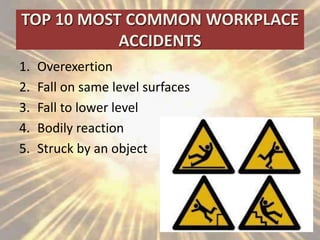
TOP 10 MOST COMMON WORKPLACE
ACCIDENTS
1. Overexertion
2. Fall on same level surfaces
3. Fall to lower level
4. Bodily reaction
5. Struck by an object
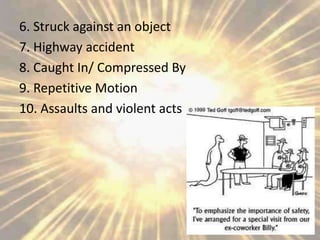
6. Struck against an object
7. Highway accident
8. Caught In/ Compressed By
9. Repetitive Motion
10. Assaults and violent acts
HOW DO WE MEASURE WORK
SAFETY?
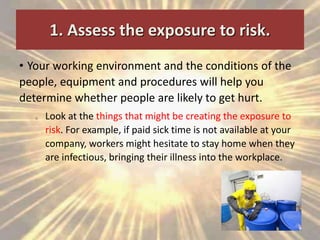
1. Assess the exposure to risk.
• Your working environment and the conditions of the
people, equipment and procedures will help you
determine whether people are likely to get hurt.
o Look at the things that might be creating the exposure to
risk. For example, if paid sick time is not available at your
company, workers might hesitate to stay home when they
are infectious, bringing their illness into the workplace.
2. Evaluate the safety programs you
currently have in place.
• Ensure they are having a positive result.
o Make sure all safety programs and initiatives cover
personal safety as well as procedural safety. For example,
workers who are trained on how to avoid getting a
chemical burn will know how to protect themselves, and
how to keep their process free from the risk of a burn.
o Adjust programs that are not working. If all new employees
are trained on how to safely use a specific piece of
equipment, but incidents are rising on that machine,
something is missing in the safety training.
3. Review your organizational culture to determine whether
safety is a priority.
• Conduct employee surveys to find out if workers feel
safe and offer rewards to departments and teams that
achieve productivity and success without any injuries.
o Evaluate the strength of your team. When workers are
concerned about the safety of others as well as their own
safety, a positive and safe environment is created.

o Encourage workers to look at safety as something not
specific to their own work or department. For example,
anyone should be comfortable pointing out a spill or a leak
or another safety concern.
4. Determine how safety decisions are
made
• For example, staffs might not seem like a safety issue,
but it could become one if workers are getting hurt
because there is not enough help when it comes to
moving heavy items or monitoring a residential
environment.
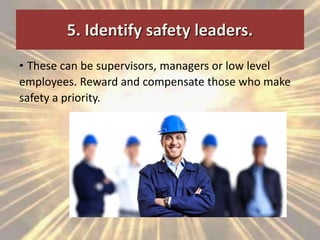
5. Identify safety leaders.
• These can be supervisors, managers or low level
employees. Reward and compensate those who make
safety a priority.
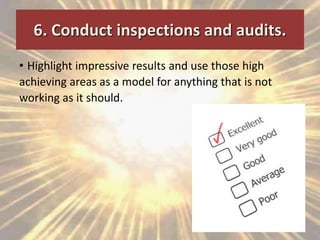
6. Conduct inspections and audits.
• Highlight impressive results and use those high
achieving areas as a model for anything that is not
working as it should.
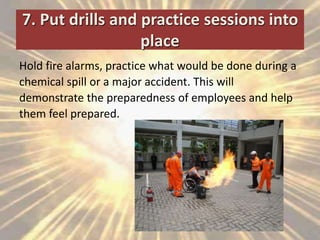
7. Put drills and practice sessions into
place
Hold fire alarms, practice what would be done during a
chemical spill or a major accident. This will
demonstrate the preparedness of employees and help
them feel prepared.
FIRE INDEX
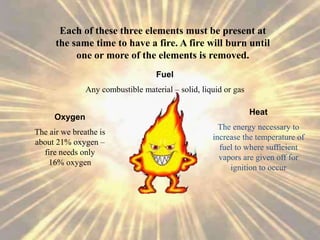
Fuel
Any combustible material – solid, liquid or gas
Oxygen
The air we breathe is
about 21% oxygen –
fire needs only
16% oxygen
Heat
The energy necessary to
increase the temperature of
fuel to where sufficient
vapors are given off for
ignition to occur
Each of these three elements must be present at
the same time to have a fire. A fire will burn until
one or more of the elements is removed.
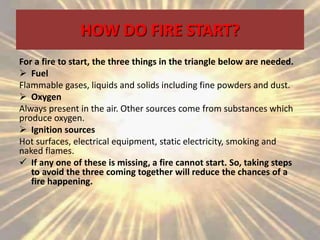
HOW DO FIRE START?
For a fire to start, the three things in the triangle below are needed.
 Fuel
Flammable gases, liquids and solids including fine powders and dust.
 Oxygen
Always present in the air. Other sources come from substances which
produce oxygen.
 Ignition sources
Hot surfaces, electrical equipment, static electricity, smoking and
naked flames.
 If any one of these is missing, a fire cannot start. So, taking steps
to avoid the three coming together will reduce the chances of a
fire happening.
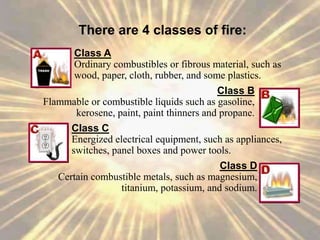
There are 4 classes of fire:
Class A
Ordinary combustibles or fibrous material, such as
wood, paper, cloth, rubber, and some plastics.
Class B
Flammable or combustible liquids such as gasoline,
kerosene, paint, paint thinners and propane.
Class C
Energized electrical equipment, such as appliances,
switches, panel boxes and power tools.
Class D
Certain combustible metals, such as magnesium,
titanium, potassium, and sodium.
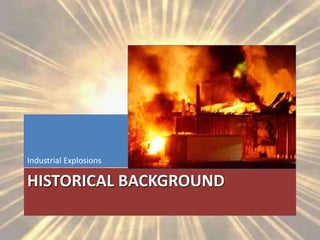
HISTORICAL BACKGROUND
Industrial Explosions
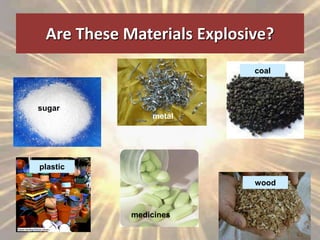
Are These Materials Explosive?
sugar
metal
plastic
wood
coal
medicines
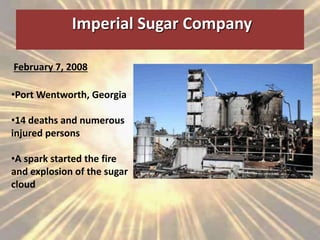
Imperial Sugar Company
February 7, 2008
•Port Wentworth, Georgia
•14 deaths and numerous
injured persons
•A spark started the fire
and explosion of the sugar
cloud
23
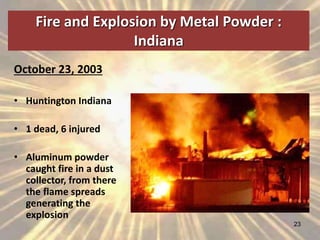
Fire and Explosion by Metal Powder :
Indiana
October 23, 2003
• Huntington Indiana
• 1 dead, 6 injured
• Aluminum powder
caught fire in a dust
collector, from there
the flame spreads
generating the
explosion
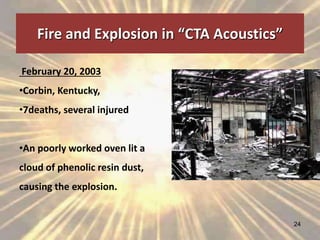
February 20, 2003
•Corbin, Kentucky,
•7deaths, several injured
•An poorly worked oven lit a
cloud of phenolic resin dust,
causing the explosion.
Fire and Explosion in “CTA Acoustics”
24
PREVENTING FIRE AT WORKPLACE
A) Controlling sources of ignition
• remove unnecessary sources of heat from the
workplace.
• Make sure that your machinery and
equipment has been designed to limit the risk
of fire and explosions.
• Make sure that all your electrical equipment is
regularly serviced and fit for the purpose it is
being used.
b) Limiting the fuel for a fire
• Make sure that flammable materials are
handled, stored and used correctly.
• Store flammable substances in their proper
storage containers .
• Do not allow grease, dust or oil to build up
around equipment
c) Detecting and warning about fire
• Detecting any fires
• Consider arrangements for detecting a fire.
• Larger premises may need an electrical alarm
system with manual call points.
d) Escaping a fire
• Once people are aware of a fire, they should
be also to leave the building safely. So the
emergency lighting needs to work completely
to:
• Show the escape routes clearly.
• To allow people to move safely towards the
final exits.
• Make sure that fire call points and firefighting
equipment can be found easily.
e) Fire safety information for
employess
All employees should get information about:
• How to escape route to use from where they
are working
• The fire warning system used in the area they
are working in.
f) Fighting Fires
• All workplaces should have equipment for
putting out fire such as:
• Fire extinguishers to tackle a fire in its early
stage.
• Fire blankets have two type which is light duty
blanket and heavy duty blanket.
• Light duty blanket for small fire and heavy
duty blanket use for molten material.
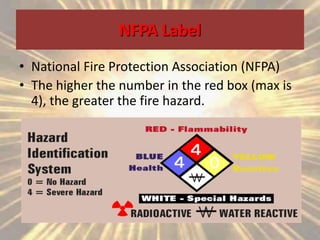
NFPA Label
• National Fire Protection Association (NFPA)
• The higher the number in the red box (max is
4), the greater the fire hazard.
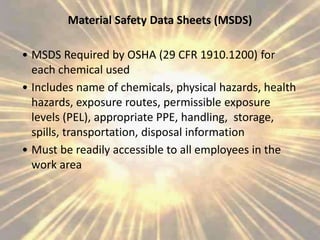
Material Safety Data Sheets (MSDS)
• MSDS Required by OSHA (29 CFR 1910.1200) for
each chemical used
• Includes name of chemicals, physical hazards, health
hazards, exposure routes, permissible exposure
levels (PEL), appropriate PPE, handling, storage,
spills, transportation, disposal information
• Must be readily accessible to all employees in the
work area
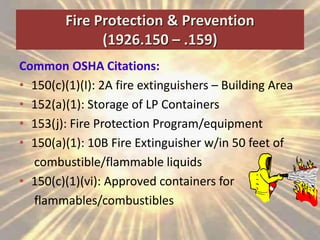
Fire Protection & Prevention
(1926.150 – .159)
Common OSHA Citations:
• 150(c)(1)(I): 2A fire extinguishers – Building Area
• 152(a)(1): Storage of LP Containers
• 153(j): Fire Protection Program/equipment
• 150(a)(1): 10B Fire Extinguisher w/in 50 feet of
combustible/flammable liquids
• 150(c)(1)(vi): Approved containers for
flammables/combustibles
Think Safety, Not Just Compliance!
THANK YOU FOR LENDING US YOUR ATTENTION
References
• Managing fire safety in the workplace. (2008). Retrieved on 20 Mac
2015 from www.healthhandsafetyworksni.gov.uk
• Fire safety. Retrieved on 20 Mac 2015 from
https://dps.mn.gov/divisions/sfm/public-
education/Documents/Presentations/FireSafetyPresentation.ppt
• Risk Associated to combustible dust handling presentation slide.
The Occupational Safety and Health Administration. United States
Department of Labor. Retrieved on 20 Mac 2015 from pages
Occupational Safety and Health Administration. Government
Agency at https://www.osha.gov/dte/grant_materials/fy09/sh-
19480-09/risks_associated_combustible
• Roof Safe. Fire Protection and Prevention presentation slide.
Retrieved on 20 Mac 2015 at
http://www.gnbvt.edu/SkillsUSA/Firesar.ppt

Safety Index and Fire Index

  • 1.
    KAS 3501 OCCUPATIONALSAFETY AND HEALTH SEMESTER 6 2014/2015 GROUP 5 SAFETY INDEX AND FIRE INDEX Group 5 Presentation date: 1st April 2015 GROUP MEMBERS MATRIC NO NAZIRAH BINTI TARMIZI UK29498 KUAN SHI YUN UK29559 NOR’AIN BINTI ISMAIL@AWANG UK29500 SITI HAJAR BINTI MOHD NOR UK29557 RAFIZAL BIN AB RAHIM @ HASSAN UK29318
  • 2.
  • 3.
    WHAT IS WORKPLACESAFETY? Workplace safety is an important aspect to the success of a company. Keeping employees safe from injuries and health problems while on the job not only makes good business sense, it is required by law. The Occupational Safety and Health Administration (OSHA) enforces rules and regulations to keep workplaces safe. There are several ways to measure work safety with the goal of improving it. Measure work safety by examining the risk of exposure, reviewing the programs and initiatives that are in place, considering the climate and culture of the workplace and identifying safety leaders.
  • 4.
    TOP 10 MOSTCOMMON WORKPLACE ACCIDENTS 1. Overexertion 2. Fall on same level surfaces 3. Fall to lower level 4. Bodily reaction 5. Struck by an object
  • 5.
    6. Struck againstan object 7. Highway accident 8. Caught In/ Compressed By 9. Repetitive Motion 10. Assaults and violent acts
  • 8.
    HOW DO WEMEASURE WORK SAFETY?
  • 9.
    1. Assess theexposure to risk. • Your working environment and the conditions of the people, equipment and procedures will help you determine whether people are likely to get hurt. o Look at the things that might be creating the exposure to risk. For example, if paid sick time is not available at your company, workers might hesitate to stay home when they are infectious, bringing their illness into the workplace.
  • 10.
    2. Evaluate thesafety programs you currently have in place. • Ensure they are having a positive result. o Make sure all safety programs and initiatives cover personal safety as well as procedural safety. For example, workers who are trained on how to avoid getting a chemical burn will know how to protect themselves, and how to keep their process free from the risk of a burn. o Adjust programs that are not working. If all new employees are trained on how to safely use a specific piece of equipment, but incidents are rising on that machine, something is missing in the safety training.
  • 11.
    3. Review yourorganizational culture to determine whether safety is a priority. • Conduct employee surveys to find out if workers feel safe and offer rewards to departments and teams that achieve productivity and success without any injuries. o Evaluate the strength of your team. When workers are concerned about the safety of others as well as their own safety, a positive and safe environment is created. o Encourage workers to look at safety as something not specific to their own work or department. For example, anyone should be comfortable pointing out a spill or a leak or another safety concern.
  • 12.
    4. Determine howsafety decisions are made • For example, staffs might not seem like a safety issue, but it could become one if workers are getting hurt because there is not enough help when it comes to moving heavy items or monitoring a residential environment.
  • 13.
    5. Identify safetyleaders. • These can be supervisors, managers or low level employees. Reward and compensate those who make safety a priority.
  • 14.
    6. Conduct inspectionsand audits. • Highlight impressive results and use those high achieving areas as a model for anything that is not working as it should.
  • 15.
    7. Put drillsand practice sessions into place Hold fire alarms, practice what would be done during a chemical spill or a major accident. This will demonstrate the preparedness of employees and help them feel prepared.
  • 16.
  • 17.
    Fuel Any combustible material– solid, liquid or gas Oxygen The air we breathe is about 21% oxygen – fire needs only 16% oxygen Heat The energy necessary to increase the temperature of fuel to where sufficient vapors are given off for ignition to occur Each of these three elements must be present at the same time to have a fire. A fire will burn until one or more of the elements is removed.
  • 18.
    HOW DO FIRESTART? For a fire to start, the three things in the triangle below are needed.  Fuel Flammable gases, liquids and solids including fine powders and dust.  Oxygen Always present in the air. Other sources come from substances which produce oxygen.  Ignition sources Hot surfaces, electrical equipment, static electricity, smoking and naked flames.  If any one of these is missing, a fire cannot start. So, taking steps to avoid the three coming together will reduce the chances of a fire happening.
  • 19.
    There are 4classes of fire: Class A Ordinary combustibles or fibrous material, such as wood, paper, cloth, rubber, and some plastics. Class B Flammable or combustible liquids such as gasoline, kerosene, paint, paint thinners and propane. Class C Energized electrical equipment, such as appliances, switches, panel boxes and power tools. Class D Certain combustible metals, such as magnesium, titanium, potassium, and sodium.
  • 20.
  • 21.
    Are These MaterialsExplosive? sugar metal plastic wood coal medicines
  • 22.
    Imperial Sugar Company February7, 2008 •Port Wentworth, Georgia •14 deaths and numerous injured persons •A spark started the fire and explosion of the sugar cloud
  • 23.
    23 Fire and Explosionby Metal Powder : Indiana October 23, 2003 • Huntington Indiana • 1 dead, 6 injured • Aluminum powder caught fire in a dust collector, from there the flame spreads generating the explosion
  • 24.
    February 20, 2003 •Corbin,Kentucky, •7deaths, several injured •An poorly worked oven lit a cloud of phenolic resin dust, causing the explosion. Fire and Explosion in “CTA Acoustics” 24
  • 25.
  • 26.
    A) Controlling sourcesof ignition • remove unnecessary sources of heat from the workplace. • Make sure that your machinery and equipment has been designed to limit the risk of fire and explosions. • Make sure that all your electrical equipment is regularly serviced and fit for the purpose it is being used.
  • 27.
    b) Limiting thefuel for a fire • Make sure that flammable materials are handled, stored and used correctly. • Store flammable substances in their proper storage containers . • Do not allow grease, dust or oil to build up around equipment
  • 28.
    c) Detecting andwarning about fire • Detecting any fires • Consider arrangements for detecting a fire. • Larger premises may need an electrical alarm system with manual call points.
  • 29.
    d) Escaping afire • Once people are aware of a fire, they should be also to leave the building safely. So the emergency lighting needs to work completely to: • Show the escape routes clearly. • To allow people to move safely towards the final exits. • Make sure that fire call points and firefighting equipment can be found easily.
  • 30.
    e) Fire safetyinformation for employess All employees should get information about: • How to escape route to use from where they are working • The fire warning system used in the area they are working in.
  • 31.
    f) Fighting Fires •All workplaces should have equipment for putting out fire such as: • Fire extinguishers to tackle a fire in its early stage. • Fire blankets have two type which is light duty blanket and heavy duty blanket. • Light duty blanket for small fire and heavy duty blanket use for molten material.
  • 32.
    NFPA Label • NationalFire Protection Association (NFPA) • The higher the number in the red box (max is 4), the greater the fire hazard.
  • 33.
    Material Safety DataSheets (MSDS) • MSDS Required by OSHA (29 CFR 1910.1200) for each chemical used • Includes name of chemicals, physical hazards, health hazards, exposure routes, permissible exposure levels (PEL), appropriate PPE, handling, storage, spills, transportation, disposal information • Must be readily accessible to all employees in the work area
  • 34.
    Fire Protection &Prevention (1926.150 – .159) Common OSHA Citations: • 150(c)(1)(I): 2A fire extinguishers – Building Area • 152(a)(1): Storage of LP Containers • 153(j): Fire Protection Program/equipment • 150(a)(1): 10B Fire Extinguisher w/in 50 feet of combustible/flammable liquids • 150(c)(1)(vi): Approved containers for flammables/combustibles
  • 37.
    Think Safety, NotJust Compliance! THANK YOU FOR LENDING US YOUR ATTENTION
  • 38.
    References • Managing firesafety in the workplace. (2008). Retrieved on 20 Mac 2015 from www.healthhandsafetyworksni.gov.uk • Fire safety. Retrieved on 20 Mac 2015 from https://dps.mn.gov/divisions/sfm/public- education/Documents/Presentations/FireSafetyPresentation.ppt • Risk Associated to combustible dust handling presentation slide. The Occupational Safety and Health Administration. United States Department of Labor. Retrieved on 20 Mac 2015 from pages Occupational Safety and Health Administration. Government Agency at https://www.osha.gov/dte/grant_materials/fy09/sh- 19480-09/risks_associated_combustible • Roof Safe. Fire Protection and Prevention presentation slide. Retrieved on 20 Mac 2015 at http://www.gnbvt.edu/SkillsUSA/Firesar.ppt