FIRE HAZARDS
ALWAYS FIRST ALWAYS READY ALWAYS THERE
WHAT IS FIRE?
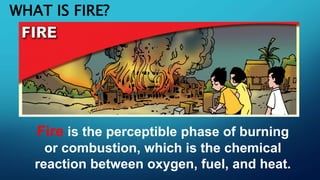
Fire is the perceptible phase of burning
or combustion, which is the chemical
reaction between oxygen, fuel, and heat.
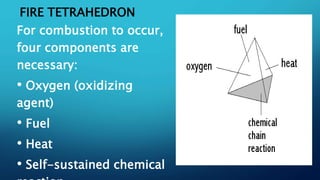
FIRE TETRAHEDRON
For combustion to occur,
four components are
necessary:
• Oxygen (oxidizing
agent)
• Fuel
• Heat
• Self-sustained chemical
ELEMENTS OF FIRE
•Oxygen or Oxidizing agents are those materials that
yield oxygen or other oxidizing gases during the course
of a chemical reaction.
•Fuel is the material or substance being oxidized or
burned in the combustion process.
•Heat is the energy component of the fire tetrahedron.
When heat comes into contact with a fuel, the energy
supports the combustion reaction.
•Combustion is a complex reaction that requires a fuel (in
the gaseous or vapor state), an oxidizer, and a heat
FIRE EXTINGUISHMENT THEORY
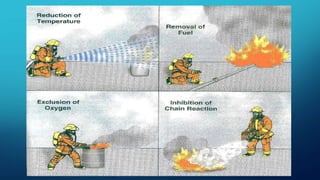
Fire is extinguished by limiting or interrupting one or
more of the essential elements in the combustion process
(fire tetrahedron). A fire may be extinguished by:
* Reducing its Temperature (Cooling)
* Removal of available Fuel (Starving)
* Exclusion of Oxygen (Blanketing)
* Inhibition of Self-Sustained Chemical
Chain Reaction. (Inhibition)
STAGES OF FIRE
•Ignition. Describes the period when the four
elements of the fire tetrahedron come
together and combustion begins
•Growth. Shortly after ignition, a fire plume
begins to form above the burning fuel. As
the plume develops, it begins to draw or
entrain air from the surrounding space into
the column
STAGES OF FIRE CONTINUED. . .
•Flashover. Is the transition between the growth
and the fully developed fire stages and is not a
specific event such as ignition.
•Fully developed Stage. Occurs when all
combustible materials in the compartment are
involved in the fire.
•Decay. As the fire consumes the available fuel
in the compartment, the rate of heat released
WILDFIRES
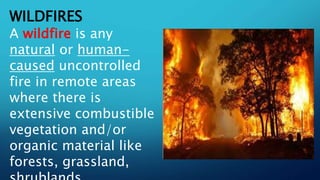
A wildfire is any
natural or human-
caused uncontrolled
fire in remote areas
where there is
extensive combustible
vegetation and/or
organic material like
forests, grassland,
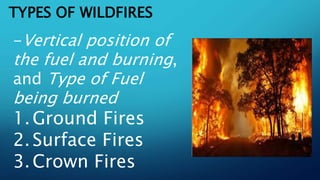
TYPES OF WILDFIRES
-Vertical position of
the fuel and burning,
and Type of Fuel
being burned
1.Ground Fires
2.Surface Fires
3.Crown Fires
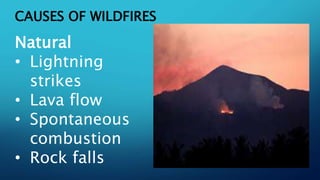
CAUSES OF WILDFIRES
Natural
• Lightning
strikes
• Lava flow
• Spontaneous
combustion
• Rock falls
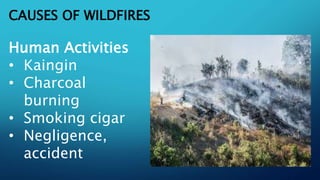
CAUSES OF WILDFIRES
Human Activities
• Kaingin
• Charcoal
burning
• Smoking cigar
• Negligence,
accident
CONTROLLING AND PREVENTING WILDFIRES
• Well-maintained forests
• Sanitation or removal of dead/dried-up/sick
trees
• Thinning or removal of dead or dying trees
• Pruning or removal of lower branches
• Firebreaks to reduce amount of flammable
matter
• Community participation in fire prevention
• Infrastructures like access roads, water supply
facilities, watchtowers

7 Module VII Fire Hazards1.pptx

  • 1.
    FIRE HAZARDS ALWAYS FIRSTALWAYS READY ALWAYS THERE
  • 2.
    WHAT IS FIRE? Fireis the perceptible phase of burning or combustion, which is the chemical reaction between oxygen, fuel, and heat.
  • 3.
    FIRE TETRAHEDRON For combustionto occur, four components are necessary: • Oxygen (oxidizing agent) • Fuel • Heat • Self-sustained chemical
  • 4.
    ELEMENTS OF FIRE •Oxygenor Oxidizing agents are those materials that yield oxygen or other oxidizing gases during the course of a chemical reaction. •Fuel is the material or substance being oxidized or burned in the combustion process. •Heat is the energy component of the fire tetrahedron. When heat comes into contact with a fuel, the energy supports the combustion reaction. •Combustion is a complex reaction that requires a fuel (in the gaseous or vapor state), an oxidizer, and a heat
  • 5.
    FIRE EXTINGUISHMENT THEORY Fireis extinguished by limiting or interrupting one or more of the essential elements in the combustion process (fire tetrahedron). A fire may be extinguished by: * Reducing its Temperature (Cooling) * Removal of available Fuel (Starving) * Exclusion of Oxygen (Blanketing) * Inhibition of Self-Sustained Chemical Chain Reaction. (Inhibition)
  • 7.
    STAGES OF FIRE •Ignition.Describes the period when the four elements of the fire tetrahedron come together and combustion begins •Growth. Shortly after ignition, a fire plume begins to form above the burning fuel. As the plume develops, it begins to draw or entrain air from the surrounding space into the column
  • 8.
    STAGES OF FIRECONTINUED. . . •Flashover. Is the transition between the growth and the fully developed fire stages and is not a specific event such as ignition. •Fully developed Stage. Occurs when all combustible materials in the compartment are involved in the fire. •Decay. As the fire consumes the available fuel in the compartment, the rate of heat released
  • 9.
    WILDFIRES A wildfire isany natural or human- caused uncontrolled fire in remote areas where there is extensive combustible vegetation and/or organic material like forests, grassland,
  • 10.
    TYPES OF WILDFIRES -Verticalposition of the fuel and burning, and Type of Fuel being burned 1.Ground Fires 2.Surface Fires 3.Crown Fires
  • 11.
    CAUSES OF WILDFIRES Natural •Lightning strikes • Lava flow • Spontaneous combustion • Rock falls
  • 12.
    CAUSES OF WILDFIRES HumanActivities • Kaingin • Charcoal burning • Smoking cigar • Negligence, accident
  • 13.
    CONTROLLING AND PREVENTINGWILDFIRES • Well-maintained forests • Sanitation or removal of dead/dried-up/sick trees • Thinning or removal of dead or dying trees • Pruning or removal of lower branches • Firebreaks to reduce amount of flammable matter • Community participation in fire prevention • Infrastructures like access roads, water supply facilities, watchtowers