1
29 CFR
1910.146
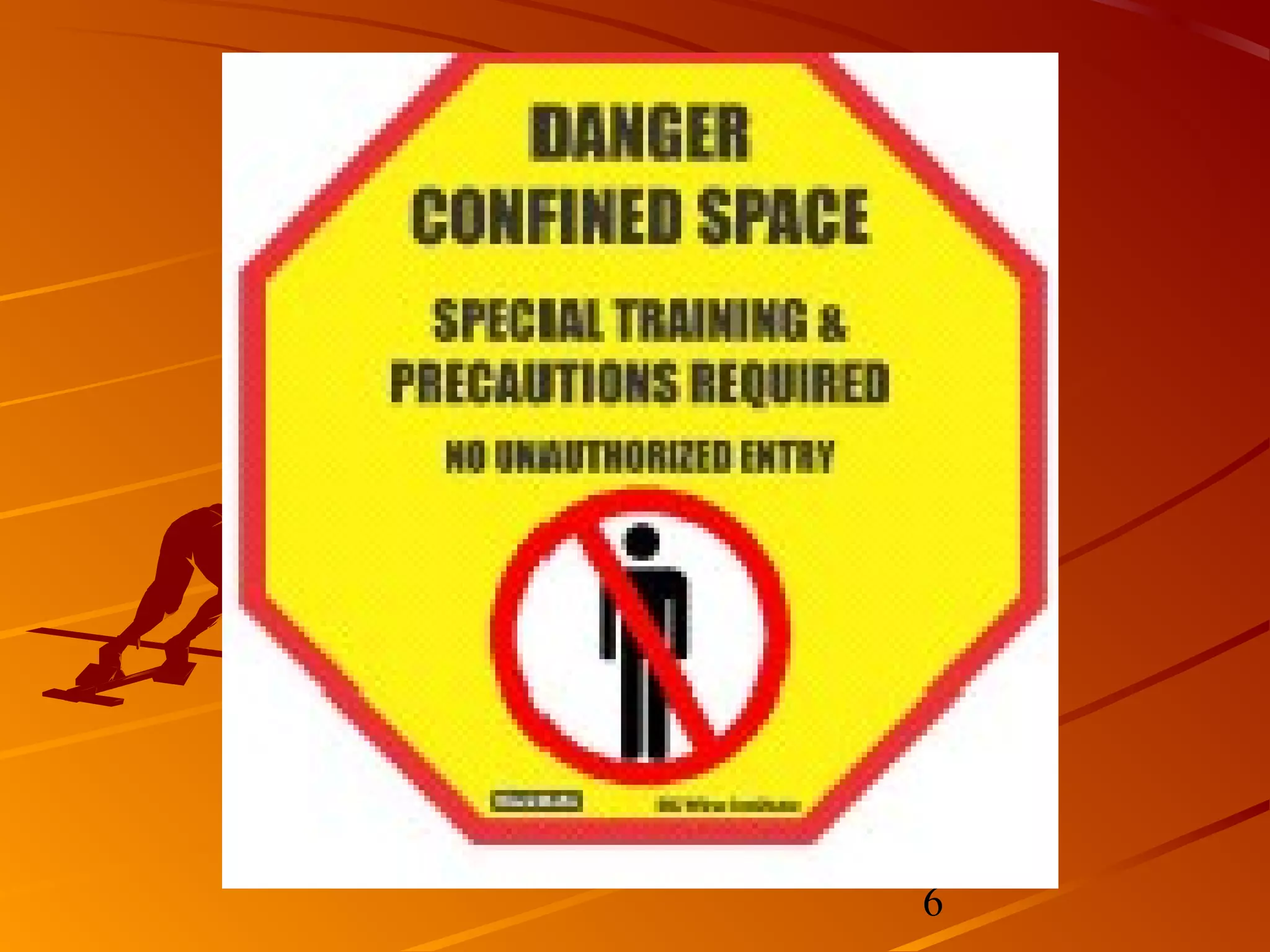
  CONFINED
   SPACE
   ENTRY
3
4
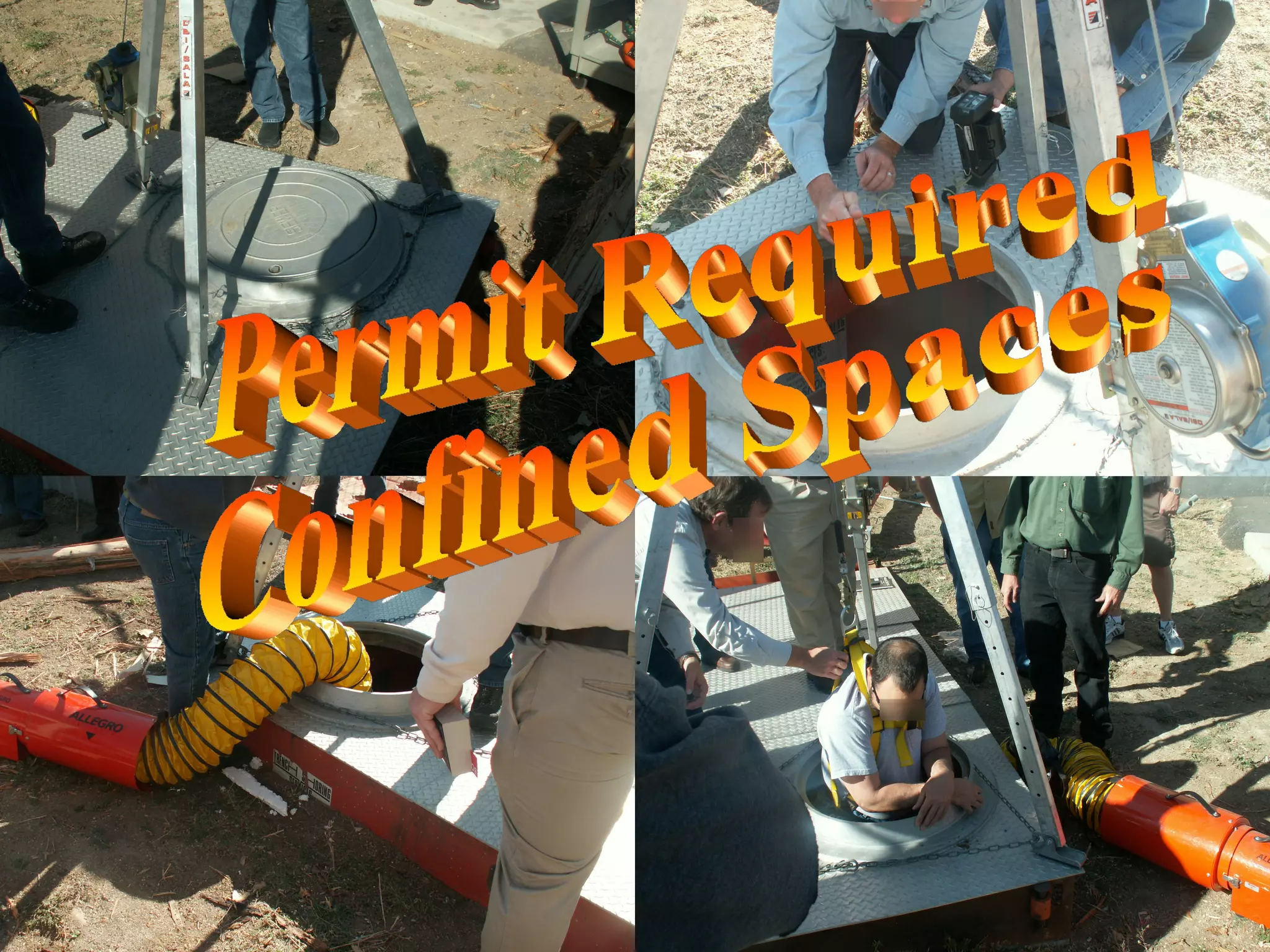
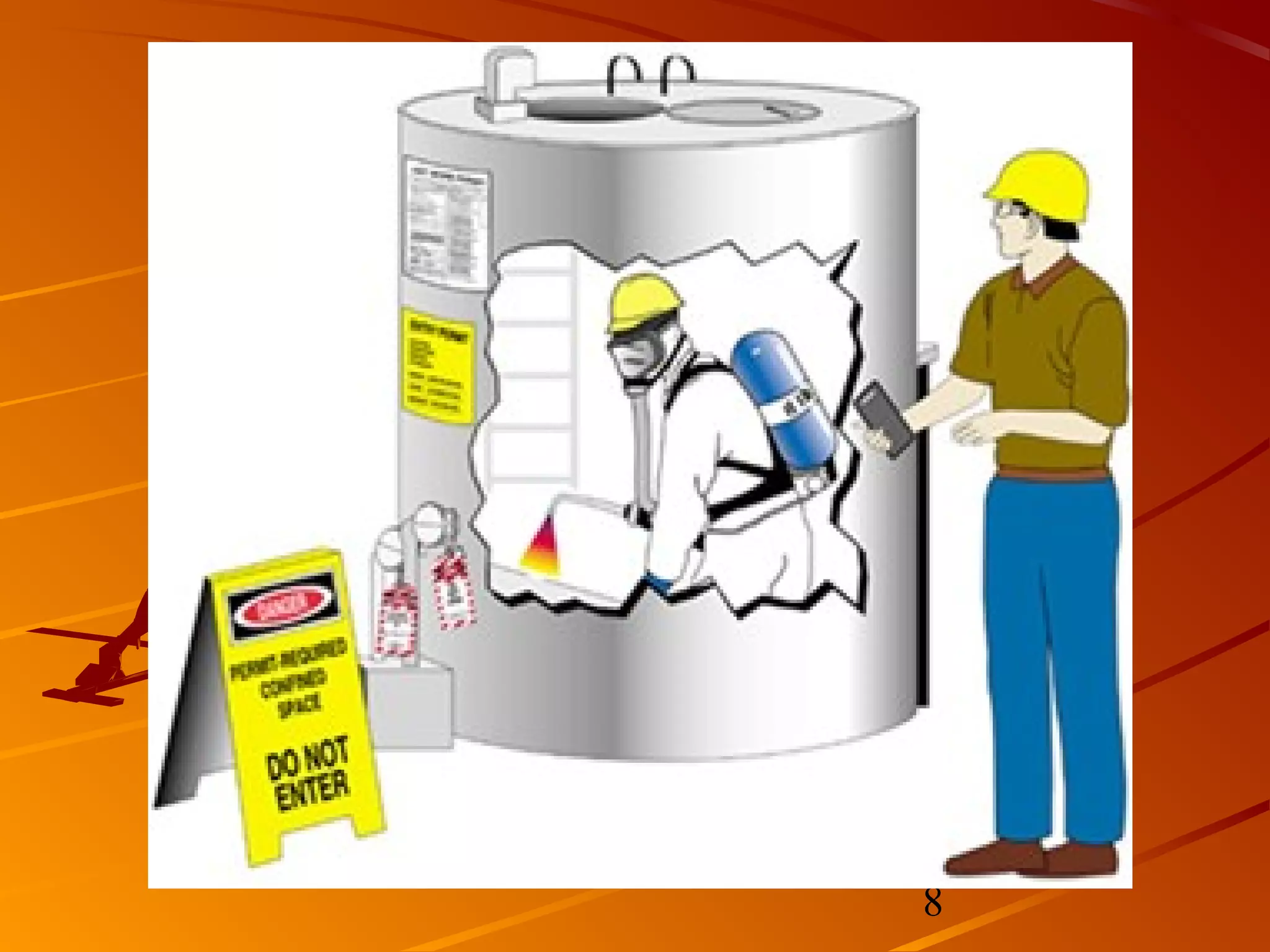
Permit-Required Confined
       Space Entry


                   5
6
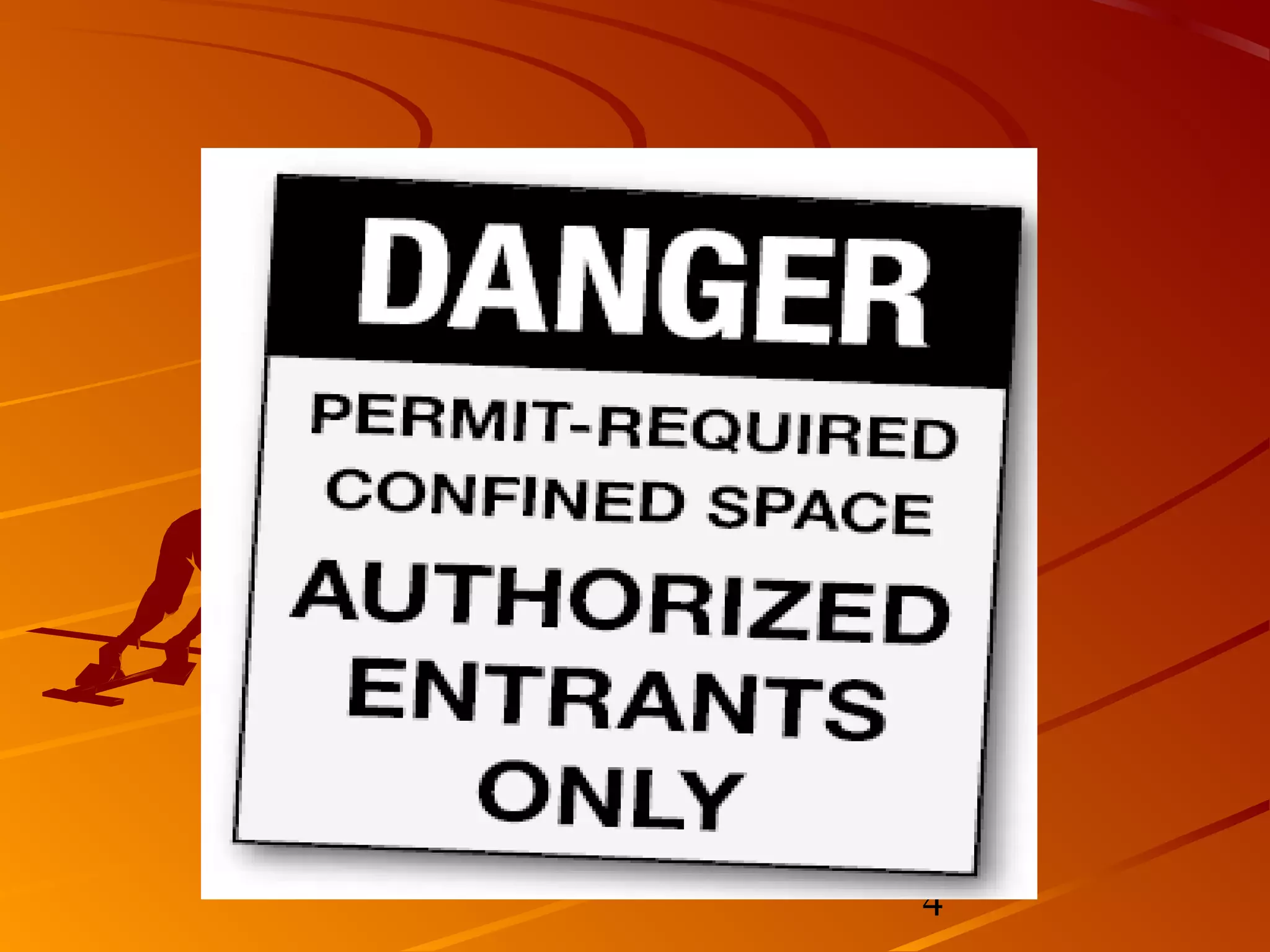
DO NOT ENTER
UNLESS AUTHORIZED
   AND TRAINED
             7
8
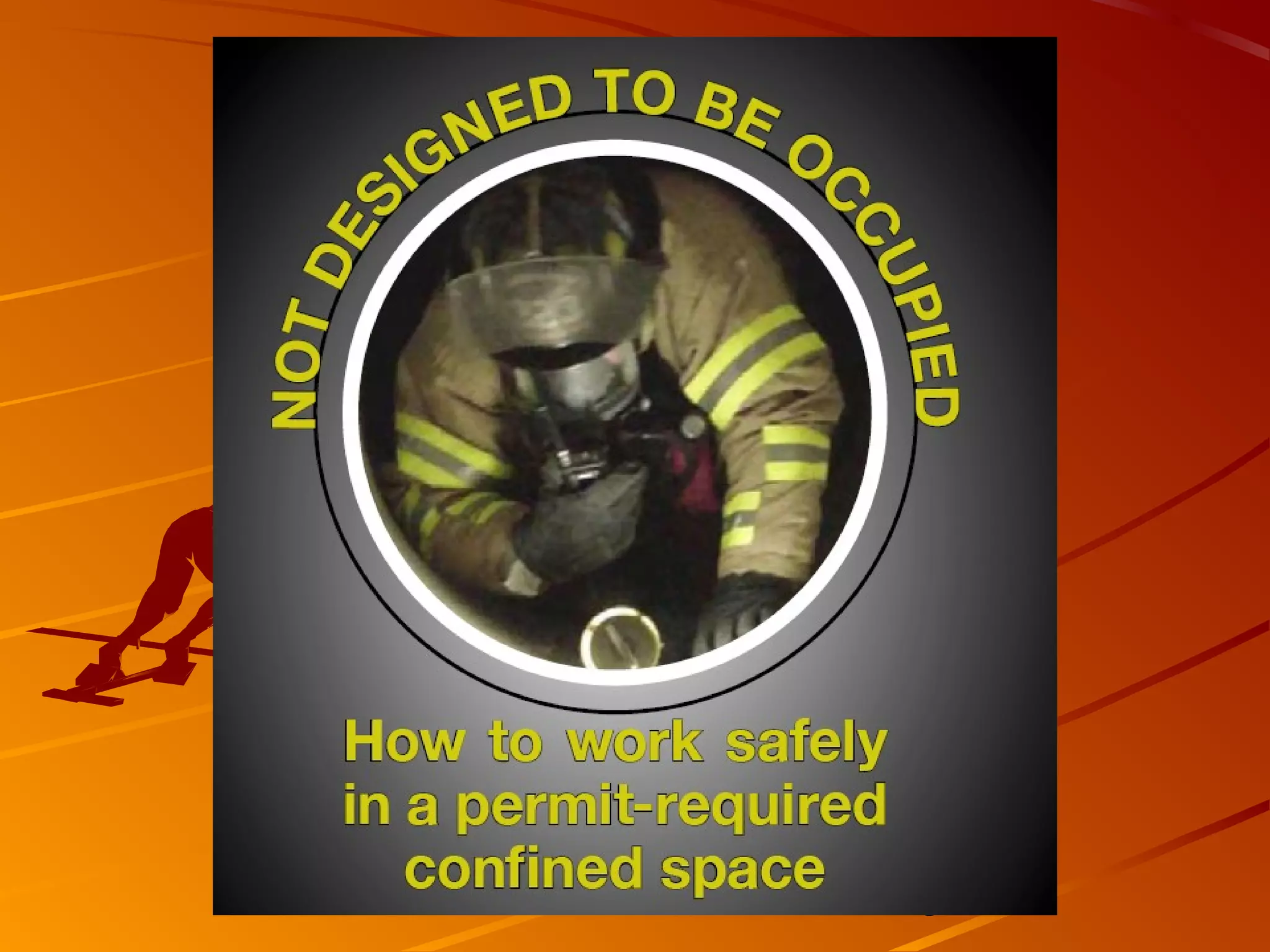
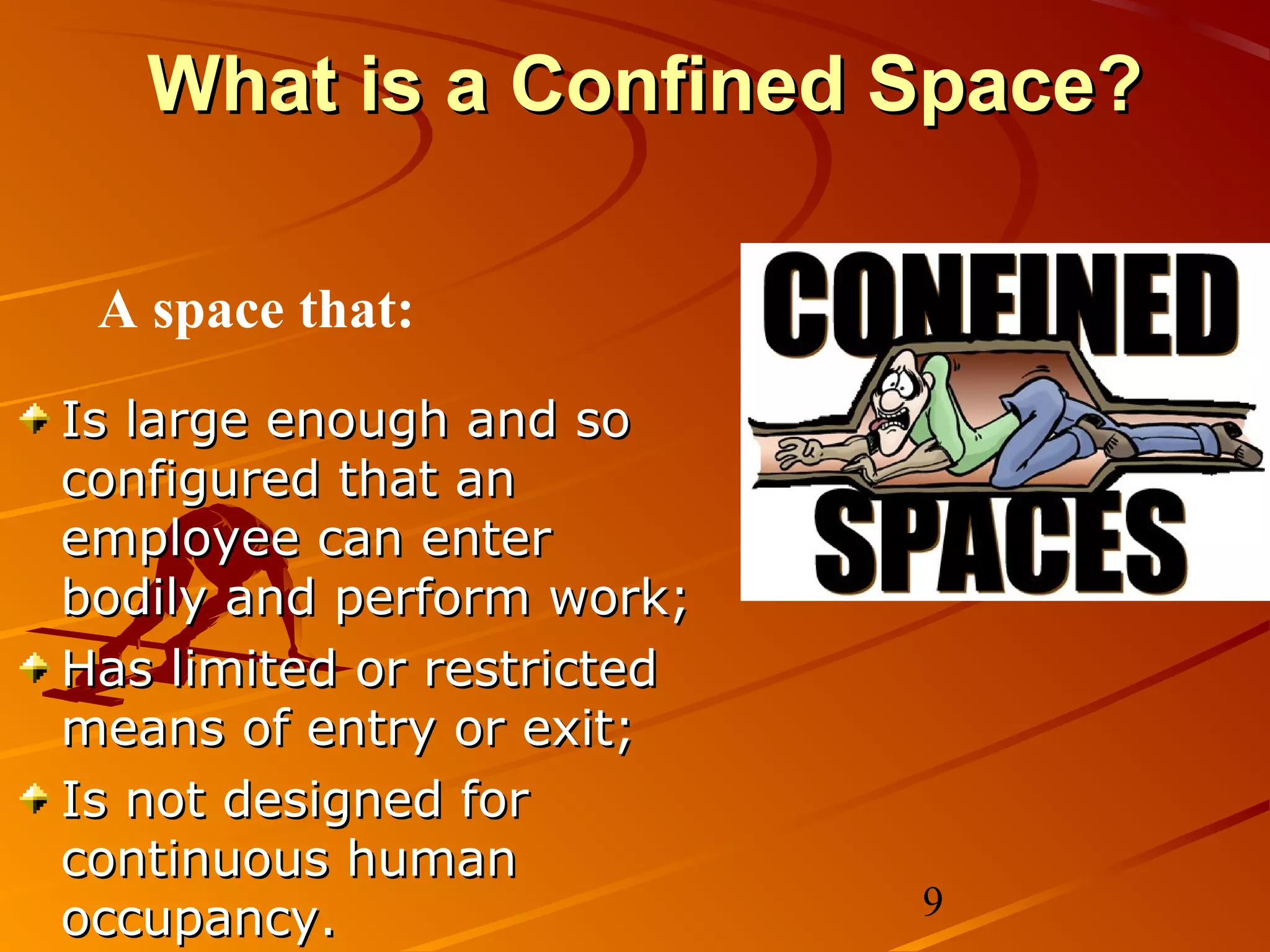
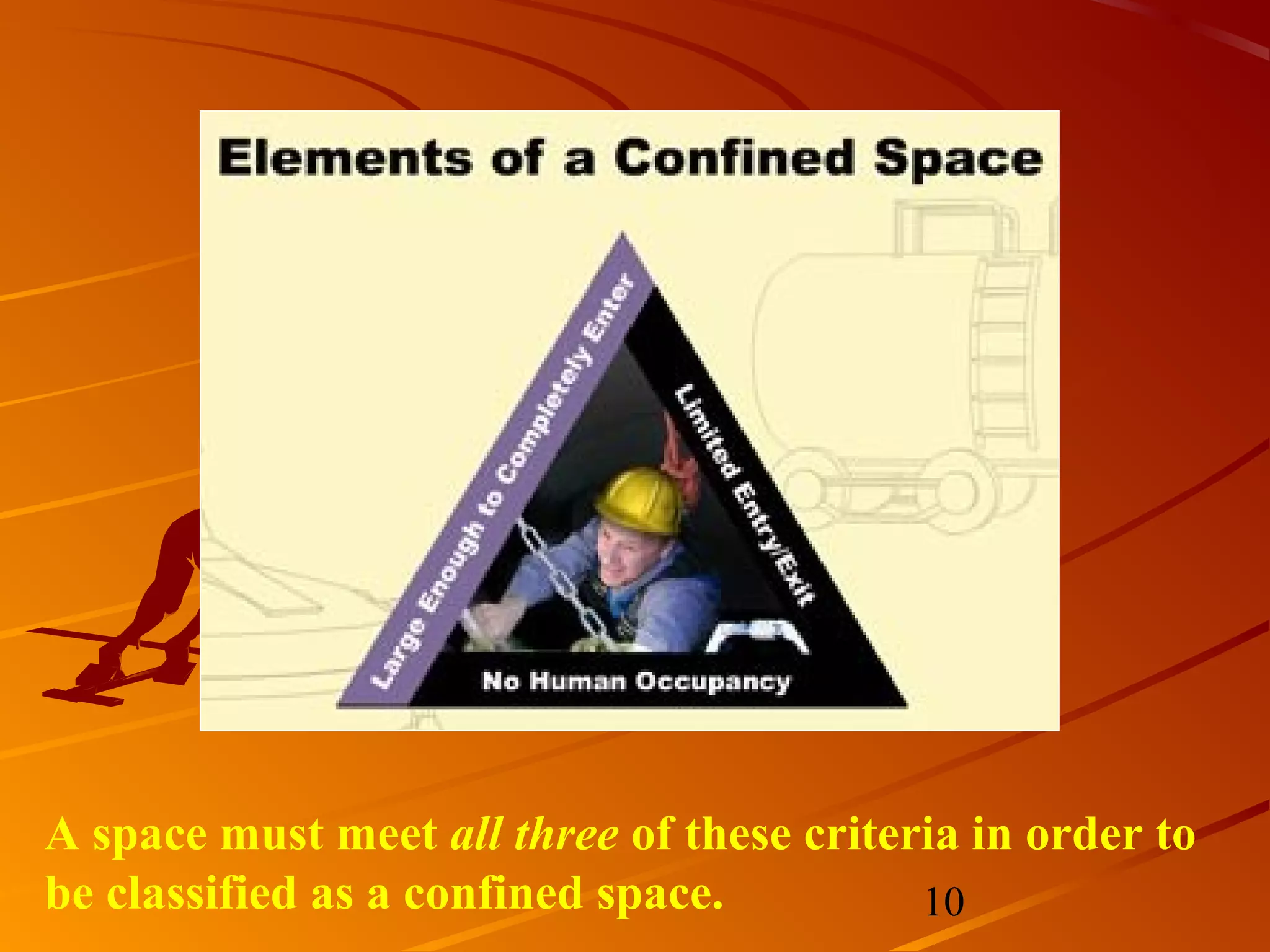
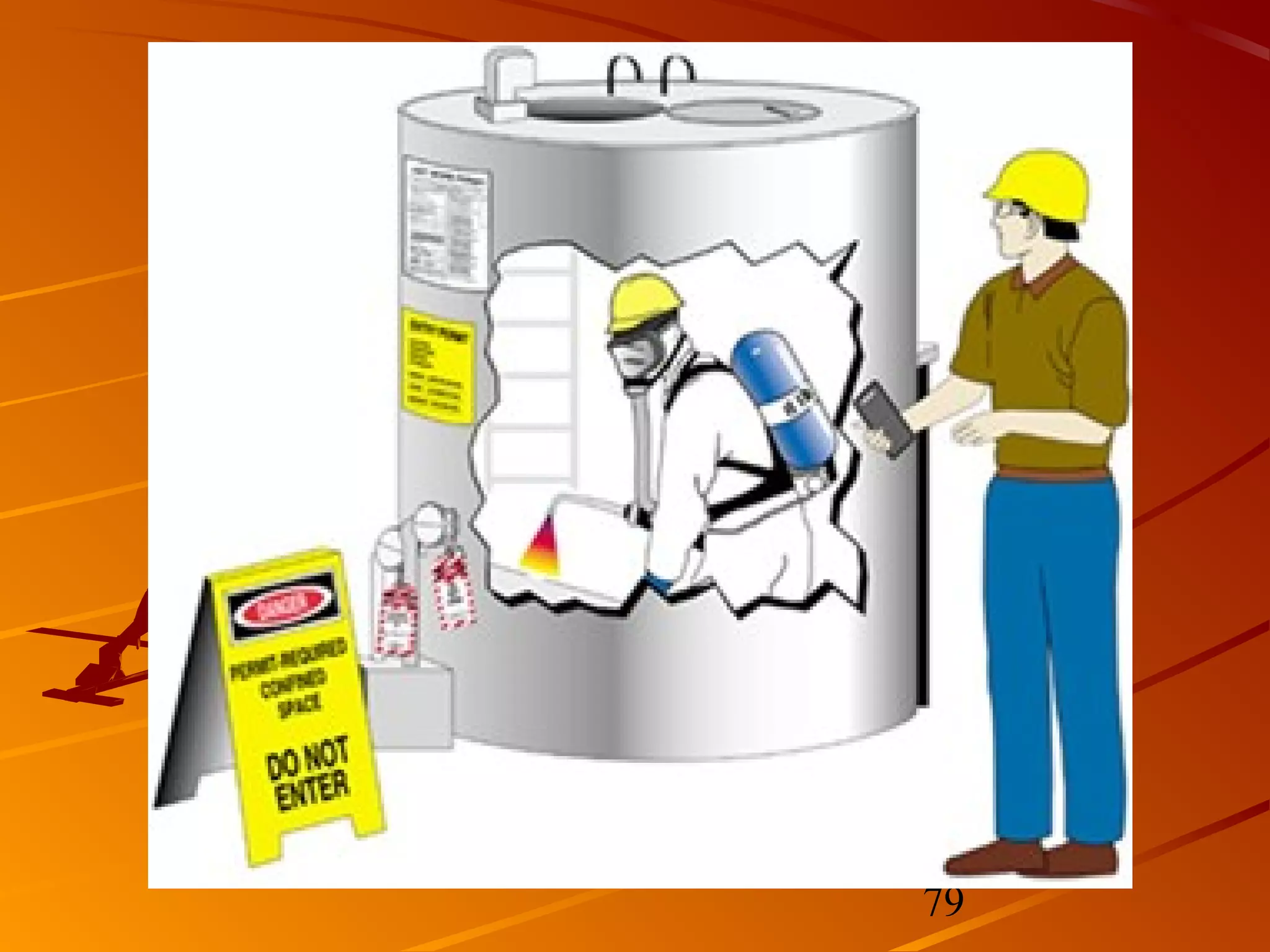
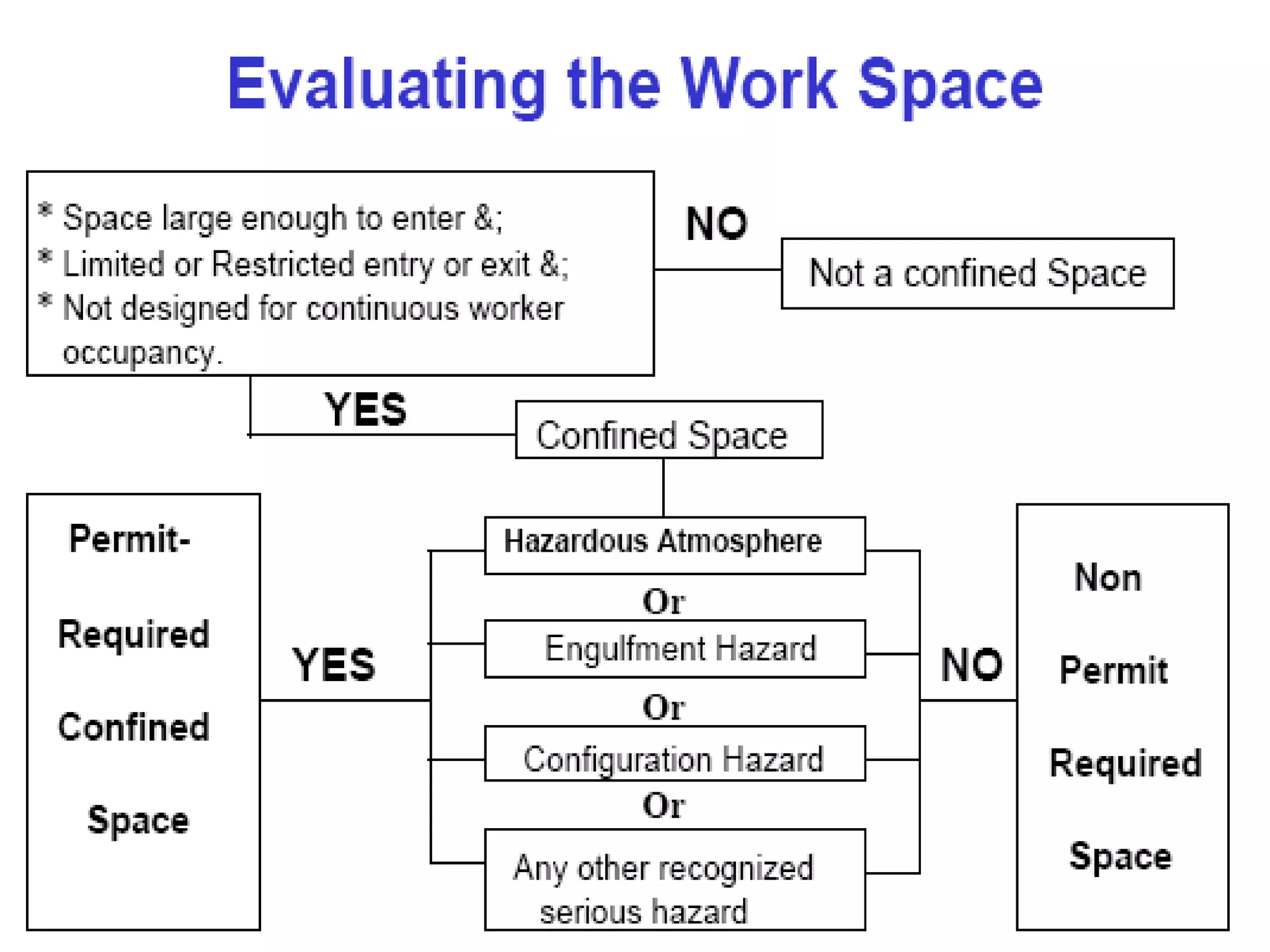
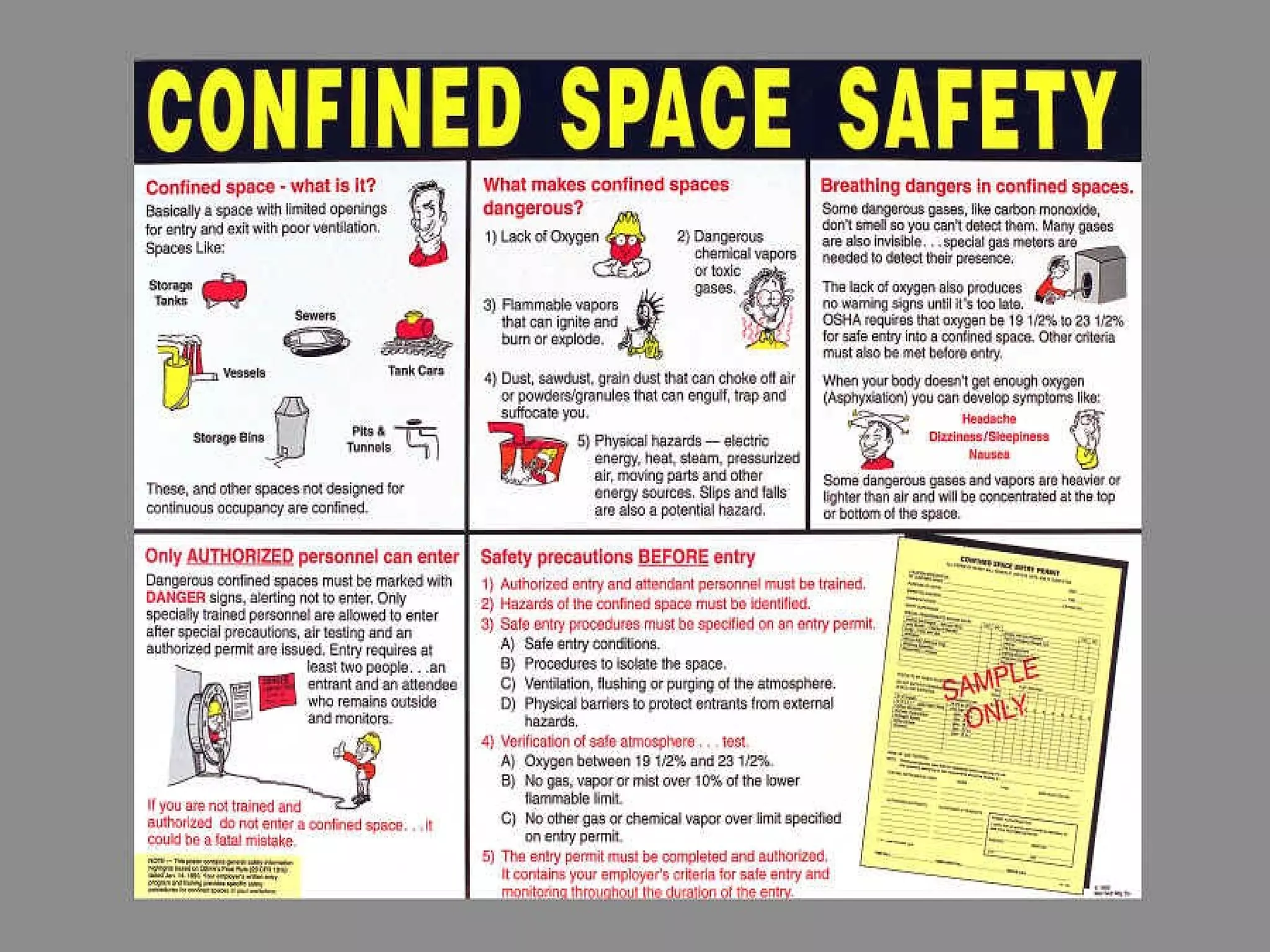
What is a Confined Space?

 A space that:
Is large enough and so
configured that an
employee can enter
bodily and perform work;
Has limited or restricted
means of entry or exit;
Is not designed for
continuous human
occupancy.                  9
A space must meet all three of these criteria in order to
be classified as a confined space.         10
Examples of Confined
        Spaces:
Tanks         Vaults
Manholes      Pipes
Boilers       Trenches
Furnaces      Tunnels
Sewers        Ducts
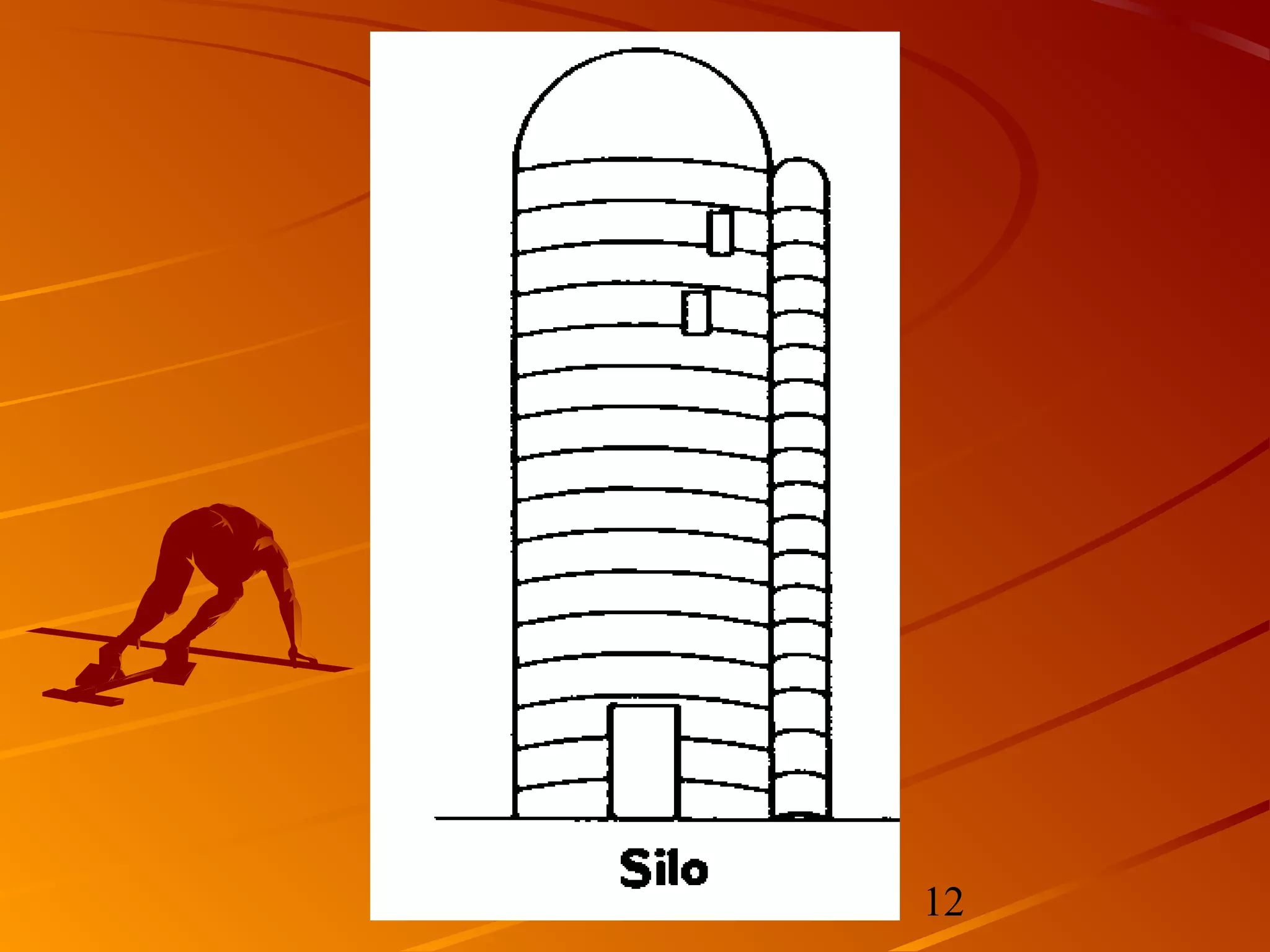
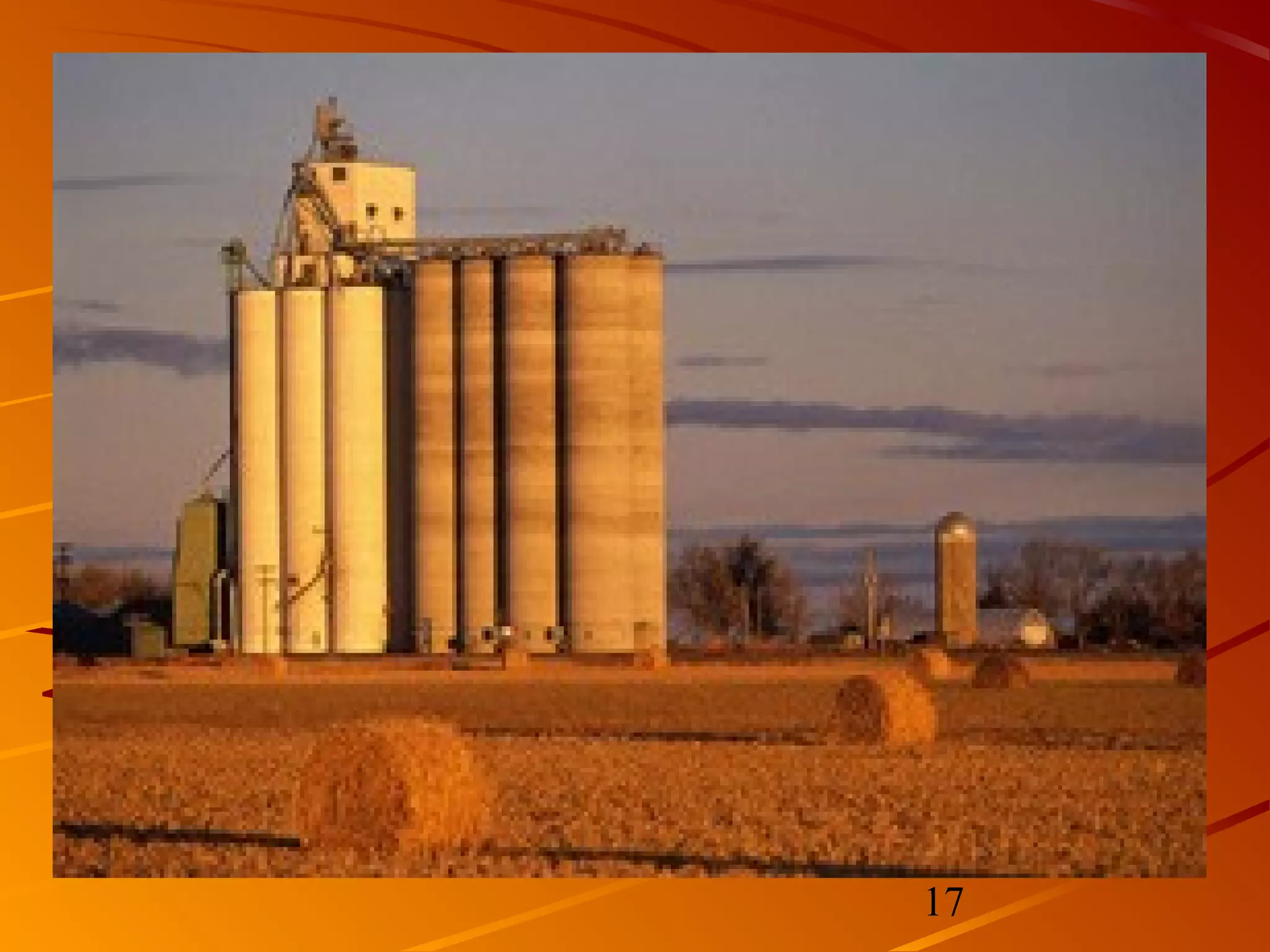
Silos         Bins
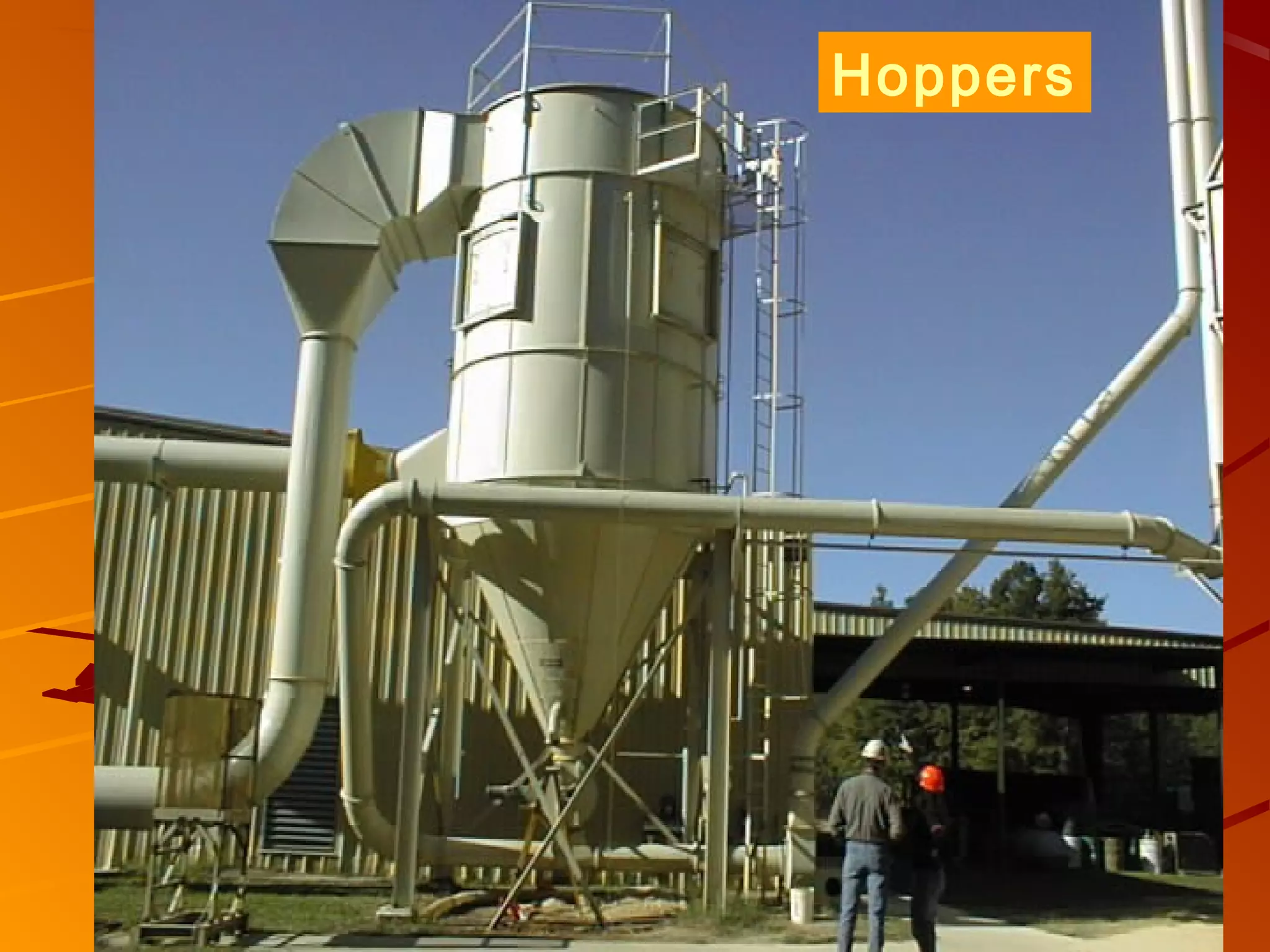
Hoppers       Pits


                    11
12
Hoppers


  13
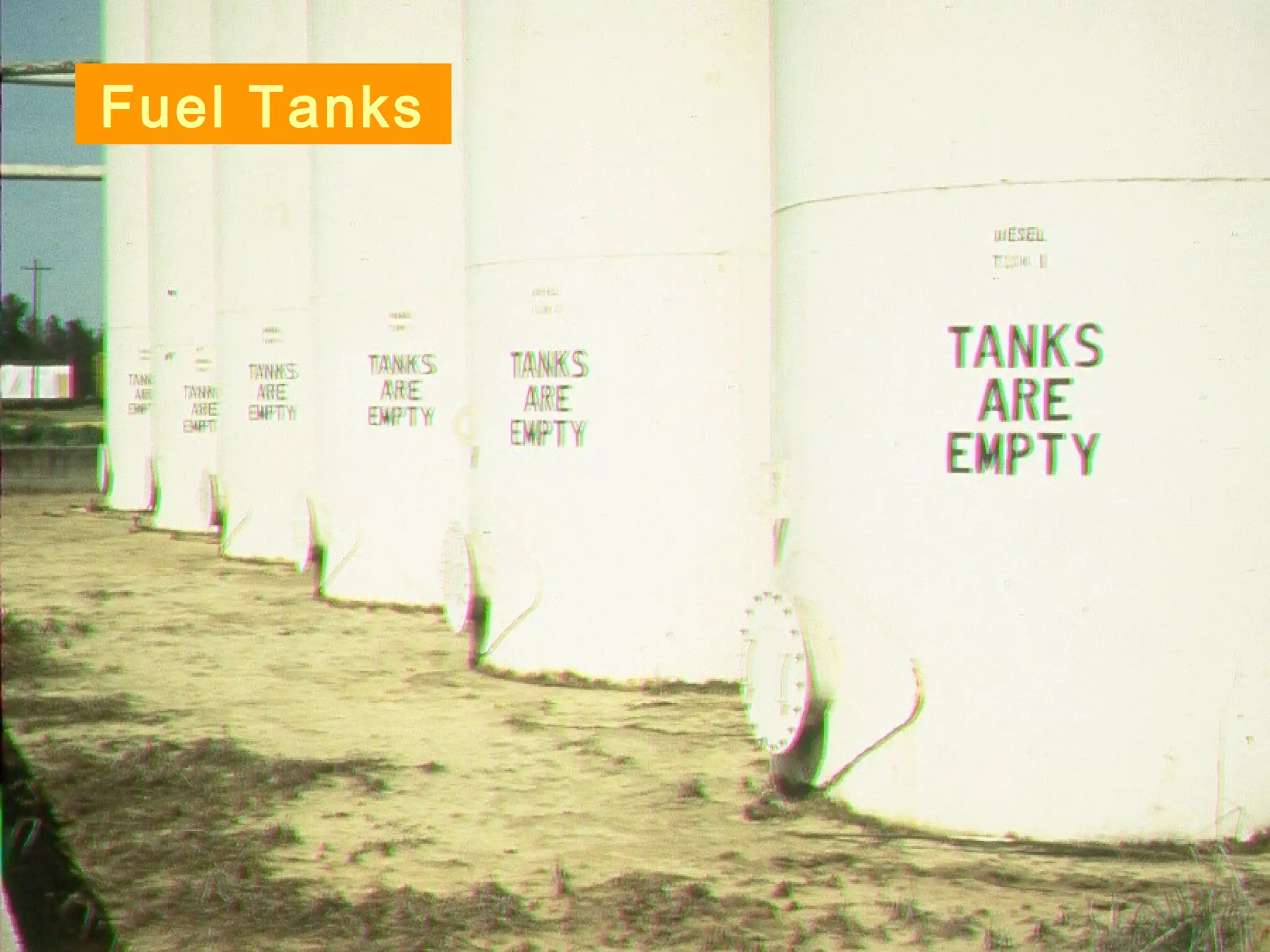
Fuel Tanks


             14
Process
 Tanks


          15
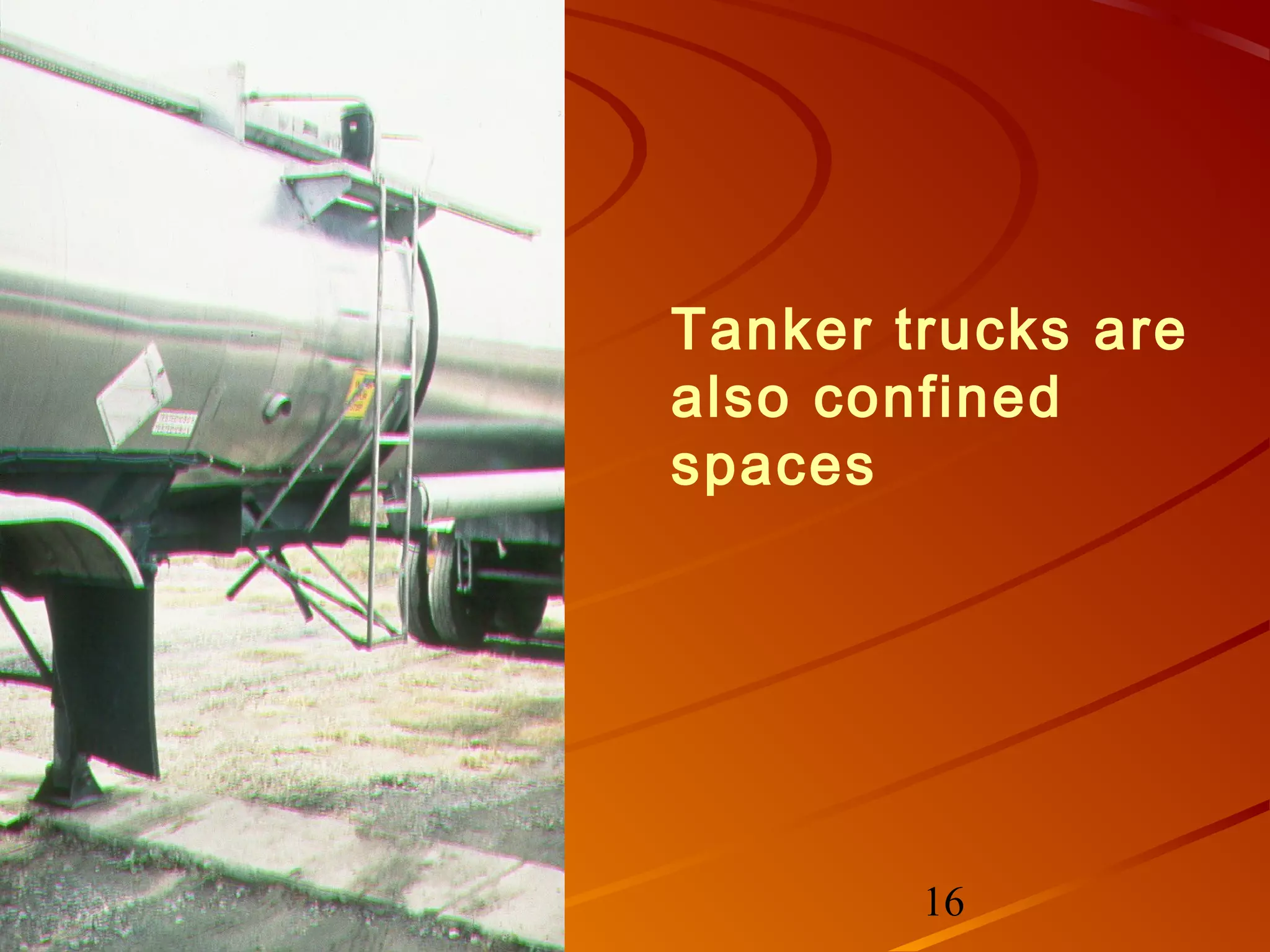
Tanker trucks are
also confined
spaces


        16
17
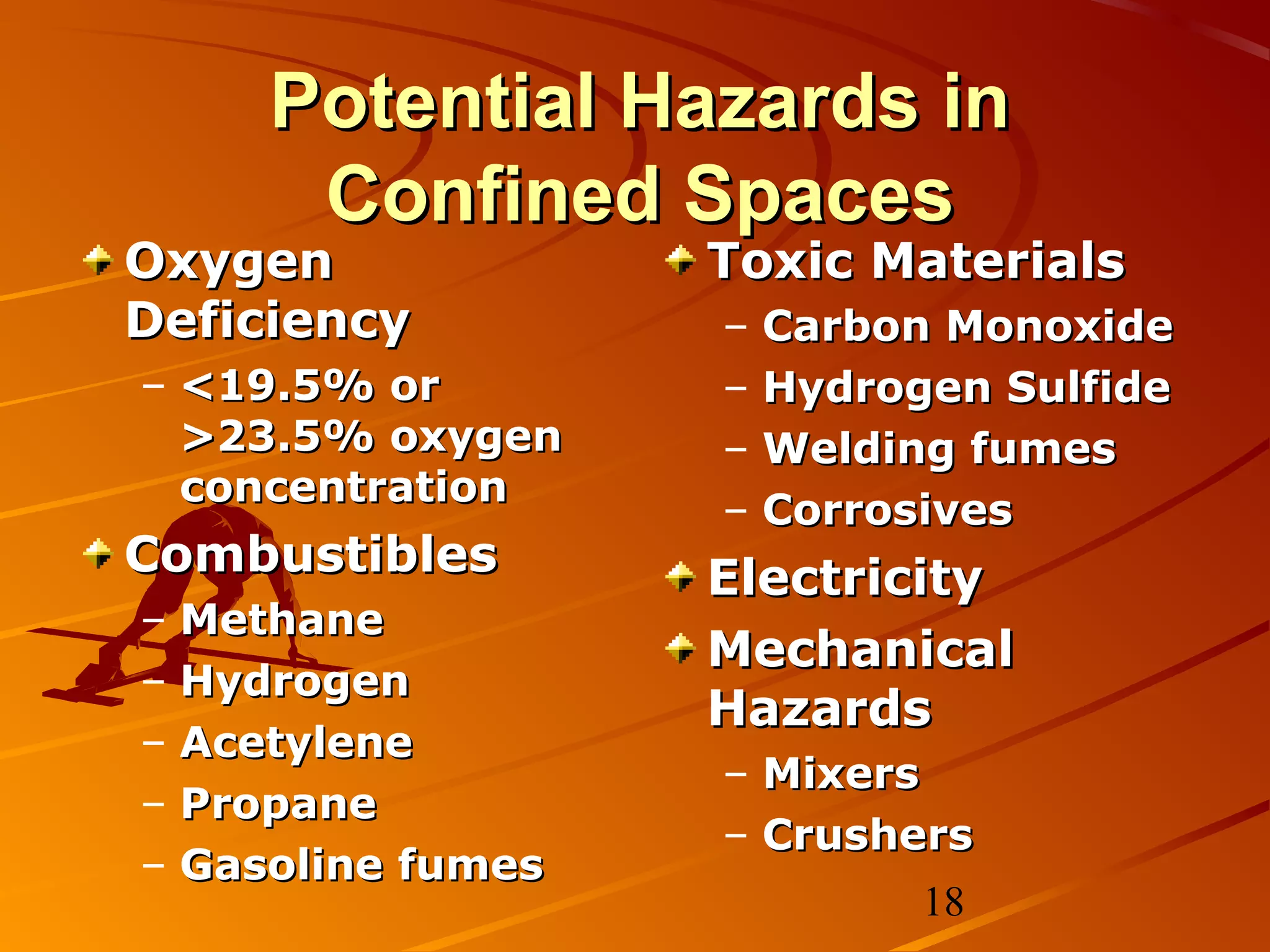
Potential Hazards in
      Confined Spaces
Oxygen             Toxic Materials
Deficiency         –   Carbon Monoxide
– <19.5% or        –   Hydrogen Sulfide
  >23.5% oxygen    –   Welding fumes
  concentration
                   –   Corrosives
Combustibles       Electricity
– Methane
                   Mechanical
– Hydrogen
                   Hazards
– Acetylene
                   – Mixers
– Propane
                   – Crushers
– Gasoline fumes
                             18
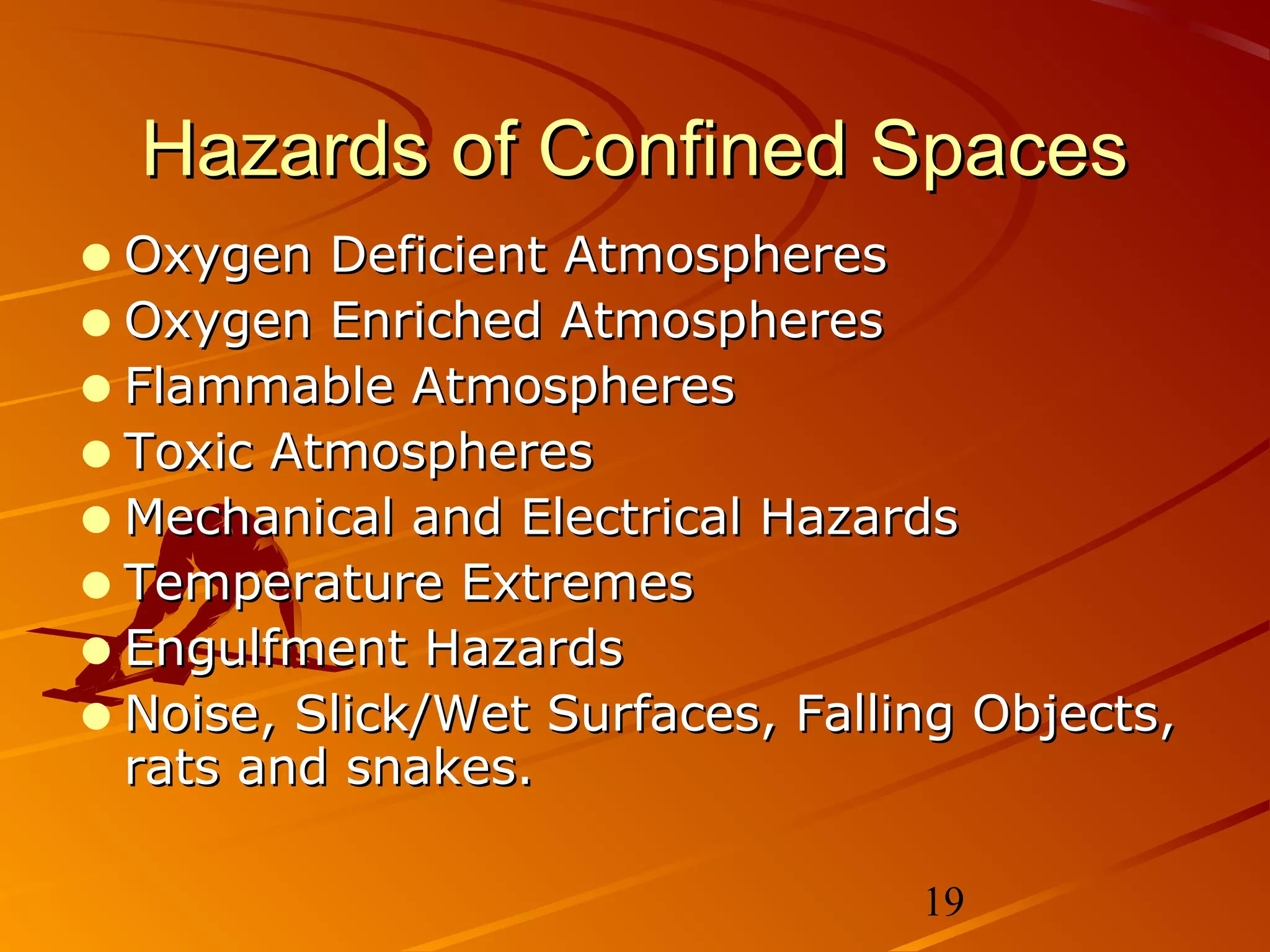
Hazards of Confined Spaces
• Oxygen Deficient Atmospheres
• Oxygen Enriched Atmospheres
• Flammable Atmospheres
• Toxic Atmospheres
• Mechanical and Electrical Hazards
• Temperature Extremes
• Engulfment Hazards
• Noise, Slick/Wet Surfaces, Falling Objects,
 rats and snakes.

                                  19
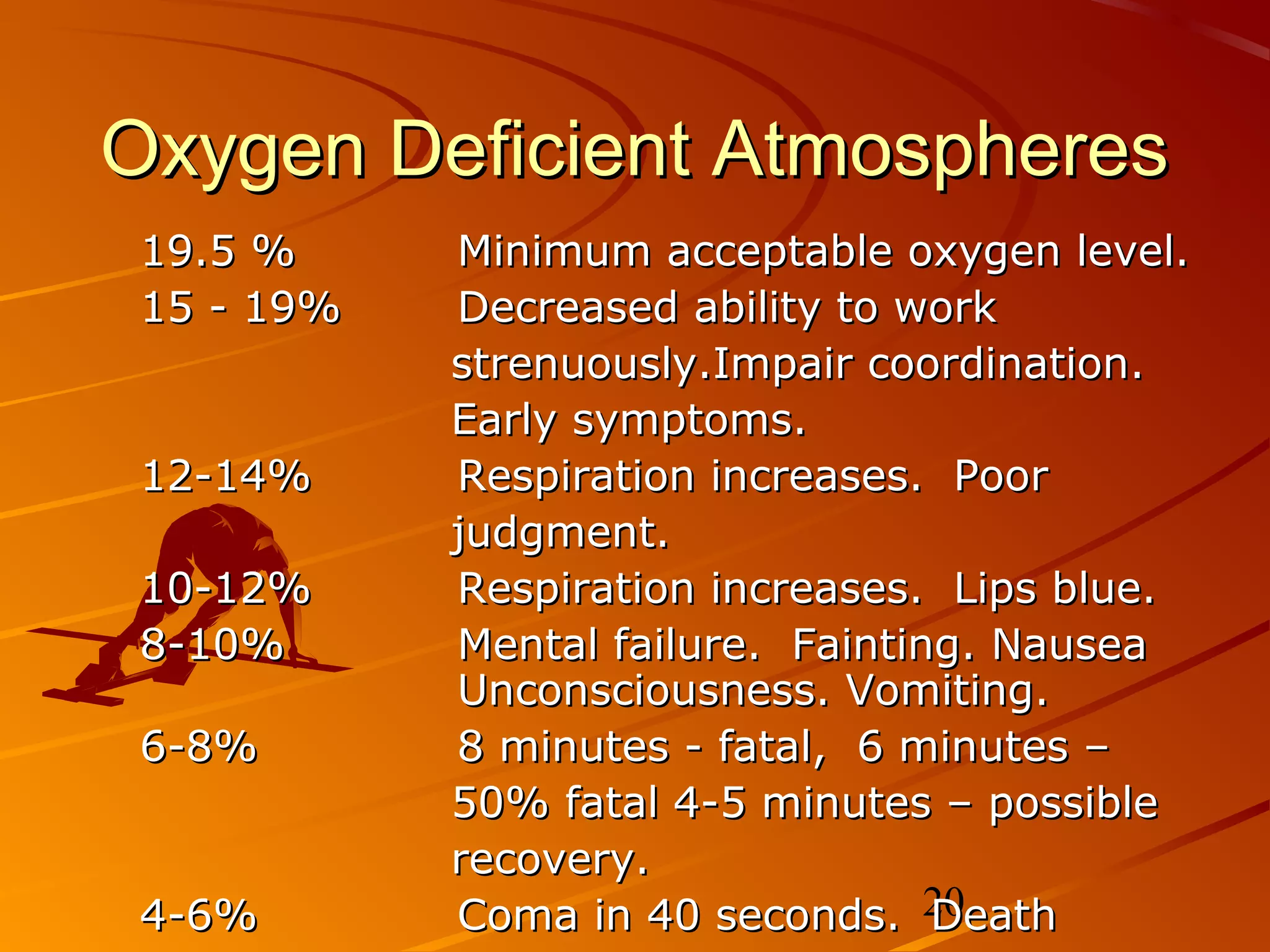
Oxygen Deficient Atmospheres
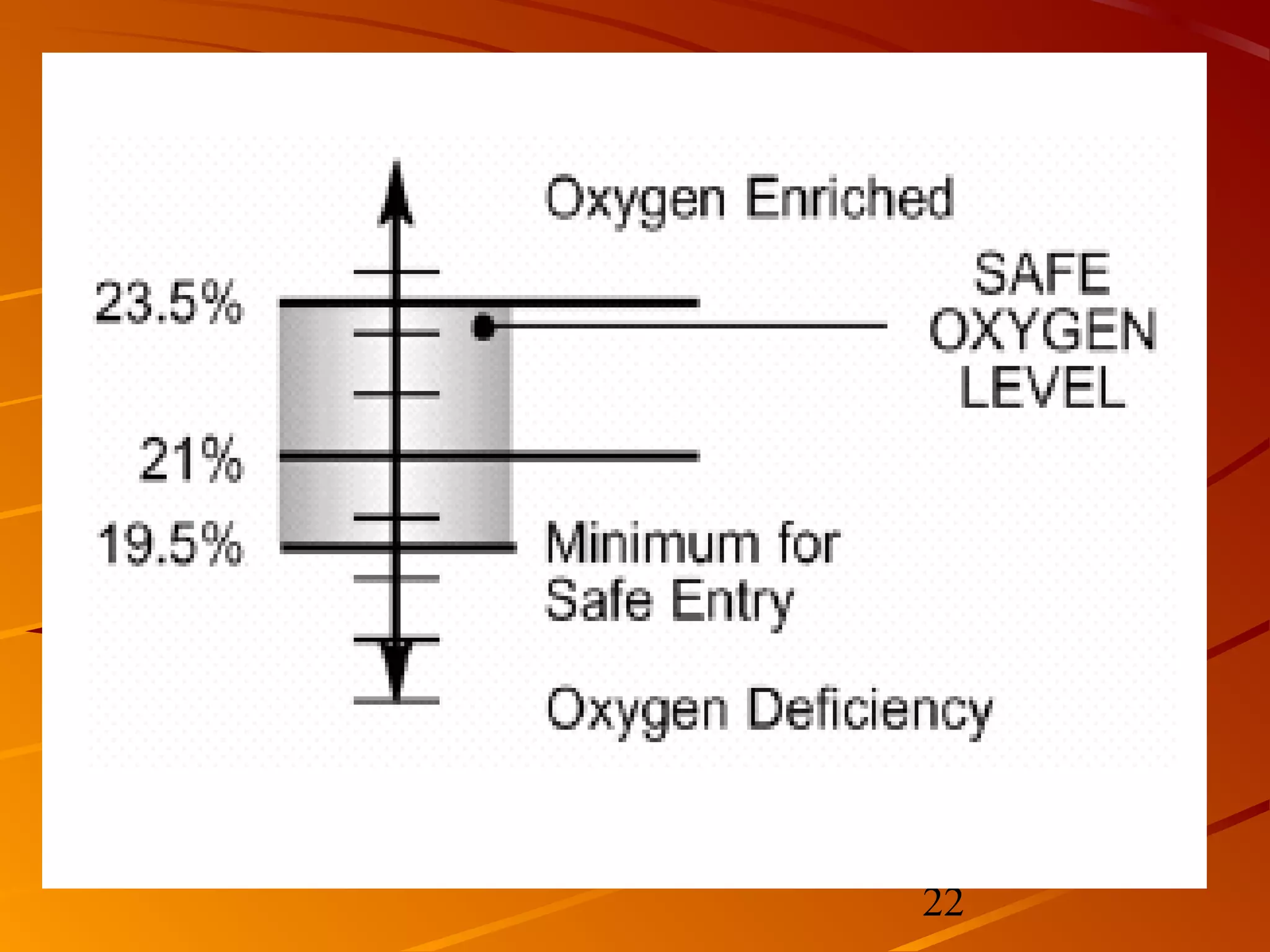
 19.5 %     Minimum acceptable oxygen level.
 15 - 19%   Decreased ability to work
            strenuously.Impair coordination.
            Early symptoms.
 12-14%     Respiration increases. Poor
            judgment.
 10-12%     Respiration increases. Lips blue.
 8-10%      Mental failure. Fainting. Nausea
            Unconsciousness. Vomiting.
 6-8%       8 minutes - fatal, 6 minutes –
            50% fatal 4-5 minutes – possible
            recovery.
 4-6%       Coma in 40 seconds. 20 Death
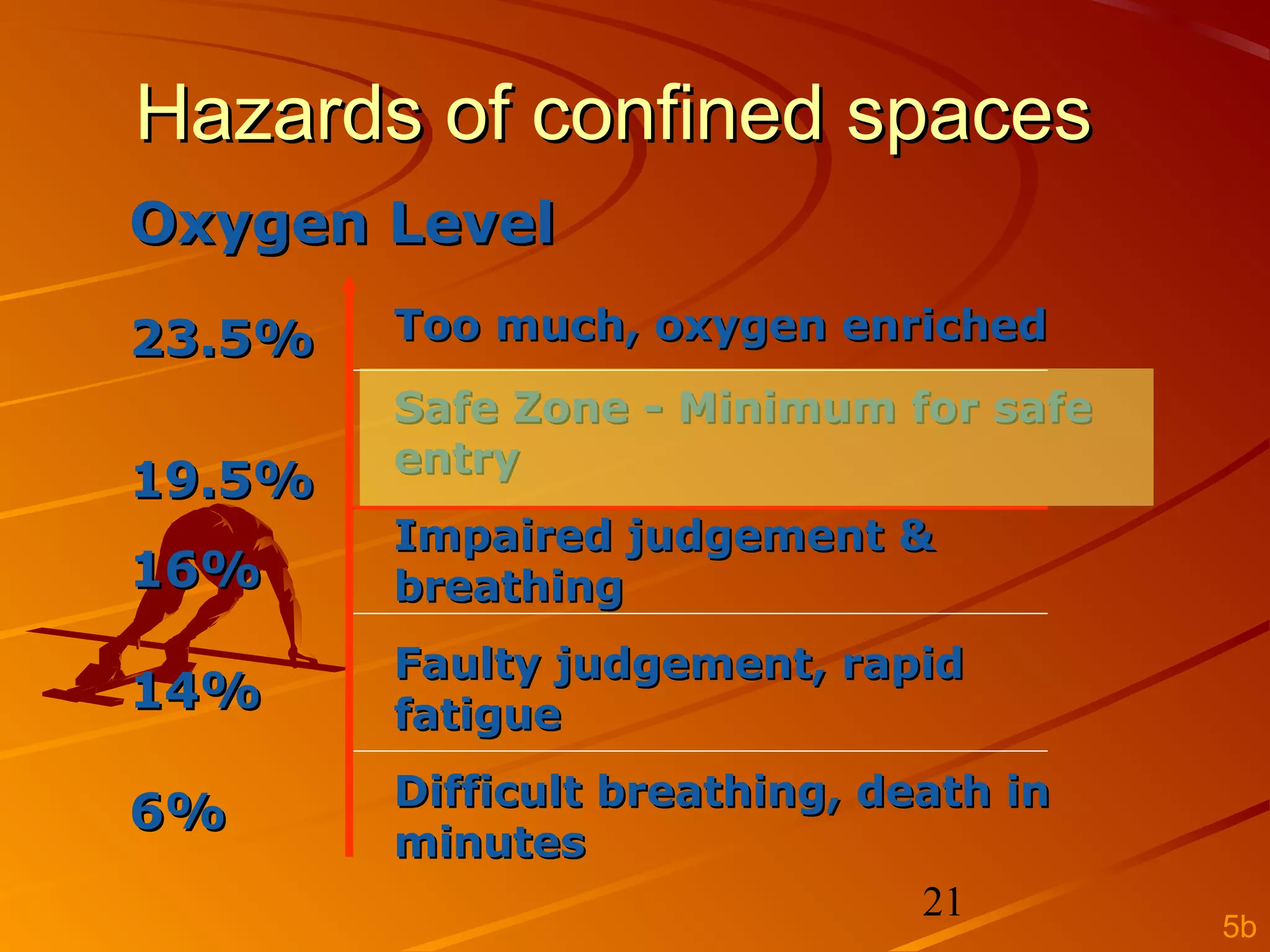
Hazards of confined spaces
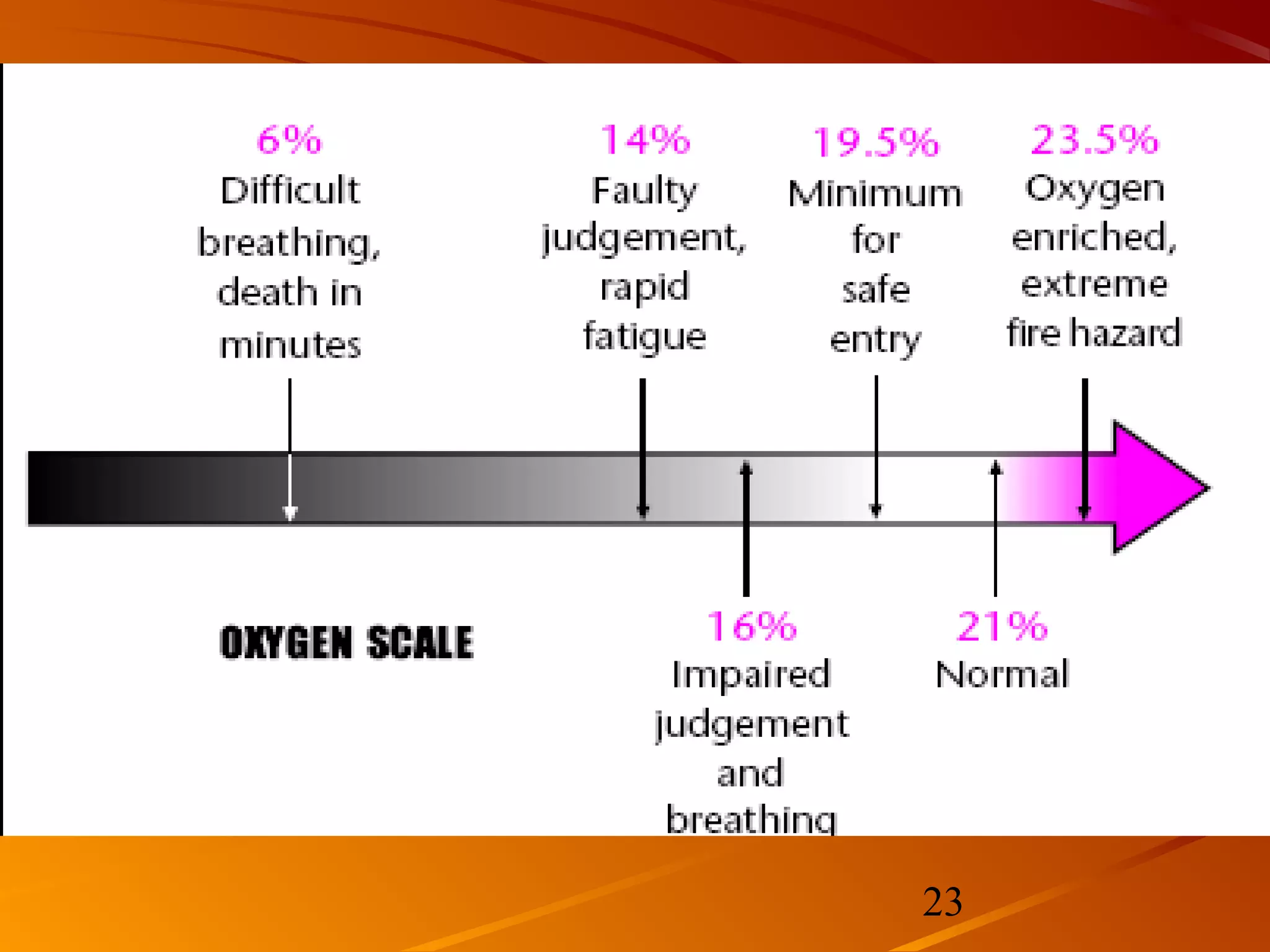
Oxygen Level

23.5%   Too much, oxygen enriched
        Safe Zone - Minimum for safe
        entry
19.5%
        Impaired judgement &
16%     breathing
        Faulty judgement, rapid
14%     fatigue
        Difficult breathing, death in
6%
        minutes
                               21
                                        5b
22
23
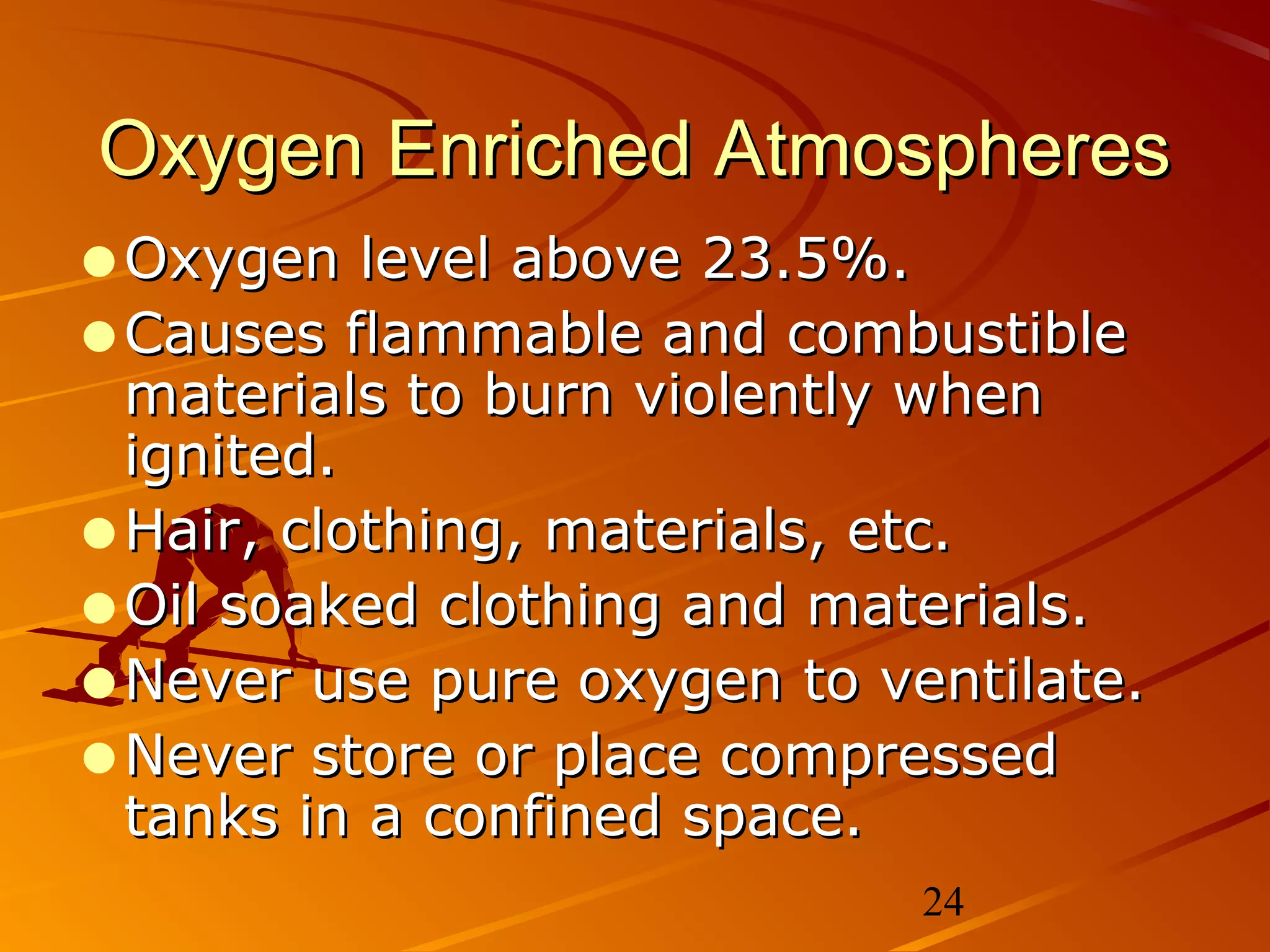
Oxygen Enriched Atmospheres
•Oxygen level above 23.5%.
•Causes flammable and combustible
 materials to burn violently when
 ignited.
•Hair, clothing, materials, etc.
•Oil soaked clothing and materials.
•Never use pure oxygen to ventilate.
•Never store or place compressed
 tanks in a confined space.
                            24
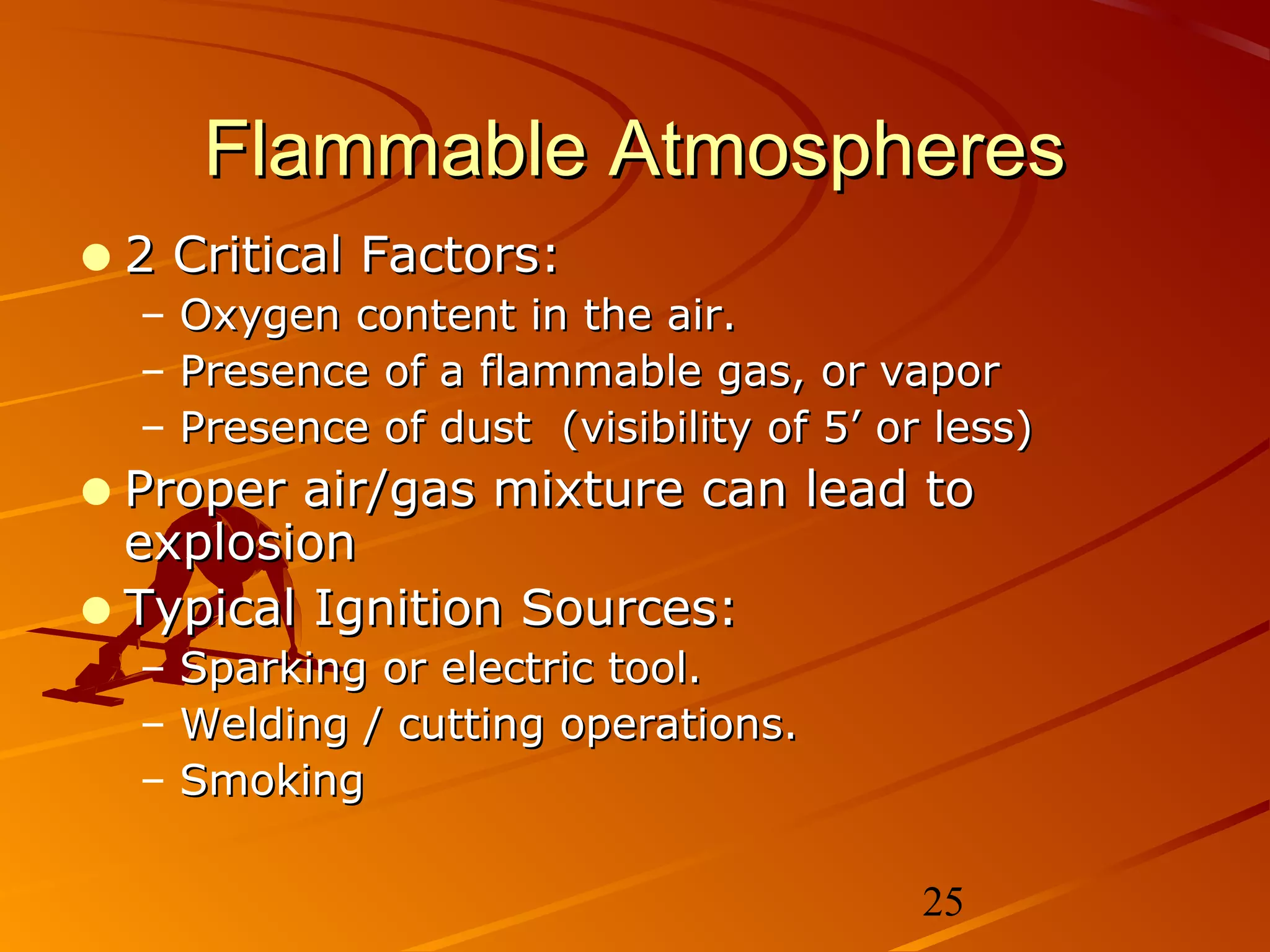
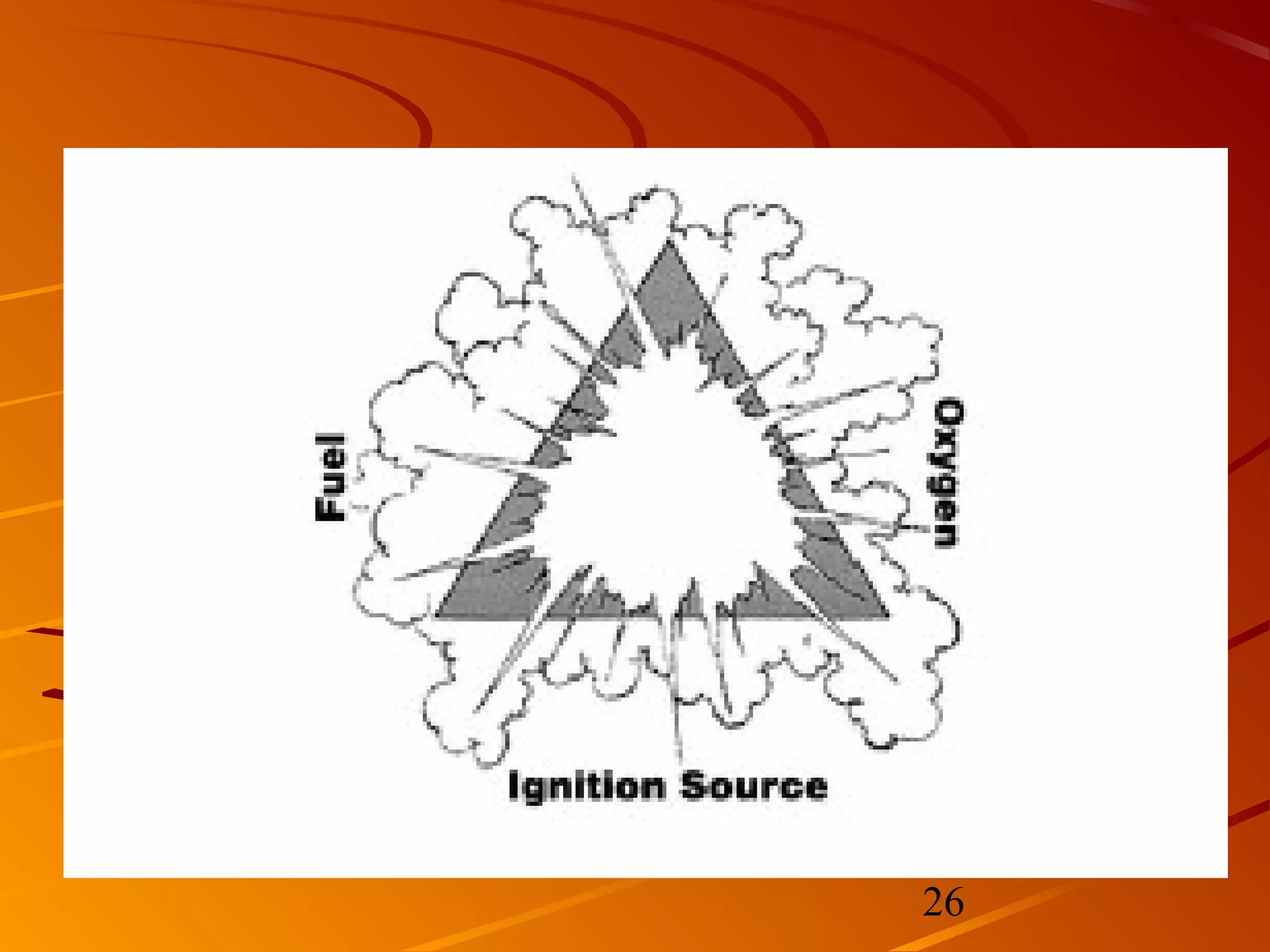
Flammable Atmospheres
• 2 Critical Factors:
  –   Oxygen content in the air.
  –   Presence of a flammable gas, or vapor
  –   Presence of dust (visibility of 5’ or less)
• Proper air/gas mixture can lead to
  explosion
• Typical Ignition Sources:
  –   Sparking or electric tool.
  –   Welding / cutting operations.
  –   Smoking

                                           25
26
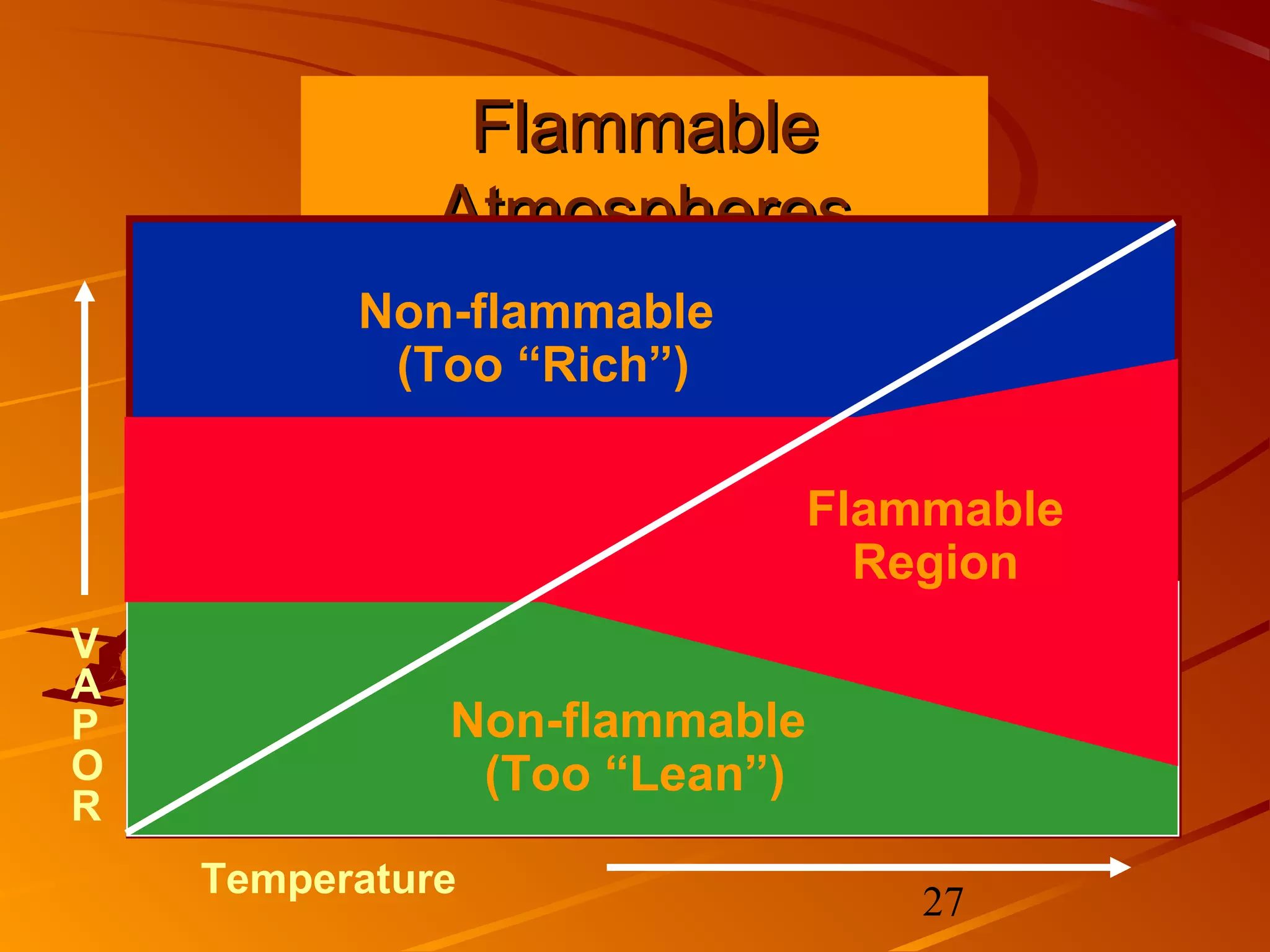
Flammable
              Atmospheres
          Non-flammable
           (Too “Rich”)

    Flammable                 Flammable
                                Region
V
A
P             Non-flammable
O              (Too “Lean”)
R
    Temperature
                                  27
Toxic Atmospheres
• Product stored in a confined space:
      Gases released when cleaning.
      Materials absorbed into walls of confined space.
      Decomposition of materials in the confined space.

• Work performed in a confined space:
      Welding, cutting, brazing, soldering.
      Painting, scraping, sanding, degreasing.
      Sealing, bonding, melting.

• Areas adjacent to a confined space.

                                            28
Hydrogen Sulfide
• Decomposition of materials. Human
  waste.
• Rotten egg odor at low concentrations.
• Possibly no warning at high
 concentrations.
 PPM          Effect                          Time
 10 ppm      Permissible Exposure Level       8   Hours
 50 - 100    Mild Irritation - eyes, throat   1   Hour
 200 - 300   Significant Irritation           1   Hour
 500 -700    Unconsciousness, Death                       1/2 - 1 Hour
  >1000      Unconsciousness, Death                       Minutes


                                                    29
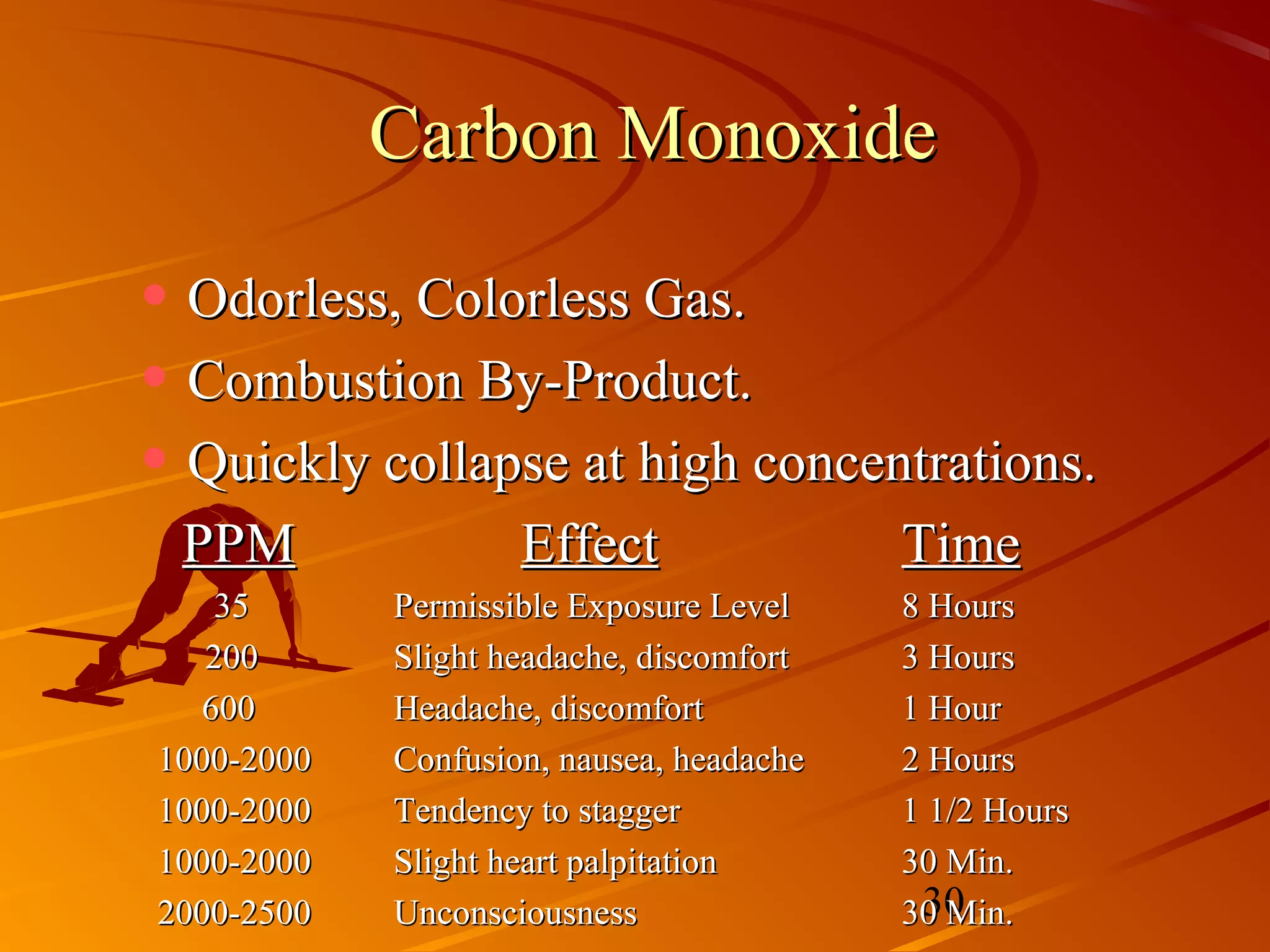
Carbon Monoxide

• Odorless, Colorless Gas.
• Combustion By-Product.
• Quickly collapse at high concentrations.
 PPM                Effect                Time
    35      Permissible Exposure Level    8 Hours
   200      Slight headache, discomfort   3 Hours
   600      Headache, discomfort          1 Hour
1000-2000   Confusion, nausea, headache   2 Hours
1000-2000   Tendency to stagger           1 1/2 Hours
1000-2000   Slight heart palpitation      30 Min.
2000-2500   Unconsciousness                30
                                          30 Min.
Engulfment Hazards
•Loose, granular materials stored in
 bins and hoppers - grain, sand, coal,
 etc.
•Crusting and bridging below a
 worker.
•Flooding of confined space.
•Water or sewage flow.

                             31
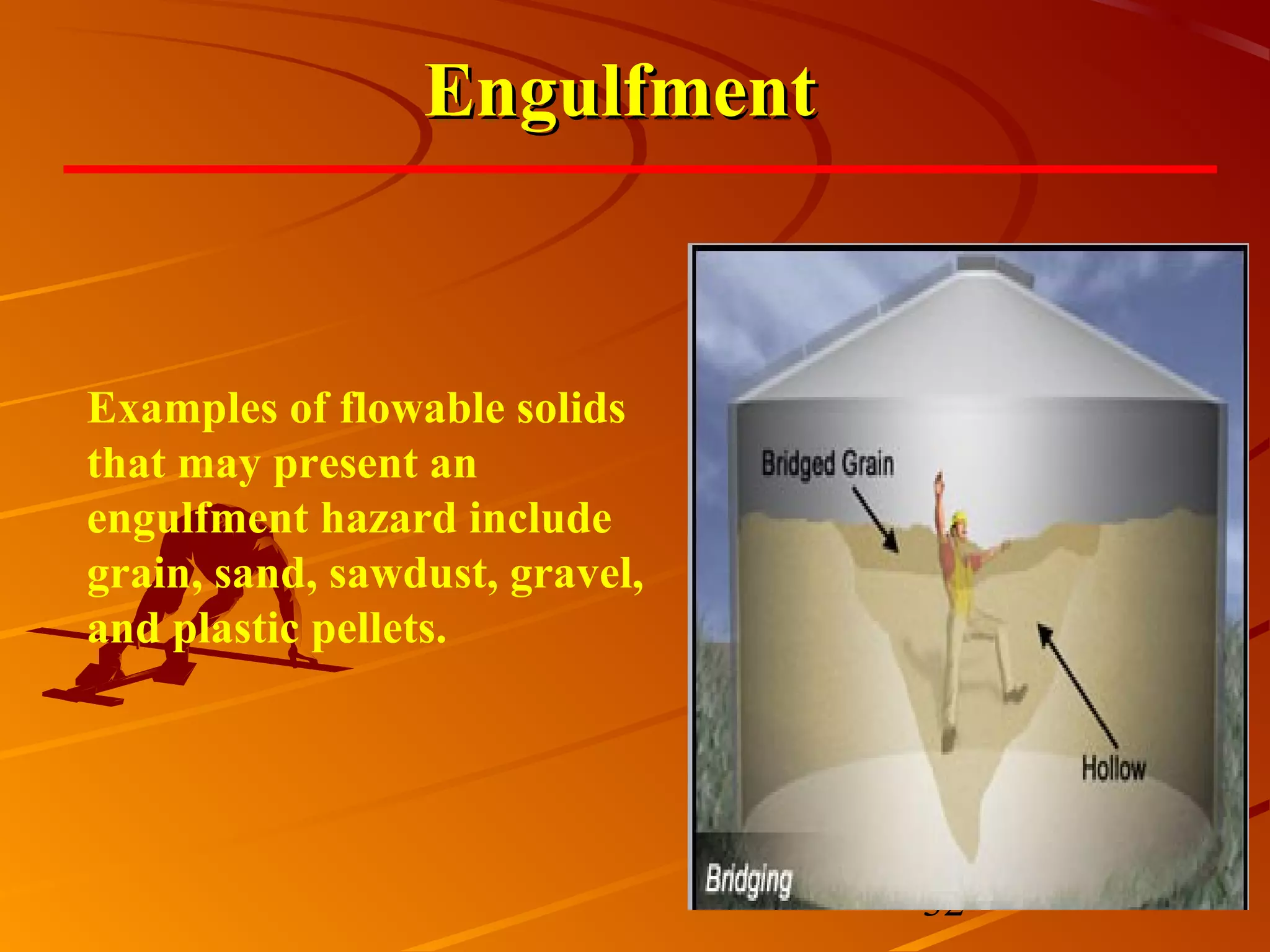
Engulfment


Examples of flowable solids
that may present an
engulfment hazard include
grain, sand, sawdust, gravel,
and plastic pellets.


                                32
Confined Space Entry - Hazards

Sudden releases of
fluid solids, such as     When torrential forces
granulated salt, sugar,   are suddenly released,
or sand, liquids, and     people may be struck
dense gases can cause     by moving objects , or
engulfment of persons     be pushed helplessly
inside underground        downstream.
tanks, or pits.


                              33
Other Hazards
•Noise
     Amplified due to acoustics within the space.
     Damaged hearing, affect communication.

•Slick / Wet Surfaces
     Slips and falls.
     Increased chance of electric shock.

•Falling Objects
     Topside openings expose workers inside
     confined space to falling objects.

                                     34
35
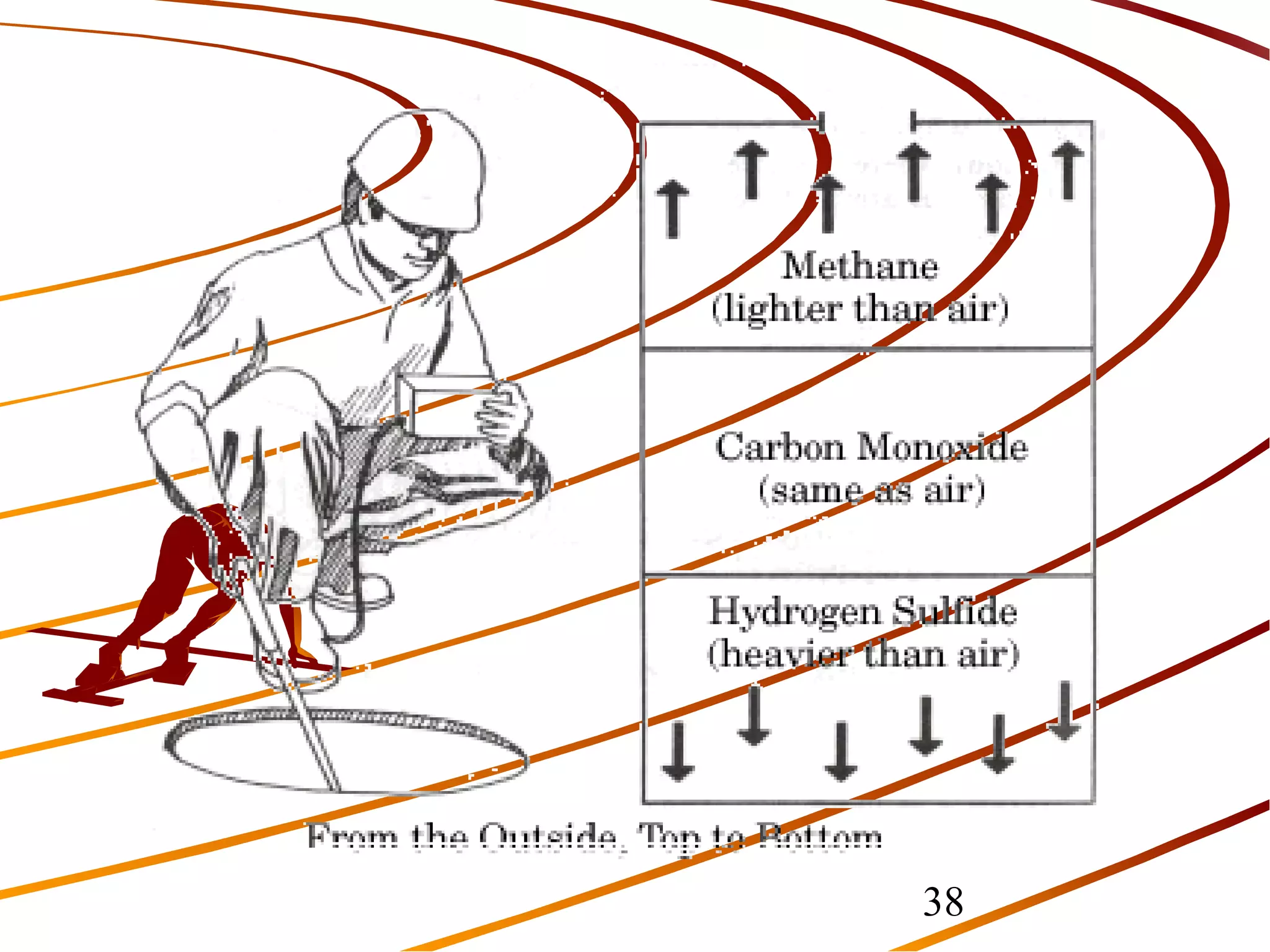
Testing The Atmosphere
•Verify presence of safe work
 atmosphere.
•Test all areas of a confined space.
  – Top, Middle, Bottom
•Methane is lighter than air.
•Carbon Monoxide is the same as air.
•Hydrogen Sulfide is heavier than air.
•Oxygen Deficiency.
                             36
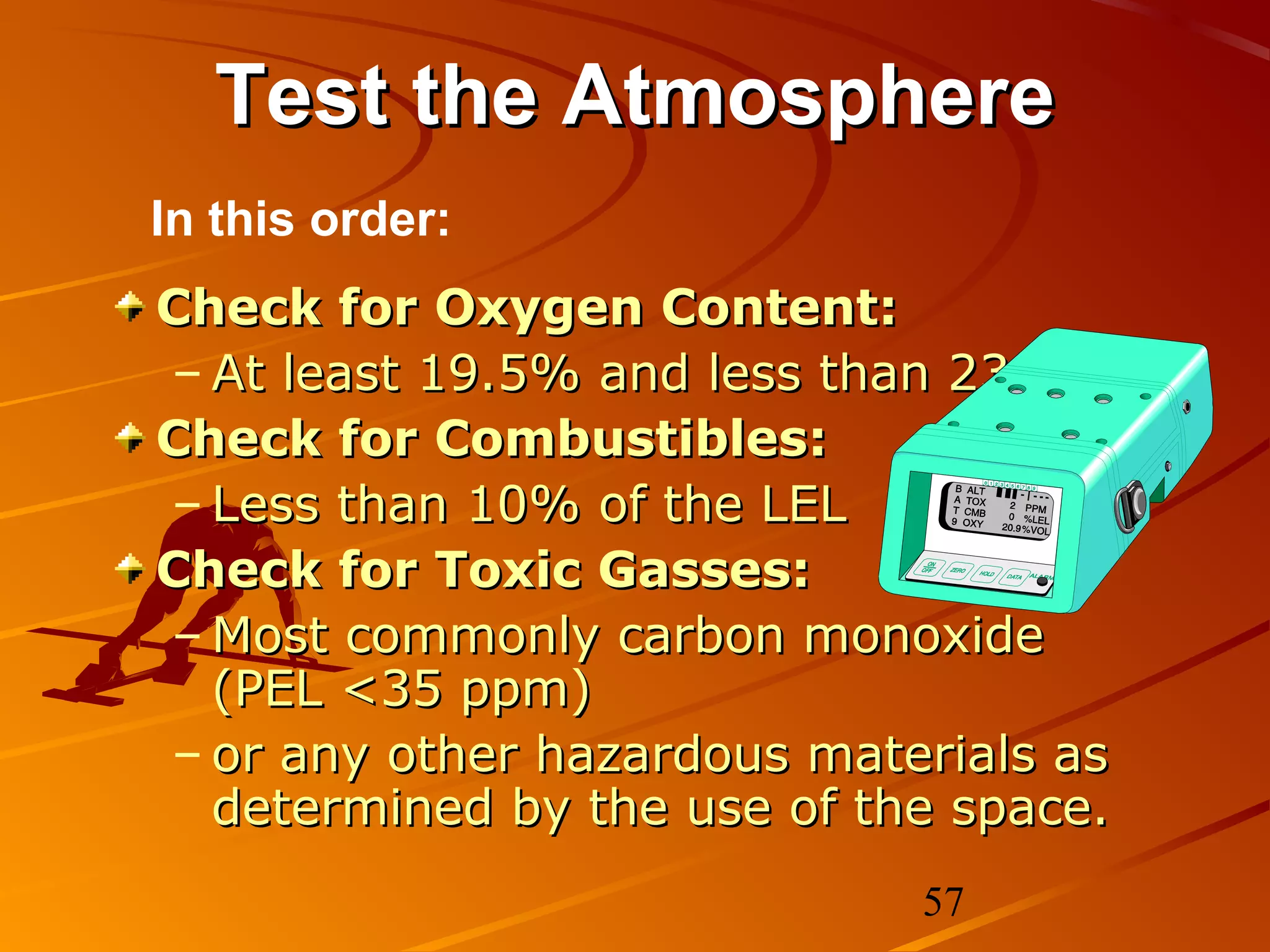
Test the Atmosphere
In this order:
Check for Oxygen Content:
– At least 19.5% and less than 23.5%
Check for Combustibles:
– Less than 10% of the LEL
Check for Toxic Gasses:
– Most commonly carbon monoxide
  (PEL <35 ppm)
– or any other hazardous materials as
  determined by the use of the space.
                             37
38
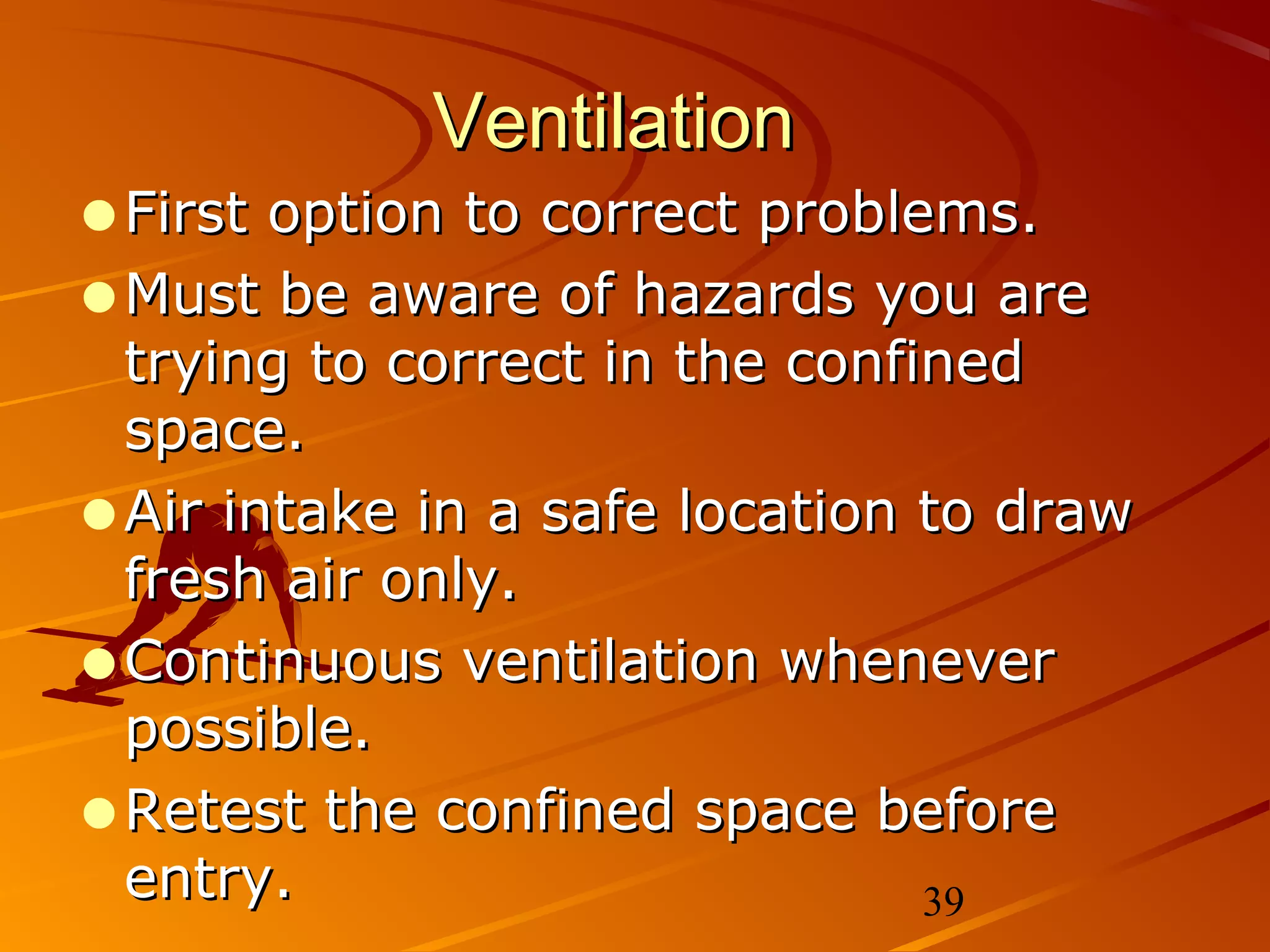
Ventilation
•First option to correct problems.
•Must be aware of hazards you are
 trying to correct in the confined
 space.
•Air intake in a safe location to draw
 fresh air only.
•Continuous ventilation whenever
 possible.
•Retest the confined space before
 entry.                        39
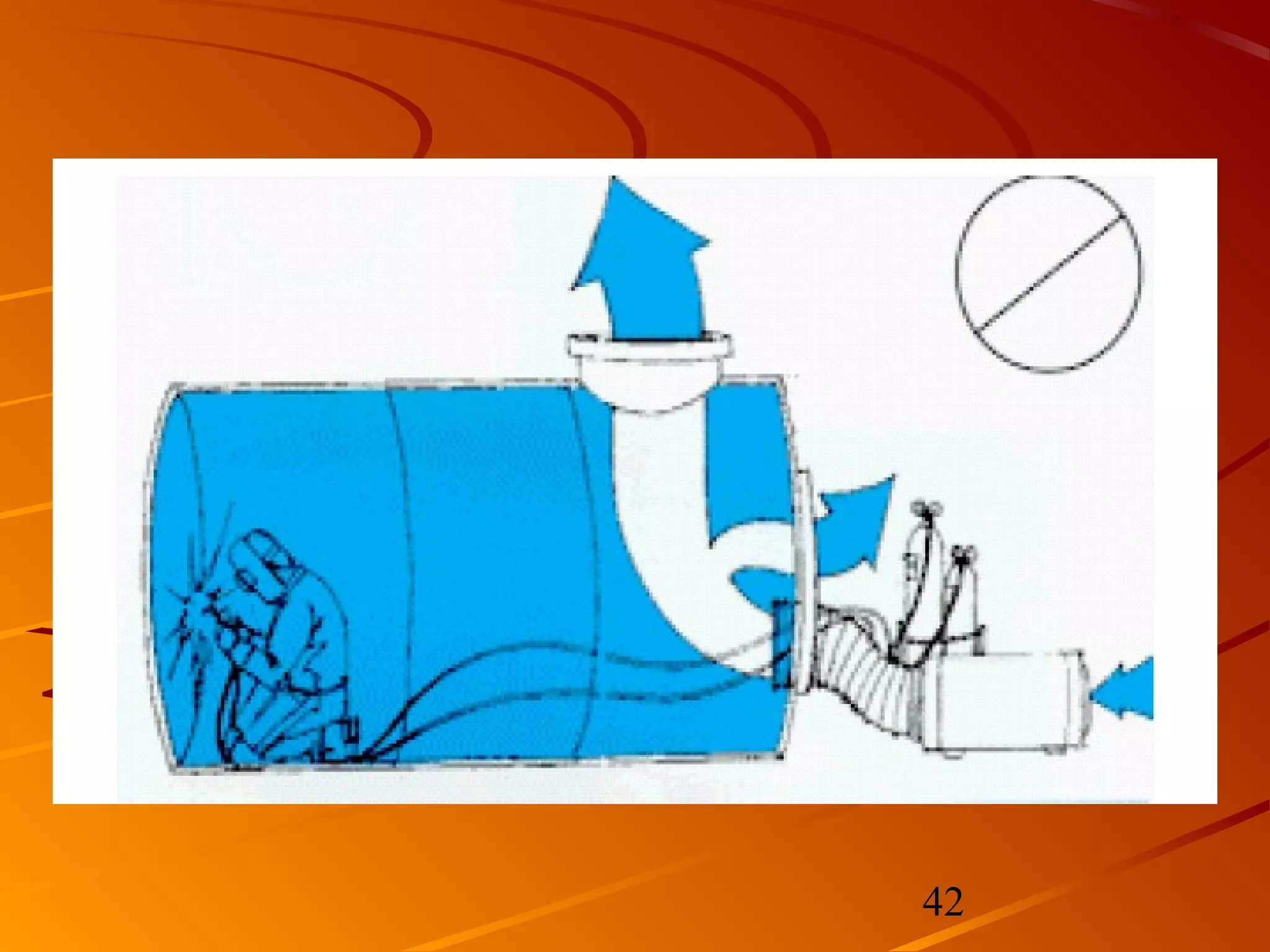
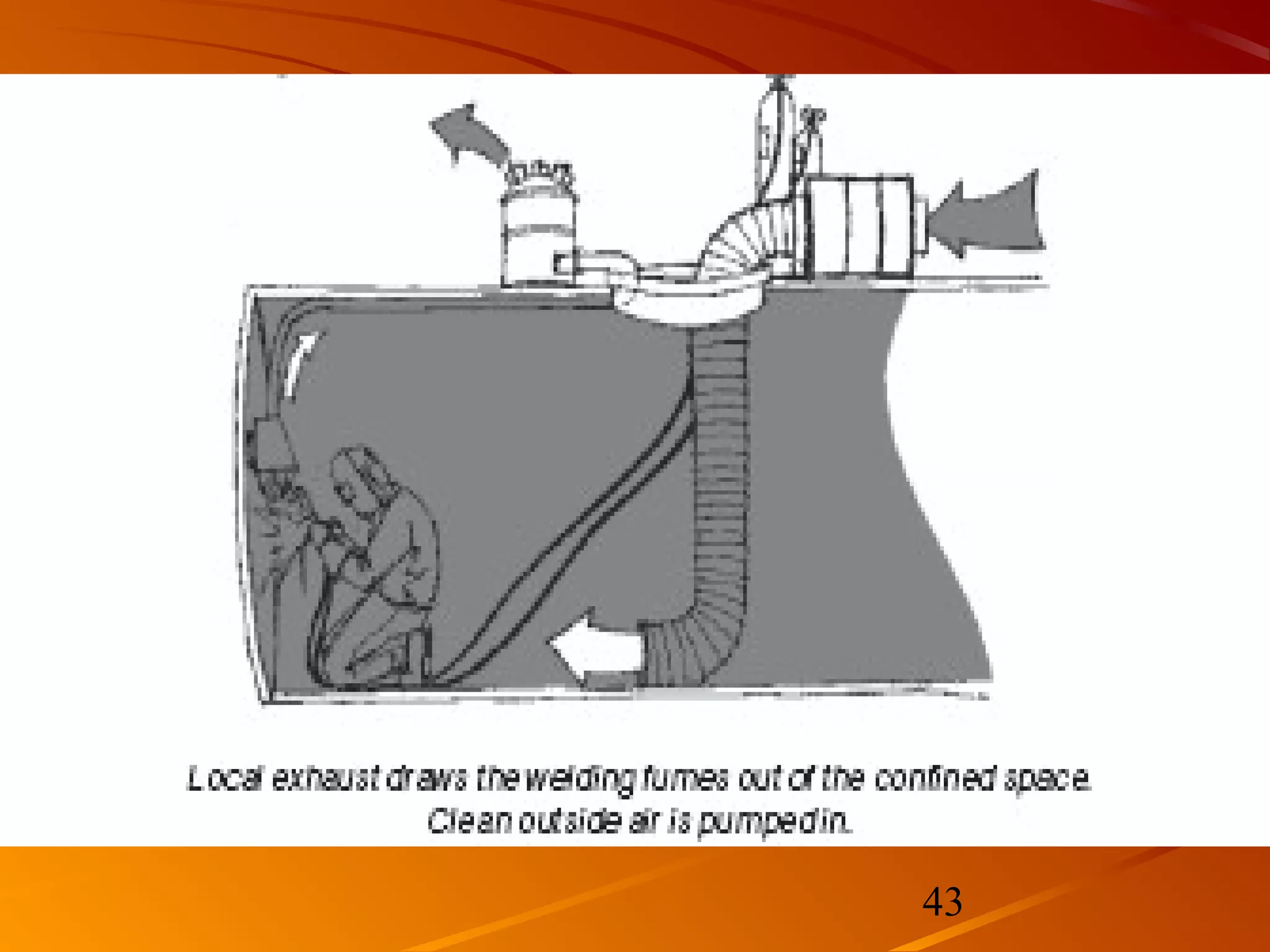
Ventilate the Space
Use mechanical ventilation
– Fans
– Air horns
Ventilate at the rate of at
least twenty (20) volumes
per hour
– Larger spaces require more
  ventilation
Make sure air supply is not
contaminated
– Ventilation air supply must be
  from fresh air uncontaminated
  with flammables, toxins, etc.    40
LESSON 3

VENTILATING THE SPACE

            Use mechanical
            ventilation - such as fans
            or forced air blowers

            Make sure air supply is
            not contaminated -
            ventilation air supply
            must be from fresh air
            uncontaminated with
            flammables, toxins, etc.
42
43
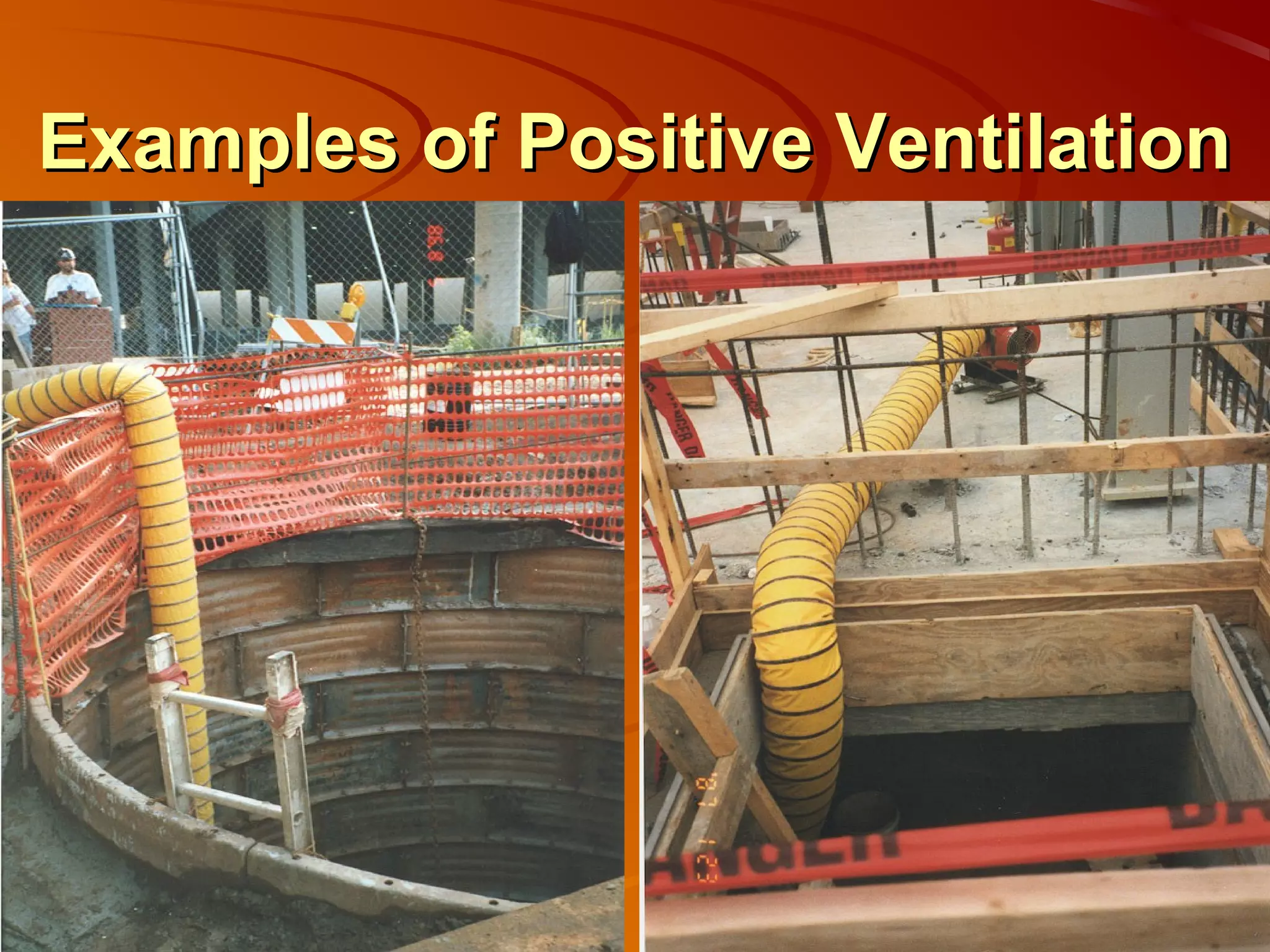
Examples of Positive Ventilation


                       44
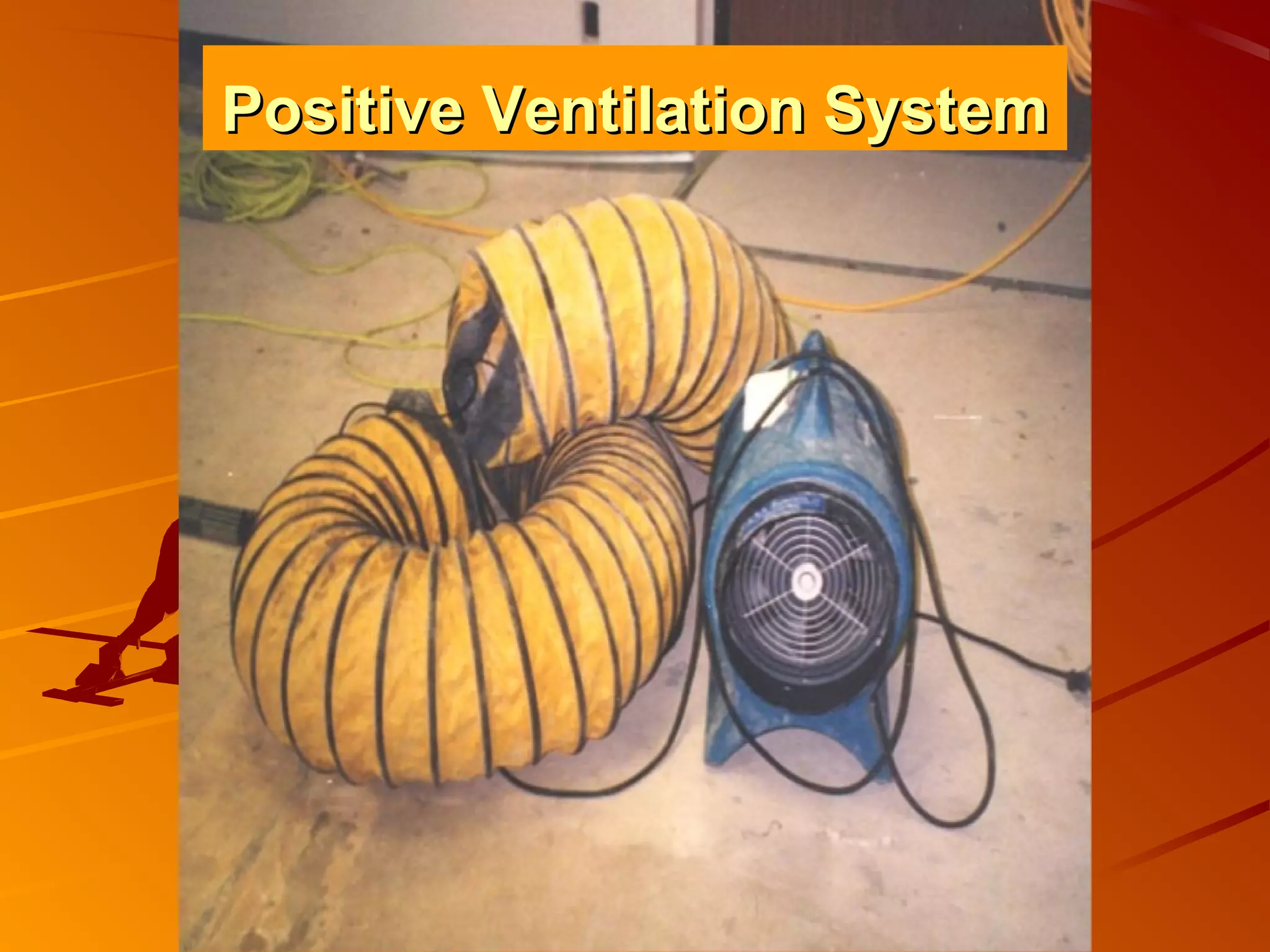
Positive Ventilation System


                      45
46
Remember, ventilation must
be continuous during entry!


                          47
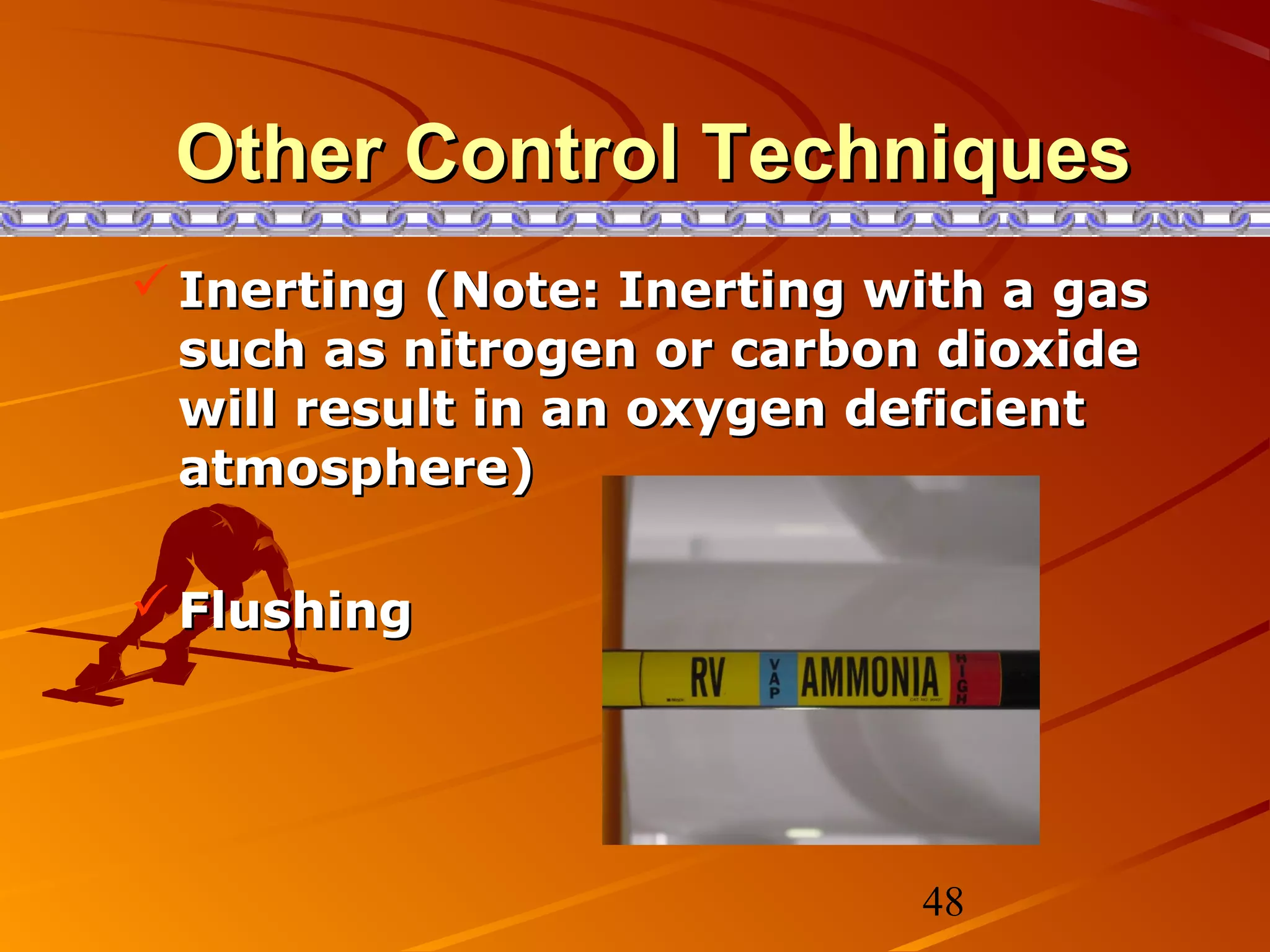
Other Control Techniques
 Inerting (Note: Inerting with a gas
  such as nitrogen or carbon dioxide
  will result in an oxygen deficient
  atmosphere)

 Flushing


                            48
Isolate the Space
         from all hazards
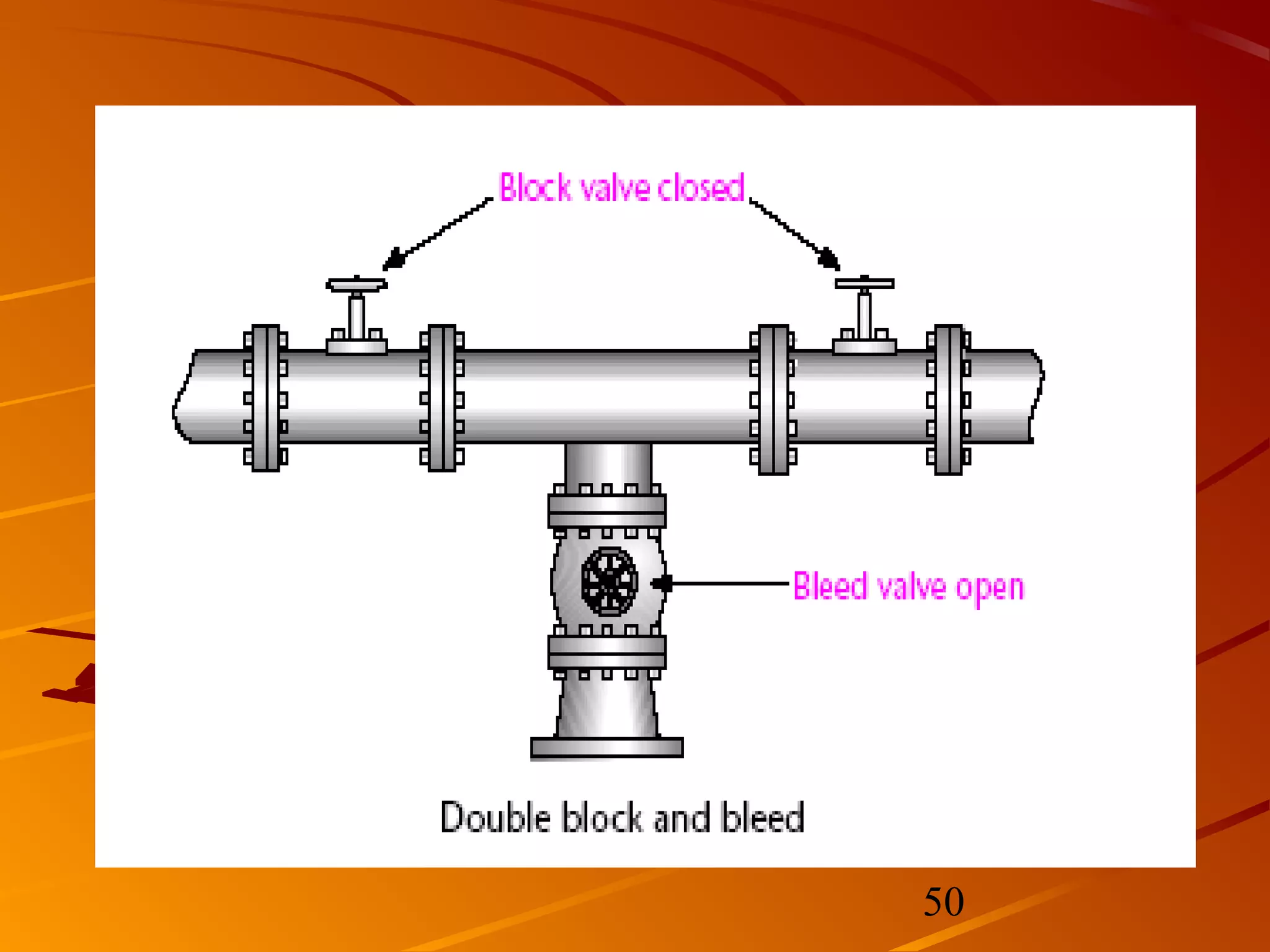
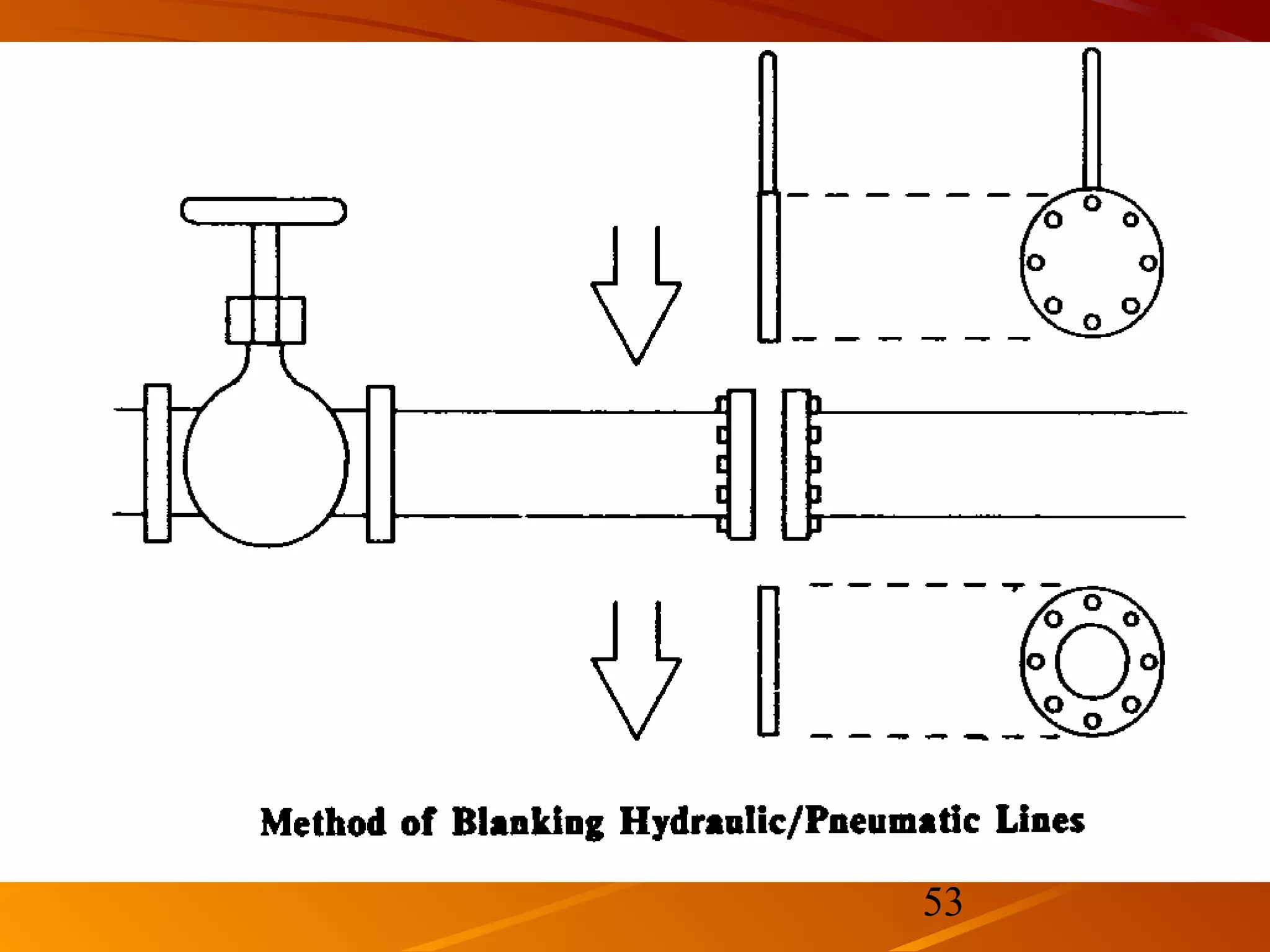
Close Valves
 – Double block & bleed, or
 – Blank flange
Empty the Space
 – Depressurize, vent & drain
Lockout/Tagout Equipment
 – Electrical sources
 – Rotating/reciprocating parts
 – Hazardous materials
Clean residue from the space49
50
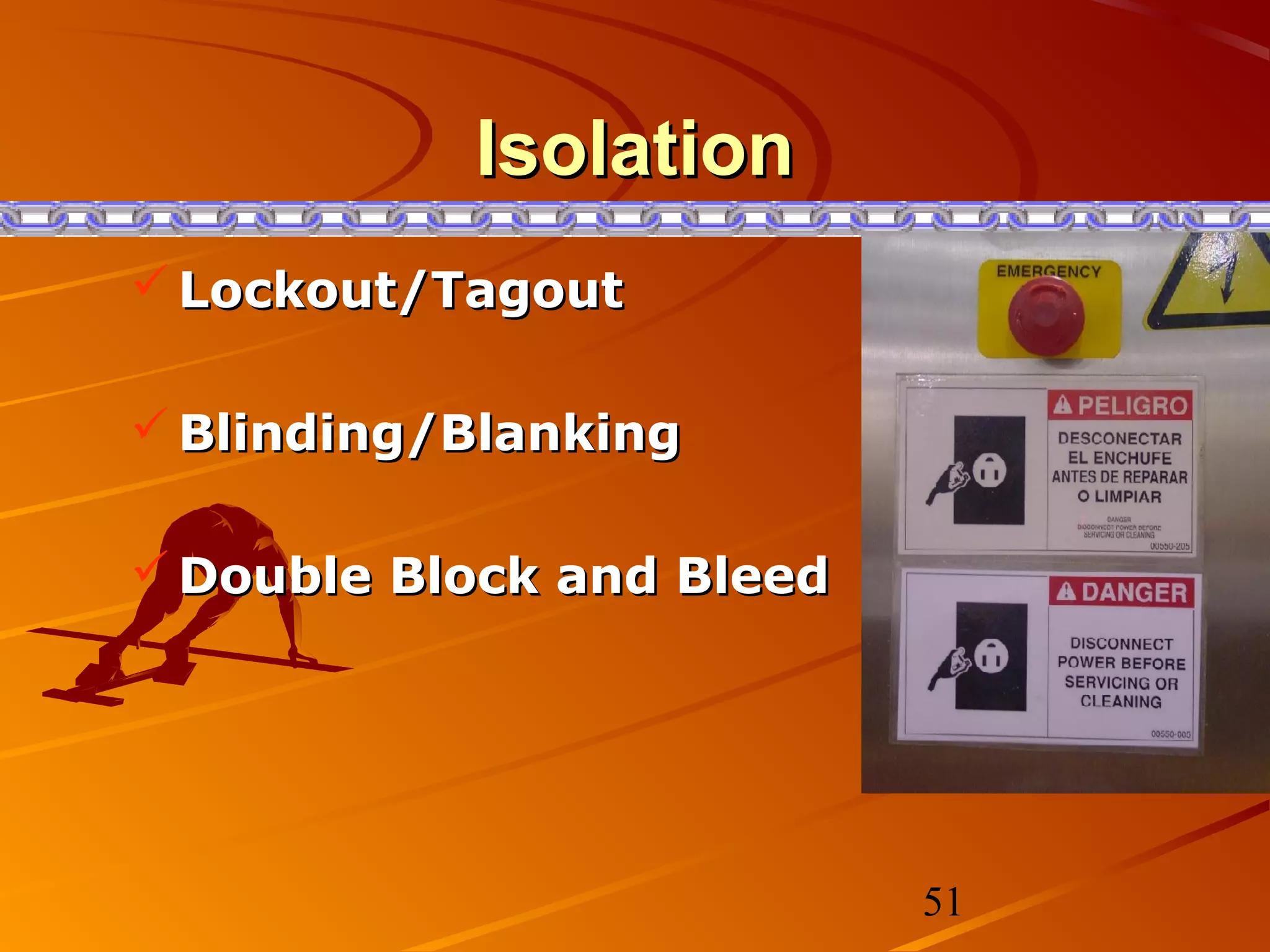
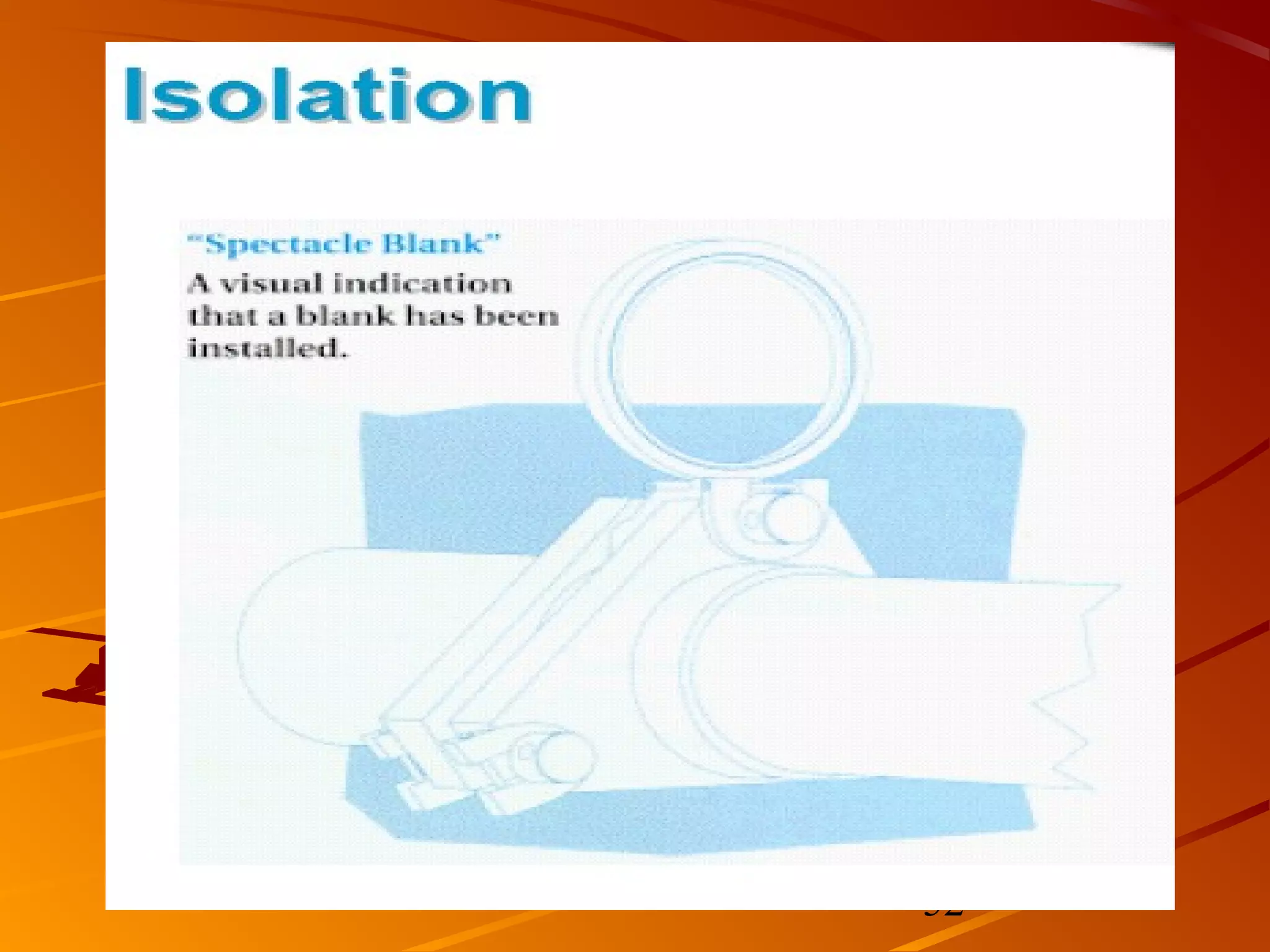
Isolation
 Lockout/Tagout

 Blinding/Blanking

 Double Block and Bleed


                           51
52
53
Conduct a Tailboard Briefing

Entire crew must attend
– Attendants, entrants, entry supervisor
Review   hazards of entry and work
Review   PPE
Review   procedure for contacting
rescue
– verify rescue available
Complete permit
                               54
Complete Entry Permit Form
 Permit must be correctly and
 completely filled out prior to
 entry.
 Permit must be activated by
 Entry Supervisor’s signature to
 be valid.
 No entry is allowed without a
 valid permit.
 Permits are valid for up to 12
 hours.
 When work is completed,
 permit and tailboard form
 should be returned to safety.
 Cancelled permits must be kept
 on file for at least one year.
                                   55
56
Test the Atmosphere
In this order:
Check for Oxygen Content:
– At least 19.5% and less than 23.5%
Check for Combustibles:
– Less than 10% of the LEL
Check for Toxic Gasses:
– Most commonly carbon monoxide
  (PEL <35 ppm)
– or any other hazardous materials as
  determined by the use of the space.
                             57
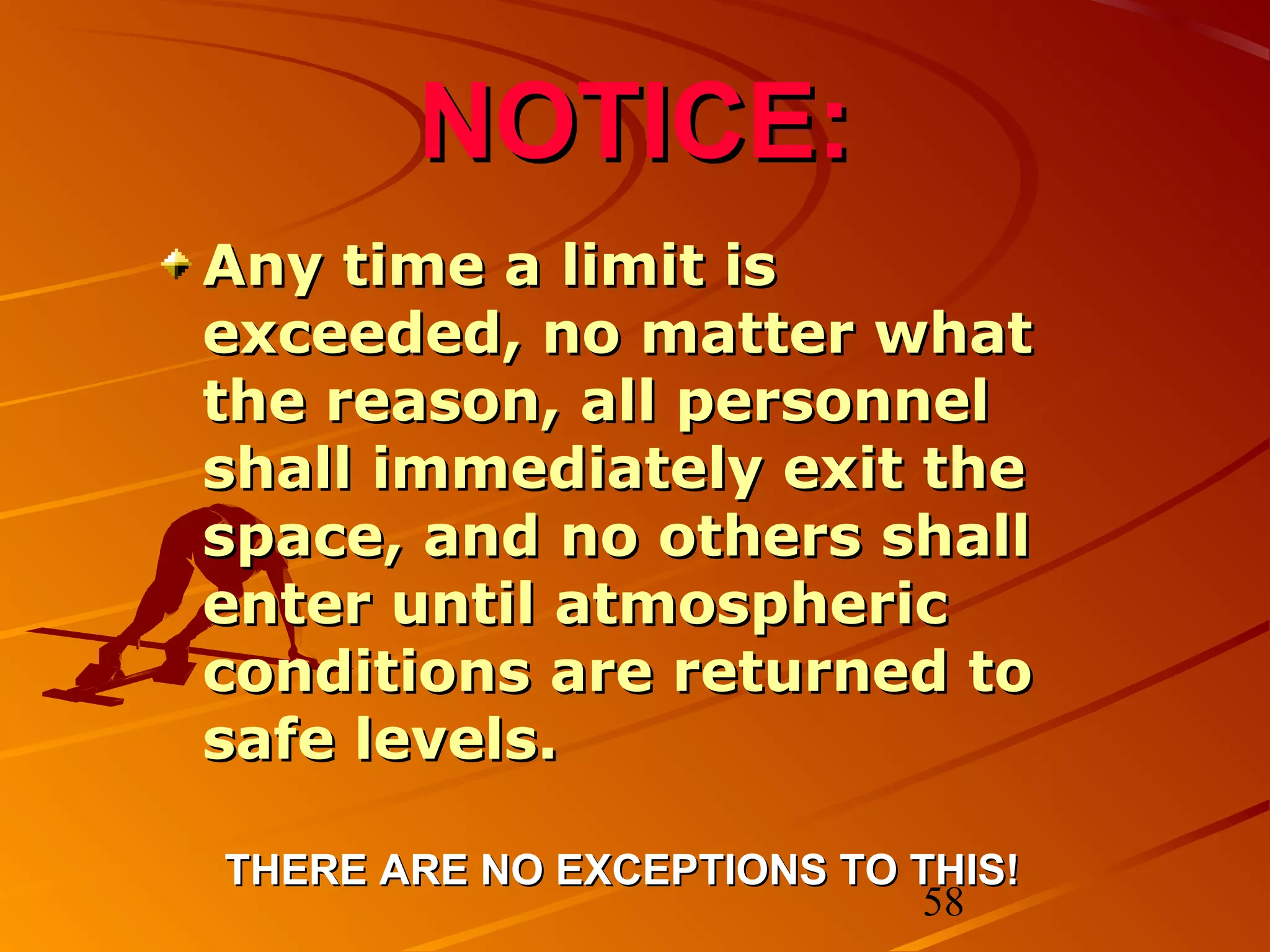
NOTICE:
Any time a limit is
exceeded, no matter what
the reason, all personnel
shall immediately exit the
space, and no others shall
enter until atmospheric
conditions are returned to
safe levels.

THERE ARE NO EXCEPTIONS TO THIS!
                            58
Atmosphere Testing Shall
    Be Performed:
Prior to every entry when the
space is vacant;
After a 10 minute ventilation
period (if ventilation is
necessary);
At least hourly for permit-
required confined spaces.
More frequently, if conditions or
suspicions warrant.
                         59
Enter the Space and
    Proceed with work:
An attendant shall be posted near
the entrance for the duration of the
work. He shall be in constant
communication with the entrants
while the job is in progress.
All entrants shall sign the sign in
log when entering the space and
sign out when exiting.
The attendant shall maintain the
permit and sign in log for the
duration of the work.         60
61
When the Job is Done:

Remove all personnel, tools,
and debris from the space.
Sign off the log.
Close the space.
Cancel the permit.
Review the job with the host
employer (hazards, problems,
other employers, etc.)
                      62
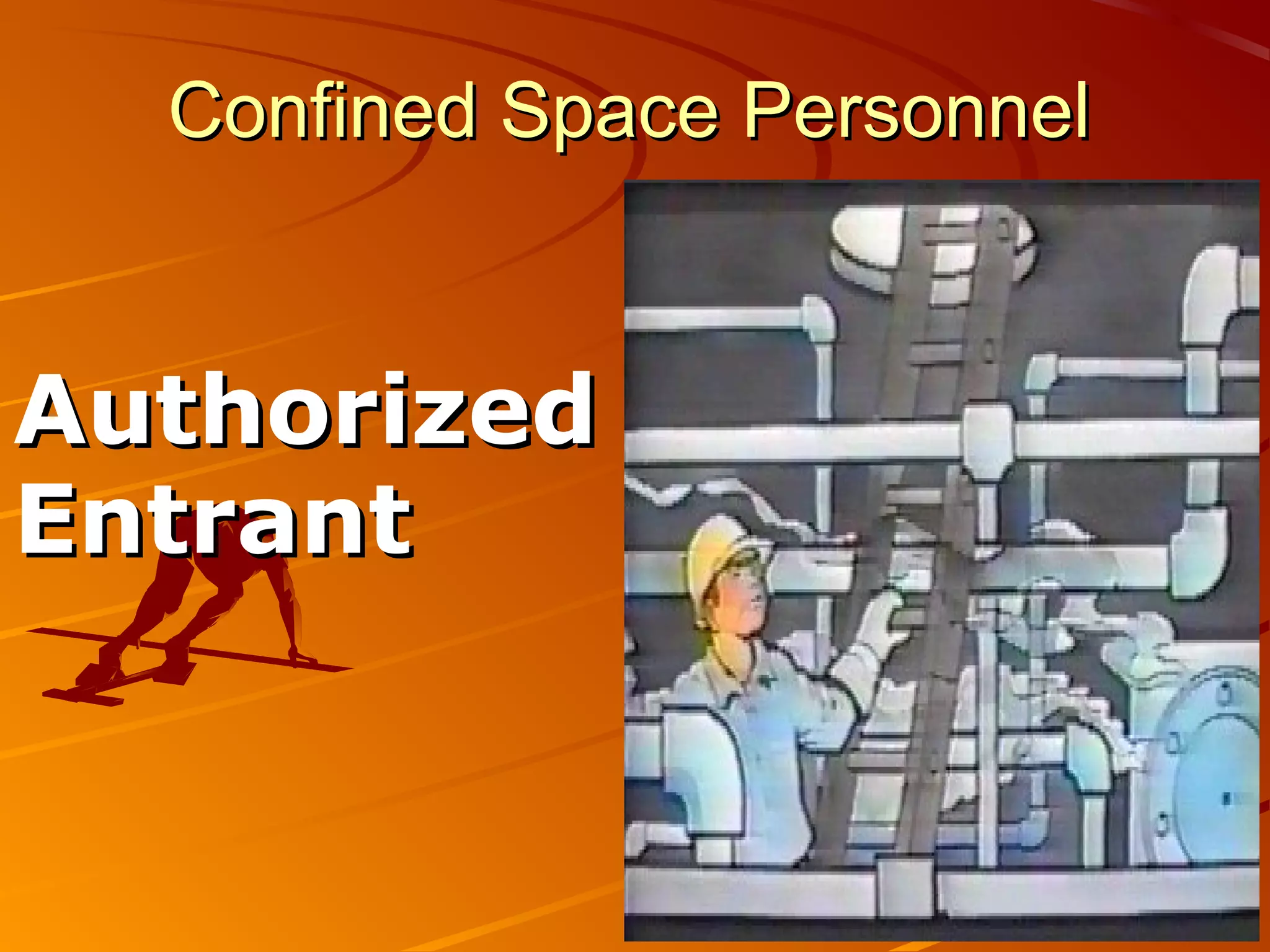
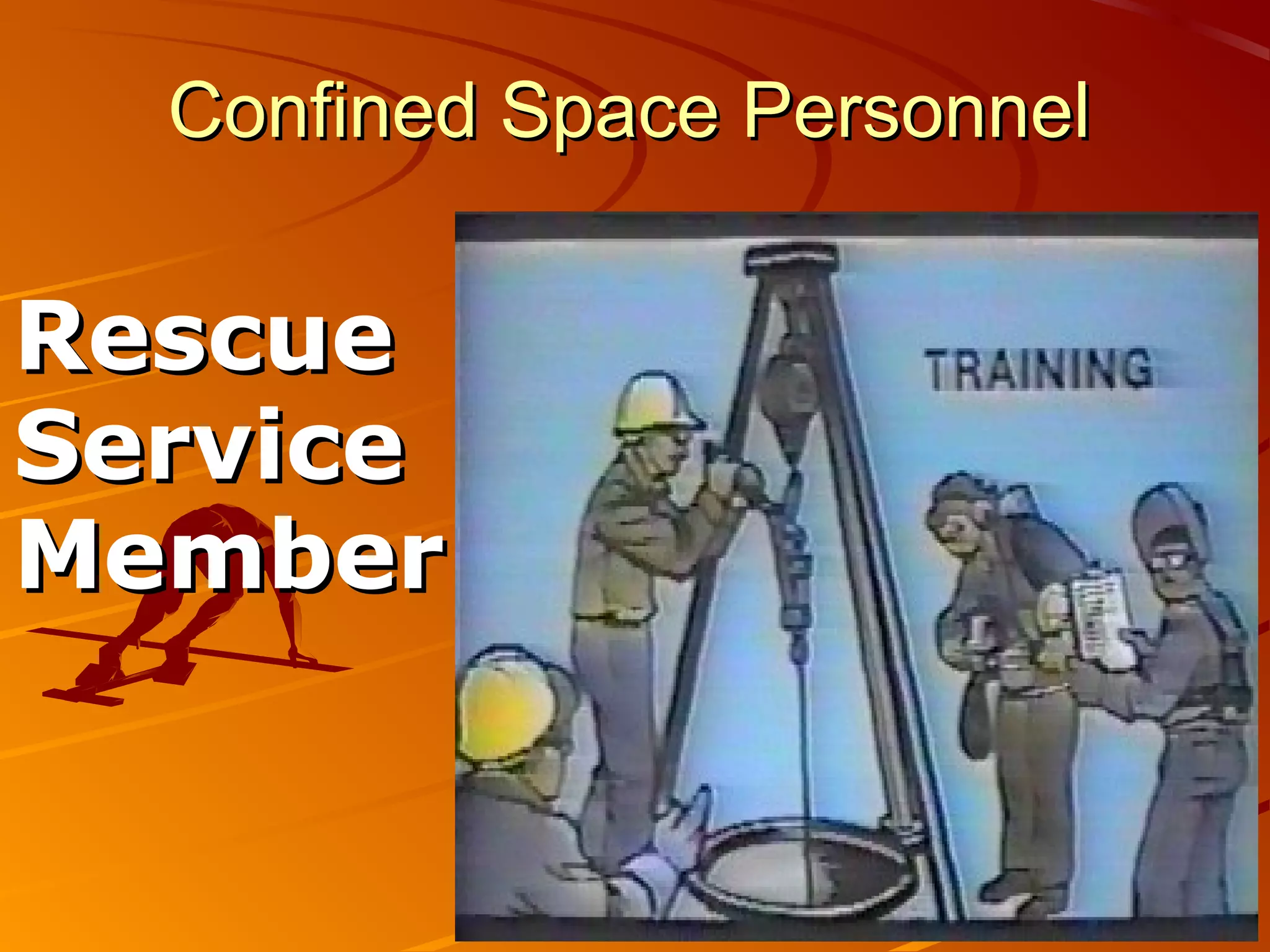
Confined Space Personnel

Authorized Entrant
Attendant
Entry Supervisor
Rescue
Service Member
Confined Space Personnel


Authorized
Entrant
Confined Space Personnel


Attendant
Confined Space Personnel

Rescue
Service
Member
68
Rescue and Emergency
     procedures


                 69
Training


           70
Entrant Responsibilities
To assure that the space has been
adequately ventilated, isolated,
emptied, or otherwise made safe for
entry.
To immediately exit a space, without
question, upon word of the attendant,
no matter what the reason.
To follow all safety rules and
procedures that apply to the job.
To be familiar with the work to be
performed and the procedures that
apply to the job.
To use the appropriate PPE whenever
necessary.

                               71
Attendant
 An individual stationed outside one or
  more permit spaces who monitors the
  authorized entrants and performs all
  attendant’s duties assigned in the
  employer’s permit space program


                             72
Duties of Attendants
 Knowledge of the hazards of the
  space

 Aware of possible behavioral effects
  of hazard exposure in authorized
  entrants

 Continuously maintains an accurate
  count of authorized entrants
                             73
Duties of Attendants
Remains outside the space
 during operations until relieved
 by another attendant

Communicates with authorized
 entrants

Monitors activities inside and
 outside the space
                          74
Duties of Attendants
 Summons rescue and other
  emergency services

 Performs non-entry rescues as
  specified by the employer's rescue
  procedure

 Performs NO duties that might
  interfere with monitoring and
  protecting the entrants     75
Supervisor Responsibilities
   To assure adequate protection is
   provided to the entrants by
   verifying adequate
   lockout/tagout and that all
   hazards are securely isolated.
   To support the attendant’s
   authority in controlling access to
   a confined space.
   To verify that all personnel have
   exited prior to closing the space.
   To assure that all personnel
   involved are aware of the hazards
   associated with the space.
   To assure that rescue services are
   available prior to entry.

                               76
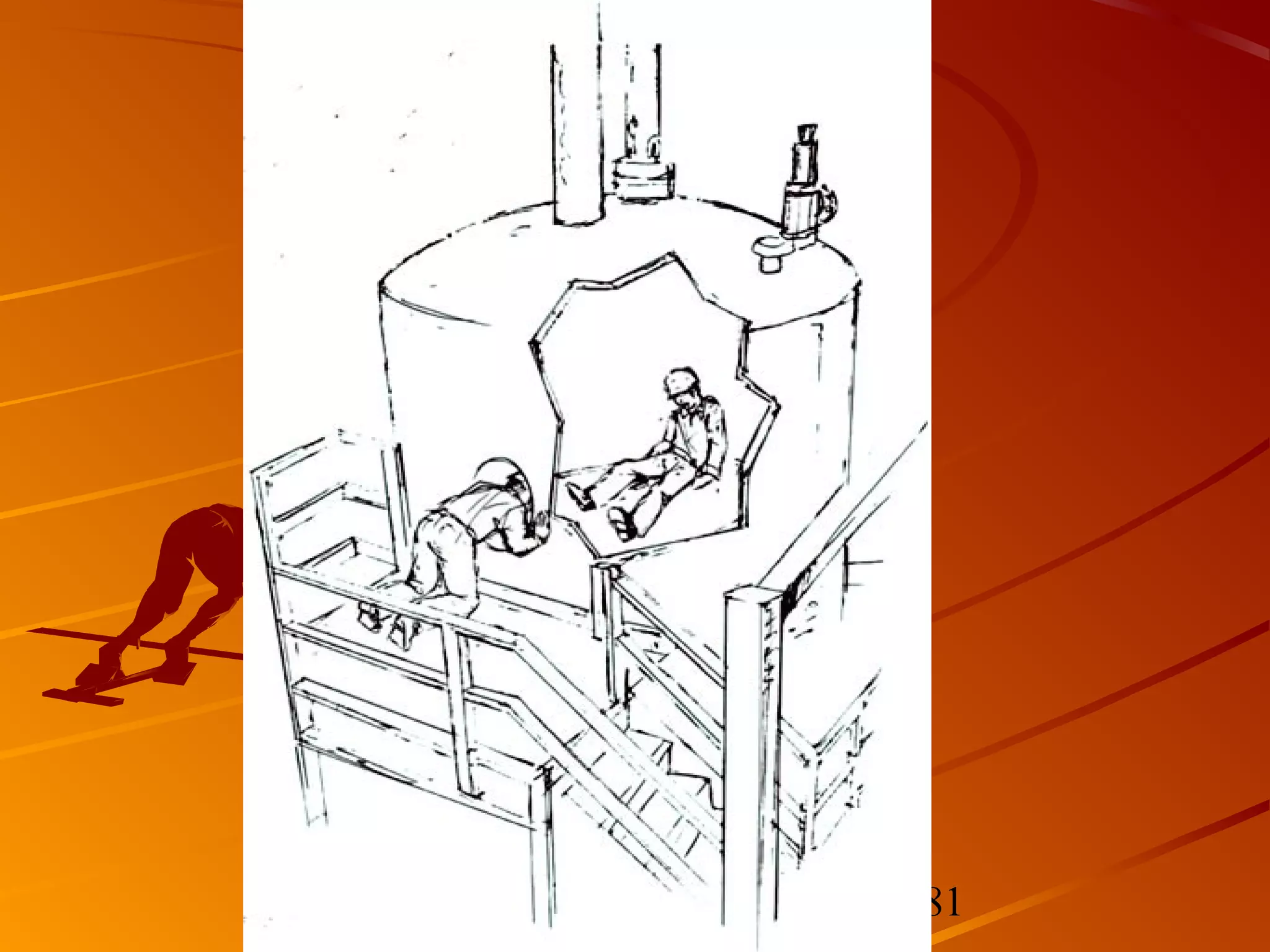
Rescue Operations


               77
78
79
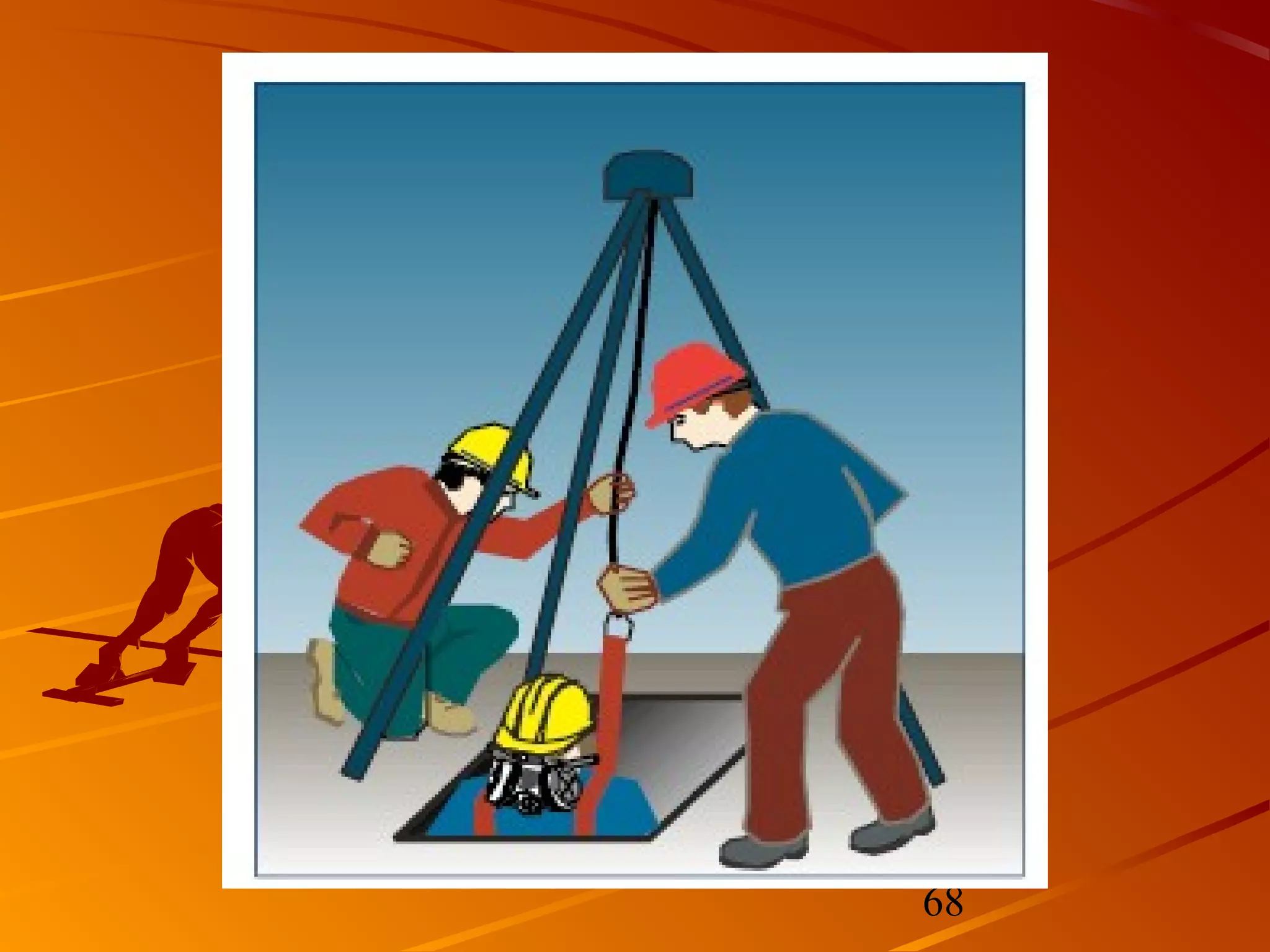
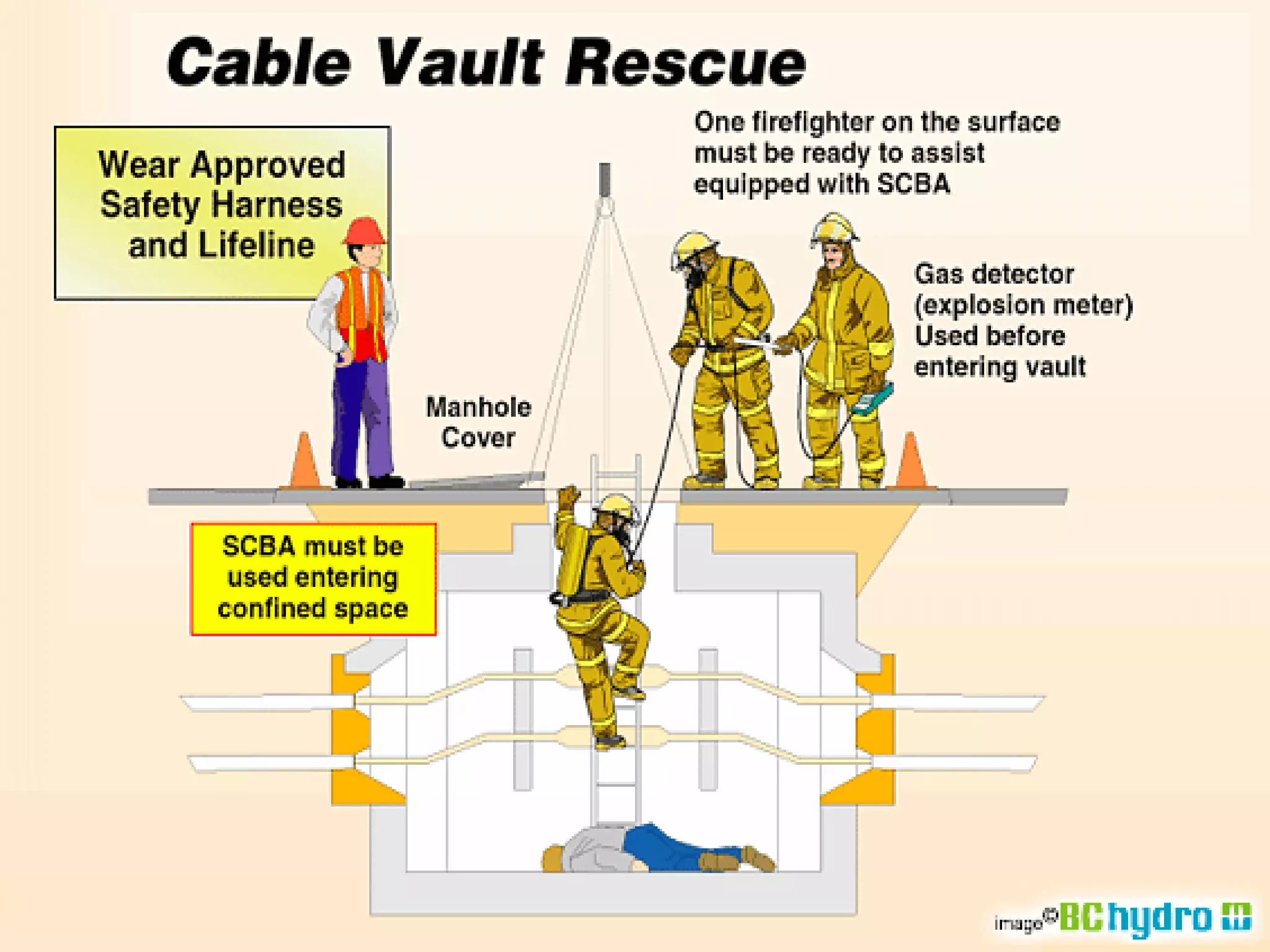
Confined Space Entry
Means of emergency rescue
must be readily available
to the confined space
entry attendant for
emergency
extrication of
entrants.


                            80
81
82
83

Permit Required Confined Spaces

  • 1.
  • 2.
    29 CFR 1910.146 CONFINED SPACE ENTRY
  • 3.
  • 4.
  • 5.
  • 6.
  • 7.
    DO NOT ENTER UNLESSAUTHORIZED AND TRAINED 7
  • 8.
  • 9.
    What is aConfined Space? A space that: Is large enough and so configured that an employee can enter bodily and perform work; Has limited or restricted means of entry or exit; Is not designed for continuous human occupancy. 9
  • 10.
    A space mustmeet all three of these criteria in order to be classified as a confined space. 10
  • 11.
    Examples of Confined Spaces: Tanks Vaults Manholes Pipes Boilers Trenches Furnaces Tunnels Sewers Ducts Silos Bins Hoppers Pits 11
  • 12.
  • 13.
  • 14.
  • 15.
  • 16.
    Tanker trucks are alsoconfined spaces 16
  • 17.
  • 18.
    Potential Hazards in Confined Spaces Oxygen Toxic Materials Deficiency – Carbon Monoxide – <19.5% or – Hydrogen Sulfide >23.5% oxygen – Welding fumes concentration – Corrosives Combustibles Electricity – Methane Mechanical – Hydrogen Hazards – Acetylene – Mixers – Propane – Crushers – Gasoline fumes 18
  • 19.
    Hazards of ConfinedSpaces • Oxygen Deficient Atmospheres • Oxygen Enriched Atmospheres • Flammable Atmospheres • Toxic Atmospheres • Mechanical and Electrical Hazards • Temperature Extremes • Engulfment Hazards • Noise, Slick/Wet Surfaces, Falling Objects, rats and snakes. 19
  • 20.
    Oxygen Deficient Atmospheres 19.5 % Minimum acceptable oxygen level. 15 - 19% Decreased ability to work strenuously.Impair coordination. Early symptoms. 12-14% Respiration increases. Poor judgment. 10-12% Respiration increases. Lips blue. 8-10% Mental failure. Fainting. Nausea Unconsciousness. Vomiting. 6-8% 8 minutes - fatal, 6 minutes – 50% fatal 4-5 minutes – possible recovery. 4-6% Coma in 40 seconds. 20 Death
  • 21.
    Hazards of confinedspaces Oxygen Level 23.5% Too much, oxygen enriched Safe Zone - Minimum for safe entry 19.5% Impaired judgement & 16% breathing Faulty judgement, rapid 14% fatigue Difficult breathing, death in 6% minutes 21 5b
  • 22.
  • 23.
  • 24.
    Oxygen Enriched Atmospheres •Oxygenlevel above 23.5%. •Causes flammable and combustible materials to burn violently when ignited. •Hair, clothing, materials, etc. •Oil soaked clothing and materials. •Never use pure oxygen to ventilate. •Never store or place compressed tanks in a confined space. 24
  • 25.
    Flammable Atmospheres • 2Critical Factors: – Oxygen content in the air. – Presence of a flammable gas, or vapor – Presence of dust (visibility of 5’ or less) • Proper air/gas mixture can lead to explosion • Typical Ignition Sources: – Sparking or electric tool. – Welding / cutting operations. – Smoking 25
  • 26.
  • 27.
    Flammable Atmospheres Non-flammable (Too “Rich”) Flammable Flammable Region V A P Non-flammable O (Too “Lean”) R Temperature 27
  • 28.
    Toxic Atmospheres • Productstored in a confined space: Gases released when cleaning. Materials absorbed into walls of confined space. Decomposition of materials in the confined space. • Work performed in a confined space: Welding, cutting, brazing, soldering. Painting, scraping, sanding, degreasing. Sealing, bonding, melting. • Areas adjacent to a confined space. 28
  • 29.
    Hydrogen Sulfide • Decompositionof materials. Human waste. • Rotten egg odor at low concentrations. • Possibly no warning at high concentrations. PPM Effect Time 10 ppm Permissible Exposure Level 8 Hours 50 - 100 Mild Irritation - eyes, throat 1 Hour 200 - 300 Significant Irritation 1 Hour 500 -700 Unconsciousness, Death 1/2 - 1 Hour >1000 Unconsciousness, Death Minutes 29
  • 30.
    Carbon Monoxide • Odorless,Colorless Gas. • Combustion By-Product. • Quickly collapse at high concentrations. PPM Effect Time 35 Permissible Exposure Level 8 Hours 200 Slight headache, discomfort 3 Hours 600 Headache, discomfort 1 Hour 1000-2000 Confusion, nausea, headache 2 Hours 1000-2000 Tendency to stagger 1 1/2 Hours 1000-2000 Slight heart palpitation 30 Min. 2000-2500 Unconsciousness 30 30 Min.
  • 31.
    Engulfment Hazards •Loose, granularmaterials stored in bins and hoppers - grain, sand, coal, etc. •Crusting and bridging below a worker. •Flooding of confined space. •Water or sewage flow. 31
  • 32.
    Engulfment Examples of flowablesolids that may present an engulfment hazard include grain, sand, sawdust, gravel, and plastic pellets. 32
  • 33.
    Confined Space Entry- Hazards Sudden releases of fluid solids, such as When torrential forces granulated salt, sugar, are suddenly released, or sand, liquids, and people may be struck dense gases can cause by moving objects , or engulfment of persons be pushed helplessly inside underground downstream. tanks, or pits. 33
  • 34.
    Other Hazards •Noise Amplified due to acoustics within the space. Damaged hearing, affect communication. •Slick / Wet Surfaces Slips and falls. Increased chance of electric shock. •Falling Objects Topside openings expose workers inside confined space to falling objects. 34
  • 35.
  • 36.
    Testing The Atmosphere •Verifypresence of safe work atmosphere. •Test all areas of a confined space. – Top, Middle, Bottom •Methane is lighter than air. •Carbon Monoxide is the same as air. •Hydrogen Sulfide is heavier than air. •Oxygen Deficiency. 36
  • 37.
    Test the Atmosphere Inthis order: Check for Oxygen Content: – At least 19.5% and less than 23.5% Check for Combustibles: – Less than 10% of the LEL Check for Toxic Gasses: – Most commonly carbon monoxide (PEL <35 ppm) – or any other hazardous materials as determined by the use of the space. 37
  • 38.
  • 39.
    Ventilation •First option tocorrect problems. •Must be aware of hazards you are trying to correct in the confined space. •Air intake in a safe location to draw fresh air only. •Continuous ventilation whenever possible. •Retest the confined space before entry. 39
  • 40.
    Ventilate the Space Usemechanical ventilation – Fans – Air horns Ventilate at the rate of at least twenty (20) volumes per hour – Larger spaces require more ventilation Make sure air supply is not contaminated – Ventilation air supply must be from fresh air uncontaminated with flammables, toxins, etc. 40
  • 41.
    LESSON 3 VENTILATING THESPACE Use mechanical ventilation - such as fans or forced air blowers Make sure air supply is not contaminated - ventilation air supply must be from fresh air uncontaminated with flammables, toxins, etc.
  • 42.
  • 43.
  • 44.
    Examples of PositiveVentilation 44
  • 45.
  • 46.
  • 47.
    Remember, ventilation must becontinuous during entry! 47
  • 48.
    Other Control Techniques Inerting (Note: Inerting with a gas such as nitrogen or carbon dioxide will result in an oxygen deficient atmosphere)  Flushing 48
  • 49.
    Isolate the Space from all hazards Close Valves – Double block & bleed, or – Blank flange Empty the Space – Depressurize, vent & drain Lockout/Tagout Equipment – Electrical sources – Rotating/reciprocating parts – Hazardous materials Clean residue from the space49
  • 50.
  • 51.
  • 52.
  • 53.
  • 54.
    Conduct a TailboardBriefing Entire crew must attend – Attendants, entrants, entry supervisor Review hazards of entry and work Review PPE Review procedure for contacting rescue – verify rescue available Complete permit 54
  • 55.
    Complete Entry PermitForm Permit must be correctly and completely filled out prior to entry. Permit must be activated by Entry Supervisor’s signature to be valid. No entry is allowed without a valid permit. Permits are valid for up to 12 hours. When work is completed, permit and tailboard form should be returned to safety. Cancelled permits must be kept on file for at least one year. 55
  • 56.
  • 57.
    Test the Atmosphere Inthis order: Check for Oxygen Content: – At least 19.5% and less than 23.5% Check for Combustibles: – Less than 10% of the LEL Check for Toxic Gasses: – Most commonly carbon monoxide (PEL <35 ppm) – or any other hazardous materials as determined by the use of the space. 57
  • 58.
    NOTICE: Any time alimit is exceeded, no matter what the reason, all personnel shall immediately exit the space, and no others shall enter until atmospheric conditions are returned to safe levels. THERE ARE NO EXCEPTIONS TO THIS! 58
  • 59.
    Atmosphere Testing Shall Be Performed: Prior to every entry when the space is vacant; After a 10 minute ventilation period (if ventilation is necessary); At least hourly for permit- required confined spaces. More frequently, if conditions or suspicions warrant. 59
  • 60.
    Enter the Spaceand Proceed with work: An attendant shall be posted near the entrance for the duration of the work. He shall be in constant communication with the entrants while the job is in progress. All entrants shall sign the sign in log when entering the space and sign out when exiting. The attendant shall maintain the permit and sign in log for the duration of the work. 60
  • 61.
  • 62.
    When the Jobis Done: Remove all personnel, tools, and debris from the space. Sign off the log. Close the space. Cancel the permit. Review the job with the host employer (hazards, problems, other employers, etc.) 62
  • 63.
    Confined Space Personnel AuthorizedEntrant Attendant Entry Supervisor Rescue Service Member
  • 64.
  • 65.
  • 66.
  • 67.
  • 68.
  • 69.
    Rescue and Emergency procedures 69
  • 70.
  • 71.
    Entrant Responsibilities To assurethat the space has been adequately ventilated, isolated, emptied, or otherwise made safe for entry. To immediately exit a space, without question, upon word of the attendant, no matter what the reason. To follow all safety rules and procedures that apply to the job. To be familiar with the work to be performed and the procedures that apply to the job. To use the appropriate PPE whenever necessary. 71
  • 72.
    Attendant  An individualstationed outside one or more permit spaces who monitors the authorized entrants and performs all attendant’s duties assigned in the employer’s permit space program 72
  • 73.
    Duties of Attendants Knowledge of the hazards of the space  Aware of possible behavioral effects of hazard exposure in authorized entrants  Continuously maintains an accurate count of authorized entrants 73
  • 74.
    Duties of Attendants Remainsoutside the space during operations until relieved by another attendant Communicates with authorized entrants Monitors activities inside and outside the space 74
  • 75.
    Duties of Attendants Summons rescue and other emergency services  Performs non-entry rescues as specified by the employer's rescue procedure  Performs NO duties that might interfere with monitoring and protecting the entrants 75
  • 76.
    Supervisor Responsibilities To assure adequate protection is provided to the entrants by verifying adequate lockout/tagout and that all hazards are securely isolated. To support the attendant’s authority in controlling access to a confined space. To verify that all personnel have exited prior to closing the space. To assure that all personnel involved are aware of the hazards associated with the space. To assure that rescue services are available prior to entry. 76
  • 77.
  • 78.
  • 79.
  • 80.
    Confined Space Entry Meansof emergency rescue must be readily available to the confined space entry attendant for emergency extrication of entrants. 80
  • 81.
  • 82.
  • 83.