The Practical Guide to Hazardous Area Classification


        By Abhisam Software


        © Copyright 2009-2010 Abhisam Software. All rights reserved.


                                                                       1
The Practical Guide to Hazardous Area Classification


           STOP! DID YOU PAY FOR THIS EBOOK?
          YOU COULD HAVE GOT IT FREE IF YOU HAD
          PURCHASED THE HAZARDOUS AREA
          INSTRUMENTATION COURSE.
                     IT IS STILL NOT TOO LATE NOW !
          IF YOU WOULD LIKE TO OWN THIS EBOOK FREE,
          PLEASE DOWNLOAD THE
          HAZARDOUS AREA INSTRUMENTATION COURSE
          Please send an email along with your proof of purchase of this book, to
          sales@bin95.com to get the coupon code to get a credit of $17 that you have paid for
          this book, when you order the HAZARDOUS AREA INSTRUMENTATION e-learning
          course from http://www.bin95.com/ebooks/hazardous_area_instrumentation.htm


                                                                                                 2
The Practical Guide to Hazardous Area Classification


        Copyright Information
        © 2009-2010 Abhisam Software. All Rights reserved. No part of this publication
        may be reproduced or transmitted in any form or by any means, mechanical or
        electronic, including photocopying or recording, or by any information storage
        and retrieval system, or transmitted by email without permission in writing from
        the author and publisher.


        Published By
        Abhisam Software,
        First Edition -2009
        Second Edition -2010


        www.abhisam.com


                                                                                       3
The Practical Guide to Hazardous Area Classification


          Disclaimer: Nothing that is stated or construed by reading the contents of this book can be
          claimed to be safety advice in the legal sense. You are urged to refer to your own local
          regulations, national and international standards for the exact regulations that may apply to
          you. This guide book is to make the task of understanding the various codes and standards,
          much easier and to give you broad guidelines and a roadmap to help your plant or facility
          become a better and safer place. While all attempts have been made to verify the information
          provided in this publication, neither the author nor the publisher assumes any responsibility
          for errors, omissions, or contrary interpretations of the subject matter herein. The publisher
          wants to stress that the information contained herein may be subject to varying international,
          federal, state, and/or local laws or regulations. The purchaser or reader of this publication
          assumes responsibility for the use of these materials and information. Adherence to all
          applicable laws and regulations, including international, federal, state and local governing
          professional licensing, business practices, advertising, and all other aspects of doing
          business in the EU, US, Canada or any other jurisdiction is the sole responsibility of the
          purchaser or reader. Neither the author nor the publisher assume any responsibility or liability
          whatsoever on the behalf of the purchaser or reader of these materials. While due care has
          been taken to review and verify the accuracy, reliability and correctness of the contents of this
          ebook, the publishers are not liable for any direct or indirect or consequential or any other
          kind of damage, which may result from using this ebook and the contents therein.


                                                                                                              4
The Practical Guide to Hazardous Area Classification


        TABLE OF CONTENTS
        Chapter 1       Introduction
                        Introduction to Hazardous Areas
                        Why do we classify Hazardous Areas?


        Chapter 2       Basic Concepts
                        What is a Hazard?
                        What is Risk?
                        Can we avoid risk altogether?
                        Area Classification - A measure of risk
                        Area Classification Benefits
                        How does Area Classification work?
                        How can Area Classification reduce costs?


        Chapter 3       Fire & Explosion Fundamentals
                        Fire
                        Flammable or Hazardous Material
                        Fire Triangle
                        What is an Explosion?
                        Properties of Hazardous Materials
                        LEL & UEL
                        Flash Point
                         Fire Point
                        Auto-ignition
                        Combustible dusts
                        Dust Explosions - Five necessary Factors


        Chapter 4      Fundamental Ideas about Area Classification


        Chapter 5      Standards for Area Classification


                                                                     5
The Practical Guide to Hazardous Area Classification


                        European System / IEC System
                        Zones
                        Groups
                        American System (NEC)
                        Classes
                        Divisions


        Chapter 6      Standards for Classification of Explosive Dusts
                        IEC System
                        North American System


        Chapter 7      Material Classification
                       IEC System
                        North American System


        Chapter 8      Temperature Classification
                        IEC System
                        Example of Temperature Classification
                        North American System


        Chapter 9      Some other important Standard Guidelines
                        ATEX Guidelines
                        ATEX Marking System
                        Equipment Group
                         Equipment Category
                         Substance Group


        Chapter 10 IEC Ex-Unification of the two Systems

        Chapter 11 How to carry out Area Classification
                    Area Classification Myths
                        Myth 1
                        Myth 2


                                                                         6
The Practical Guide to Hazardous Area Classification


                        Myth 3
                        Myth 4
                        Sources of release
                        Relations of Grade with Zones
                        Ventilation Considerations
                        Step by step guide to Area Classification


        Chapter 12 Practical Study of an Area Classification Exercise

        Chapter 13 Consequences of poor Area Classification
                    Over Classification - A white elephant
                        Under Classification - Playing with Fire
                        So now, what do we do?
                        Example 1
                        Example 2
                        Example 3
                        Example 4
                        Example 5


                                                                        7
The Practical Guide to Hazardous Area Classification


        Introduction to hazardous areas
        Many industrial work places produce, process, handle and store materials which
        are potentially explosive and thus hazardous in nature. The risk of fire or
        explosion while handling these materials is high. But it is not just the chemical or
        petrochemical industries that we are talking about here.


        Surprised? You should not be really. Grain storage silos, processing plants that
        handle large amounts of powders (including flour milling units), coal mining and
        handling plants, large oil supertankers, all handle materials, that could possibly
        lead to fires and explosions. Other typical examples, include offshore and
        onshore oil & gas production platforms, oil refineries, ships carrying chemical
        containers, storage terminals at ports, large tank farms, pulp & paper industries,
        industrial warehouses, gas based power plants and even gasoline filling stations.


        Potentially explosive atmospheres, need not be generated in only these
        obviously hazardous areas. A location which looks innocuous enough, like a
        grain silo can also be classified as a hazardous area, because grain dust can
        also be explosive. In fact, dust explosions can sometimes be more severe than
        even gas or vapor explosions. Therefore grain elevators & associated equipment
        like bucket elevators and conveyors carrying grain, which have a large amount of
        grain dust are also classified as hazardous areas. Similar powder processing
        plants like those handling coal dust, flour or cotton fibers can also be classified
        as hazardous (dust) locations.


        These areas are prone to risk of fires and explosions due to the nature of the
        materials handled and hence need a different approach than other “normal”
        areas. If proper area classification and safety engineering practices are followed
        while working in these areas, we can greatly reduce the risk of fire and explosion
        hazards in these places. This “practical” guide book is meant to be used as the
        name suggests-to get a working idea of how hazardous area classification works,


                                                                                          8
The Practical Guide to Hazardous Area Classification


        how you can use it to your advantage, by reducing the costs of compliance-but
        without compromising in any way, on the actual safety of your plant.


        It is intended for all those people who are involved in working in hazardous areas,
        whether as a plant engineer, or instrument technician or a safety supervisor. It
        should be noted that this book does not contain complicated math or partial
        differential equations (that may induce sleep in the best of practising engineers).


        Why do we classify hazardous areas?
        This is the first fundamental question that begs an answer. Why do we classify
        areas and the materials present in these areas and call them “hazardous”? The
        reason is, that general purpose electrical equipment, like motors or lamps,
        cannot be used in these areas without having some kind of protection against
        accidental ignition. Nor can we use general purpose electrical or electronic
        instruments like transmitters or local indicators. This is because all electrical
        equipment can produce energy in the form of sparks, which can ignite these
        hazardous materials and /or cause explosions, thereby causing catastrophic
        damage.


        Hence, in hazardous areas we use special purpose, “explosion protected”
        electrical equipment and instruments.


        Note that the mere presence of flammable materials or explosive dusts in an
        area, does not immediately mean that the risk of fire or explosion is high. The
        flammable vapor or gas, has to be a part of a mixture with air, which can then
        easily ignite or explode, if some more conditions are met. Since these conditions
        are not uniformly present throughout a place that handles these materials, we
        have the concept of classification.


        It is to be noted that “hazardous area classification” is to be done for areas of the
        plant that would have instances of flammable mixtures of vapors, gases or dusts

                                                                                              9
The Practical Guide to Hazardous Area Classification


        in the day to day operations. Under unusual conditions like a catastrophic
        accidental release of a large quantity of inflammable vapors for example, this is
        not applicable, as such situations are not easily predictable. Under the usual day
        to day operational conditions in a plant or facility, there are some areas, which
        would have the presence of flammable mixtures of vapors, gases or dusts. Thus,
        the vapor space in a storage tank, the area around a mechanical seal of a pump
        or agitator, the area surrounding a breather valve on a storage tank (that
        contains flammable liquids), are all hazardous areas, which need to be classified.
        We classify some areas as “more prone” to the risk of fire and or explosion and
        others as “less prone”. We may find some areas, that are not at all prone to any
        kind of fire or explosion, except in the rarest of circumstances. For example, if an
        industrial facility has large open spaces and the office building is located several
        hundred meters away from the plant that actually processes the hazardous
        materials, then the chance of an explosion occurring in the office block, is very
        less (assuming some other conditions that will be explained later).


        How we do this segregation and classification in a structured manner, will be the
        main subject of this book, area classification.


        Before we jump headlong into area classification, let us understand some basic
        concepts first.


                                                                                          10
The Practical Guide to Hazardous Area Classification


        Basic Concepts
        What is a hazard?
        A hazard is an inherent attribute or feature of a material, that can cause harm to
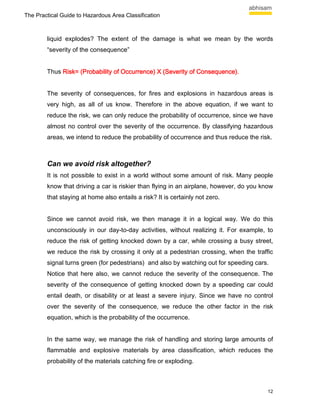
        equipment, people or the environment. An example of a hazard is a large
        quantity of flammable gas stored at a high pressure in a tank. Thus a plant
        having a large quantity of a flammable gas stored in a tank, as shown in the
        picture below, is an example of a hazard.


                                              Fig 1: A Hazard


        What is Risk?
        Risk is the measure of the likelihood, that the undesired event or accident will
        actually occur. Thus if a plant stores a large quantity of flammable gas as
        described above, but has a lot of safety systems in place to ensure that the gas
        does not leak, ignite or explode, or cause an accident in other ways, then the
        likelihood of an accident happening, is very less, therefore, one can say that the
        risk is low. Risk is also dependent on the severity of the consequences. The
        severity of the consequence means in simple words “how bad”. For example how
        bad will it be if a large storage tank of Acetone, a highly volatile and inflammable


                                                                                          11
The Practical Guide to Hazardous Area Classification


        liquid explodes? The extent of the damage is what we mean by the words
        “severity of the consequence”


        Thus Risk= (Probability of Occurrence) X (Severity of Consequence).
                                                              Consequence)


        The severity of consequences, for fires and explosions in hazardous areas is
        very high, as all of us know. Therefore in the above equation, if we want to
        reduce the risk, we can only reduce the probability of occurrence, since we have
        almost no control over the severity of the occurrence. By classifying hazardous
        areas, we intend to reduce the probability of occurrence and thus reduce the risk.


        Can we avoid risk altogether?
        It is not possible to exist in a world without some amount of risk. Many people
        know that driving a car is riskier than flying in an airplane, however, do you know
        that staying at home also entails a risk? It is certainly not zero.


        Since we cannot avoid risk, we then manage it in a logical way. We do this
        unconsciously in our day-to-day activities, without realizing it. For example, to
        reduce the risk of getting knocked down by a car, while crossing a busy street,
        we reduce the risk by crossing it only at a pedestrian crossing, when the traffic
        signal turns green (for pedestrians) and also by watching out for speeding cars.
        Notice that here also, we cannot reduce the severity of the consequence. The
        severity of the consequence of getting knocked down by a speeding car could
        entail death, or disability or at least a severe injury. Since we have no control
        over the severity of the consequence, we reduce the other factor in the risk
        equation, which is the probability of the occurrence.


        In the same way, we manage the risk of handling and storing large amounts of
        flammable and explosive materials by area classification, which reduces the
        probability of the materials catching fire or exploding.


                                                                                         12
The Practical Guide to Hazardous Area Classification


        Hazardous Area Classification- A measure of risk
        Hazardous Area classification tries to give a profile of the risk of explosion in
        these areas. It cannot predict definitively, that an explosion will or will not take
        place in that area. It only segregates areas into areas where the likelihood of an
        explosion is more and areas where the likelihood is low or improbable. The
        classification provides us a tool to mitigate the risk of explosion in such areas.


        Area Classification-What are the benefits?
        If properly carried out, an area classification can


            a) Give us a risk profile of the plant or facility, to enable us to operate it safer.
               This enables top management to really understand the real risk of the
               facility and then come up with appropriate strategies to mitigate this risk.


            b) Enable us to design and install electrical, instrumentation and control
               system equipment that will not cause fires or explosions, at an optimum
               cost.


            c) Reduce the costs of compliance to regulations and standards without
               compromising on the safety.


            d) Make the overall operations safer and more profitable.


        How does Area Classification work?
        By properly and judiciously designating certain areas of the plant or facility, as
        hazardous (with its subdivisions of Zone 0,1 and 2 or Division 1 and Division 2)
        we can know which areas of the plant are more hazardous (and need special
        attention or equipment) and which are less hazardous. We can also know which
        areas are safe (well, almost). This gives a proper risk profile to the top
        management

                                                                                               13
The Practical Guide to Hazardous Area Classification


        ------------------------------------------END OF PREVIEW---------------------------------------


        To get the full ebook, please visit the following link
        http://www.bin95.com/ebooks/hazardous_area_classification.htm


                                                                                                     14

The Practical Guide to Hazardous Area Classification eBook

  • 1.
    The Practical Guideto Hazardous Area Classification By Abhisam Software © Copyright 2009-2010 Abhisam Software. All rights reserved. 1
  • 2.
    The Practical Guideto Hazardous Area Classification STOP! DID YOU PAY FOR THIS EBOOK? YOU COULD HAVE GOT IT FREE IF YOU HAD PURCHASED THE HAZARDOUS AREA INSTRUMENTATION COURSE. IT IS STILL NOT TOO LATE NOW ! IF YOU WOULD LIKE TO OWN THIS EBOOK FREE, PLEASE DOWNLOAD THE HAZARDOUS AREA INSTRUMENTATION COURSE Please send an email along with your proof of purchase of this book, to sales@bin95.com to get the coupon code to get a credit of $17 that you have paid for this book, when you order the HAZARDOUS AREA INSTRUMENTATION e-learning course from http://www.bin95.com/ebooks/hazardous_area_instrumentation.htm 2
  • 3.
    The Practical Guideto Hazardous Area Classification Copyright Information © 2009-2010 Abhisam Software. All Rights reserved. No part of this publication may be reproduced or transmitted in any form or by any means, mechanical or electronic, including photocopying or recording, or by any information storage and retrieval system, or transmitted by email without permission in writing from the author and publisher. Published By Abhisam Software, First Edition -2009 Second Edition -2010 www.abhisam.com 3
  • 4.
    The Practical Guideto Hazardous Area Classification Disclaimer: Nothing that is stated or construed by reading the contents of this book can be claimed to be safety advice in the legal sense. You are urged to refer to your own local regulations, national and international standards for the exact regulations that may apply to you. This guide book is to make the task of understanding the various codes and standards, much easier and to give you broad guidelines and a roadmap to help your plant or facility become a better and safer place. While all attempts have been made to verify the information provided in this publication, neither the author nor the publisher assumes any responsibility for errors, omissions, or contrary interpretations of the subject matter herein. The publisher wants to stress that the information contained herein may be subject to varying international, federal, state, and/or local laws or regulations. The purchaser or reader of this publication assumes responsibility for the use of these materials and information. Adherence to all applicable laws and regulations, including international, federal, state and local governing professional licensing, business practices, advertising, and all other aspects of doing business in the EU, US, Canada or any other jurisdiction is the sole responsibility of the purchaser or reader. Neither the author nor the publisher assume any responsibility or liability whatsoever on the behalf of the purchaser or reader of these materials. While due care has been taken to review and verify the accuracy, reliability and correctness of the contents of this ebook, the publishers are not liable for any direct or indirect or consequential or any other kind of damage, which may result from using this ebook and the contents therein. 4
  • 5.
    The Practical Guideto Hazardous Area Classification TABLE OF CONTENTS Chapter 1 Introduction Introduction to Hazardous Areas Why do we classify Hazardous Areas? Chapter 2 Basic Concepts What is a Hazard? What is Risk? Can we avoid risk altogether? Area Classification - A measure of risk Area Classification Benefits How does Area Classification work? How can Area Classification reduce costs? Chapter 3 Fire & Explosion Fundamentals Fire Flammable or Hazardous Material Fire Triangle What is an Explosion? Properties of Hazardous Materials LEL & UEL Flash Point Fire Point Auto-ignition Combustible dusts Dust Explosions - Five necessary Factors Chapter 4 Fundamental Ideas about Area Classification Chapter 5 Standards for Area Classification 5
  • 6.
    The Practical Guideto Hazardous Area Classification European System / IEC System Zones Groups American System (NEC) Classes Divisions Chapter 6 Standards for Classification of Explosive Dusts IEC System North American System Chapter 7 Material Classification IEC System North American System Chapter 8 Temperature Classification IEC System Example of Temperature Classification North American System Chapter 9 Some other important Standard Guidelines ATEX Guidelines ATEX Marking System Equipment Group Equipment Category Substance Group Chapter 10 IEC Ex-Unification of the two Systems Chapter 11 How to carry out Area Classification Area Classification Myths Myth 1 Myth 2 6
  • 7.
    The Practical Guideto Hazardous Area Classification Myth 3 Myth 4 Sources of release Relations of Grade with Zones Ventilation Considerations Step by step guide to Area Classification Chapter 12 Practical Study of an Area Classification Exercise Chapter 13 Consequences of poor Area Classification Over Classification - A white elephant Under Classification - Playing with Fire So now, what do we do? Example 1 Example 2 Example 3 Example 4 Example 5 7
  • 8.
    The Practical Guideto Hazardous Area Classification Introduction to hazardous areas Many industrial work places produce, process, handle and store materials which are potentially explosive and thus hazardous in nature. The risk of fire or explosion while handling these materials is high. But it is not just the chemical or petrochemical industries that we are talking about here. Surprised? You should not be really. Grain storage silos, processing plants that handle large amounts of powders (including flour milling units), coal mining and handling plants, large oil supertankers, all handle materials, that could possibly lead to fires and explosions. Other typical examples, include offshore and onshore oil & gas production platforms, oil refineries, ships carrying chemical containers, storage terminals at ports, large tank farms, pulp & paper industries, industrial warehouses, gas based power plants and even gasoline filling stations. Potentially explosive atmospheres, need not be generated in only these obviously hazardous areas. A location which looks innocuous enough, like a grain silo can also be classified as a hazardous area, because grain dust can also be explosive. In fact, dust explosions can sometimes be more severe than even gas or vapor explosions. Therefore grain elevators & associated equipment like bucket elevators and conveyors carrying grain, which have a large amount of grain dust are also classified as hazardous areas. Similar powder processing plants like those handling coal dust, flour or cotton fibers can also be classified as hazardous (dust) locations. These areas are prone to risk of fires and explosions due to the nature of the materials handled and hence need a different approach than other “normal” areas. If proper area classification and safety engineering practices are followed while working in these areas, we can greatly reduce the risk of fire and explosion hazards in these places. This “practical” guide book is meant to be used as the name suggests-to get a working idea of how hazardous area classification works, 8
  • 9.
    The Practical Guideto Hazardous Area Classification how you can use it to your advantage, by reducing the costs of compliance-but without compromising in any way, on the actual safety of your plant. It is intended for all those people who are involved in working in hazardous areas, whether as a plant engineer, or instrument technician or a safety supervisor. It should be noted that this book does not contain complicated math or partial differential equations (that may induce sleep in the best of practising engineers). Why do we classify hazardous areas? This is the first fundamental question that begs an answer. Why do we classify areas and the materials present in these areas and call them “hazardous”? The reason is, that general purpose electrical equipment, like motors or lamps, cannot be used in these areas without having some kind of protection against accidental ignition. Nor can we use general purpose electrical or electronic instruments like transmitters or local indicators. This is because all electrical equipment can produce energy in the form of sparks, which can ignite these hazardous materials and /or cause explosions, thereby causing catastrophic damage. Hence, in hazardous areas we use special purpose, “explosion protected” electrical equipment and instruments. Note that the mere presence of flammable materials or explosive dusts in an area, does not immediately mean that the risk of fire or explosion is high. The flammable vapor or gas, has to be a part of a mixture with air, which can then easily ignite or explode, if some more conditions are met. Since these conditions are not uniformly present throughout a place that handles these materials, we have the concept of classification. It is to be noted that “hazardous area classification” is to be done for areas of the plant that would have instances of flammable mixtures of vapors, gases or dusts 9
  • 10.
    The Practical Guideto Hazardous Area Classification in the day to day operations. Under unusual conditions like a catastrophic accidental release of a large quantity of inflammable vapors for example, this is not applicable, as such situations are not easily predictable. Under the usual day to day operational conditions in a plant or facility, there are some areas, which would have the presence of flammable mixtures of vapors, gases or dusts. Thus, the vapor space in a storage tank, the area around a mechanical seal of a pump or agitator, the area surrounding a breather valve on a storage tank (that contains flammable liquids), are all hazardous areas, which need to be classified. We classify some areas as “more prone” to the risk of fire and or explosion and others as “less prone”. We may find some areas, that are not at all prone to any kind of fire or explosion, except in the rarest of circumstances. For example, if an industrial facility has large open spaces and the office building is located several hundred meters away from the plant that actually processes the hazardous materials, then the chance of an explosion occurring in the office block, is very less (assuming some other conditions that will be explained later). How we do this segregation and classification in a structured manner, will be the main subject of this book, area classification. Before we jump headlong into area classification, let us understand some basic concepts first. 10
  • 11.
    The Practical Guideto Hazardous Area Classification Basic Concepts What is a hazard? A hazard is an inherent attribute or feature of a material, that can cause harm to equipment, people or the environment. An example of a hazard is a large quantity of flammable gas stored at a high pressure in a tank. Thus a plant having a large quantity of a flammable gas stored in a tank, as shown in the picture below, is an example of a hazard. Fig 1: A Hazard What is Risk? Risk is the measure of the likelihood, that the undesired event or accident will actually occur. Thus if a plant stores a large quantity of flammable gas as described above, but has a lot of safety systems in place to ensure that the gas does not leak, ignite or explode, or cause an accident in other ways, then the likelihood of an accident happening, is very less, therefore, one can say that the risk is low. Risk is also dependent on the severity of the consequences. The severity of the consequence means in simple words “how bad”. For example how bad will it be if a large storage tank of Acetone, a highly volatile and inflammable 11
  • 12.
    The Practical Guideto Hazardous Area Classification liquid explodes? The extent of the damage is what we mean by the words “severity of the consequence” Thus Risk= (Probability of Occurrence) X (Severity of Consequence). Consequence) The severity of consequences, for fires and explosions in hazardous areas is very high, as all of us know. Therefore in the above equation, if we want to reduce the risk, we can only reduce the probability of occurrence, since we have almost no control over the severity of the occurrence. By classifying hazardous areas, we intend to reduce the probability of occurrence and thus reduce the risk. Can we avoid risk altogether? It is not possible to exist in a world without some amount of risk. Many people know that driving a car is riskier than flying in an airplane, however, do you know that staying at home also entails a risk? It is certainly not zero. Since we cannot avoid risk, we then manage it in a logical way. We do this unconsciously in our day-to-day activities, without realizing it. For example, to reduce the risk of getting knocked down by a car, while crossing a busy street, we reduce the risk by crossing it only at a pedestrian crossing, when the traffic signal turns green (for pedestrians) and also by watching out for speeding cars. Notice that here also, we cannot reduce the severity of the consequence. The severity of the consequence of getting knocked down by a speeding car could entail death, or disability or at least a severe injury. Since we have no control over the severity of the consequence, we reduce the other factor in the risk equation, which is the probability of the occurrence. In the same way, we manage the risk of handling and storing large amounts of flammable and explosive materials by area classification, which reduces the probability of the materials catching fire or exploding. 12
  • 13.
    The Practical Guideto Hazardous Area Classification Hazardous Area Classification- A measure of risk Hazardous Area classification tries to give a profile of the risk of explosion in these areas. It cannot predict definitively, that an explosion will or will not take place in that area. It only segregates areas into areas where the likelihood of an explosion is more and areas where the likelihood is low or improbable. The classification provides us a tool to mitigate the risk of explosion in such areas. Area Classification-What are the benefits? If properly carried out, an area classification can a) Give us a risk profile of the plant or facility, to enable us to operate it safer. This enables top management to really understand the real risk of the facility and then come up with appropriate strategies to mitigate this risk. b) Enable us to design and install electrical, instrumentation and control system equipment that will not cause fires or explosions, at an optimum cost. c) Reduce the costs of compliance to regulations and standards without compromising on the safety. d) Make the overall operations safer and more profitable. How does Area Classification work? By properly and judiciously designating certain areas of the plant or facility, as hazardous (with its subdivisions of Zone 0,1 and 2 or Division 1 and Division 2) we can know which areas of the plant are more hazardous (and need special attention or equipment) and which are less hazardous. We can also know which areas are safe (well, almost). This gives a proper risk profile to the top management 13
  • 14.
    The Practical Guideto Hazardous Area Classification ------------------------------------------END OF PREVIEW--------------------------------------- To get the full ebook, please visit the following link http://www.bin95.com/ebooks/hazardous_area_classification.htm 14