Dust Explosions
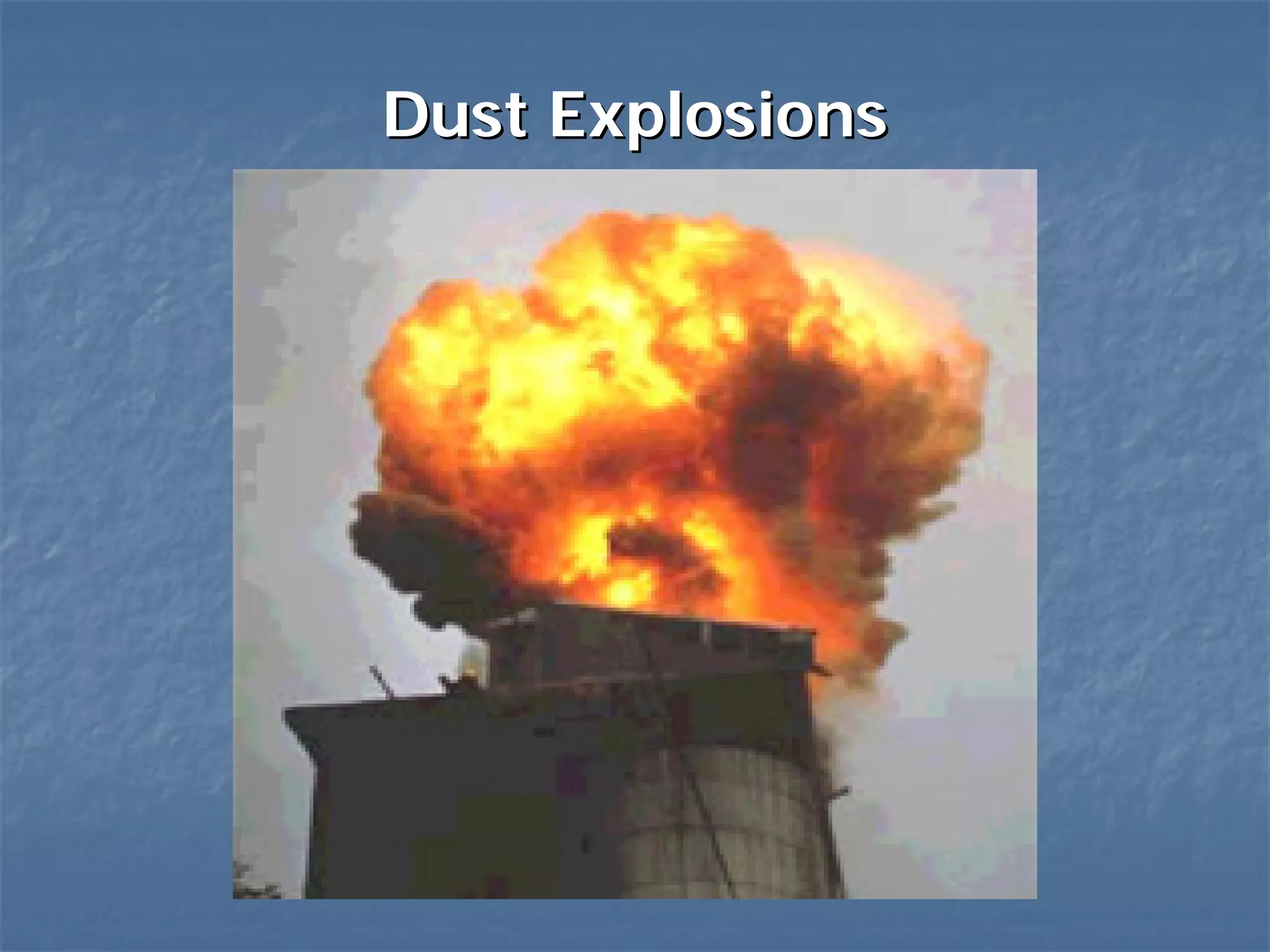
Dust Explosions
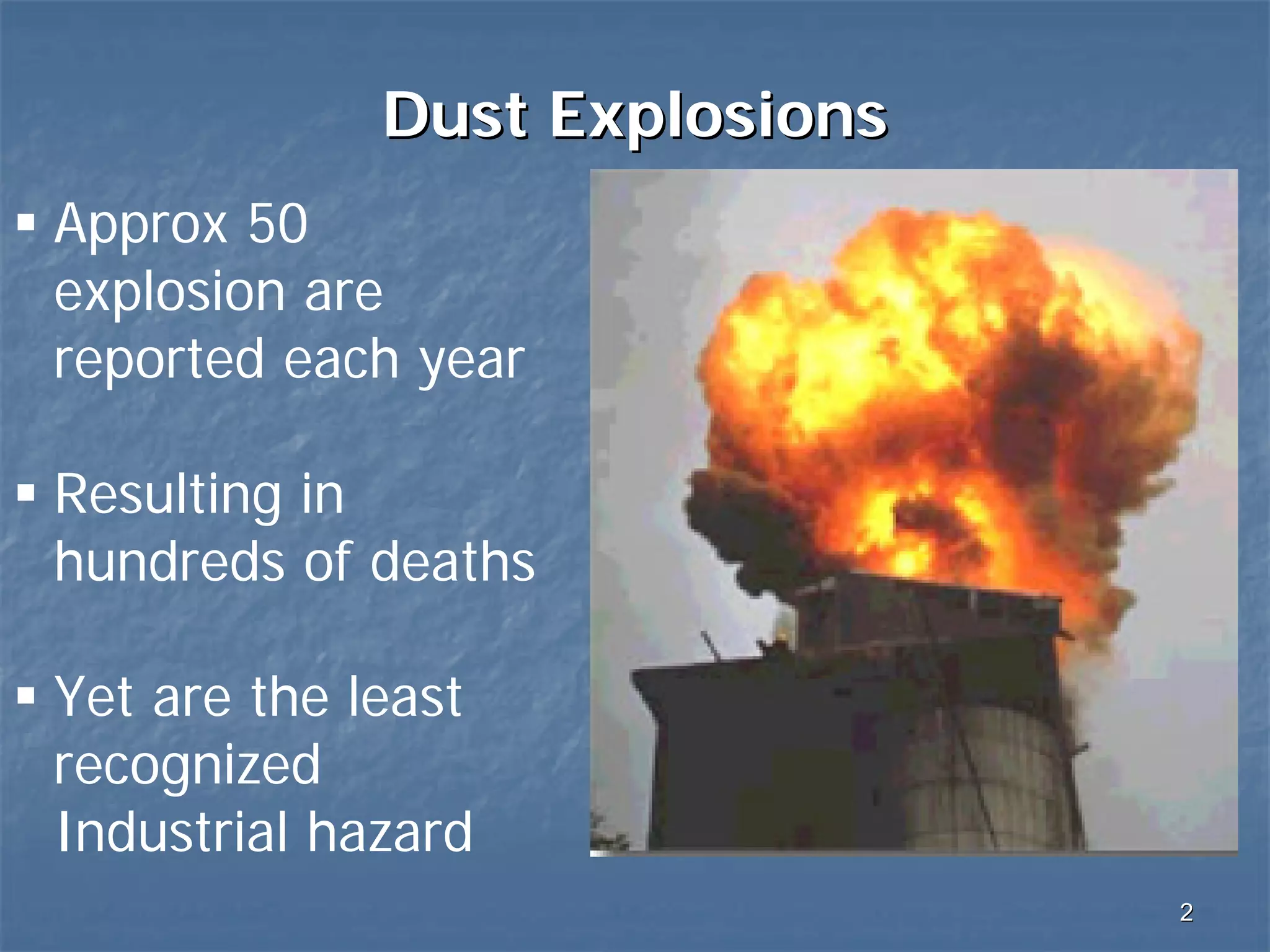
Approx 50
explosion are
reported each year
Resulting in
hundreds of deaths
Yet are the least
recognized
Industrial hazard
2
Dust Explosions
February 1999, Massachusetts
Iron foundry
A small, primary Resin dust
explosion within the ductwork,
fuelled a secondary explosion,
powerful enough to lift the roof
and cause wall failures.
3 people were killed, and 9 were
injured.
3
Dust Explosions
January 2003 – North CarolinaPharmaceutical plant that
manufactures rubber drug
delivery components
A fire and a series of explosions
destroyed the plant with minor
damage surrounding area
6 people killed and 38 injured
including 2 firefighters
4
Dust Explosions
February 2003 - Kentucky
insulation manufacturing plant.
Primary blast was ignited by a
small fire while cleaning
A deadly cascade of dust
explosions followed throughout
the plant.
7 people were killed and 37
injured
5
Dust Explosions
February 2008 – Georgia
Imperial Sugar refinery
Dust Explosions ripped through
the plant destroying 2 silos and
1 building
Seven days to extinguish
13 people were killed and 17
injured
6
Dust Explosions
US Chemical Safety Board (CSB) identified 281
dust fires & explosions between 1980 & 2005
In the USA alone, Dust explosions in the last 25
yrs killed 119 workers and injured 718 others.
Wood & Coal Dust explosions are by far the
leading sources for Explosions
Dust Collection/ Hopper systems are the leading
equipment type for Explosions

7
Dust Explosions
Can occur anywhere combustible dust is
produced
Can be almost any organic material
An Explosion be initiated by any energy
source.
Sparks, Friction, Open Flames, Heat
Usually results in secondary explosions

8
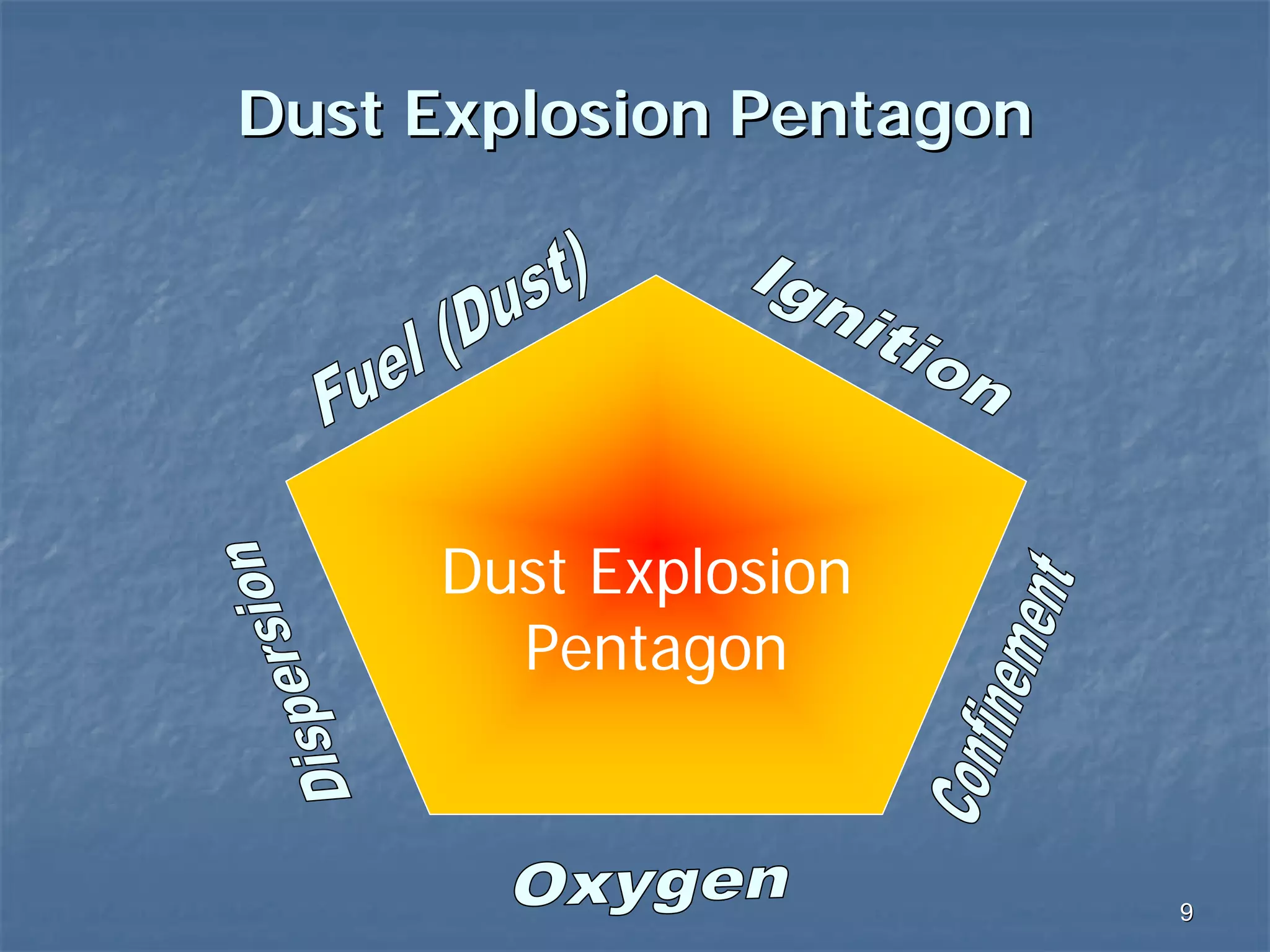
Dust Explosion Pentagon

Dust Explosion
Pentagon

9
Dust Explosions
Rules for dust explosions.
Must be combustible.
Dust cloud must be confined.
Capable of becoming airborne.
Size & distribution = flame spread.
Explosive range 50g/m3 to 23kg/m3
10
Dust Explosions
Dust / Powders that CAN Explode
Natural Organic materials (grains, linen,
sugar, coal, peat)
Synthetic Organic materials (pesticides,
plastics, resins)
Metals ( aluminum, zinc, iron)
Any Unstable Oxide
11
Dust Explosions
Dust / Powders that WILL NOT Explode
Silicates, Sulphates
Nitrates,Carbonates,Phosphates
Cement, Sand, limestone
Any Stable Oxide

12
Dust Explosions
Glass breaks at 50 kpa (7 psi.)
Wood frame at 56-70 kpa (8-10 psi.)
Reinforced concrete 70-85 kpa (10-12 psi.)

FORCE FROM DUST EXPLOSIONS
CAN EXCEED 700 kpa or 100 PSI
13
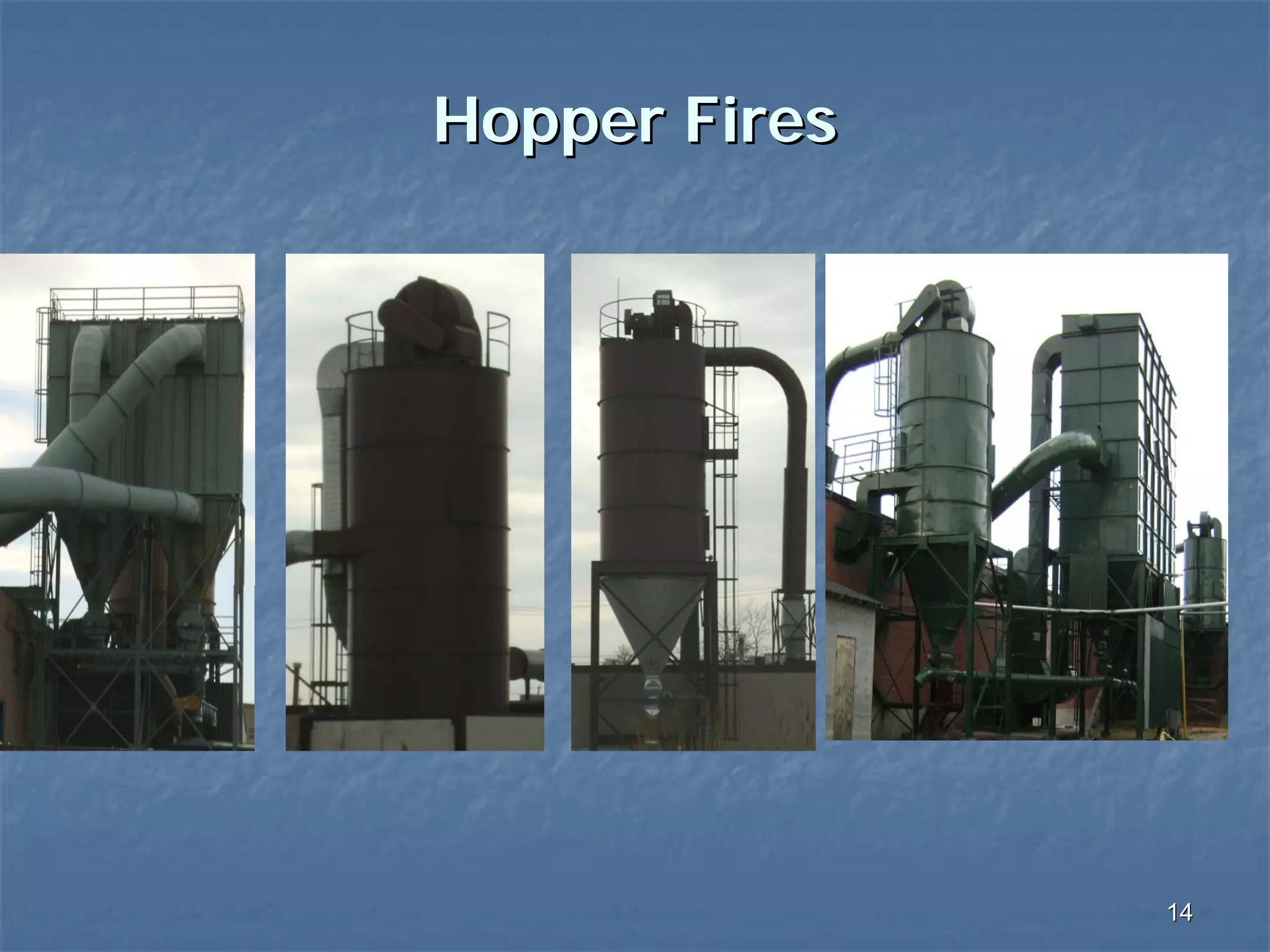
Hopper Fires

14
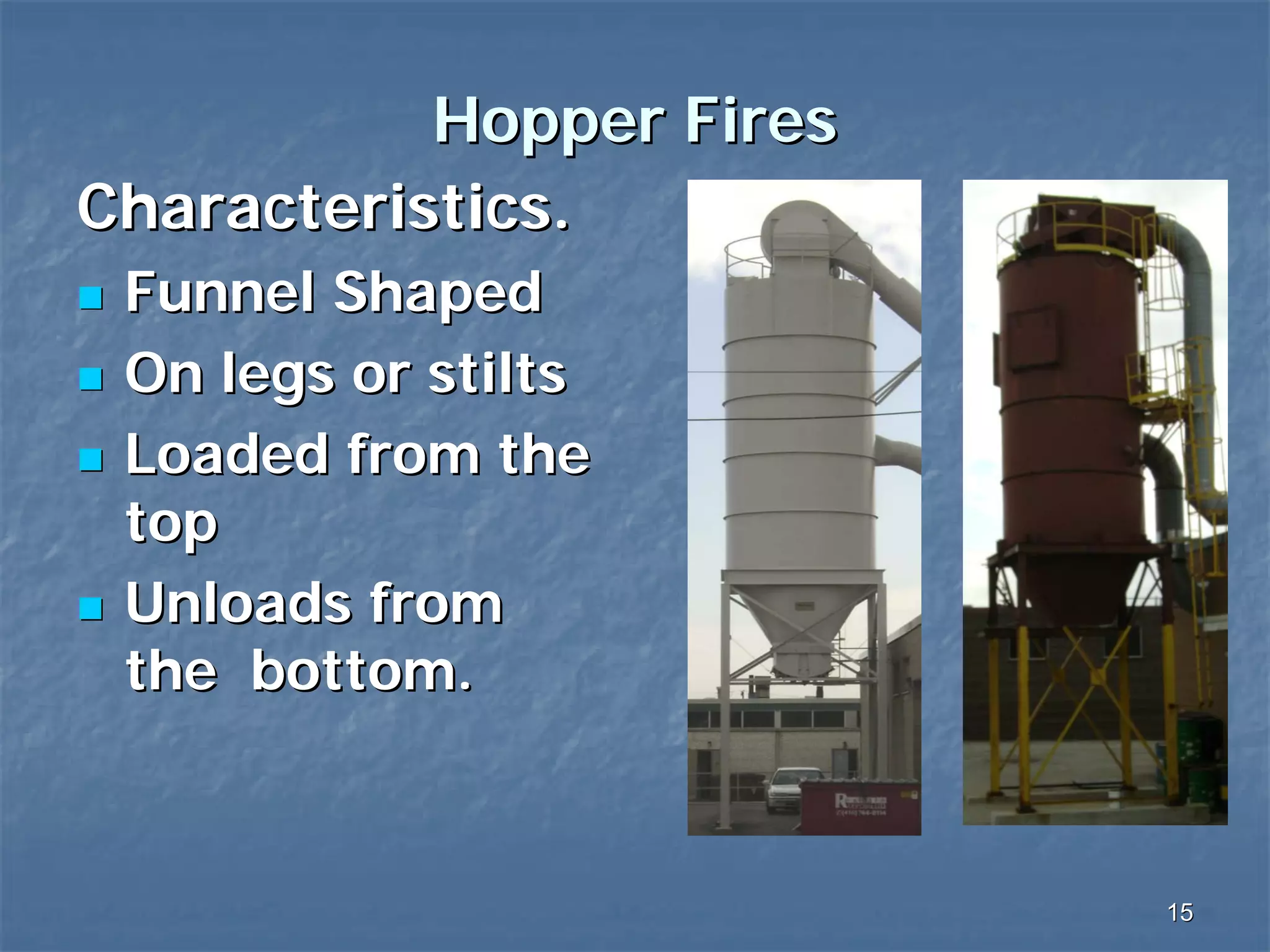
Hopper Fires
Characteristics.
Funnel Shaped
On legs or stilts
Loaded from the
top
Unloads from
the bottom.

15
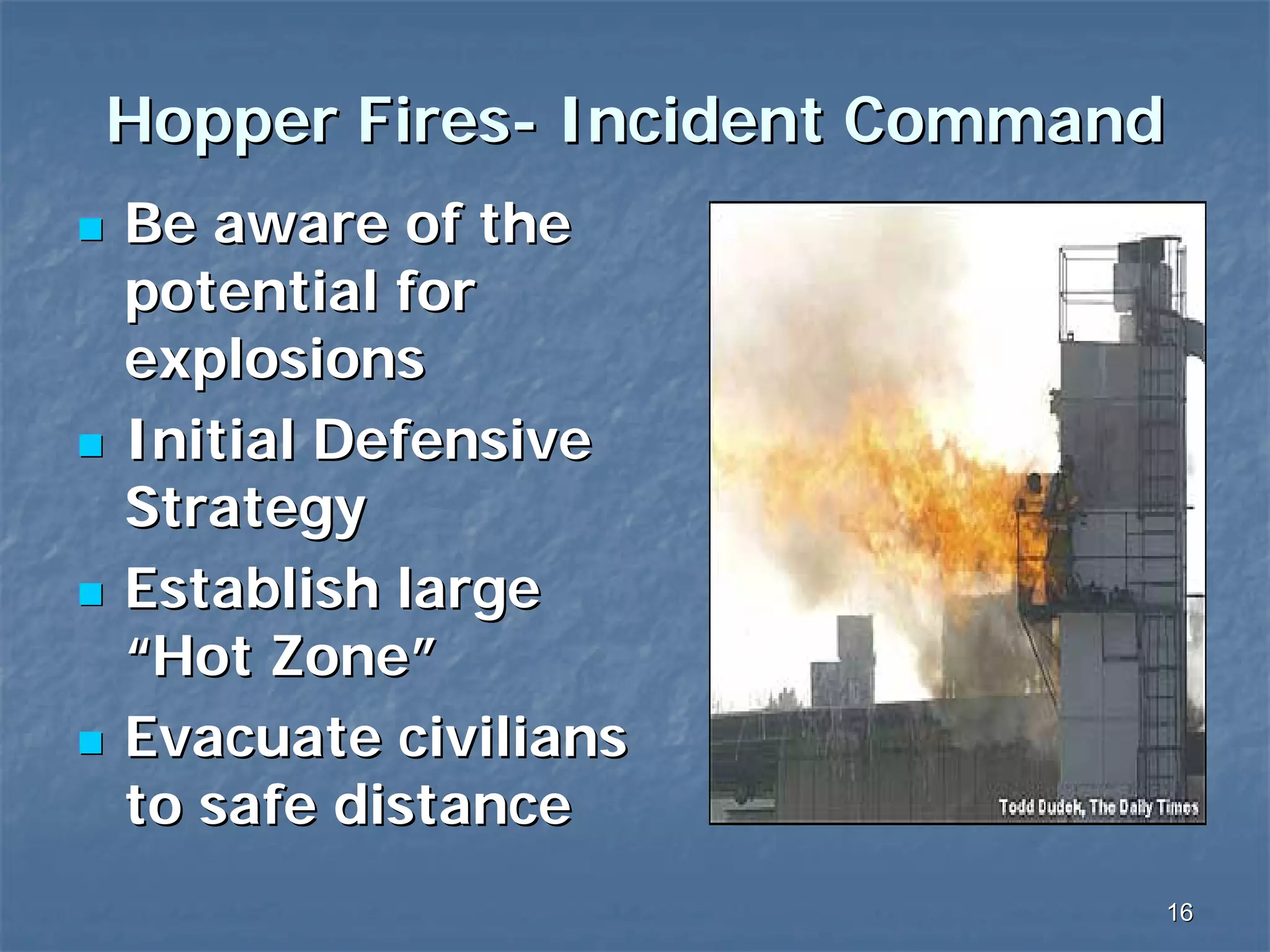
Hopper Fires- Incident Command
Be aware of the
potential for
explosions
Initial Defensive
Strategy
Establish large
“Hot Zone”
Evacuate civilians
to safe distance
16
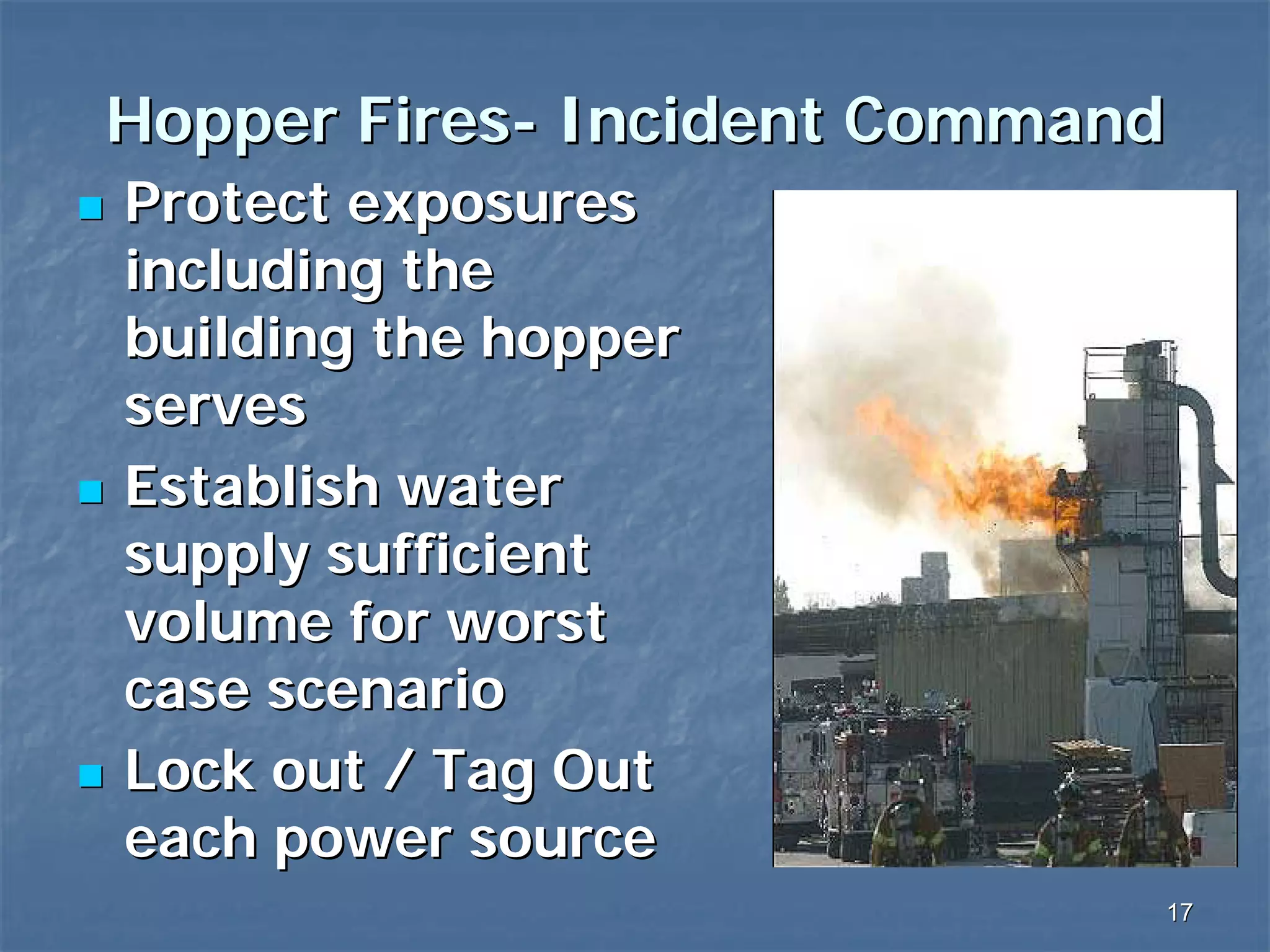
Hopper Fires- Incident Command
Protect exposures
including the
building the hopper
serves
Establish water
supply sufficient
volume for worst
case scenario
Lock out / Tag Out
each power source
17
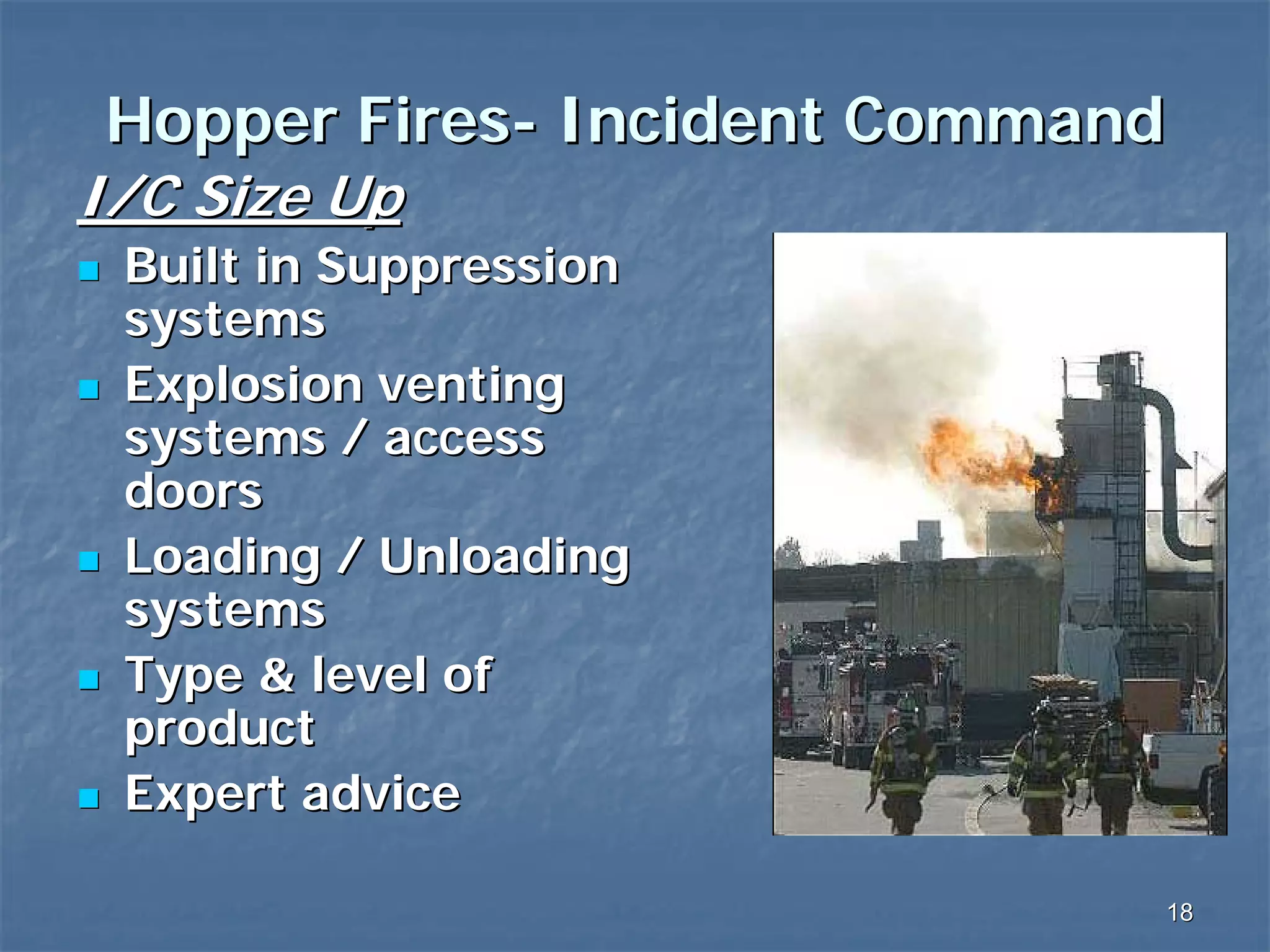
Hopper Fires- Incident Command

I/C Size Up

Built in Suppression
systems
Explosion venting
systems / access
doors
Loading / Unloading
systems
Type & level of
product
Expert advice
18
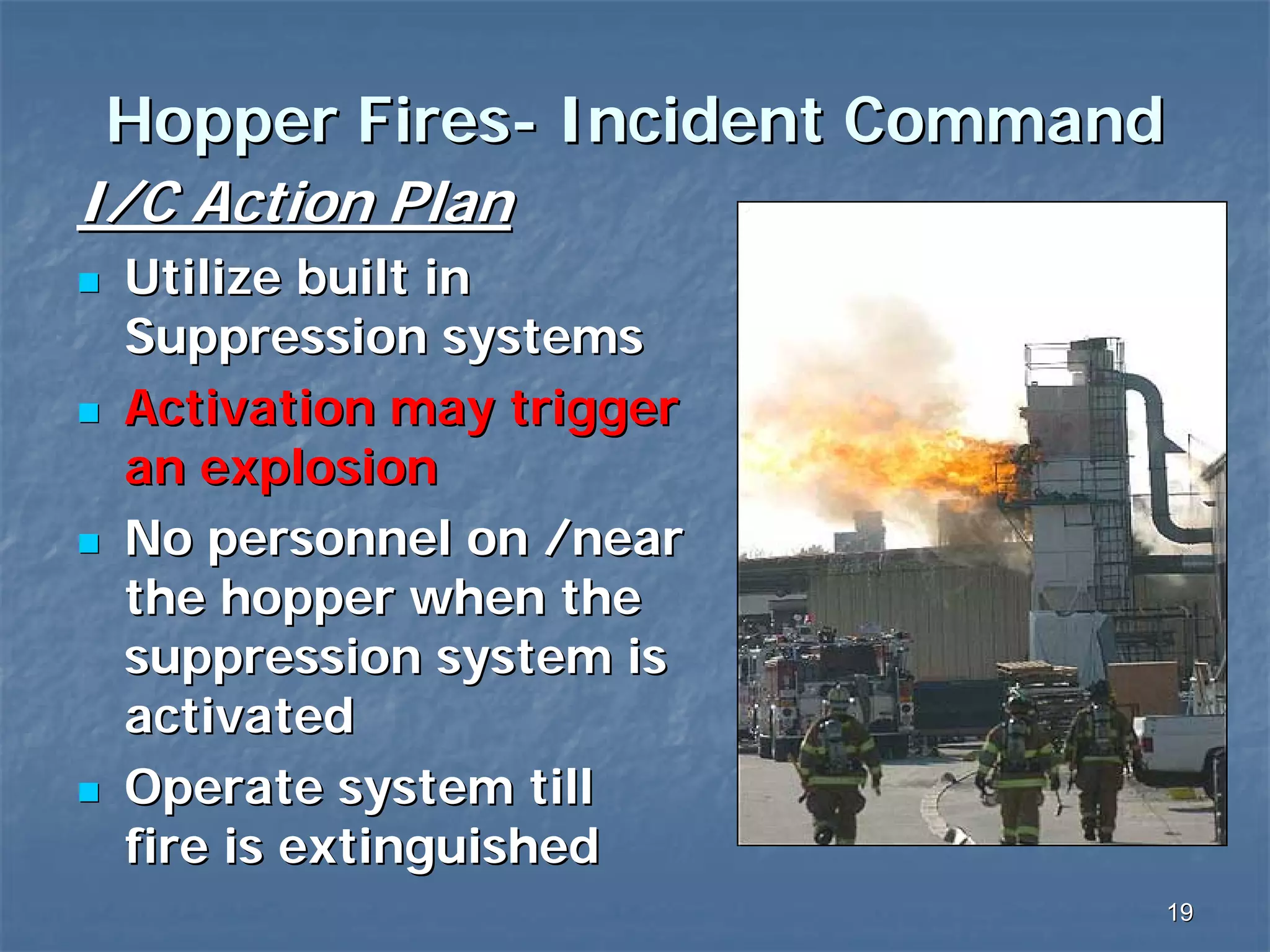
Hopper Fires- Incident Command
I/C Action Plan
Utilize built in
Suppression systems
Activation may trigger
an explosion
No personnel on /near
the hopper when the
suppression system is
activated
Operate system till
fire is extinguished
19
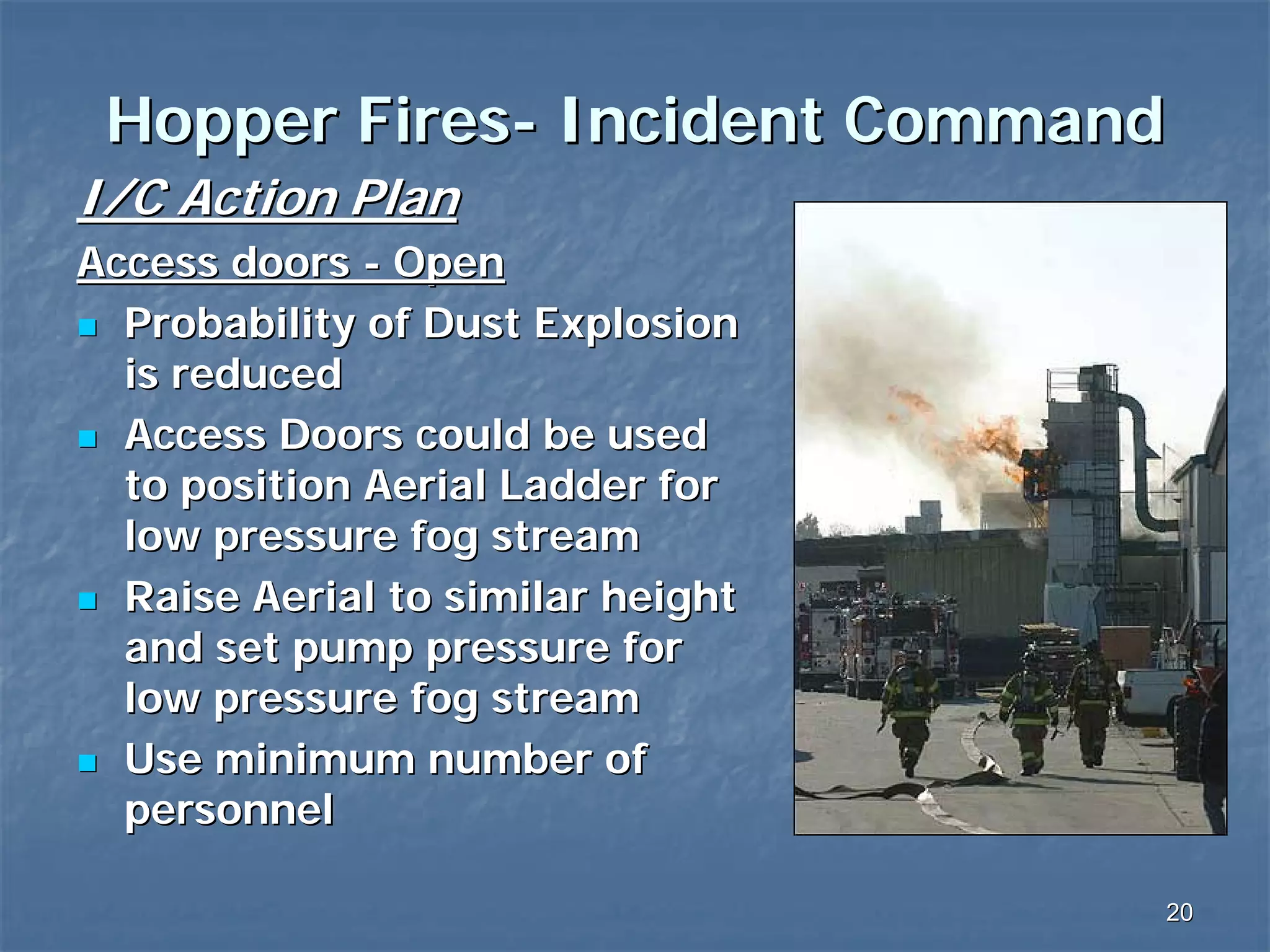
Hopper Fires- Incident Command
I/C Action Plan
Access doors - Open
Probability of Dust Explosion
is reduced
Access Doors could be used
to position Aerial Ladder for
low pressure fog stream
Raise Aerial to similar height
and set pump pressure for
low pressure fog stream
Use minimum number of
personnel
20
Hopper Fires- Incident Command
I/C Action Plan
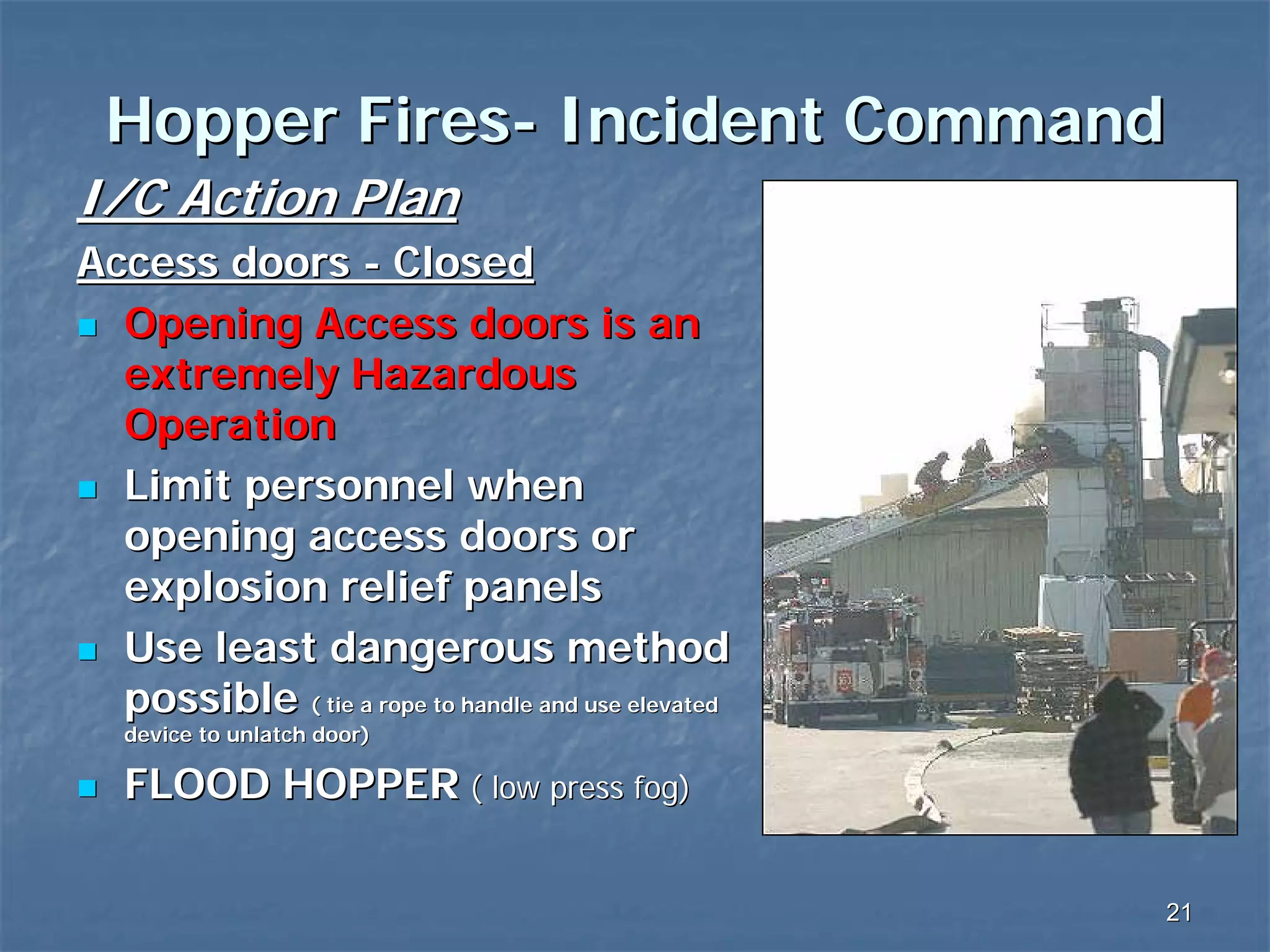
Access doors - Closed
Opening Access doors is an
extremely Hazardous
Operation
Limit personnel when
opening access doors or
explosion relief panels
Use least dangerous method
possible ( tie a rope to handle and use elevated
device to unlatch door)

FLOOD HOPPER ( low press fog)
21
Hopper Fires- Incident Command
I/C Action Plan
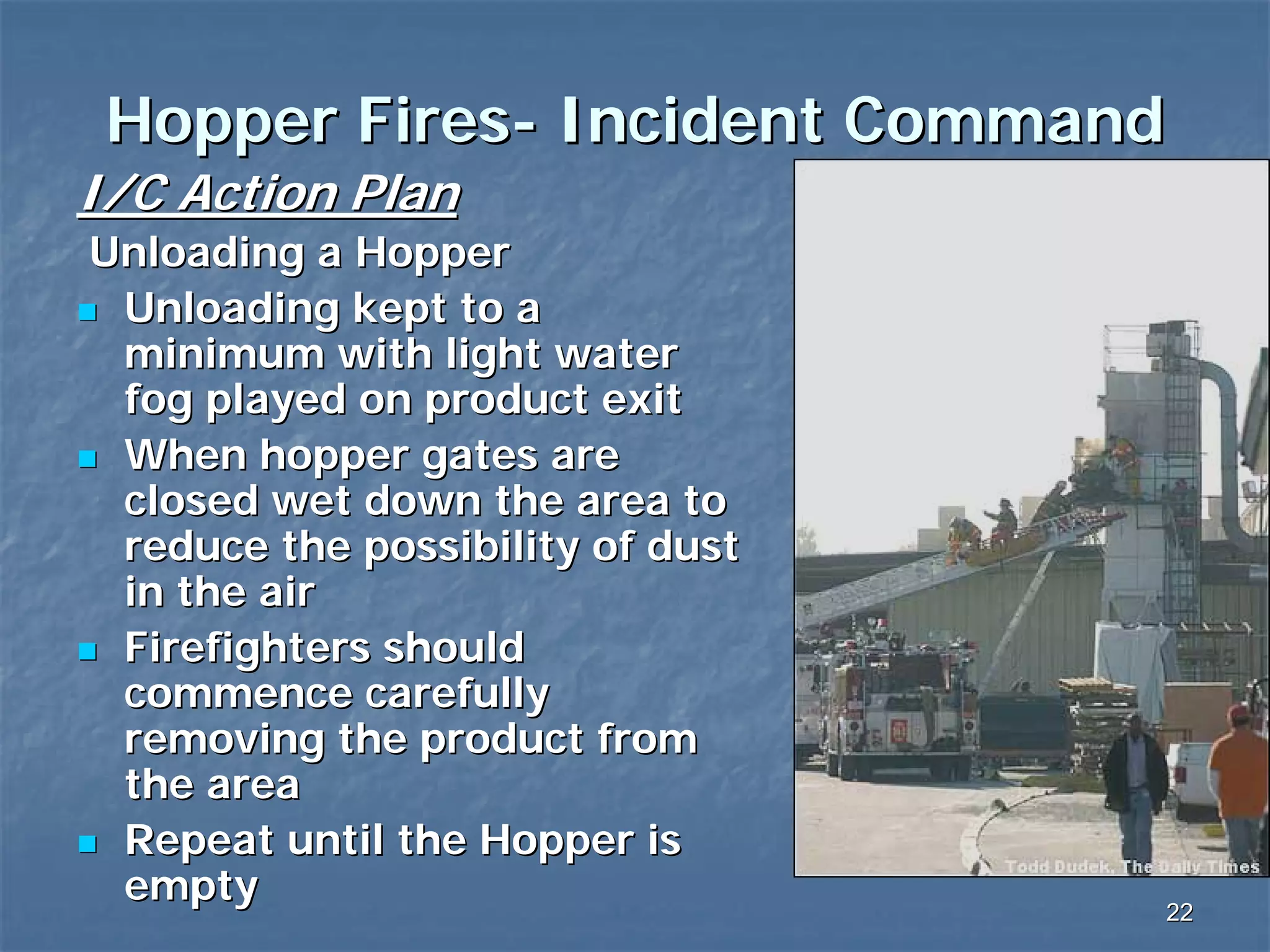
Unloading a Hopper
Unloading kept to a
minimum with light water
fog played on product exit
When hopper gates are
closed wet down the area to
reduce the possibility of dust
in the air
Firefighters should
commence carefully
removing the product from
the area
Repeat until the Hopper is
empty

22
Hopper Fires- Incident Command
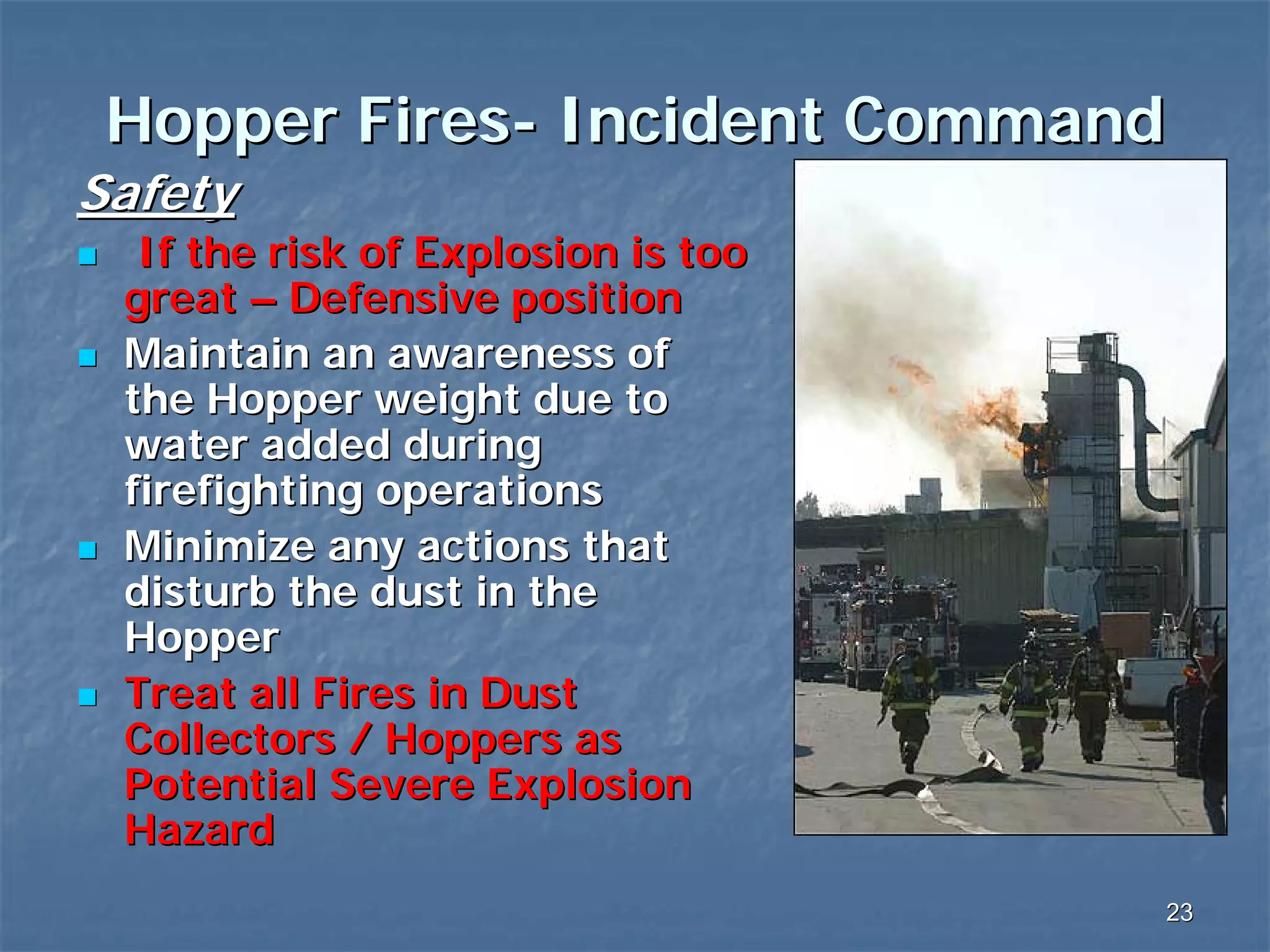
Safety
If the risk of Explosion is too
great – Defensive position
Maintain an awareness of
the Hopper weight due to
water added during
firefighting operations
Minimize any actions that
disturb the dust in the
Hopper
Treat all Fires in Dust
Collectors / Hoppers as
Potential Severe Explosion
Hazard
23
Hopper Fires- Incident Command

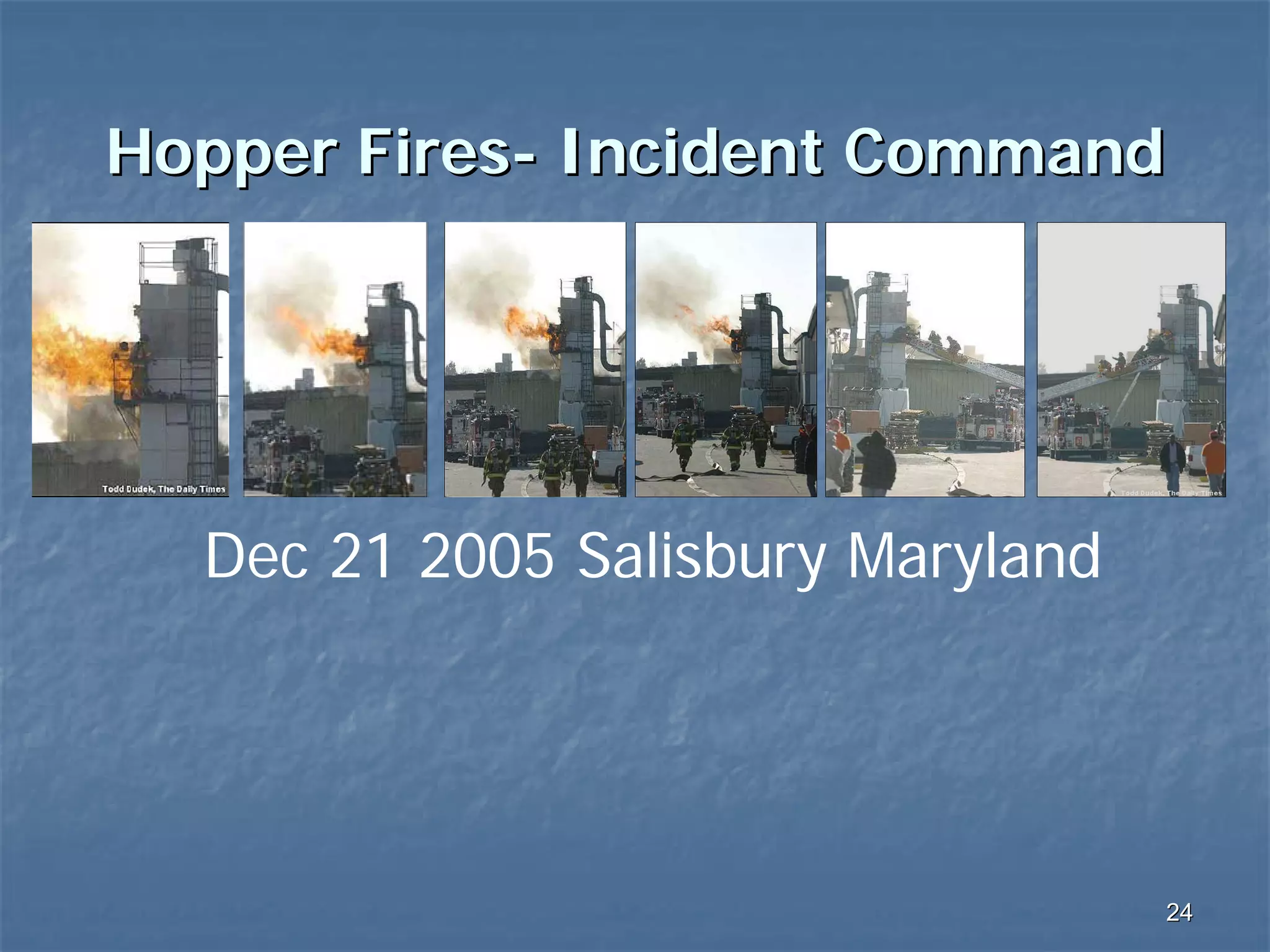
Dec 21 2005 Salisbury Maryland

24
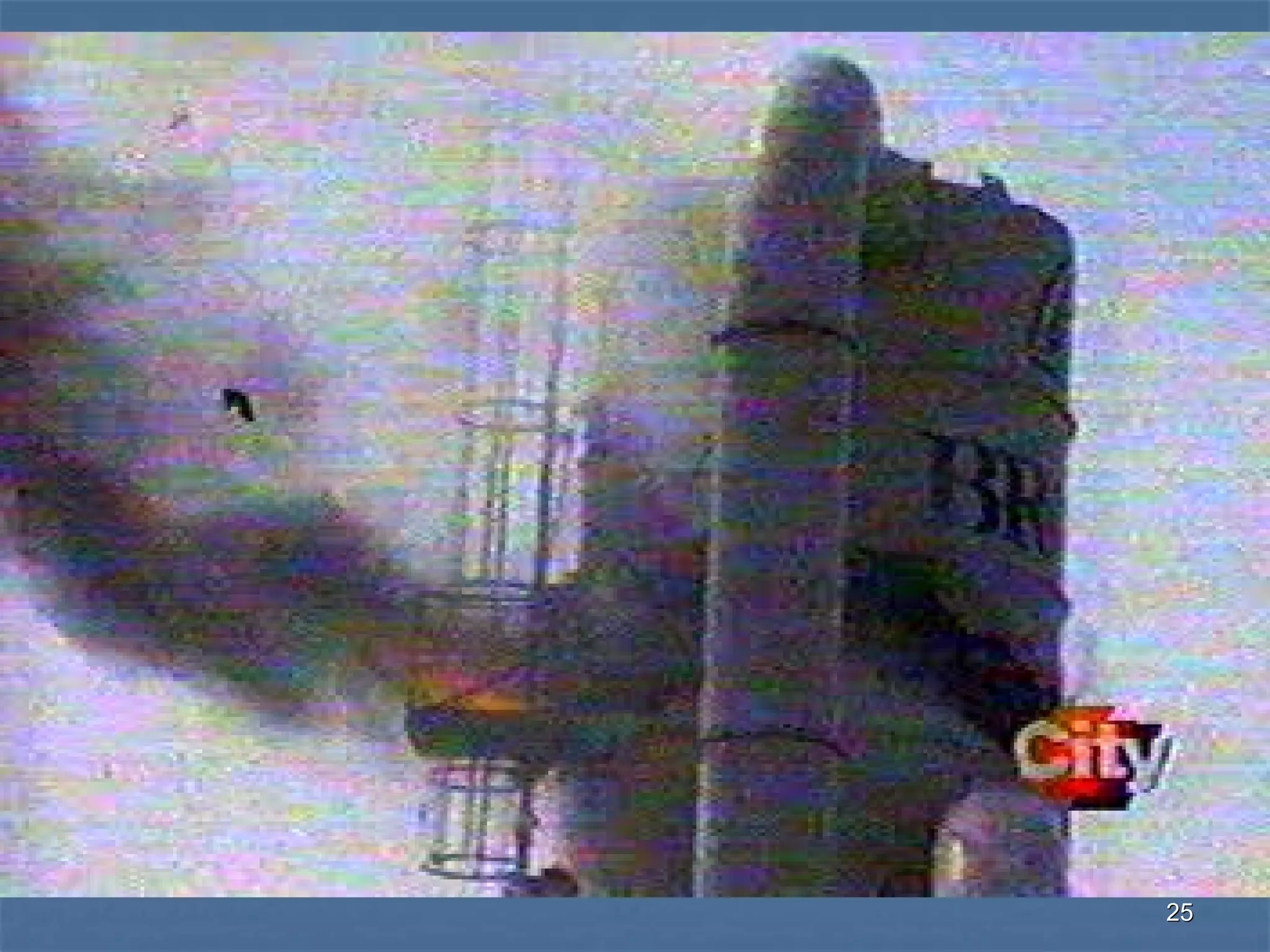
25
Silo Fires / Explosions
Significant Fires and Explosions.
Alabama
California
Ohio
New York
Nova Scotia – Halifax 2003
Georgia – Imperial Sugar – 13 Killed
Ontario – 2006 Perth, 2008 Woodbridge
26
Silo Fires / Explosions
Fire Fighter Serious Injuries / Deaths.
Georgia 1993 – 2 FF killed
Texas 2000 – 1 FF Killed
North Carolina 2001 – 3 FF injured
Nebraska 2002 – 13 FF injured ( shredded
Rubber Silo)
Missouri 2005 – 2 FF killed
Ohio ( Twice) – 1985 & 2003 – 5 FF killed
27
Firefighter Injuries / Deaths
August 27th 1985 Marshville Ohio.
Three Firefighters killed, 4 injured.
Concrete Oxygen limiting silo.
50 minutes into fire operations.
10,000 liters of water applied.

SILO EXPLODED
28
Firefighter Injuries/ Deaths
October 1st 2003 New Knoxville Ohio.
Two FF’s Killed – 8 injured
Concrete Modified Oxygen Limiting Silo.
2.5 hours into firefighting operations.
30,000 liters applied.

SILO EXPLODED
29
Firefighter Injuries / Deaths
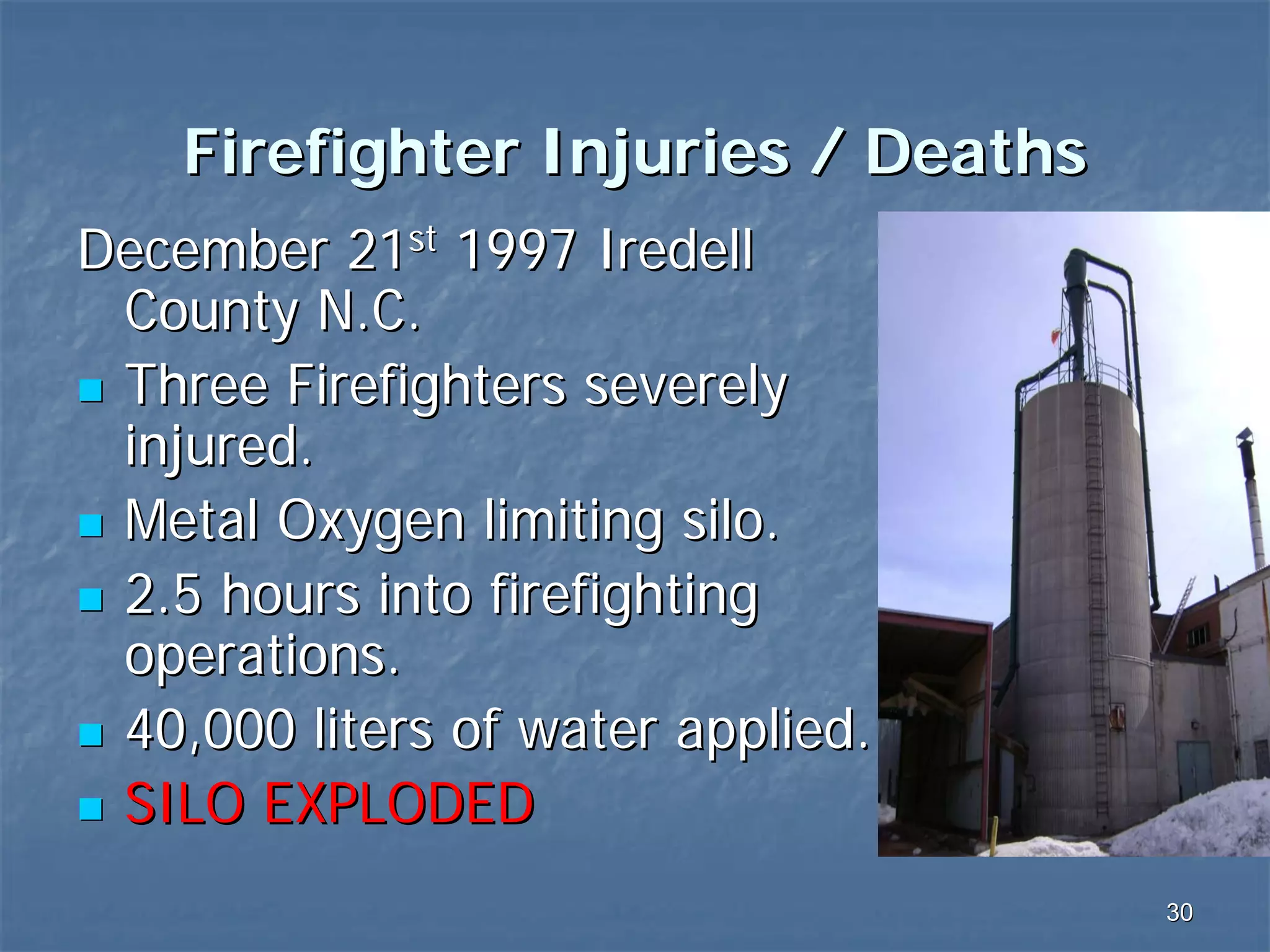
December 21st 1997 Iredell
County N.C.
Three Firefighters severely
injured.
Metal Oxygen limiting silo.
2.5 hours into firefighting
operations.
40,000 liters of water applied.
SILO EXPLODED
30
Silo Fires / Explosions
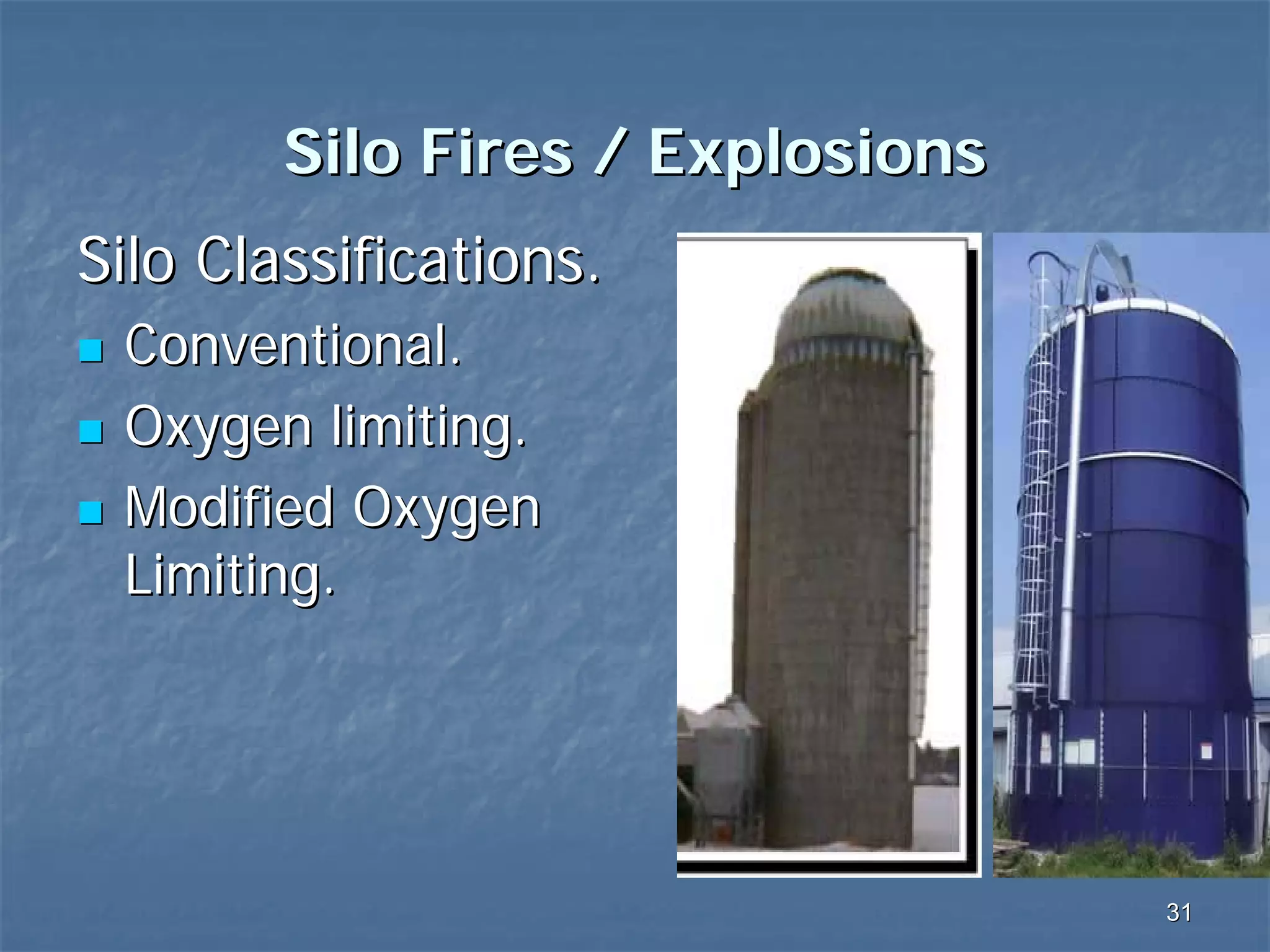
Silo Classifications.
Conventional.
Oxygen limiting.
Modified Oxygen
Limiting.

31
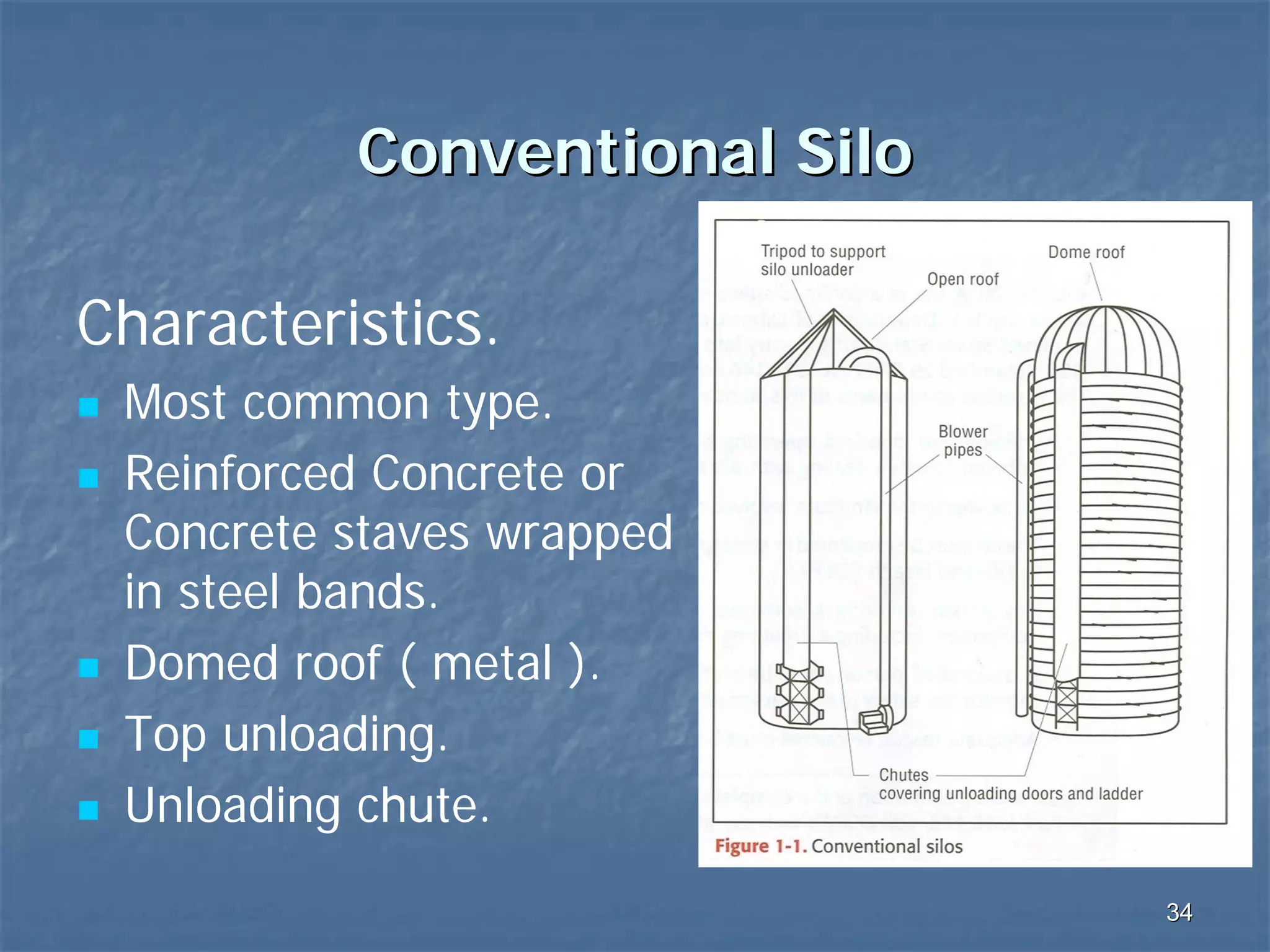
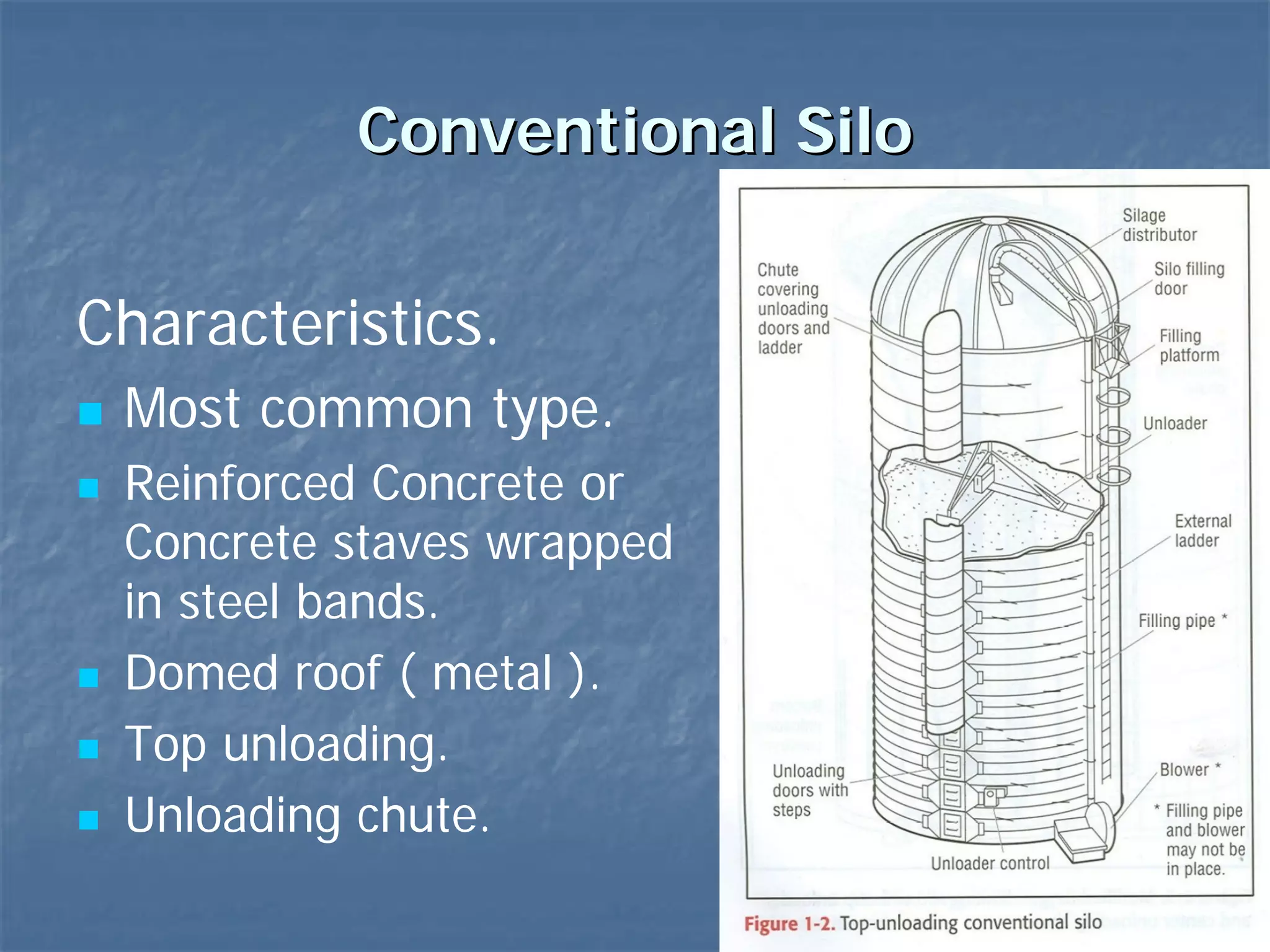
Conventional Silos
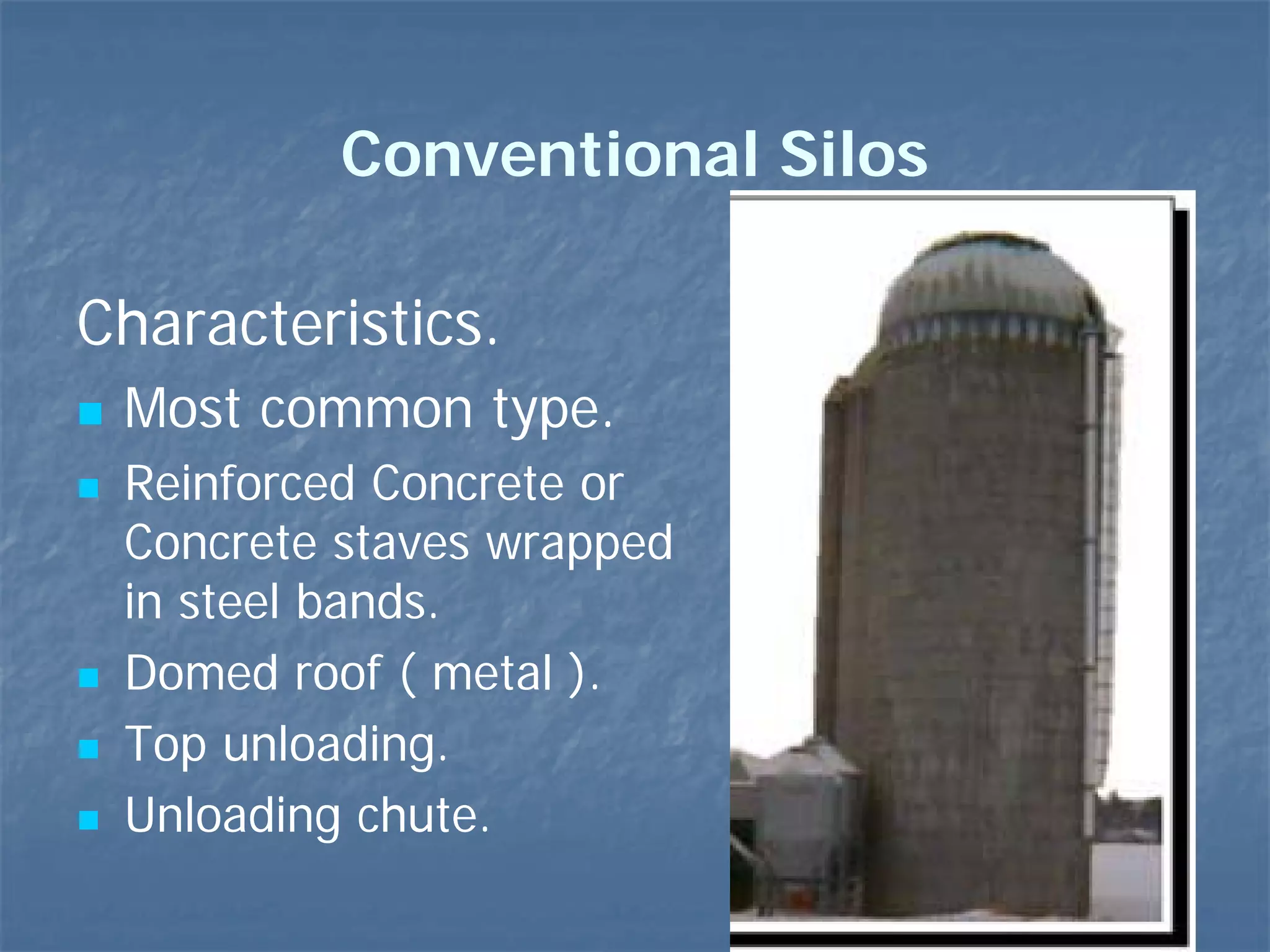
Characteristics.
Most common type.
Reinforced Concrete or
Concrete staves wrapped
in steel bands.
Domed roof ( metal ).
Top unloading.
Unloading chute.
32
Conventional Silo
Characteristics.
Most common type.
Reinforced Concrete or
Concrete staves wrapped
in steel bands.
Domed roof ( metal ).
Top unloading.
Unloading chute.
33
Conventional Silo
Characteristics.
Most common type.
Reinforced Concrete or
Concrete staves wrapped
in steel bands.
Domed roof ( metal ).
Top unloading.
Unloading chute.
34
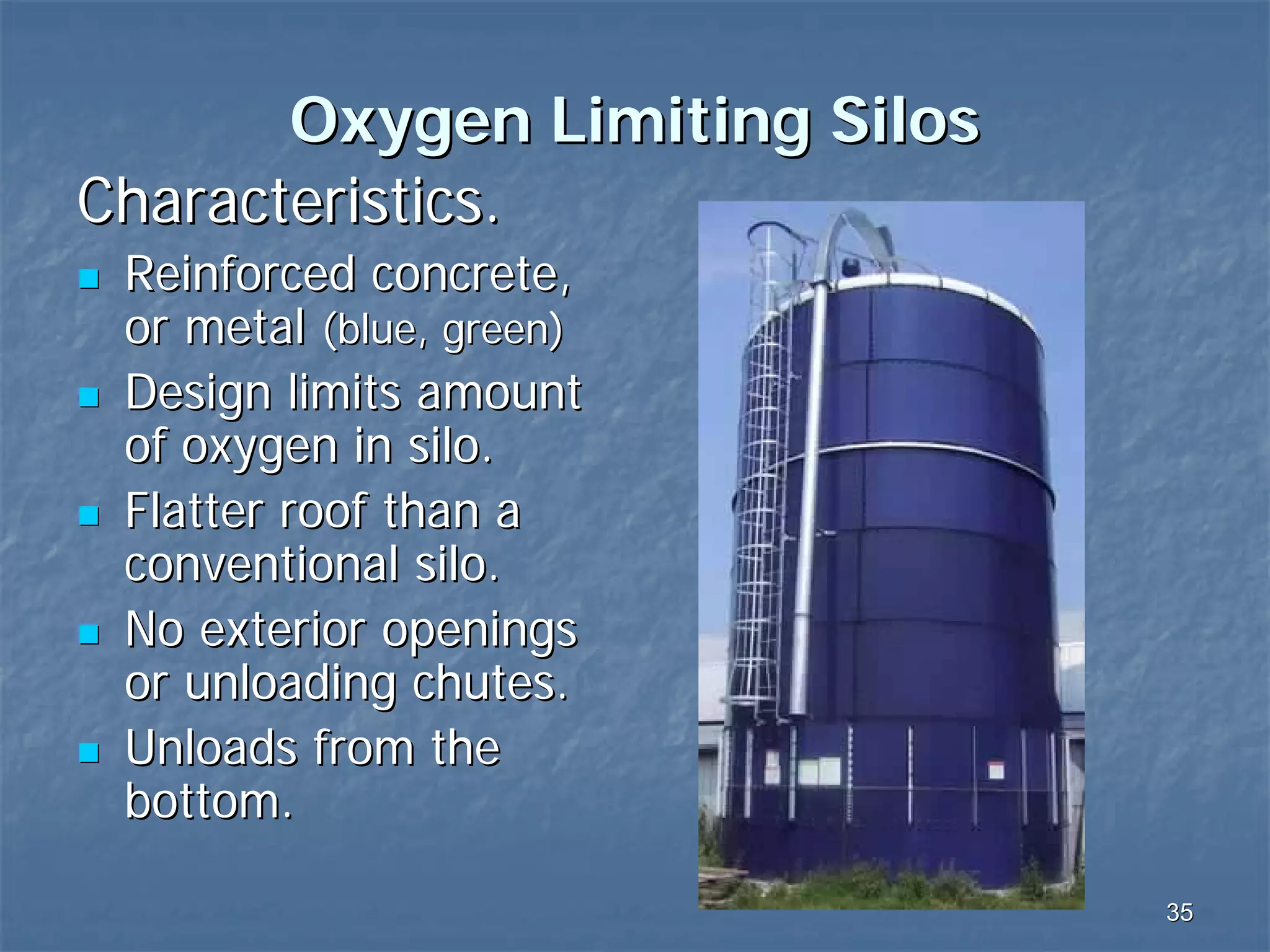
Oxygen Limiting Silos
Characteristics.
Reinforced concrete,
or metal (blue, green)
Design limits amount
of oxygen in silo.
Flatter roof than a
conventional silo.
No exterior openings
or unloading chutes.
Unloads from the
bottom.
35
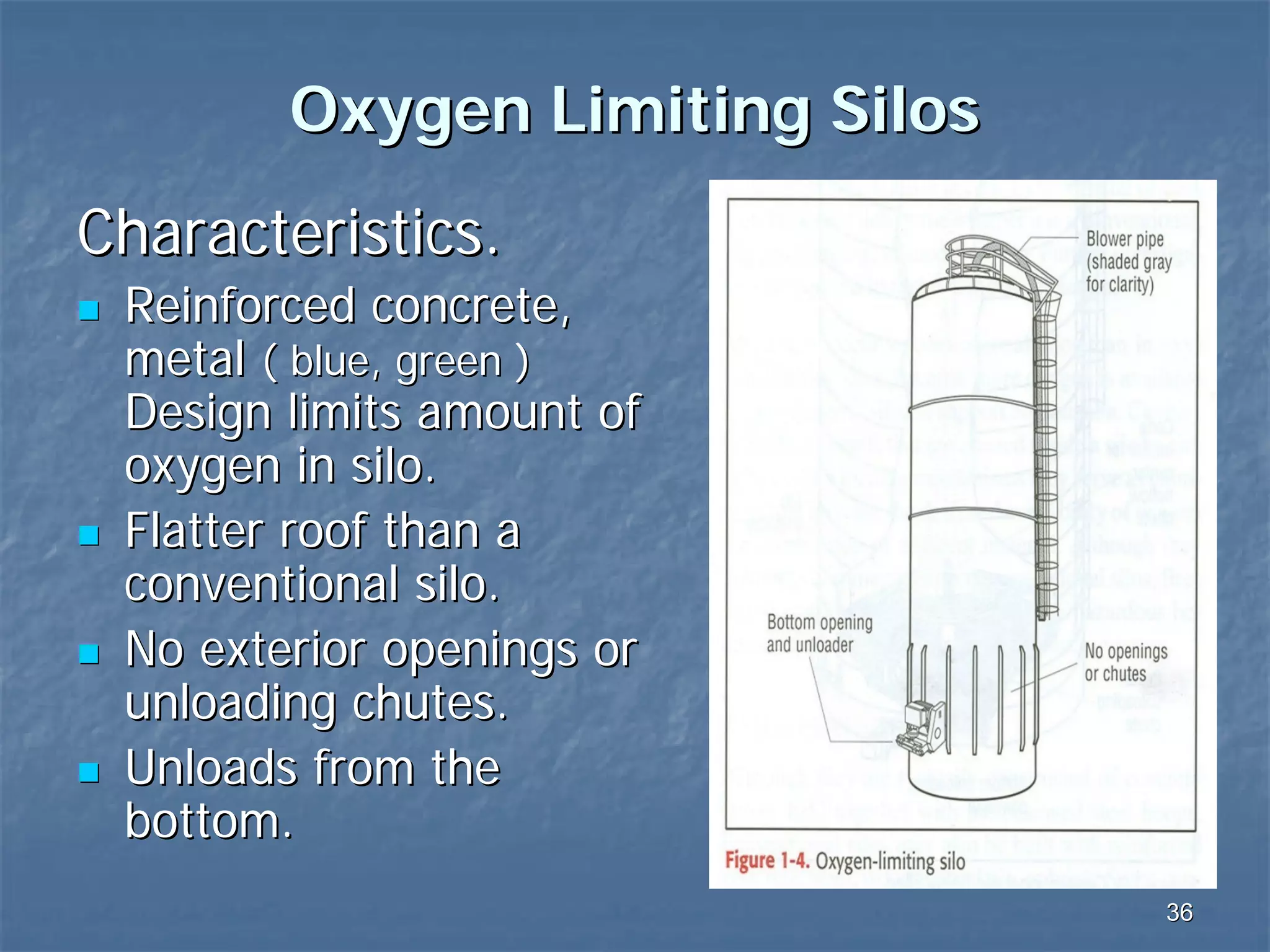
Oxygen Limiting Silos
Characteristics.
Reinforced concrete,
metal ( blue, green )
Design limits amount of
oxygen in silo.
Flatter roof than a
conventional silo.
No exterior openings or
unloading chutes.
Unloads from the
bottom.
36
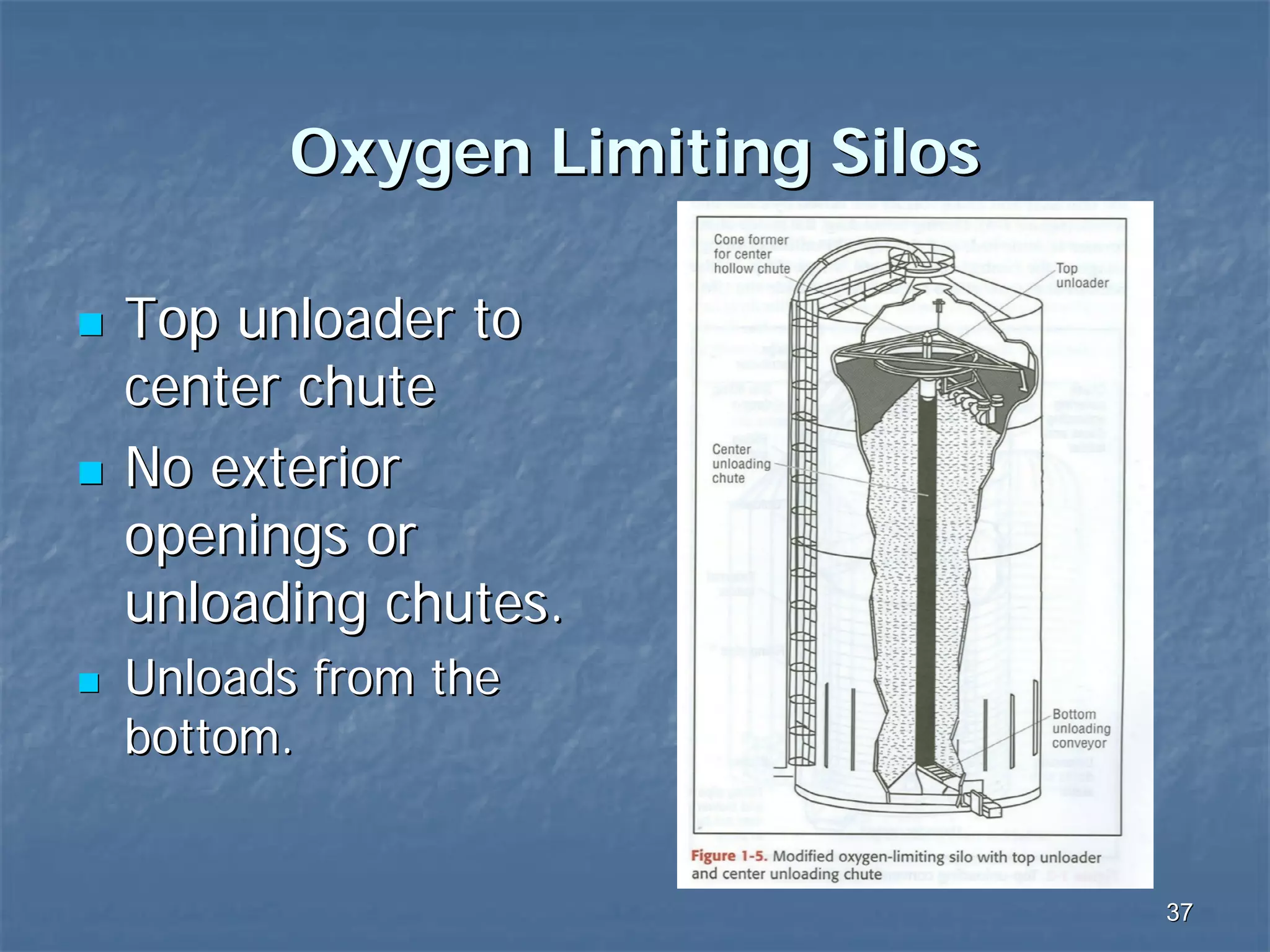
Oxygen Limiting Silos
Top unloader to
center chute
No exterior
openings or
unloading chutes.
Unloads from the
bottom.

37
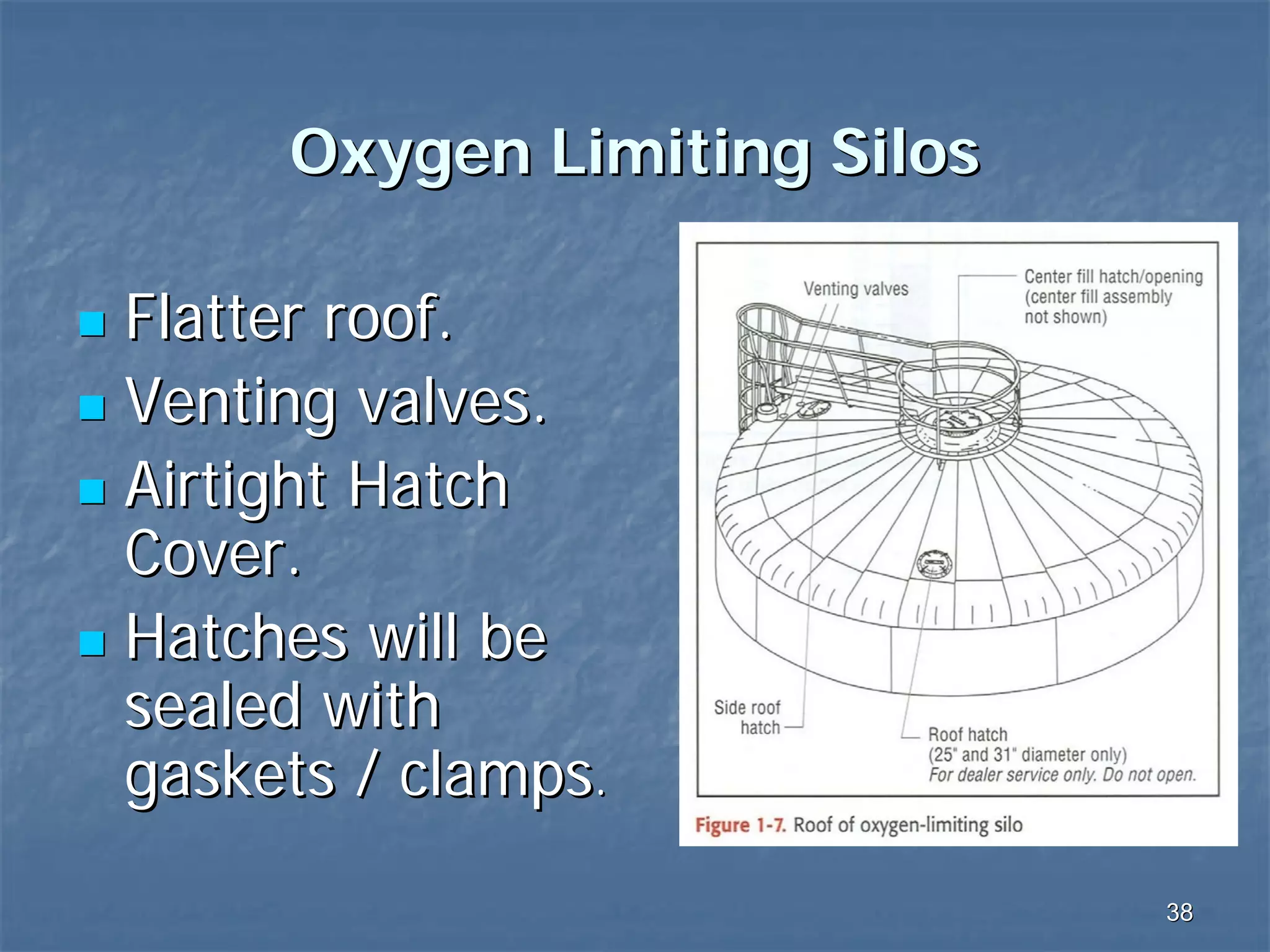
Oxygen Limiting Silos
Flatter roof.
Venting valves.
Airtight Hatch
Cover.
Hatches will be
sealed with
gaskets / clamps.
38
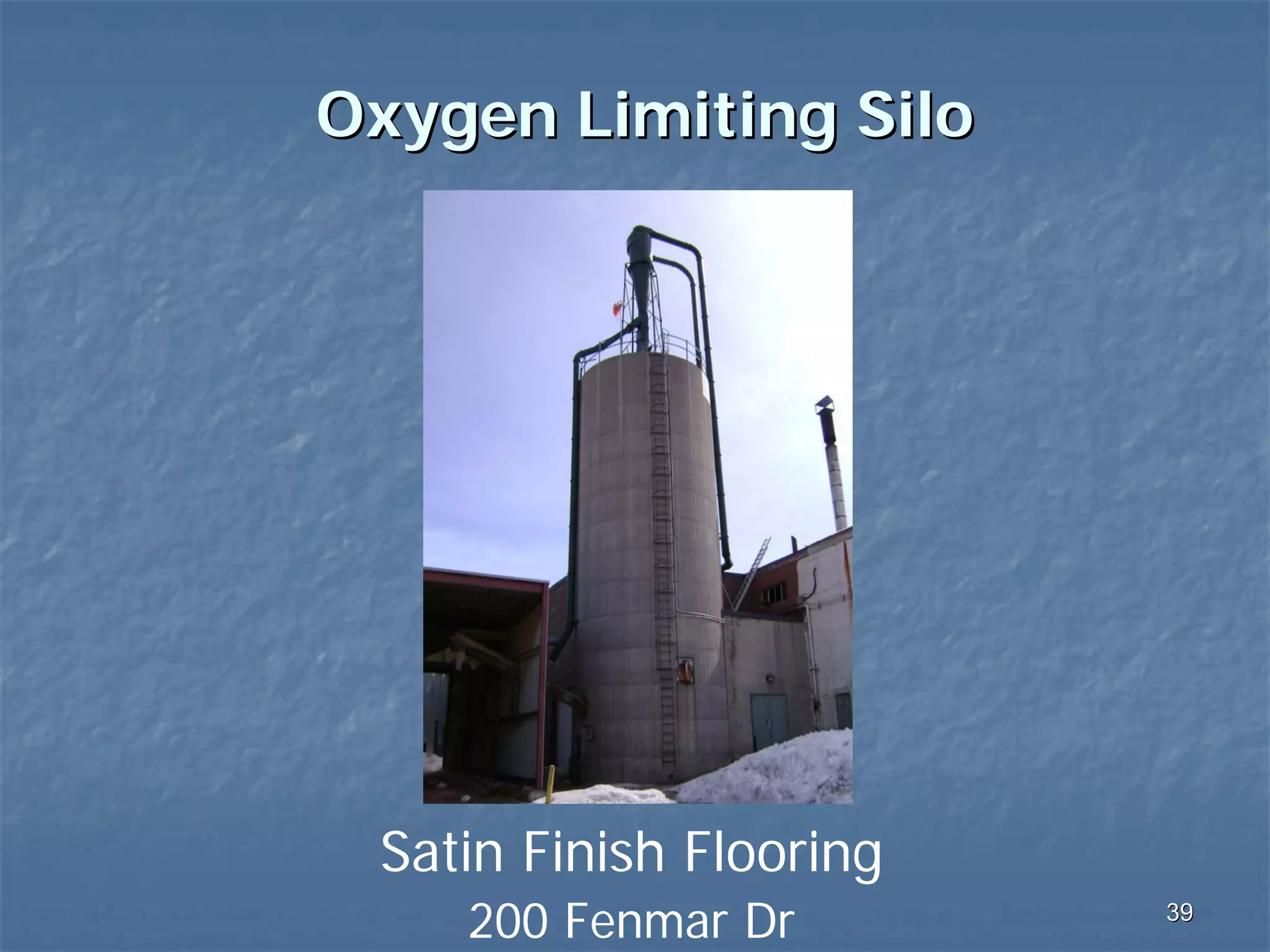
Oxygen Limiting Silo

Satin Finish Flooring
200 Fenmar Dr

39
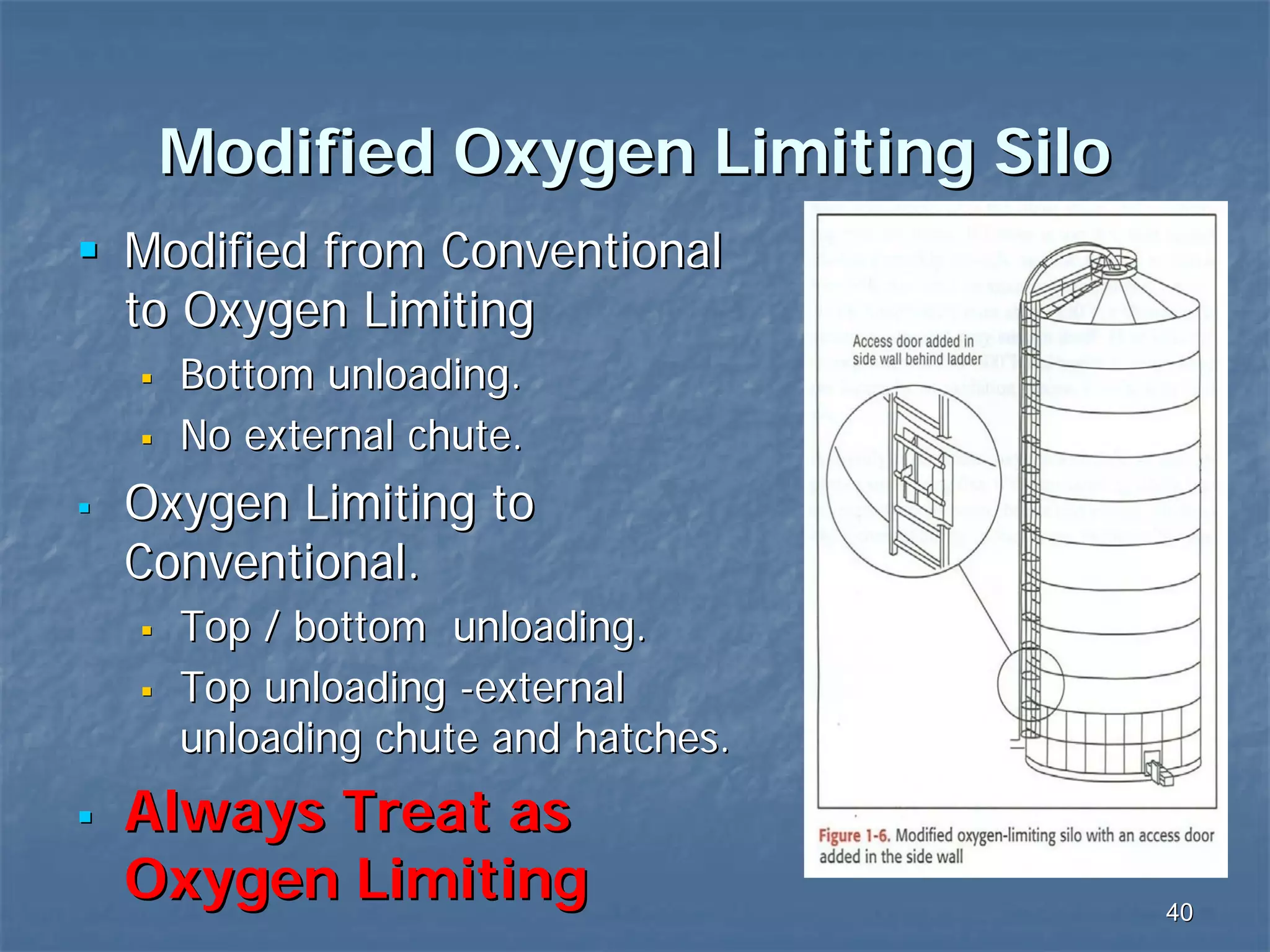
Modified Oxygen Limiting Silo
Modified from Conventional
to Oxygen Limiting
Bottom unloading.
No external chute.

Oxygen Limiting to
Conventional.
Top / bottom unloading.
Top unloading -external
unloading chute and hatches.

Always Treat as
Oxygen Limiting

40
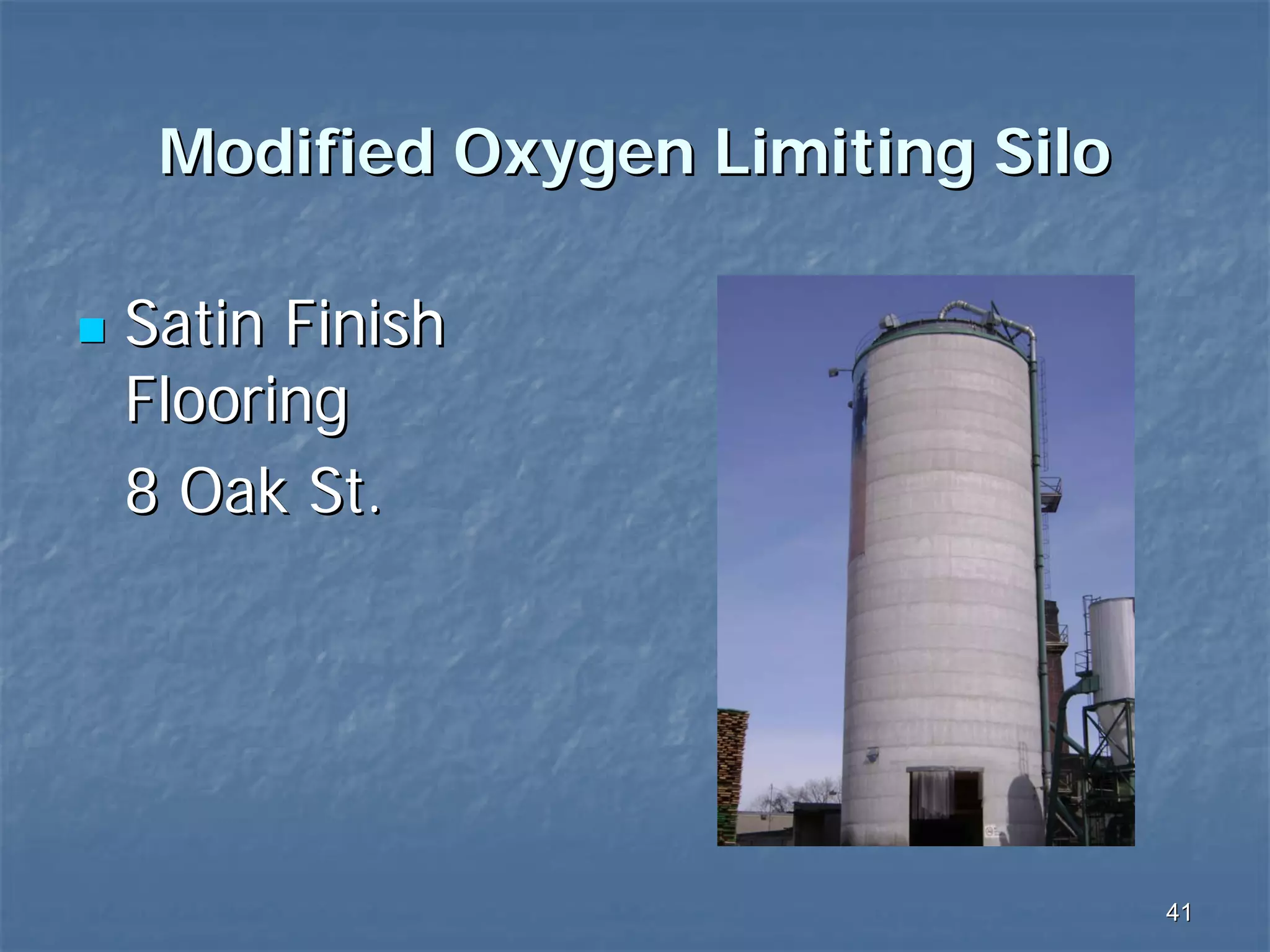
Modified Oxygen Limiting Silo
Satin Finish
Flooring
8 Oak St.

41
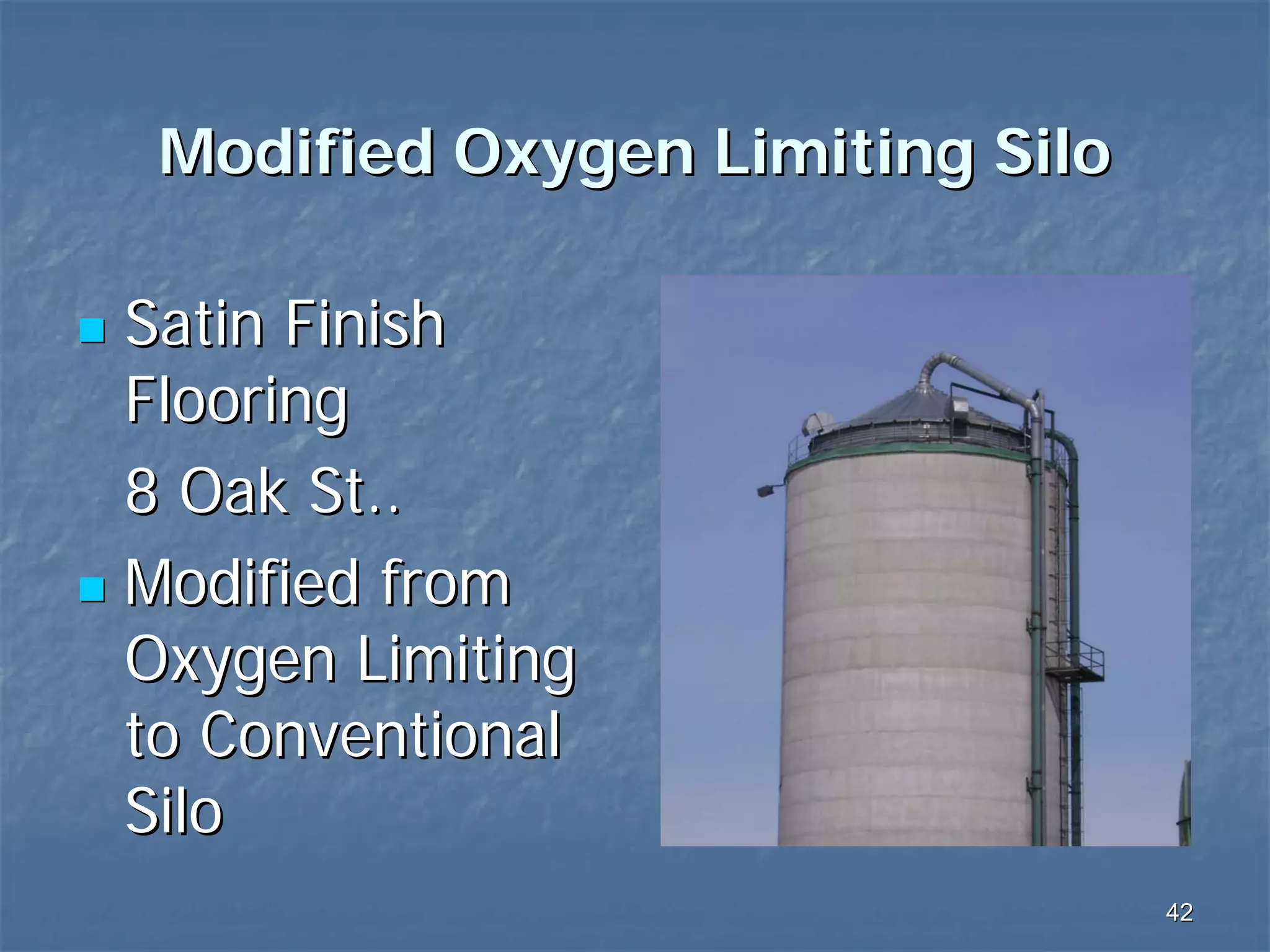
Modified Oxygen Limiting Silo
Satin Finish
Flooring
8 Oak St..
Modified from
Oxygen Limiting
to Conventional
Silo
42
Firefighting- Silos
Personal Protection Equipment.
S.C.B.A.: smoke, gasses, oxygen deficiency.
I.M.S.: large hot zone, Safety Officer, R.I.T..
Fall arresting devices: heights.
Confined space: avoid entering.

43
Firefighting-Silos
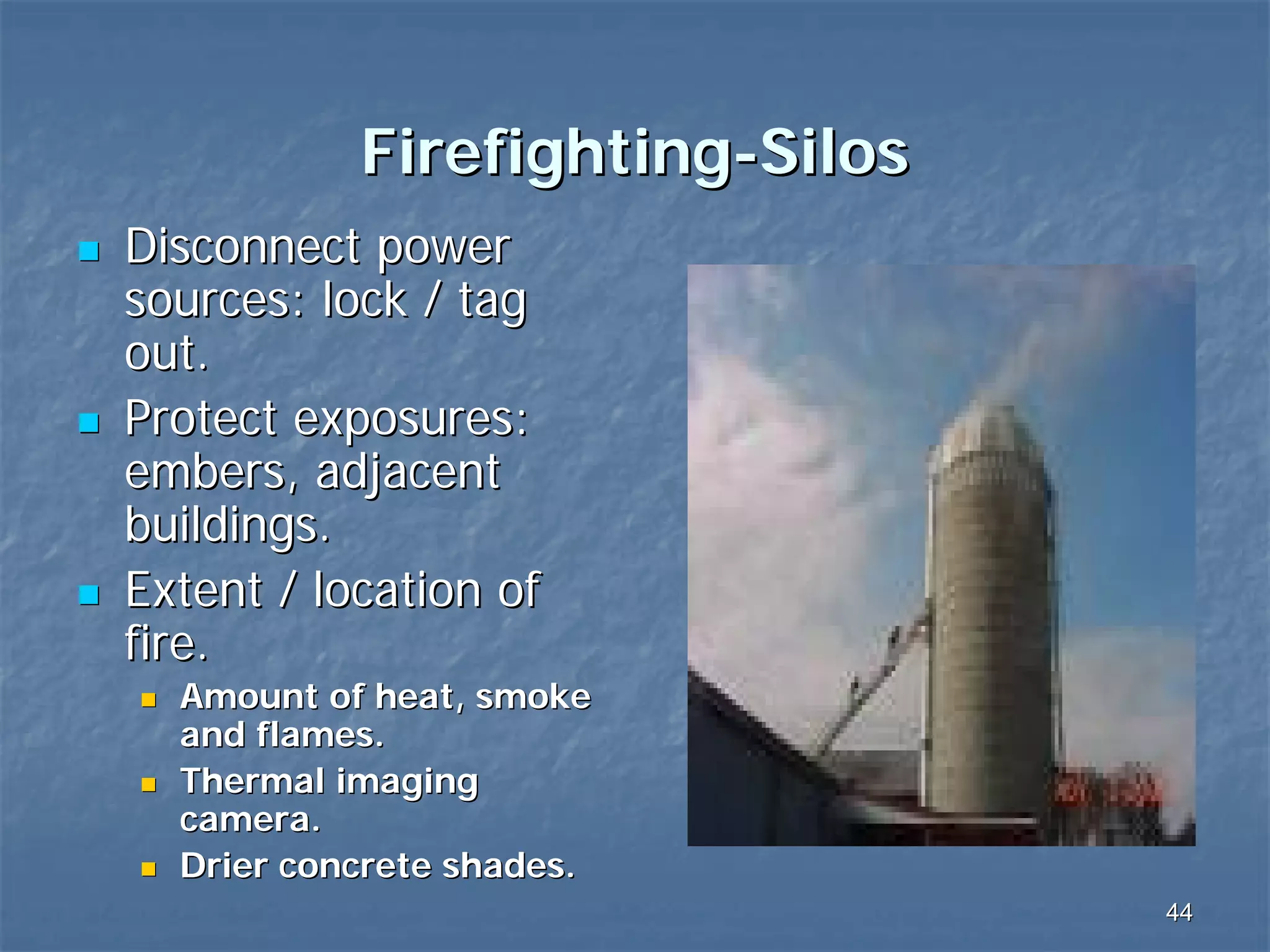
Disconnect power
sources: lock / tag
out.
Protect exposures:
embers, adjacent
buildings.
Extent / location of
fire.
Amount of heat, smoke
and flames.
Thermal imaging
camera.
Drier concrete shades.
44
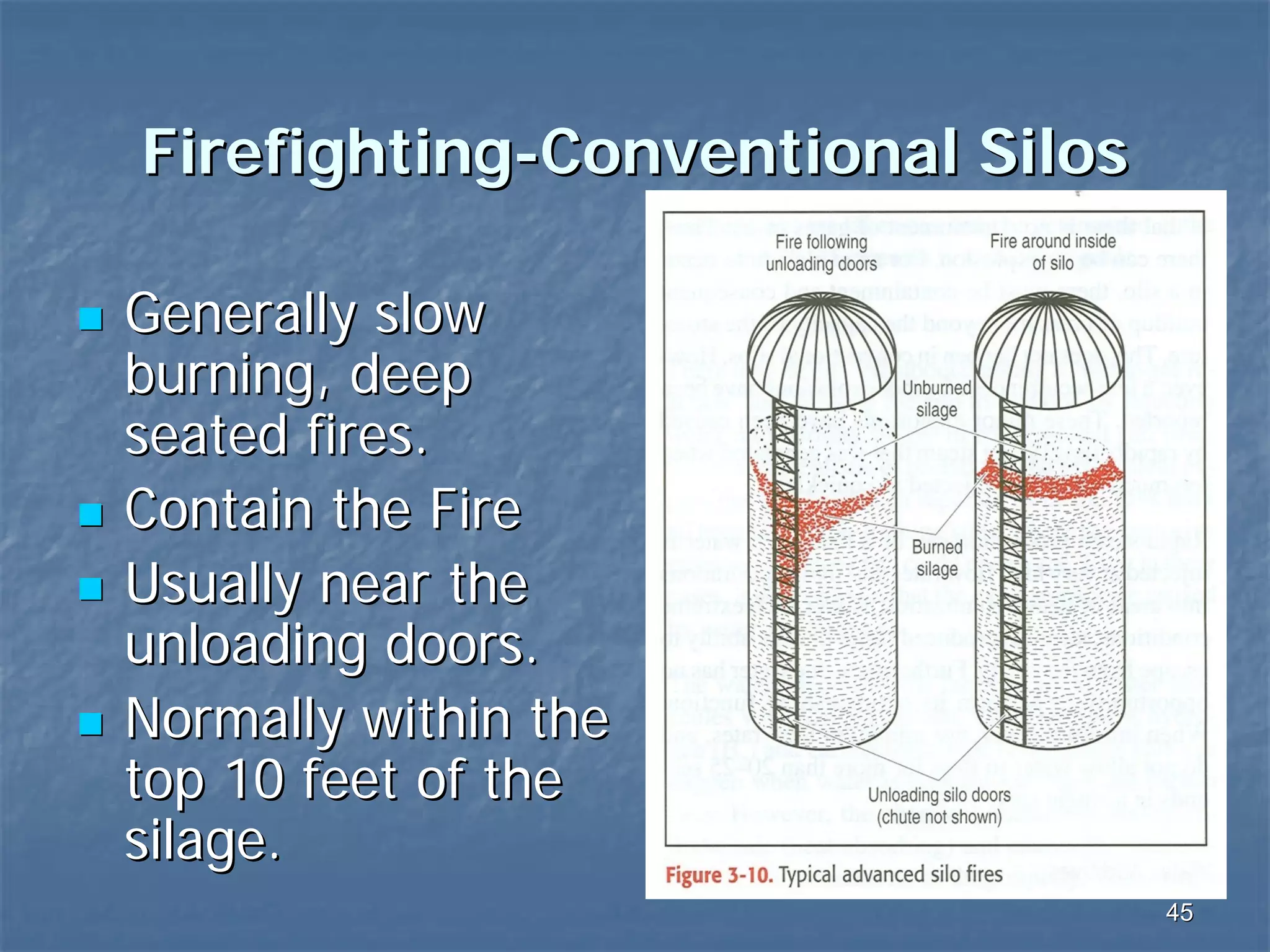
Firefighting-Conventional Silos
Generally slow
burning, deep
seated fires.
Contain the Fire
Usually near the
unloading doors.
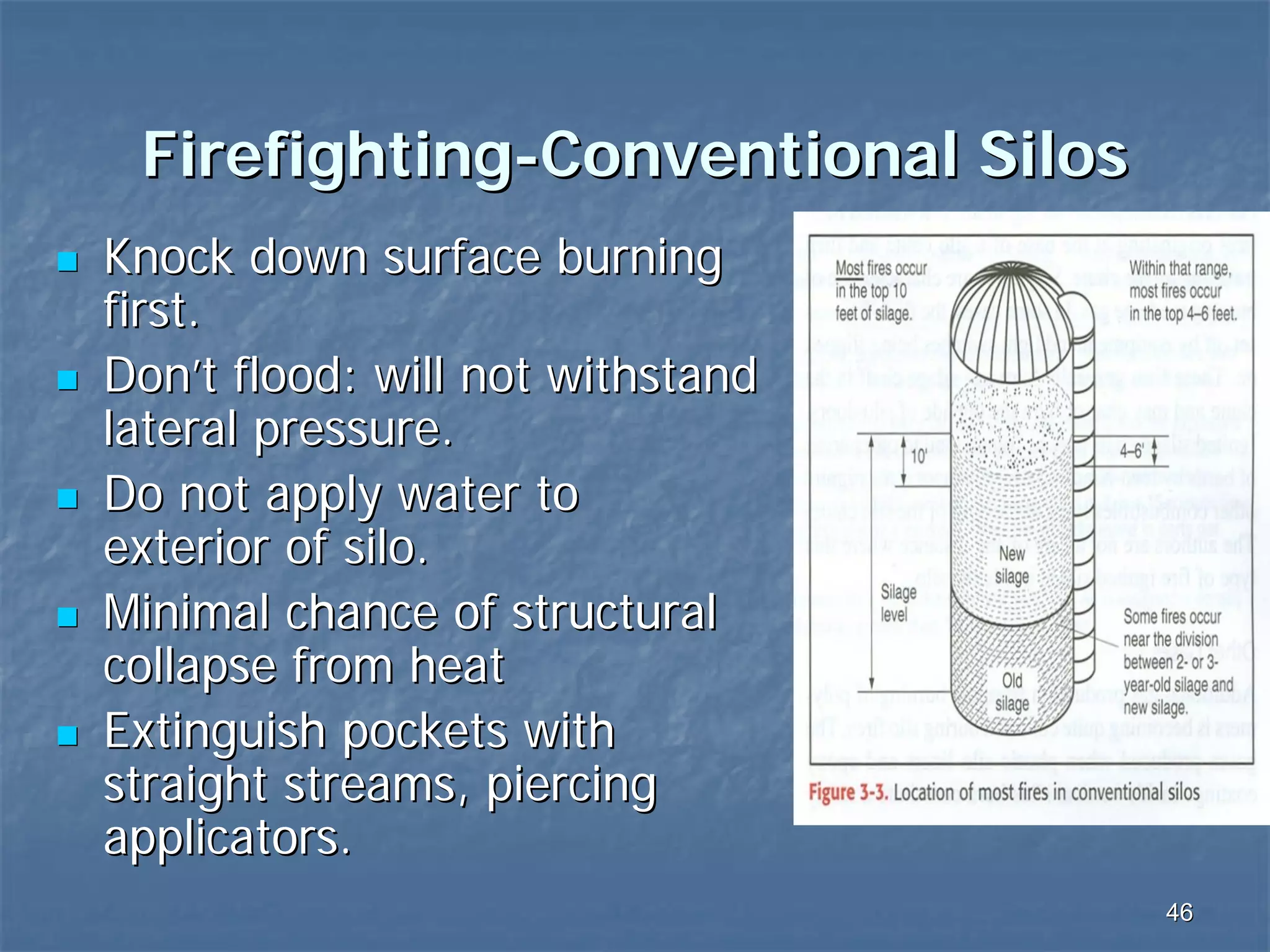
Normally within the
top 10 feet of the
silage.
45
Firefighting-Conventional Silos
Knock down surface burning
first.
Don’t flood: will not withstand
lateral pressure.
Do not apply water to
exterior of silo.
Minimal chance of structural
collapse from heat
Extinguish pockets with
straight streams, piercing
applicators.
46
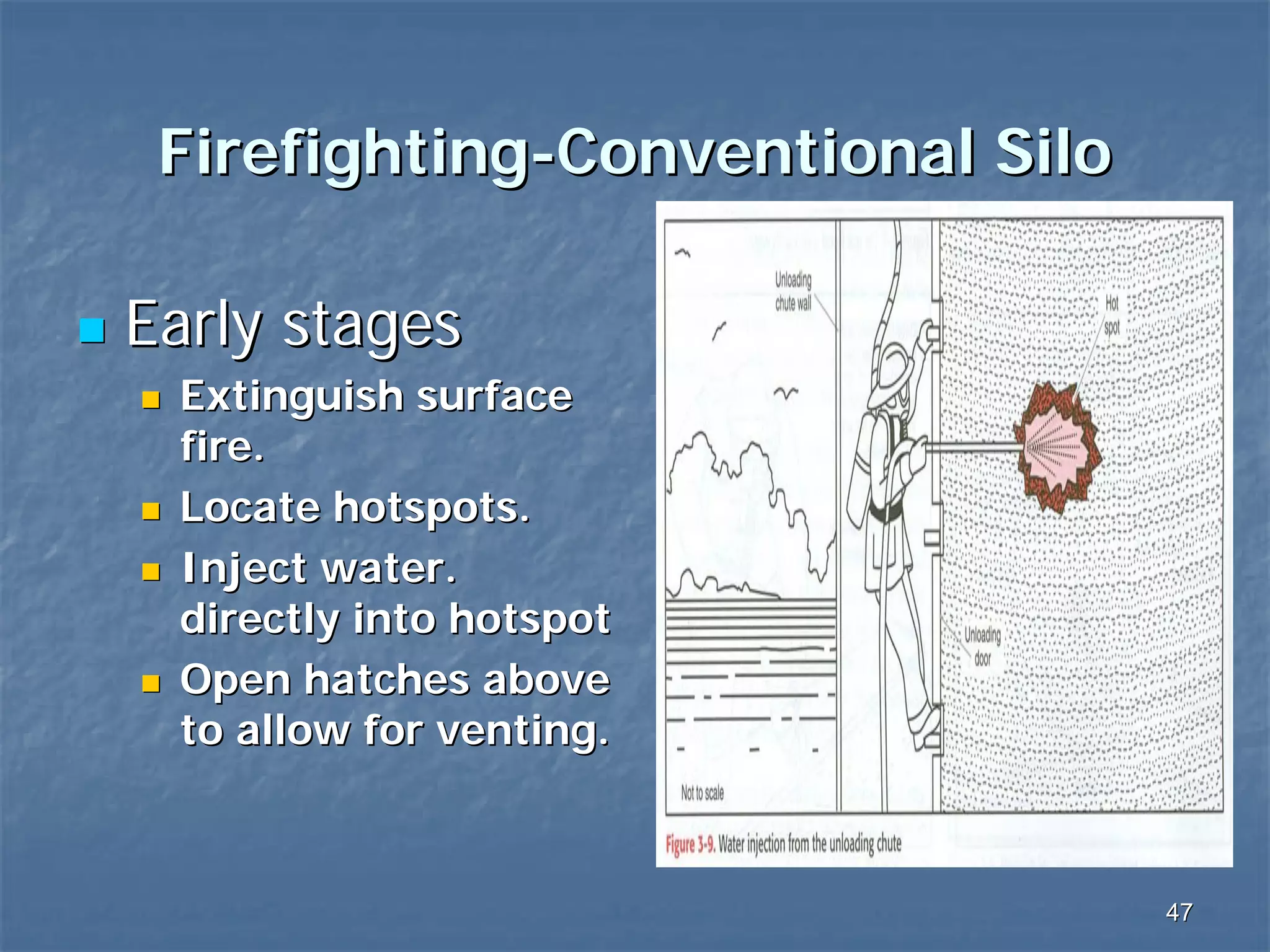
Firefighting-Conventional Silo
Early stages
Extinguish surface
fire.
Locate hotspots.
Inject water.
directly into hotspot
Open hatches above
to allow for venting.

47
Firefighting-Conventional Silos
Advanced Fires.
Leave to burn themselves out.
Product is unsalvageable.
Fires in concrete silos do little harm.
Protect exposures to prevent spread of fire.
Unload silo to ensure complete
extinguishment

48
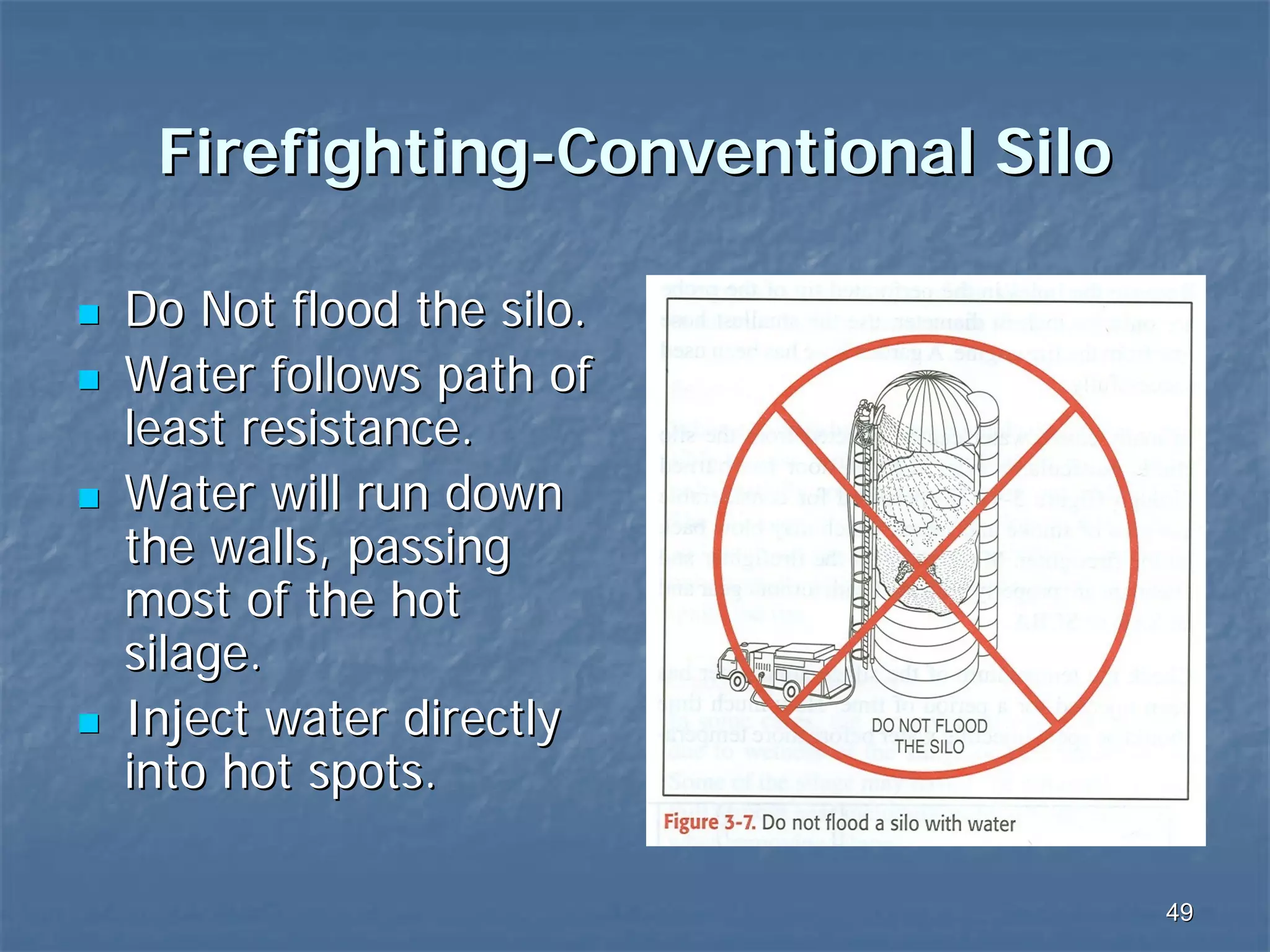
Firefighting-Conventional Silo
Do Not flood the silo.
Water follows path of
least resistance.
Water will run down
the walls, passing
most of the hot
silage.
Inject water directly
into hot spots.
49
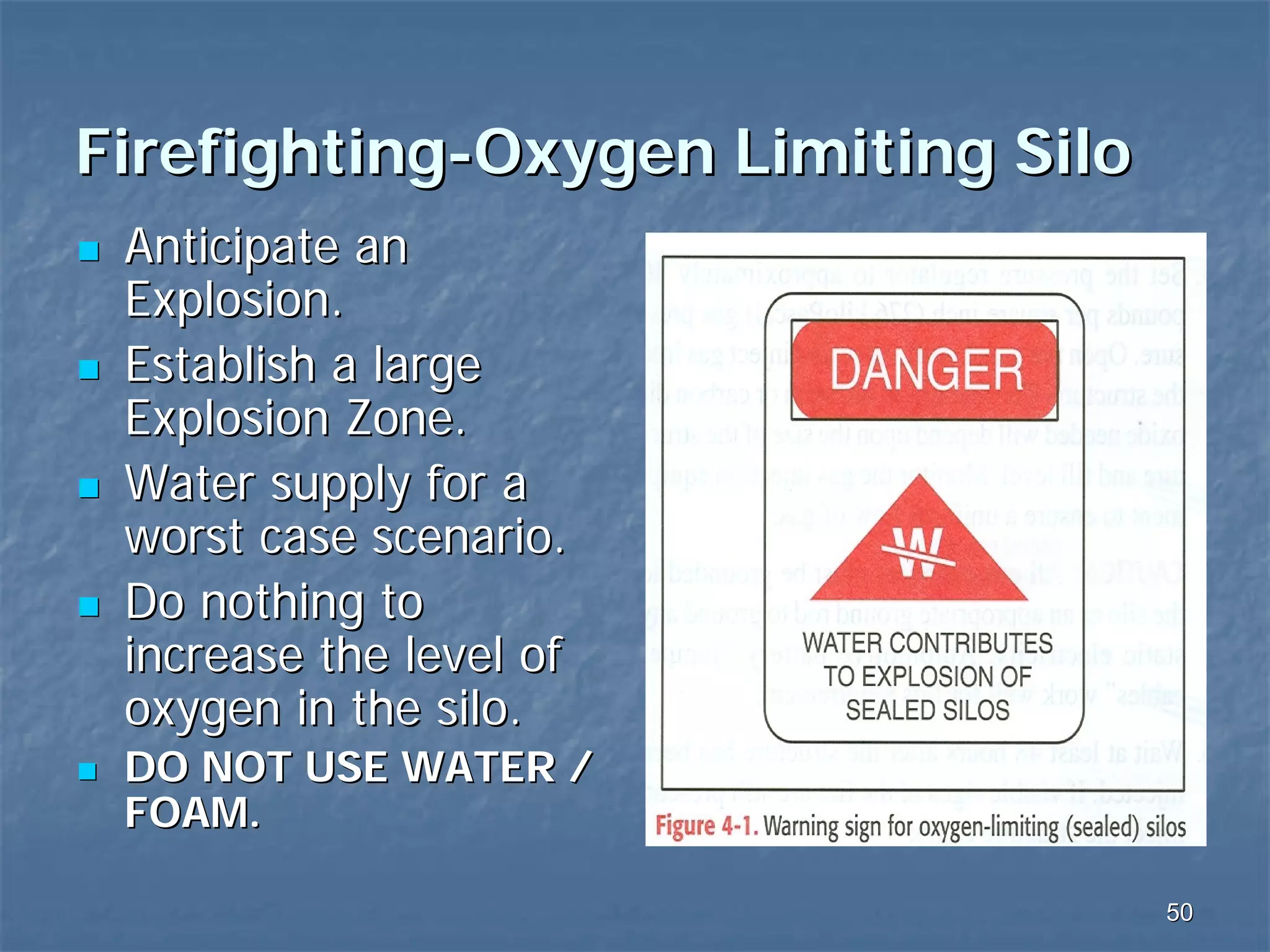
Firefighting-Oxygen Limiting Silo
Anticipate an
Explosion.
Establish a large
Explosion Zone.
Water supply for a
worst case scenario.
Do nothing to
increase the level of
oxygen in the silo.
DO NOT USE WATER /
FOAM.
50
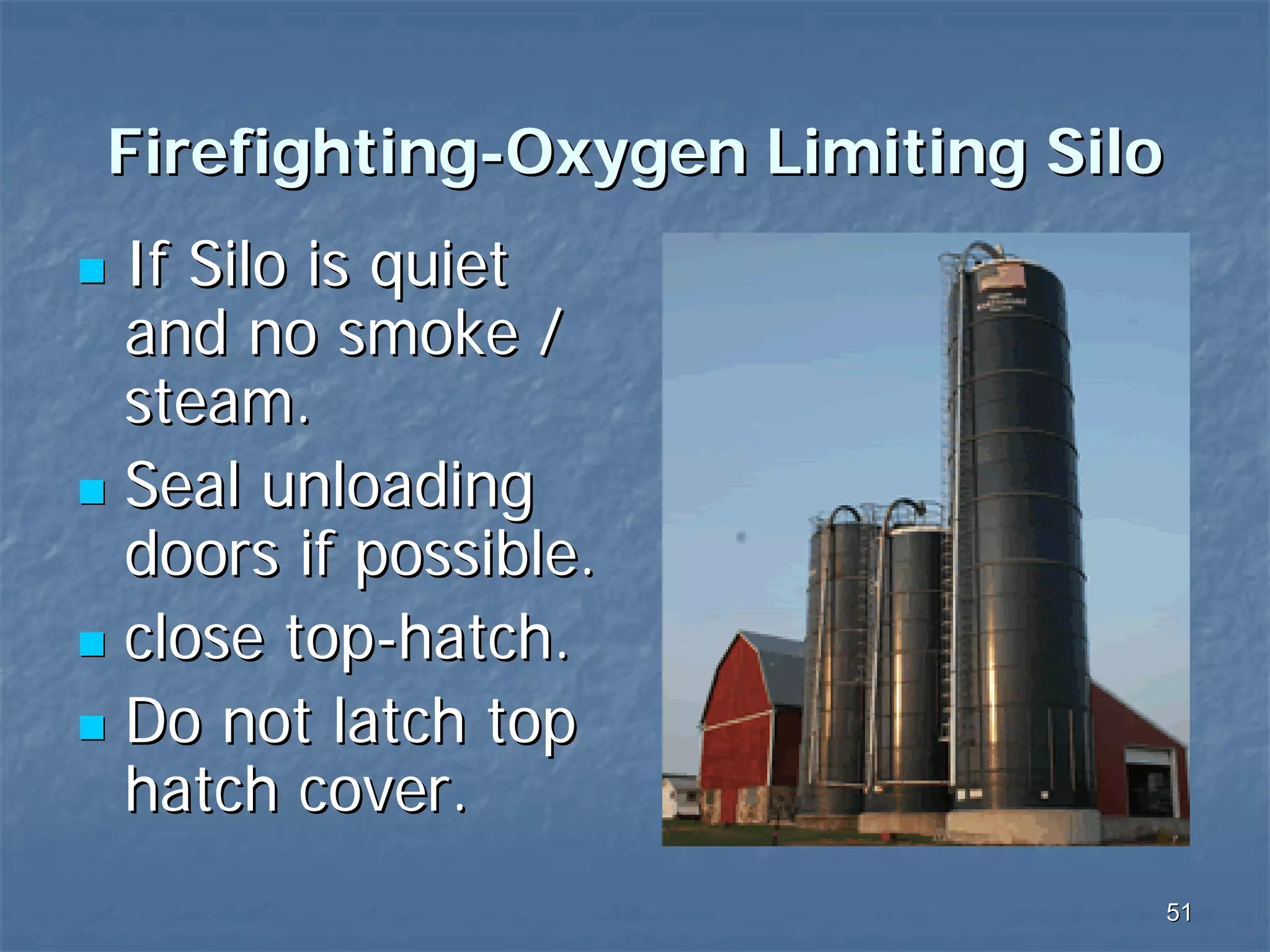
Firefighting-Oxygen Limiting Silo
If Silo is quiet
and no smoke /
steam.
Seal unloading
doors if possible.
close top-hatch.
Do not latch top
hatch cover.
51
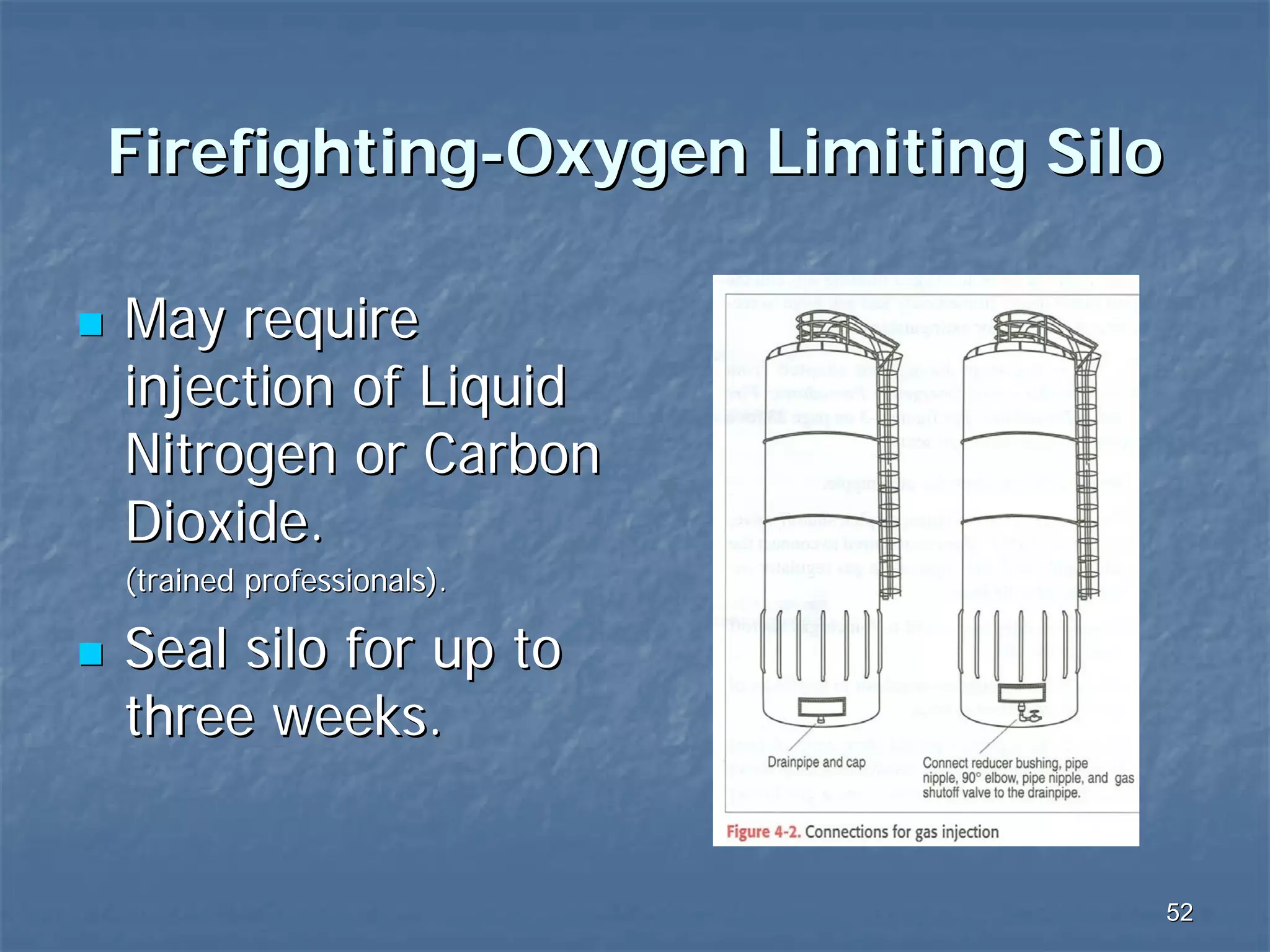
Firefighting-Oxygen Limiting Silo
May require
injection of Liquid
Nitrogen or Carbon
Dioxide.
(trained professionals).

Seal silo for up to
three weeks.

52
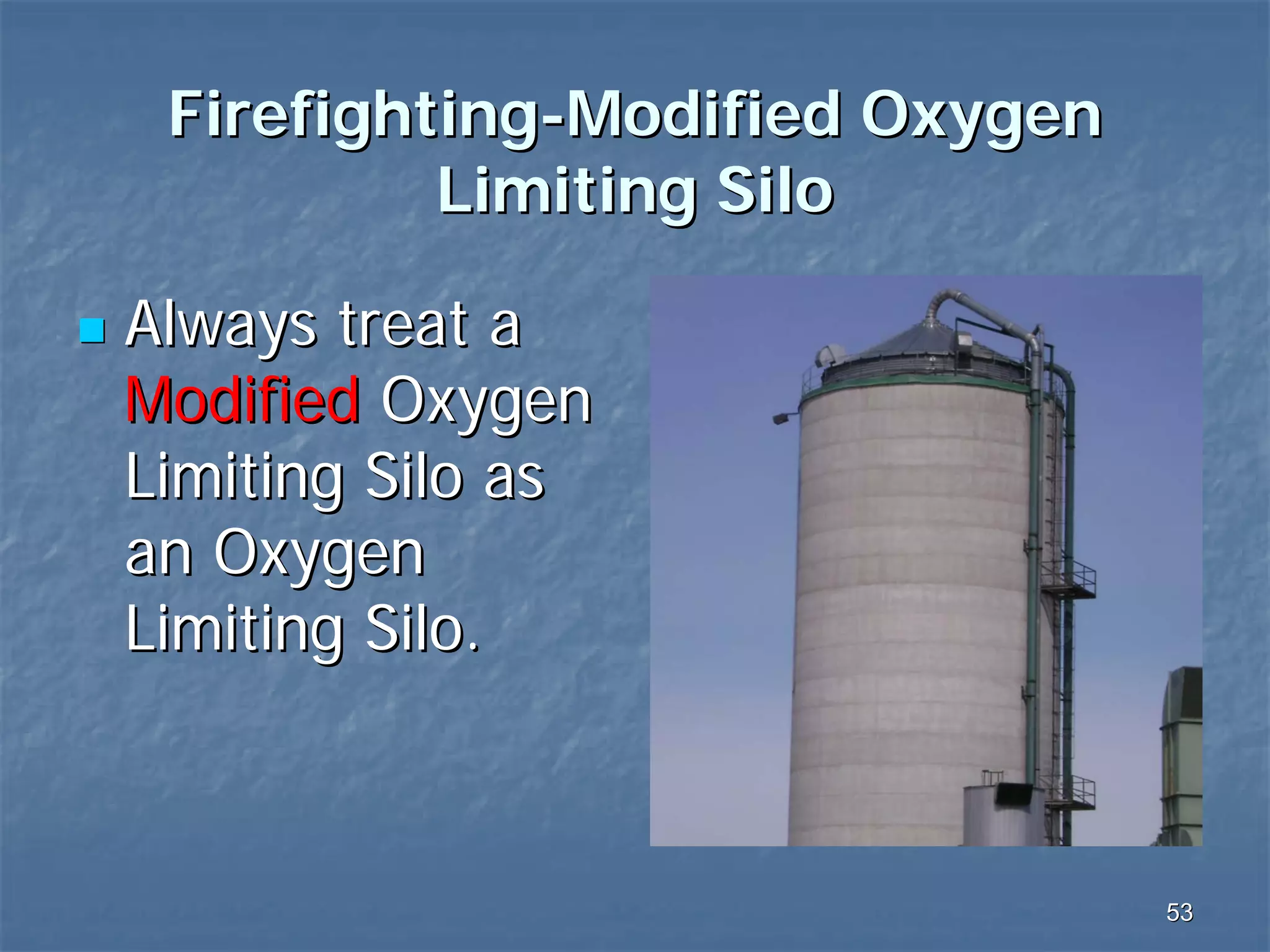
Firefighting-Modified Oxygen
Limiting Silo
Always treat a
Modified Oxygen
Limiting Silo as
an Oxygen
Limiting Silo.

53
Firefighting- Silos
Pre-plan silos in your Command.
Type, age, and contents.
Fire suppression systems (sprinklers).
Information site personnel, Experts.
Have time to review and confirm pre-plans.

54
Silo Gases
Carbon Monoxide (CO).
Carbon Dioxide (CO2).
Nitrogen Dioxide (NO2) – Silo gas.

55
Silo Fires / Explosions
It is essential that the incident commander
determines the type of silo, whether the
Silo is a Conventional, Oxygen Limiting, or
modified oxygen limiting.
NEVER proceed with extinguishing
procedures until you are certain the type
of Silo
The contents of a Silo are never worth
putting a firefighter’s life at risk
56

Dust Explosions Silo Hopper Fires

  • 1.
  • 2.
    Dust Explosions Approx 50 explosionare reported each year Resulting in hundreds of deaths Yet are the least recognized Industrial hazard 2
  • 3.
    Dust Explosions February 1999,Massachusetts Iron foundry A small, primary Resin dust explosion within the ductwork, fuelled a secondary explosion, powerful enough to lift the roof and cause wall failures. 3 people were killed, and 9 were injured. 3
  • 4.
    Dust Explosions January 2003– North CarolinaPharmaceutical plant that manufactures rubber drug delivery components A fire and a series of explosions destroyed the plant with minor damage surrounding area 6 people killed and 38 injured including 2 firefighters 4
  • 5.
    Dust Explosions February 2003- Kentucky insulation manufacturing plant. Primary blast was ignited by a small fire while cleaning A deadly cascade of dust explosions followed throughout the plant. 7 people were killed and 37 injured 5
  • 6.
    Dust Explosions February 2008– Georgia Imperial Sugar refinery Dust Explosions ripped through the plant destroying 2 silos and 1 building Seven days to extinguish 13 people were killed and 17 injured 6
  • 7.
    Dust Explosions US ChemicalSafety Board (CSB) identified 281 dust fires & explosions between 1980 & 2005 In the USA alone, Dust explosions in the last 25 yrs killed 119 workers and injured 718 others. Wood & Coal Dust explosions are by far the leading sources for Explosions Dust Collection/ Hopper systems are the leading equipment type for Explosions 7
  • 8.
    Dust Explosions Can occuranywhere combustible dust is produced Can be almost any organic material An Explosion be initiated by any energy source. Sparks, Friction, Open Flames, Heat Usually results in secondary explosions 8
  • 9.
    Dust Explosion Pentagon DustExplosion Pentagon 9
  • 10.
    Dust Explosions Rules fordust explosions. Must be combustible. Dust cloud must be confined. Capable of becoming airborne. Size & distribution = flame spread. Explosive range 50g/m3 to 23kg/m3 10
  • 11.
    Dust Explosions Dust /Powders that CAN Explode Natural Organic materials (grains, linen, sugar, coal, peat) Synthetic Organic materials (pesticides, plastics, resins) Metals ( aluminum, zinc, iron) Any Unstable Oxide 11
  • 12.
    Dust Explosions Dust /Powders that WILL NOT Explode Silicates, Sulphates Nitrates,Carbonates,Phosphates Cement, Sand, limestone Any Stable Oxide 12
  • 13.
    Dust Explosions Glass breaksat 50 kpa (7 psi.) Wood frame at 56-70 kpa (8-10 psi.) Reinforced concrete 70-85 kpa (10-12 psi.) FORCE FROM DUST EXPLOSIONS CAN EXCEED 700 kpa or 100 PSI 13
  • 14.
  • 15.
    Hopper Fires Characteristics. Funnel Shaped Onlegs or stilts Loaded from the top Unloads from the bottom. 15
  • 16.
    Hopper Fires- IncidentCommand Be aware of the potential for explosions Initial Defensive Strategy Establish large “Hot Zone” Evacuate civilians to safe distance 16
  • 17.
    Hopper Fires- IncidentCommand Protect exposures including the building the hopper serves Establish water supply sufficient volume for worst case scenario Lock out / Tag Out each power source 17
  • 18.
    Hopper Fires- IncidentCommand I/C Size Up Built in Suppression systems Explosion venting systems / access doors Loading / Unloading systems Type & level of product Expert advice 18
  • 19.
    Hopper Fires- IncidentCommand I/C Action Plan Utilize built in Suppression systems Activation may trigger an explosion No personnel on /near the hopper when the suppression system is activated Operate system till fire is extinguished 19
  • 20.
    Hopper Fires- IncidentCommand I/C Action Plan Access doors - Open Probability of Dust Explosion is reduced Access Doors could be used to position Aerial Ladder for low pressure fog stream Raise Aerial to similar height and set pump pressure for low pressure fog stream Use minimum number of personnel 20
  • 21.
    Hopper Fires- IncidentCommand I/C Action Plan Access doors - Closed Opening Access doors is an extremely Hazardous Operation Limit personnel when opening access doors or explosion relief panels Use least dangerous method possible ( tie a rope to handle and use elevated device to unlatch door) FLOOD HOPPER ( low press fog) 21
  • 22.
    Hopper Fires- IncidentCommand I/C Action Plan Unloading a Hopper Unloading kept to a minimum with light water fog played on product exit When hopper gates are closed wet down the area to reduce the possibility of dust in the air Firefighters should commence carefully removing the product from the area Repeat until the Hopper is empty 22
  • 23.
    Hopper Fires- IncidentCommand Safety If the risk of Explosion is too great – Defensive position Maintain an awareness of the Hopper weight due to water added during firefighting operations Minimize any actions that disturb the dust in the Hopper Treat all Fires in Dust Collectors / Hoppers as Potential Severe Explosion Hazard 23
  • 24.
    Hopper Fires- IncidentCommand Dec 21 2005 Salisbury Maryland 24
  • 25.
  • 26.
    Silo Fires /Explosions Significant Fires and Explosions. Alabama California Ohio New York Nova Scotia – Halifax 2003 Georgia – Imperial Sugar – 13 Killed Ontario – 2006 Perth, 2008 Woodbridge 26
  • 27.
    Silo Fires /Explosions Fire Fighter Serious Injuries / Deaths. Georgia 1993 – 2 FF killed Texas 2000 – 1 FF Killed North Carolina 2001 – 3 FF injured Nebraska 2002 – 13 FF injured ( shredded Rubber Silo) Missouri 2005 – 2 FF killed Ohio ( Twice) – 1985 & 2003 – 5 FF killed 27
  • 28.
    Firefighter Injuries /Deaths August 27th 1985 Marshville Ohio. Three Firefighters killed, 4 injured. Concrete Oxygen limiting silo. 50 minutes into fire operations. 10,000 liters of water applied. SILO EXPLODED 28
  • 29.
    Firefighter Injuries/ Deaths October1st 2003 New Knoxville Ohio. Two FF’s Killed – 8 injured Concrete Modified Oxygen Limiting Silo. 2.5 hours into firefighting operations. 30,000 liters applied. SILO EXPLODED 29
  • 30.
    Firefighter Injuries /Deaths December 21st 1997 Iredell County N.C. Three Firefighters severely injured. Metal Oxygen limiting silo. 2.5 hours into firefighting operations. 40,000 liters of water applied. SILO EXPLODED 30
  • 31.
    Silo Fires /Explosions Silo Classifications. Conventional. Oxygen limiting. Modified Oxygen Limiting. 31
  • 32.
    Conventional Silos Characteristics. Most commontype. Reinforced Concrete or Concrete staves wrapped in steel bands. Domed roof ( metal ). Top unloading. Unloading chute. 32
  • 33.
    Conventional Silo Characteristics. Most commontype. Reinforced Concrete or Concrete staves wrapped in steel bands. Domed roof ( metal ). Top unloading. Unloading chute. 33
  • 34.
    Conventional Silo Characteristics. Most commontype. Reinforced Concrete or Concrete staves wrapped in steel bands. Domed roof ( metal ). Top unloading. Unloading chute. 34
  • 35.
    Oxygen Limiting Silos Characteristics. Reinforcedconcrete, or metal (blue, green) Design limits amount of oxygen in silo. Flatter roof than a conventional silo. No exterior openings or unloading chutes. Unloads from the bottom. 35
  • 36.
    Oxygen Limiting Silos Characteristics. Reinforcedconcrete, metal ( blue, green ) Design limits amount of oxygen in silo. Flatter roof than a conventional silo. No exterior openings or unloading chutes. Unloads from the bottom. 36
  • 37.
    Oxygen Limiting Silos Topunloader to center chute No exterior openings or unloading chutes. Unloads from the bottom. 37
  • 38.
    Oxygen Limiting Silos Flatterroof. Venting valves. Airtight Hatch Cover. Hatches will be sealed with gaskets / clamps. 38
  • 39.
    Oxygen Limiting Silo SatinFinish Flooring 200 Fenmar Dr 39
  • 40.
    Modified Oxygen LimitingSilo Modified from Conventional to Oxygen Limiting Bottom unloading. No external chute. Oxygen Limiting to Conventional. Top / bottom unloading. Top unloading -external unloading chute and hatches. Always Treat as Oxygen Limiting 40
  • 41.
    Modified Oxygen LimitingSilo Satin Finish Flooring 8 Oak St. 41
  • 42.
    Modified Oxygen LimitingSilo Satin Finish Flooring 8 Oak St.. Modified from Oxygen Limiting to Conventional Silo 42
  • 43.
    Firefighting- Silos Personal ProtectionEquipment. S.C.B.A.: smoke, gasses, oxygen deficiency. I.M.S.: large hot zone, Safety Officer, R.I.T.. Fall arresting devices: heights. Confined space: avoid entering. 43
  • 44.
    Firefighting-Silos Disconnect power sources: lock/ tag out. Protect exposures: embers, adjacent buildings. Extent / location of fire. Amount of heat, smoke and flames. Thermal imaging camera. Drier concrete shades. 44
  • 45.
    Firefighting-Conventional Silos Generally slow burning,deep seated fires. Contain the Fire Usually near the unloading doors. Normally within the top 10 feet of the silage. 45
  • 46.
    Firefighting-Conventional Silos Knock downsurface burning first. Don’t flood: will not withstand lateral pressure. Do not apply water to exterior of silo. Minimal chance of structural collapse from heat Extinguish pockets with straight streams, piercing applicators. 46
  • 47.
    Firefighting-Conventional Silo Early stages Extinguishsurface fire. Locate hotspots. Inject water. directly into hotspot Open hatches above to allow for venting. 47
  • 48.
    Firefighting-Conventional Silos Advanced Fires. Leaveto burn themselves out. Product is unsalvageable. Fires in concrete silos do little harm. Protect exposures to prevent spread of fire. Unload silo to ensure complete extinguishment 48
  • 49.
    Firefighting-Conventional Silo Do Notflood the silo. Water follows path of least resistance. Water will run down the walls, passing most of the hot silage. Inject water directly into hot spots. 49
  • 50.
    Firefighting-Oxygen Limiting Silo Anticipatean Explosion. Establish a large Explosion Zone. Water supply for a worst case scenario. Do nothing to increase the level of oxygen in the silo. DO NOT USE WATER / FOAM. 50
  • 51.
    Firefighting-Oxygen Limiting Silo IfSilo is quiet and no smoke / steam. Seal unloading doors if possible. close top-hatch. Do not latch top hatch cover. 51
  • 52.
    Firefighting-Oxygen Limiting Silo Mayrequire injection of Liquid Nitrogen or Carbon Dioxide. (trained professionals). Seal silo for up to three weeks. 52
  • 53.
    Firefighting-Modified Oxygen Limiting Silo Alwaystreat a Modified Oxygen Limiting Silo as an Oxygen Limiting Silo. 53
  • 54.
    Firefighting- Silos Pre-plan silosin your Command. Type, age, and contents. Fire suppression systems (sprinklers). Information site personnel, Experts. Have time to review and confirm pre-plans. 54
  • 55.
    Silo Gases Carbon Monoxide(CO). Carbon Dioxide (CO2). Nitrogen Dioxide (NO2) – Silo gas. 55
  • 56.
    Silo Fires /Explosions It is essential that the incident commander determines the type of silo, whether the Silo is a Conventional, Oxygen Limiting, or modified oxygen limiting. NEVER proceed with extinguishing procedures until you are certain the type of Silo The contents of a Silo are never worth putting a firefighter’s life at risk 56