Building Codes  and  Regulatory Requirements Building Codes & Life Safety ○  Code Development    Zoning Ordinances    Legal Constraints
Building Codes Overall Purpose: To protect public health and safety by setting a  minimum  standard of quality Codes are to be followed & maintained, but are to be used as  basic  foundations for quality Codes do not regulate building  appearance , but do deal with issues of building  performance   Codes do place limitations on design and aesthetics
Building Codes Building construction is regulated by an impartial authority; ensures that interests of all are protected Jurisdictional: state, county, city Also referred to as  “Authority Having Jurisdiction”  (AHJ) Enforced by a  building official  or  code official Building Codes have one major benefit to all: Liability protection If building is designed/constructed according to code, the building professionals are exposed to substantially lower liability risk
Building Codes The building code regulates the following aspects of building design and construction: Life safety Fire safety Structural safety Health and welfare Property protection
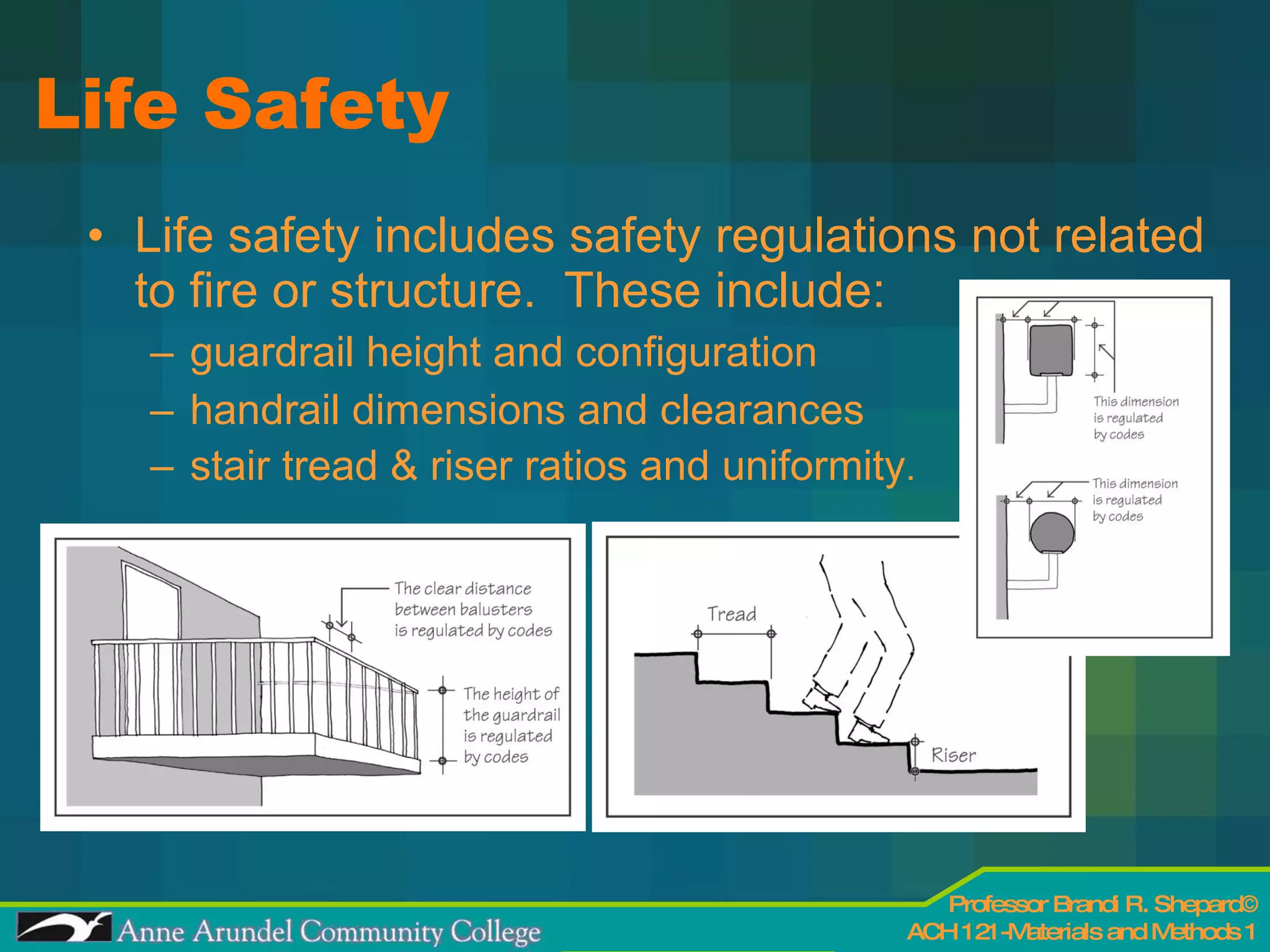
Life Safety Life safety includes safety regulations not related to fire or structure.  These include: guardrail height and configuration handrail dimensions and clearances stair tread & riser ratios and uniformity .
Fire Safety Fire resistance of materials and construction Types of building construction Smoke protection Means of Egress
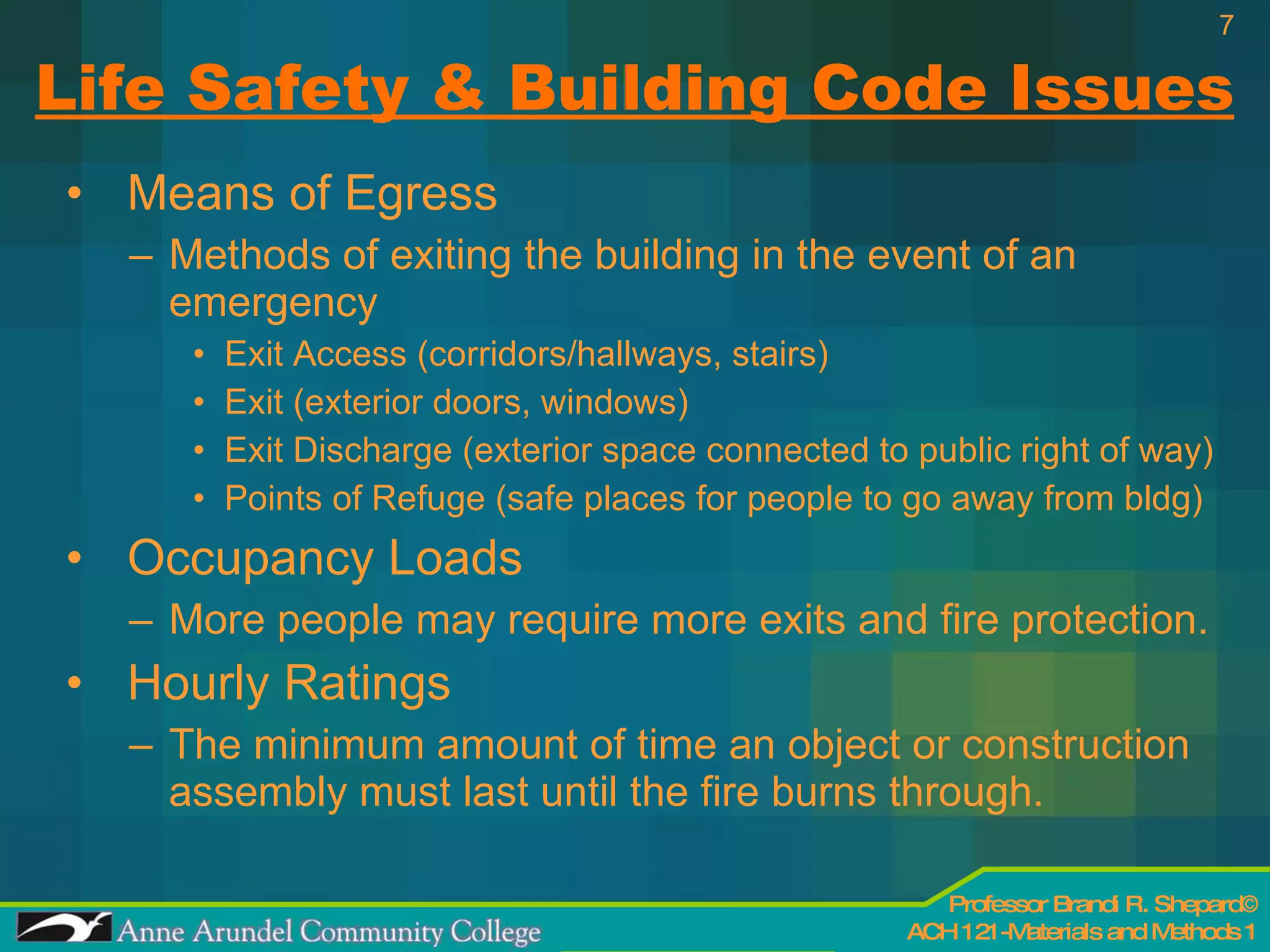
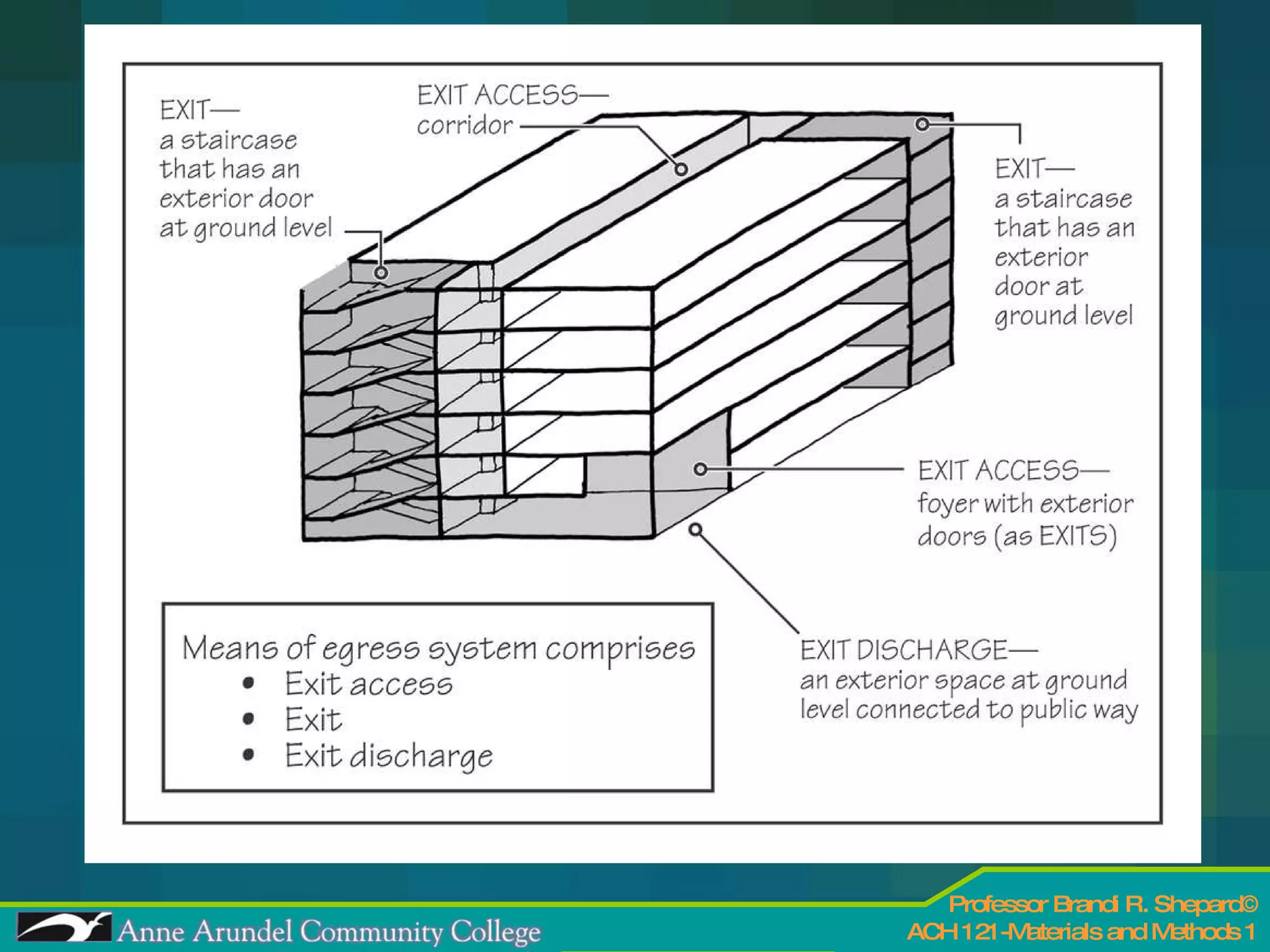
Life Safety & Building Code Issues Means of Egress Methods of exiting the building in the event of an emergency Exit Access (corridors/hallways, stairs) Exit (exterior doors, windows) Exit Discharge (exterior space connected to public right of way) Points of Refuge (safe places for people to go away from bldg) Occupancy Loads More people may require more exits and fire protection. Hourly Ratings The minimum amount of time an object or construction assembly must last until the fire burns through.
 
Structural Safety The objective of structural safety accounts for the most regulations in a building code.  Accounts for the largest volume in the building code
Human Health and Welfare Lighting Ventilation  Sanitation Indoor climate Noise control
Property Protection Safeguarding against loss or damage Integral to fire safety and life safety These are two major causes of property damage Durability of materials Material and construction standards embedded in code Example:  roof membranes conform to quality building standards;  structural and non-structural wood must be protected from decay and fungus;  degeneration of materials due to freeze-thaw action corrosion of metals
Model Building Codes Codes are Nationally and Internationally Developed These are the basis in which all codes are standardized in the United States Prepared by a National Group of Code Administrators that organize locally with knowledge of: safety requirements  construction methods and techniques performance of materials and systems Adopted by local jurisdictions  ( Townships, Counties, States, Etc…) Local amendments may be issued to make certain restrictions either more strict or lax They are regulations based on construction type These are known as  model building codes
Components of a  Typical Building Code (IBC) Code administration Defines how the AHJ will administer codes  Building planning Occupancy Type of construction Frontage Maximum allowable area and height Fire protection Fire-resistive materials  Systems that will detect and suppress fires Occupant needs Health and welfare issues; means of egress; accessibility
Components of a  Typical Model Building Code (IBC) Building Envelope Performance of exterior bldg skin (walls, cladding, roof, windows) Structural Systems and Materials Loads on buildings; structural tests/inspections; foundations Non-Structural Materials  Aluminum; gypsum board; glass; plastics Building Services Electrical, mechanical, plumbing systems only related to architectural design (technical requirements are related to specialty codes) Miscellaneous Provisions Construction in a public right of way; site work; demolition; existing structures
Building Codes Types of building codes IBC 2003/2006 - International Building Code Developed by the International Code Council (ICC) Used by most jurisdictions throughout the United States. First unified code in history. Site, Construction, Mechanical, Electrical, Etc… IBC has both standard and residential code restrictions. Addresses construction standards and life safety IRC 2003/2006 – International Residential Code Focuses primarily on residential dwellings One, two-story dwellings, townhouses, condos/apartments
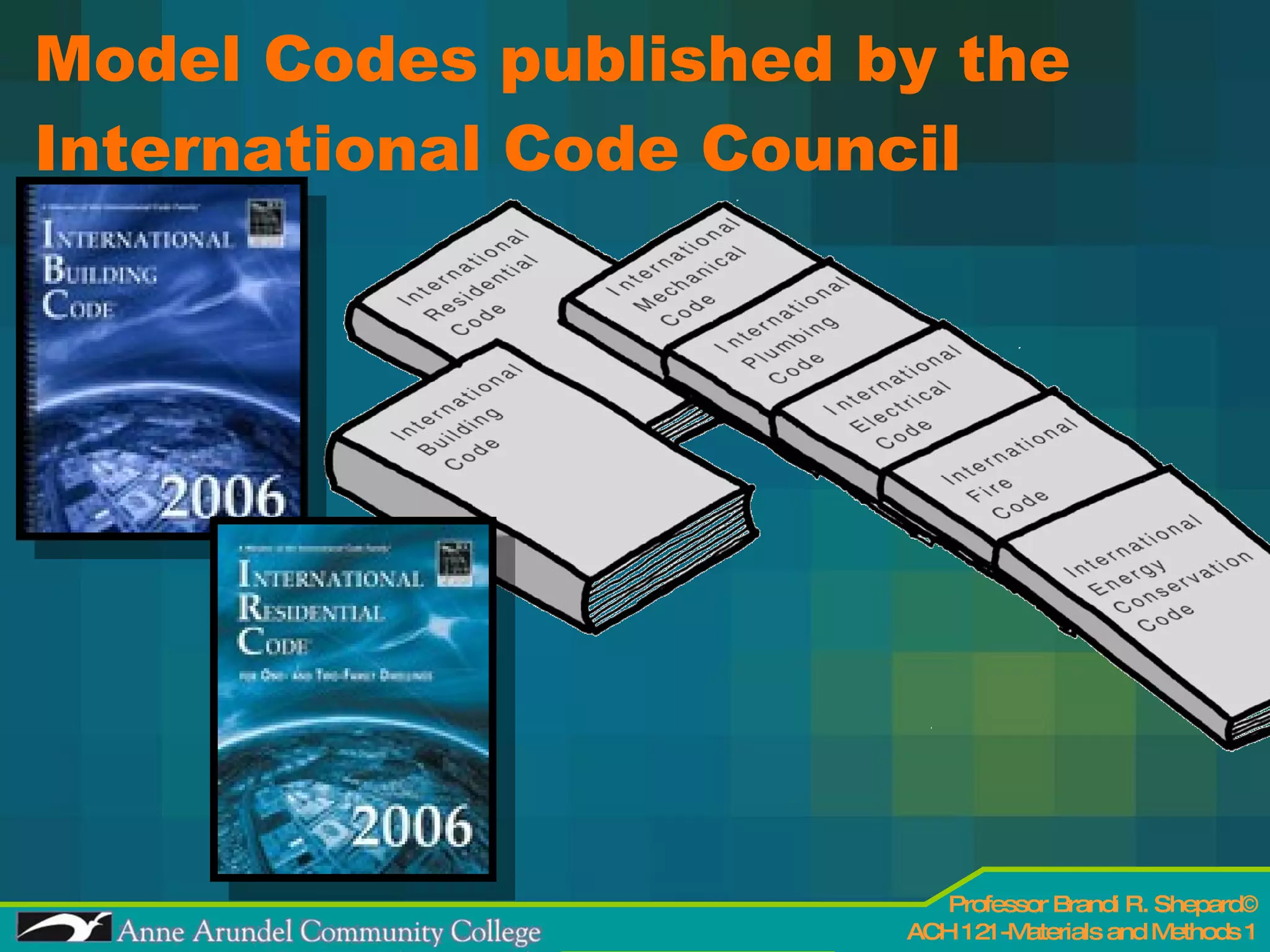
Model Codes published by the  International Code Council
Building Codes Prior to 2000, older codes are… Building Officials and Code Administrators (BOCA - 1996)  (central and NE states) Uniform Building Code (UBC)  (west coast & some US cities) up to date seismic provisions-earthquakes Standard Building Code (SBC)  (southern & SE states) up to date wind load provisions - hurricanes Council of American Building Officials (CABO) BOCA, UBC and SBC codes are not as commonly used today as they were in the past. CABO One- and Two-Dwelling Code of 1995 was replaced by IRC
Additional Codes International Plumbing Code Water supply, wastewater, storm water management  International Electrical Code Electrical systems International Mechanical Code Heating, ventilation, air-conditioning (HVAC) equipment and related duct work International Fire Code  ( Fire Prevention Code ) Fire-safe maintenance of buildings  International Energy Conservation Code Conservation of energy by buildings
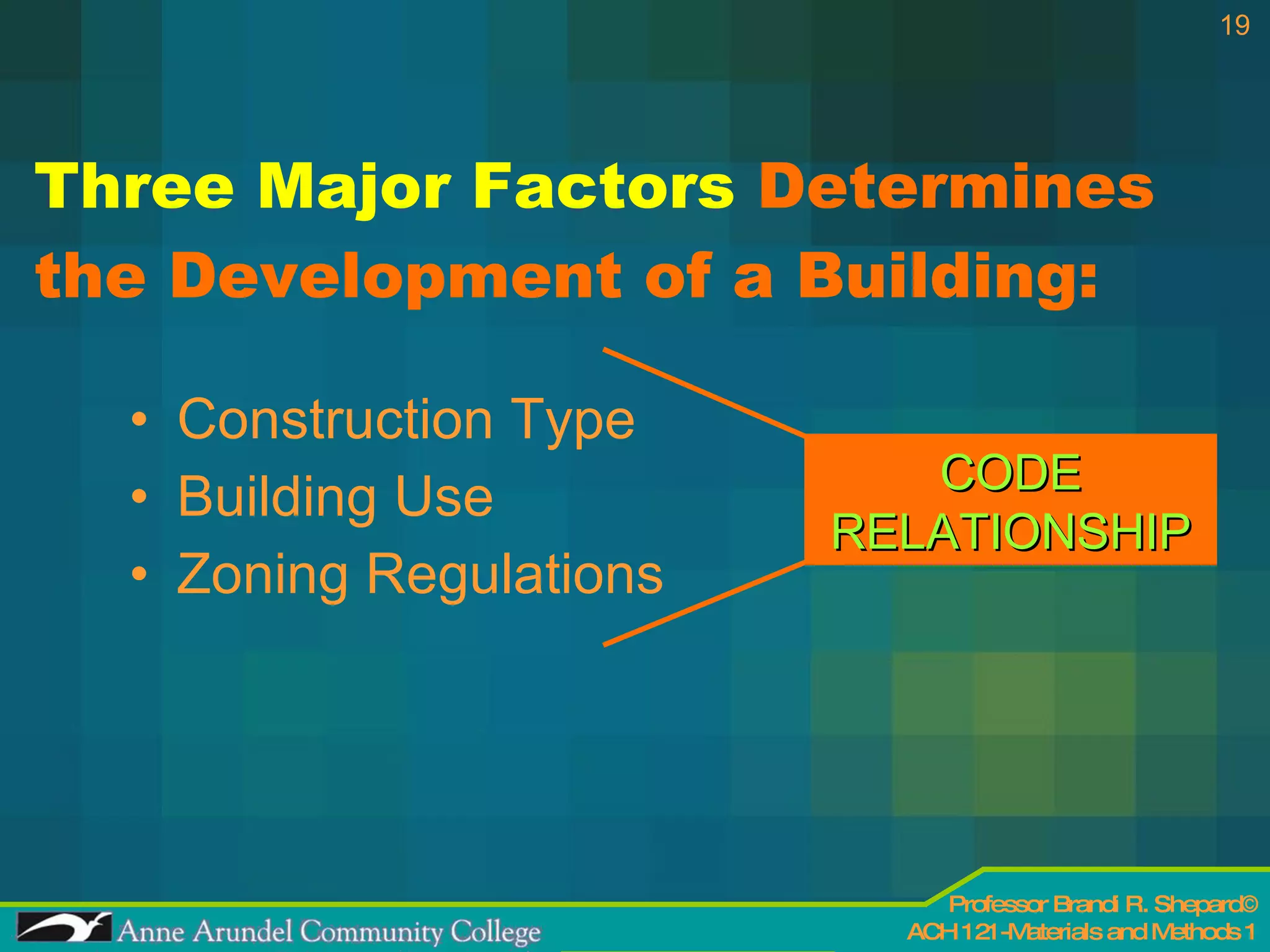
Three Major Factors  Determines the Development of a Building: Construction Type Building Use Zoning Regulations CODE RELATIONSHIP
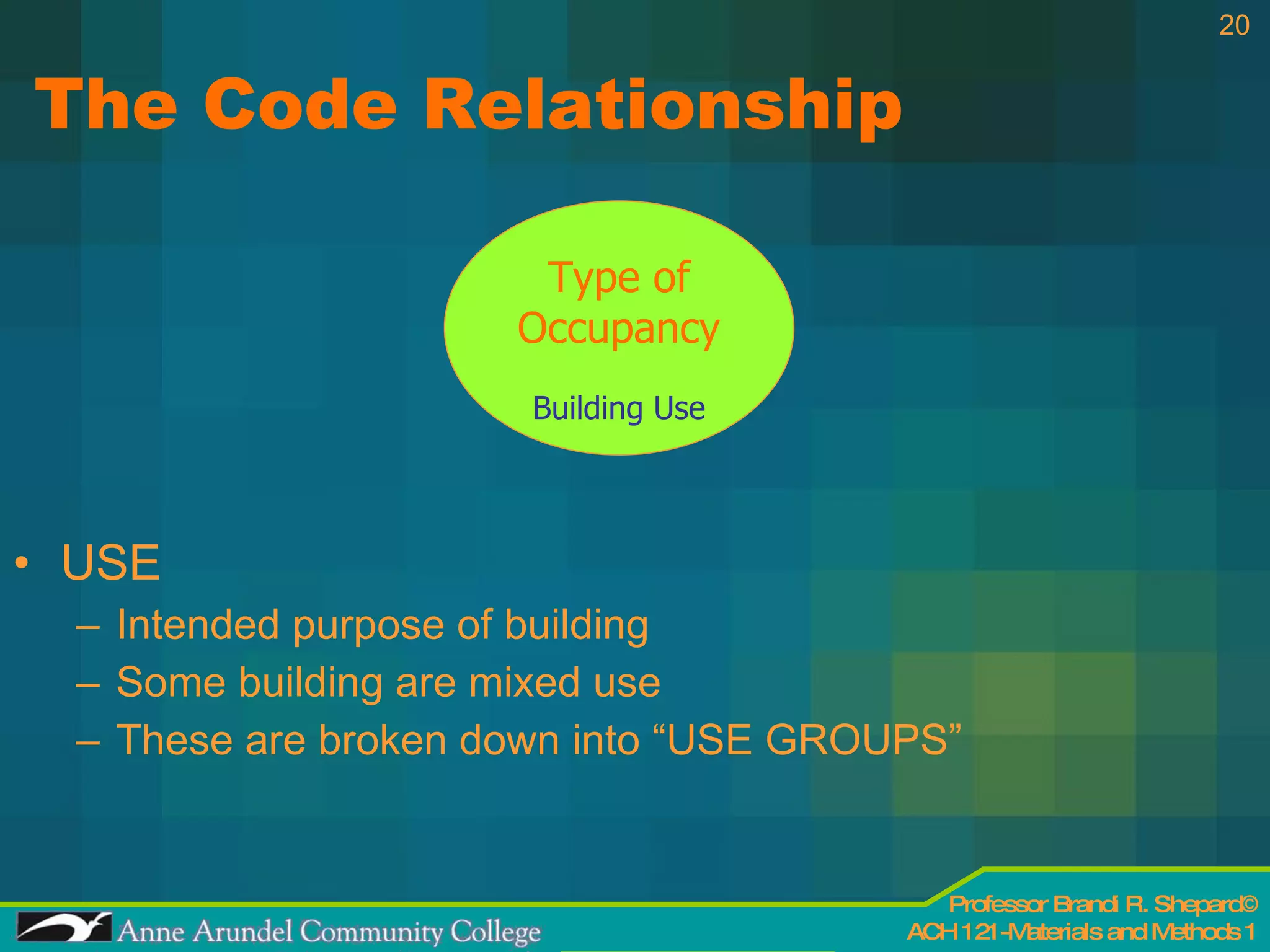
The Code Relationship USE Intended purpose of building Some building are mixed use These are broken down into “USE GROUPS” Type of Occupancy Building Use
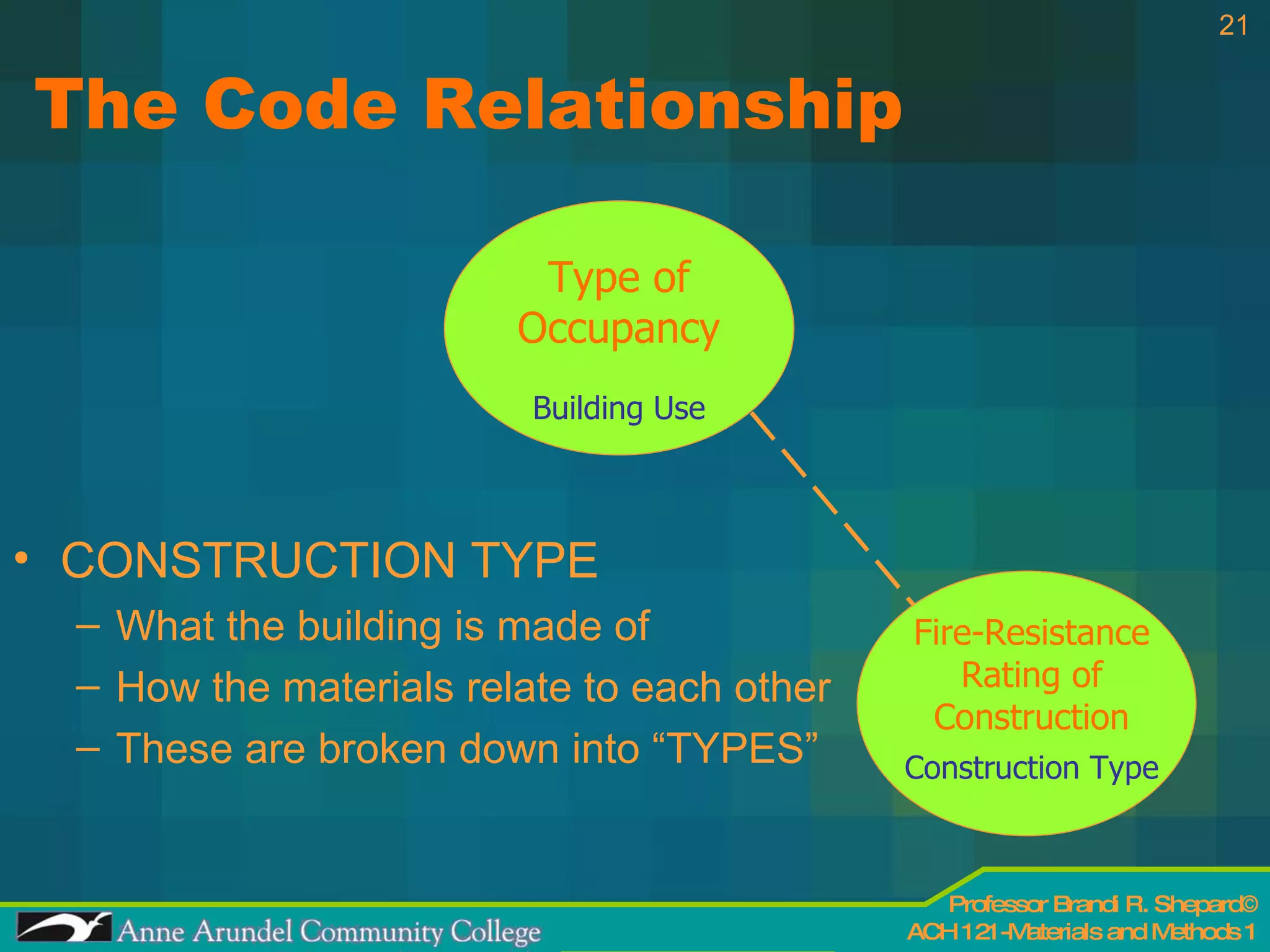
The Code Relationship CONSTRUCTION TYPE What the building is made of How the materials relate to each other These are broken down into “TYPES” Type of Occupancy Building Use Fire-Resistance Rating of Construction Construction Type
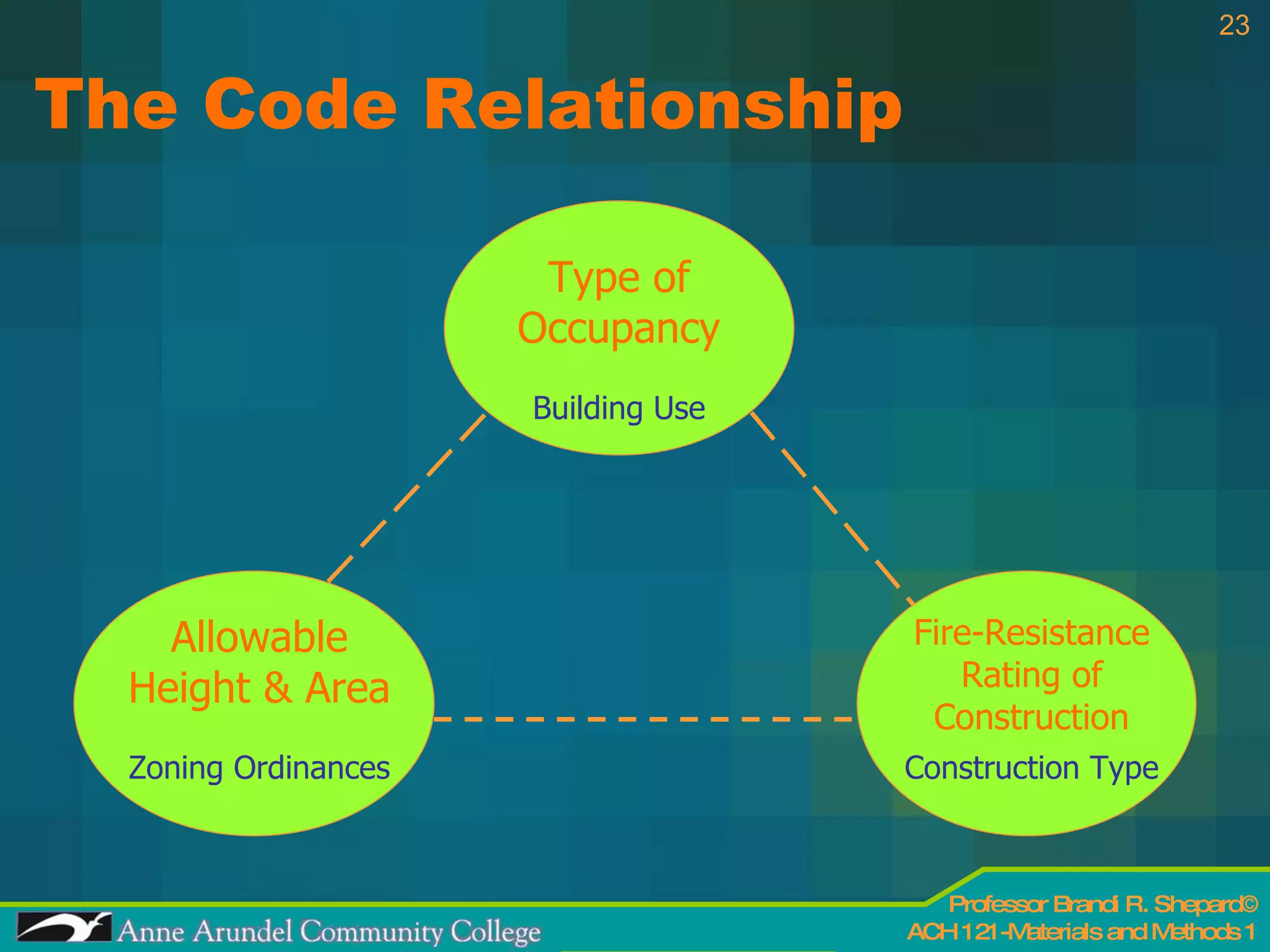
The Code Relationship ZONING ORDINANCES  Drawn up by local jurisdictions to manage:  density & pattern  types of development Regulations based on land use Allowable Height & Area Zoning Ordinances Fire-Resistance Rating of Construction Construction Type
The Code Relationship Type of Occupancy Building Use Allowable Height & Area Zoning Ordinances Fire-Resistance Rating of Construction Construction Type
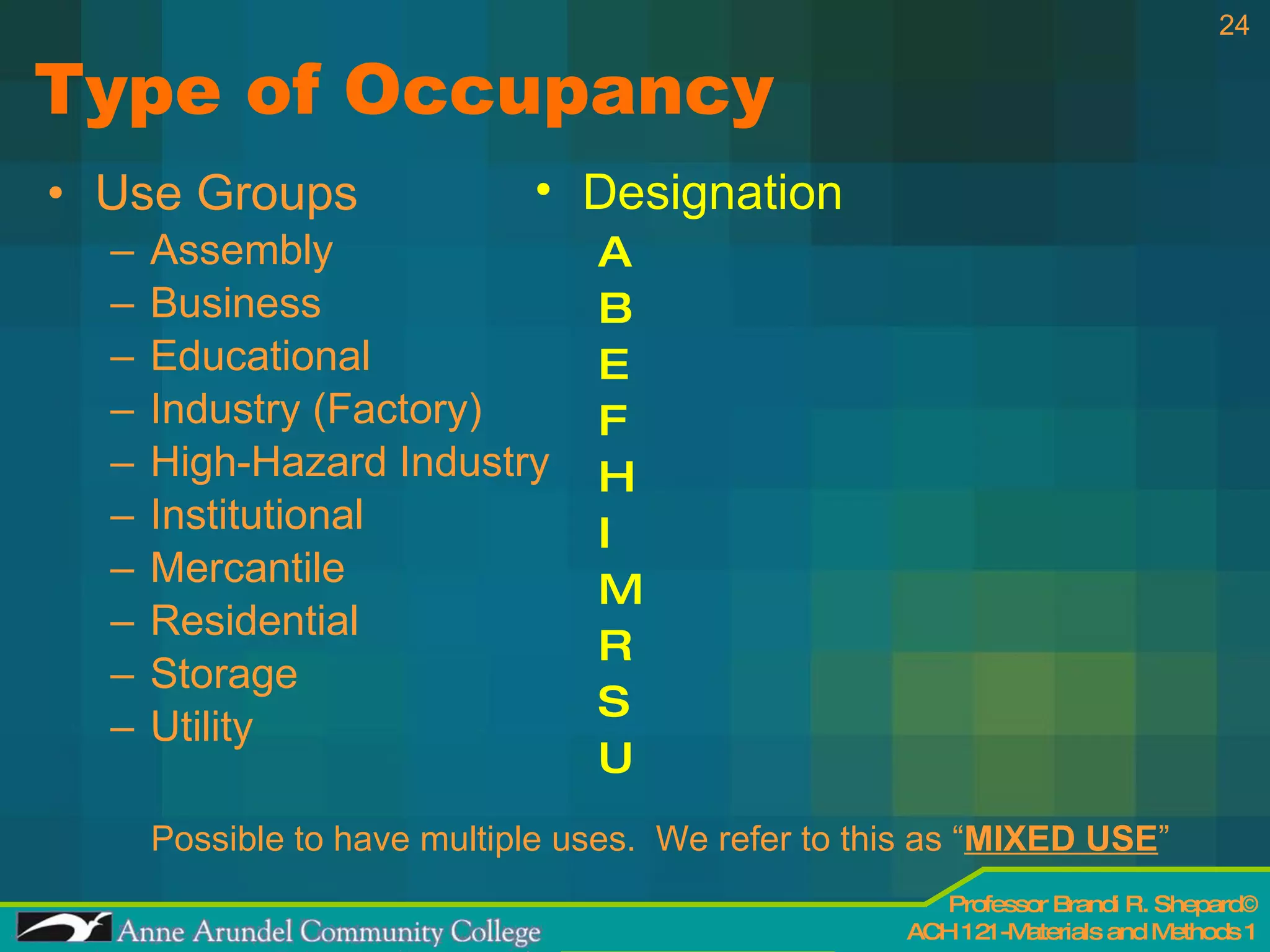
Type of Occupancy Use Groups Assembly Business Educational  Industry (Factory) High-Hazard Industry Institutional Mercantile  Residential Storage Utility Possible to have multiple uses.  We refer to this as “ MIXED USE ” Designation A B E F H I M R S U
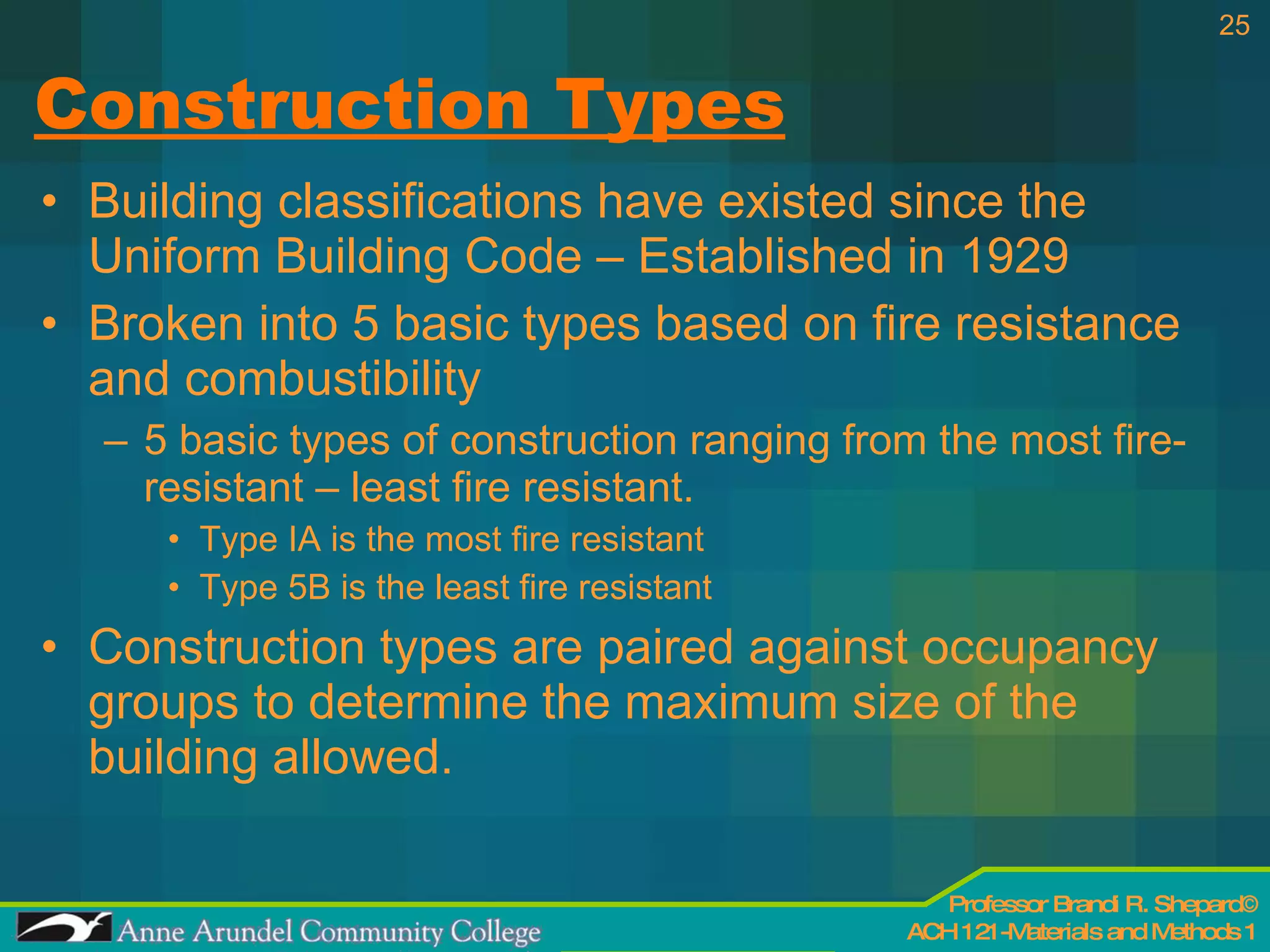
Construction Types Building classifications have existed since the Uniform Building Code – Established in 1929 Broken into 5 basic types based on fire resistance and combustibility 5 basic types of construction ranging from the most fire-resistant – least fire resistant. Type IA is the most fire resistant Type 5B is the least fire resistant Construction types are paired against occupancy groups to determine the maximum size of the building allowed.
Construction Types Materials are broken down into two categories: Combustible Materials that will ignite and burn when subjected to fire. Fire treatment / protection may increase the resistance of some materials. Noncombustible Material of which no part will ignite and burn when subjected to fire.
Construction Types Construction types are further broken down into sub-categories designating their fire protection: #A = Protected #B = Unprotected The more fire protection, the larger you can build Even buildings constructed in steel have both classifications because steel will melt and deflect under extreme heat.
Construction Types The principal elements of type I & II construction are made of noncombustible materials. Principal elements generally refers to the structure Type I & II generally relies on steel, concrete of masonry for its structure. Section 402.0 TYPE 1 CONSTRUCTION 402.1 General: Buildings and structures of Type 1 construction are those in which the walls, partitions, structural elements, floors, ceilings, roofs and the  exits  are constructed of approved  non-combustible  materials and  protected  to afford the fire resistance rating specified in Table 401.  Buildings are Type 1 construction shall be further classified as Type 1A or 1B. Same description as Type II
Construction Types Type III buildings area  mix of both combustible and noncombustible materials. Noncombustible exterior walls Combustible interior structure Designed to prevent fires from spreading from one structure to another Ex.: a Wood Frame Building with a brick veneer on all sides. Section 404.0 TYPE 3 CONSTRUCTION 404.1 General: Buildings and structures of Type 3 construction are those in which the exterior, fire walls, and party walls are constructed of masonry or other approved  non-combustible  materials of the required fire resistance rating and structural properties; the floors, roofs and interior framing are wholly or partly constructed of wood, metal, or other approved construction; ……. .
Construction Types Type IV buildings addresses heavy timber construction. Heavy timber members begin to flame and char at about 400 degrees. As charring continues, it begins to act as a fire protection by insulating the interior of the wood members. Section 405.0 TYPE 4 CONSTRUCTION 405.1 General: Buildings and structures of Type 4 construction are those in which the exterior walls are constructed of  non-combustible  materials having a  fire resistance rating not less than that specified in Table 401 and the interior structural members are of solid or laminated wood without concealed spaces.
Construction Types Type V construction is the most restrictive in terms of what you can build BUT least restrictive in what you can use to build it. Allows the use of any material permitted by code Type V is the conventional light-wood frame construction in residential homes. V-A protects all major building elements (stairs, bearing walls, columns) with a 1 hour rating V-B is generally unprotected construction Section 406.0 TYPE 5 CONSTRUCTION 406.1 General: Buildings and structures of Type 5 construction are those in which the exterior walls, bearing walls, partitions, floors and roofs are constructed of any materials permitted by this code and in which the structural elements have the required fire resistance rating specified in Table 401. Buildings of Type 5 construction shall be further classified as Type 5A or 5B.
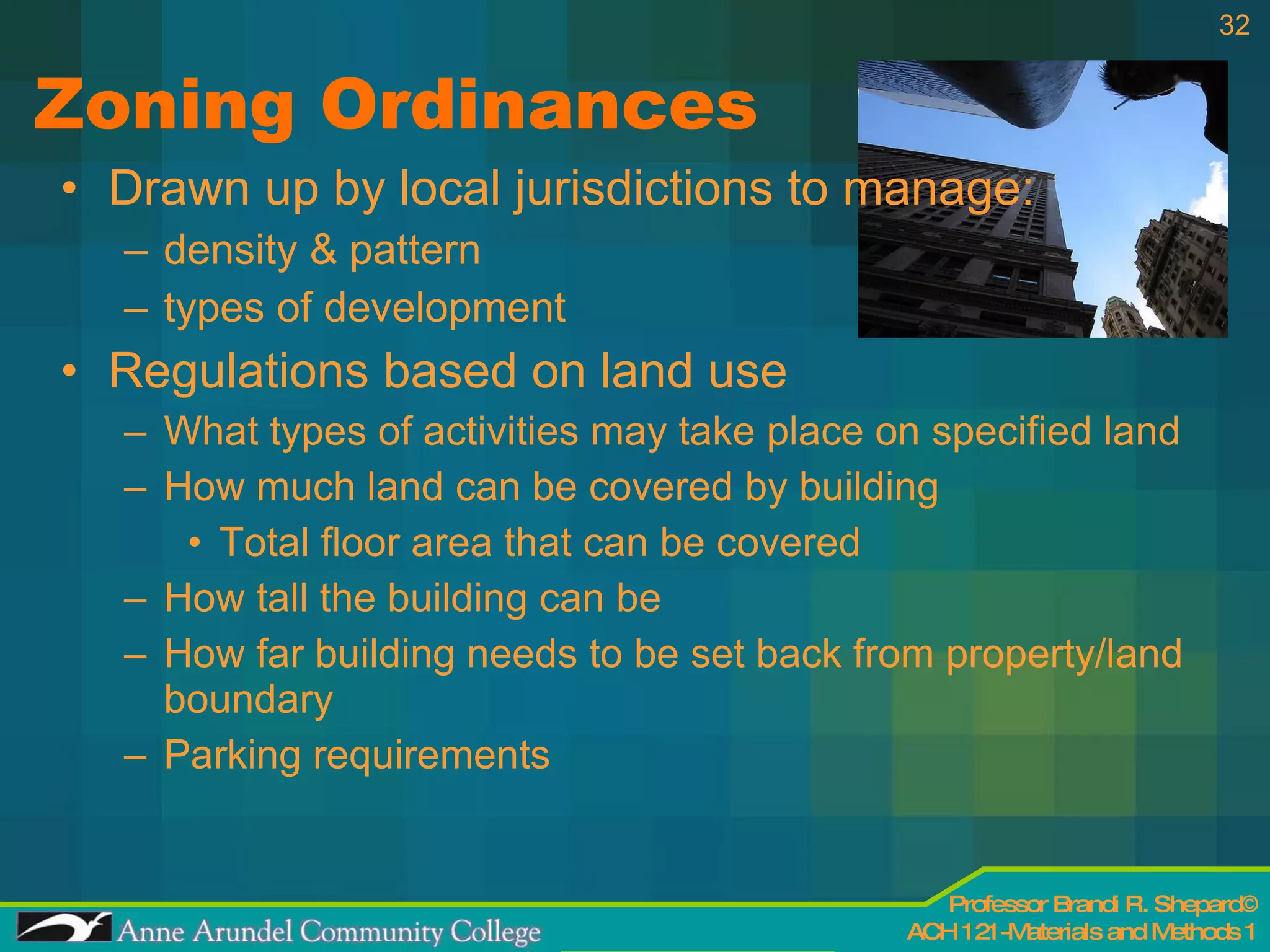
Zoning Ordinances Drawn up by local jurisdictions to manage:  density & pattern  types of development Regulations based on land use What types of activities may take place on specified land How much land can be covered by building Total floor area that can be covered How tall the building can be How far building needs to be set back from property/land boundary Parking requirements
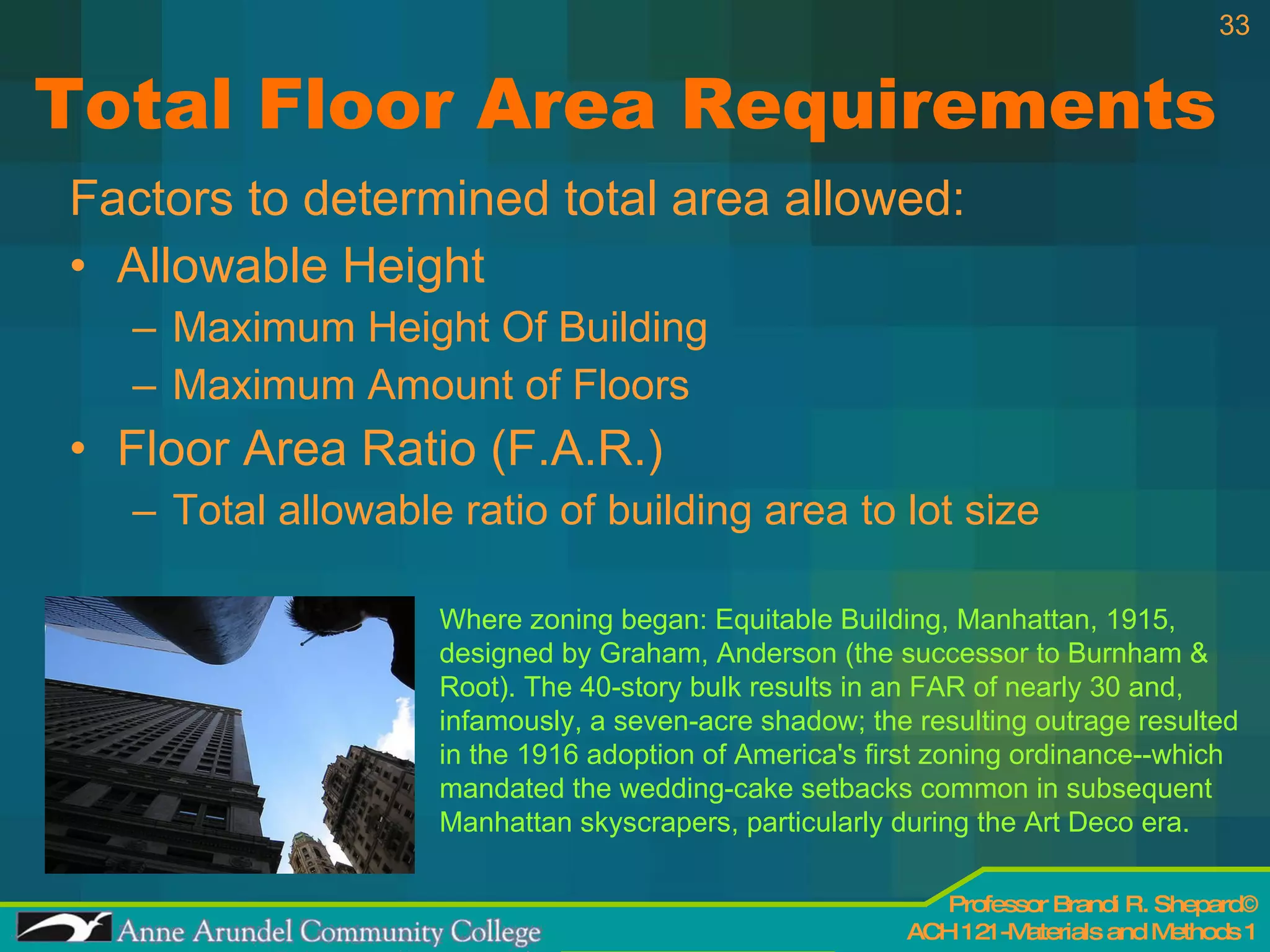
Total Floor Area Requirements Factors to determined total area allowed: Allowable Height Maximum Height Of Building Maximum Amount of Floors Floor Area Ratio (F.A.R.) Total allowable ratio of building area to lot size Where zoning began: Equitable Building, Manhattan, 1915, designed by Graham, Anderson (the successor to Burnham & Root). The 40-story bulk results in an FAR of nearly 30 and, infamously, a seven-acre shadow; the resulting outrage resulted in the 1916 adoption of America's first zoning ordinance--which mandated the wedding-cake setbacks common in subsequent Manhattan skyscrapers, particularly during the Art Deco era.
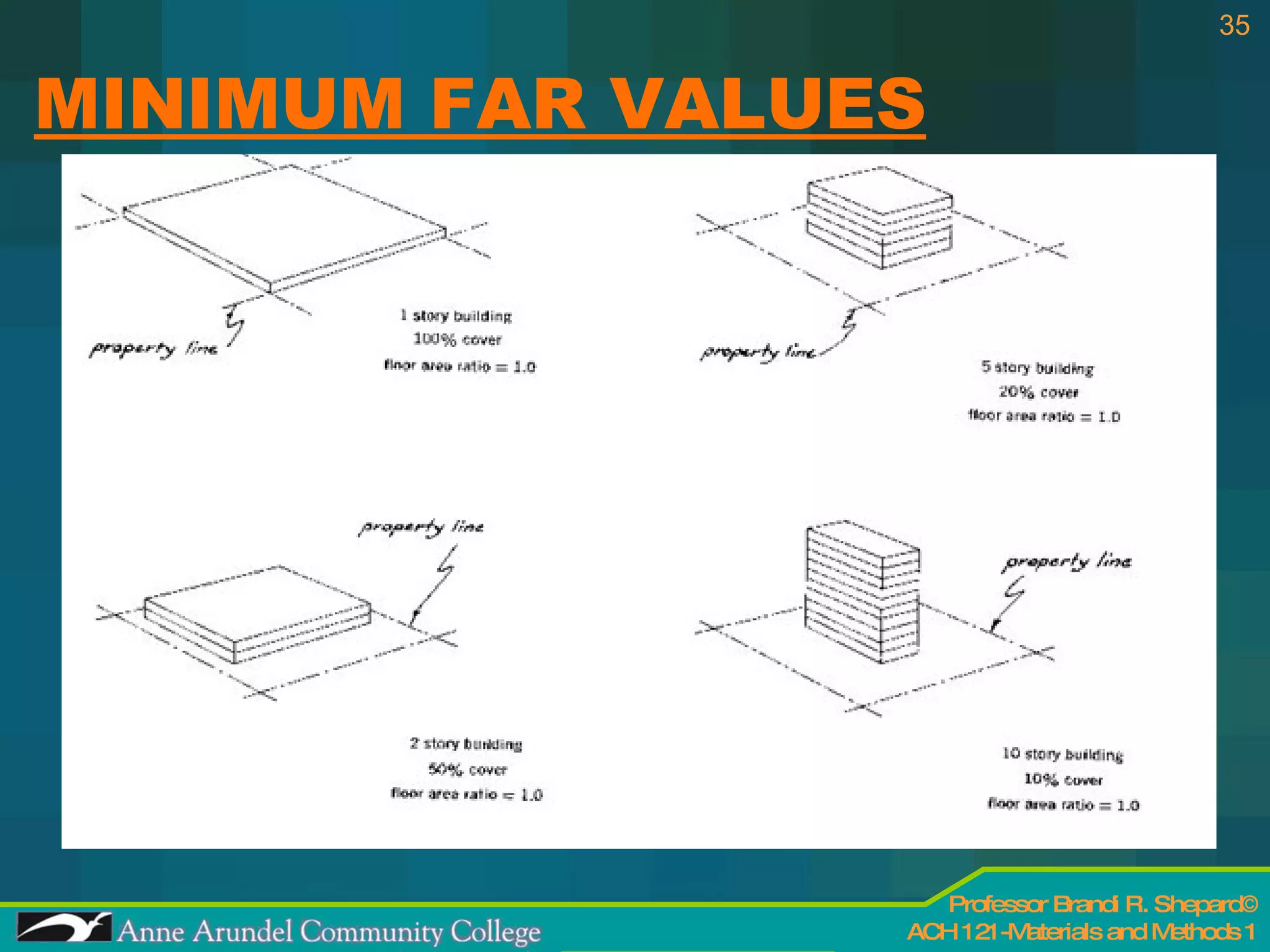
FLOOR AREA RATIO We use FAR calculations for three reasons… To determine the maximum size building that can be constructed To determine the feasibility of building or property expansion To determine the FAR value of an existing building for real-estate marketing Almost every local jurisdiction has their own “rules” for calculating floor area ratios. There are variations in the formulas!  We will use a simplified version! Planning & Zoning may give both minimum & maximum FAR Values.
MINIMUM FAR VALUES
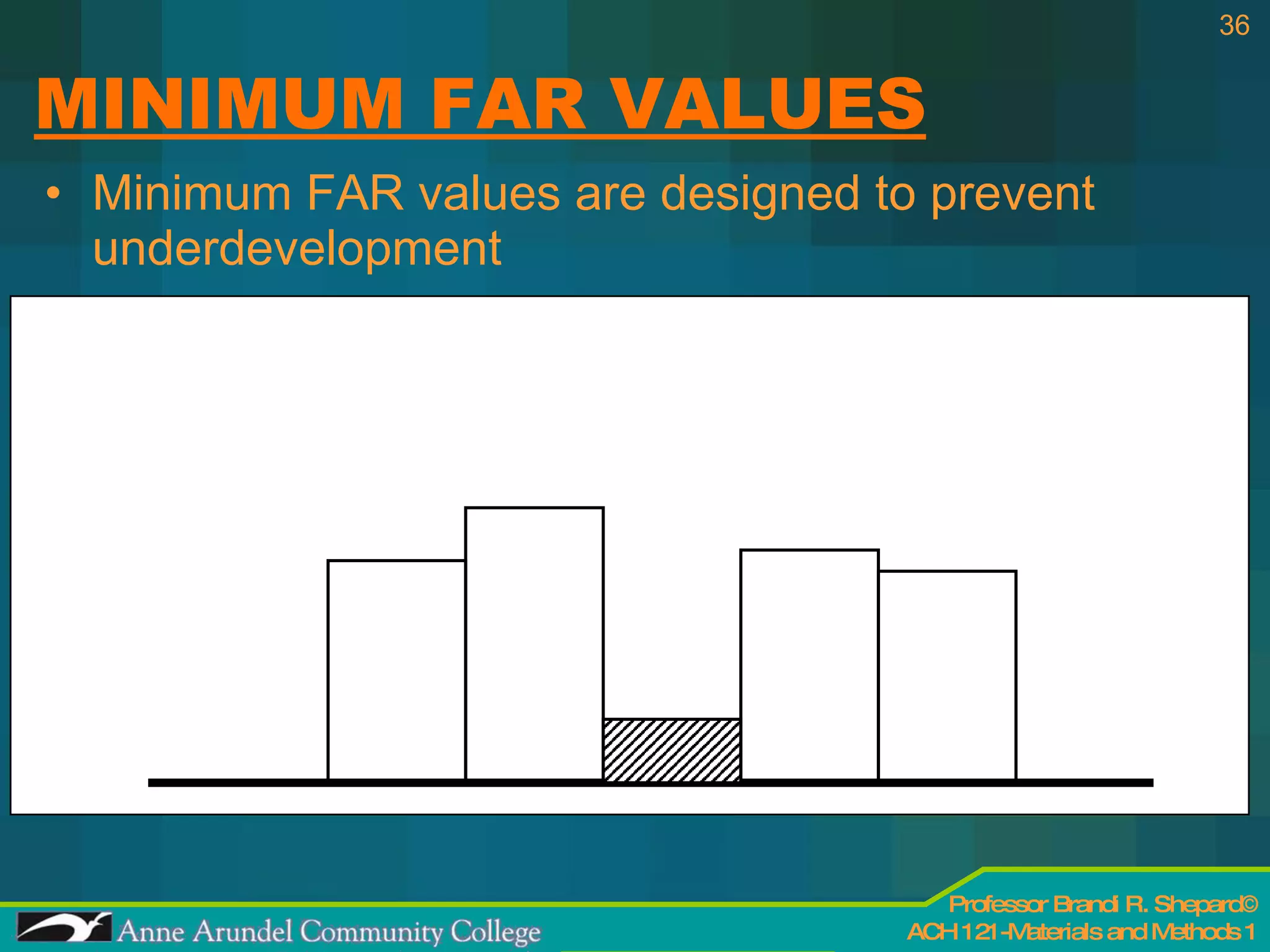
MINIMUM FAR VALUES Minimum FAR values are designed to prevent underdevelopment
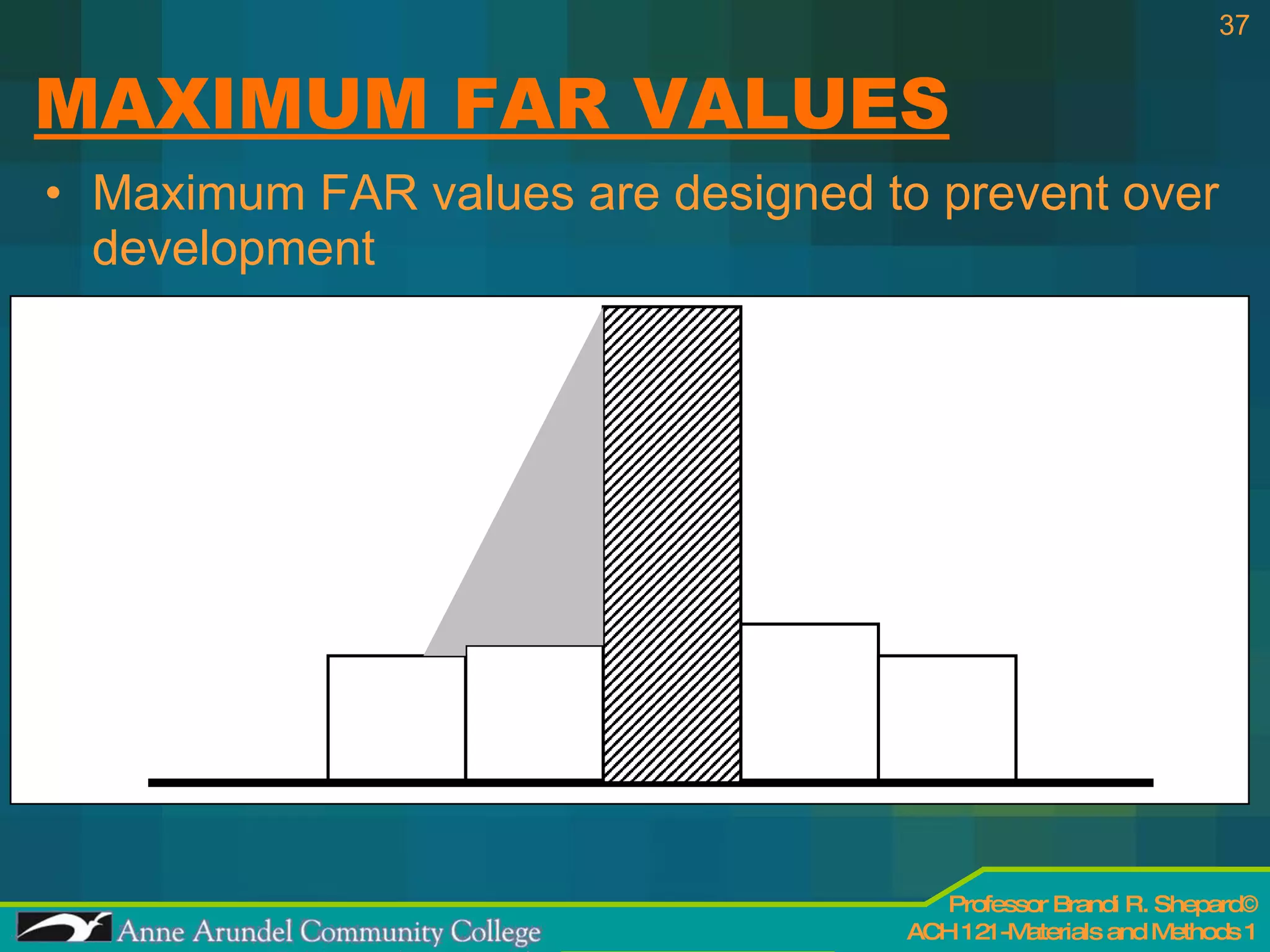
MAXIMUM FAR VALUES Maximum FAR values are designed to prevent over development
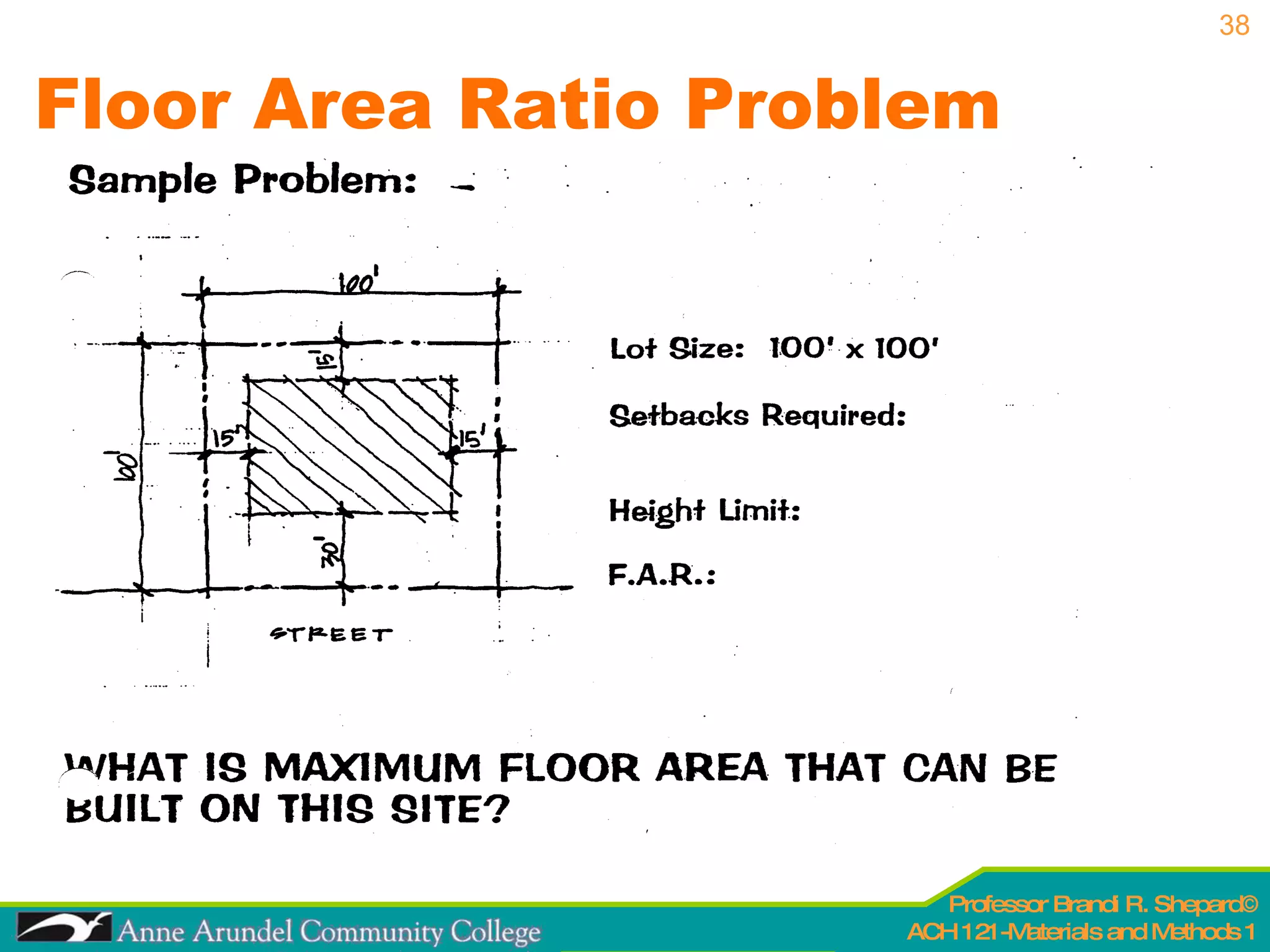
Floor Area Ratio Problem
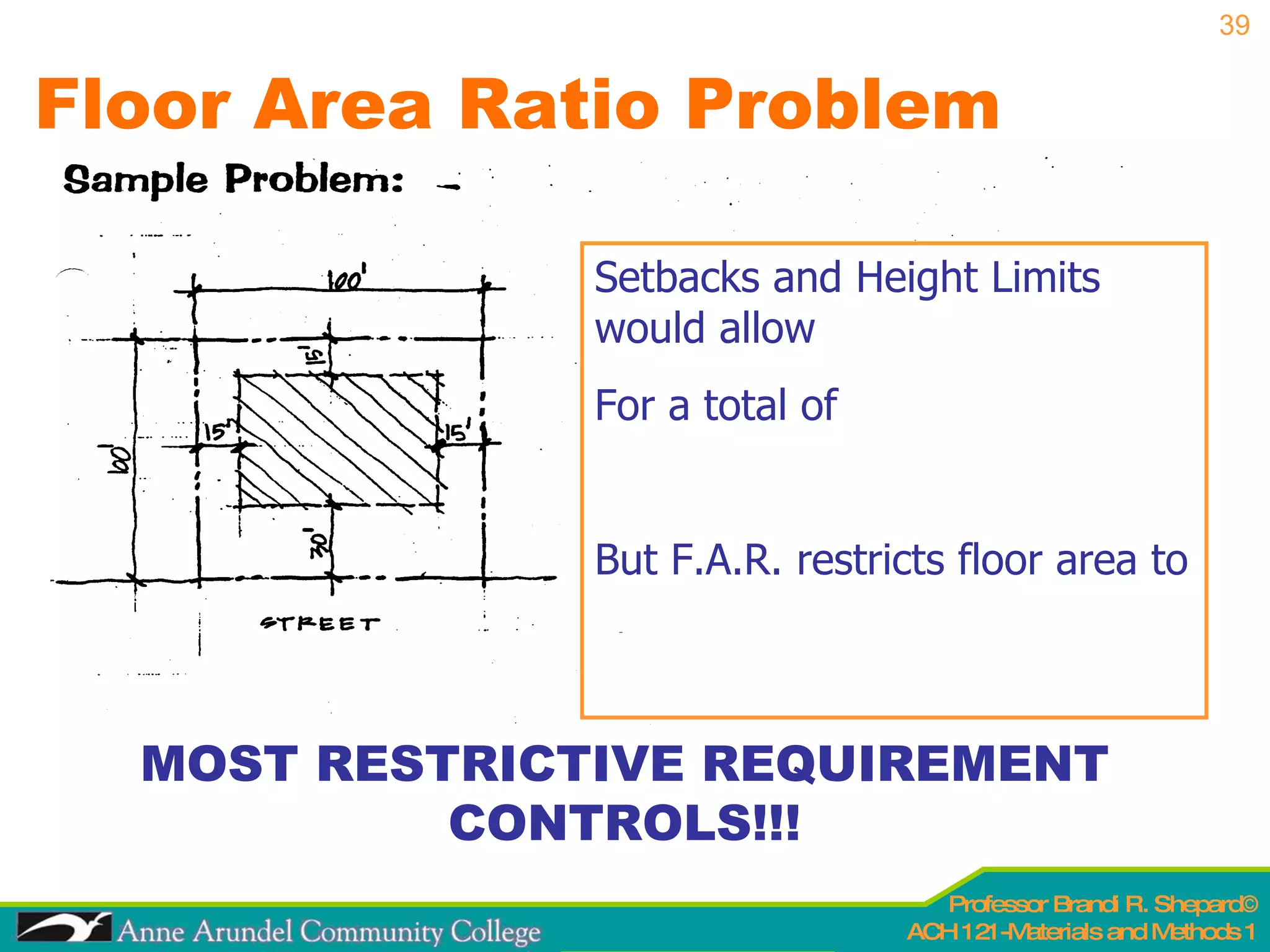
Floor Area Ratio Problem Setbacks and Height Limits would allow 2 floors @ 3,850sf,  For a total of 7,700sf But F.A.R. restricts floor area to 2,500sf TOTAL MOST RESTRICTIVE REQUIREMENT CONTROLS!!!
Legal Constraints American with Disabilities Act (ADA) Federal civil rights law enacted in 1990, effective Jan. 1992 Provides guidelines in design and construction to accommodate the physically disabled New construction and modifications to existing construction provide barrier-free access to site, into and within all building spaces Addresses four major concerns: Title I: employment discrimination Title II: accessibility of public transportation (trains, buses, metro) Title III: accessibility to buildings Title IV: accessible telecommunication
Legal Constraints American with Disabilities Act (ADA) ADAAG (ADA Accessibility Guidelines) provide details for design of: Entrances & Doors (including width and door hardware) Stairways Ramps Changes in level Sidewalks Elevators Drinking foundations Toilet facilities
Additional Building Code Info Testing & Certification Standards Underwriters Laboratories (UL) American Society for Testing and Materials (ASTM) American National Standards Institute (ANSI) Professional Trade Associations and Organizations Construction Specifications Institute (CSI) Independent and specific trade organizations for individual trades and materials These organizations publish supplemental information for quality recommendations
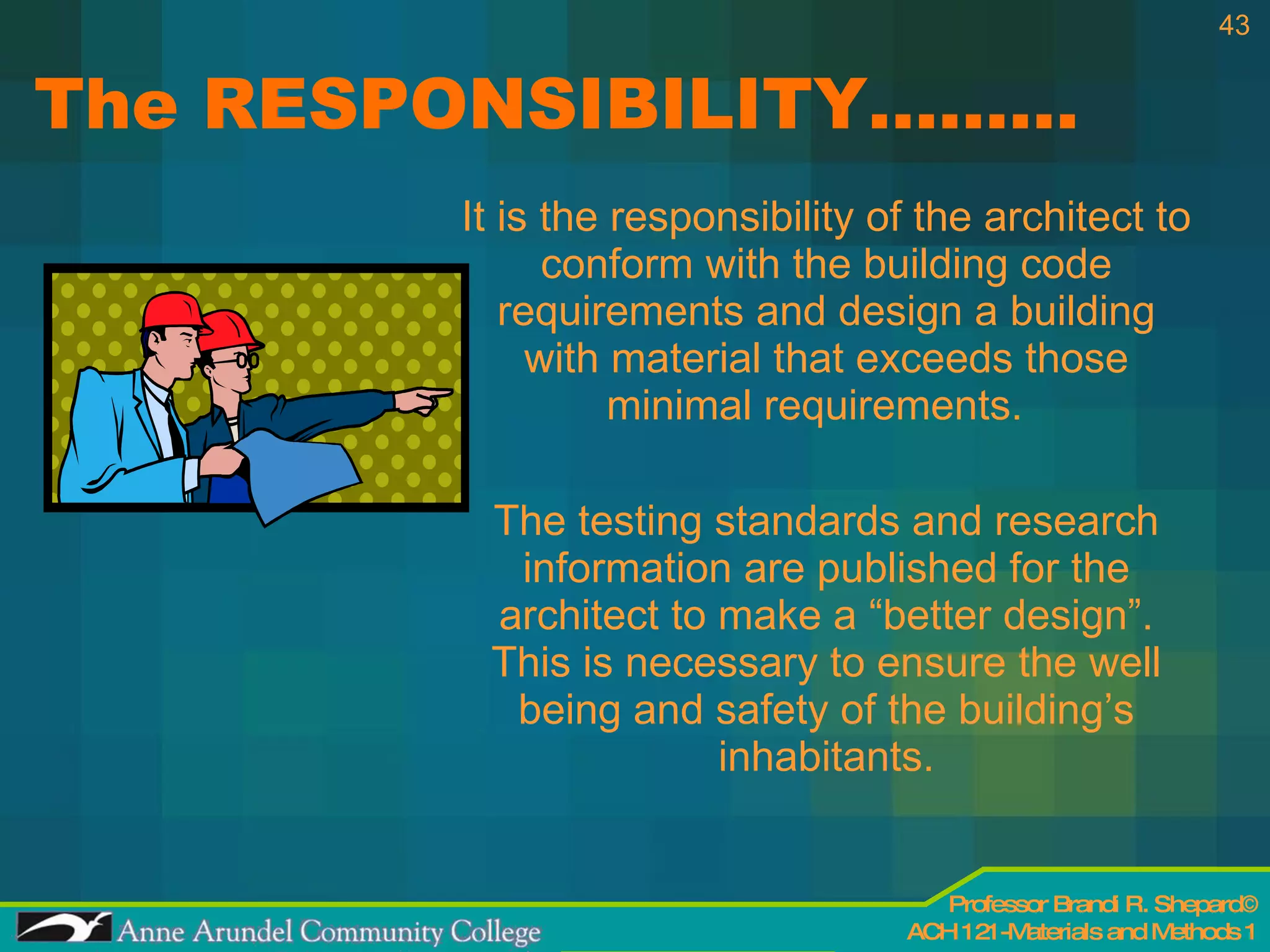
The RESPONSIBILITY……… It is the responsibility of the architect to conform with the building code requirements and design a building with material that exceeds those minimal requirements.  The testing standards and research information are published for the architect to make a “better design”. This is necessary to ensure the well being and safety of the building’s inhabitants.
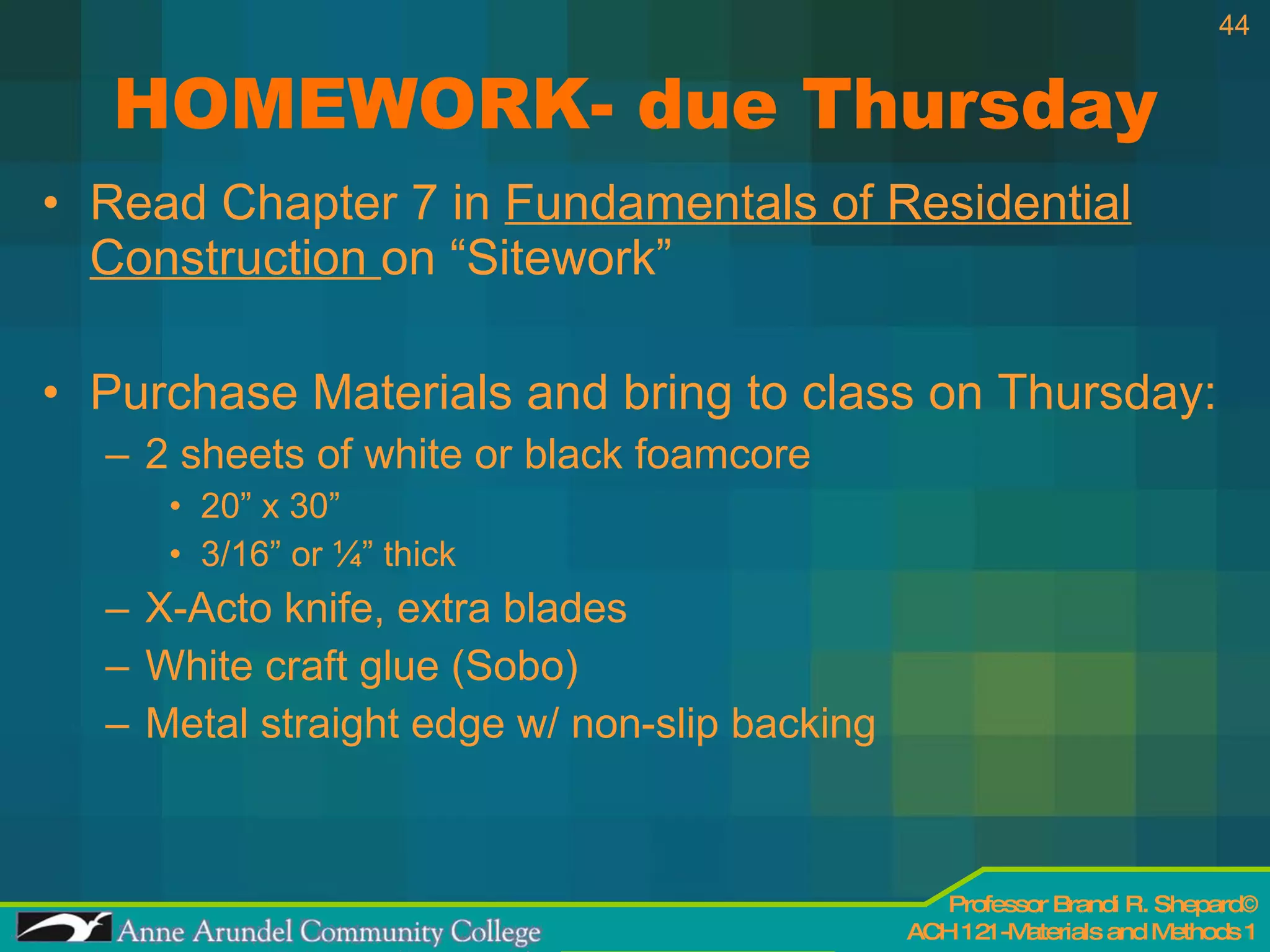
HOMEWORK- due Thursday Read Chapter 7 in  Fundamentals of Residential Construction  on “Sitework” Purchase Materials and bring to class on Thursday:  2 sheets of white or black foamcore 20” x 30” 3/16” or ¼” thick X-Acto knife, extra blades White craft glue (Sobo) Metal straight edge w/ non-slip backing
NEXT CLASS The Building Site

ACH 121 Lecture 03 (Codes)

  • 1.
    Building Codes and Regulatory Requirements Building Codes & Life Safety ○ Code Development  Zoning Ordinances  Legal Constraints
  • 2.
    Building Codes OverallPurpose: To protect public health and safety by setting a minimum standard of quality Codes are to be followed & maintained, but are to be used as basic foundations for quality Codes do not regulate building appearance , but do deal with issues of building performance Codes do place limitations on design and aesthetics
  • 3.
    Building Codes Buildingconstruction is regulated by an impartial authority; ensures that interests of all are protected Jurisdictional: state, county, city Also referred to as “Authority Having Jurisdiction” (AHJ) Enforced by a building official or code official Building Codes have one major benefit to all: Liability protection If building is designed/constructed according to code, the building professionals are exposed to substantially lower liability risk
  • 4.
    Building Codes Thebuilding code regulates the following aspects of building design and construction: Life safety Fire safety Structural safety Health and welfare Property protection
  • 5.
    Life Safety Lifesafety includes safety regulations not related to fire or structure. These include: guardrail height and configuration handrail dimensions and clearances stair tread & riser ratios and uniformity .
  • 6.
    Fire Safety Fireresistance of materials and construction Types of building construction Smoke protection Means of Egress
  • 7.
    Life Safety &Building Code Issues Means of Egress Methods of exiting the building in the event of an emergency Exit Access (corridors/hallways, stairs) Exit (exterior doors, windows) Exit Discharge (exterior space connected to public right of way) Points of Refuge (safe places for people to go away from bldg) Occupancy Loads More people may require more exits and fire protection. Hourly Ratings The minimum amount of time an object or construction assembly must last until the fire burns through.
  • 8.
  • 9.
    Structural Safety Theobjective of structural safety accounts for the most regulations in a building code. Accounts for the largest volume in the building code
  • 10.
    Human Health andWelfare Lighting Ventilation Sanitation Indoor climate Noise control
  • 11.
    Property Protection Safeguardingagainst loss or damage Integral to fire safety and life safety These are two major causes of property damage Durability of materials Material and construction standards embedded in code Example: roof membranes conform to quality building standards; structural and non-structural wood must be protected from decay and fungus; degeneration of materials due to freeze-thaw action corrosion of metals
  • 12.
    Model Building CodesCodes are Nationally and Internationally Developed These are the basis in which all codes are standardized in the United States Prepared by a National Group of Code Administrators that organize locally with knowledge of: safety requirements construction methods and techniques performance of materials and systems Adopted by local jurisdictions ( Townships, Counties, States, Etc…) Local amendments may be issued to make certain restrictions either more strict or lax They are regulations based on construction type These are known as model building codes
  • 13.
    Components of a Typical Building Code (IBC) Code administration Defines how the AHJ will administer codes Building planning Occupancy Type of construction Frontage Maximum allowable area and height Fire protection Fire-resistive materials Systems that will detect and suppress fires Occupant needs Health and welfare issues; means of egress; accessibility
  • 14.
    Components of a Typical Model Building Code (IBC) Building Envelope Performance of exterior bldg skin (walls, cladding, roof, windows) Structural Systems and Materials Loads on buildings; structural tests/inspections; foundations Non-Structural Materials Aluminum; gypsum board; glass; plastics Building Services Electrical, mechanical, plumbing systems only related to architectural design (technical requirements are related to specialty codes) Miscellaneous Provisions Construction in a public right of way; site work; demolition; existing structures
  • 15.
    Building Codes Typesof building codes IBC 2003/2006 - International Building Code Developed by the International Code Council (ICC) Used by most jurisdictions throughout the United States. First unified code in history. Site, Construction, Mechanical, Electrical, Etc… IBC has both standard and residential code restrictions. Addresses construction standards and life safety IRC 2003/2006 – International Residential Code Focuses primarily on residential dwellings One, two-story dwellings, townhouses, condos/apartments
  • 16.
    Model Codes publishedby the International Code Council
  • 17.
    Building Codes Priorto 2000, older codes are… Building Officials and Code Administrators (BOCA - 1996) (central and NE states) Uniform Building Code (UBC) (west coast & some US cities) up to date seismic provisions-earthquakes Standard Building Code (SBC) (southern & SE states) up to date wind load provisions - hurricanes Council of American Building Officials (CABO) BOCA, UBC and SBC codes are not as commonly used today as they were in the past. CABO One- and Two-Dwelling Code of 1995 was replaced by IRC
  • 18.
    Additional Codes InternationalPlumbing Code Water supply, wastewater, storm water management International Electrical Code Electrical systems International Mechanical Code Heating, ventilation, air-conditioning (HVAC) equipment and related duct work International Fire Code ( Fire Prevention Code ) Fire-safe maintenance of buildings International Energy Conservation Code Conservation of energy by buildings
  • 19.
    Three Major Factors Determines the Development of a Building: Construction Type Building Use Zoning Regulations CODE RELATIONSHIP
  • 20.
    The Code RelationshipUSE Intended purpose of building Some building are mixed use These are broken down into “USE GROUPS” Type of Occupancy Building Use
  • 21.
    The Code RelationshipCONSTRUCTION TYPE What the building is made of How the materials relate to each other These are broken down into “TYPES” Type of Occupancy Building Use Fire-Resistance Rating of Construction Construction Type
  • 22.
    The Code RelationshipZONING ORDINANCES Drawn up by local jurisdictions to manage: density & pattern types of development Regulations based on land use Allowable Height & Area Zoning Ordinances Fire-Resistance Rating of Construction Construction Type
  • 23.
    The Code RelationshipType of Occupancy Building Use Allowable Height & Area Zoning Ordinances Fire-Resistance Rating of Construction Construction Type
  • 24.
    Type of OccupancyUse Groups Assembly Business Educational Industry (Factory) High-Hazard Industry Institutional Mercantile Residential Storage Utility Possible to have multiple uses. We refer to this as “ MIXED USE ” Designation A B E F H I M R S U
  • 25.
    Construction Types Buildingclassifications have existed since the Uniform Building Code – Established in 1929 Broken into 5 basic types based on fire resistance and combustibility 5 basic types of construction ranging from the most fire-resistant – least fire resistant. Type IA is the most fire resistant Type 5B is the least fire resistant Construction types are paired against occupancy groups to determine the maximum size of the building allowed.
  • 26.
    Construction Types Materialsare broken down into two categories: Combustible Materials that will ignite and burn when subjected to fire. Fire treatment / protection may increase the resistance of some materials. Noncombustible Material of which no part will ignite and burn when subjected to fire.
  • 27.
    Construction Types Constructiontypes are further broken down into sub-categories designating their fire protection: #A = Protected #B = Unprotected The more fire protection, the larger you can build Even buildings constructed in steel have both classifications because steel will melt and deflect under extreme heat.
  • 28.
    Construction Types Theprincipal elements of type I & II construction are made of noncombustible materials. Principal elements generally refers to the structure Type I & II generally relies on steel, concrete of masonry for its structure. Section 402.0 TYPE 1 CONSTRUCTION 402.1 General: Buildings and structures of Type 1 construction are those in which the walls, partitions, structural elements, floors, ceilings, roofs and the exits are constructed of approved non-combustible materials and protected to afford the fire resistance rating specified in Table 401. Buildings are Type 1 construction shall be further classified as Type 1A or 1B. Same description as Type II
  • 29.
    Construction Types TypeIII buildings area mix of both combustible and noncombustible materials. Noncombustible exterior walls Combustible interior structure Designed to prevent fires from spreading from one structure to another Ex.: a Wood Frame Building with a brick veneer on all sides. Section 404.0 TYPE 3 CONSTRUCTION 404.1 General: Buildings and structures of Type 3 construction are those in which the exterior, fire walls, and party walls are constructed of masonry or other approved non-combustible materials of the required fire resistance rating and structural properties; the floors, roofs and interior framing are wholly or partly constructed of wood, metal, or other approved construction; ……. .
  • 30.
    Construction Types TypeIV buildings addresses heavy timber construction. Heavy timber members begin to flame and char at about 400 degrees. As charring continues, it begins to act as a fire protection by insulating the interior of the wood members. Section 405.0 TYPE 4 CONSTRUCTION 405.1 General: Buildings and structures of Type 4 construction are those in which the exterior walls are constructed of non-combustible materials having a fire resistance rating not less than that specified in Table 401 and the interior structural members are of solid or laminated wood without concealed spaces.
  • 31.
    Construction Types TypeV construction is the most restrictive in terms of what you can build BUT least restrictive in what you can use to build it. Allows the use of any material permitted by code Type V is the conventional light-wood frame construction in residential homes. V-A protects all major building elements (stairs, bearing walls, columns) with a 1 hour rating V-B is generally unprotected construction Section 406.0 TYPE 5 CONSTRUCTION 406.1 General: Buildings and structures of Type 5 construction are those in which the exterior walls, bearing walls, partitions, floors and roofs are constructed of any materials permitted by this code and in which the structural elements have the required fire resistance rating specified in Table 401. Buildings of Type 5 construction shall be further classified as Type 5A or 5B.
  • 32.
    Zoning Ordinances Drawnup by local jurisdictions to manage: density & pattern types of development Regulations based on land use What types of activities may take place on specified land How much land can be covered by building Total floor area that can be covered How tall the building can be How far building needs to be set back from property/land boundary Parking requirements
  • 33.
    Total Floor AreaRequirements Factors to determined total area allowed: Allowable Height Maximum Height Of Building Maximum Amount of Floors Floor Area Ratio (F.A.R.) Total allowable ratio of building area to lot size Where zoning began: Equitable Building, Manhattan, 1915, designed by Graham, Anderson (the successor to Burnham & Root). The 40-story bulk results in an FAR of nearly 30 and, infamously, a seven-acre shadow; the resulting outrage resulted in the 1916 adoption of America's first zoning ordinance--which mandated the wedding-cake setbacks common in subsequent Manhattan skyscrapers, particularly during the Art Deco era.
  • 34.
    FLOOR AREA RATIOWe use FAR calculations for three reasons… To determine the maximum size building that can be constructed To determine the feasibility of building or property expansion To determine the FAR value of an existing building for real-estate marketing Almost every local jurisdiction has their own “rules” for calculating floor area ratios. There are variations in the formulas! We will use a simplified version! Planning & Zoning may give both minimum & maximum FAR Values.
  • 35.
  • 36.
    MINIMUM FAR VALUESMinimum FAR values are designed to prevent underdevelopment
  • 37.
    MAXIMUM FAR VALUESMaximum FAR values are designed to prevent over development
  • 38.
  • 39.
    Floor Area RatioProblem Setbacks and Height Limits would allow 2 floors @ 3,850sf, For a total of 7,700sf But F.A.R. restricts floor area to 2,500sf TOTAL MOST RESTRICTIVE REQUIREMENT CONTROLS!!!
  • 40.
    Legal Constraints Americanwith Disabilities Act (ADA) Federal civil rights law enacted in 1990, effective Jan. 1992 Provides guidelines in design and construction to accommodate the physically disabled New construction and modifications to existing construction provide barrier-free access to site, into and within all building spaces Addresses four major concerns: Title I: employment discrimination Title II: accessibility of public transportation (trains, buses, metro) Title III: accessibility to buildings Title IV: accessible telecommunication
  • 41.
    Legal Constraints Americanwith Disabilities Act (ADA) ADAAG (ADA Accessibility Guidelines) provide details for design of: Entrances & Doors (including width and door hardware) Stairways Ramps Changes in level Sidewalks Elevators Drinking foundations Toilet facilities
  • 42.
    Additional Building CodeInfo Testing & Certification Standards Underwriters Laboratories (UL) American Society for Testing and Materials (ASTM) American National Standards Institute (ANSI) Professional Trade Associations and Organizations Construction Specifications Institute (CSI) Independent and specific trade organizations for individual trades and materials These organizations publish supplemental information for quality recommendations
  • 43.
    The RESPONSIBILITY……… Itis the responsibility of the architect to conform with the building code requirements and design a building with material that exceeds those minimal requirements. The testing standards and research information are published for the architect to make a “better design”. This is necessary to ensure the well being and safety of the building’s inhabitants.
  • 44.
    HOMEWORK- due ThursdayRead Chapter 7 in Fundamentals of Residential Construction on “Sitework” Purchase Materials and bring to class on Thursday: 2 sheets of white or black foamcore 20” x 30” 3/16” or ¼” thick X-Acto knife, extra blades White craft glue (Sobo) Metal straight edge w/ non-slip backing
  • 45.
    NEXT CLASS TheBuilding Site