INTRODUCTION
In 1943 pier luigi nervi tested and presented in his
paper, a new structural elements, an extremely thin
plate of concrete made of layers of small diameter
wire mesh and cement mortar with sand used as the
binder.
WHAT IS FERRO CEMENT ?
“Ferro cement is a type of thin wall reinforced
concrete, commonly constructed of hydraulic
cement mortar, reinforced with closely spaced layers
of continuous and relatively small size wire mesh.
The mesh may be made of metallic or other suitable
materials.”
 Mortar provides the mass and wire mesh imparts tensile
strength and ductility.
 When building Ferro-cement structures the sand/cement
mortar is applied to the reinforcing wire with a trowel,
never poured like common concrete work. Often a form is
used to provide the desired shape.
 Ferrocement is a super reinforced concrete. It differs from
conventional concrete in that there is a higher ratio of steel
to cement mortar. By altering the cement/steel ratio to
make ferrocement we actually produce a material, which
exhibits properties, superior to either steel or cement
separately. Ferrocement has many of the properties of steel
and yet it will not rust. Although it looks and feels like
concrete it can flex without cracking.
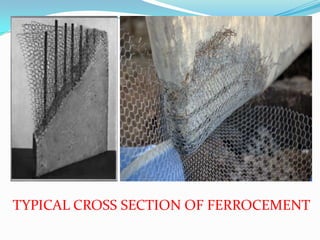
TYPICAL CROSS SECTION OF FERROCEMENT
TECHNIQUES OF MANUFACTURES
 Hand plastering
 semi-mechanised process
 Centrifuging and Guniting
MATERIALS USED IN FERRO CEMENT
 Cement mortar mix
 Skeleton steel
 Steel mesh reinforcement or Fibre-reinforced polymeric
meshes
CEMENT MORTAR MIX
ordinary Portland cement and fine aggregate matrix is
used
The matrix constitutes 95% cement mortar & 5% wire
mesh of the composite.
FA (sand), occupies 60 to 75% of the volume of the
mortar
Plasticizers and other admixtures are used
MIX PROPORTIONS
 Sand: cement ratio (by mass) 1.5 to 2.5
 Water: cement ratio (by mass) 0.35 to 0.60
SAND
 confirming to zone-I or Zone-II
 free from impurities
WATER
 Free from salts and organic impurities
 Minimum to achieve desired workability
 pH equal or greater than 7
SKELETON STEEL
 It support the steel wire mesh
 3 to 8 mm steel rods are used
 Thickness varies from 6-20mm according to loading
condition
 Generally mild steel or Fe 415 or Fe 500 bars are used
 Spacing 7.5cm to 12m
 Used to impart structural strength in case of boats, barges
etc.
 Reinforcement should be free from dust, rust and other
impurities.
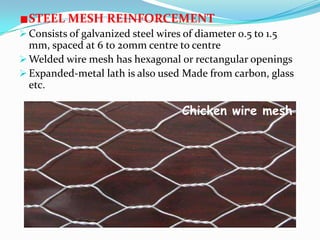
STEEL MESH REINFORCEMENT
 Consists of galvanized steel wires of diameter 0.5 to 1.5
mm, spaced at 6 to 20mm centre to centre
 Welded wire mesh has hexagonal or rectangular openings
 Expanded-metal lath is also used Made from carbon, glass
etc.
Chicken wire mesh
PROPERTIES OF FERRO CEMENT
It is very durable, cheap and versatile material.
Low w/c ratio produces impermeable structures.
Less shrinkage, and low weight.
High tensile strength and stiffness.
Better impact and punching shear resistance.
Undergo large deformation before cracking or high
deflection.
ADVANTAGES OF FERRO-CEMENT
 It is highly versatile and can be formed into almost any
shape for a wide range of uses
 20% savings on materials and cost
 Suitability for pre-casting
 Flexibility in cutting, drilling and jointing
 Very appropriate for developing countries; labor intensive
 Good fire resistance
 Good impermeability
 Low maintenance costs
 Thin elements and light structures, reduction in self
weight & Its simple techniques require a minimum of
skilled labor
 Reduction in expensive form work so economy & speed can
be achieved
 Only a few simple hand tools are needed to build any
structures
 Structures are highly waterproof & Higher strength to
weight ratio than R.C.C
DISADVANTAGES OF FERRO-CEMENT
Low shear strength
Low ductility
Susceptibility to stress rupture failure
It can be punctured by collision with pointed objects.
Corrosion of the reinforcing material due to the
incomplete coverage of metal by mortar.
It is difficult to fasten to ferrocement with bolt, screw,
welding and nail etc.
Large no of labours required
Tying rods and mesh together is especially tedious and
time consuming.
APPLICATIONS OF FERRO CEMENT
1. Marine Applications
 Boats, fishing vessels, barges, cargo tugs, flotation buoys
Key criteria for marine applications: light weight,
impact resistance, thickness and water tightness
2. Water supply and sanitation
 Water tanks, sedimentation tanks, swimming pool linings,
well casings, septic tanks etc.
3. Agricultural
 Grain storage bins, silos, canal linings, pipes, shells for fish
and poultry farms
4. Residential Buildings
 Houses, community centers, precast housing elements,
corrugated roofing sheets, wall panels etc.
5. Rural Energy
 Biogas digesters, biogas holders, incinerators, panels for
solar energy collectors etc.
6. Miscellaneous uses
 Mobile homes
 Kiosks
 Wind tunnel
 Silos and bins
 Bus shelters
 pedestrian bridges
 soil stabilization
 chemical resistant treatment
 Precast ferrocement structures
 Boats, fishing vessels, barges, cargo tugs
THANK YOU

Ferrocement ppt

  • 2.
    INTRODUCTION In 1943 pierluigi nervi tested and presented in his paper, a new structural elements, an extremely thin plate of concrete made of layers of small diameter wire mesh and cement mortar with sand used as the binder. WHAT IS FERRO CEMENT ? “Ferro cement is a type of thin wall reinforced concrete, commonly constructed of hydraulic cement mortar, reinforced with closely spaced layers of continuous and relatively small size wire mesh. The mesh may be made of metallic or other suitable materials.”
  • 3.
     Mortar providesthe mass and wire mesh imparts tensile strength and ductility.  When building Ferro-cement structures the sand/cement mortar is applied to the reinforcing wire with a trowel, never poured like common concrete work. Often a form is used to provide the desired shape.  Ferrocement is a super reinforced concrete. It differs from conventional concrete in that there is a higher ratio of steel to cement mortar. By altering the cement/steel ratio to make ferrocement we actually produce a material, which exhibits properties, superior to either steel or cement separately. Ferrocement has many of the properties of steel and yet it will not rust. Although it looks and feels like concrete it can flex without cracking.
  • 4.
    TYPICAL CROSS SECTIONOF FERROCEMENT
  • 5.
    TECHNIQUES OF MANUFACTURES Hand plastering  semi-mechanised process  Centrifuging and Guniting MATERIALS USED IN FERRO CEMENT  Cement mortar mix  Skeleton steel  Steel mesh reinforcement or Fibre-reinforced polymeric meshes
  • 6.
    CEMENT MORTAR MIX ordinaryPortland cement and fine aggregate matrix is used The matrix constitutes 95% cement mortar & 5% wire mesh of the composite. FA (sand), occupies 60 to 75% of the volume of the mortar Plasticizers and other admixtures are used
  • 7.
    MIX PROPORTIONS  Sand:cement ratio (by mass) 1.5 to 2.5  Water: cement ratio (by mass) 0.35 to 0.60 SAND  confirming to zone-I or Zone-II  free from impurities WATER  Free from salts and organic impurities  Minimum to achieve desired workability  pH equal or greater than 7
  • 8.
    SKELETON STEEL  Itsupport the steel wire mesh  3 to 8 mm steel rods are used  Thickness varies from 6-20mm according to loading condition  Generally mild steel or Fe 415 or Fe 500 bars are used  Spacing 7.5cm to 12m  Used to impart structural strength in case of boats, barges etc.  Reinforcement should be free from dust, rust and other impurities.
  • 9.
    STEEL MESH REINFORCEMENT Consists of galvanized steel wires of diameter 0.5 to 1.5 mm, spaced at 6 to 20mm centre to centre  Welded wire mesh has hexagonal or rectangular openings  Expanded-metal lath is also used Made from carbon, glass etc. Chicken wire mesh
  • 10.
    PROPERTIES OF FERROCEMENT It is very durable, cheap and versatile material. Low w/c ratio produces impermeable structures. Less shrinkage, and low weight. High tensile strength and stiffness. Better impact and punching shear resistance. Undergo large deformation before cracking or high deflection.
  • 11.
    ADVANTAGES OF FERRO-CEMENT It is highly versatile and can be formed into almost any shape for a wide range of uses  20% savings on materials and cost  Suitability for pre-casting  Flexibility in cutting, drilling and jointing  Very appropriate for developing countries; labor intensive  Good fire resistance  Good impermeability  Low maintenance costs
  • 12.
     Thin elementsand light structures, reduction in self weight & Its simple techniques require a minimum of skilled labor  Reduction in expensive form work so economy & speed can be achieved  Only a few simple hand tools are needed to build any structures  Structures are highly waterproof & Higher strength to weight ratio than R.C.C
  • 13.
    DISADVANTAGES OF FERRO-CEMENT Lowshear strength Low ductility Susceptibility to stress rupture failure It can be punctured by collision with pointed objects. Corrosion of the reinforcing material due to the incomplete coverage of metal by mortar. It is difficult to fasten to ferrocement with bolt, screw, welding and nail etc. Large no of labours required Tying rods and mesh together is especially tedious and time consuming.
  • 14.
    APPLICATIONS OF FERROCEMENT 1. Marine Applications  Boats, fishing vessels, barges, cargo tugs, flotation buoys Key criteria for marine applications: light weight, impact resistance, thickness and water tightness 2. Water supply and sanitation  Water tanks, sedimentation tanks, swimming pool linings, well casings, septic tanks etc. 3. Agricultural  Grain storage bins, silos, canal linings, pipes, shells for fish and poultry farms
  • 15.
    4. Residential Buildings Houses, community centers, precast housing elements, corrugated roofing sheets, wall panels etc. 5. Rural Energy  Biogas digesters, biogas holders, incinerators, panels for solar energy collectors etc. 6. Miscellaneous uses  Mobile homes  Kiosks  Wind tunnel  Silos and bins
  • 16.
     Bus shelters pedestrian bridges  soil stabilization  chemical resistant treatment  Precast ferrocement structures  Boats, fishing vessels, barges, cargo tugs
  • 17.