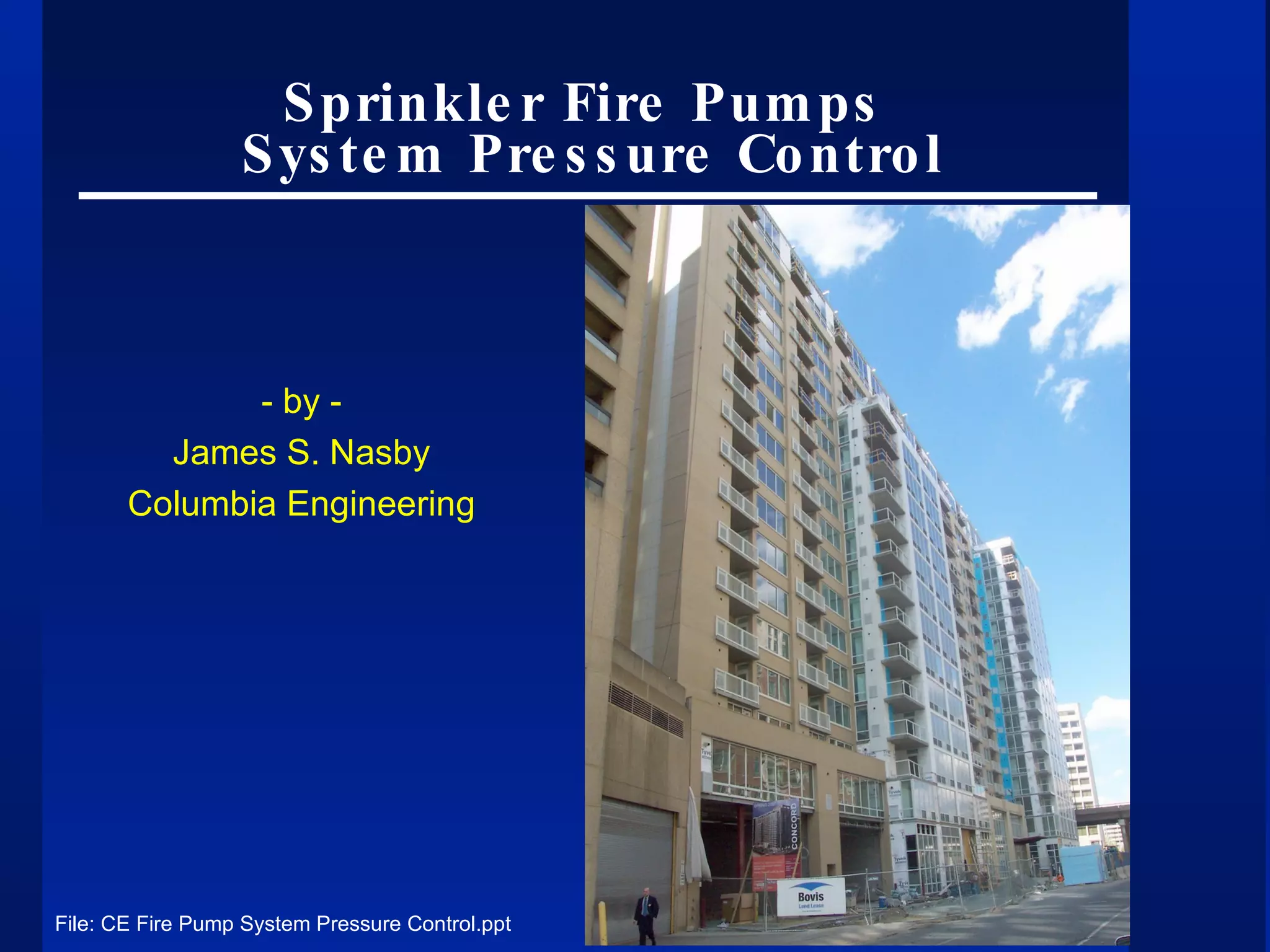
Sprinkler Fire Pumps  System Pressure Control - by - James S. Nasby Columbia Engineering File: CE Fire Pump System Pressure Control.ppt
Main Topics Covered: NFPA 20 -2007 Provides Three New Means of Pressure Control in Sprinkler Systems :   1) Break Tanks 2) Pressure Regulating or Reducing Valves 3) Variable Speed Diesel Driven Fire Pumps  4) Variable Speed Electric Motor Driven Fire Pumps  5) Bypass Methods of Motor Starting  Application for variable Speed Pumps & Case Studies :  6) High Rise and Warehouse Systems  7) Horizontal and Vertical Fire Pump Examples 8) Combined (Dual Use) Systems 9) Requirement for Successful Installations
1 - Break Tanks 5.30 Break Tanks.  Where a break tank is used to provide the pump suction water supply, the installation shall comply with this section. 5.30.1 Application.  Break tanks are used for one or more of the following reasons: (1) As a backflow prevention device… [E.g.: City of Houston, Texas] (2) To eliminate pressure fluctuations in the city water supply…  (3) To augment the city water supply… 5.30.2 Break Tank Size.  The tank shall be sized for a minimum duration of 15 minutes with the fire pump operating at 150 percent of rated capacity. 5.30.3   Refill Mechanism  --  on next slides. 5.30.4  The break tank shall be installed in accordance with NFPA 22,  Standard for Water Tanks for Private Fire Protection .
Break Tanks  - cont'd Refill Requirements 5.30.3 Refill Mechanism -  refill mechanism must be  listed  for automatic operation. 5.30.3.1  If the break tank capacity is  less than  the maximum system demand for 30 minutes, the refill mechanism must meet 5.30.3.1.1 through 5.30.3.1.5. 5.30.3.1.1  Dual automatic refill lines:  each  capable of refilling at a min. rate of  150 percent  of the fire pump(s) capacity 5.30.3.1.2  If available supplies  do not  permit 150 percent, each refill line must be capable of at least 110 percent of the max. system design flow. 5.30.3.1.3  A manual tank fill bypass designed & capable of refilling the tank at at least150 percent of the fire pump(s) capacity must be provided. 5.30.3.1.4  If available supplies do not permit 150 percent, the manual fill bypass must be capable of at least 110 percent of the max. system design flow. 5.30.3.1.5  A local visible and audible low liquid level signal must be provided in the vicinity of the tank fill mechanism.
Break Tanks  Refill Requirements - cont'd 5.30.3.2  If the break tank is sized to a min. of 30 minutes of the max. system demand, the refill mechanism must meet 5.30.3.2.1 through 5.30.3.2.5. 5.30.3.2.1  The refill mechanism must supply 110 percent of total fire protection system demand [110% × (Total Demand   Tank Capacity) / Duration] 5.30.3.2.2  A manual tank fill bypass must also supply the tank at 110 percent of the total system demand [110% × (Total Demand   Tank Capacity) / Duration] 5.30.3.2.3  The pipe between the city connection and the automatic fill valve must be installed per NFPA24,  Standard for the Installation of Private Fire Service Mains and Their Appurtenances . 5.30.3.2.4  The automatic filling mechanism must be maintained at a min. temperature of 40°F (4.4°C). 5.30.3.2.5  The automatic filling mechanism must activate a maximum of 6 in. (152 mm) below the overflow level.
2 - Pressure Regulating or Reducing Valves Floor Valves - Recognized in NFPA-13 - Some Redundancy (Floor Below and/or Floor Above) - Prohibited in some jurisdictions Riser or Main Valves - Prohibited in NFPA-20  - Clause 5.15.10 " No pressure-regulating devices…"  [except for "Low Suction Throttling Valves"] &  - Clause 5.7.6.2* Pressure relief valves and pressure regulating devices in the fire pump installation shall not be used as a means to meet the requirements of 5.7.6.1. - Prohibited in NFPA-24 5.3.1  "No pressure-regulating valve…" - Recognized in NFPA-14  --  but: Anecdotal and direct observation of failures: Stick Open or Closed & Destructive Oscillation
3 - Variable Speed Diesel Engine Driven Fire Pumps Salient Points : Mechanical Pressure Control Limited (3) Pre-Set Pressures Available Not Field Adjustable Dynamic Response Times Not Field Adjustable EPA Emission Limitations (Mechanical Injection & Speed Governor) Not Factory Mutual Approved
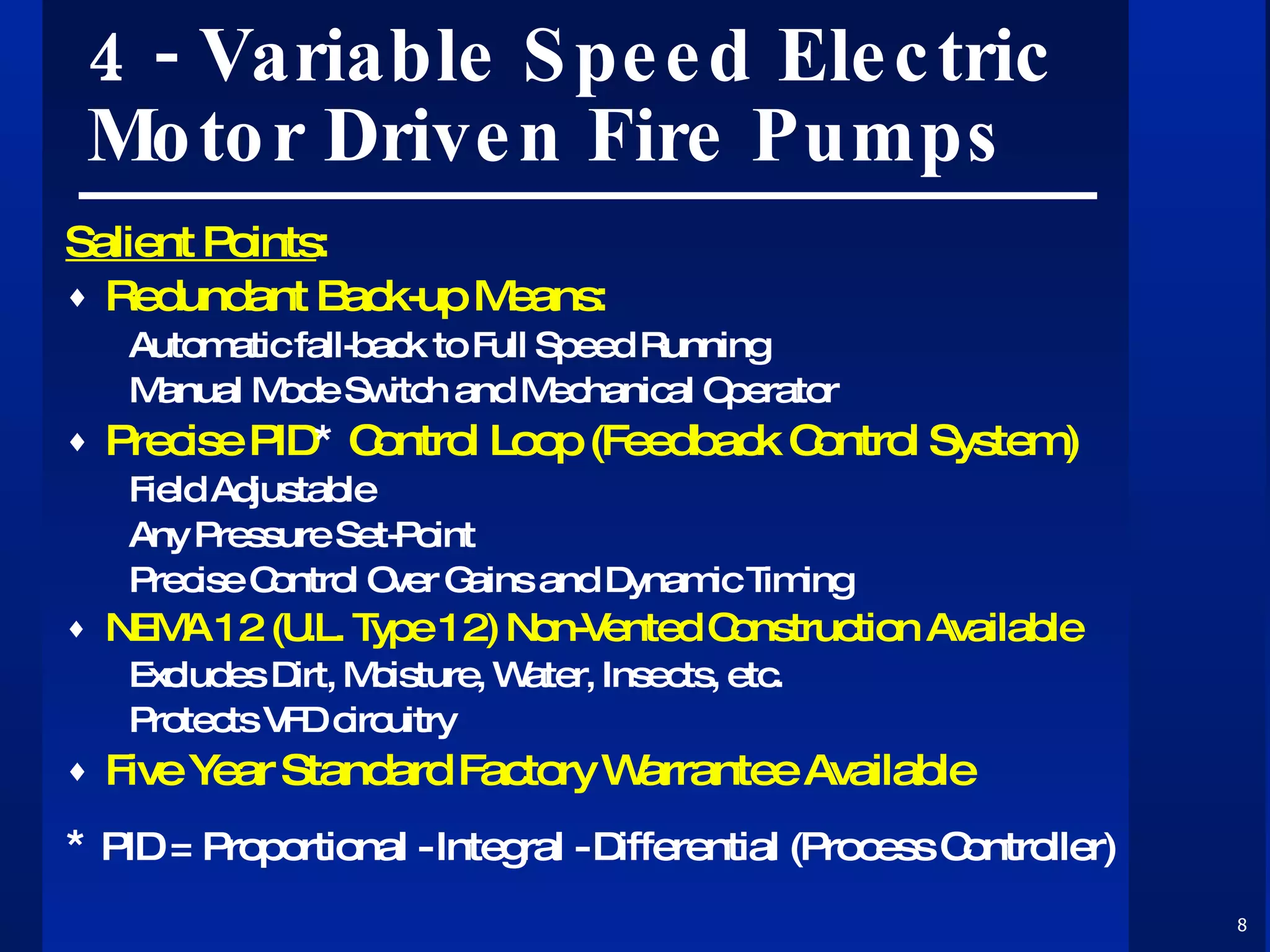
4 - Variable Speed Electric Motor Driven Fire Pumps Salient Points : Redundant Back-up Means: Automatic fall-back to Full Speed Running Manual Mode Switch and Mechanical Operator Precise PID *  Control Loop (Feedback Control System) Field Adjustable Any Pressure Set-Point Precise Control Over Gains and Dynamic Timing NEMA 12 (U.L. Type 12) Non-Vented Construction Available Excludes Dirt, Moisture, Water, Insects, etc. Protects VFD circuitry Five Year Standard Factory Warrantee Available *  PID = Proportional - Integral - Differential (Process Controller)
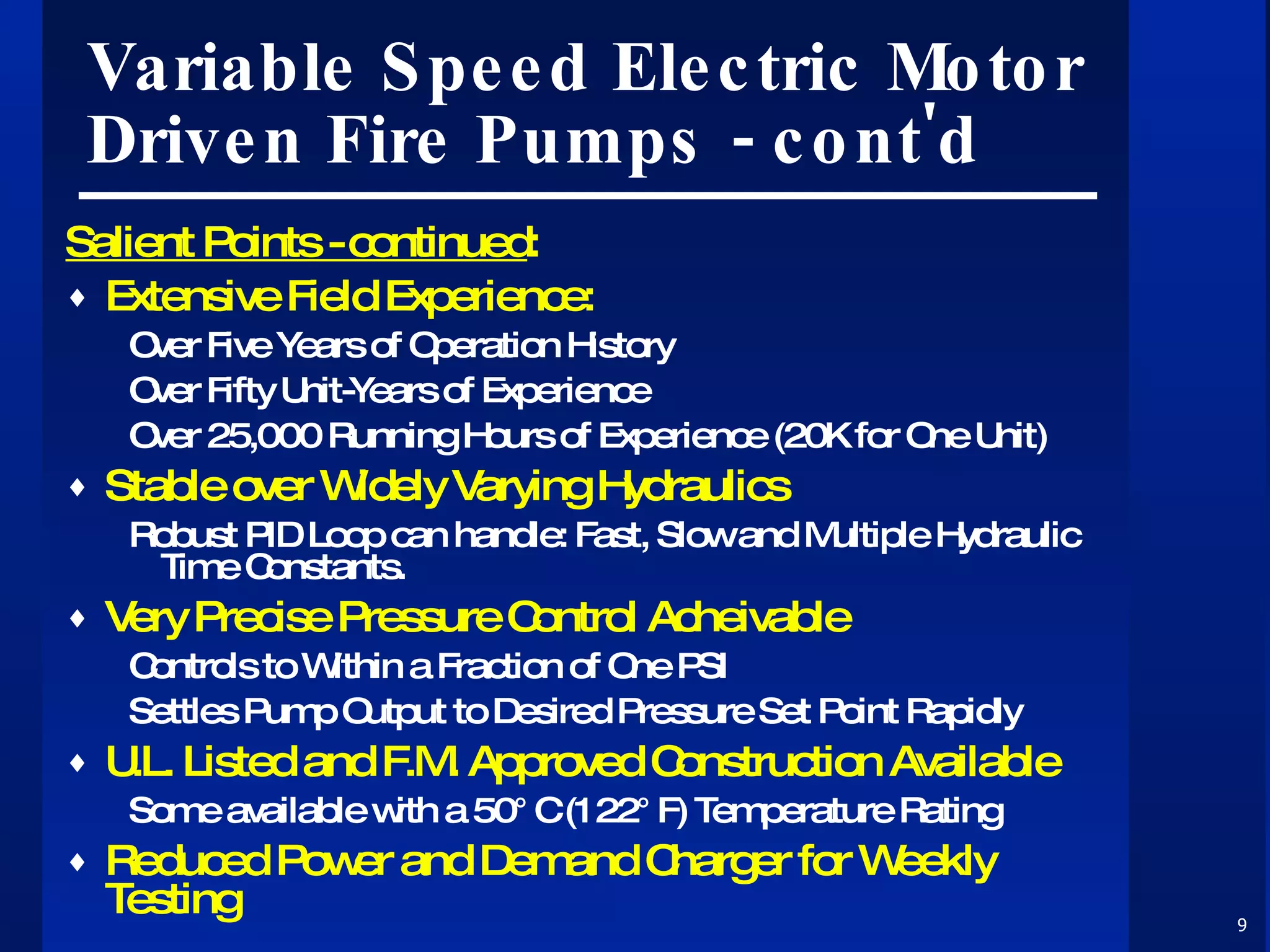
Variable Speed Electric Motor Driven Fire Pumps - cont'd Salient Points - continued : Extensive Field Experience: Over Five Years of Operation History Over Fifty Unit-Years of Experience Over 25,000 Running Hours of Experience (20K for One Unit) Stable over Widely Varying Hydraulics Robust PID Loop can handle: Fast, Slow and Multiple Hydraulic Time Constants. Very Precise Pressure Control Acheivable Controls to Within a Fraction of One PSI Settles Pump Output to Desired Pressure Set Point Rapidly U.L. Listed and F.M. Approved Construction Available Some available with a 50°C (122°F) Temperature Rating Reduced Power and Demand Charger for Weekly Testing
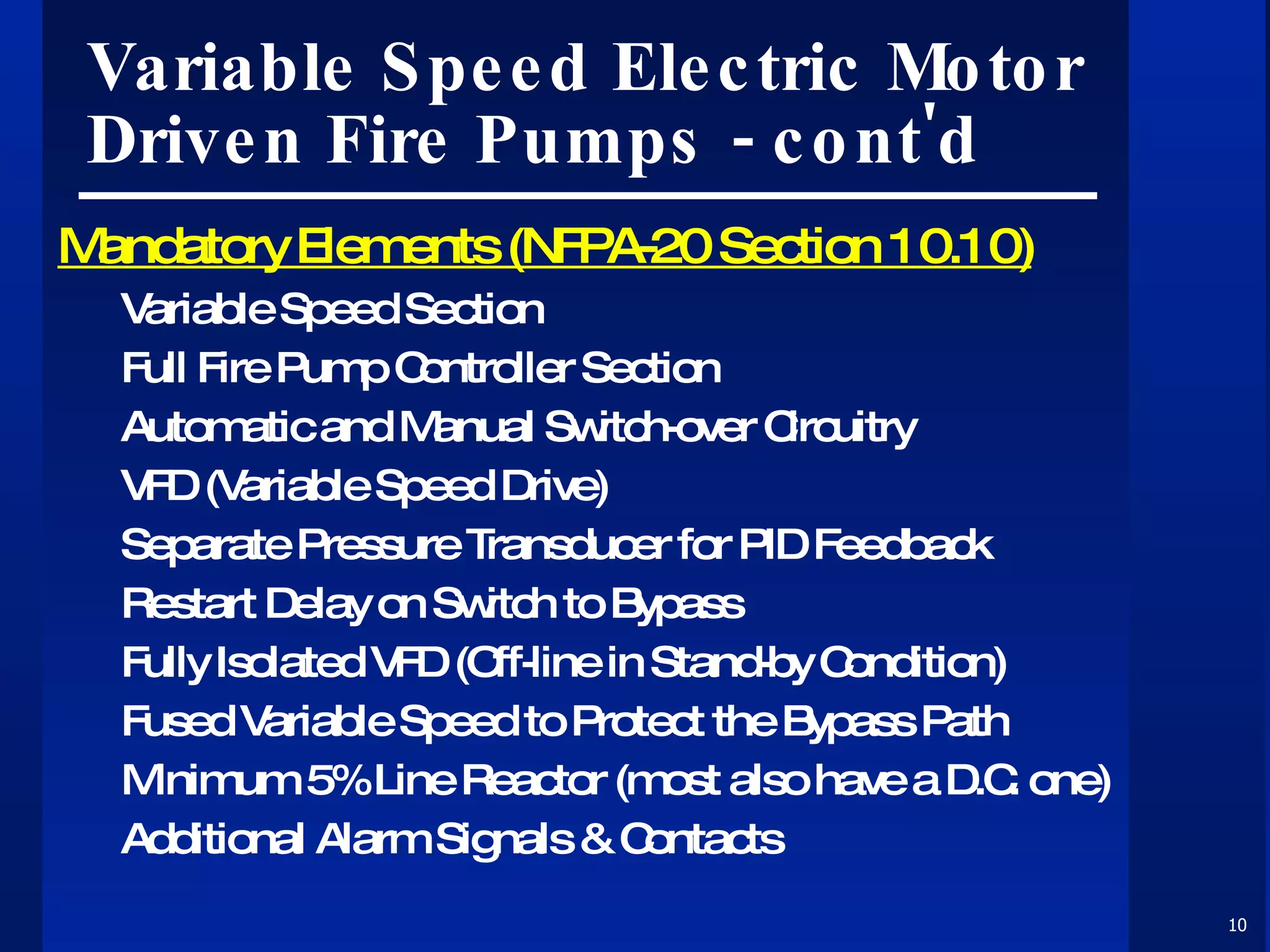
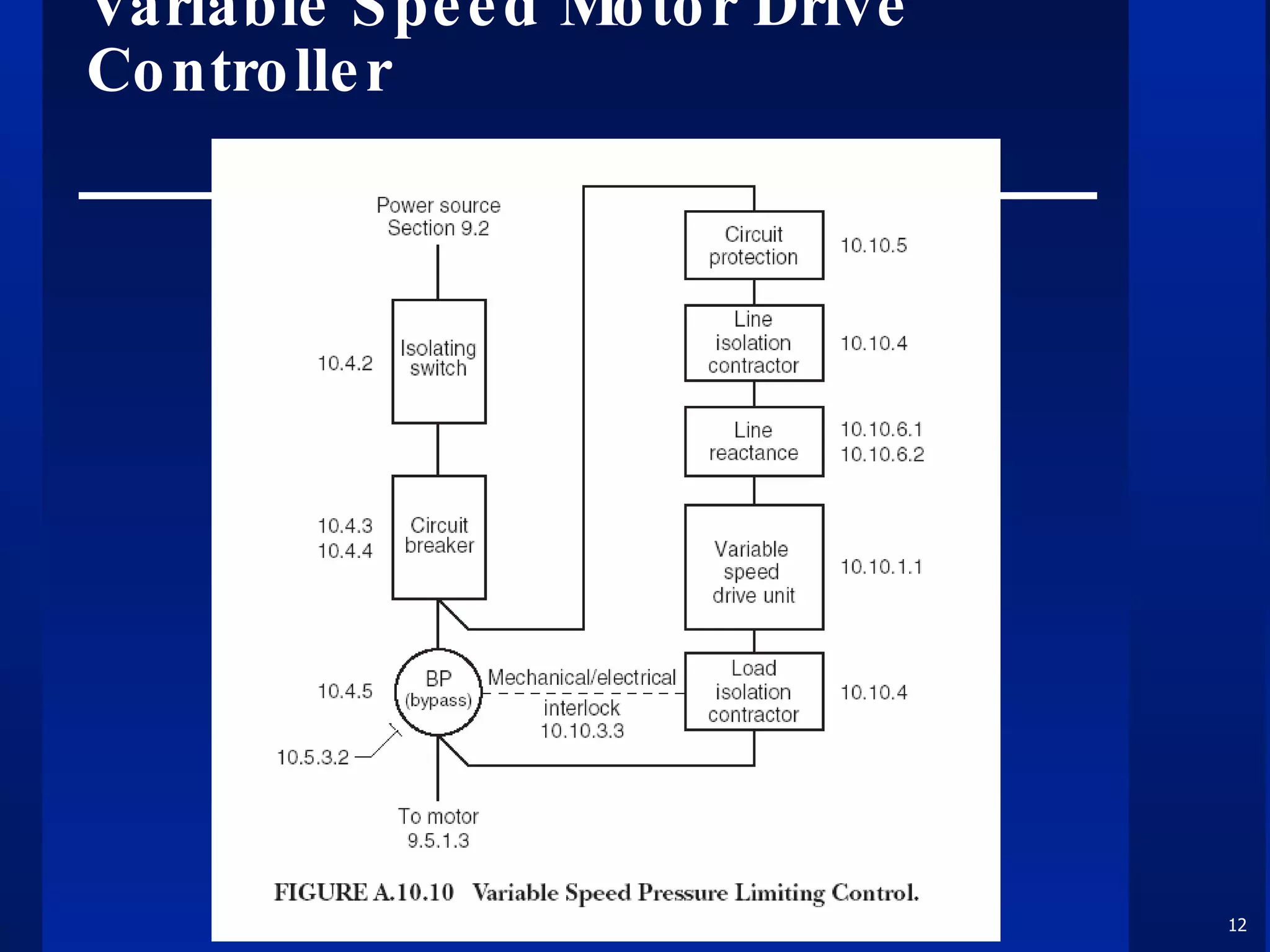
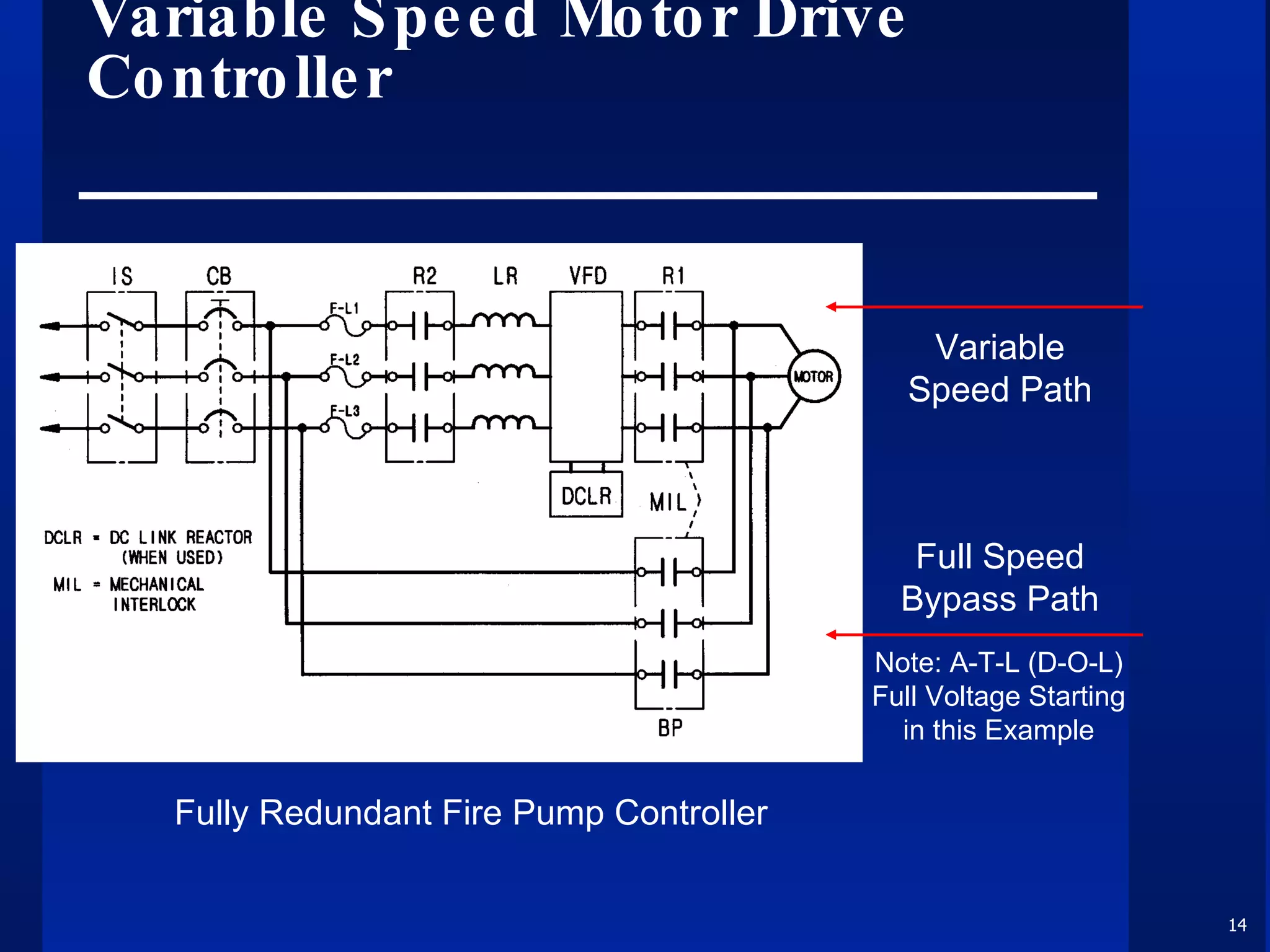
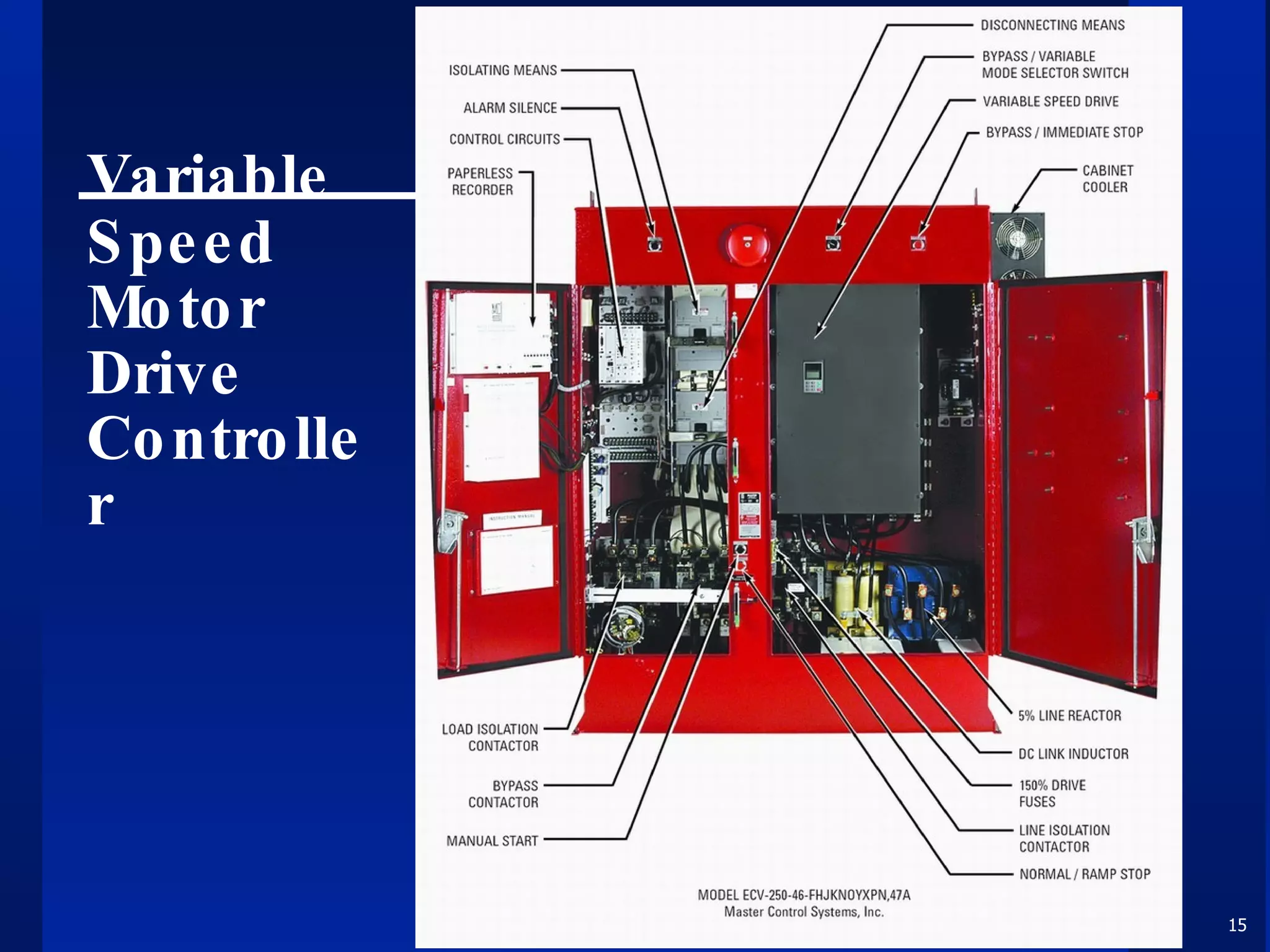
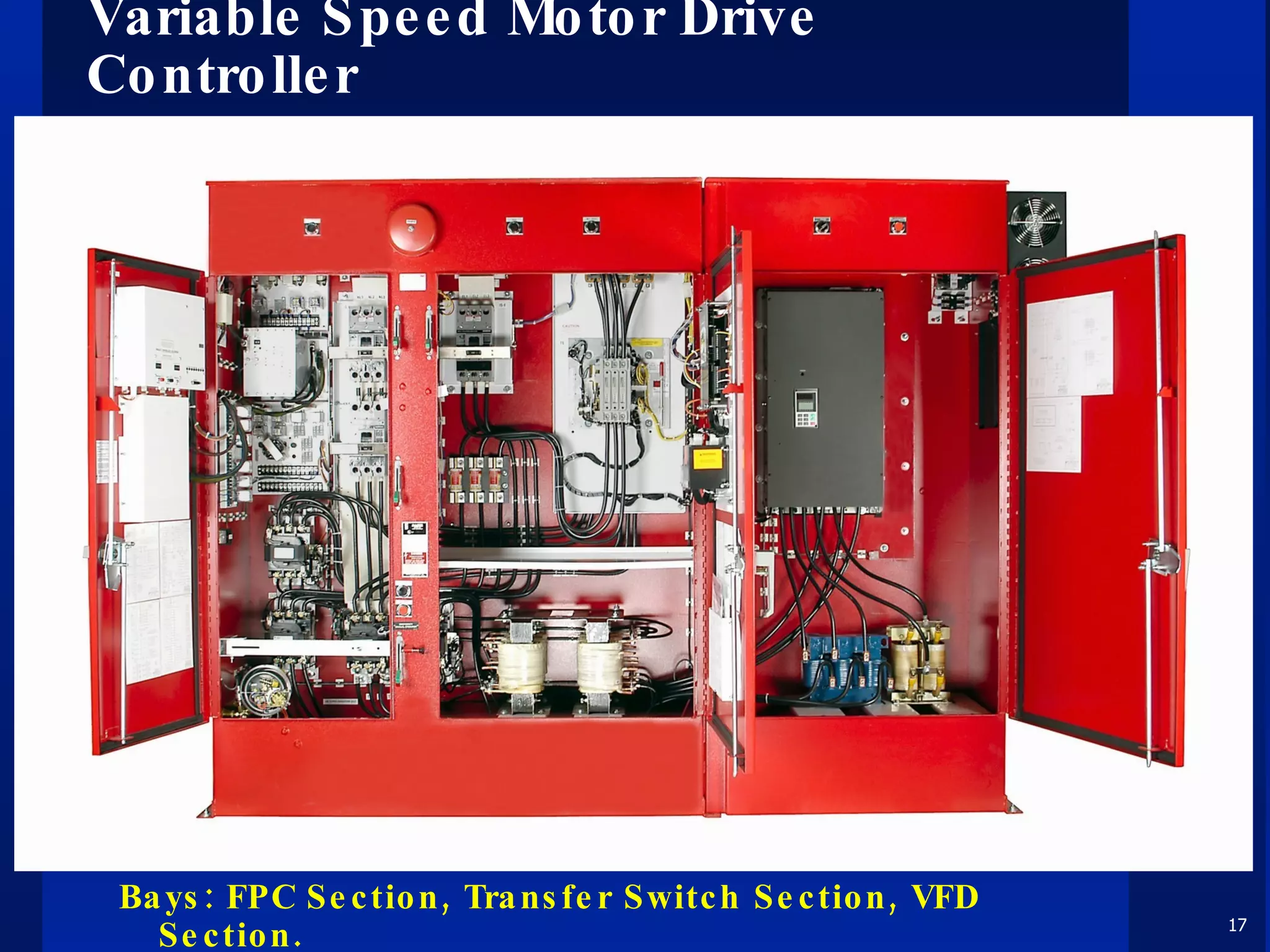
Variable Speed Electric Motor Driven Fire Pumps - cont'd Mandatory Elements (NFPA-20 Section 10.10) Variable Speed Section Full Fire Pump Controller Section Automatic and Manual Switch-over Circuitry VFD (Variable Speed Drive) Separate Pressure Transducer for PID Feedback Restart Delay on Switch to Bypass Fully Isolated VFD (Off-line in Stand-by Condition) Fused Variable Speed to Protect the Bypass Path Minimum 5% Line Reactor (most also have a D.C. one) Additional Alarm Signals & Contacts
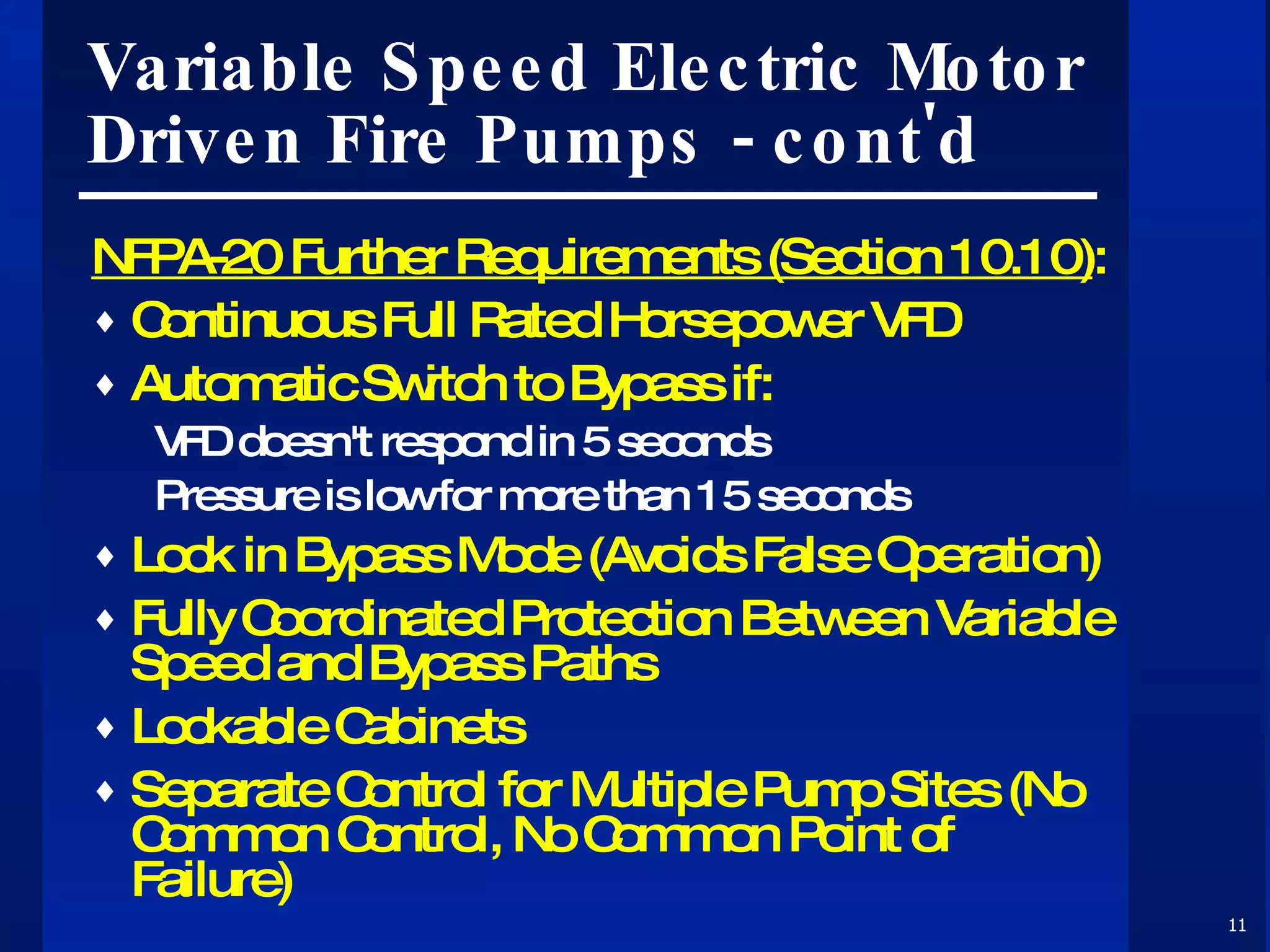
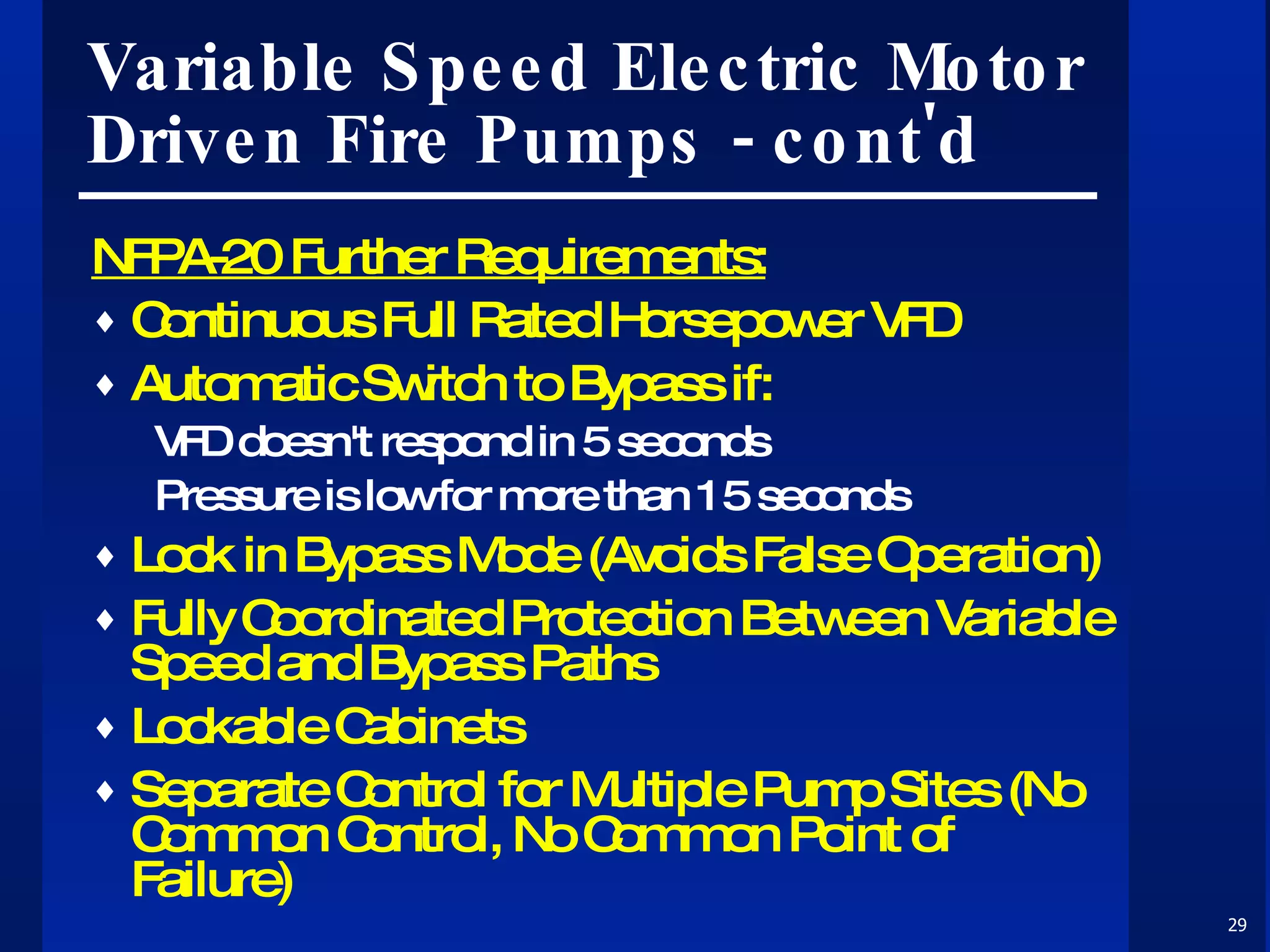
Variable Speed Electric Motor Driven Fire Pumps - cont'd NFPA-20 Further Requirements (Section 10.10) : Continuous Full Rated Horsepower VFD Automatic Switch to Bypass if: VFD doesn't respond in 5 seconds Pressure is low for more than 15 seconds Lock in Bypass Mode (Avoids False Operation) Fully Coordinated Protection Between Variable Speed and Bypass Paths Lockable Cabinets Separate Control for Multiple Pump Sites (No Common Control, No Common Point of Failure)
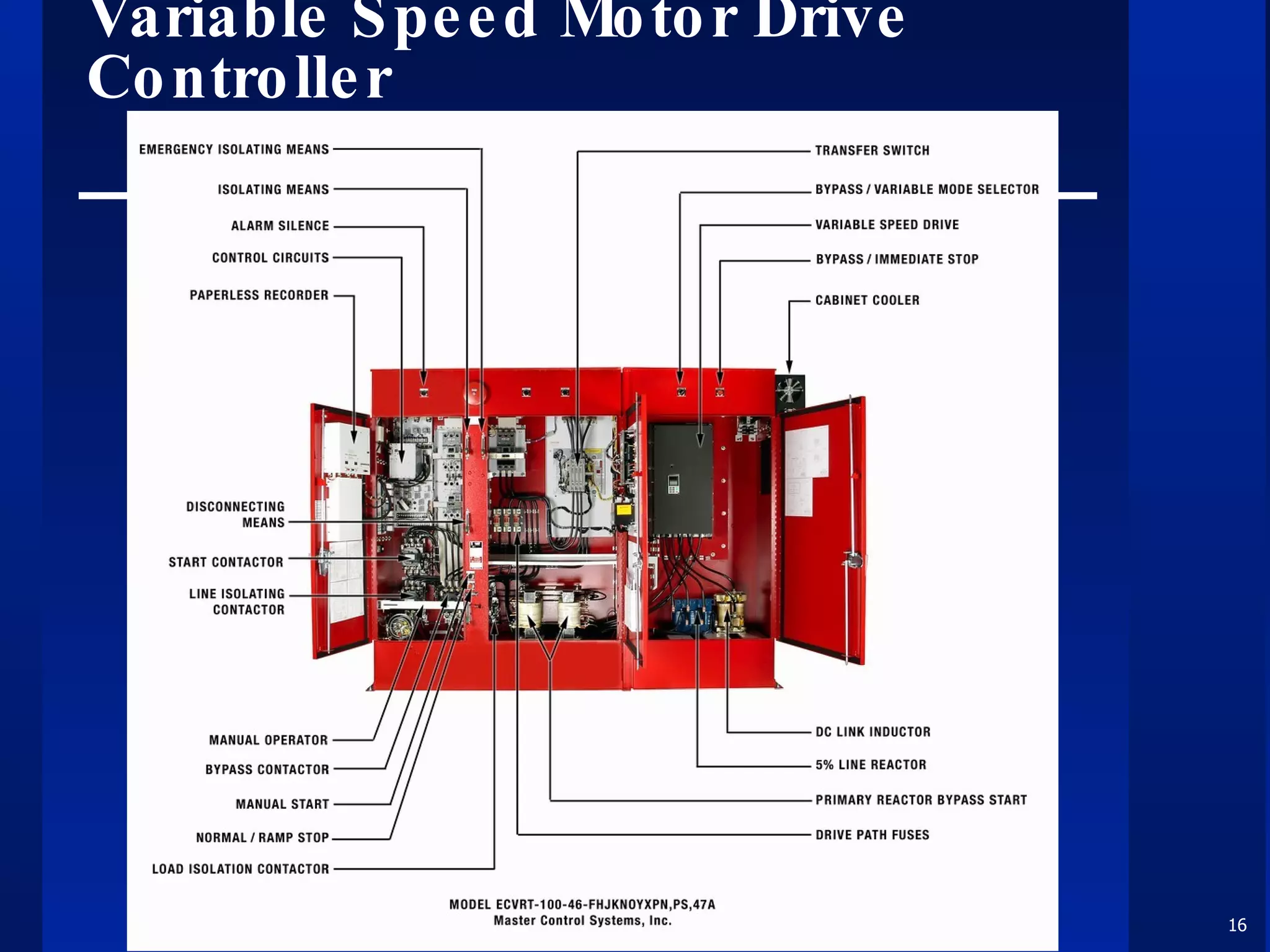
Variable Speed Motor Drive Controller
Variable Speed Motor Drive Controller Full Speed Bypass Path Variable Speed Path Fully Redundant Fire Pump Controller Note: A-T-L (D-O-L) Full Voltage Starting in this Example
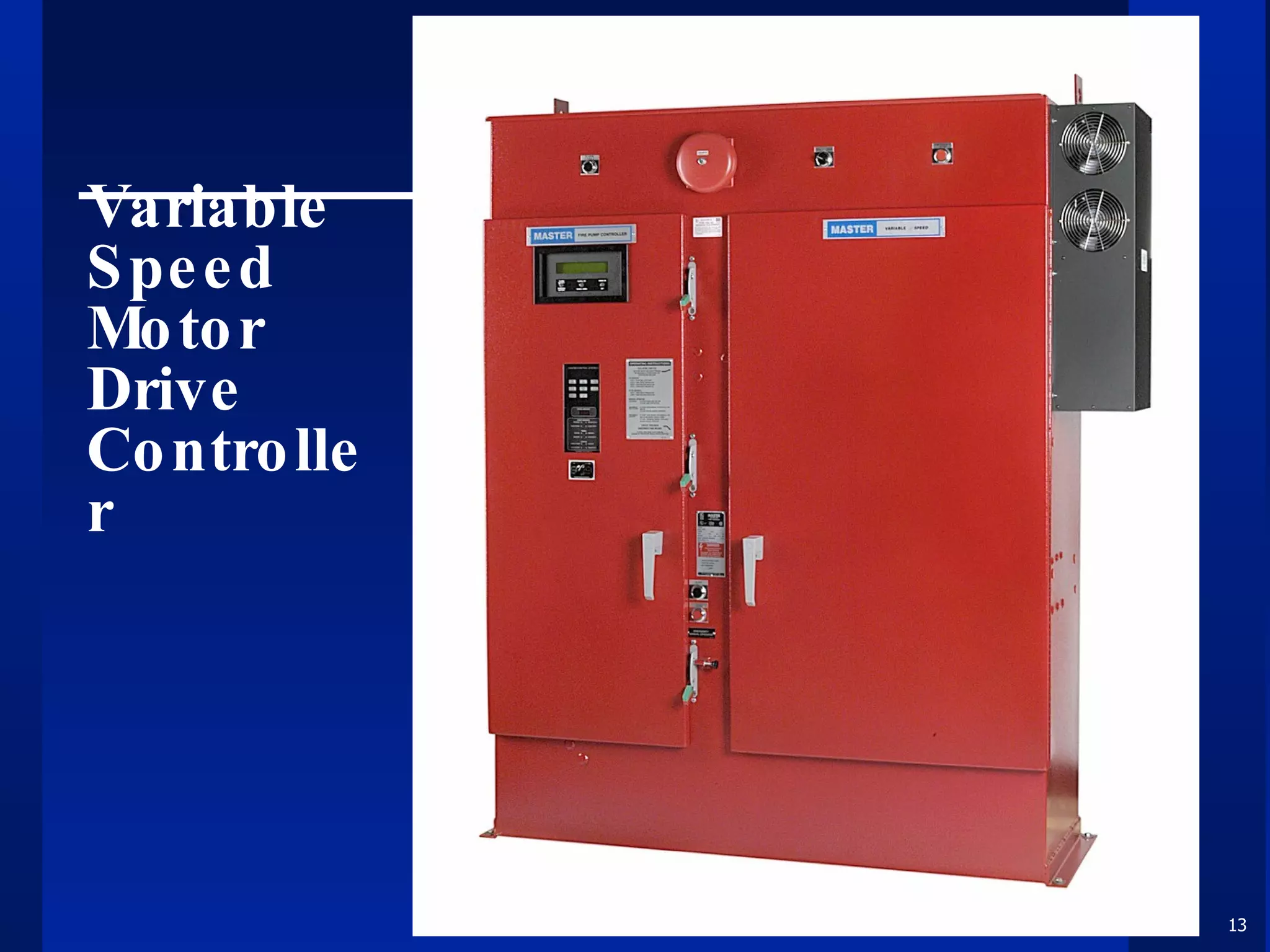
Variable Speed Motor Drive Controller
Variable Speed Motor Drive Controller Bays: FPC Section, Transfer Switch Section, VFD Section.
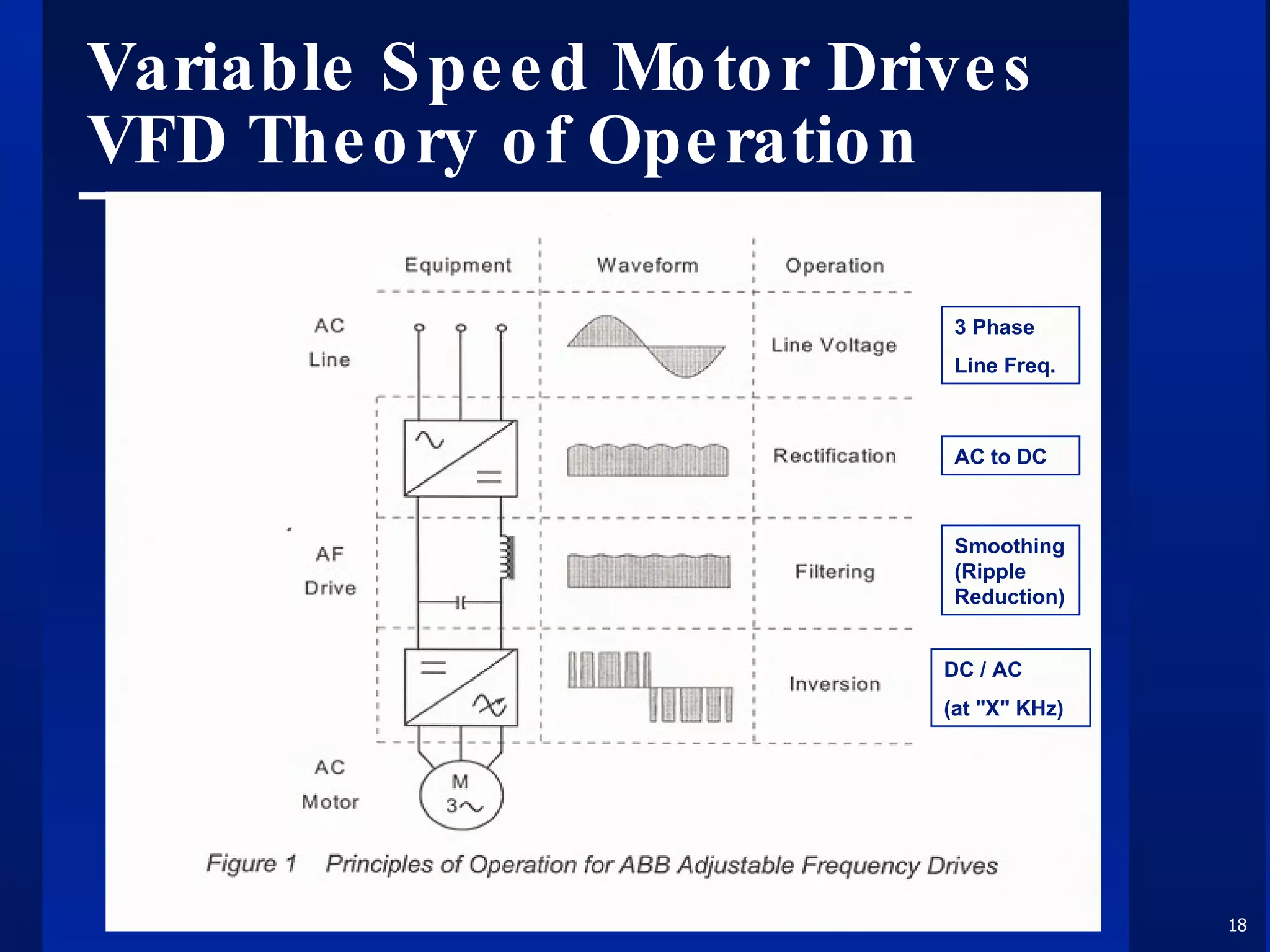
Variable Speed Motor Drives VFD Theory of Operation 3 Phase Line Freq. AC to DC Smoothing(Ripple Reduction) DC / AC (at "X" KHz)
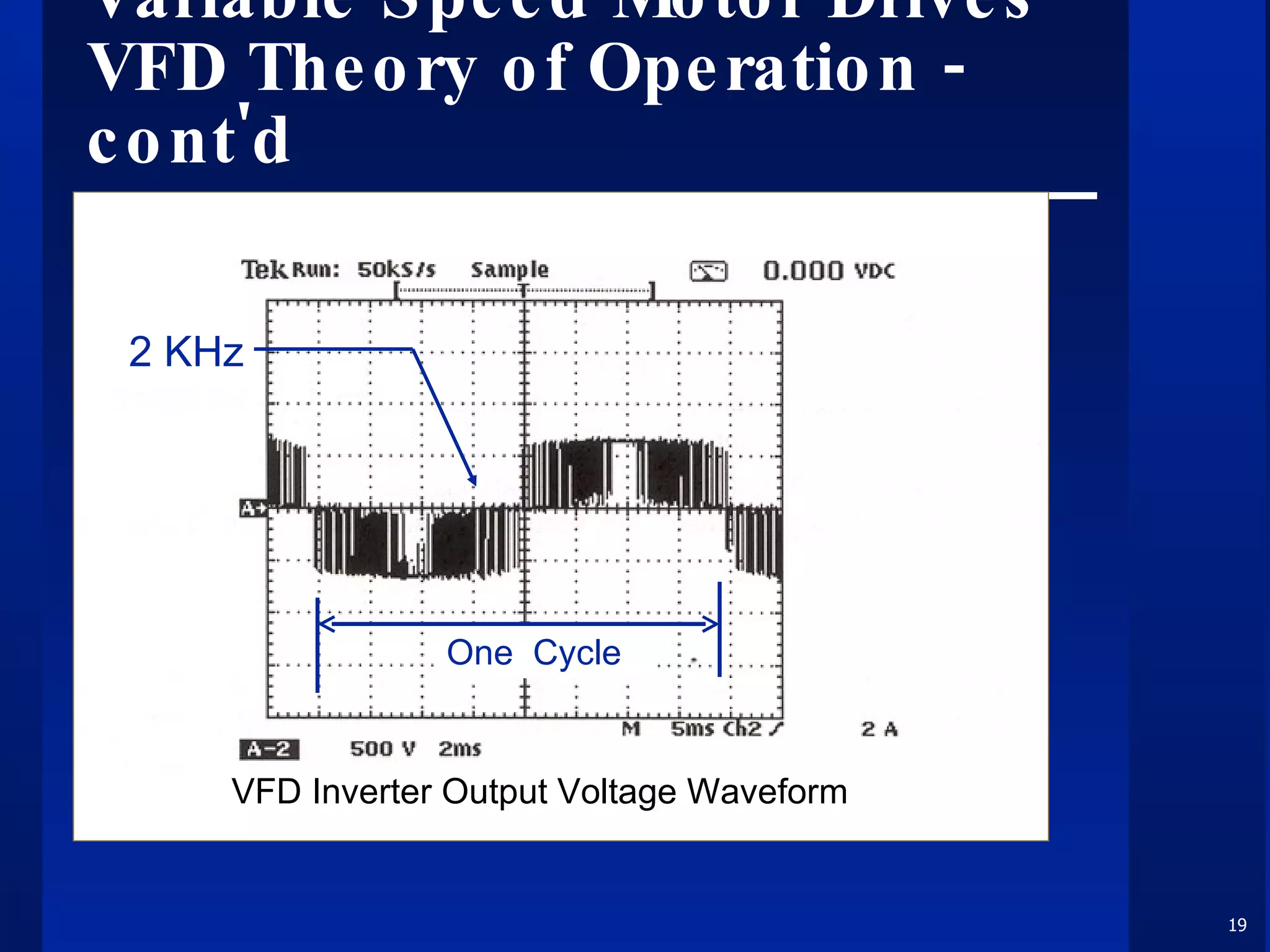
Variable Speed Motor Drives VFD Theory of Operation - cont'd 2 KHz One  Cycle VFD Inverter Output Voltage Waveform
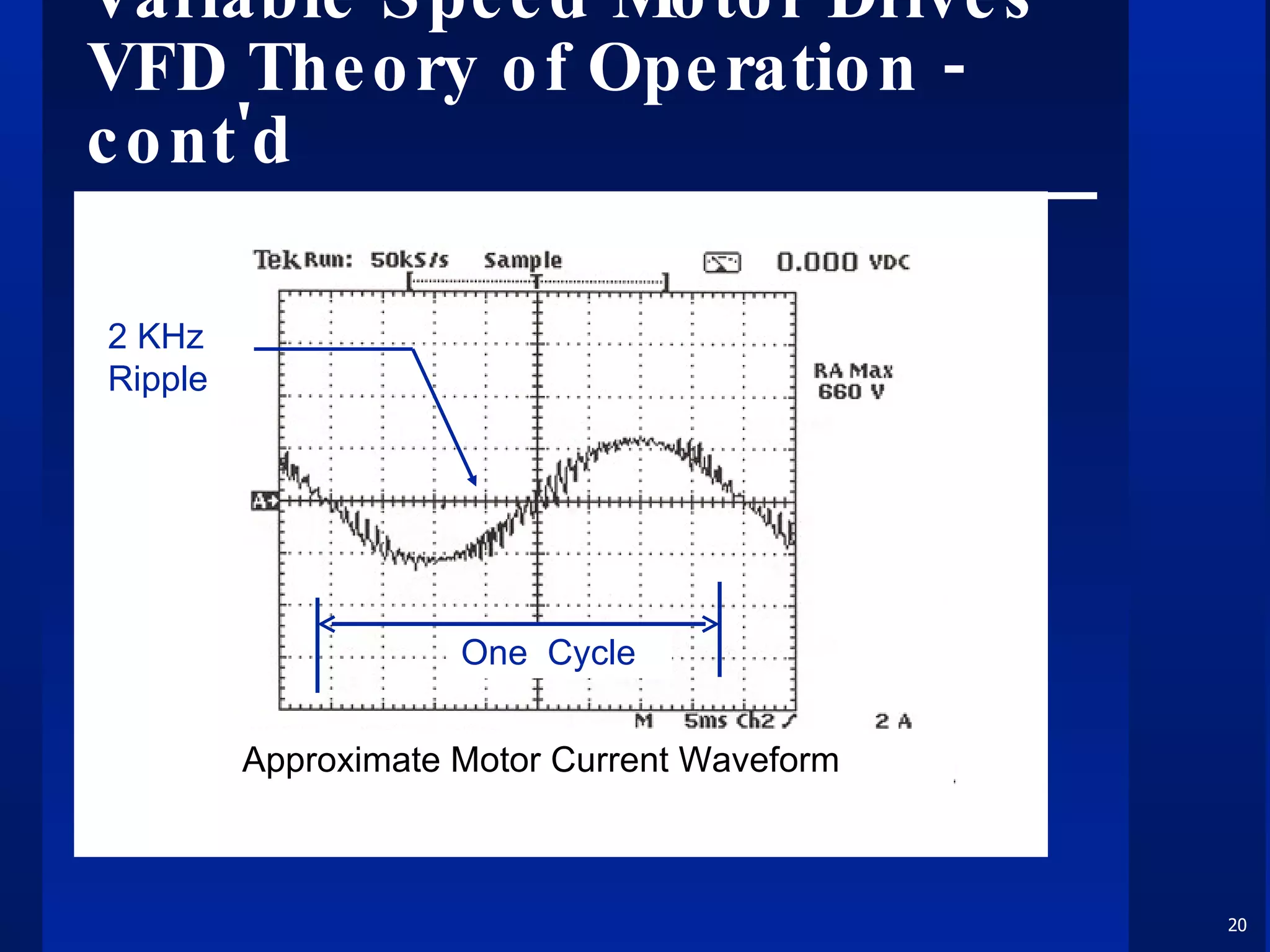
Variable Speed Motor Drives VFD Theory of Operation - cont'd Approximate Motor Current Waveform 2 KHz Ripple One  Cycle
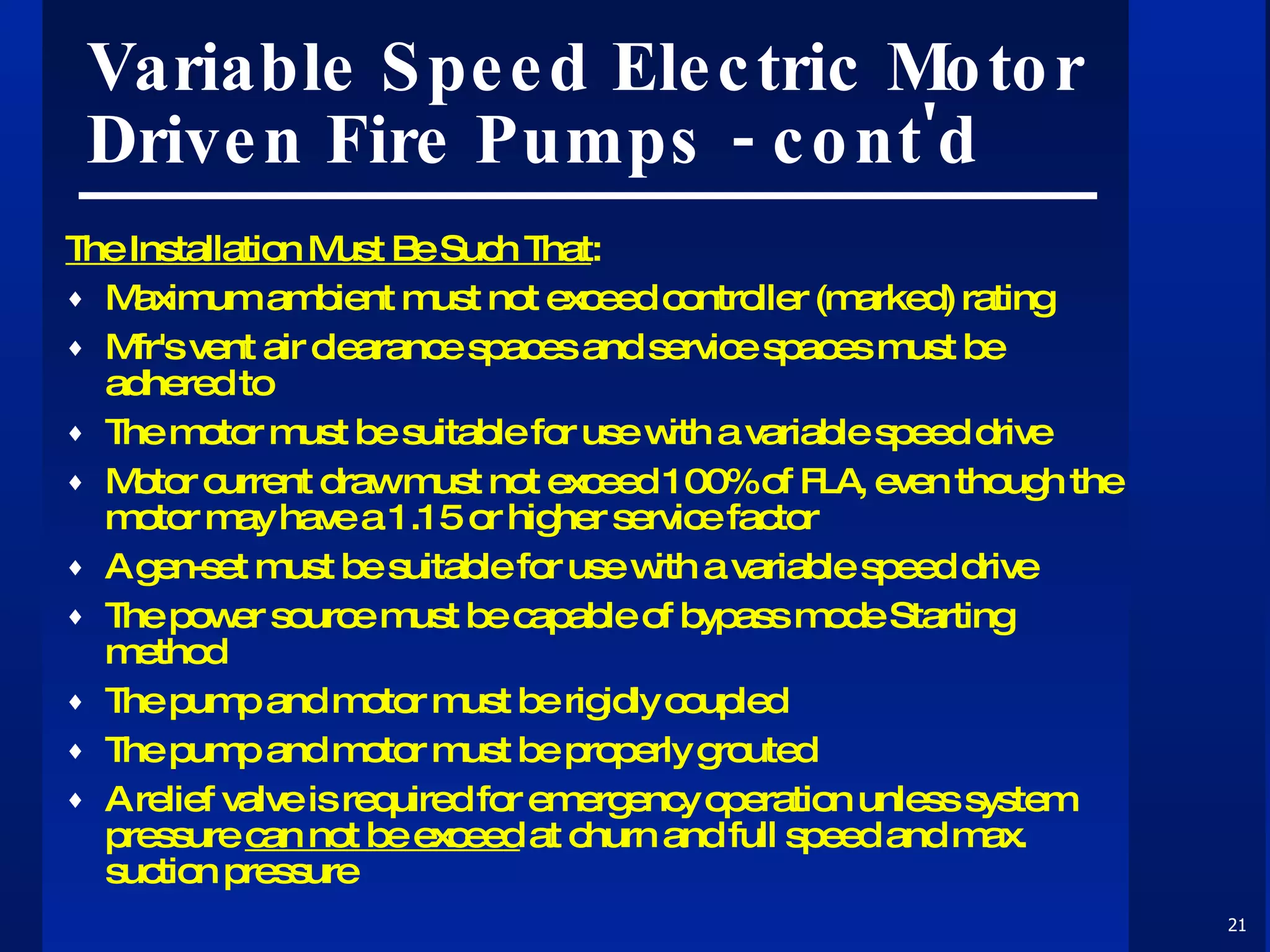
Variable Speed Electric Motor Driven Fire Pumps - cont'd The Installation Must Be Such That : Maximum ambient must not exceed controller (marked) rating Mfr's vent air clearance spaces and service spaces must be adhered to  The motor must be suitable for use with a variable speed drive Motor current draw must not exceed 100% of FLA, even though the motor may have a 1.15 or higher service factor A gen-set must be suitable for use with a variable speed drive The power source must be capable of bypass mode Starting method The pump and motor must be rigidly coupled The pump and motor must be properly grouted A relief valve is required for emergency operation unless system pressure  can not be exceed  at churn and full speed and max. suction pressure
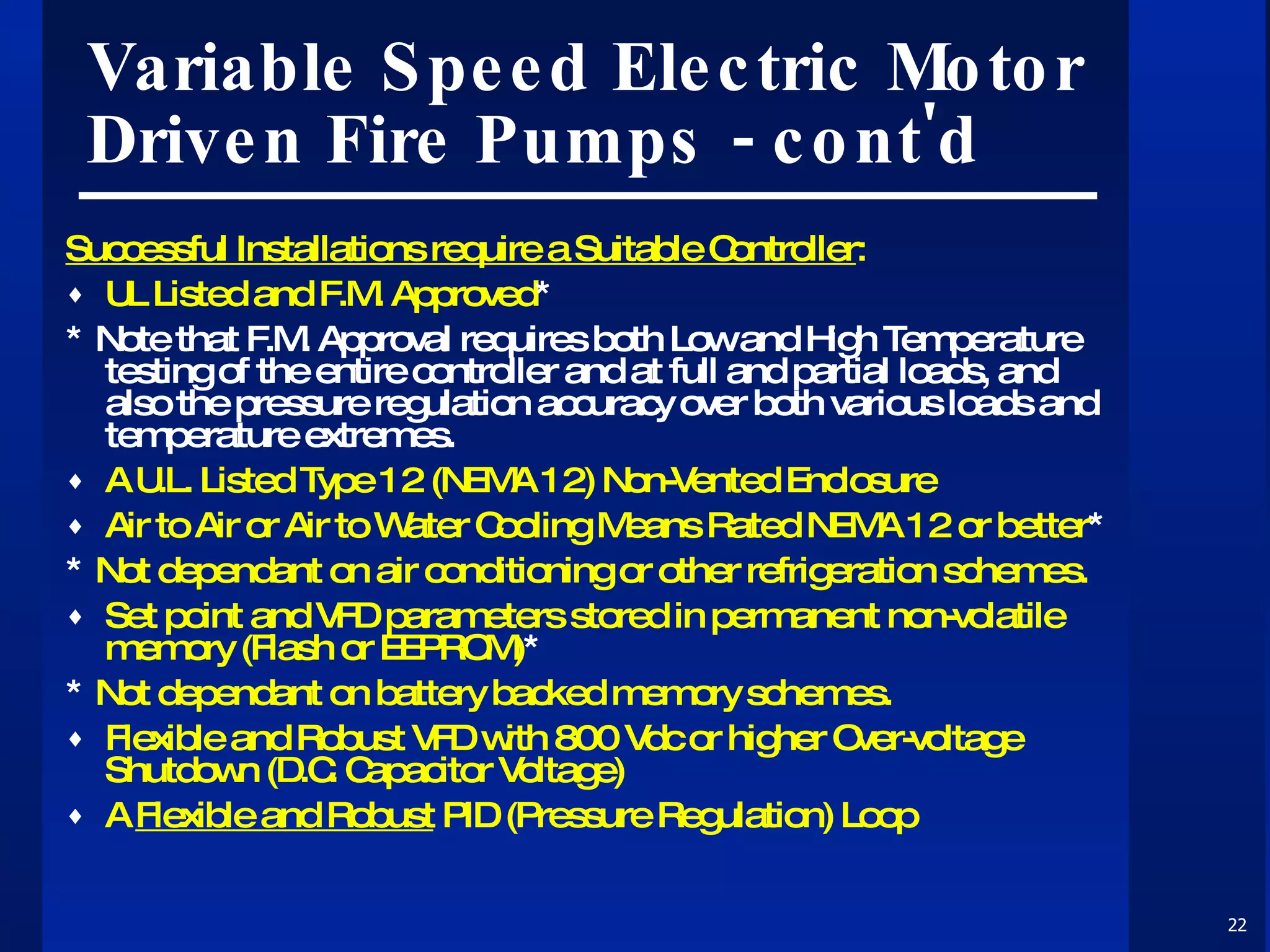
Variable Speed Electric Motor Driven Fire Pumps - cont'd Successful Installations require a Suitable Controller : UL Listed and F.M. Approved * * Note that F.M. Approval requires both Low and High Temperature testing of the entire controller and at full and partial loads, and also the pressure regulation accuracy over both various loads and temperature extremes. A U.L. Listed Type 12 (NEMA 12) Non-Vented Enclosure Air to Air or Air to Water Cooling Means Rated NEMA 12 or better * *  Not dependant on air conditioning or other refrigeration schemes. Set point and VFD parameters stored in permanent non-volatile memory (Flash or EEPROM) * *  Not dependant on battery backed memory schemes. Flexible and Robust VFD with 800 Vdc or higher Over-voltage Shutdown (D.C. Capacitor Voltage) A  Flexible and Robust  PID (Pressure Regulation) Loop
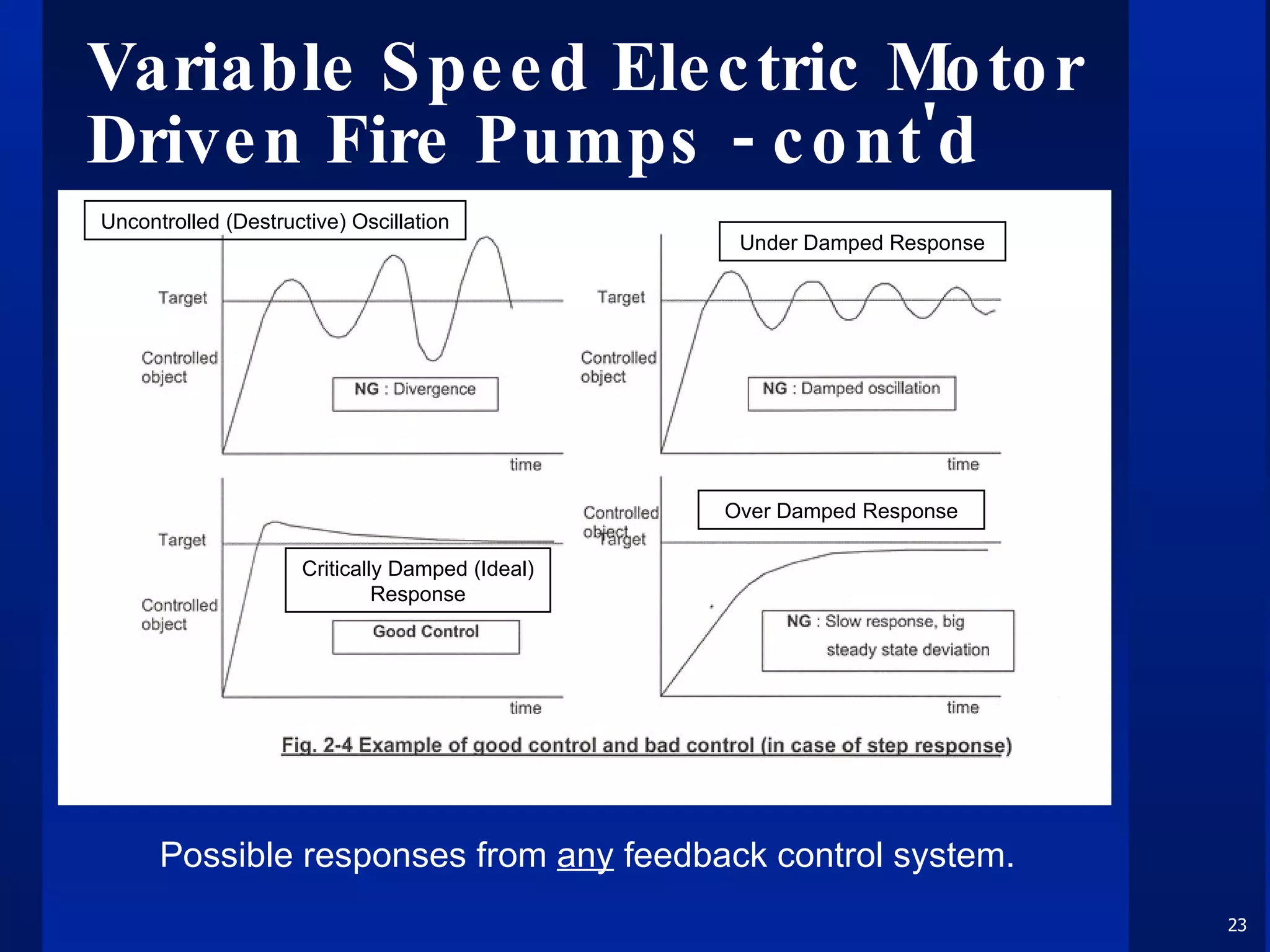
Variable Speed Electric Motor Driven Fire Pumps - cont'd Possible responses from  any  feedback control system. Under Damped Response Uncontrolled (Destructive) Oscillation Critically Damped (Ideal) Response Over Damped Response
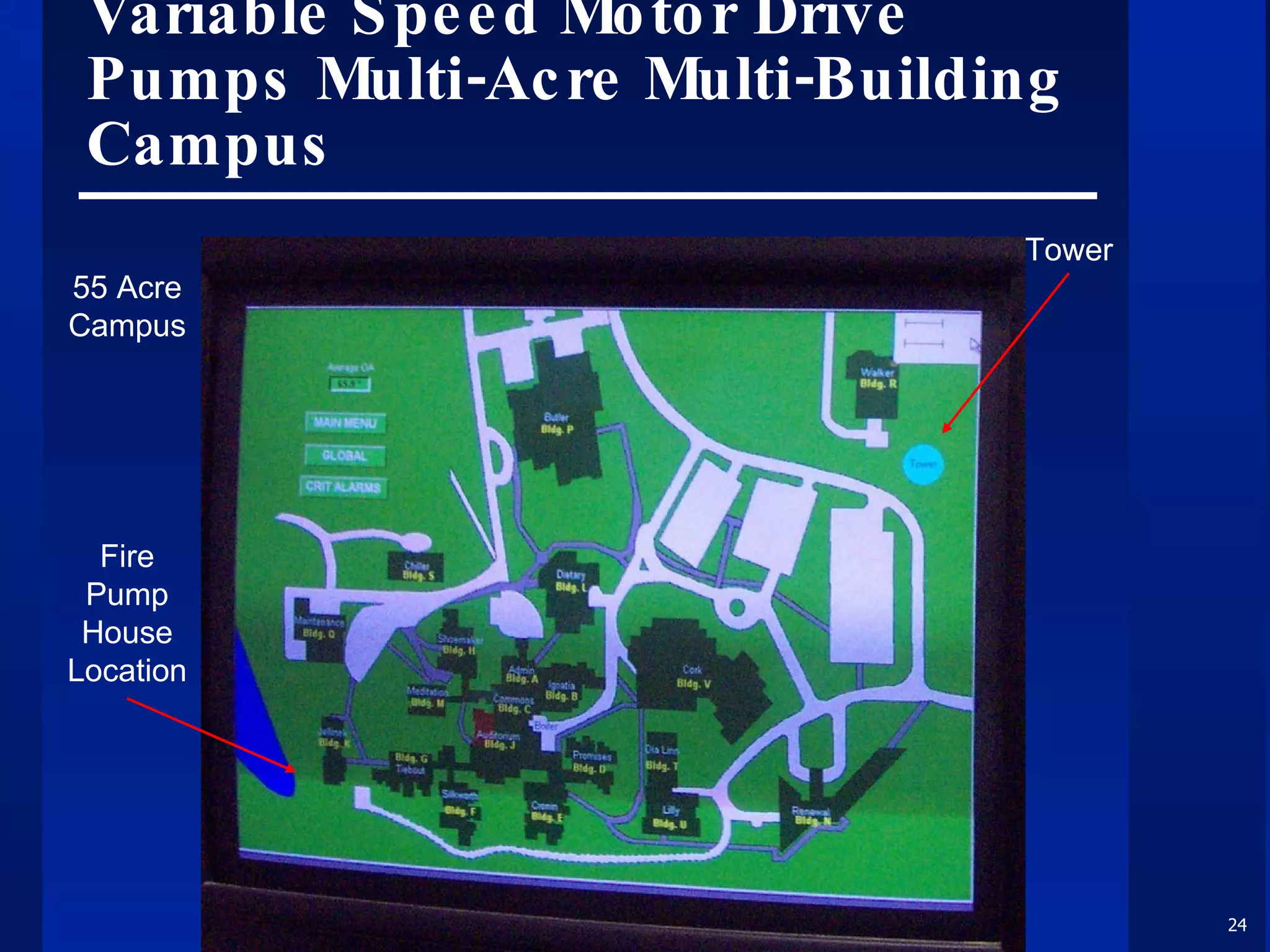
Variable Speed Motor Drive Pumps Multi-Acre Multi-Building Campus Fire Pump House Location Tower 55 Acre Campus
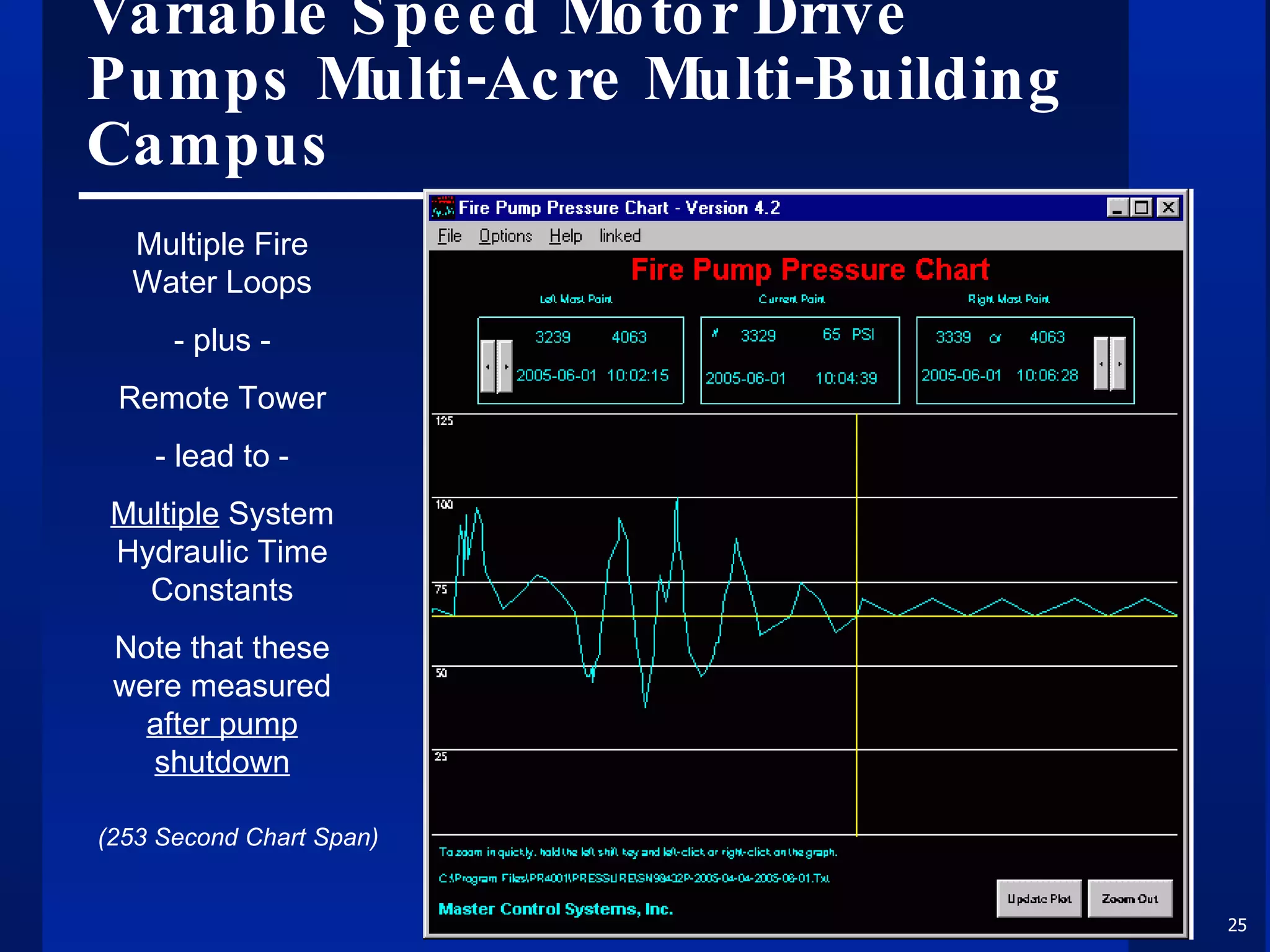
Variable Speed Motor Drive Pumps Multi-Acre Multi-Building Campus (253 Second Chart Span) Multiple Fire Water Loops - plus - Remote Tower - lead to - Multiple  System Hydraulic Time Constants Note that these were measured  after pump shutdown
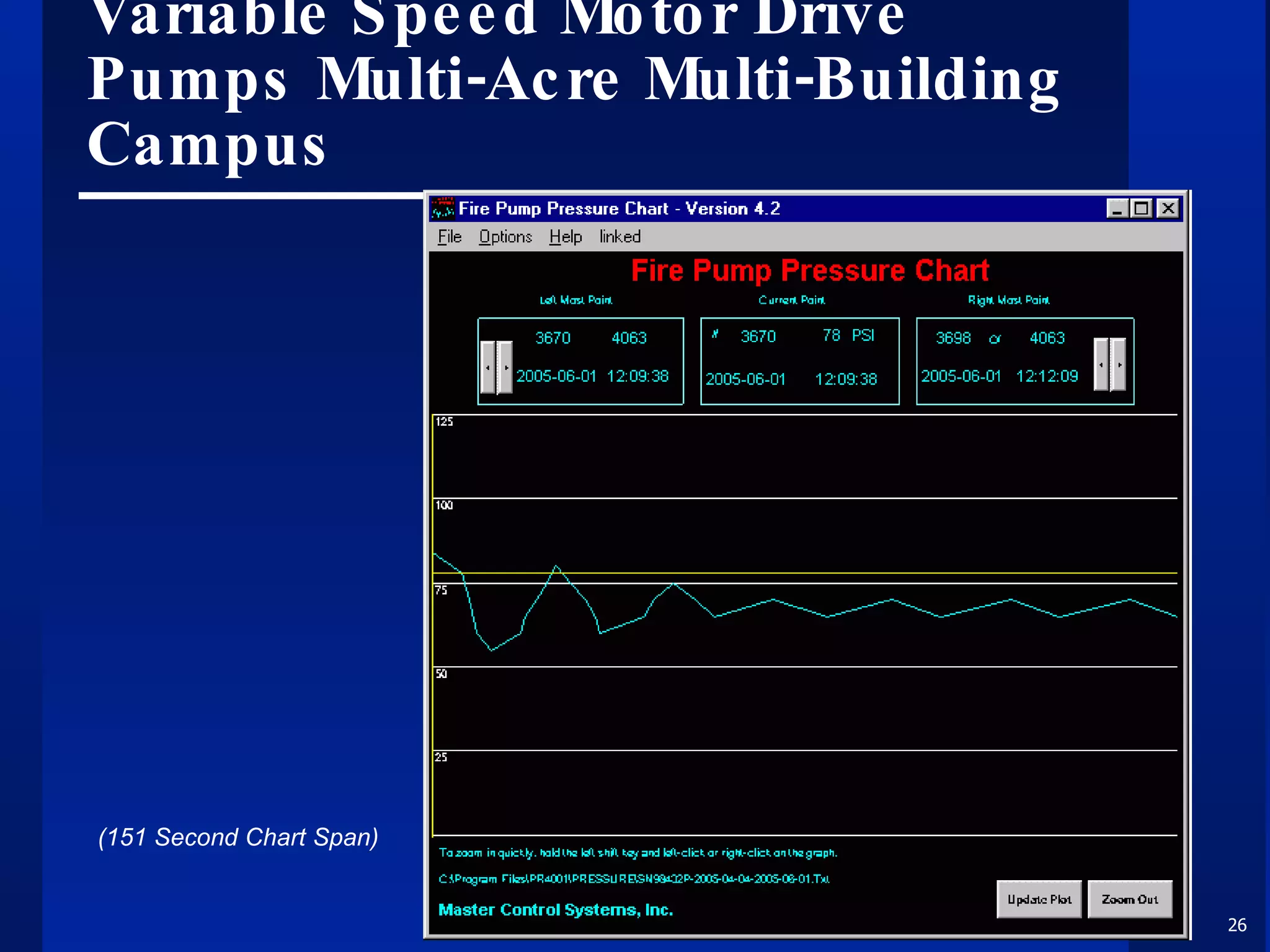
Variable Speed Motor Drive Pumps Multi-Acre Multi-Building Campus (151 Second Chart Span)
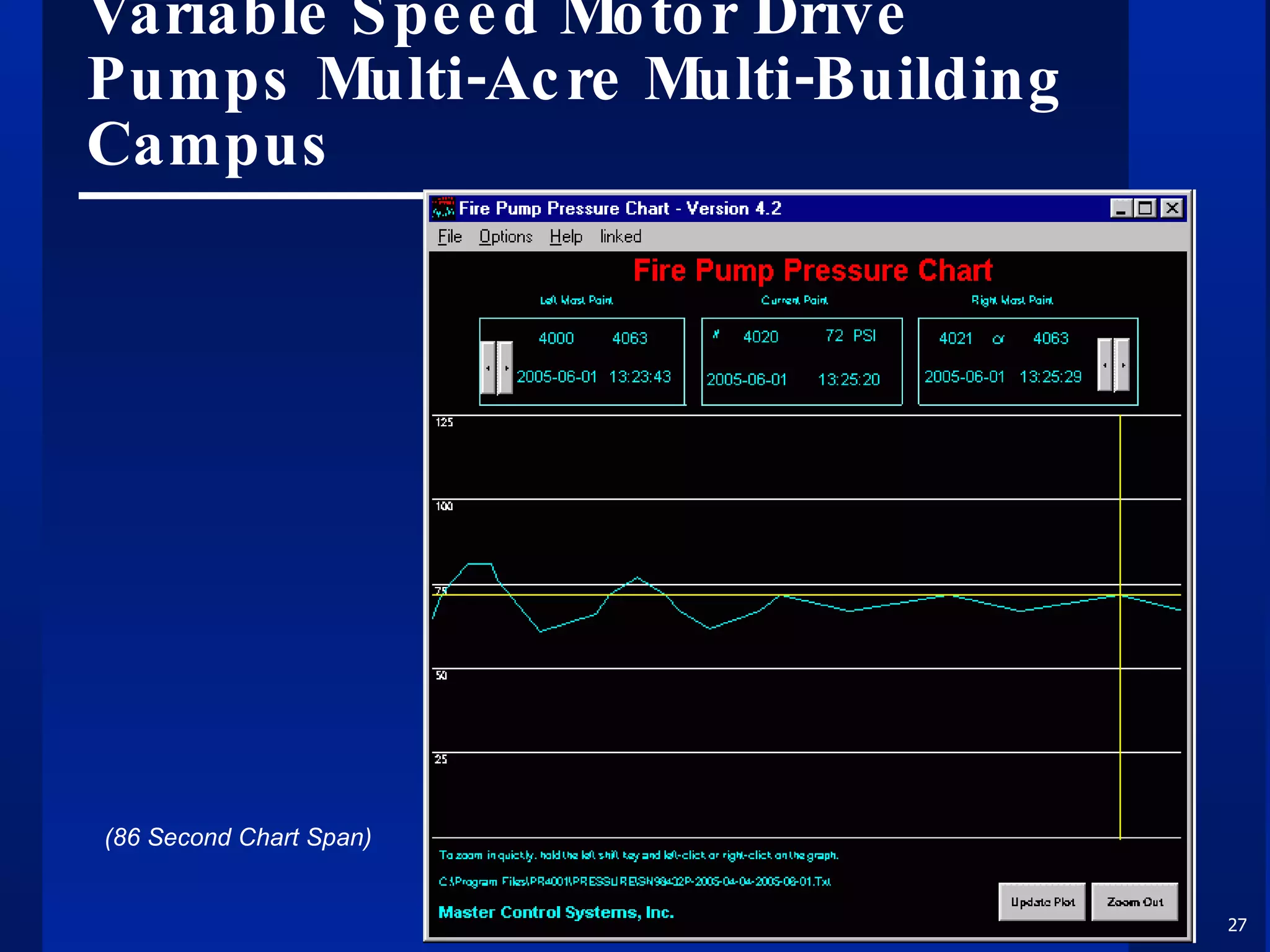
Variable Speed Motor Drive Pumps Multi-Acre Multi-Building Campus (86 Second Chart Span)
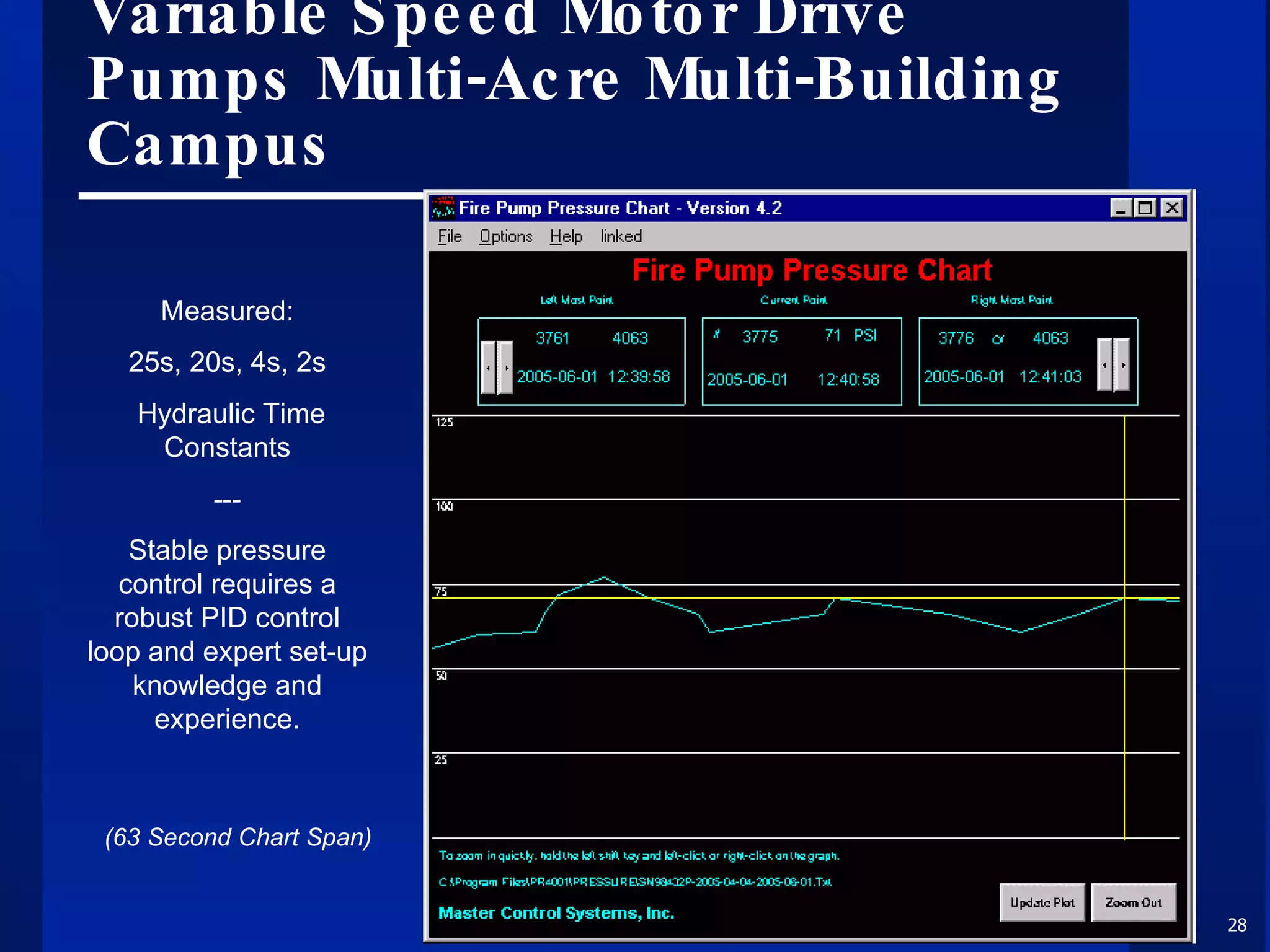
Variable Speed Motor Drive Pumps Multi-Acre Multi-Building Campus Measured: 25s, 20s, 4s, 2s  Hydraulic Time Constants --- Stable pressure control requires a robust PID control loop and expert set-up knowledge and experience. (63 Second Chart Span)
Variable Speed Electric Motor Driven Fire Pumps - cont'd NFPA-20 Further Requirements: Continuous Full Rated Horsepower VFD Automatic Switch to Bypass if: VFD doesn't respond in 5 seconds Pressure is low for more than 15 seconds Lock in Bypass Mode (Avoids False Operation) Fully Coordinated Protection Between Variable Speed and Bypass Paths Lockable Cabinets Separate Control for Multiple Pump Sites (No Common Control, No Common Point of Failure)
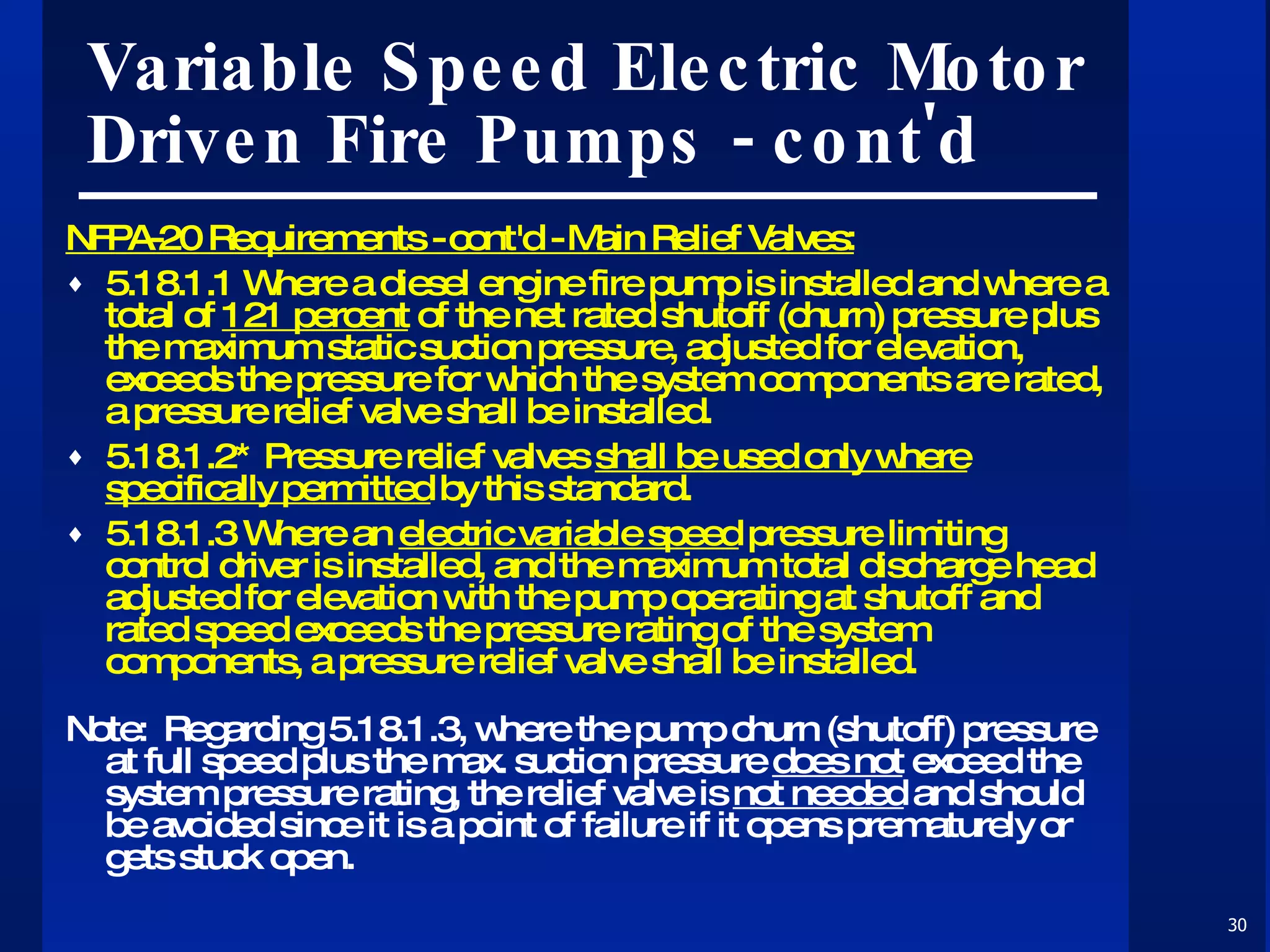
Variable Speed Electric Motor Driven Fire Pumps - cont'd NFPA-20 Requirements - cont'd - Main Relief Valves: 5.18.1.1 Where a diesel engine fire pump is installed and where a total of  121 percent  of the net rated shutoff (churn) pressure plus the maximum static suction pressure, adjusted for elevation, exceeds the pressure for which the system components are rated, a pressure relief valve shall be installed. 5.18.1.2* Pressure relief valves  shall be used only where specifically permitted  by this standard. 5.18.1.3 Where an  electric variable speed  pressure limiting control driver is installed, and the maximum total discharge head adjusted for elevation with the pump operating at shutoff and rated speed exceeds the pressure rating of the system components, a pressure relief valve shall be installed. Note:  Regarding 5.18.1.3, where the pump churn (shutoff) pressure at full speed plus the max. suction pressure  does not  exceed the system pressure rating, the relief valve is  not needed  and should be avoided since it is a point of failure if it opens prematurely or gets stuck open.
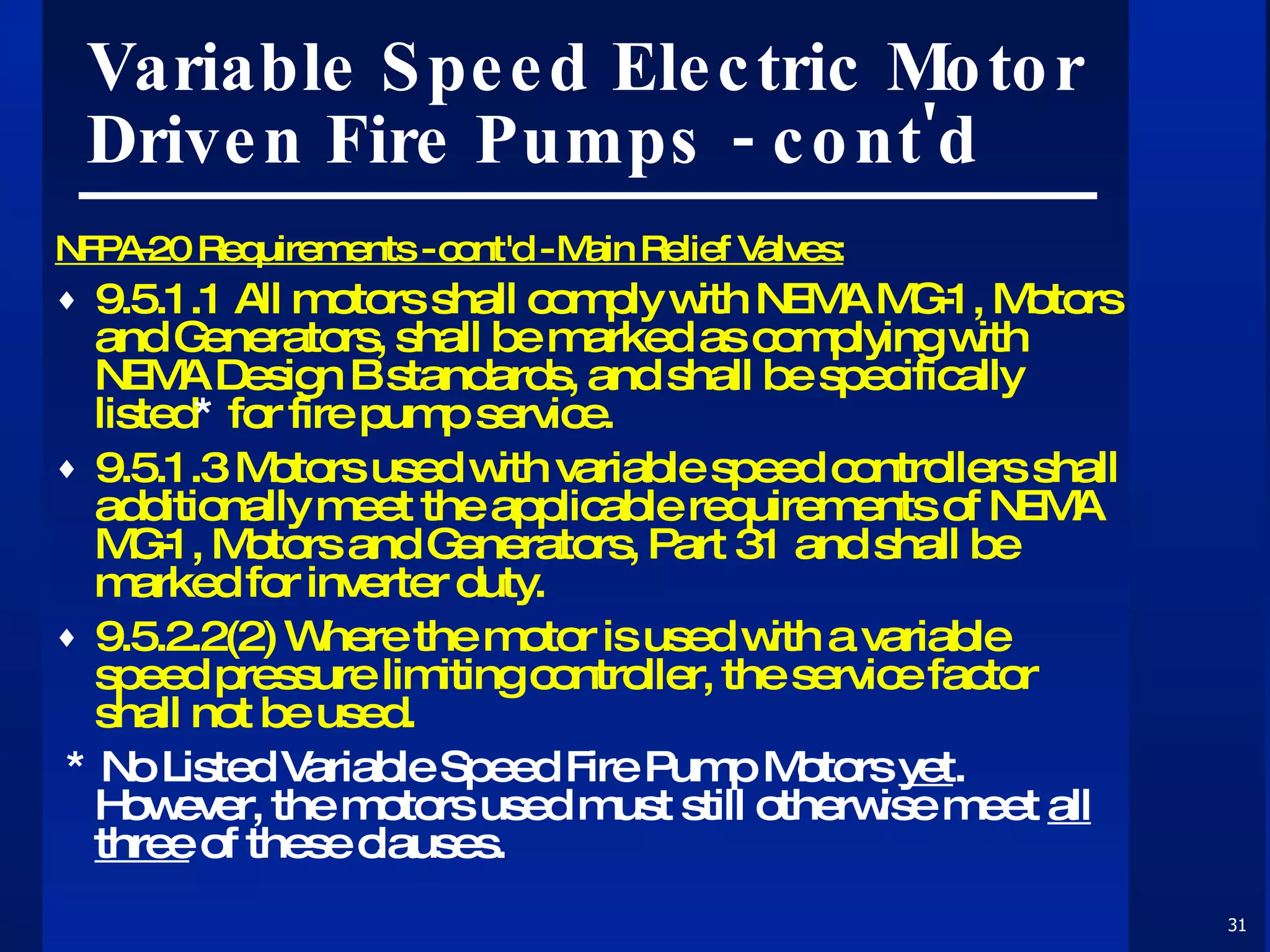
Variable Speed Electric Motor Driven Fire Pumps - cont'd NFPA-20 Requirements - cont'd - Main Relief Valves: 9.5.1.1 All motors shall comply with NEMA MG-1, Motors and Generators, shall be marked as complying with NEMA Design B standards, and shall be specifically listed *  for fire pump service. 9.5.1.3 Motors used with variable speed controllers shall additionally meet the applicable requirements of NEMA MG-1, Motors and Generators, Part 31 and shall be marked for inverter duty. 9.5.2.2(2) Where the motor is used with a variable speed pressure limiting controller, the service factor shall not be used. * No Listed Variable Speed Fire Pump Motors  yet .  However, the motors used must still otherwise meet  all three  of these clauses.
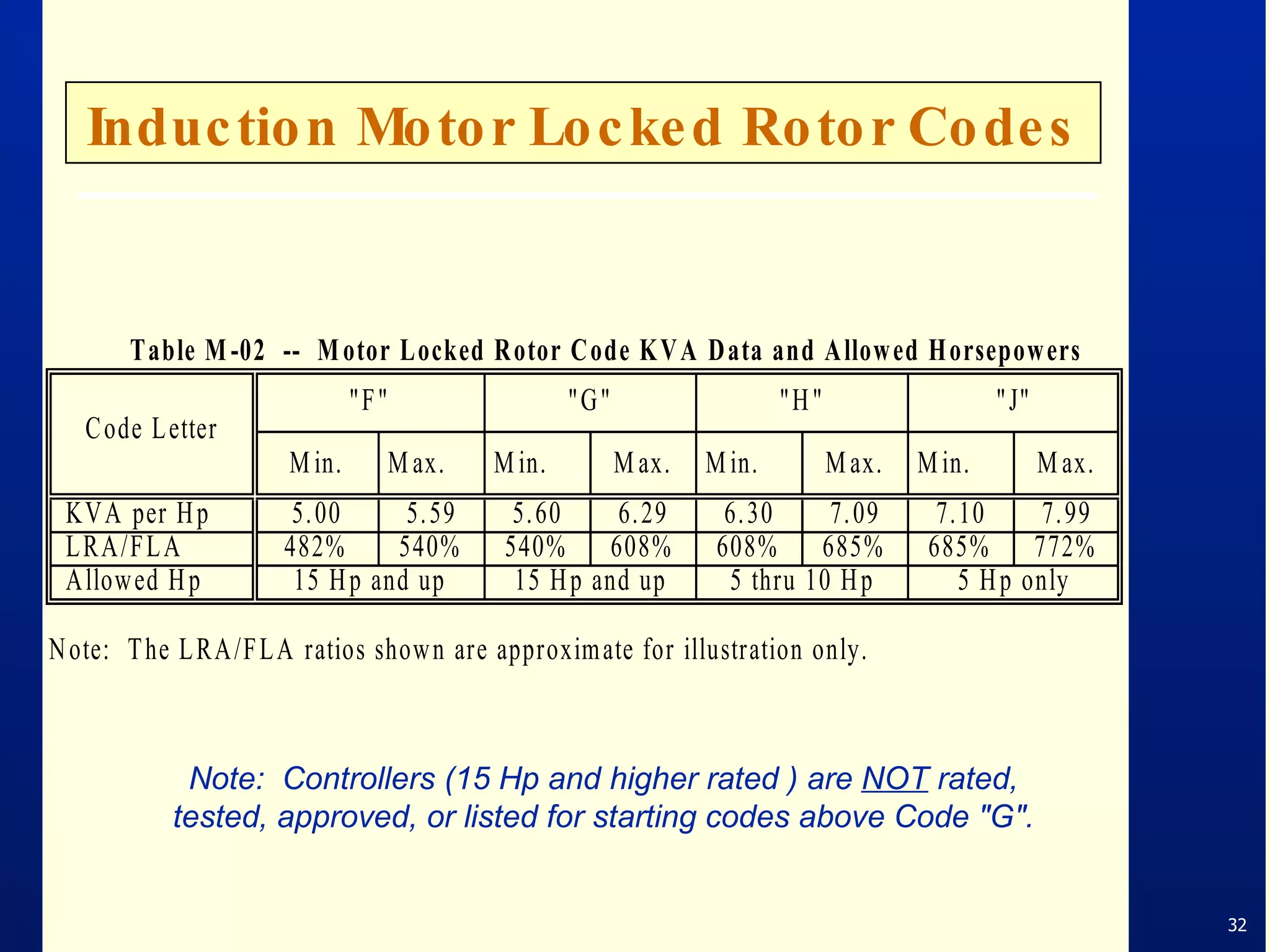
Induction Motor Locked Rotor Codes Note:  Controllers (15 Hp and higher rated ) are  NOT  rated, tested, approved, or listed for starting codes above Code "G".
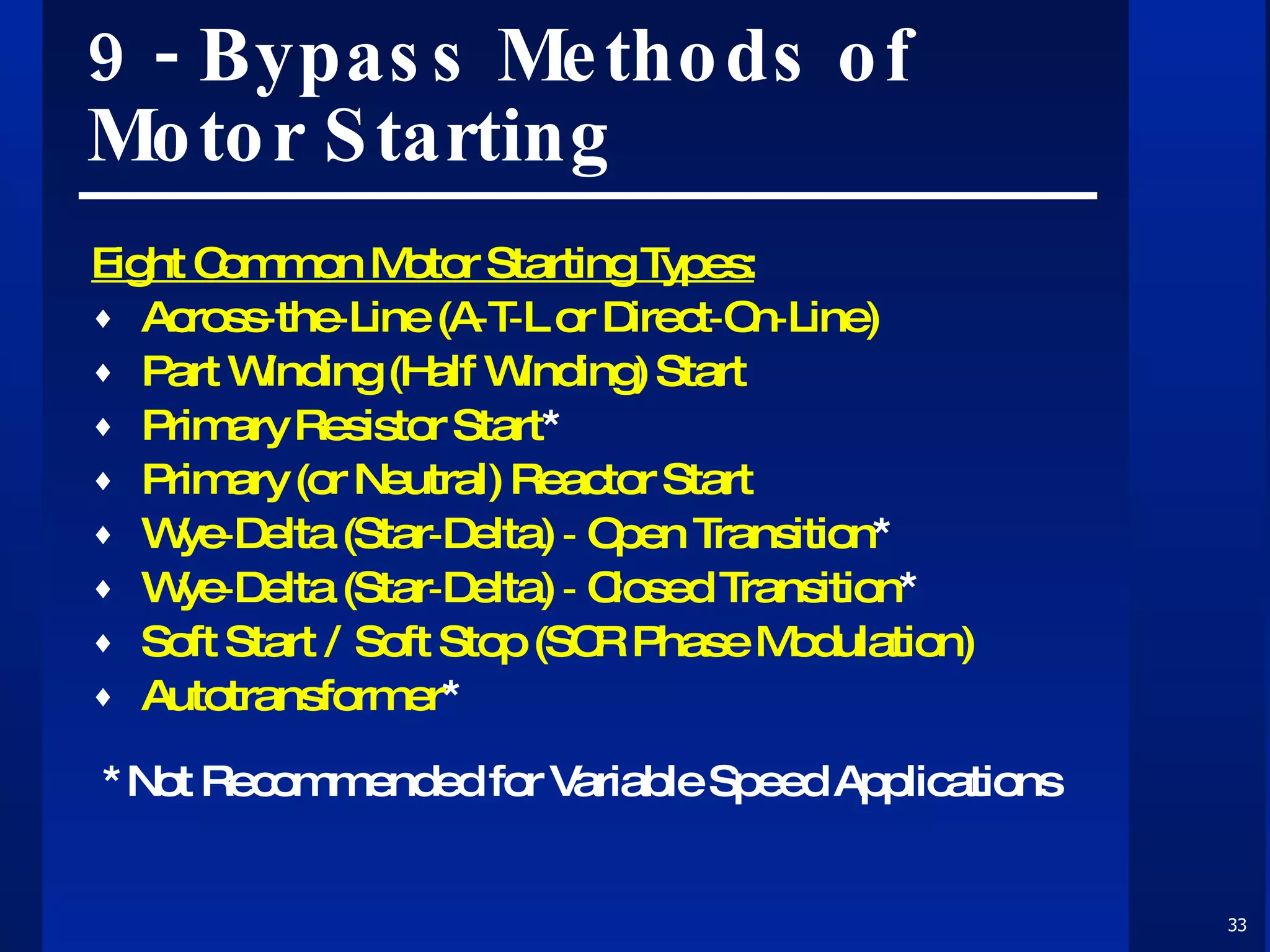
9 - Bypass Methods of Motor Starting Eight Common Motor Starting Types: Across‑the‑Line (A‑T‑L or Direct‑On‑Line) Part Winding (Half Winding) Start Primary Resistor Start * Primary (or Neutral) Reactor Start Wye‑Delta (Star‑Delta) ‑ Open Transition * Wye‑Delta (Star‑Delta) ‑ Closed Transition * Soft Start / Soft Stop (SCR Phase Modulation) Autotransformer * *Not Recommended for Variable Speed Applications
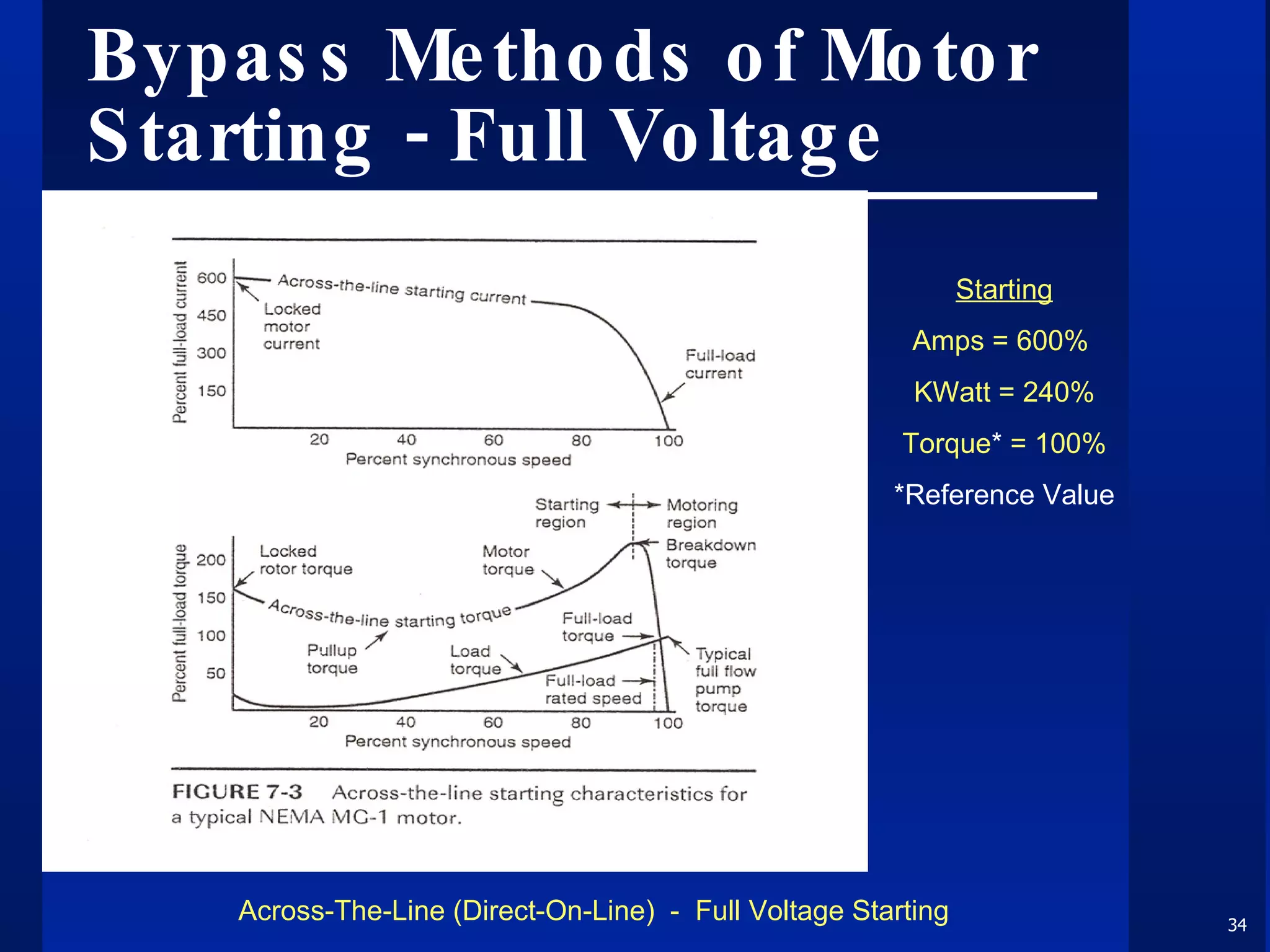
Bypass Methods of Motor Starting - Full Voltage Across-The-Line (Direct-On-Line)  -  Full Voltage Starting Starting Amps = 600%  KWatt = 240% Torque *  = 100% *Reference Value
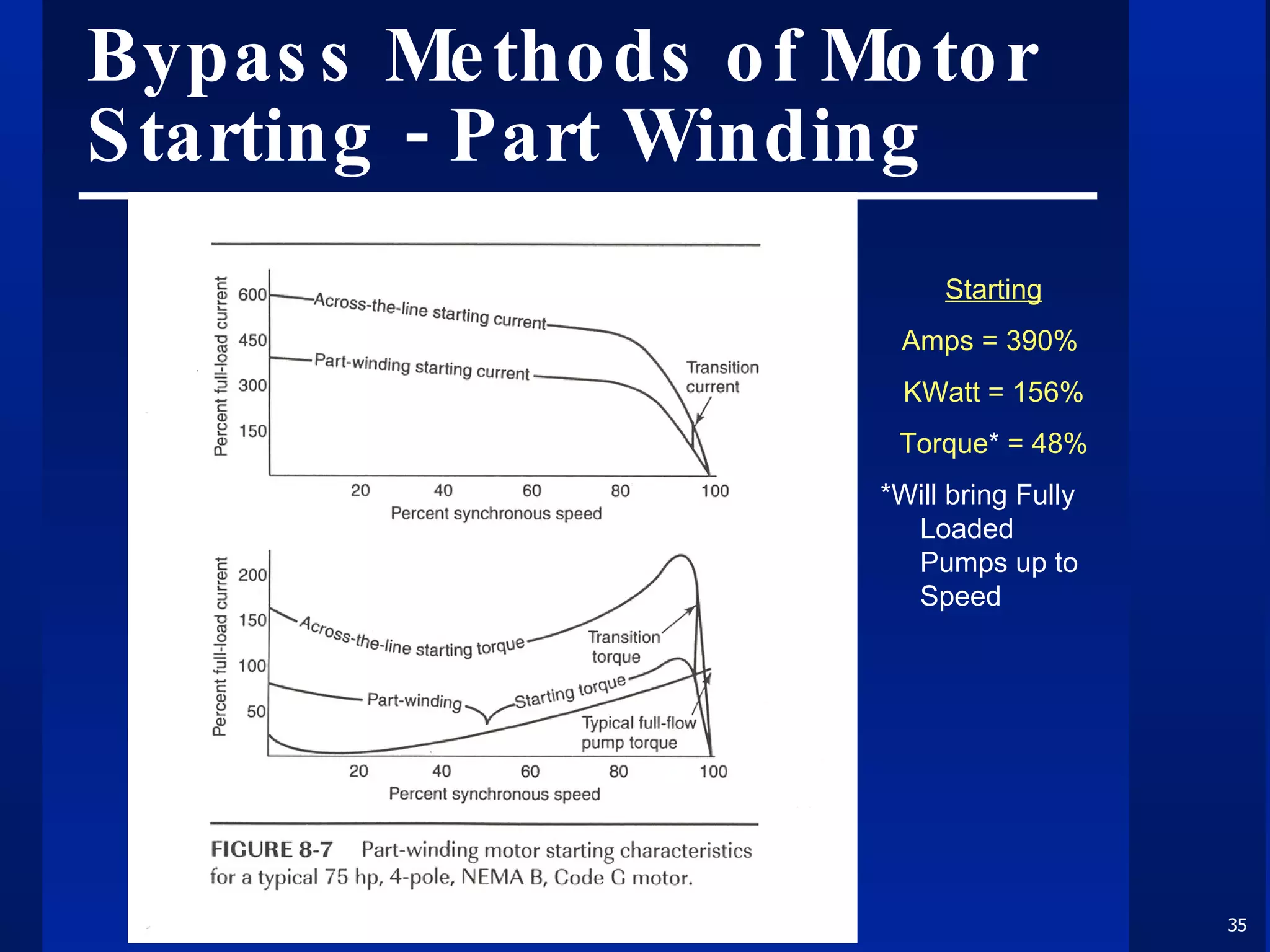
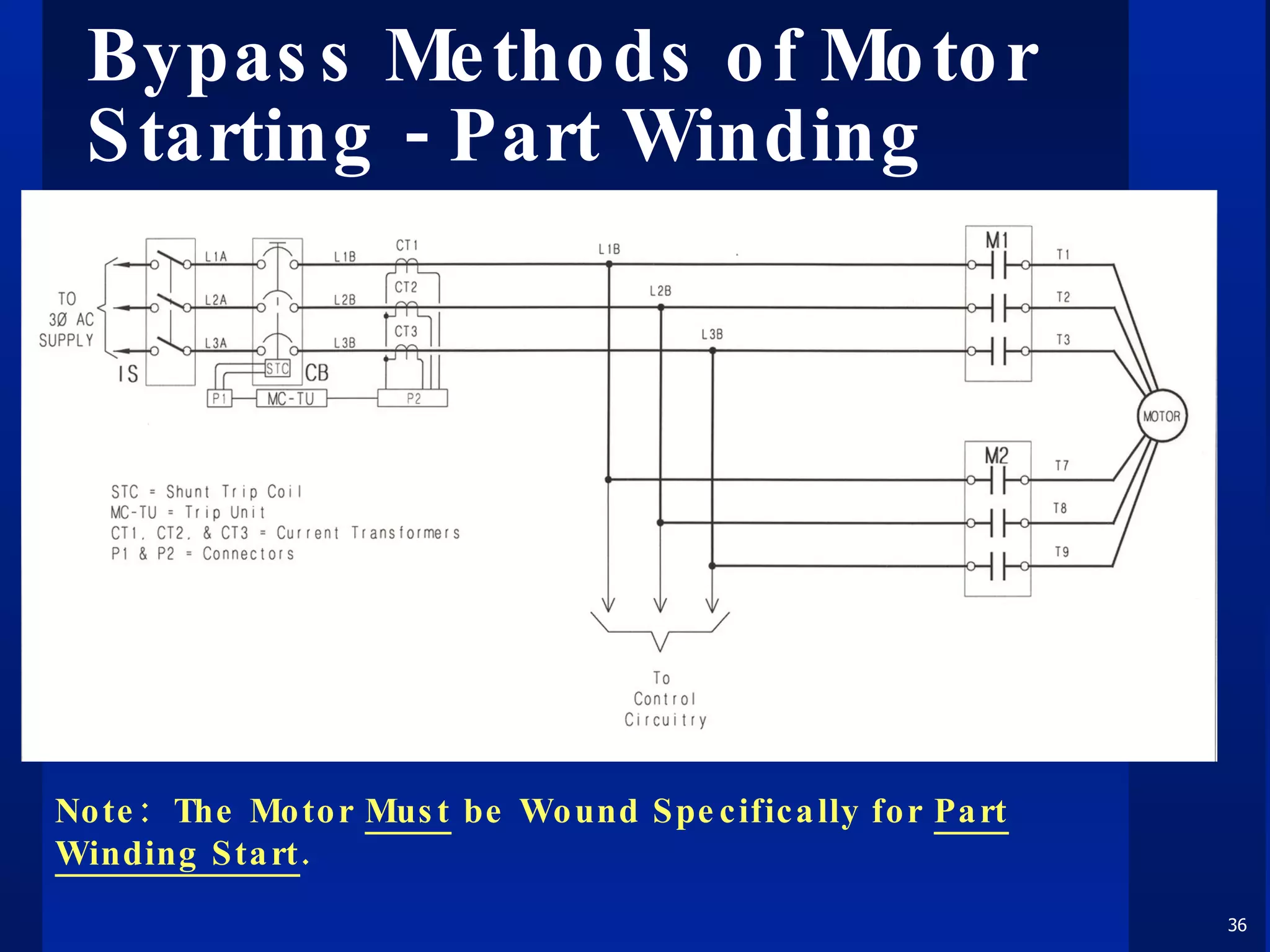
Bypass Methods of Motor Starting - Part Winding Starting Amps = 390%  KWatt = 156% Torque *  = 48% *Will bring Fully Loaded Pumps up to Speed
Bypass Methods of Motor Starting - Part Winding Note:  The Motor  Must  be Wound Specifically for  Part Winding Start .
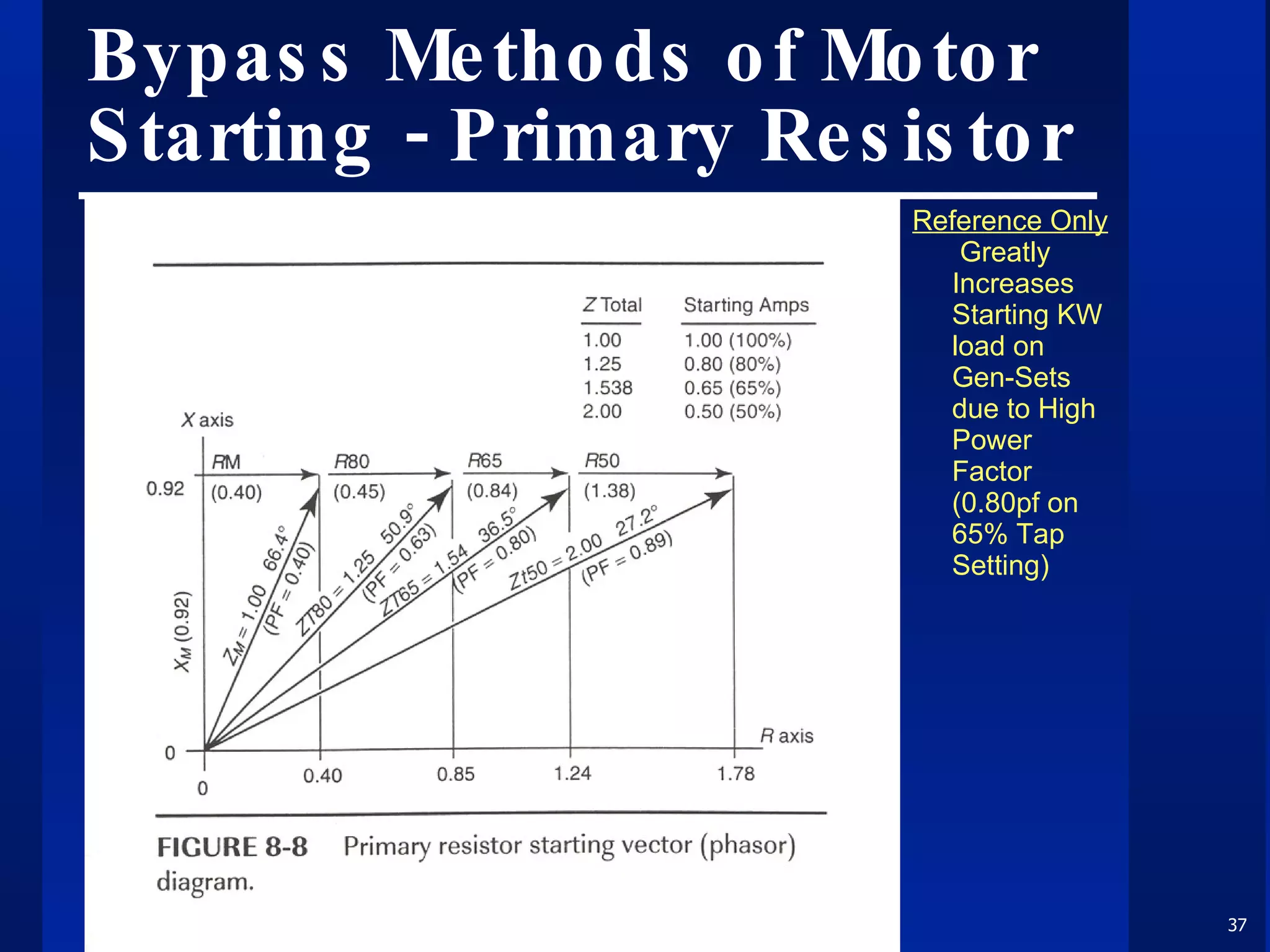
Bypass Methods of Motor Starting - Primary Resistor Reference Only   Greatly Increases Starting KW load on Gen-Sets due to High Power Factor (0.80pf on 65% Tap Setting)
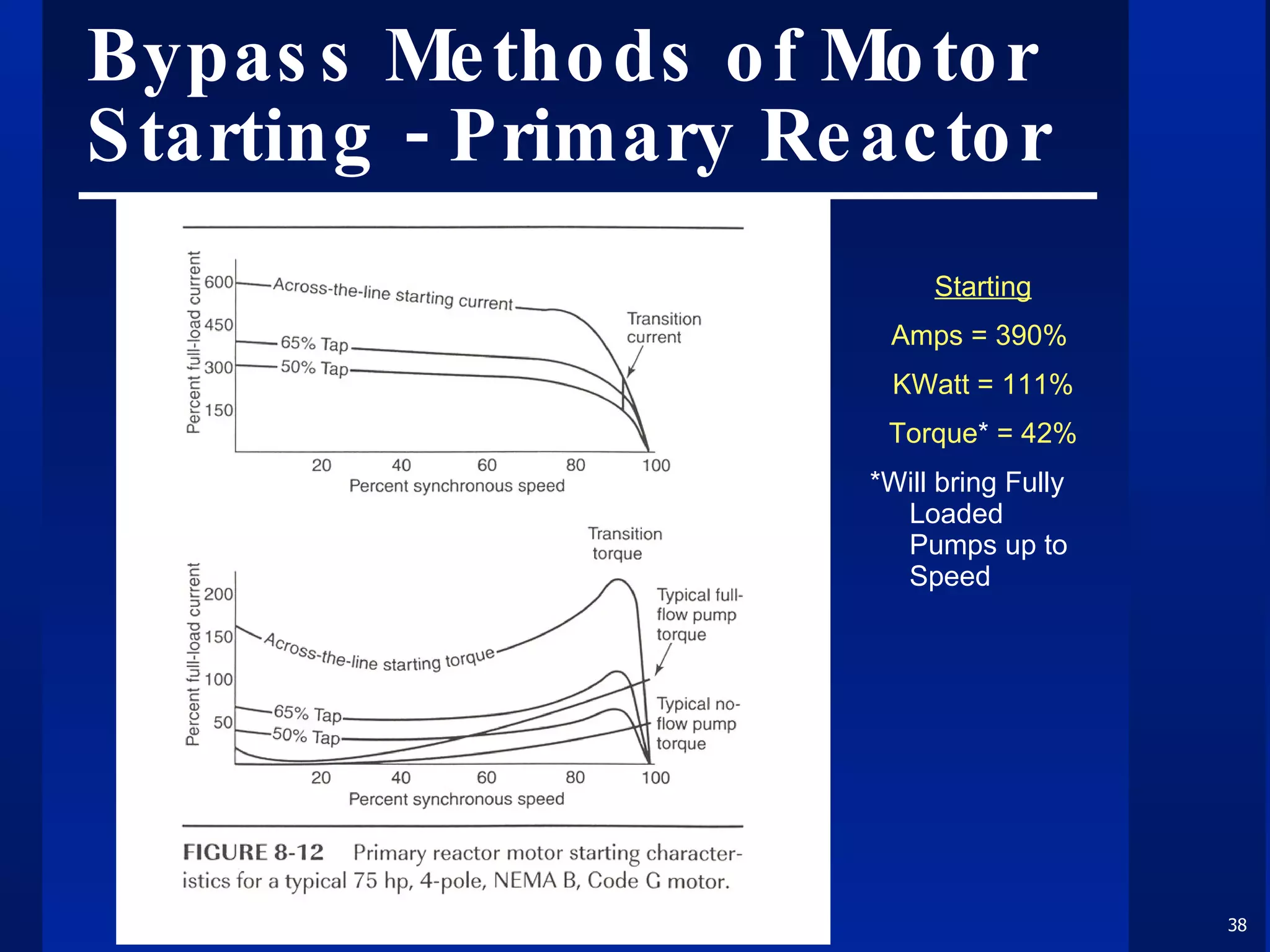
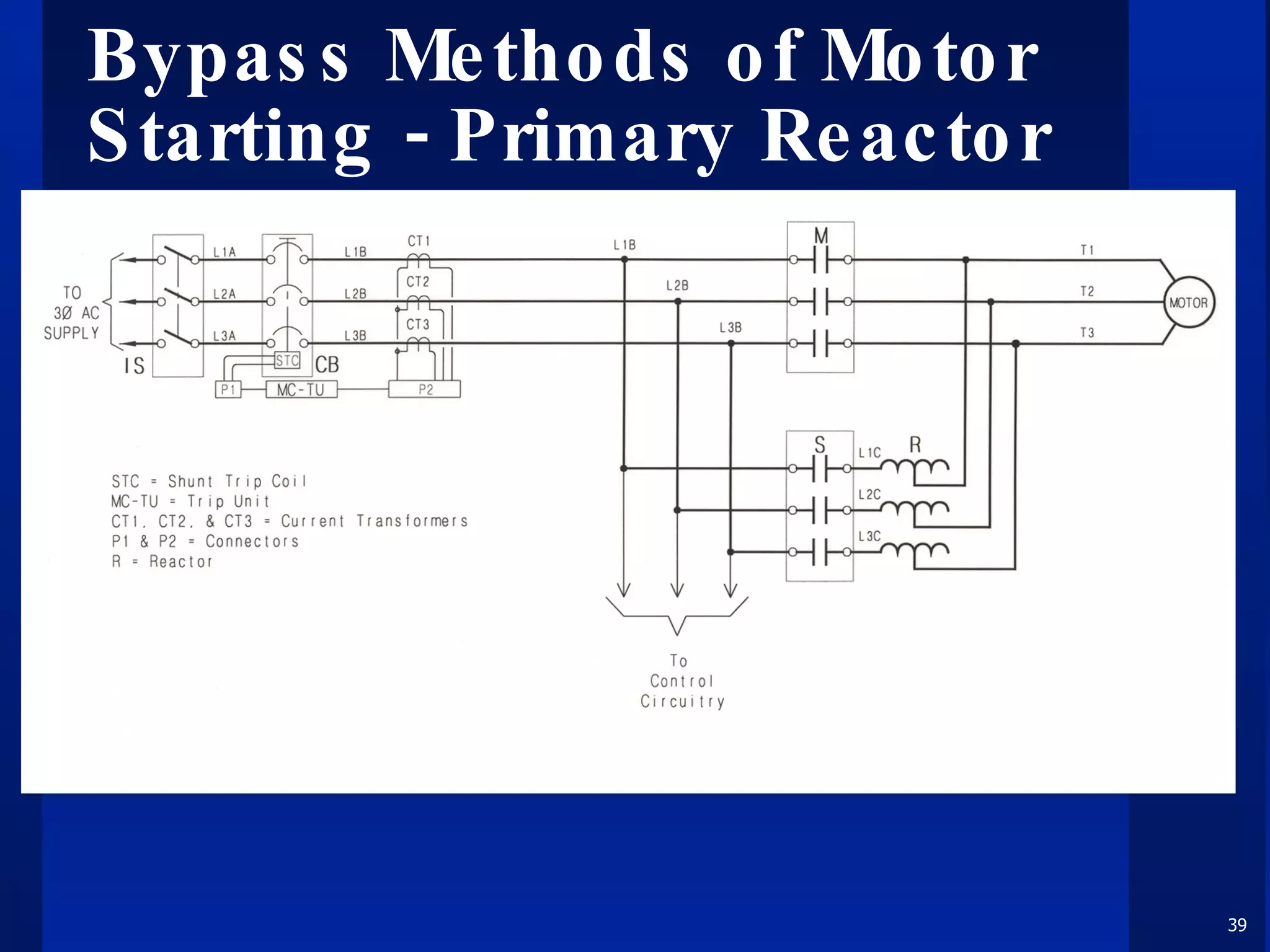
Bypass Methods of Motor Starting - Primary Reactor Starting Amps = 390%  KWatt = 111% Torque *  = 42% *Will bring Fully Loaded Pumps up to Speed
Bypass Methods of Motor Starting - Primary Reactor
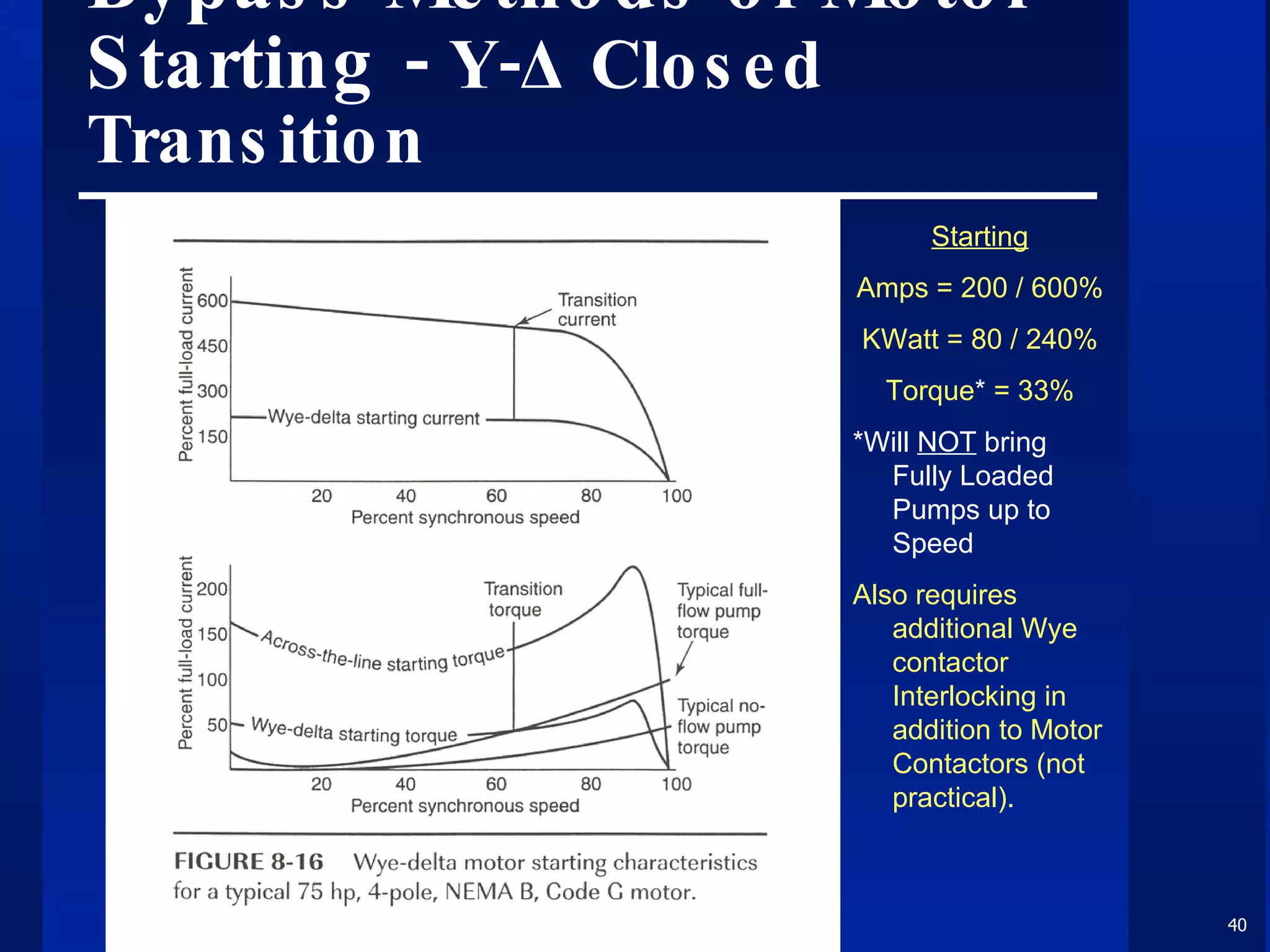
Bypass Methods of Motor Starting -  Y-Δ Closed Transition Starting Amps = 200 / 600%  KWatt = 80 / 240% Torque *  = 33% *Will  NOT  bring Fully Loaded Pumps up to Speed Also requires additional Wye contactor  Interlocking in addition to Motor Contactors (not practical).
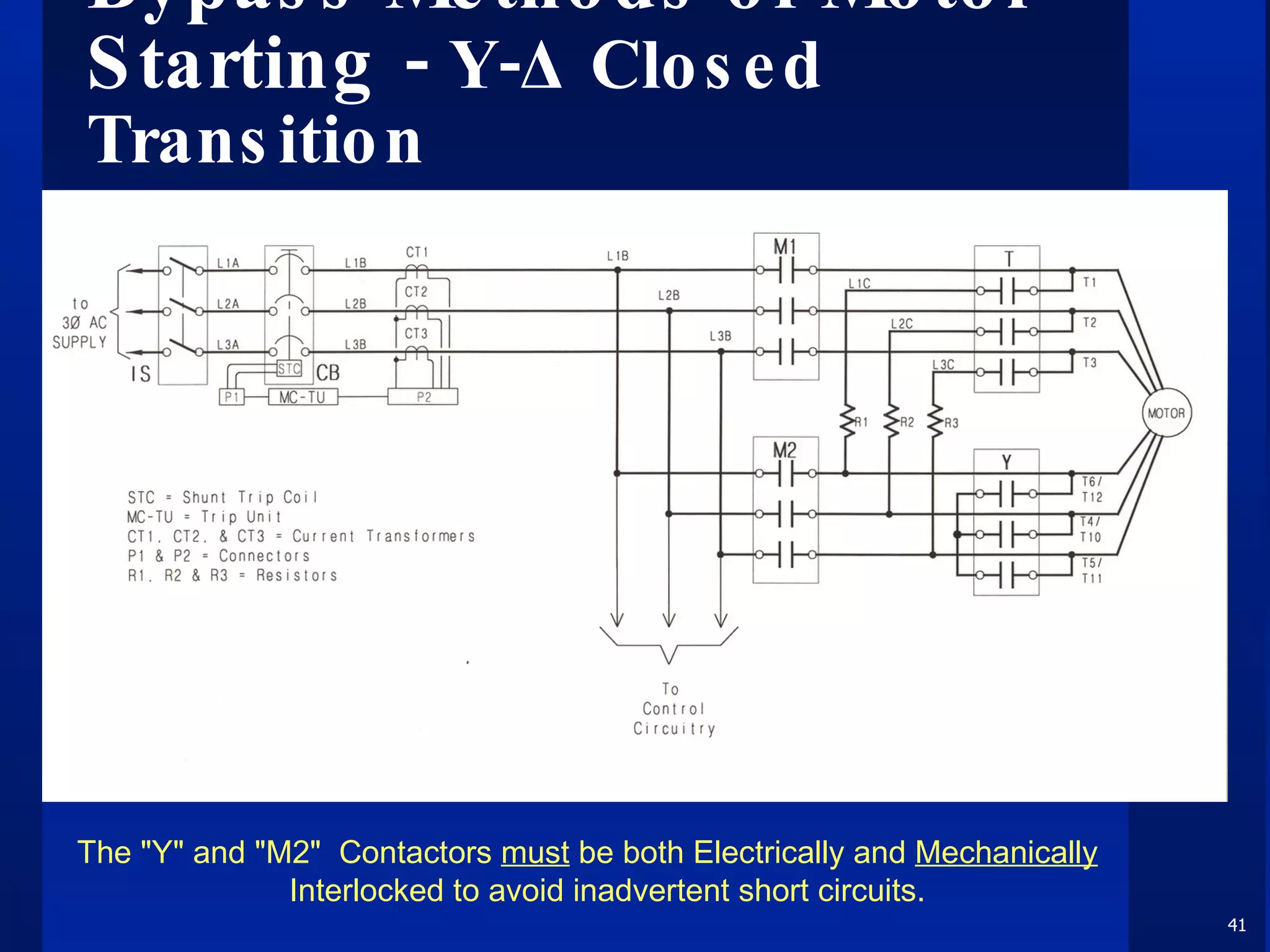
Bypass Methods of Motor Starting -  Y-Δ Closed Transition The "Y" and "M2"  Contactors  must  be both Electrically and  Mechanically  Interlocked to avoid inadvertent short circuits.
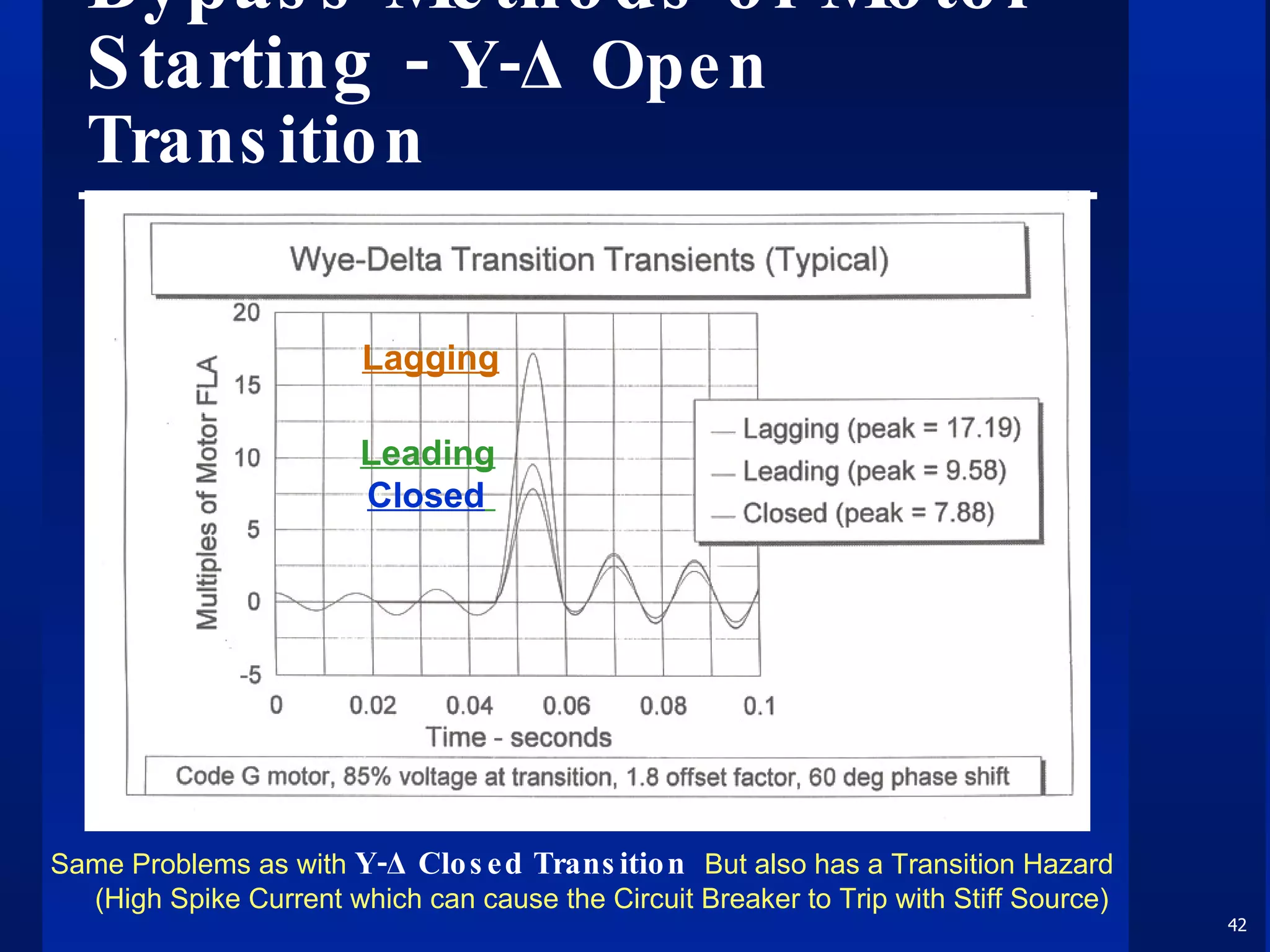
Bypass Methods of Motor Starting -  Y-Δ Open Transition Same Problems as with  Y-Δ Closed Transition  But also has a Transition Hazard (High Spike Current which can cause the Circuit Breaker to Trip with Stiff Source) Lagging Leading  Closed
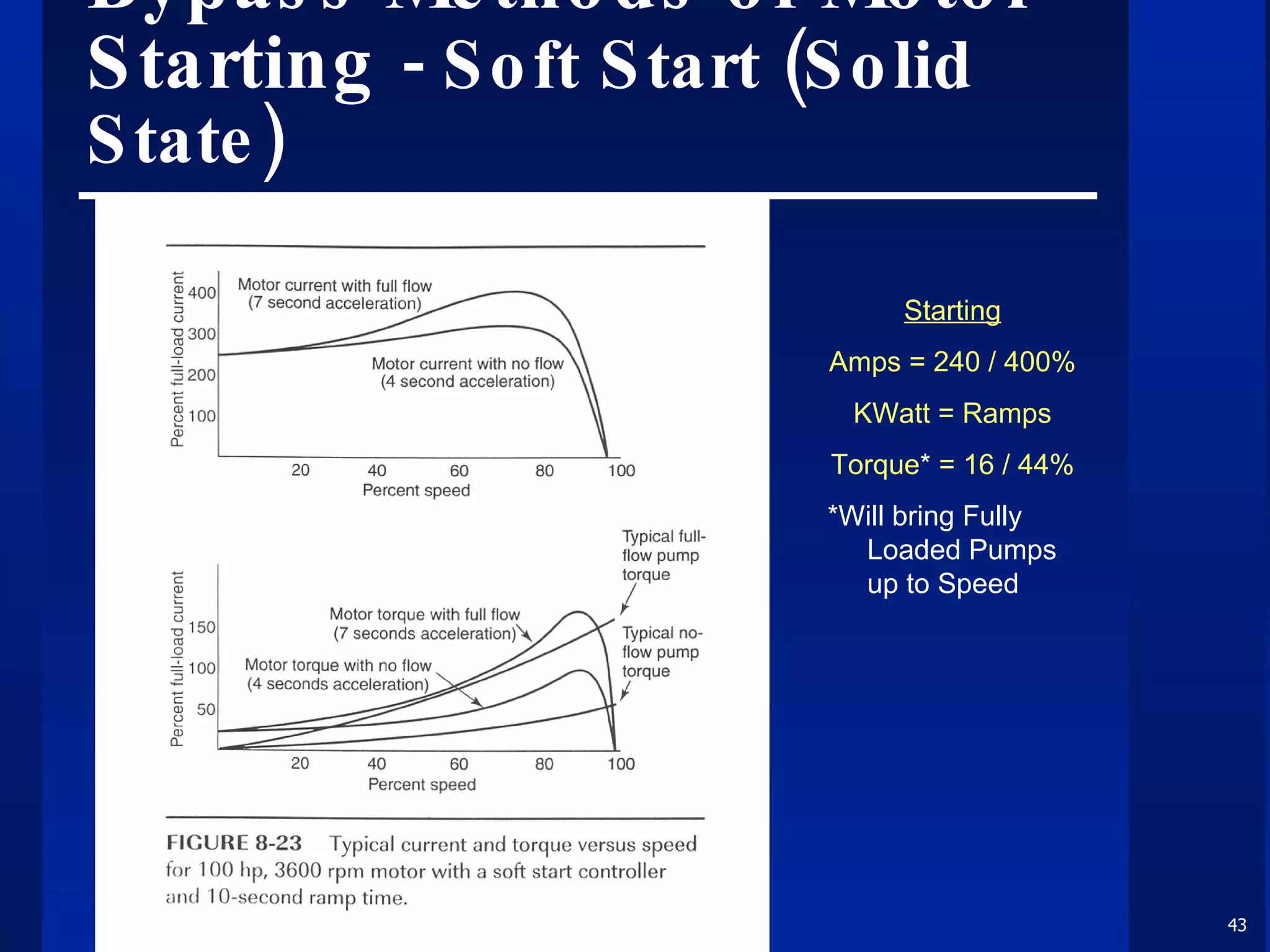
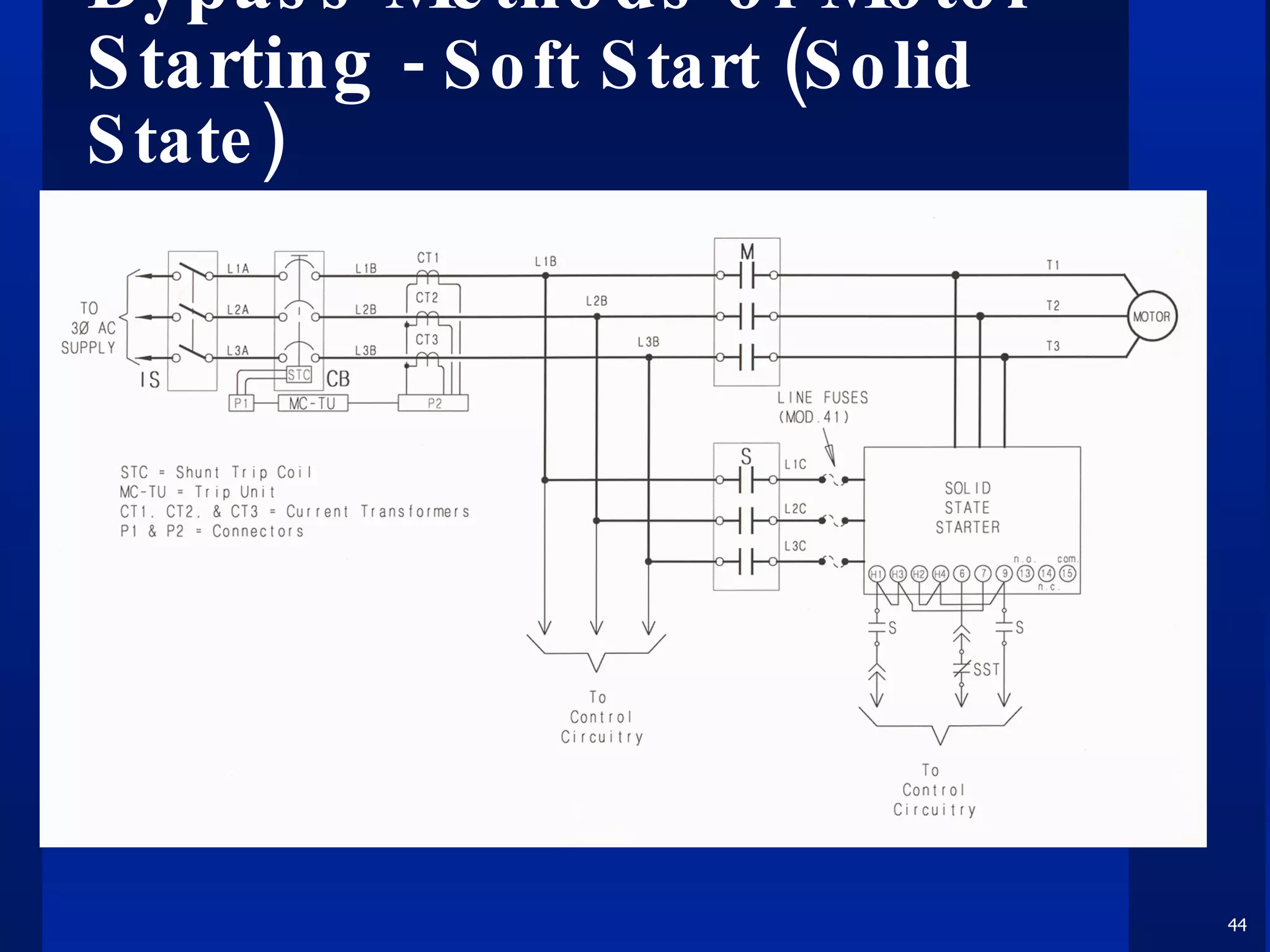
Bypass Methods of Motor Starting  - Soft Start (Solid State) Starting Amps = 240 / 400%  KWatt = Ramps Torque *  = 16 / 44% *Will bring Fully Loaded Pumps up to Speed
Bypass Methods of Motor Starting  - Soft Start (Solid State)
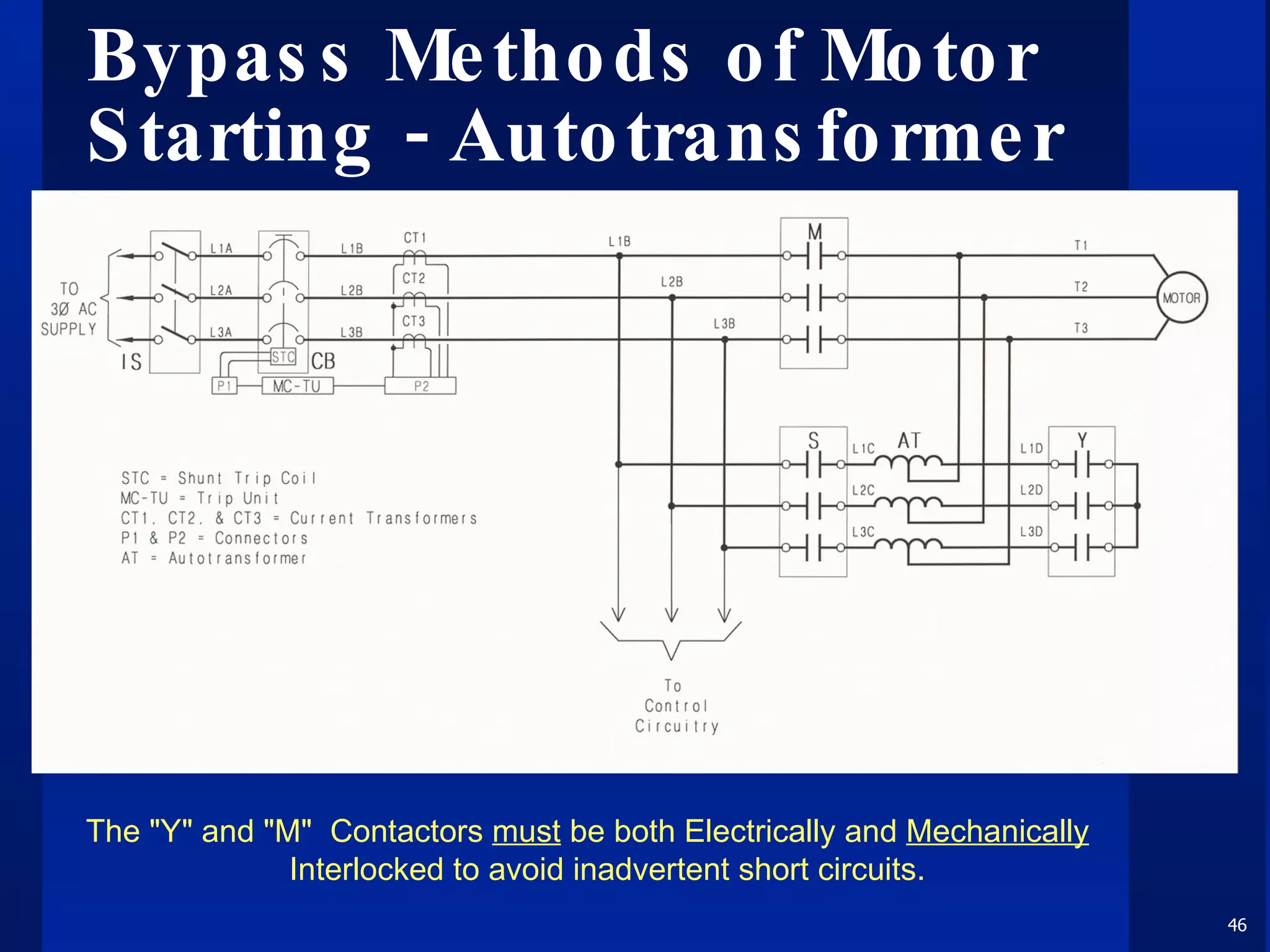
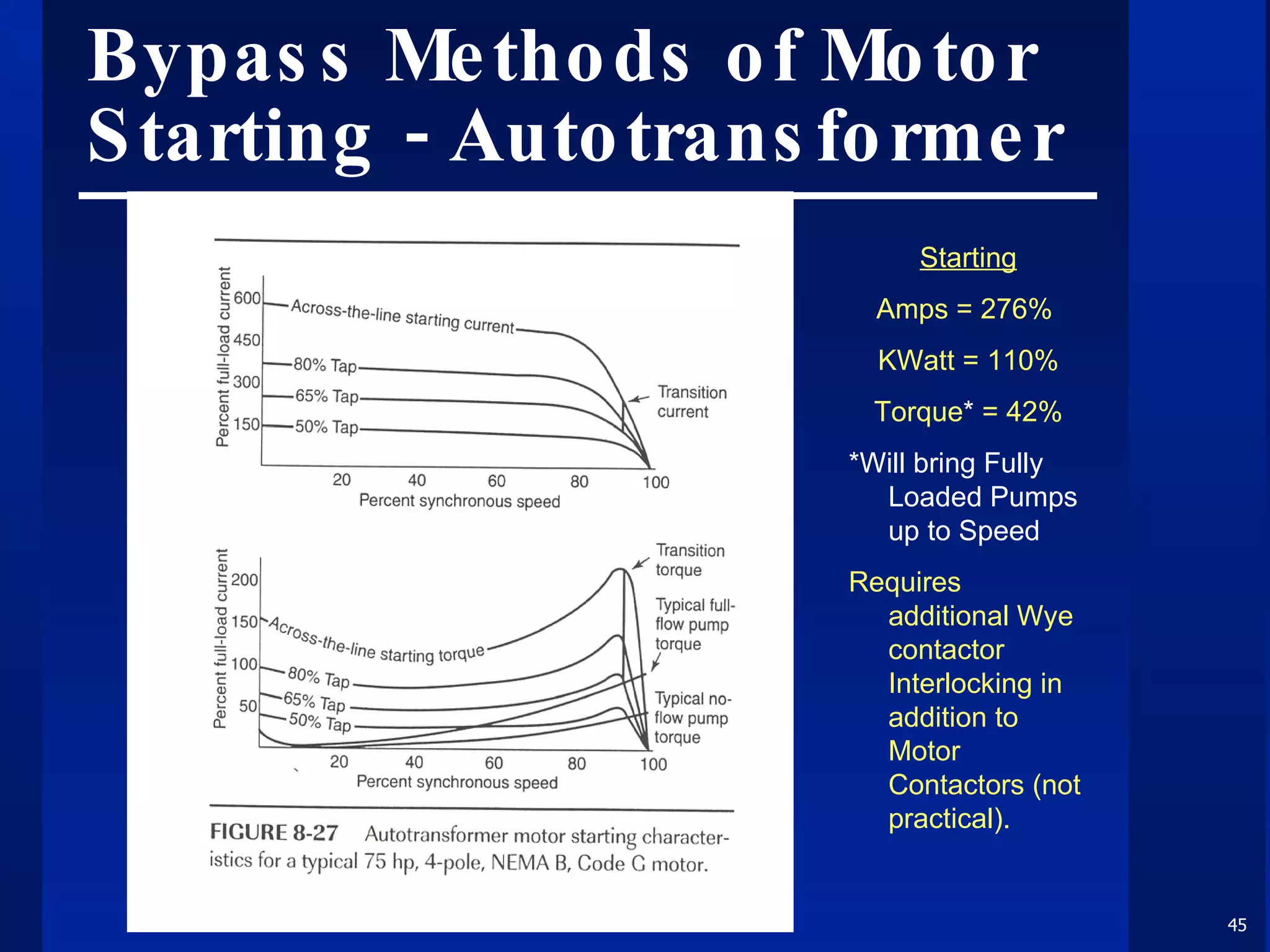
Bypass Methods of Motor Starting - Autotransformer Starting Amps = 276%  KWatt = 110% Torque *  = 42% *Will bring Fully Loaded Pumps up to Speed Requires additional Wye contactor  Interlocking in addition to Motor Contactors (not practical).
Bypass Methods of Motor Starting - Autotransformer The "Y" and "M"  Contactors  must  be both Electrically and  Mechanically  Interlocked to avoid inadvertent short circuits.
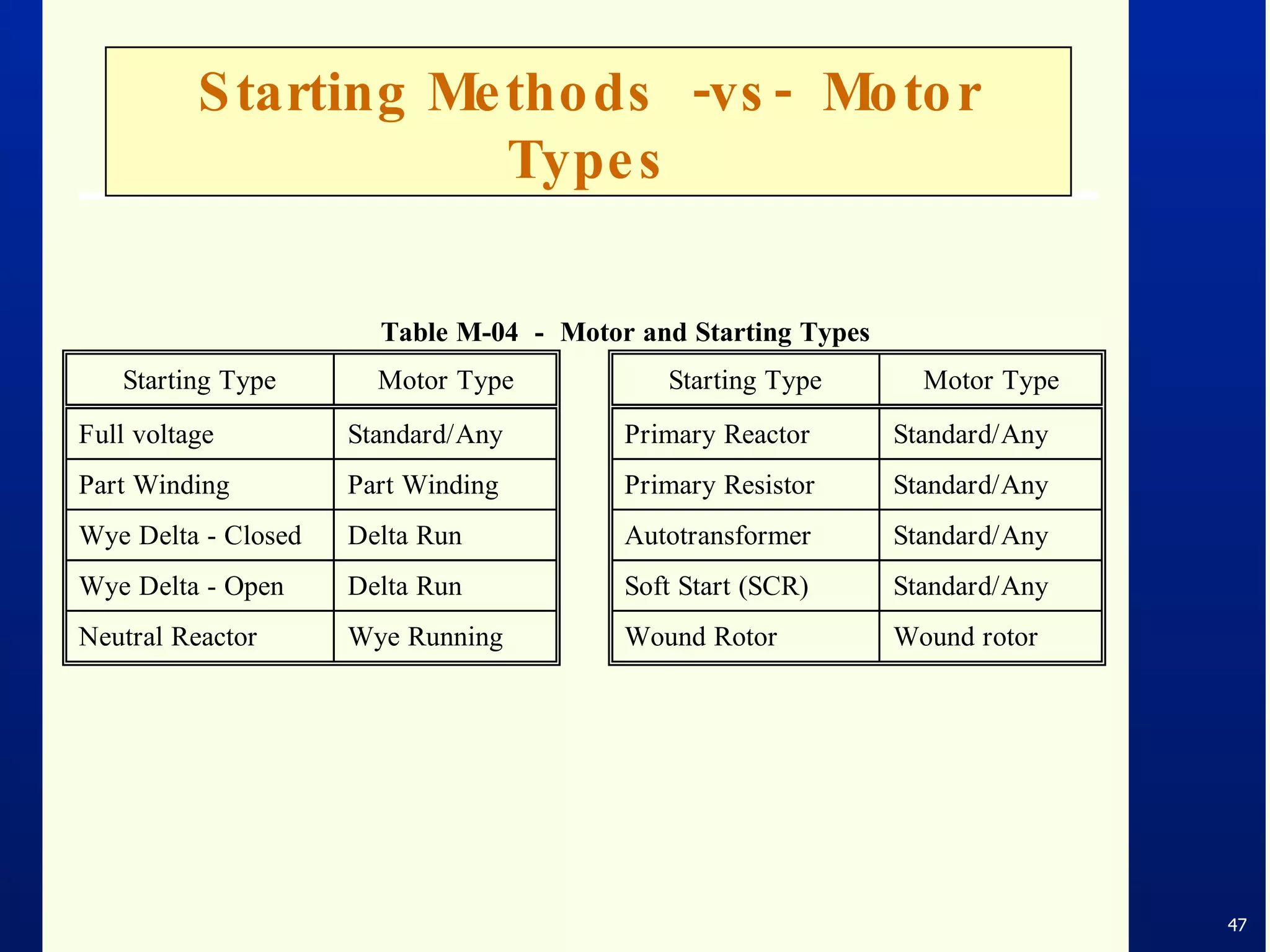
Starting Methods  -vs-  Motor Types
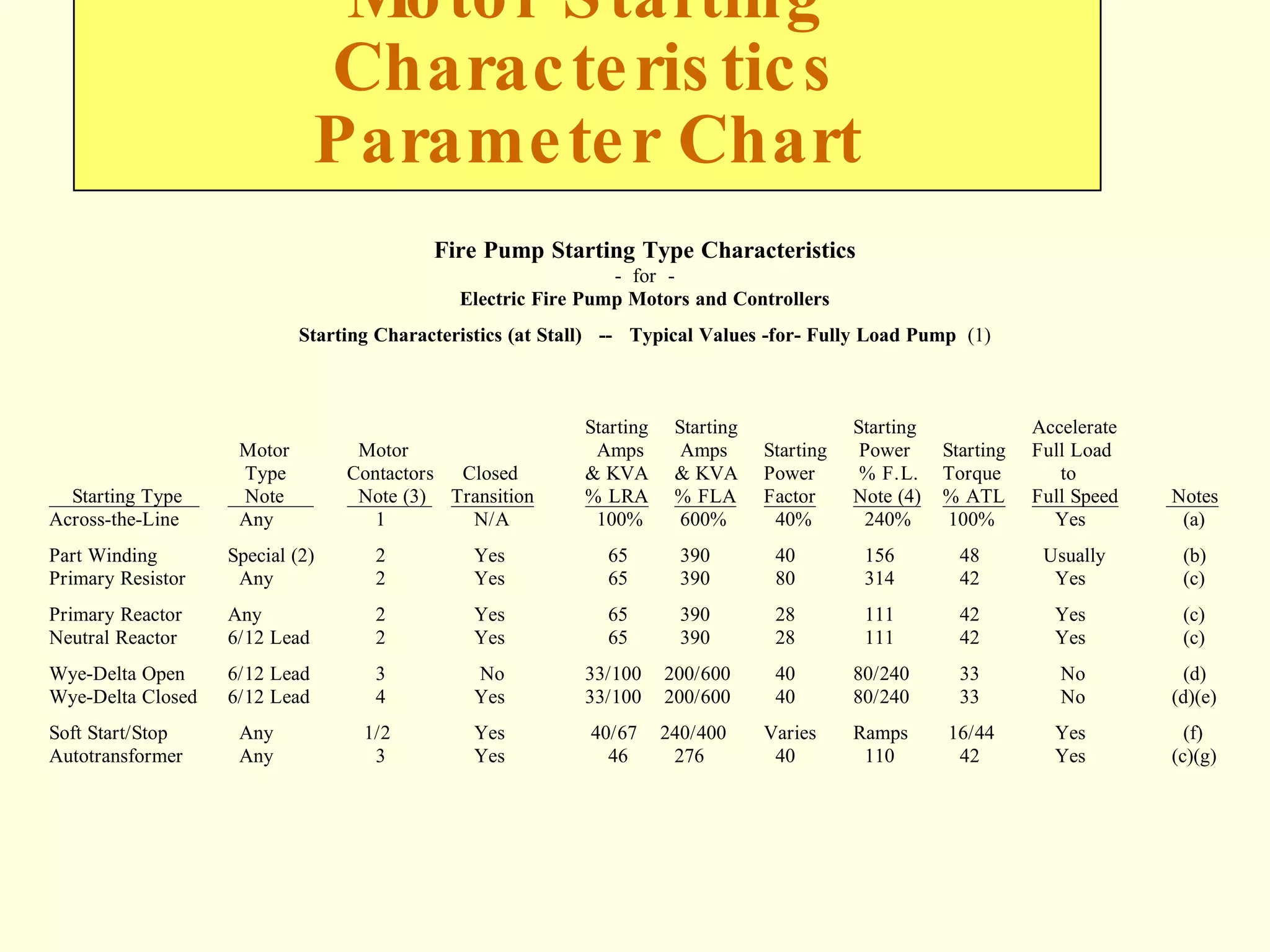
Motor Starting Characteristics Parameter Chart
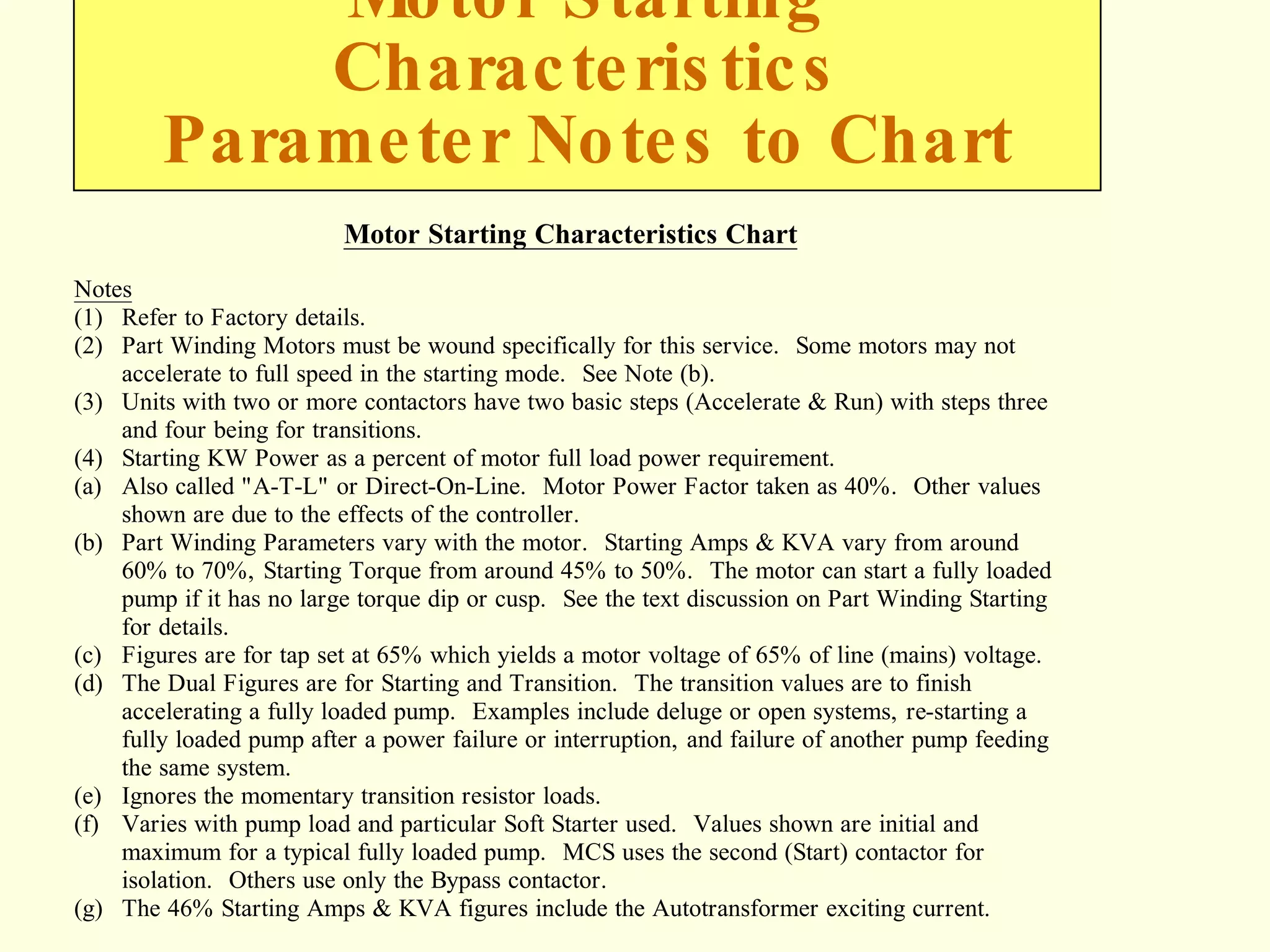
Motor Starting Characteristics Parameter Notes to Chart
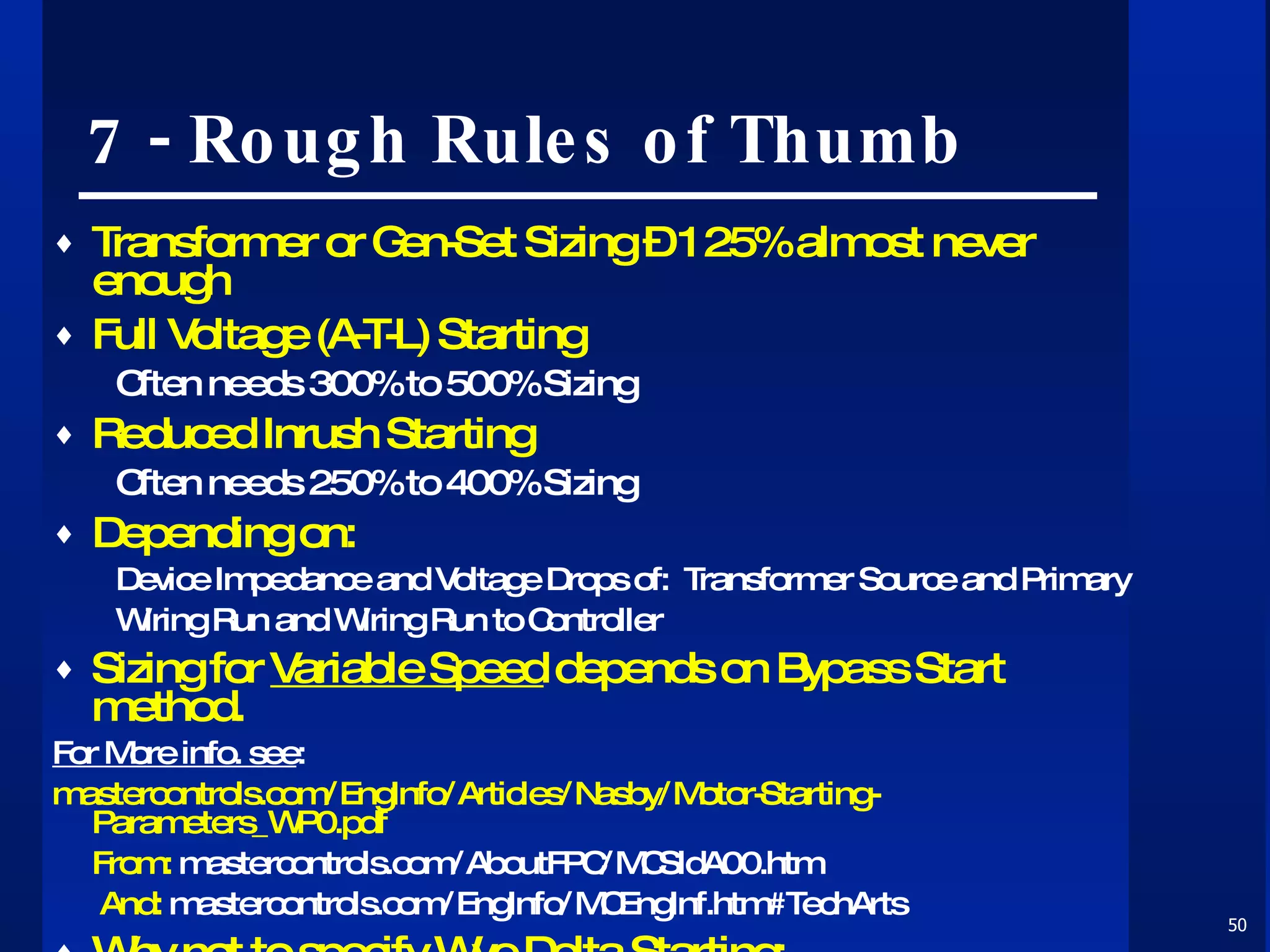
7 - Rough Rules of Thumb Transformer or Gen-Set Sizing – 125% almost never enough Full Voltage (A-T-L) Starting Often needs 300% to 500% Sizing Reduced Inrush Starting Often needs 250% to 400% Sizing Depending on: Device Impedance and Voltage Drops of:  Transformer Source and Primary  Wiring Run and Wiring Run to Controller Sizing for  Variable Speed  depends on Bypass Start method. For More info. see :   mastercontrols.com/EngInfo/Articles/Nasby/Motor-Starting-Parameters_WP0.pdf From:  mastercontrols.com/AboutFPC/MCSldA00.htm   And:  mastercontrols.com/EngInfo/MCEngInf.htm#TechArts Why  not  to specify Wye-Delta Starting: mastercontrols.com/EngInfo/Articles/Nasby/Wye-Delta_Starting_White_Paper.pdf
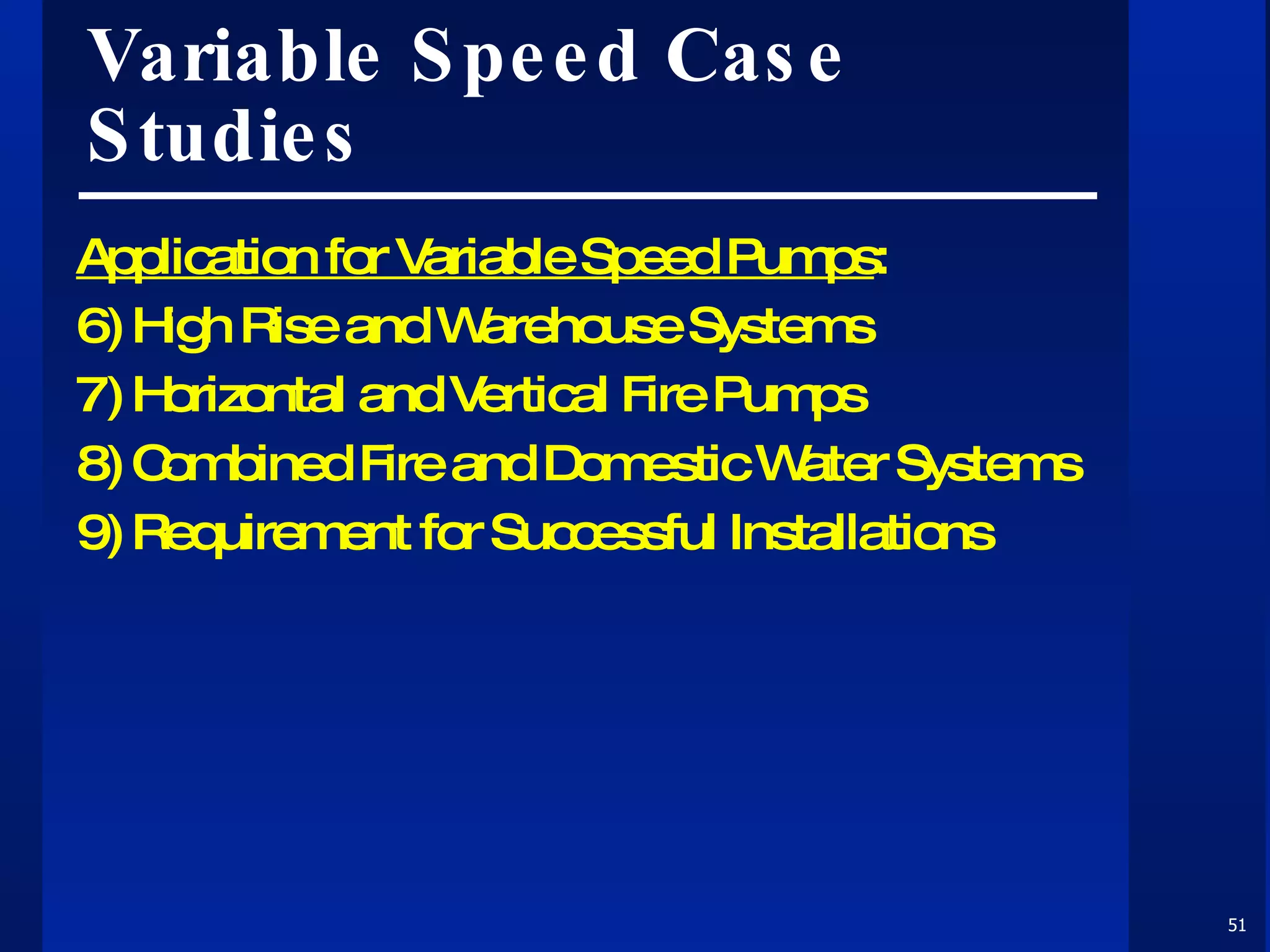
Variable Speed Case Studies Application for Variable Speed Pumps :  6) High Rise and Warehouse Systems  7) Horizontal and Vertical Fire Pumps 8) Combined Fire and Domestic Water Systems 9) Requirement for Successful Installations
6 - High Rise and Warehouse Systems
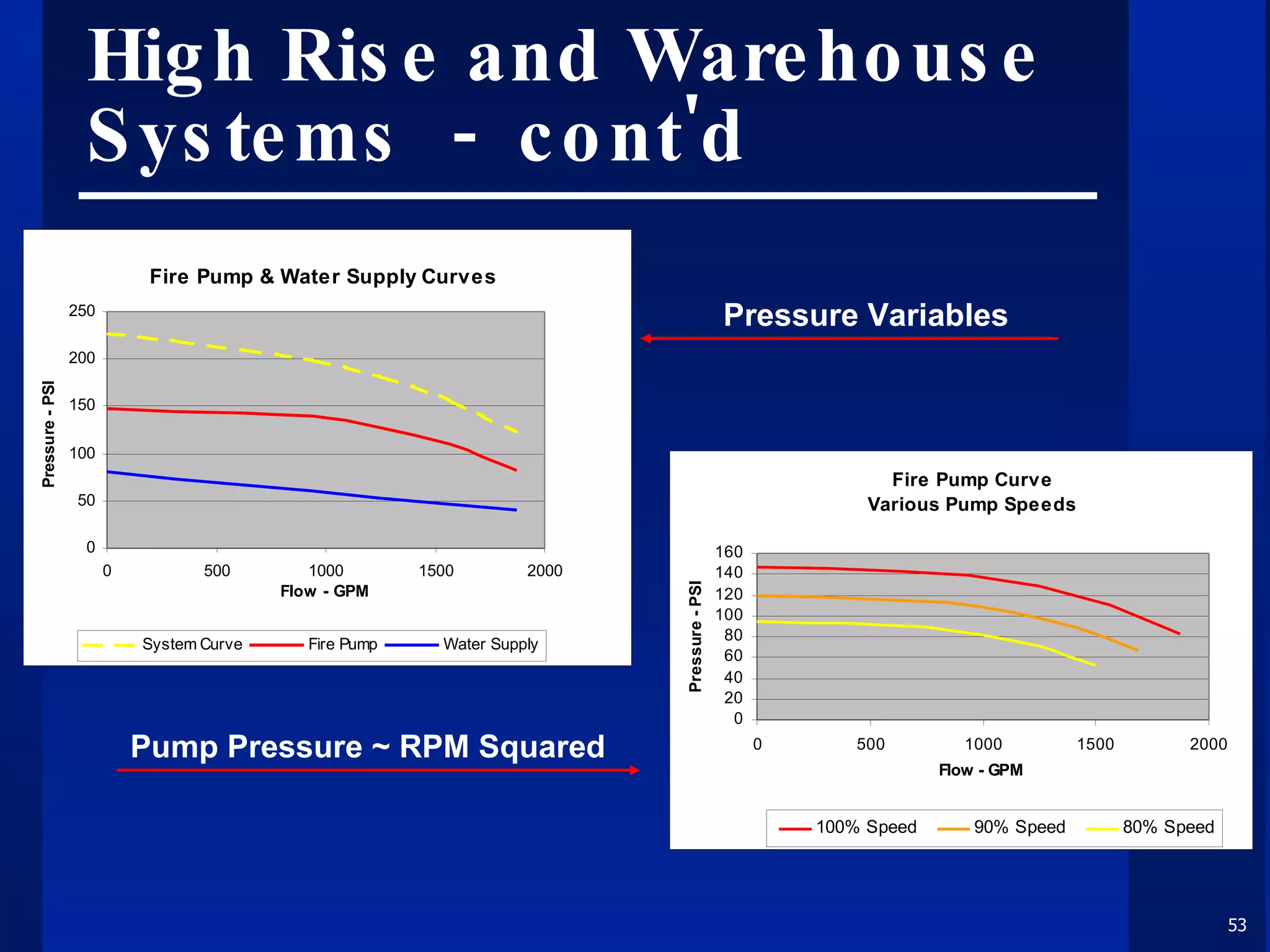
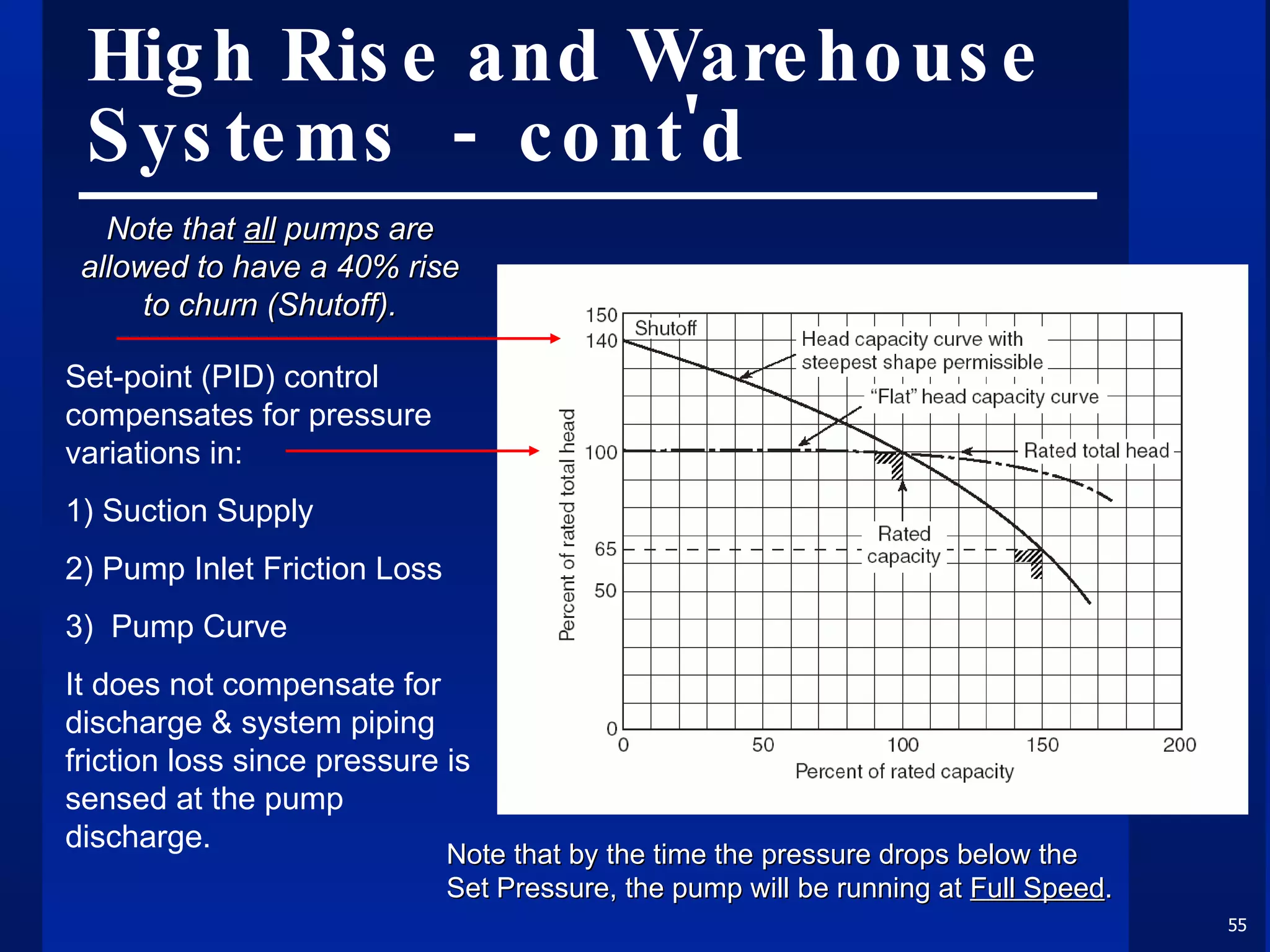
High Rise and Warehouse Systems  -  cont'd Pressure Variables Pump Pressure ~ RPM Squared
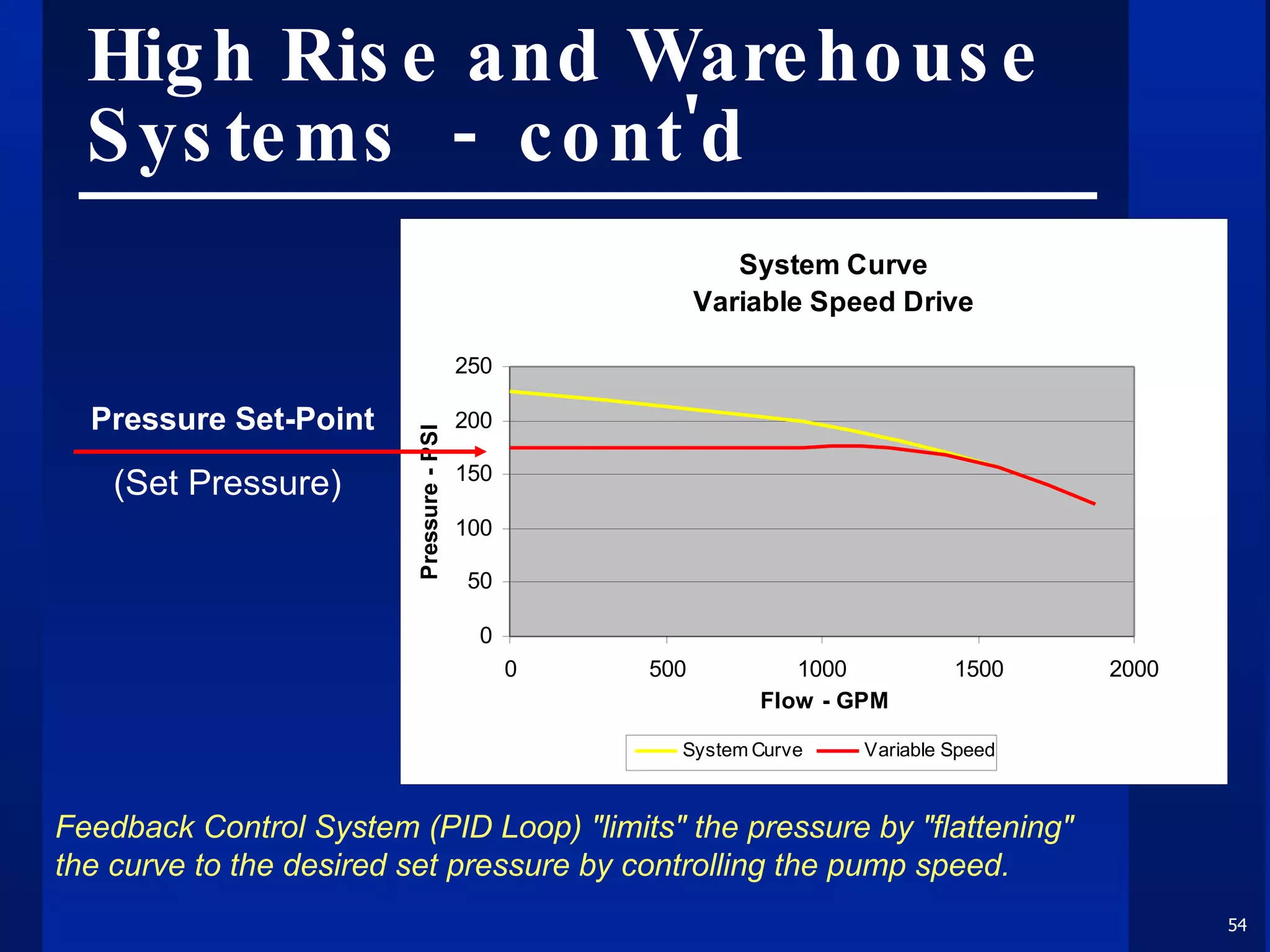
High Rise and Warehouse Systems  -  cont'd Pressure Set-Point (Set Pressure) Feedback Control System (PID Loop) "limits" the pressure by "flattening" the curve to the desired set pressure by controlling the pump speed.
High Rise and Warehouse Systems  -  cont'd Note that  all  pumps are allowed to have a 40% rise to churn (Shutoff). Set-point (PID) control compensates for pressure variations in: 1) Suction Supply 2) Pump Inlet Friction Loss 3)  Pump Curve It does not compensate for discharge & system piping friction loss since pressure is sensed at the pump discharge. Note that by the time the pressure drops below the Set Pressure, the pump will be running at  Full Speed .
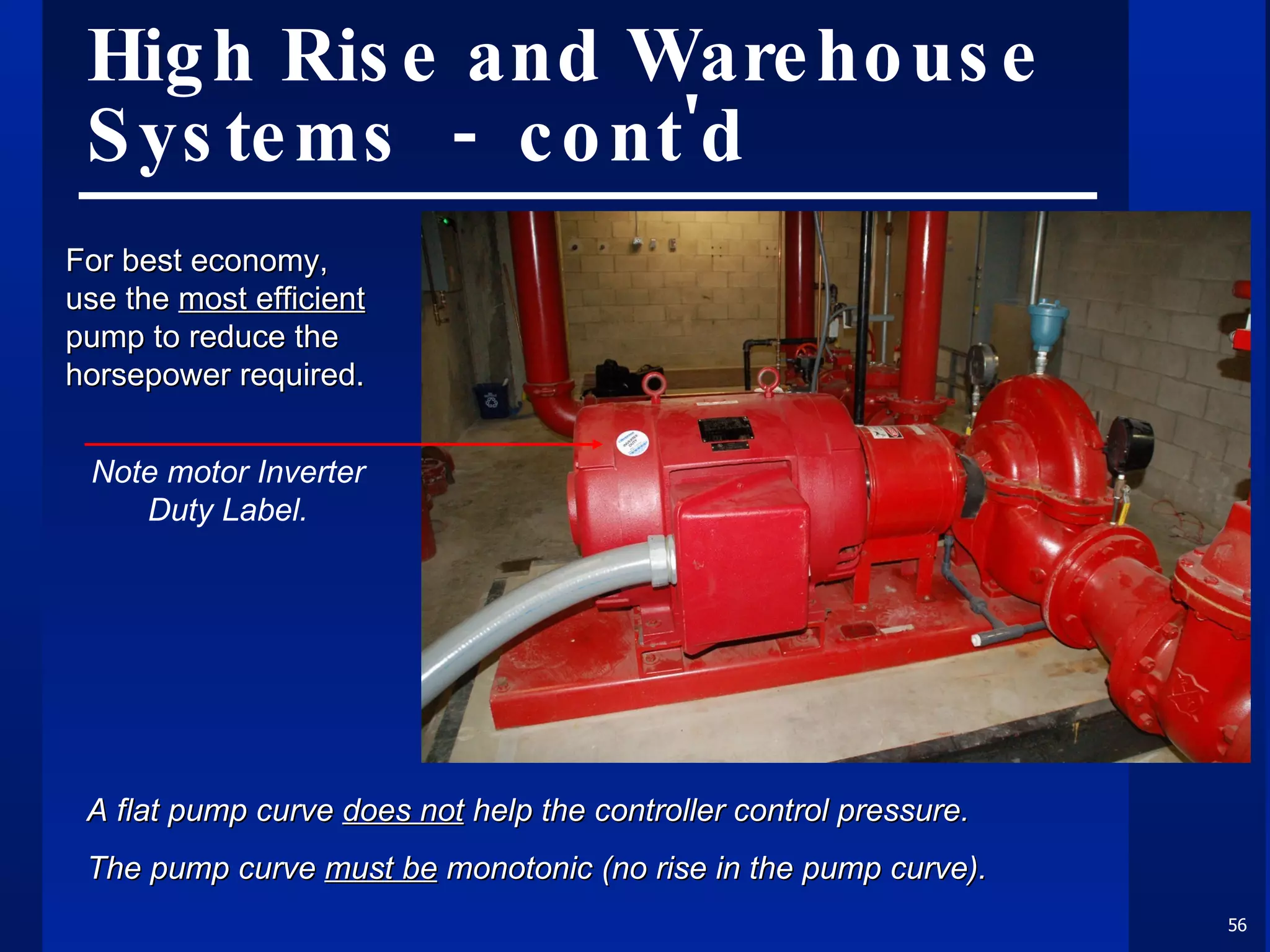
High Rise and Warehouse Systems  -  cont'd For best economy, use the  most efficient  pump to reduce the horsepower required.  A flat pump curve  does not  help the controller control pressure.  The pump curve  must be  monotonic (no rise in the pump curve).  Note motor Inverter Duty Label.
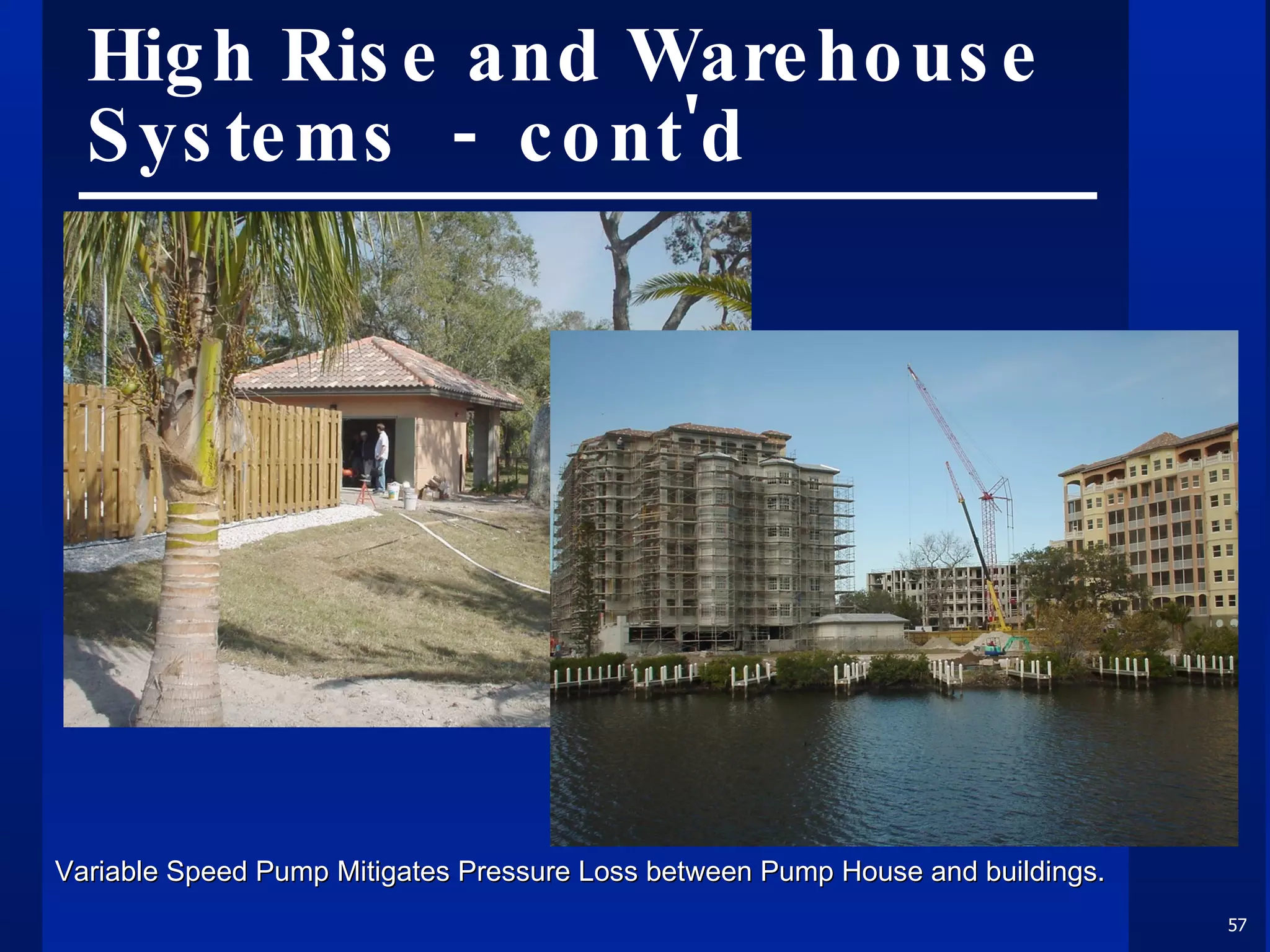
High Rise and Warehouse Systems  -  cont'd Variable Speed Pump Mitigates Pressure Loss between Pump House and buildings.
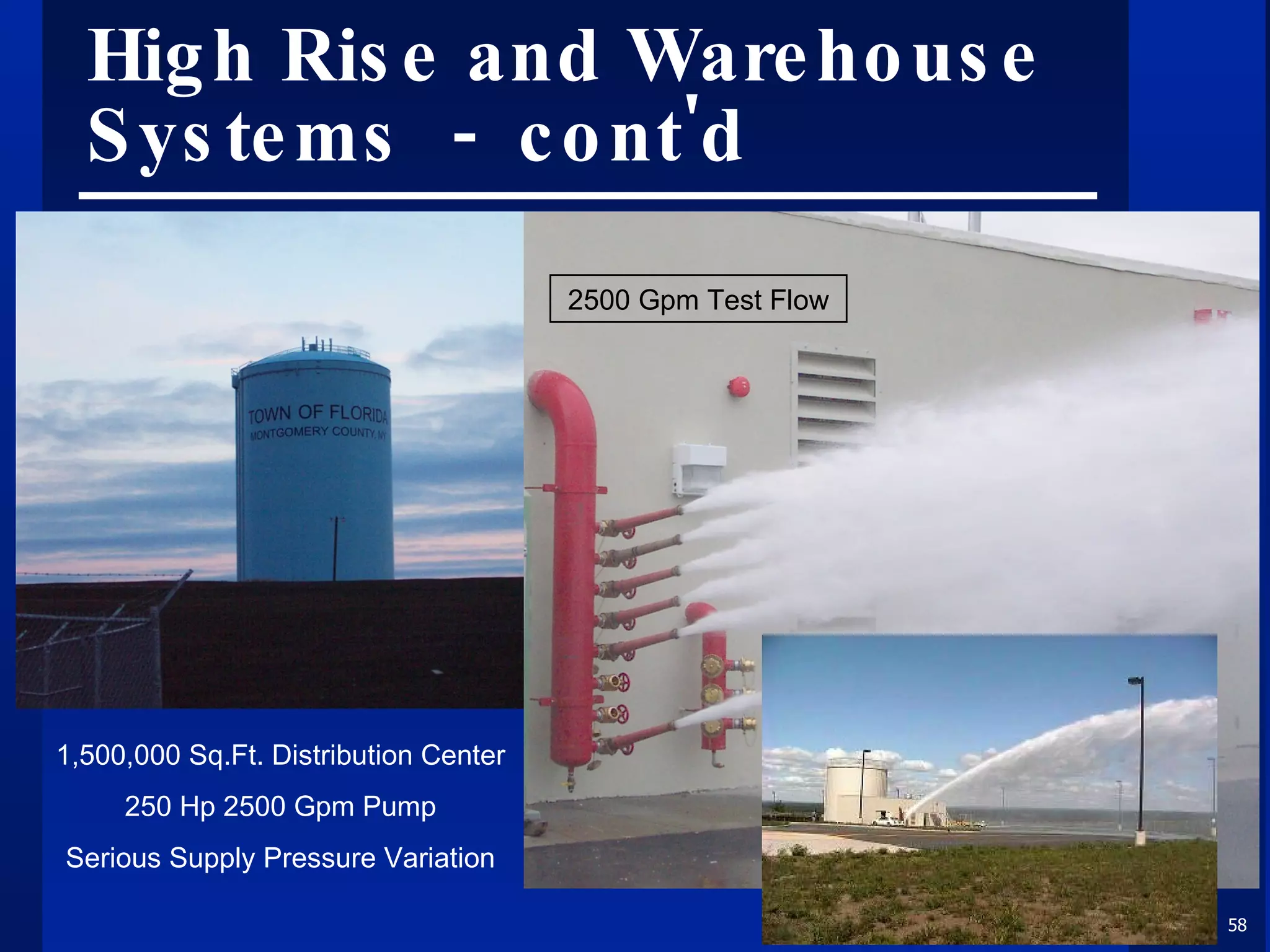
High Rise and Warehouse Systems  -  cont'd 2500 Gpm Test Flow 1,500,000 Sq.Ft. Distribution Center 250 Hp 2500 Gpm Pump Serious Supply Pressure Variation
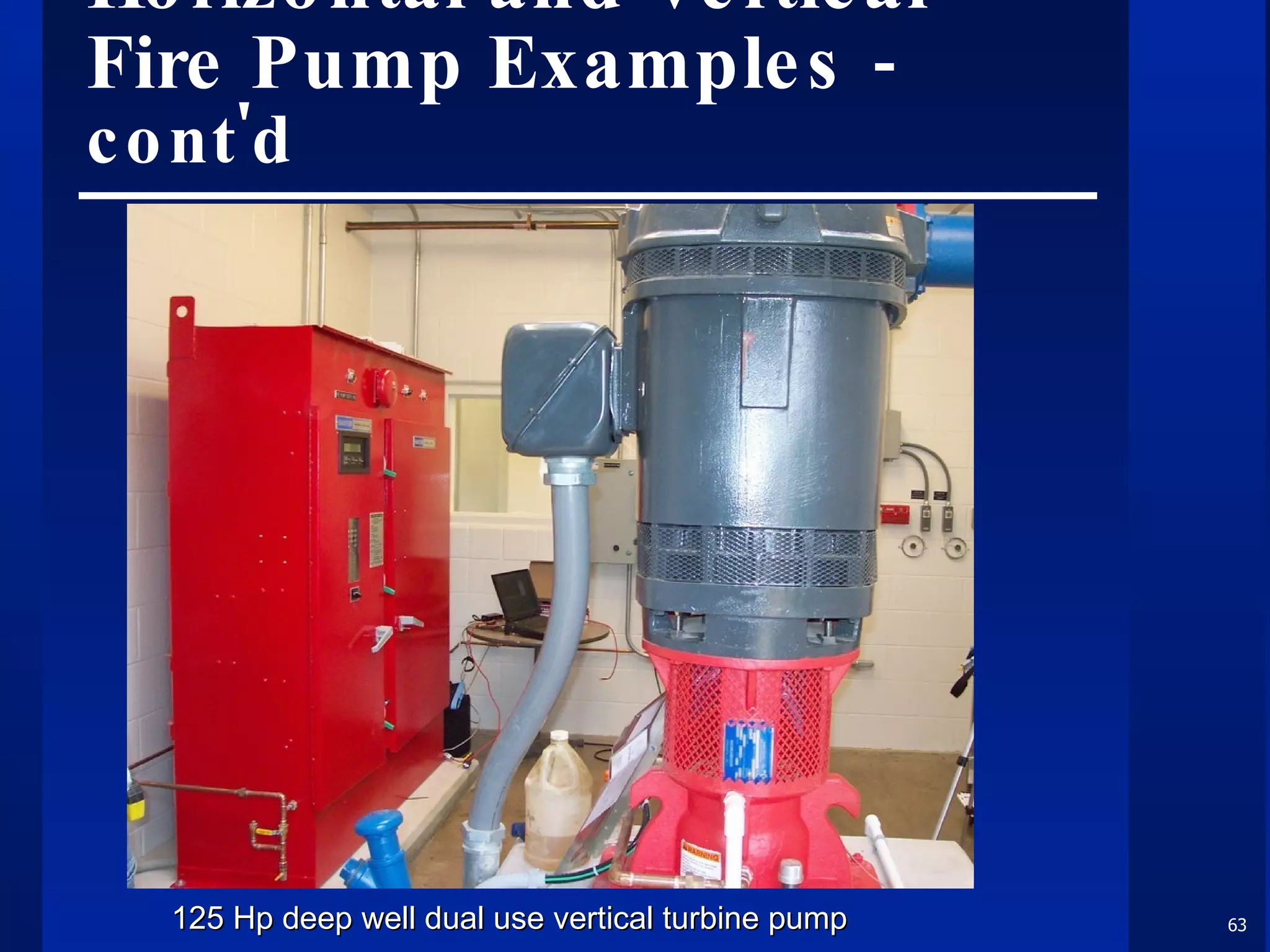
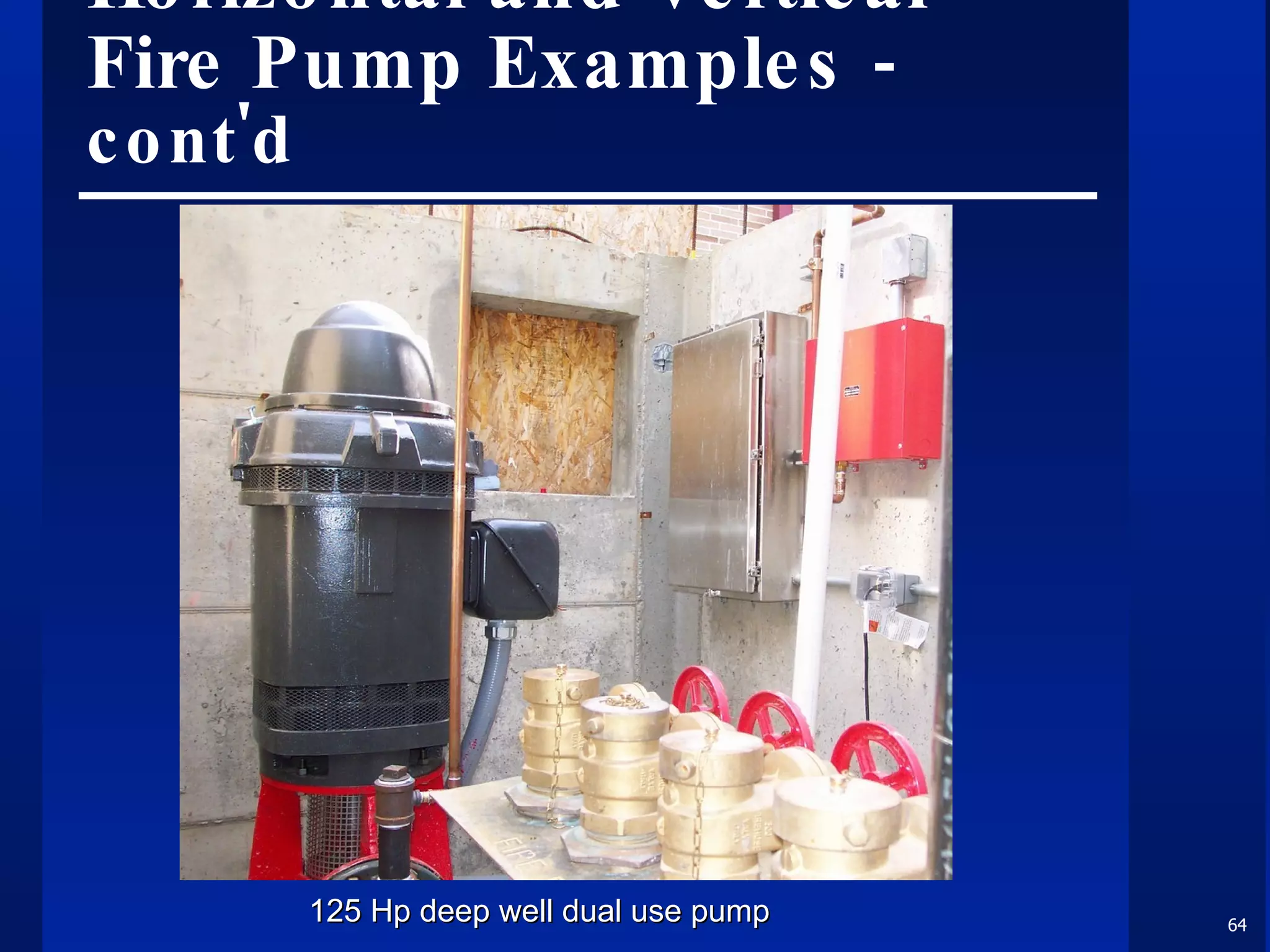
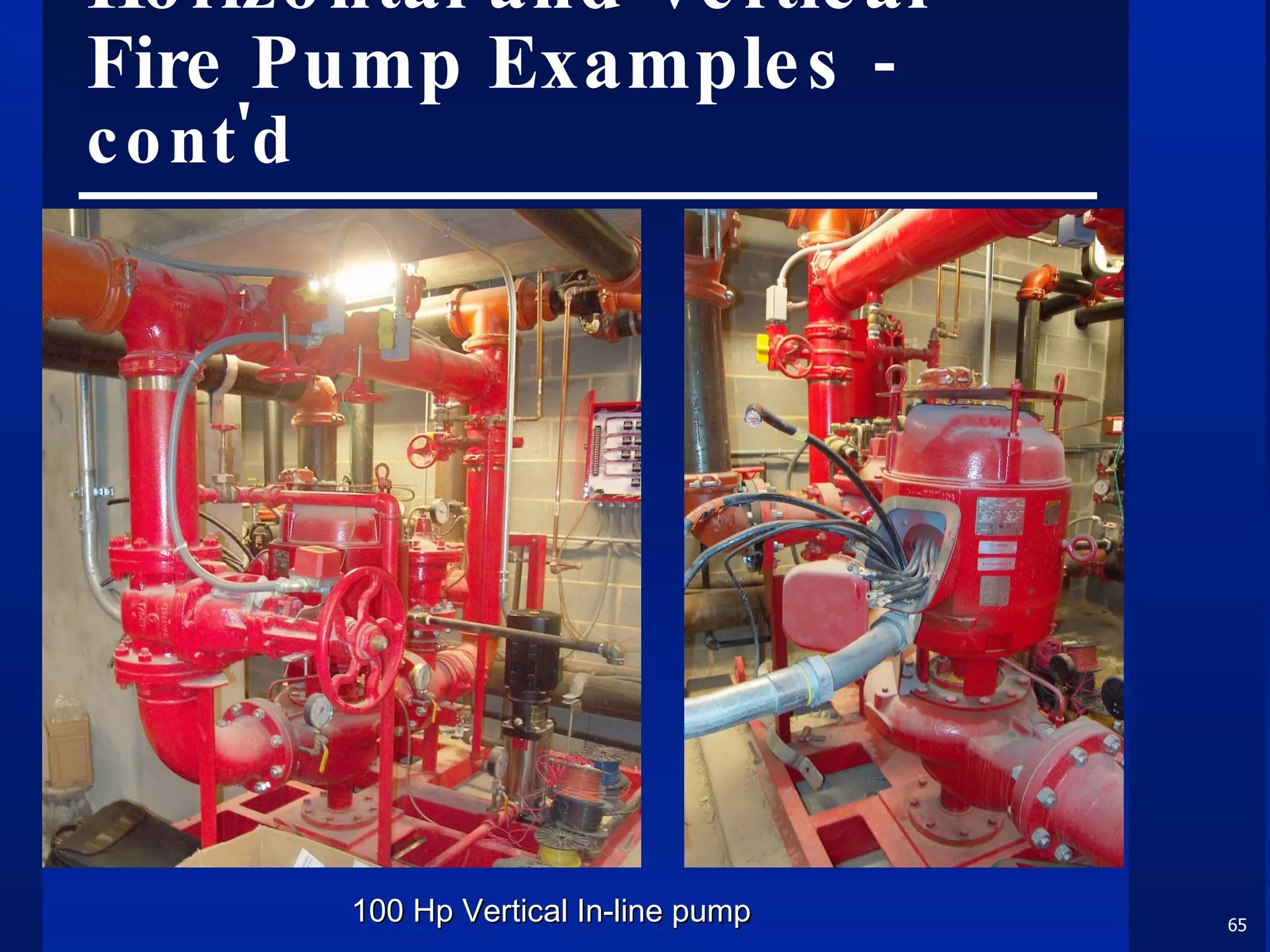
7 - Horizontal and Vertical Fire Pump Examples Horizontal Split Case Vertical In-Line Vertical Turbine Deep Well Vertical Turbine
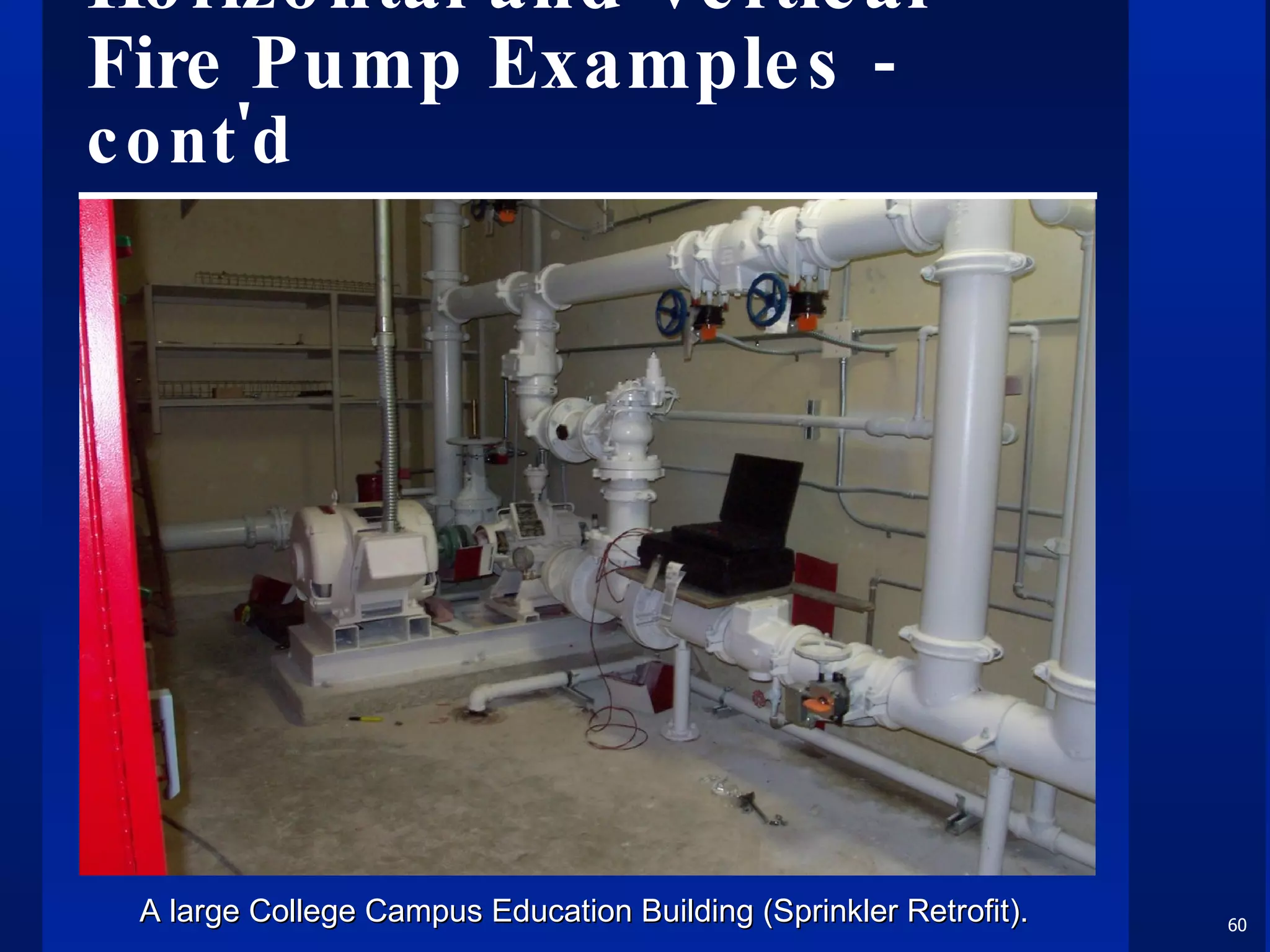
Horizontal and Vertical Fire Pump Examples  - cont'd A large College Campus Education Building (Sprinkler Retrofit).
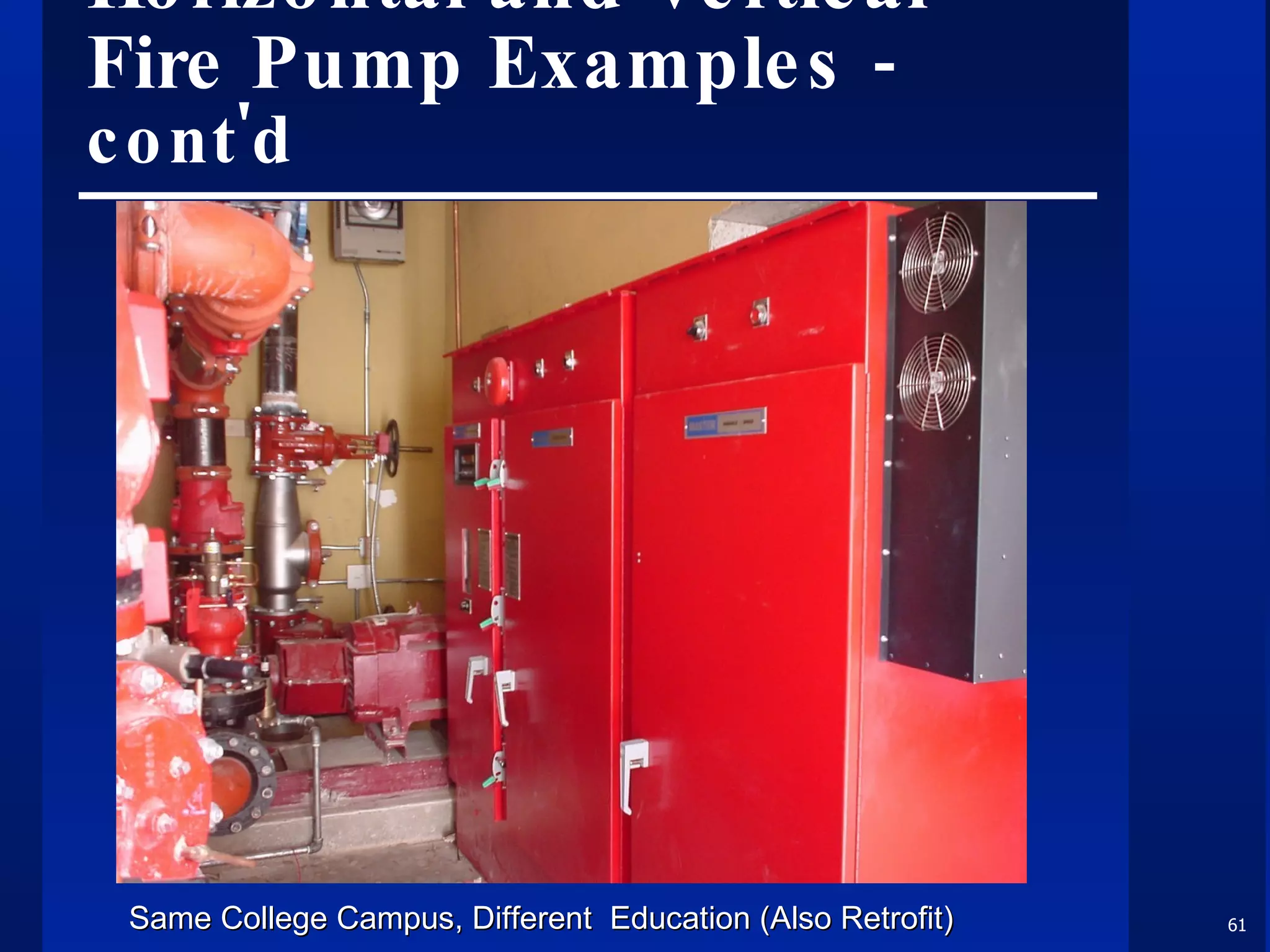
Horizontal and Vertical Fire Pump Examples  - cont'd Same College Campus, Different  Education (Also Retrofit)
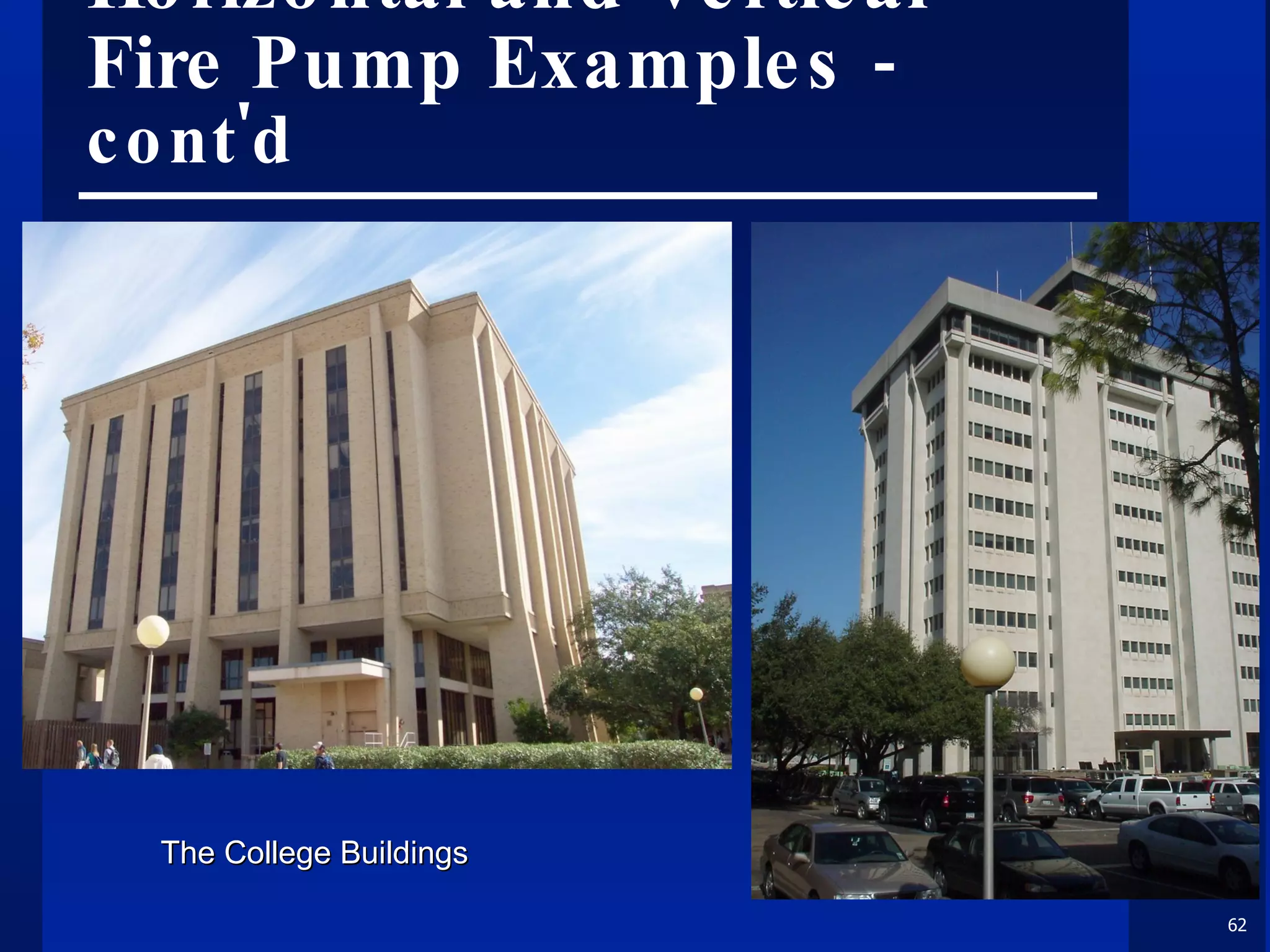
Horizontal and Vertical Fire Pump Examples  - cont'd The College Buildings
Horizontal and Vertical Fire Pump Examples  - cont'd 125 Hp deep well dual use vertical turbine pump
Horizontal and Vertical Fire Pump Examples  - cont'd 125 Hp deep well dual use pump
Horizontal and Vertical Fire Pump Examples  - cont'd 100 Hp Vertical In-line pump
8 - Combined (Dual Use) Systems Water Supplies Municipal Deep Well Types (Purpose) Domestic and Fire Water Process Water for Heat Pumps Back-up Fire Water (Must Have) Multiple Pumps w/ Municipal Source Multiple Wells Well & Tower
Combined (Dual Use) Systems  -  cont'd Optional Multiplexing (Must be Independent) Variable Speed Jockey Pump Alternate Between Pumps Tower Re-fill (Domestic Water) Optional Additional Control - Pressure Switch & Remote Fire Signal Start Building (Campus) Control System (speed control)
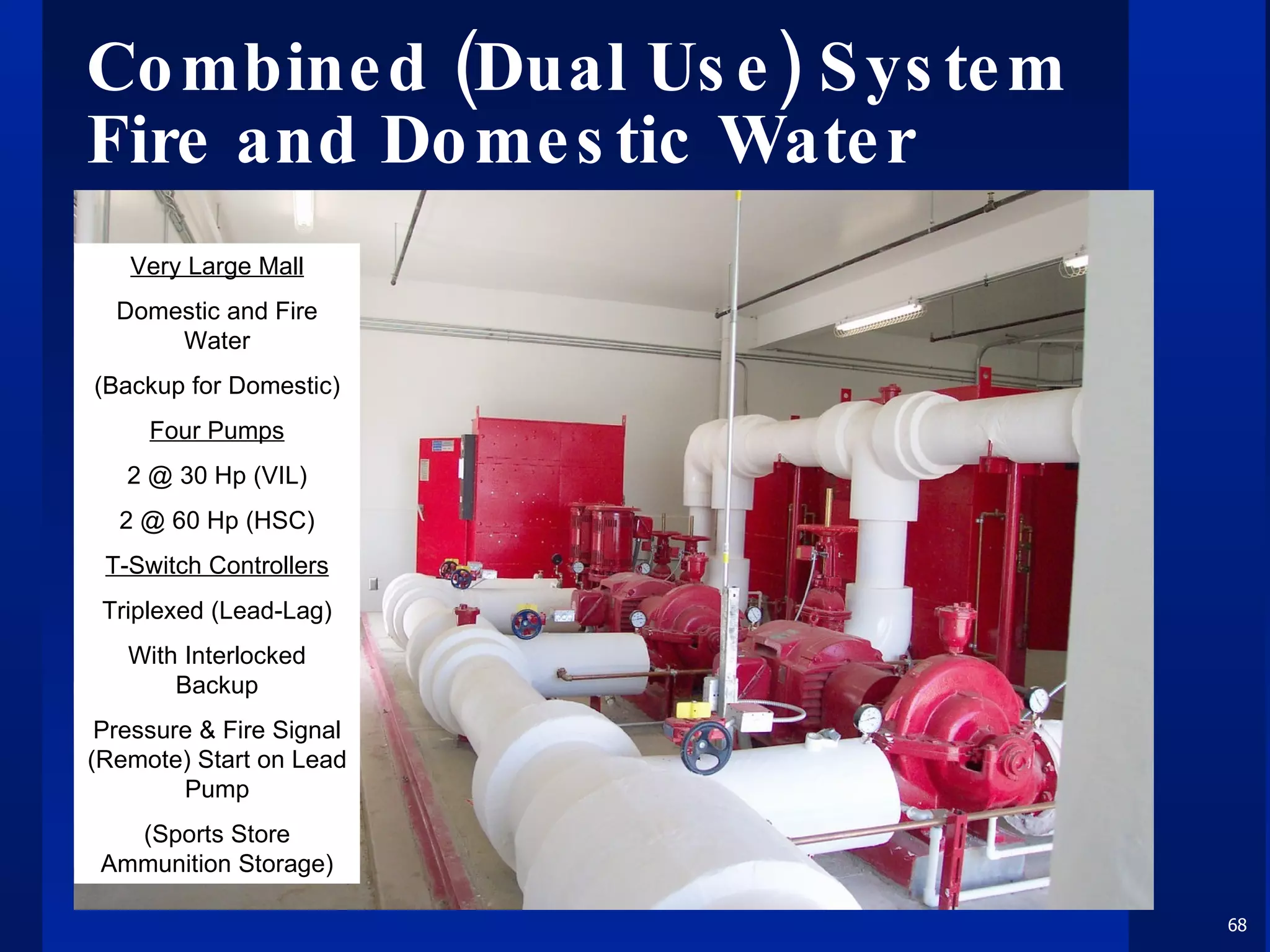
Combined (Dual Use) System Fire and Domestic Water Very Large Mall Domestic and Fire Water (Backup for Domestic) Four Pumps 2 @ 30 Hp (VIL) 2 @ 60 Hp (HSC) T-Switch Controllers Triplexed (Lead-Lag) With Interlocked Backup Pressure & Fire Signal (Remote) Start on Lead Pump (Sports Store Ammunition Storage)
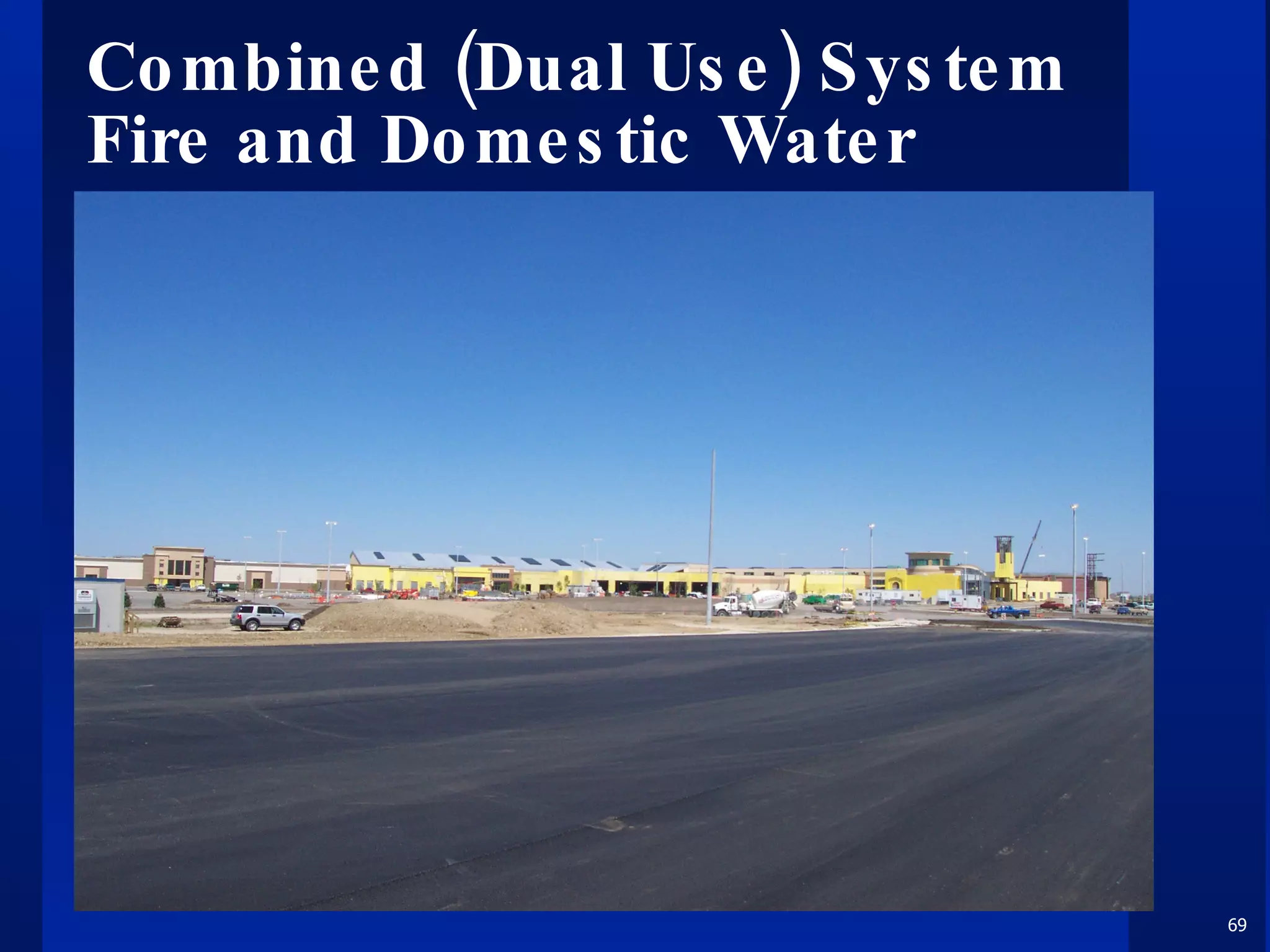
Combined (Dual Use) System Fire and Domestic Water
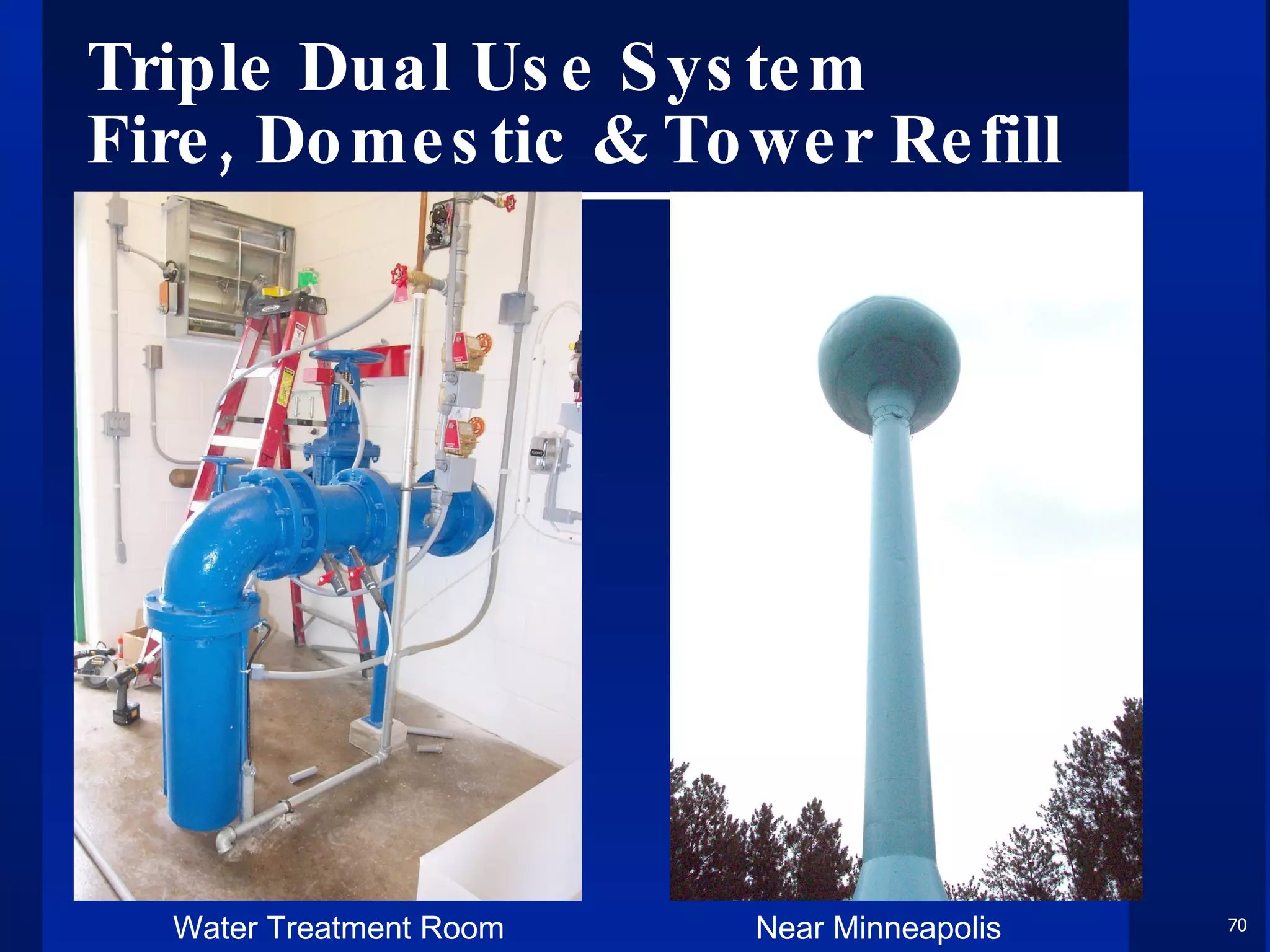
Triple Dual Use System Fire, Domestic & Tower Refill Near Minneapolis Water Treatment Room
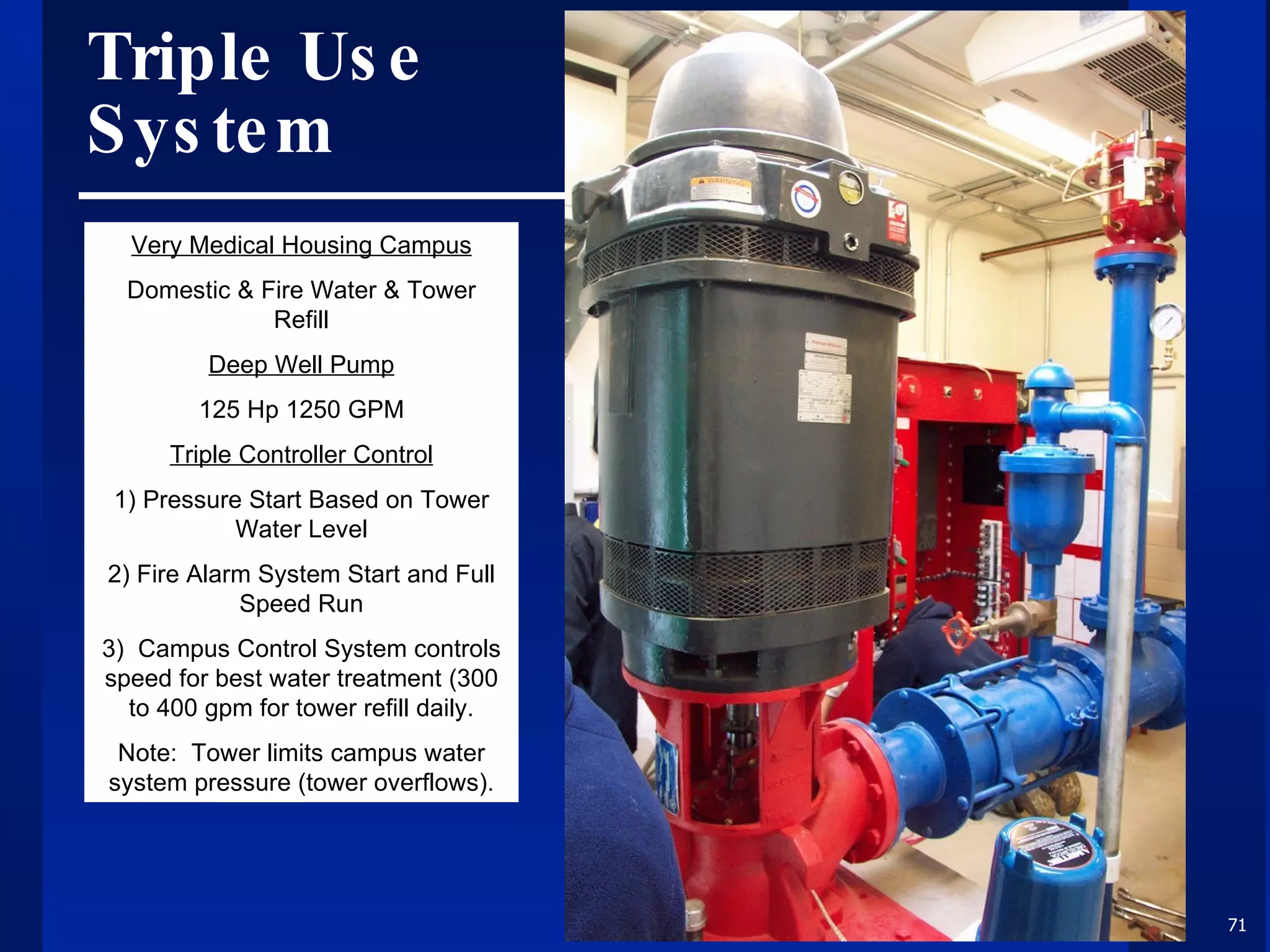
Triple Use System Very Medical Housing Campus Domestic & Fire Water & Tower Refill Deep Well Pump 125 Hp 1250 GPM Triple Controller Control 1) Pressure Start Based on Tower Water Level 2) Fire Alarm System Start and Full Speed Run 3)  Campus Control System controls speed for best water treatment (300 to 400 gpm for tower refill daily. Note:  Tower limits campus water system pressure (tower overflows).
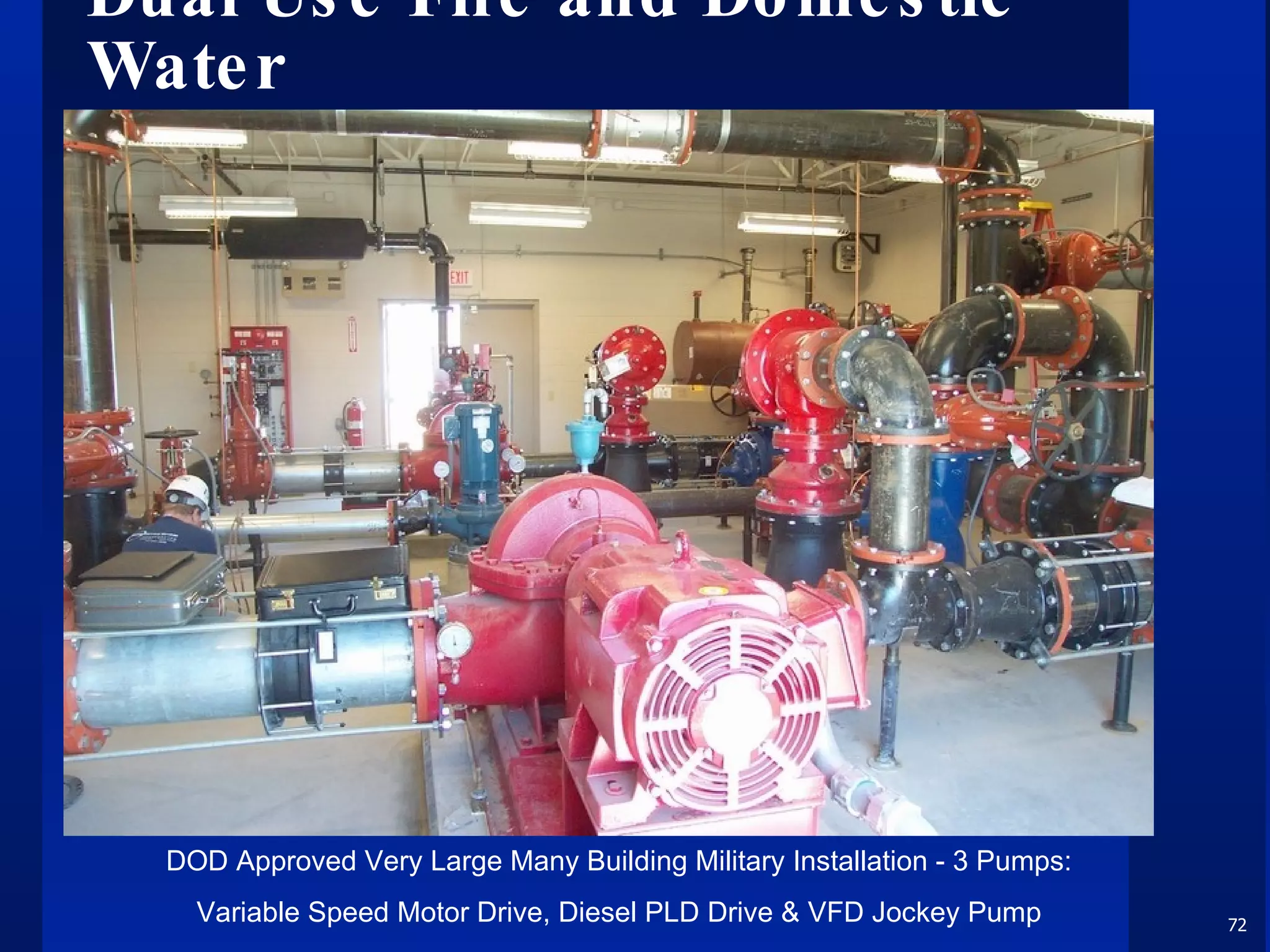
Dual Use Fire and Domestic Water DOD Approved Very Large Many Building Military Installation - 3 Pumps: Variable Speed Motor Drive, Diesel PLD Drive & VFD Jockey Pump
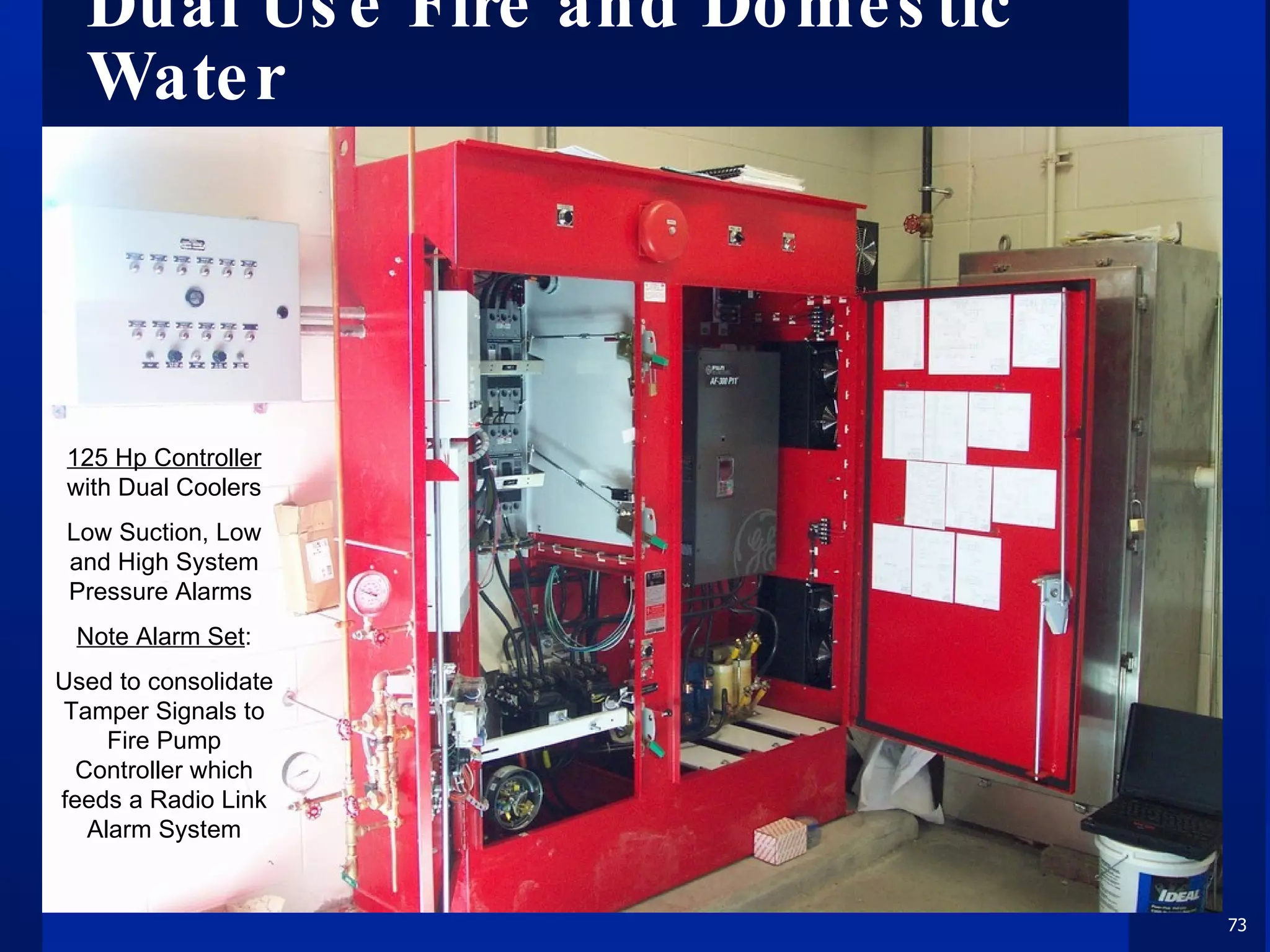
Dual Use Fire and Domestic Water 125 Hp Controller  with Dual Coolers Low Suction, Low and High System Pressure Alarms  Note Alarm Set : Used to consolidate Tamper Signals to Fire Pump Controller which feeds a Radio Link Alarm System
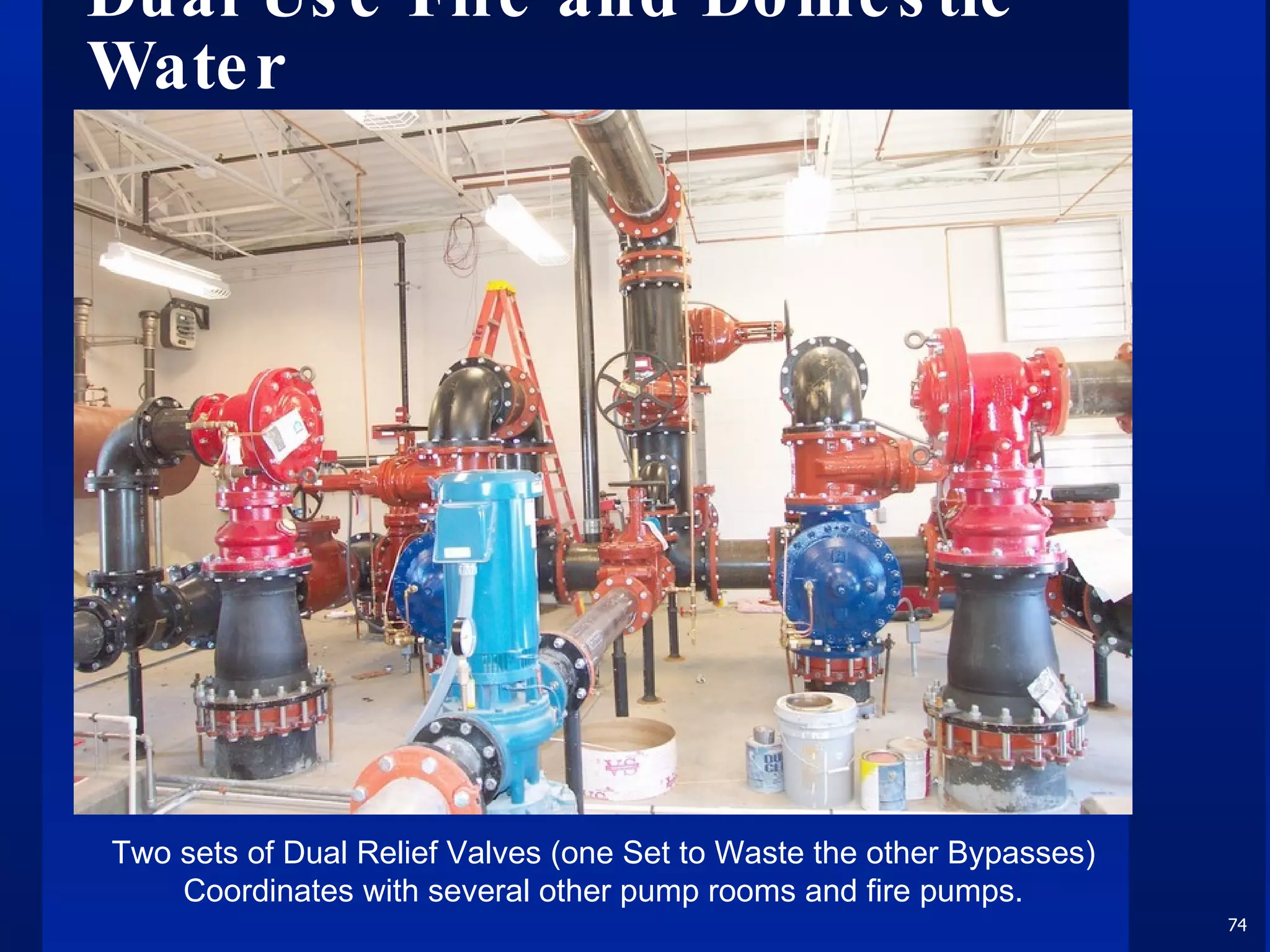
Dual Use Fire and Domestic Water Two sets of Dual Relief Valves (one Set to Waste the other Bypasses) Coordinates with several other pump rooms and fire pumps.
9 - Requirement for Successful Dual-Use Installations Back-up Fire Water Supply Careful Analysis and System Design Suitable Controller(s)  - See Section 4 Careful Attention to Pressure Settings Flexible and Robust PID Loop Proper Sequencing &Multiplexing Between Pumps Fully Independent Control Proper Installation  - See Section 4 Training of Personnel
Requirement for Successful Dual-Use Installations - cont'd Automatic sequencing of pumps required in accordance with 9.6.3 (and required by 10.5.2.5). Note: This eases the starting electrical load.  Automatic sequencing of fire pumps needed for pumps in  parallel  or in  series -  Any pump supplying suction to another pump starts before it  (High Zone Delayed Start) -or-  - I f water requirements call for more than one pumping unit to operate (pumps in parallel) - Pumps must start at intervals of 5 to 10 seconds - Failure of any pump may  not  prevent any others from starting
NFPA-20 2007  Chapter 9 Electric Drive for Pumps  - Cont'd Motor Starting Slide Show Links: mastercontrols.com/EngInfo/Articles/Nasby/EFPXS-2B_WP5.PDF mastercontrols.com/EngInfo/Articles/Nasby/Motor-Starting-Parameters_WP0.pdf mastercontrols.com/EngInfo/Articles/Nasby/Wye-Delta_Starting_White_Paper.pdf mastercontrols.com/ProdInfo/Flyers/ECV_Application_Notes-Iss4.PDF Above from:  mastercontrols.com/EngInfo/MCEngInf.htm#TechArts mastercontrols.com/EngInfo/Articles/Nasby/Handouts/Motor_Starting/Session_321-2_Supplemental-Handout.PDF Above from:  mastercontrols.com/AboutFPC/MCSldA00.htm This Show: slideshare.net/JamesSNasby/fire-pump-system-pressure-control
Questions ?   [email_address] 847-677-3468

Fire Pump System Pressure Control

  • 1.
    Sprinkler Fire Pumps System Pressure Control - by - James S. Nasby Columbia Engineering File: CE Fire Pump System Pressure Control.ppt
  • 2.
    Main Topics Covered:NFPA 20 -2007 Provides Three New Means of Pressure Control in Sprinkler Systems : 1) Break Tanks 2) Pressure Regulating or Reducing Valves 3) Variable Speed Diesel Driven Fire Pumps 4) Variable Speed Electric Motor Driven Fire Pumps 5) Bypass Methods of Motor Starting Application for variable Speed Pumps & Case Studies : 6) High Rise and Warehouse Systems 7) Horizontal and Vertical Fire Pump Examples 8) Combined (Dual Use) Systems 9) Requirement for Successful Installations
  • 3.
    1 - BreakTanks 5.30 Break Tanks. Where a break tank is used to provide the pump suction water supply, the installation shall comply with this section. 5.30.1 Application. Break tanks are used for one or more of the following reasons: (1) As a backflow prevention device… [E.g.: City of Houston, Texas] (2) To eliminate pressure fluctuations in the city water supply… (3) To augment the city water supply… 5.30.2 Break Tank Size. The tank shall be sized for a minimum duration of 15 minutes with the fire pump operating at 150 percent of rated capacity. 5.30.3 Refill Mechanism -- on next slides. 5.30.4 The break tank shall be installed in accordance with NFPA 22, Standard for Water Tanks for Private Fire Protection .
  • 4.
    Break Tanks - cont'd Refill Requirements 5.30.3 Refill Mechanism - refill mechanism must be listed for automatic operation. 5.30.3.1 If the break tank capacity is less than the maximum system demand for 30 minutes, the refill mechanism must meet 5.30.3.1.1 through 5.30.3.1.5. 5.30.3.1.1 Dual automatic refill lines: each capable of refilling at a min. rate of 150 percent of the fire pump(s) capacity 5.30.3.1.2 If available supplies do not permit 150 percent, each refill line must be capable of at least 110 percent of the max. system design flow. 5.30.3.1.3 A manual tank fill bypass designed & capable of refilling the tank at at least150 percent of the fire pump(s) capacity must be provided. 5.30.3.1.4 If available supplies do not permit 150 percent, the manual fill bypass must be capable of at least 110 percent of the max. system design flow. 5.30.3.1.5 A local visible and audible low liquid level signal must be provided in the vicinity of the tank fill mechanism.
  • 5.
    Break Tanks Refill Requirements - cont'd 5.30.3.2 If the break tank is sized to a min. of 30 minutes of the max. system demand, the refill mechanism must meet 5.30.3.2.1 through 5.30.3.2.5. 5.30.3.2.1 The refill mechanism must supply 110 percent of total fire protection system demand [110% × (Total Demand  Tank Capacity) / Duration] 5.30.3.2.2 A manual tank fill bypass must also supply the tank at 110 percent of the total system demand [110% × (Total Demand  Tank Capacity) / Duration] 5.30.3.2.3 The pipe between the city connection and the automatic fill valve must be installed per NFPA24, Standard for the Installation of Private Fire Service Mains and Their Appurtenances . 5.30.3.2.4 The automatic filling mechanism must be maintained at a min. temperature of 40°F (4.4°C). 5.30.3.2.5 The automatic filling mechanism must activate a maximum of 6 in. (152 mm) below the overflow level.
  • 6.
    2 - PressureRegulating or Reducing Valves Floor Valves - Recognized in NFPA-13 - Some Redundancy (Floor Below and/or Floor Above) - Prohibited in some jurisdictions Riser or Main Valves - Prohibited in NFPA-20 - Clause 5.15.10 " No pressure-regulating devices…" [except for "Low Suction Throttling Valves"] & - Clause 5.7.6.2* Pressure relief valves and pressure regulating devices in the fire pump installation shall not be used as a means to meet the requirements of 5.7.6.1. - Prohibited in NFPA-24 5.3.1 "No pressure-regulating valve…" - Recognized in NFPA-14 -- but: Anecdotal and direct observation of failures: Stick Open or Closed & Destructive Oscillation
  • 7.
    3 - VariableSpeed Diesel Engine Driven Fire Pumps Salient Points : Mechanical Pressure Control Limited (3) Pre-Set Pressures Available Not Field Adjustable Dynamic Response Times Not Field Adjustable EPA Emission Limitations (Mechanical Injection & Speed Governor) Not Factory Mutual Approved
  • 8.
    4 - VariableSpeed Electric Motor Driven Fire Pumps Salient Points : Redundant Back-up Means: Automatic fall-back to Full Speed Running Manual Mode Switch and Mechanical Operator Precise PID * Control Loop (Feedback Control System) Field Adjustable Any Pressure Set-Point Precise Control Over Gains and Dynamic Timing NEMA 12 (U.L. Type 12) Non-Vented Construction Available Excludes Dirt, Moisture, Water, Insects, etc. Protects VFD circuitry Five Year Standard Factory Warrantee Available * PID = Proportional - Integral - Differential (Process Controller)
  • 9.
    Variable Speed ElectricMotor Driven Fire Pumps - cont'd Salient Points - continued : Extensive Field Experience: Over Five Years of Operation History Over Fifty Unit-Years of Experience Over 25,000 Running Hours of Experience (20K for One Unit) Stable over Widely Varying Hydraulics Robust PID Loop can handle: Fast, Slow and Multiple Hydraulic Time Constants. Very Precise Pressure Control Acheivable Controls to Within a Fraction of One PSI Settles Pump Output to Desired Pressure Set Point Rapidly U.L. Listed and F.M. Approved Construction Available Some available with a 50°C (122°F) Temperature Rating Reduced Power and Demand Charger for Weekly Testing
  • 10.
    Variable Speed ElectricMotor Driven Fire Pumps - cont'd Mandatory Elements (NFPA-20 Section 10.10) Variable Speed Section Full Fire Pump Controller Section Automatic and Manual Switch-over Circuitry VFD (Variable Speed Drive) Separate Pressure Transducer for PID Feedback Restart Delay on Switch to Bypass Fully Isolated VFD (Off-line in Stand-by Condition) Fused Variable Speed to Protect the Bypass Path Minimum 5% Line Reactor (most also have a D.C. one) Additional Alarm Signals & Contacts
  • 11.
    Variable Speed ElectricMotor Driven Fire Pumps - cont'd NFPA-20 Further Requirements (Section 10.10) : Continuous Full Rated Horsepower VFD Automatic Switch to Bypass if: VFD doesn't respond in 5 seconds Pressure is low for more than 15 seconds Lock in Bypass Mode (Avoids False Operation) Fully Coordinated Protection Between Variable Speed and Bypass Paths Lockable Cabinets Separate Control for Multiple Pump Sites (No Common Control, No Common Point of Failure)
  • 12.
    Variable Speed MotorDrive Controller
  • 13.
    Variable Speed MotorDrive Controller
  • 14.
    Variable Speed MotorDrive Controller Full Speed Bypass Path Variable Speed Path Fully Redundant Fire Pump Controller Note: A-T-L (D-O-L) Full Voltage Starting in this Example
  • 15.
    Variable Speed MotorDrive Controller
  • 16.
    Variable Speed MotorDrive Controller
  • 17.
    Variable Speed MotorDrive Controller Bays: FPC Section, Transfer Switch Section, VFD Section.
  • 18.
    Variable Speed MotorDrives VFD Theory of Operation 3 Phase Line Freq. AC to DC Smoothing(Ripple Reduction) DC / AC (at "X" KHz)
  • 19.
    Variable Speed MotorDrives VFD Theory of Operation - cont'd 2 KHz One Cycle VFD Inverter Output Voltage Waveform
  • 20.
    Variable Speed MotorDrives VFD Theory of Operation - cont'd Approximate Motor Current Waveform 2 KHz Ripple One Cycle
  • 21.
    Variable Speed ElectricMotor Driven Fire Pumps - cont'd The Installation Must Be Such That : Maximum ambient must not exceed controller (marked) rating Mfr's vent air clearance spaces and service spaces must be adhered to The motor must be suitable for use with a variable speed drive Motor current draw must not exceed 100% of FLA, even though the motor may have a 1.15 or higher service factor A gen-set must be suitable for use with a variable speed drive The power source must be capable of bypass mode Starting method The pump and motor must be rigidly coupled The pump and motor must be properly grouted A relief valve is required for emergency operation unless system pressure can not be exceed at churn and full speed and max. suction pressure
  • 22.
    Variable Speed ElectricMotor Driven Fire Pumps - cont'd Successful Installations require a Suitable Controller : UL Listed and F.M. Approved * * Note that F.M. Approval requires both Low and High Temperature testing of the entire controller and at full and partial loads, and also the pressure regulation accuracy over both various loads and temperature extremes. A U.L. Listed Type 12 (NEMA 12) Non-Vented Enclosure Air to Air or Air to Water Cooling Means Rated NEMA 12 or better * * Not dependant on air conditioning or other refrigeration schemes. Set point and VFD parameters stored in permanent non-volatile memory (Flash or EEPROM) * * Not dependant on battery backed memory schemes. Flexible and Robust VFD with 800 Vdc or higher Over-voltage Shutdown (D.C. Capacitor Voltage) A Flexible and Robust PID (Pressure Regulation) Loop
  • 23.
    Variable Speed ElectricMotor Driven Fire Pumps - cont'd Possible responses from any feedback control system. Under Damped Response Uncontrolled (Destructive) Oscillation Critically Damped (Ideal) Response Over Damped Response
  • 24.
    Variable Speed MotorDrive Pumps Multi-Acre Multi-Building Campus Fire Pump House Location Tower 55 Acre Campus
  • 25.
    Variable Speed MotorDrive Pumps Multi-Acre Multi-Building Campus (253 Second Chart Span) Multiple Fire Water Loops - plus - Remote Tower - lead to - Multiple System Hydraulic Time Constants Note that these were measured after pump shutdown
  • 26.
    Variable Speed MotorDrive Pumps Multi-Acre Multi-Building Campus (151 Second Chart Span)
  • 27.
    Variable Speed MotorDrive Pumps Multi-Acre Multi-Building Campus (86 Second Chart Span)
  • 28.
    Variable Speed MotorDrive Pumps Multi-Acre Multi-Building Campus Measured: 25s, 20s, 4s, 2s Hydraulic Time Constants --- Stable pressure control requires a robust PID control loop and expert set-up knowledge and experience. (63 Second Chart Span)
  • 29.
    Variable Speed ElectricMotor Driven Fire Pumps - cont'd NFPA-20 Further Requirements: Continuous Full Rated Horsepower VFD Automatic Switch to Bypass if: VFD doesn't respond in 5 seconds Pressure is low for more than 15 seconds Lock in Bypass Mode (Avoids False Operation) Fully Coordinated Protection Between Variable Speed and Bypass Paths Lockable Cabinets Separate Control for Multiple Pump Sites (No Common Control, No Common Point of Failure)
  • 30.
    Variable Speed ElectricMotor Driven Fire Pumps - cont'd NFPA-20 Requirements - cont'd - Main Relief Valves: 5.18.1.1 Where a diesel engine fire pump is installed and where a total of 121 percent of the net rated shutoff (churn) pressure plus the maximum static suction pressure, adjusted for elevation, exceeds the pressure for which the system components are rated, a pressure relief valve shall be installed. 5.18.1.2* Pressure relief valves shall be used only where specifically permitted by this standard. 5.18.1.3 Where an electric variable speed pressure limiting control driver is installed, and the maximum total discharge head adjusted for elevation with the pump operating at shutoff and rated speed exceeds the pressure rating of the system components, a pressure relief valve shall be installed. Note: Regarding 5.18.1.3, where the pump churn (shutoff) pressure at full speed plus the max. suction pressure does not exceed the system pressure rating, the relief valve is not needed and should be avoided since it is a point of failure if it opens prematurely or gets stuck open.
  • 31.
    Variable Speed ElectricMotor Driven Fire Pumps - cont'd NFPA-20 Requirements - cont'd - Main Relief Valves: 9.5.1.1 All motors shall comply with NEMA MG-1, Motors and Generators, shall be marked as complying with NEMA Design B standards, and shall be specifically listed * for fire pump service. 9.5.1.3 Motors used with variable speed controllers shall additionally meet the applicable requirements of NEMA MG-1, Motors and Generators, Part 31 and shall be marked for inverter duty. 9.5.2.2(2) Where the motor is used with a variable speed pressure limiting controller, the service factor shall not be used. * No Listed Variable Speed Fire Pump Motors yet . However, the motors used must still otherwise meet all three of these clauses.
  • 32.
    Induction Motor LockedRotor Codes Note: Controllers (15 Hp and higher rated ) are NOT rated, tested, approved, or listed for starting codes above Code "G".
  • 33.
    9 - BypassMethods of Motor Starting Eight Common Motor Starting Types: Across‑the‑Line (A‑T‑L or Direct‑On‑Line) Part Winding (Half Winding) Start Primary Resistor Start * Primary (or Neutral) Reactor Start Wye‑Delta (Star‑Delta) ‑ Open Transition * Wye‑Delta (Star‑Delta) ‑ Closed Transition * Soft Start / Soft Stop (SCR Phase Modulation) Autotransformer * *Not Recommended for Variable Speed Applications
  • 34.
    Bypass Methods ofMotor Starting - Full Voltage Across-The-Line (Direct-On-Line) - Full Voltage Starting Starting Amps = 600% KWatt = 240% Torque * = 100% *Reference Value
  • 35.
    Bypass Methods ofMotor Starting - Part Winding Starting Amps = 390% KWatt = 156% Torque * = 48% *Will bring Fully Loaded Pumps up to Speed
  • 36.
    Bypass Methods ofMotor Starting - Part Winding Note: The Motor Must be Wound Specifically for Part Winding Start .
  • 37.
    Bypass Methods ofMotor Starting - Primary Resistor Reference Only Greatly Increases Starting KW load on Gen-Sets due to High Power Factor (0.80pf on 65% Tap Setting)
  • 38.
    Bypass Methods ofMotor Starting - Primary Reactor Starting Amps = 390% KWatt = 111% Torque * = 42% *Will bring Fully Loaded Pumps up to Speed
  • 39.
    Bypass Methods ofMotor Starting - Primary Reactor
  • 40.
    Bypass Methods ofMotor Starting - Y-Δ Closed Transition Starting Amps = 200 / 600% KWatt = 80 / 240% Torque * = 33% *Will NOT bring Fully Loaded Pumps up to Speed Also requires additional Wye contactor Interlocking in addition to Motor Contactors (not practical).
  • 41.
    Bypass Methods ofMotor Starting - Y-Δ Closed Transition The "Y" and "M2" Contactors must be both Electrically and Mechanically Interlocked to avoid inadvertent short circuits.
  • 42.
    Bypass Methods ofMotor Starting - Y-Δ Open Transition Same Problems as with Y-Δ Closed Transition But also has a Transition Hazard (High Spike Current which can cause the Circuit Breaker to Trip with Stiff Source) Lagging Leading Closed
  • 43.
    Bypass Methods ofMotor Starting - Soft Start (Solid State) Starting Amps = 240 / 400% KWatt = Ramps Torque * = 16 / 44% *Will bring Fully Loaded Pumps up to Speed
  • 44.
    Bypass Methods ofMotor Starting - Soft Start (Solid State)
  • 45.
    Bypass Methods ofMotor Starting - Autotransformer Starting Amps = 276% KWatt = 110% Torque * = 42% *Will bring Fully Loaded Pumps up to Speed Requires additional Wye contactor Interlocking in addition to Motor Contactors (not practical).
  • 46.
    Bypass Methods ofMotor Starting - Autotransformer The "Y" and "M" Contactors must be both Electrically and Mechanically Interlocked to avoid inadvertent short circuits.
  • 47.
    Starting Methods -vs- Motor Types
  • 48.
  • 49.
    Motor Starting CharacteristicsParameter Notes to Chart
  • 50.
    7 - RoughRules of Thumb Transformer or Gen-Set Sizing – 125% almost never enough Full Voltage (A-T-L) Starting Often needs 300% to 500% Sizing Reduced Inrush Starting Often needs 250% to 400% Sizing Depending on: Device Impedance and Voltage Drops of: Transformer Source and Primary Wiring Run and Wiring Run to Controller Sizing for Variable Speed depends on Bypass Start method. For More info. see : mastercontrols.com/EngInfo/Articles/Nasby/Motor-Starting-Parameters_WP0.pdf From: mastercontrols.com/AboutFPC/MCSldA00.htm And: mastercontrols.com/EngInfo/MCEngInf.htm#TechArts Why not to specify Wye-Delta Starting: mastercontrols.com/EngInfo/Articles/Nasby/Wye-Delta_Starting_White_Paper.pdf
  • 51.
    Variable Speed CaseStudies Application for Variable Speed Pumps : 6) High Rise and Warehouse Systems 7) Horizontal and Vertical Fire Pumps 8) Combined Fire and Domestic Water Systems 9) Requirement for Successful Installations
  • 52.
    6 - HighRise and Warehouse Systems
  • 53.
    High Rise andWarehouse Systems - cont'd Pressure Variables Pump Pressure ~ RPM Squared
  • 54.
    High Rise andWarehouse Systems - cont'd Pressure Set-Point (Set Pressure) Feedback Control System (PID Loop) "limits" the pressure by "flattening" the curve to the desired set pressure by controlling the pump speed.
  • 55.
    High Rise andWarehouse Systems - cont'd Note that all pumps are allowed to have a 40% rise to churn (Shutoff). Set-point (PID) control compensates for pressure variations in: 1) Suction Supply 2) Pump Inlet Friction Loss 3) Pump Curve It does not compensate for discharge & system piping friction loss since pressure is sensed at the pump discharge. Note that by the time the pressure drops below the Set Pressure, the pump will be running at Full Speed .
  • 56.
    High Rise andWarehouse Systems - cont'd For best economy, use the most efficient pump to reduce the horsepower required. A flat pump curve does not help the controller control pressure. The pump curve must be monotonic (no rise in the pump curve). Note motor Inverter Duty Label.
  • 57.
    High Rise andWarehouse Systems - cont'd Variable Speed Pump Mitigates Pressure Loss between Pump House and buildings.
  • 58.
    High Rise andWarehouse Systems - cont'd 2500 Gpm Test Flow 1,500,000 Sq.Ft. Distribution Center 250 Hp 2500 Gpm Pump Serious Supply Pressure Variation
  • 59.
    7 - Horizontaland Vertical Fire Pump Examples Horizontal Split Case Vertical In-Line Vertical Turbine Deep Well Vertical Turbine
  • 60.
    Horizontal and VerticalFire Pump Examples - cont'd A large College Campus Education Building (Sprinkler Retrofit).
  • 61.
    Horizontal and VerticalFire Pump Examples - cont'd Same College Campus, Different Education (Also Retrofit)
  • 62.
    Horizontal and VerticalFire Pump Examples - cont'd The College Buildings
  • 63.
    Horizontal and VerticalFire Pump Examples - cont'd 125 Hp deep well dual use vertical turbine pump
  • 64.
    Horizontal and VerticalFire Pump Examples - cont'd 125 Hp deep well dual use pump
  • 65.
    Horizontal and VerticalFire Pump Examples - cont'd 100 Hp Vertical In-line pump
  • 66.
    8 - Combined(Dual Use) Systems Water Supplies Municipal Deep Well Types (Purpose) Domestic and Fire Water Process Water for Heat Pumps Back-up Fire Water (Must Have) Multiple Pumps w/ Municipal Source Multiple Wells Well & Tower
  • 67.
    Combined (Dual Use)Systems - cont'd Optional Multiplexing (Must be Independent) Variable Speed Jockey Pump Alternate Between Pumps Tower Re-fill (Domestic Water) Optional Additional Control - Pressure Switch & Remote Fire Signal Start Building (Campus) Control System (speed control)
  • 68.
    Combined (Dual Use)System Fire and Domestic Water Very Large Mall Domestic and Fire Water (Backup for Domestic) Four Pumps 2 @ 30 Hp (VIL) 2 @ 60 Hp (HSC) T-Switch Controllers Triplexed (Lead-Lag) With Interlocked Backup Pressure & Fire Signal (Remote) Start on Lead Pump (Sports Store Ammunition Storage)
  • 69.
    Combined (Dual Use)System Fire and Domestic Water
  • 70.
    Triple Dual UseSystem Fire, Domestic & Tower Refill Near Minneapolis Water Treatment Room
  • 71.
    Triple Use SystemVery Medical Housing Campus Domestic & Fire Water & Tower Refill Deep Well Pump 125 Hp 1250 GPM Triple Controller Control 1) Pressure Start Based on Tower Water Level 2) Fire Alarm System Start and Full Speed Run 3) Campus Control System controls speed for best water treatment (300 to 400 gpm for tower refill daily. Note: Tower limits campus water system pressure (tower overflows).
  • 72.
    Dual Use Fireand Domestic Water DOD Approved Very Large Many Building Military Installation - 3 Pumps: Variable Speed Motor Drive, Diesel PLD Drive & VFD Jockey Pump
  • 73.
    Dual Use Fireand Domestic Water 125 Hp Controller with Dual Coolers Low Suction, Low and High System Pressure Alarms Note Alarm Set : Used to consolidate Tamper Signals to Fire Pump Controller which feeds a Radio Link Alarm System
  • 74.
    Dual Use Fireand Domestic Water Two sets of Dual Relief Valves (one Set to Waste the other Bypasses) Coordinates with several other pump rooms and fire pumps.
  • 75.
    9 - Requirementfor Successful Dual-Use Installations Back-up Fire Water Supply Careful Analysis and System Design Suitable Controller(s) - See Section 4 Careful Attention to Pressure Settings Flexible and Robust PID Loop Proper Sequencing &Multiplexing Between Pumps Fully Independent Control Proper Installation - See Section 4 Training of Personnel
  • 76.
    Requirement for SuccessfulDual-Use Installations - cont'd Automatic sequencing of pumps required in accordance with 9.6.3 (and required by 10.5.2.5). Note: This eases the starting electrical load. Automatic sequencing of fire pumps needed for pumps in parallel or in series - Any pump supplying suction to another pump starts before it (High Zone Delayed Start) -or- - I f water requirements call for more than one pumping unit to operate (pumps in parallel) - Pumps must start at intervals of 5 to 10 seconds - Failure of any pump may not prevent any others from starting
  • 77.
    NFPA-20 2007 Chapter 9 Electric Drive for Pumps - Cont'd Motor Starting Slide Show Links: mastercontrols.com/EngInfo/Articles/Nasby/EFPXS-2B_WP5.PDF mastercontrols.com/EngInfo/Articles/Nasby/Motor-Starting-Parameters_WP0.pdf mastercontrols.com/EngInfo/Articles/Nasby/Wye-Delta_Starting_White_Paper.pdf mastercontrols.com/ProdInfo/Flyers/ECV_Application_Notes-Iss4.PDF Above from: mastercontrols.com/EngInfo/MCEngInf.htm#TechArts mastercontrols.com/EngInfo/Articles/Nasby/Handouts/Motor_Starting/Session_321-2_Supplemental-Handout.PDF Above from: mastercontrols.com/AboutFPC/MCSldA00.htm This Show: slideshare.net/JamesSNasby/fire-pump-system-pressure-control
  • 78.
    Questions ? [email_address] 847-677-3468