Fire Protection System
  Inspection and Test
Fire Protection Systems
            •
            •

            •


            •
Inspection and Test
          • Inspection
          • Test
            – Periodic Test
            – Acceptance Test
Fire Protection Systems
            • Sprinkler
            • Water Spray
            • Clean Agent
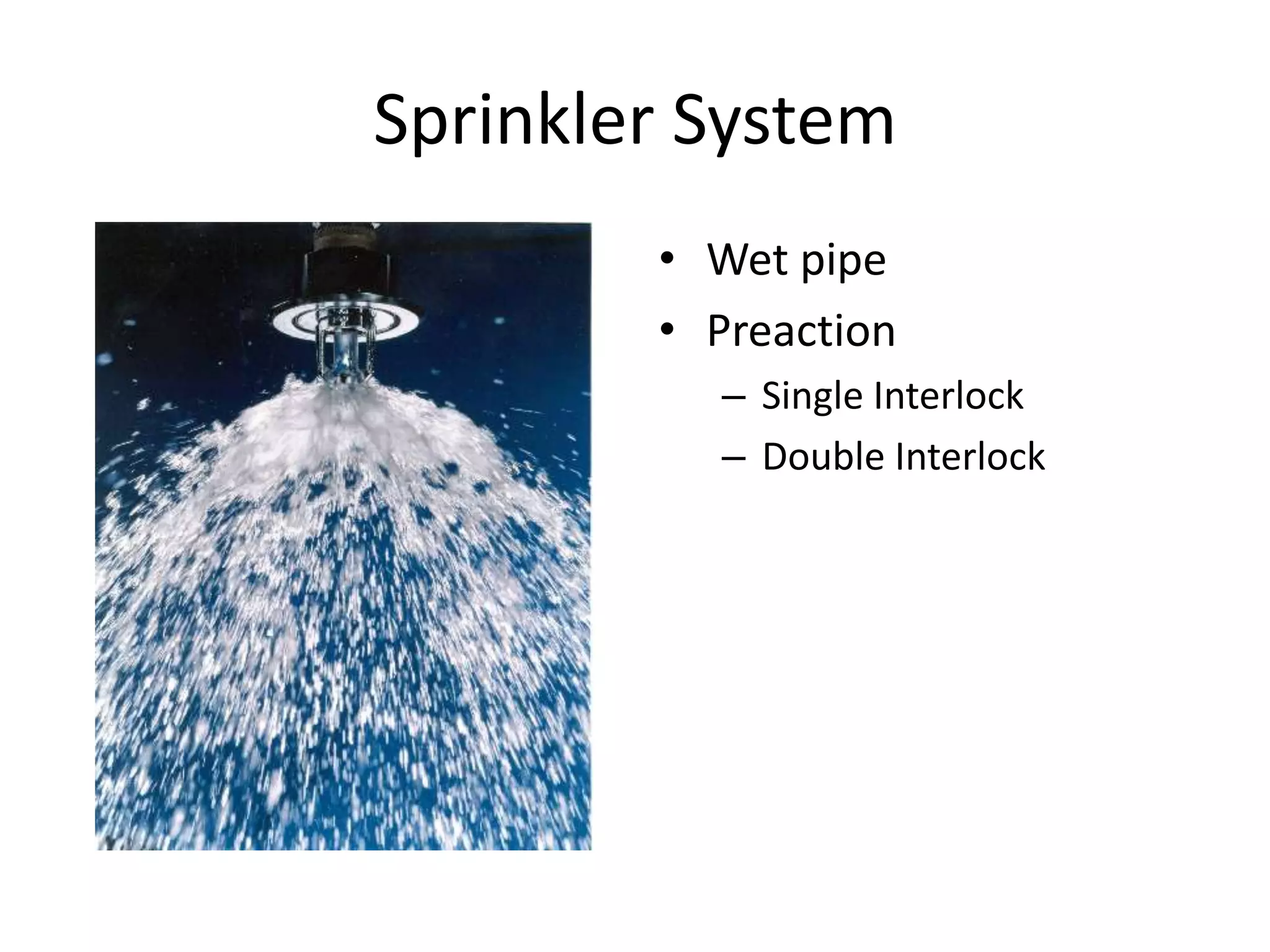
Sprinkler System
        • Wet pipe
        • Preaction
          – Single Interlock
          – Double Interlock
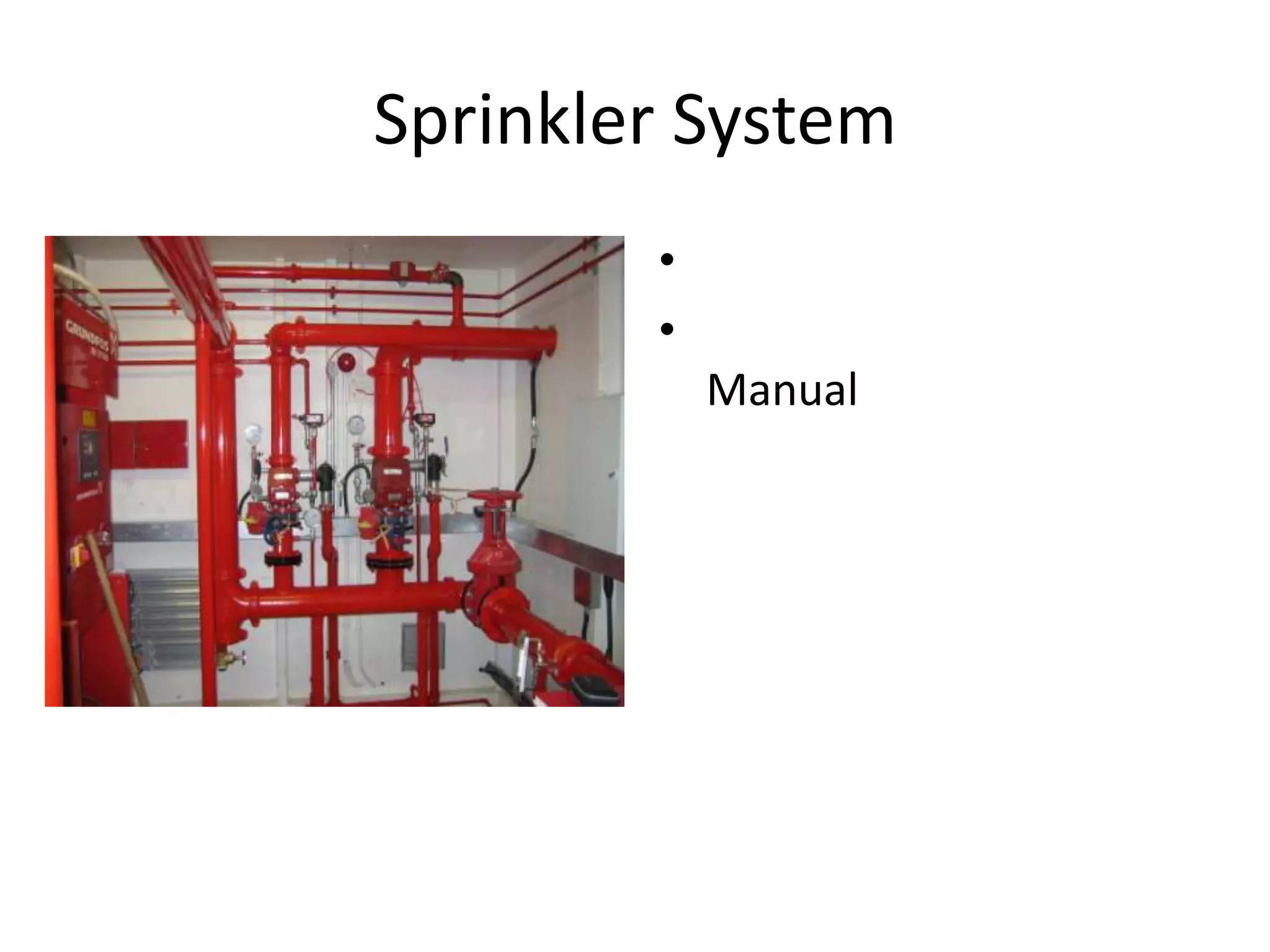
Sprinkler System
        •
        •
            Manual
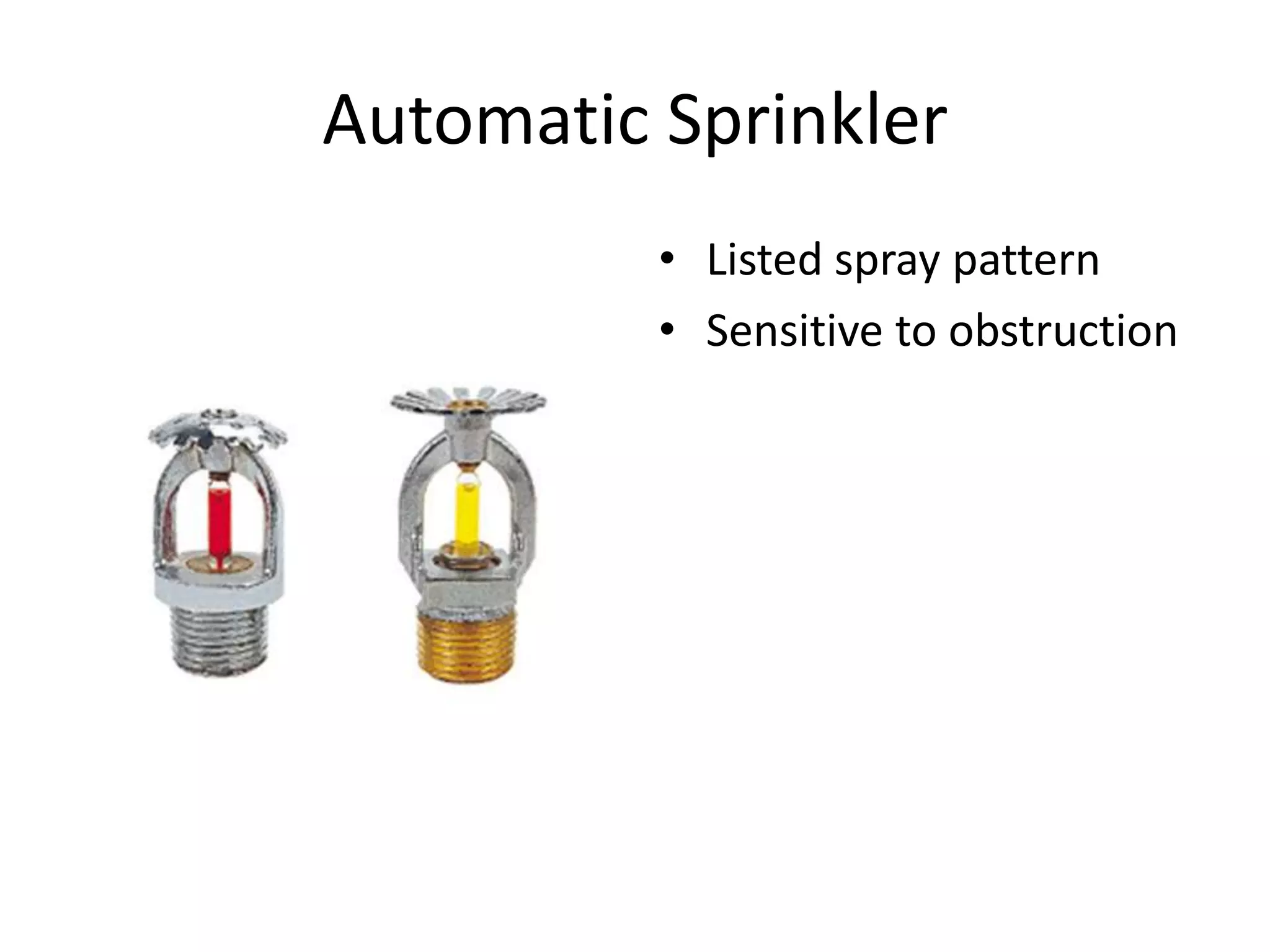
Automatic Sprinkler
          • Listed spray pattern
          • Sensitive to obstruction
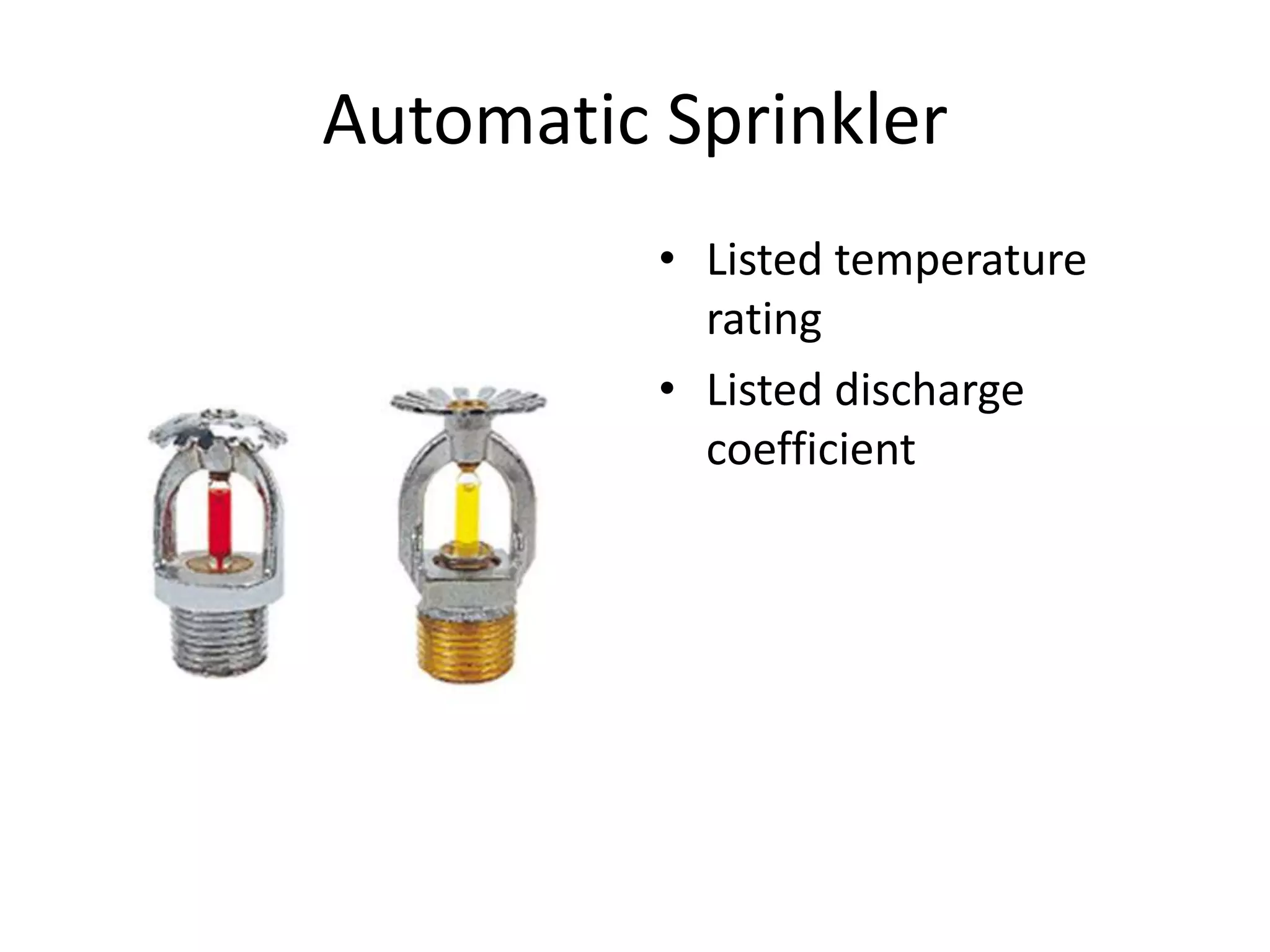
Automatic Sprinkler
          • Listed temperature
            rating
          • Listed discharge
            coefficient
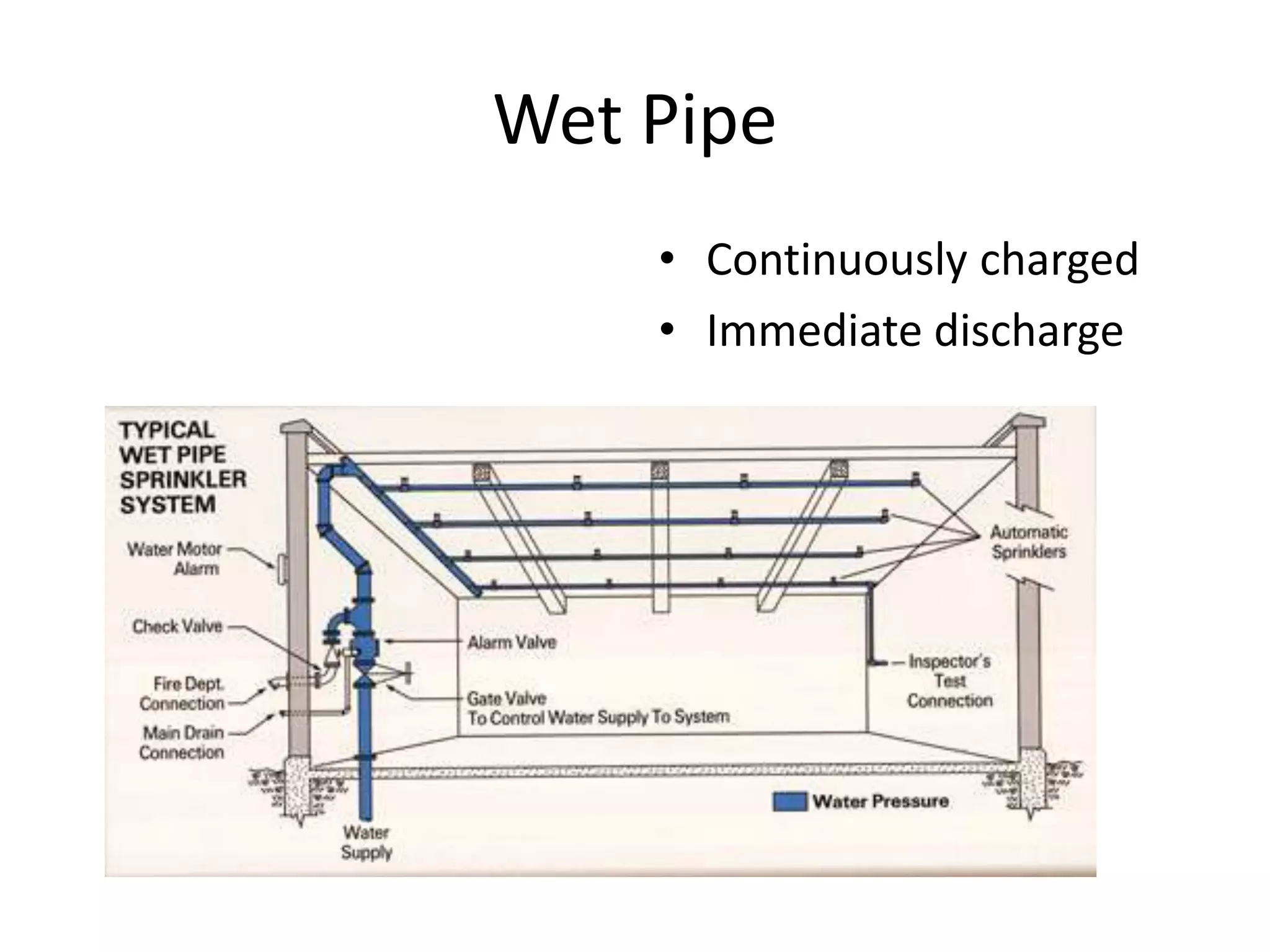
Wet Pipe
    • Continuously charged
    • Immediate discharge
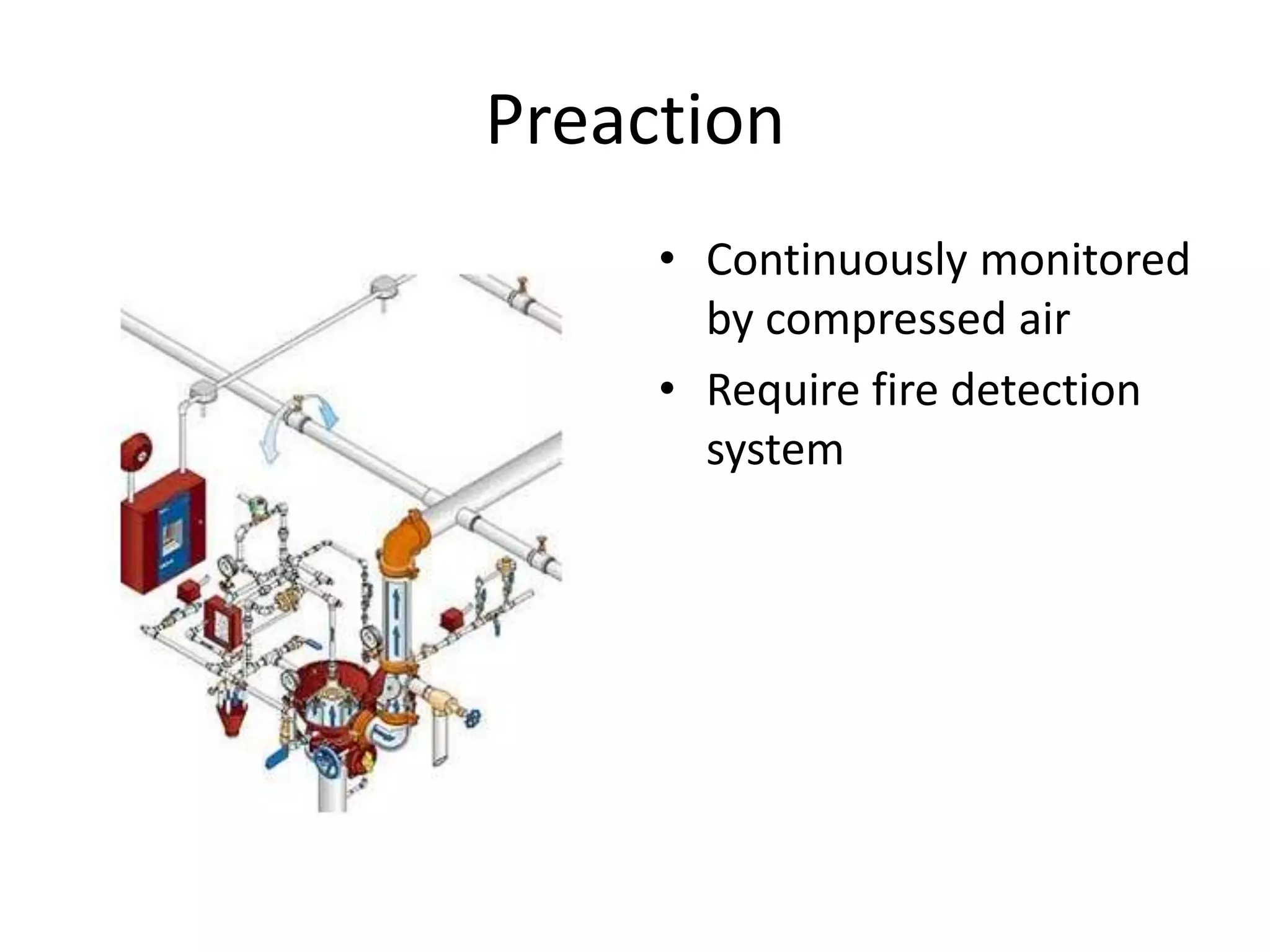
Preaction
     • Continuously monitored
       by compressed air
     • Require fire detection
       system
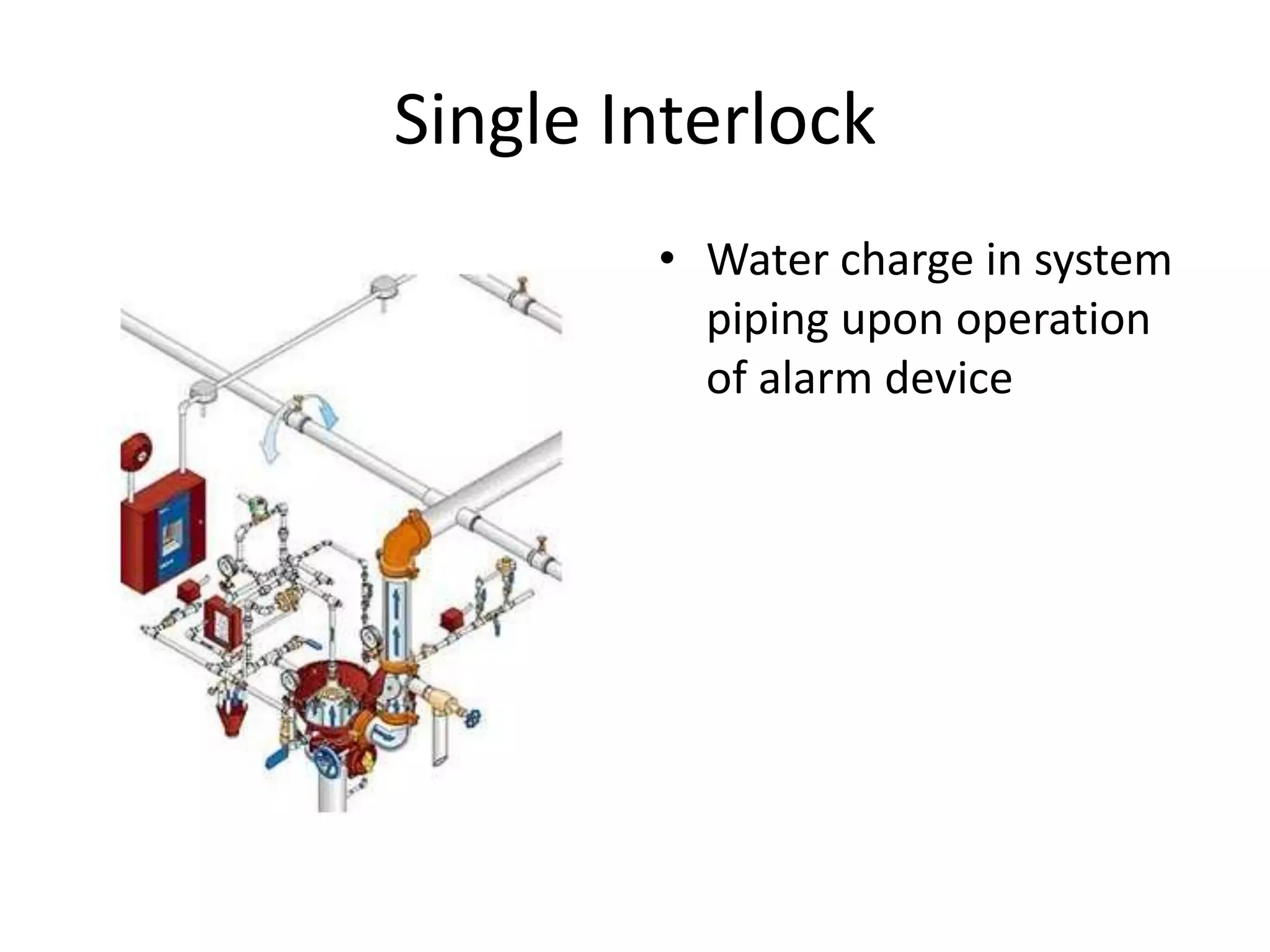
Single Interlock
        • Water charge in system
          piping upon operation
          of alarm device
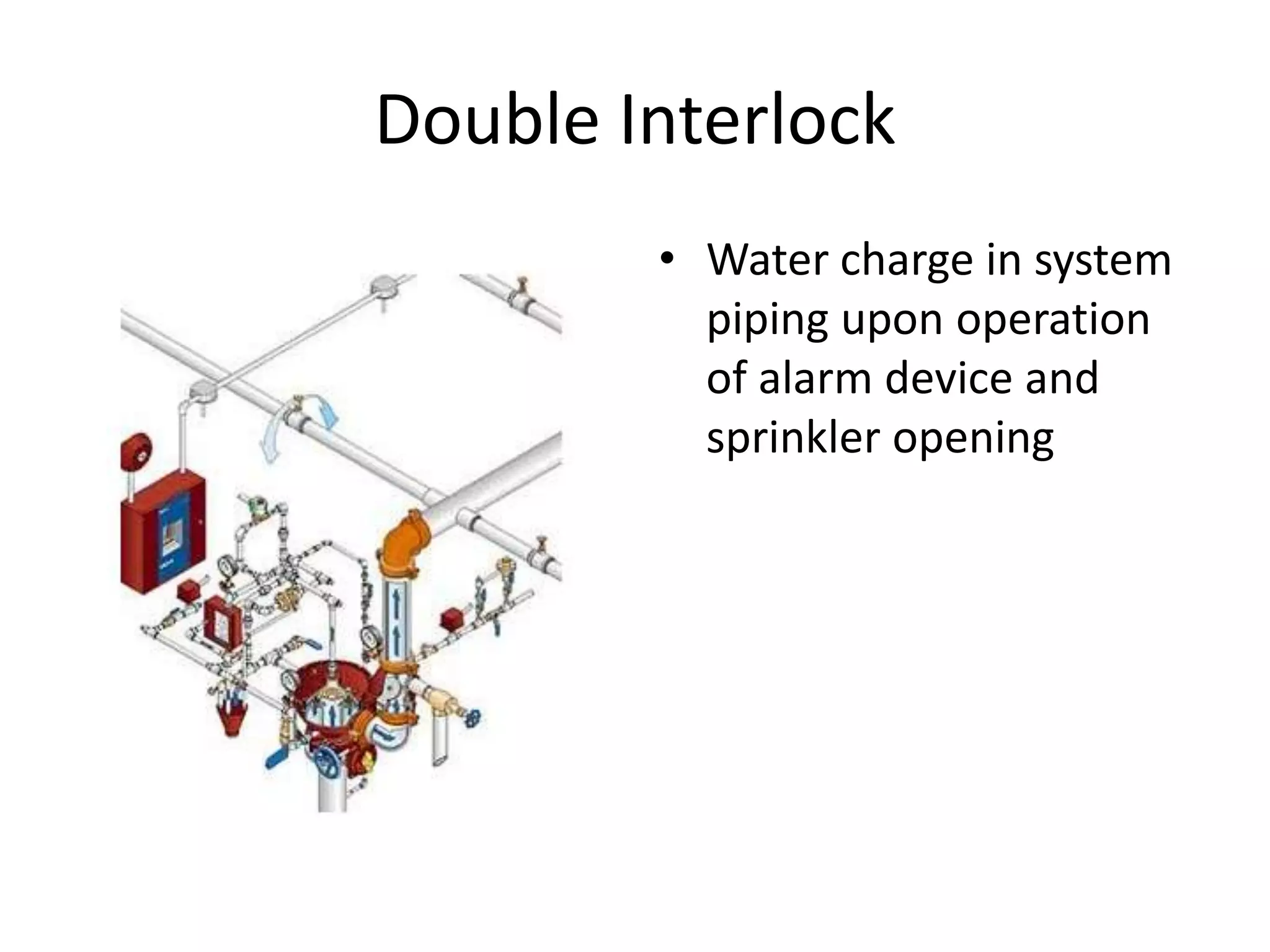
Double Interlock
        • Water charge in system
          piping upon operation
          of alarm device and
          sprinkler opening
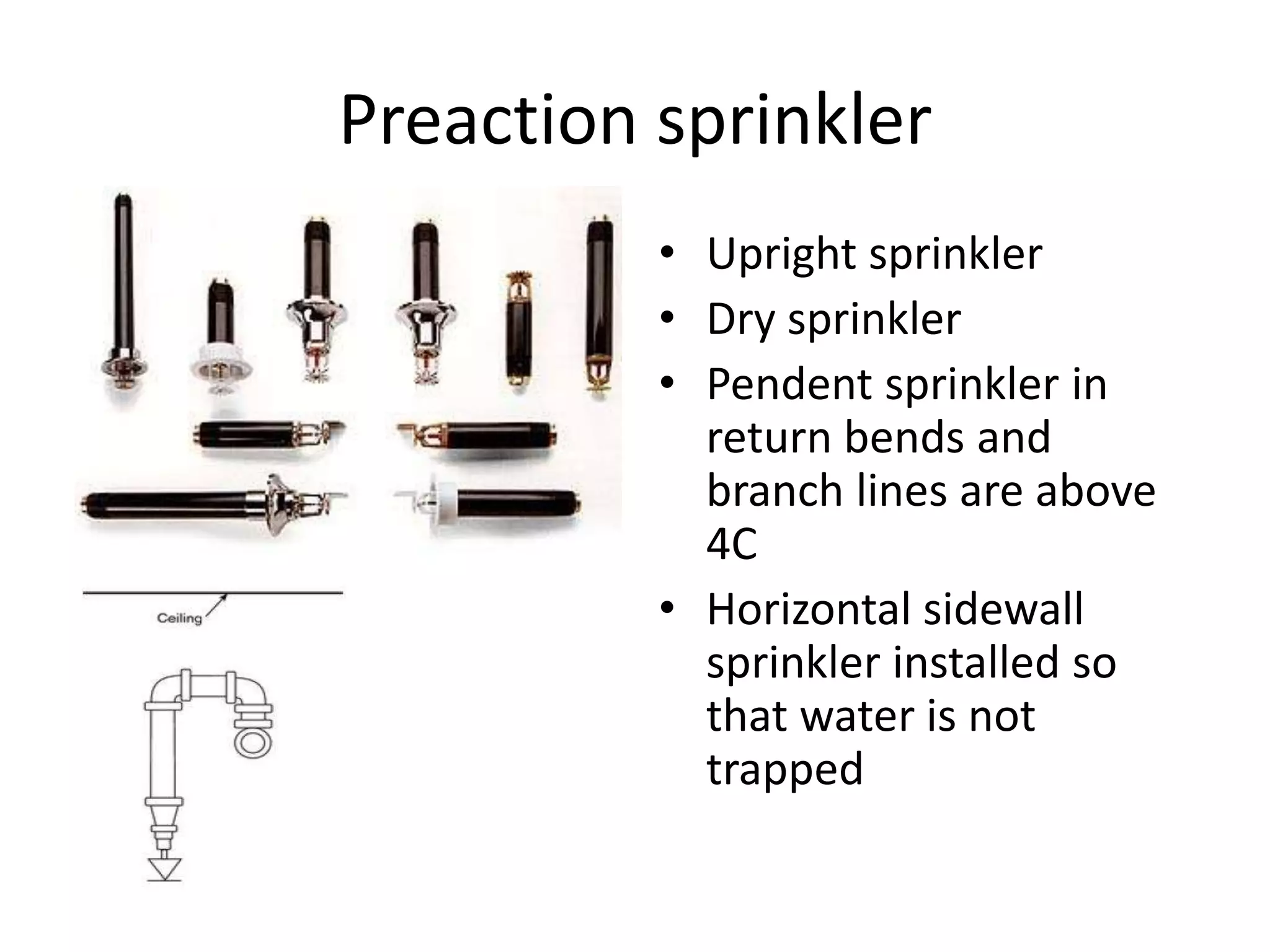
Preaction sprinkler
          • Upright sprinkler
          • Dry sprinkler
          • Pendent sprinkler in
            return bends and
            branch lines are above
            4C
          • Horizontal sidewall
            sprinkler installed so
            that water is not
            trapped
Required Information
          • As-Built drawings
          • AHJ additional
            requirements
          • Calculation sheets
          • Data sheets
          • User Manual
          • Maintenance Manual
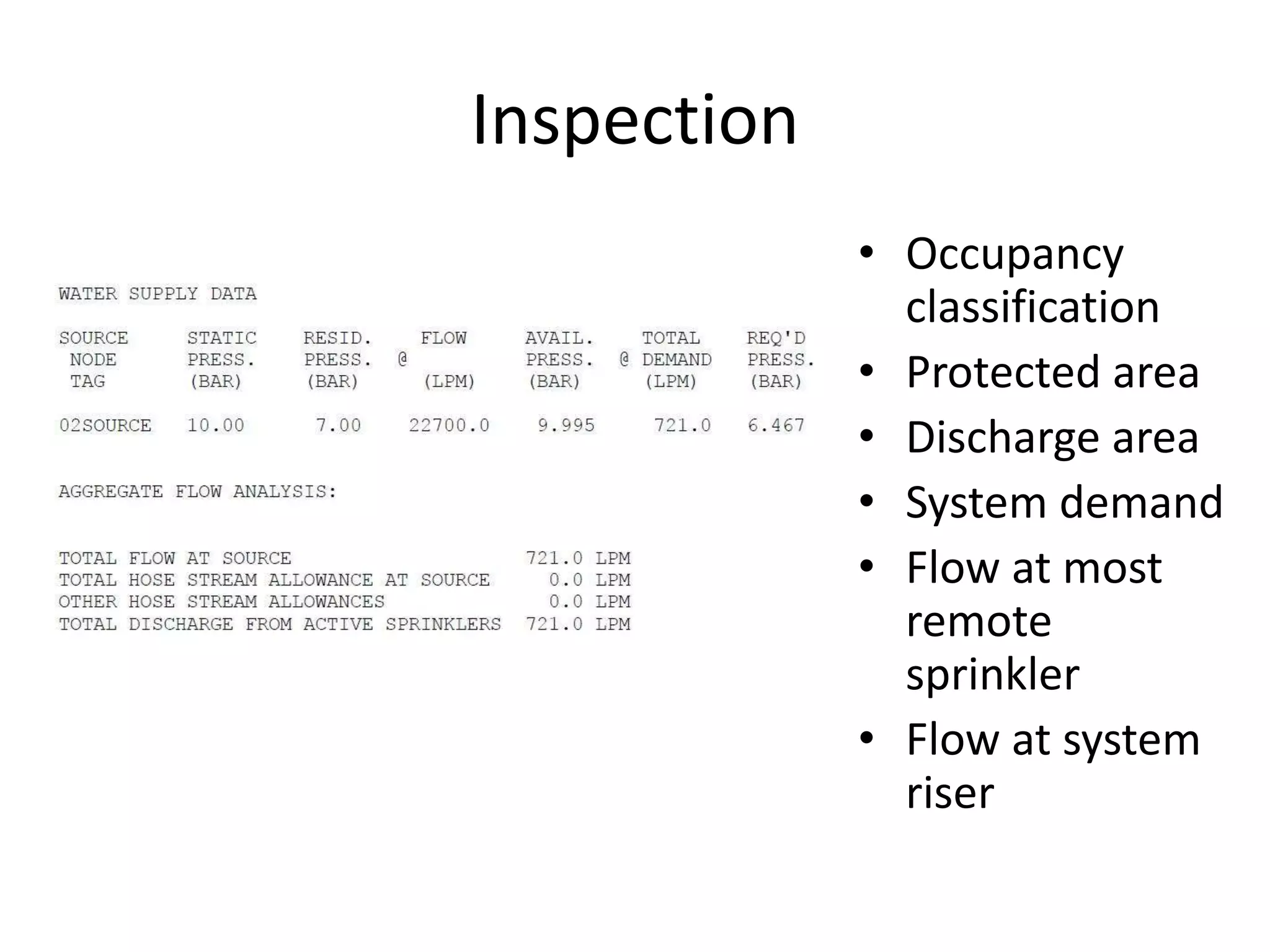
Inspection
             • Occupancy
               classification
             • Protected area
             • Discharge area
             • System demand
             • Flow at most
               remote
               sprinkler
             • Flow at system
               riser
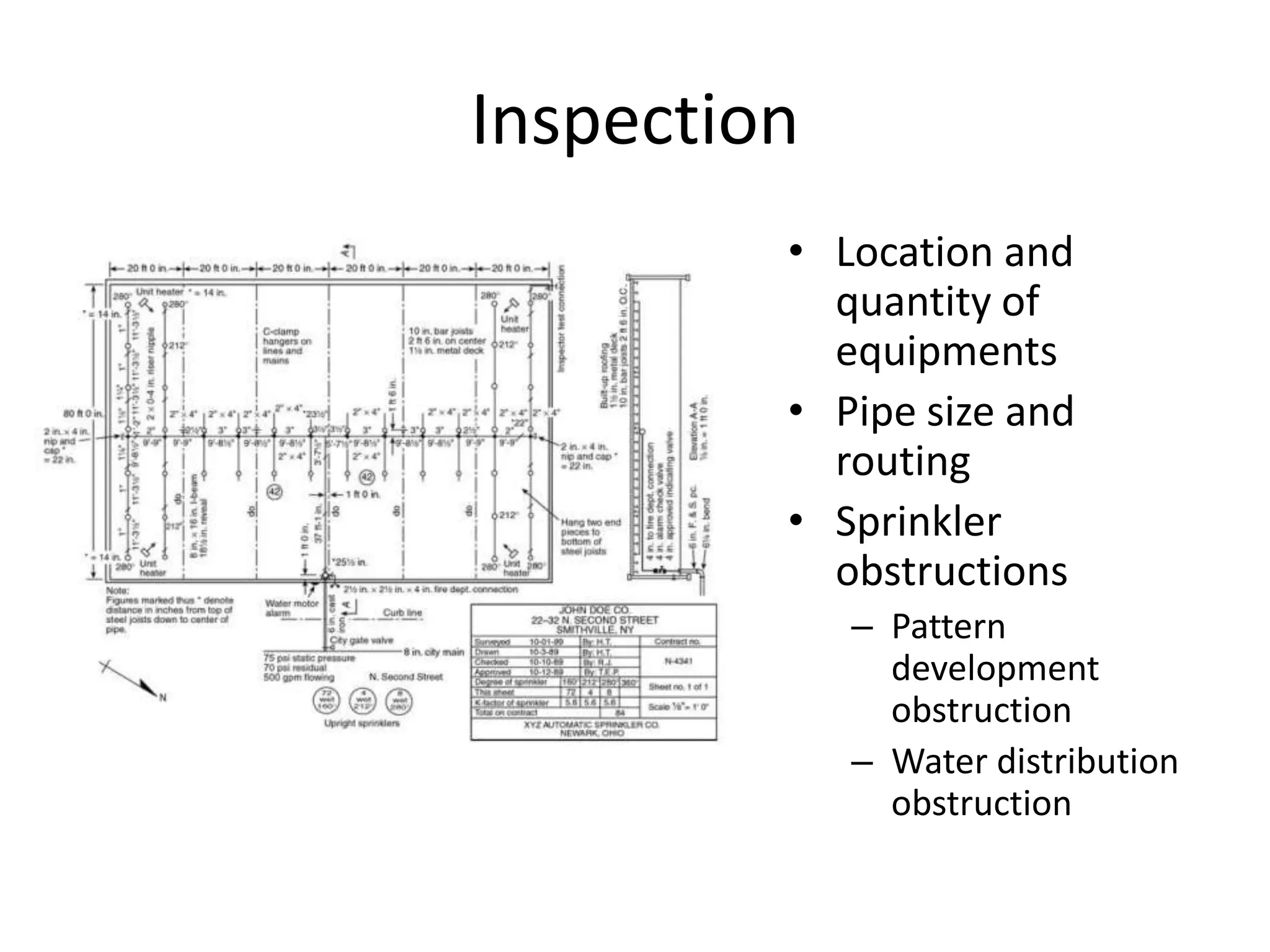
Inspection
         • Location and
           quantity of
           equipments
         • Pipe size and
           routing
         • Sprinkler
           obstructions
             – Pattern
               development
               obstruction
             – Water distribution
               obstruction
Inspection
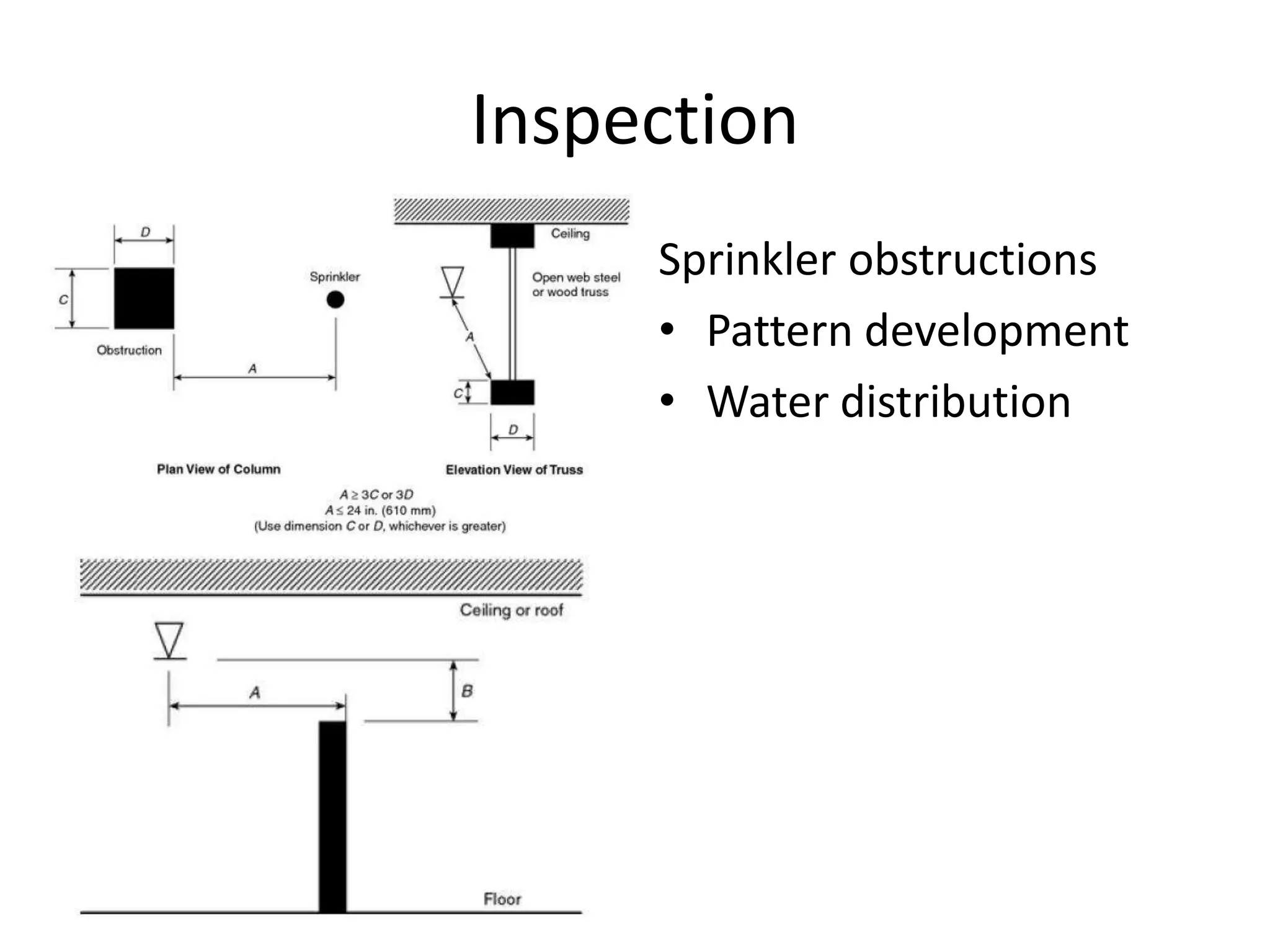
     Sprinkler obstructions
     • Pattern development
     • Water distribution
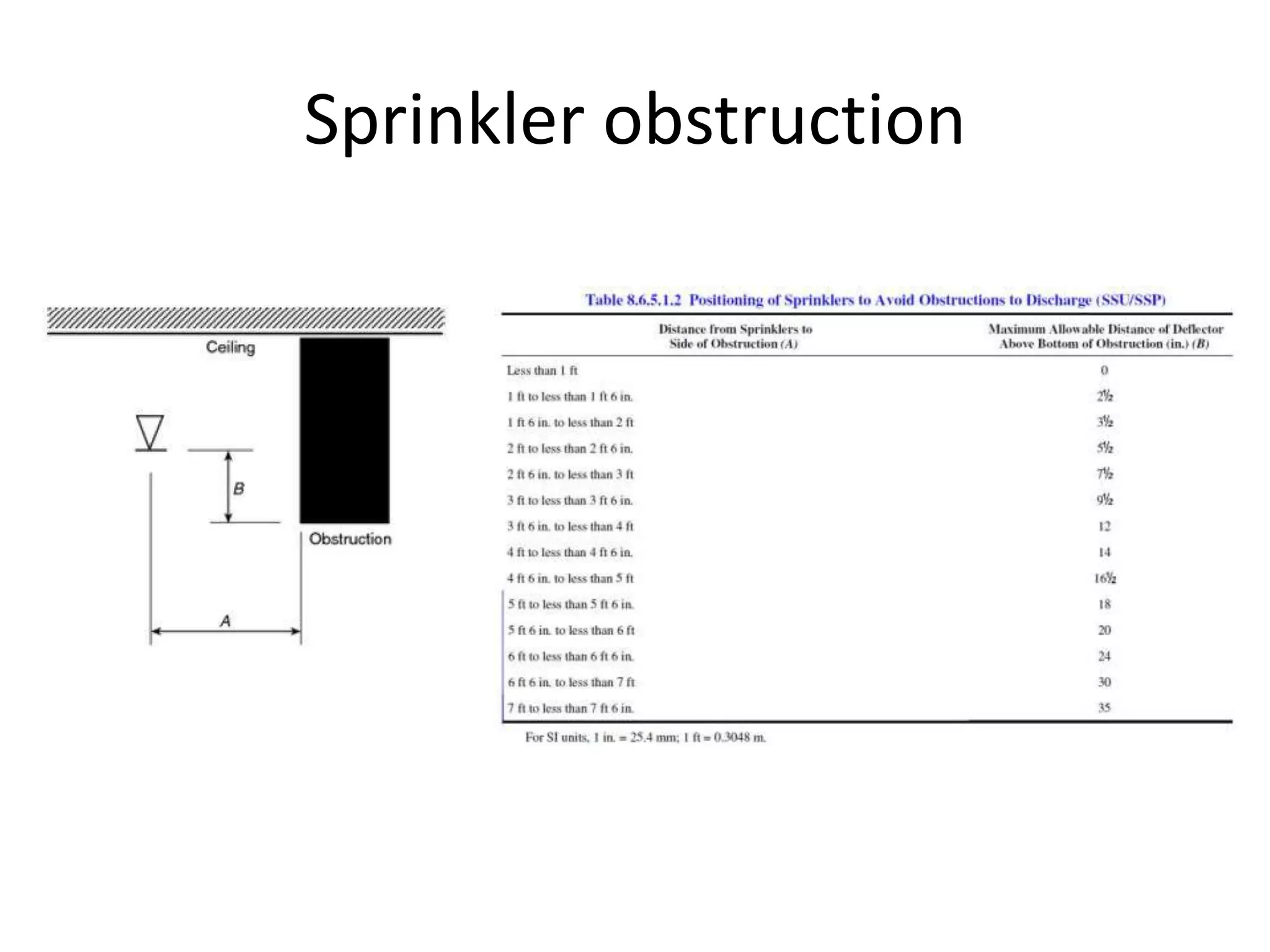
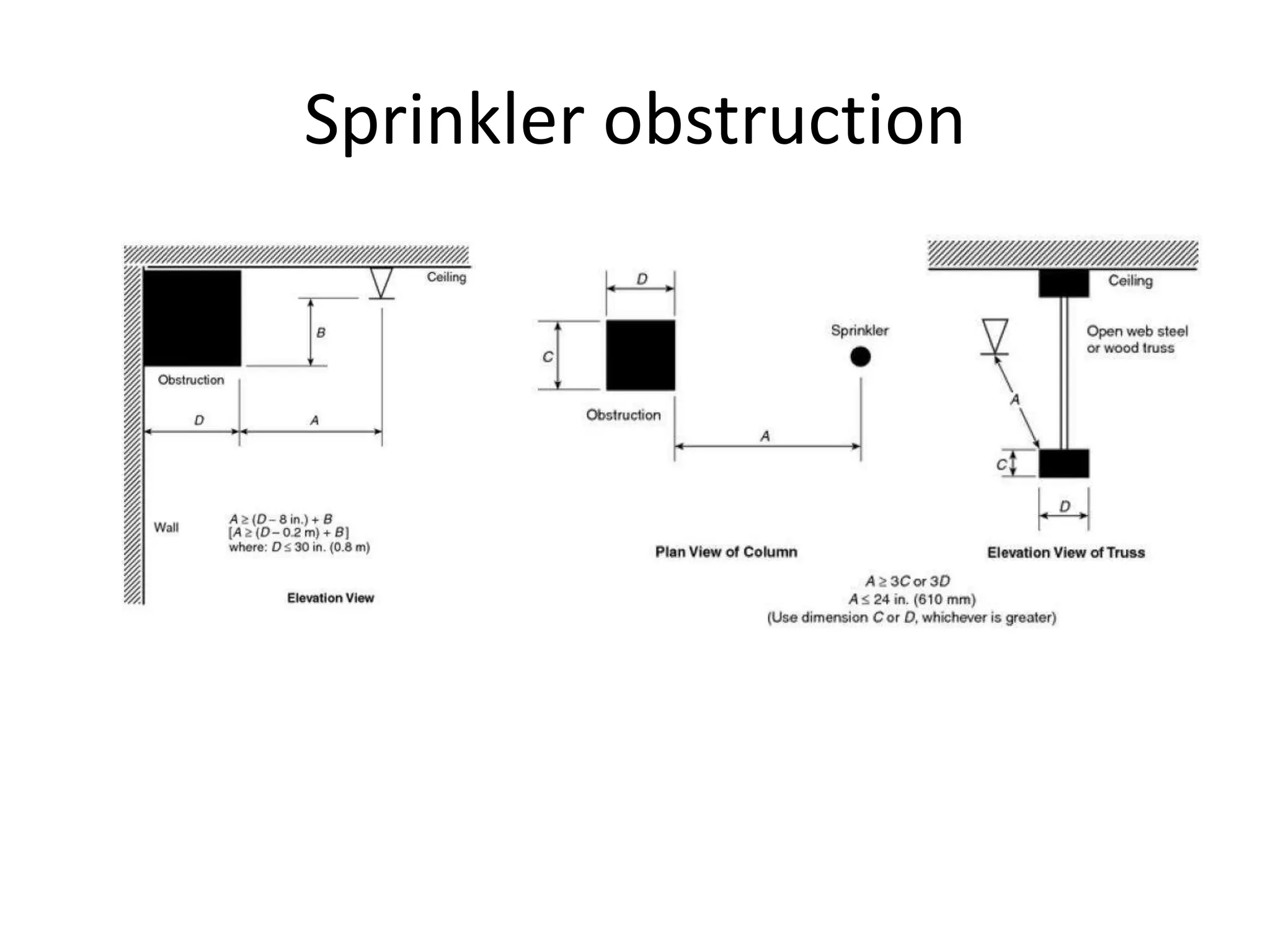
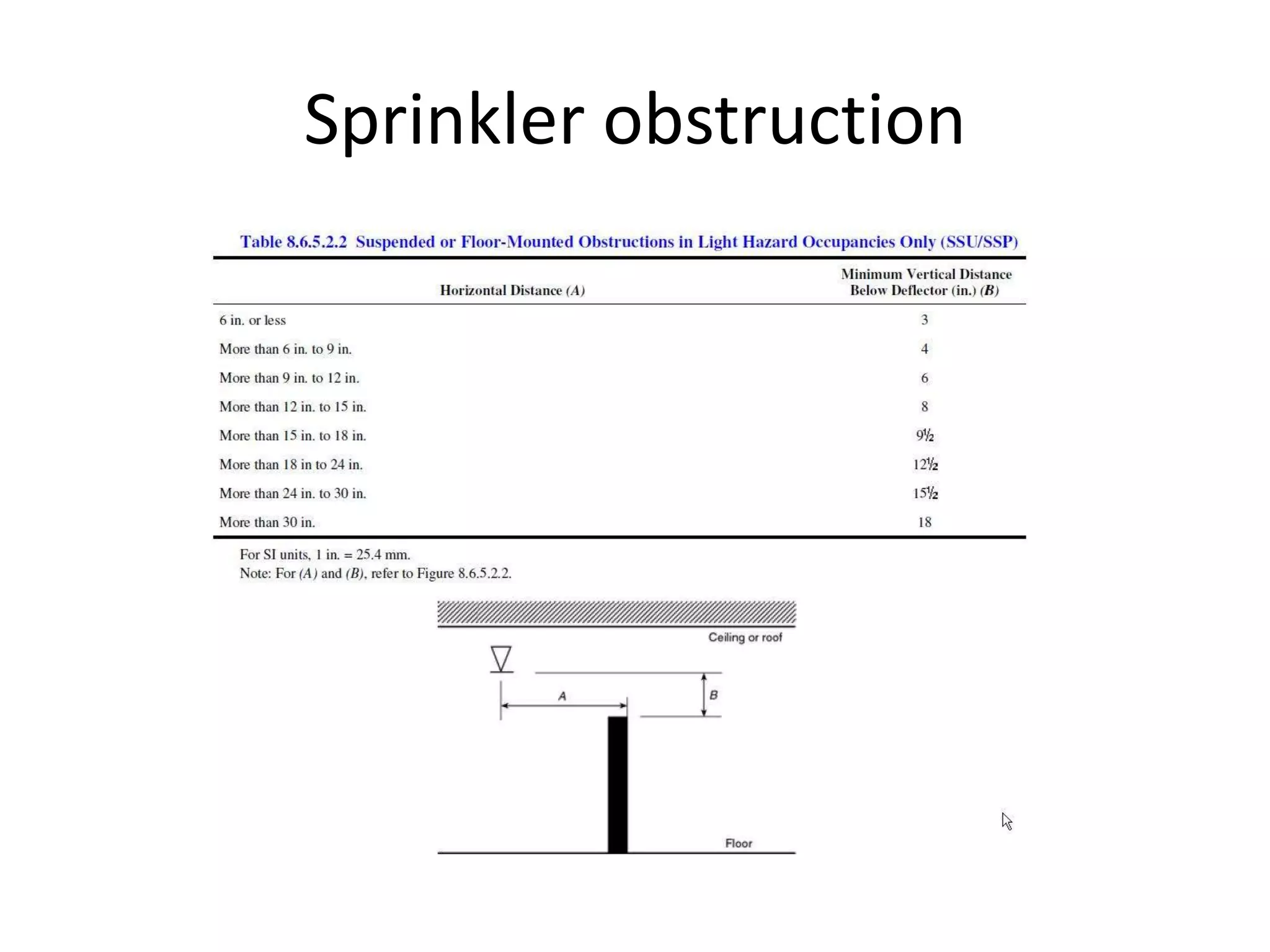
Sprinkler obstruction
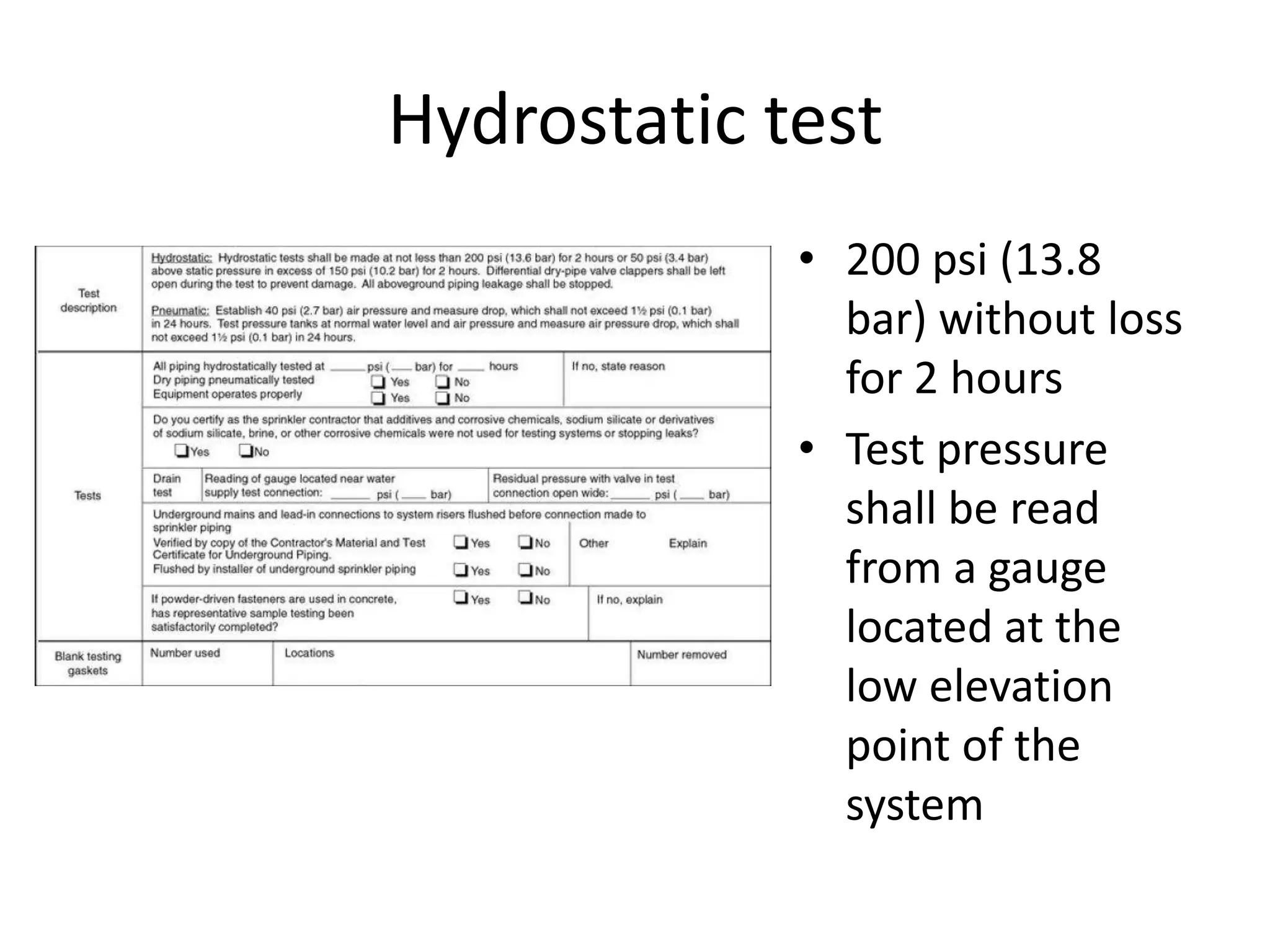
Hydrostatic test
               • 200 psi (13.8
                 bar) without
                 loss for 2 hours
               • Test pressure
                 shall be read
                 from a gauge
                 located at the
                 low elevation
                 point of the
                 system
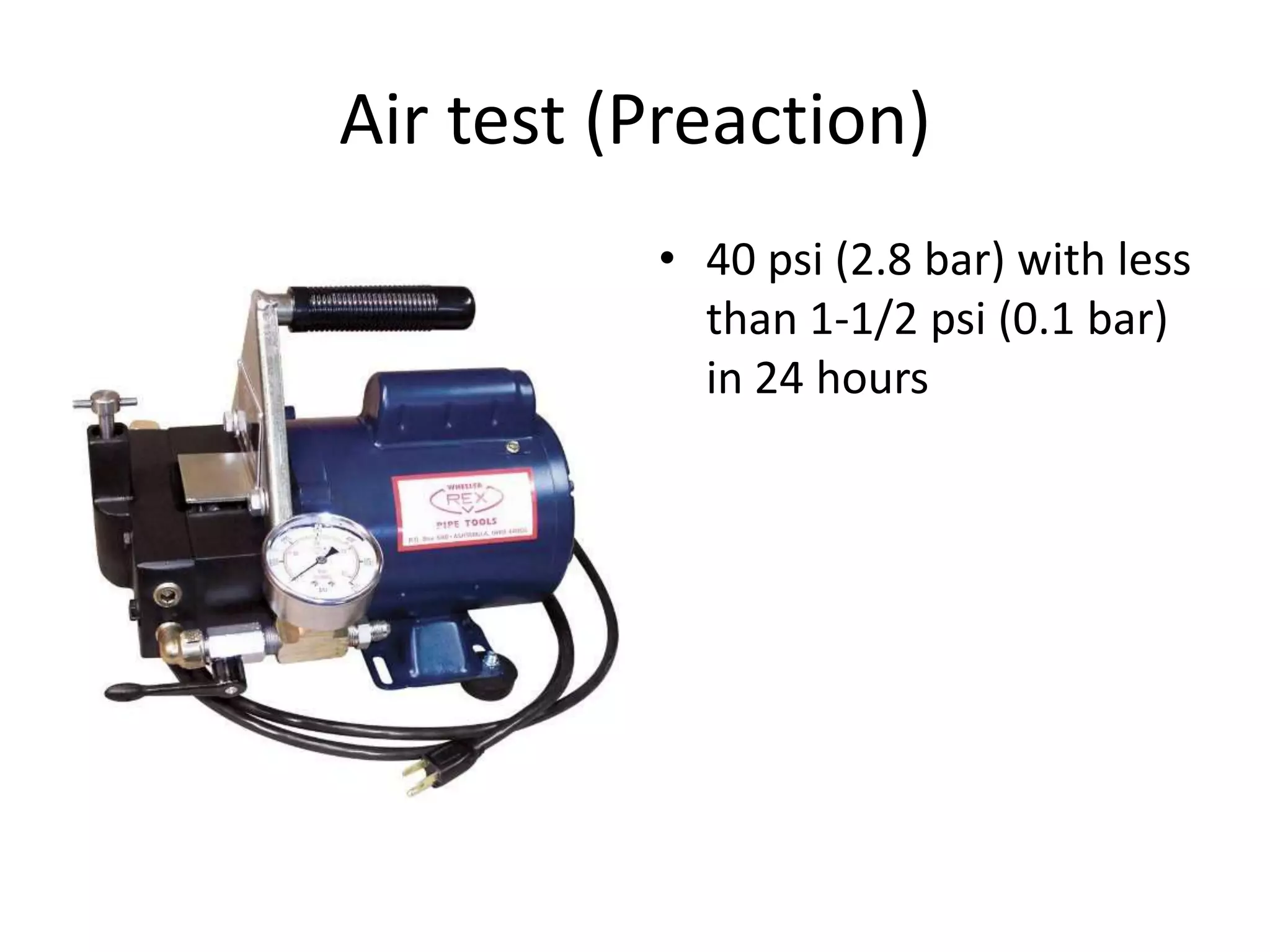
Air test (Preaction)
          • 40 psi (2.8 bar) with less
            than 1-1/2 psi (0.1 bar)
            in 24 hours
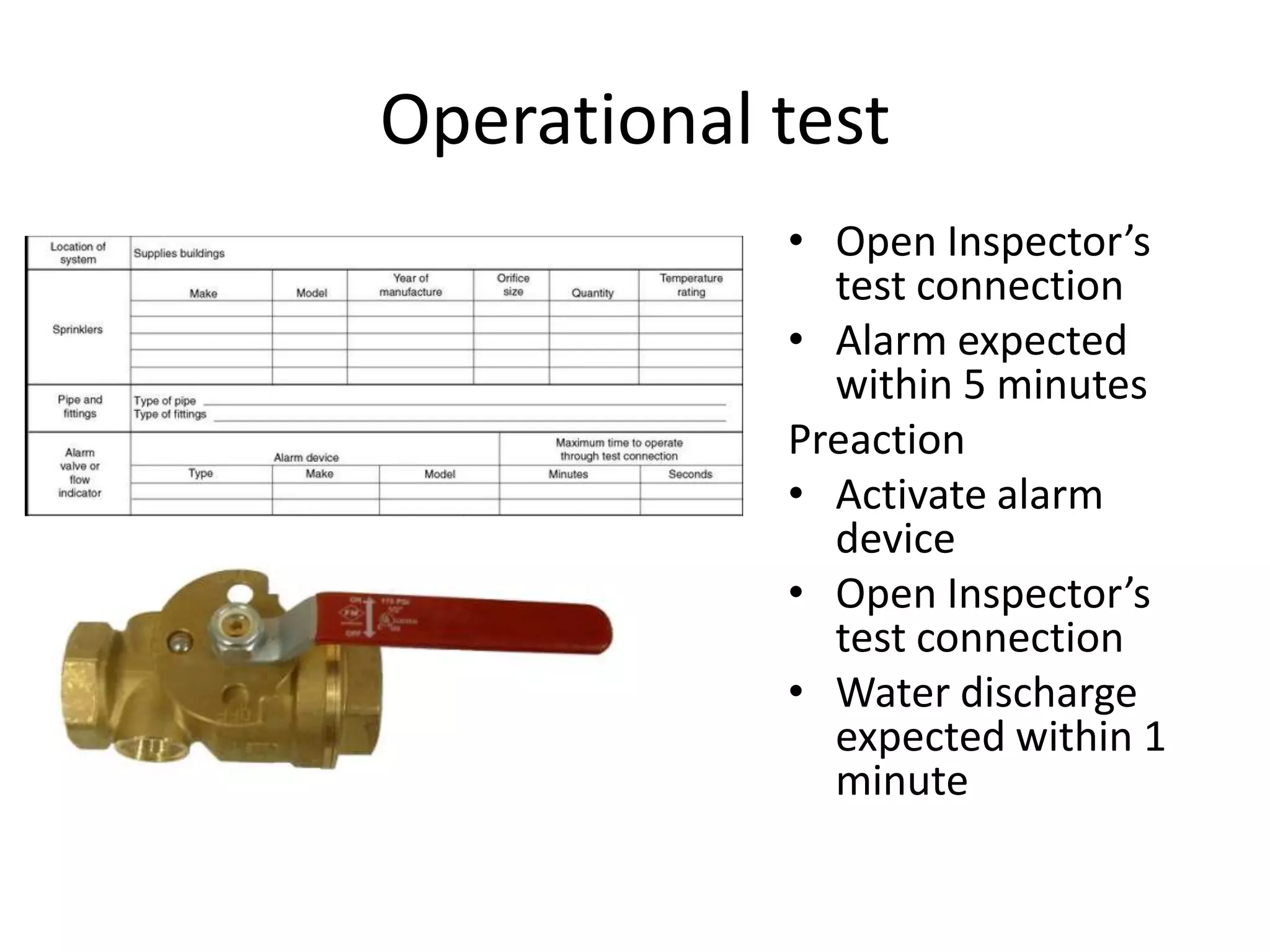
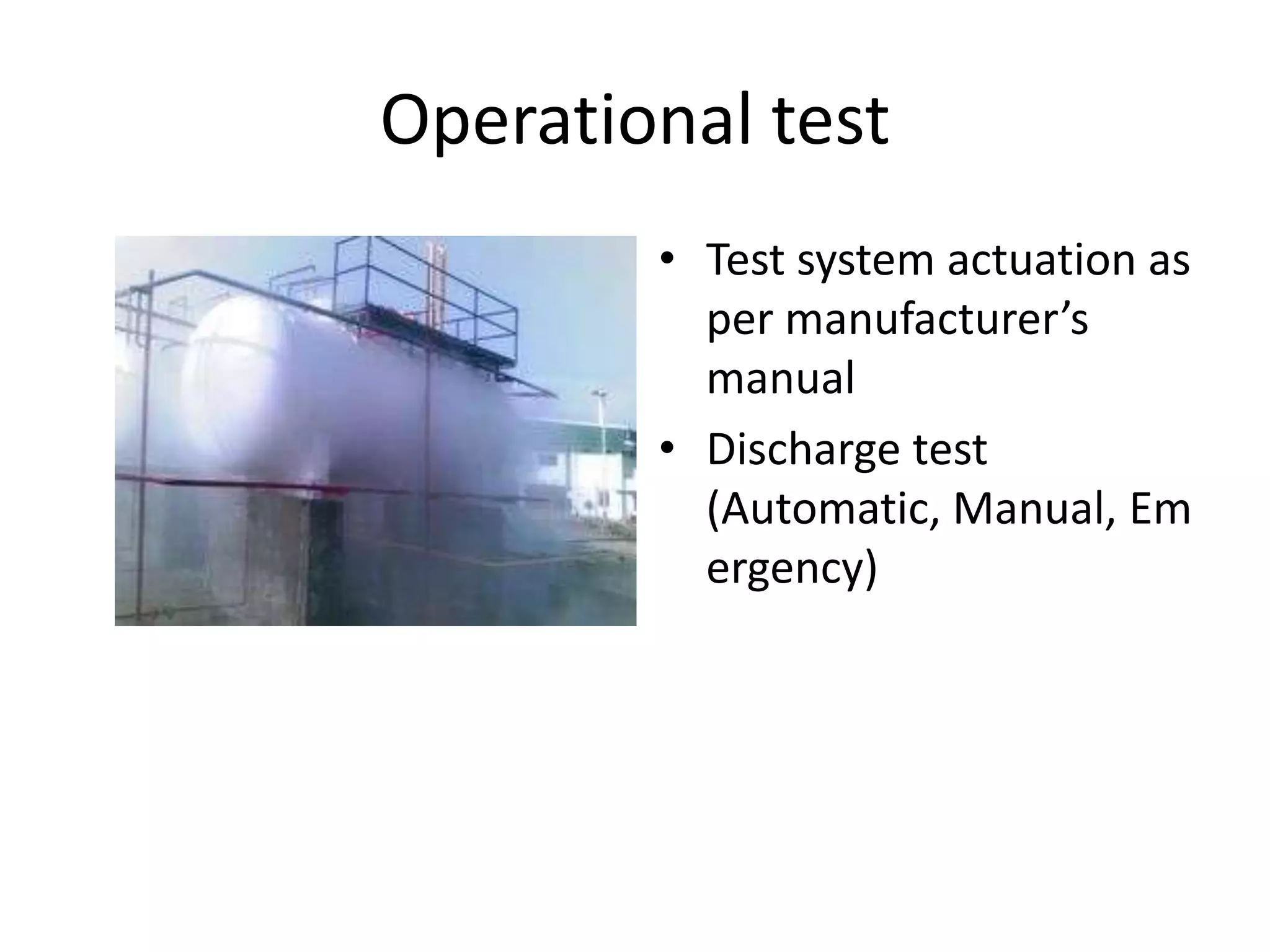
Operational test
            • Open Inspector’s
              test connection
            • Alarm expected
              within 5 minutes
            Preaction
            • Activate alarm
              device
            • Open Inspector’s
              test connection
            • Water discharge
              expected within 1
              minute
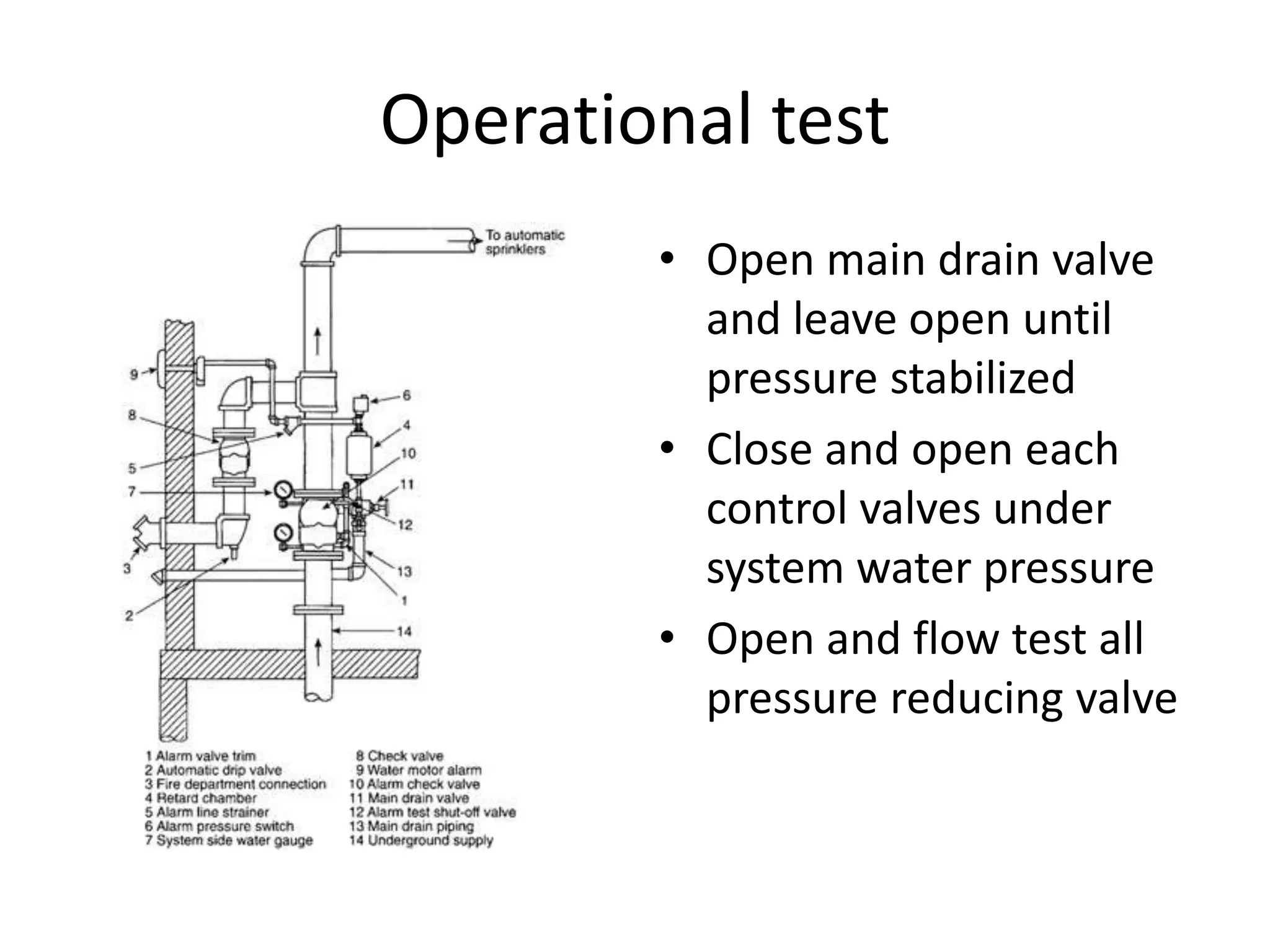
Operational test
        • Open main drain valve
          and leave open until
          pressure stabilized
        • Close and open each
          control valves under
          system water pressure
        • Open and flow test all
          pressure reducing valve
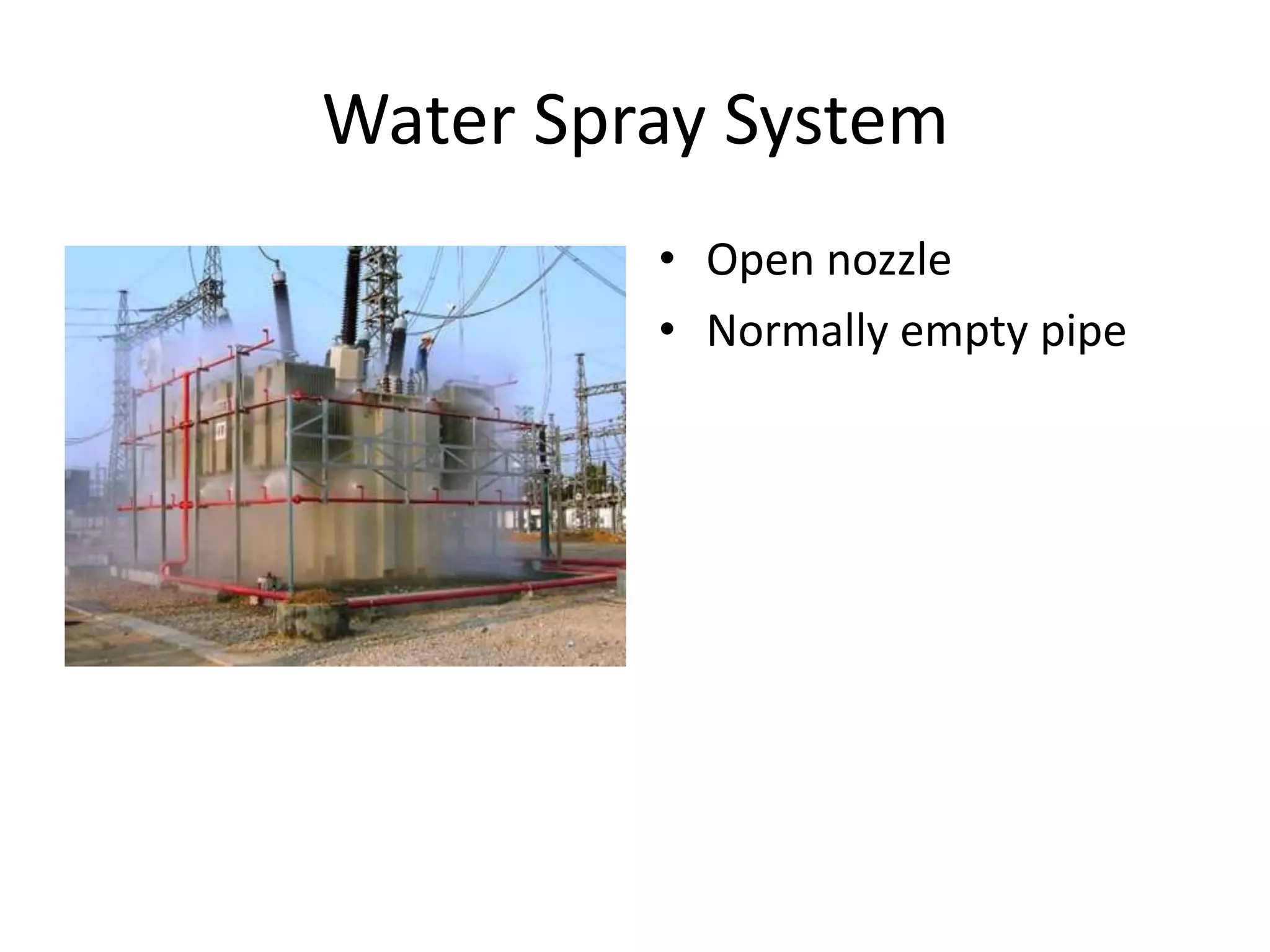
Water Spray System
         • Open nozzle
         • Normally empty pipe
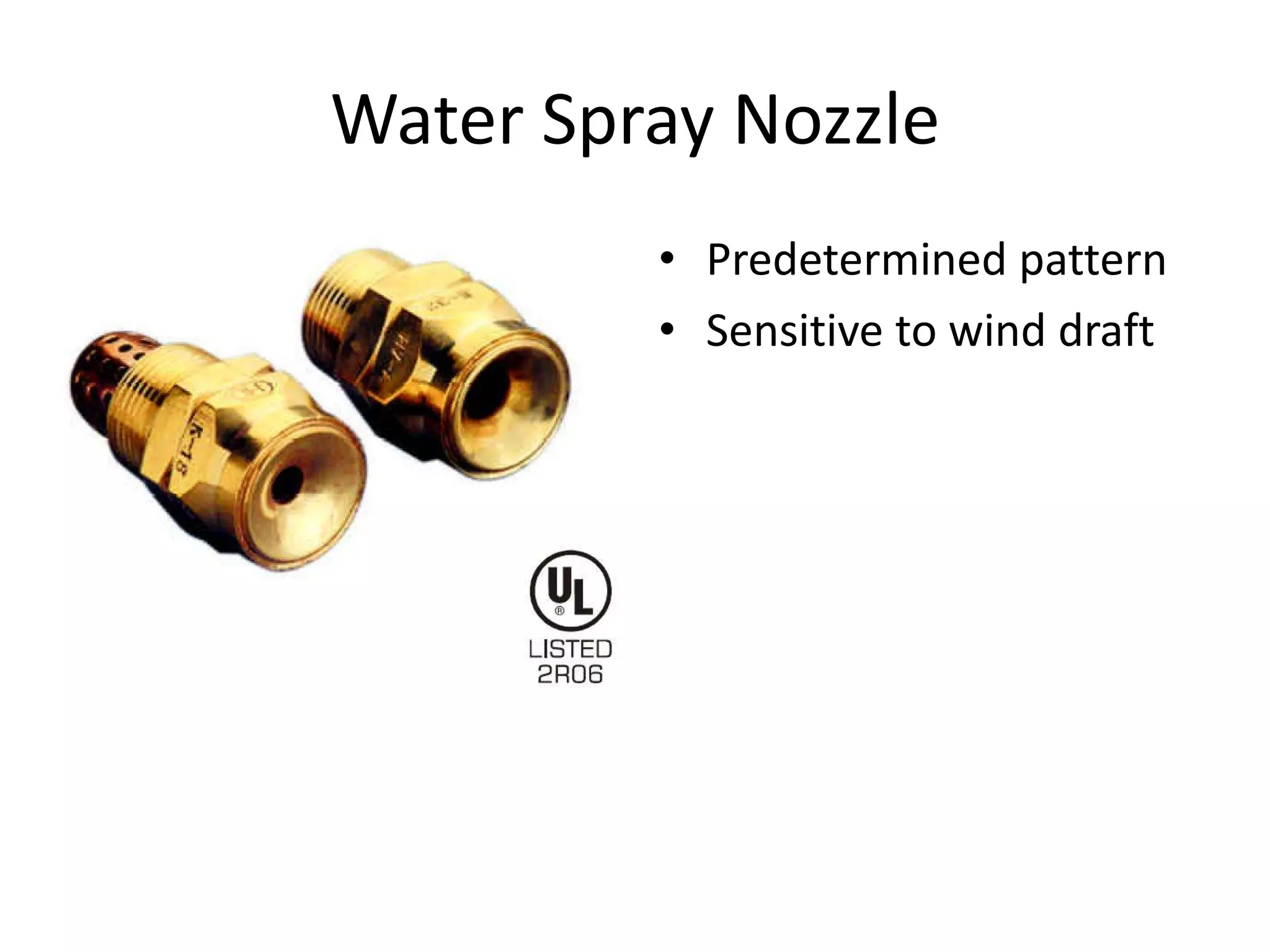
Water Spray Nozzle
         • Predetermined pattern
         • Sensitive to wind draft
Required Information
          • As-Built drawings
          • AHJ additional
            requirements
          • Calculation sheets
          • Data sheets
          • User Manual
          • Maintenance Manual
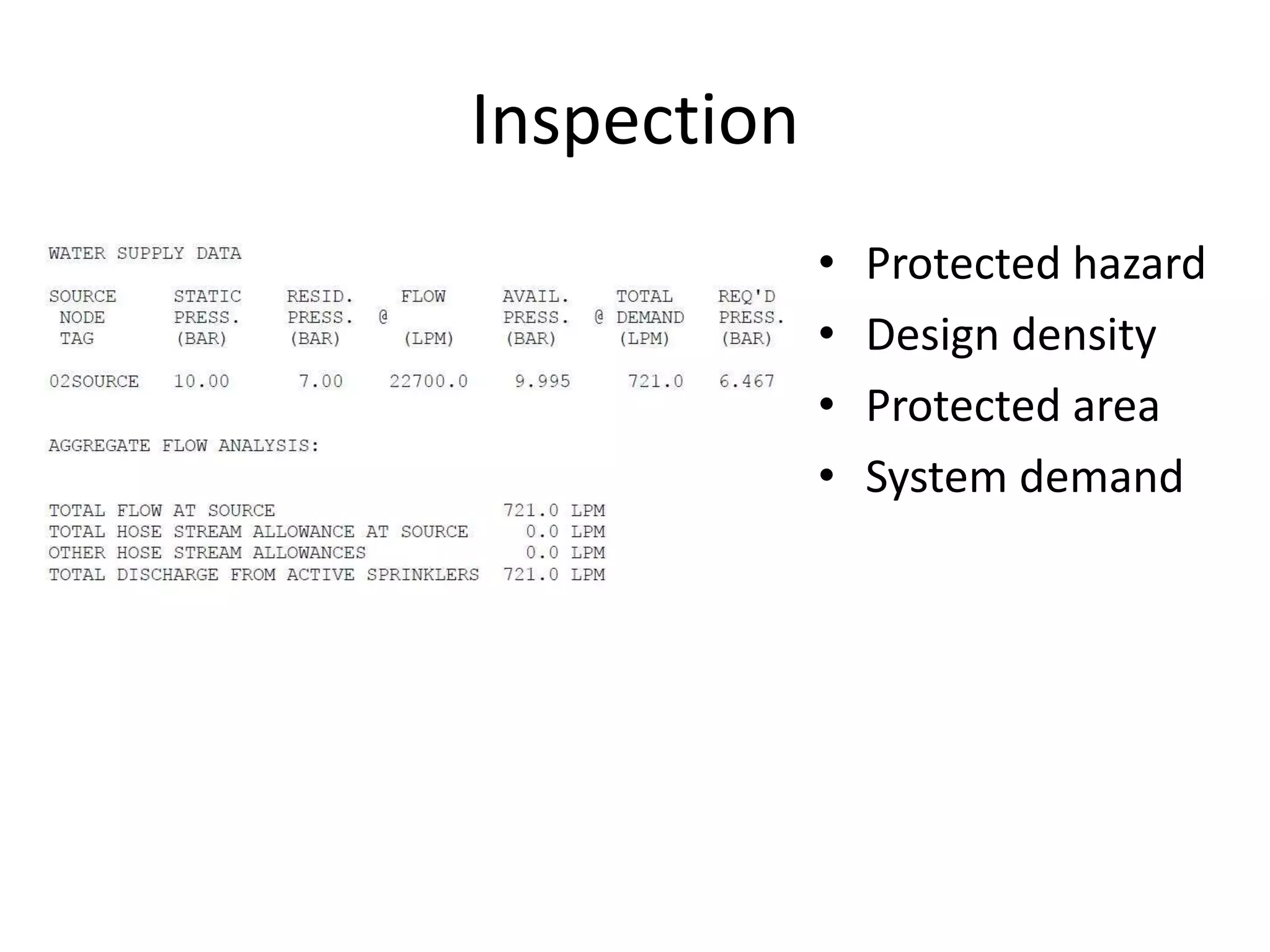
Inspection
             •   Protected hazard
             •   Design density
             •   Protected area
             •   System demand
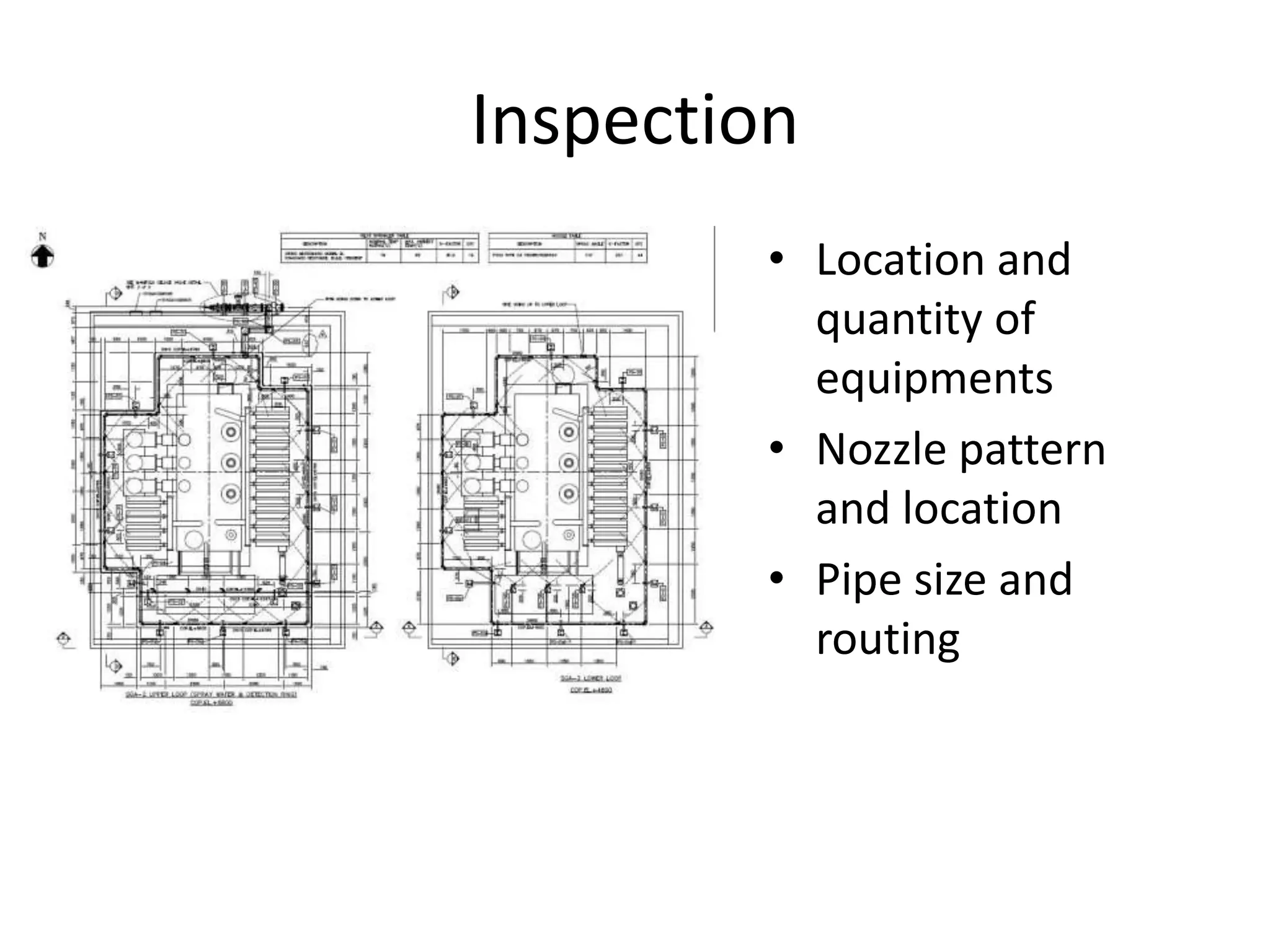
Inspection
         • Location and
           quantity of
           equipments
         • Nozzle pattern
           and location
         • Pipe size and
           routing
Hydrostatic test
             • 200 psi (13.8
               bar) without loss
               for 2 hours
             • Test pressure
               shall be read
               from a gauge
               located at the
               low elevation
               point of the
               system
Operational test
        • Test system actuation as
          per manufacturer’s
          manual
        • Discharge test
          (Automatic, Manual, Em
          ergency)
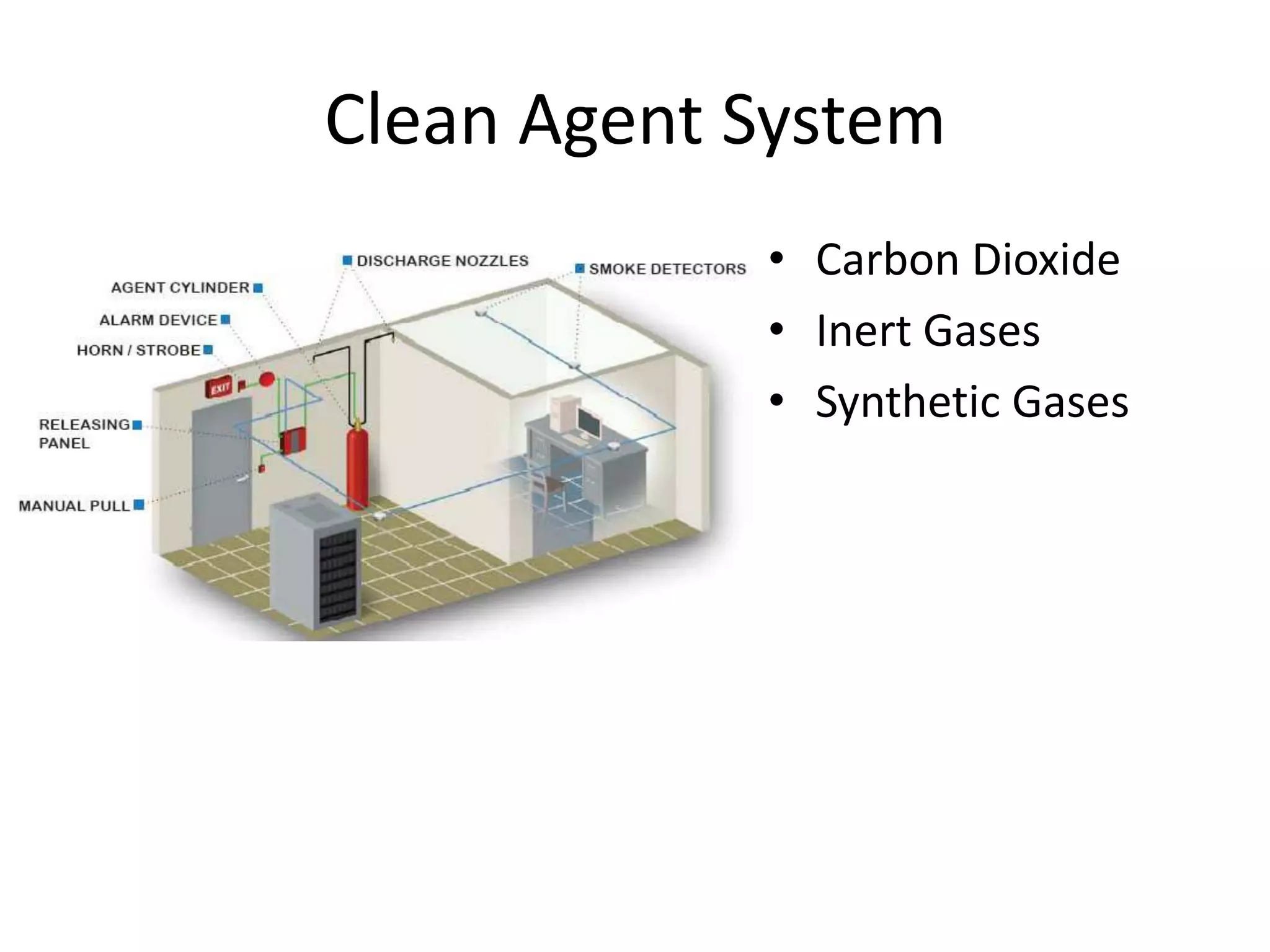
Clean Agent System
            • Carbon Dioxide
            • Inert Gases
            • Synthetic Gases
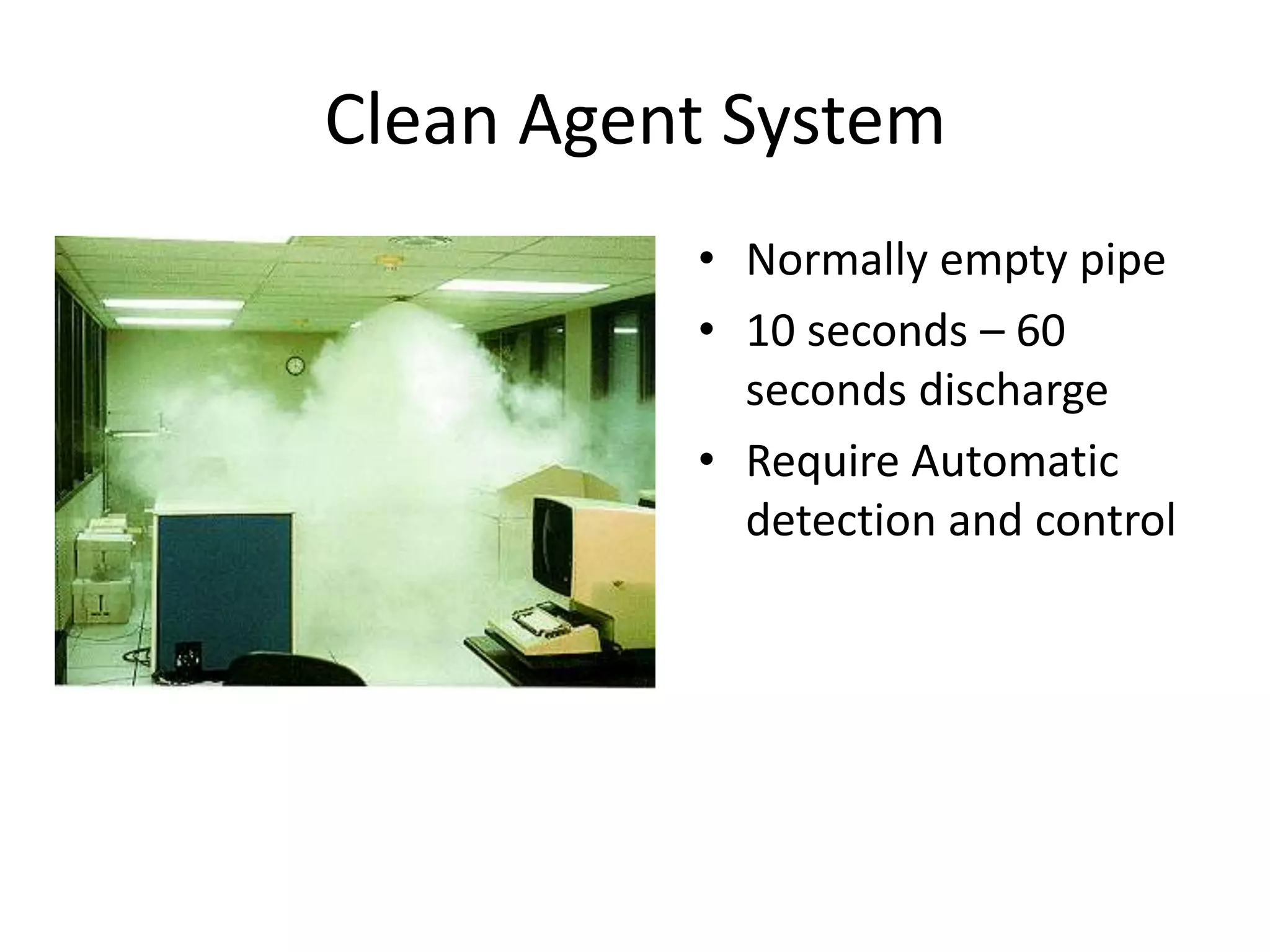
Clean Agent System
          • Normally empty pipe
          • 10 seconds – 60
            seconds discharge
          • Require Automatic
            detection and control
Carbon Dioxide
       • Stored in liquid or
         superheated gas state
       • No pressure gauge
       • Quantity check only by
         weighing
       • Flow in two phases
       • Very low temperature
         discharge
       • Nominal 60 seconds
         discharge
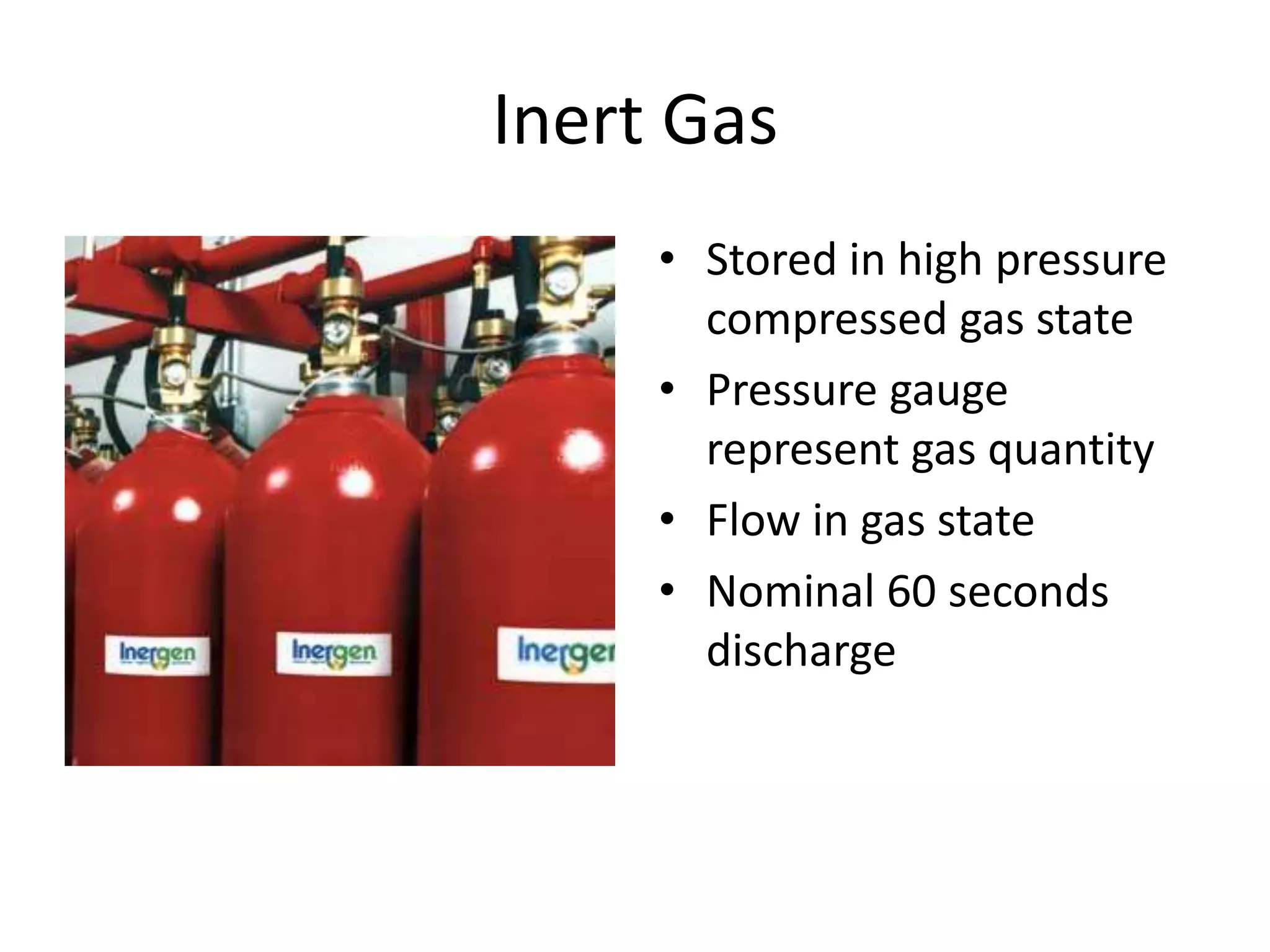
Inert Gas
     • Stored in high pressure
       compressed gas state
     • Pressure gauge
       represent gas quantity
     • Flow in gas state
     • Nominal 60 seconds
       discharge
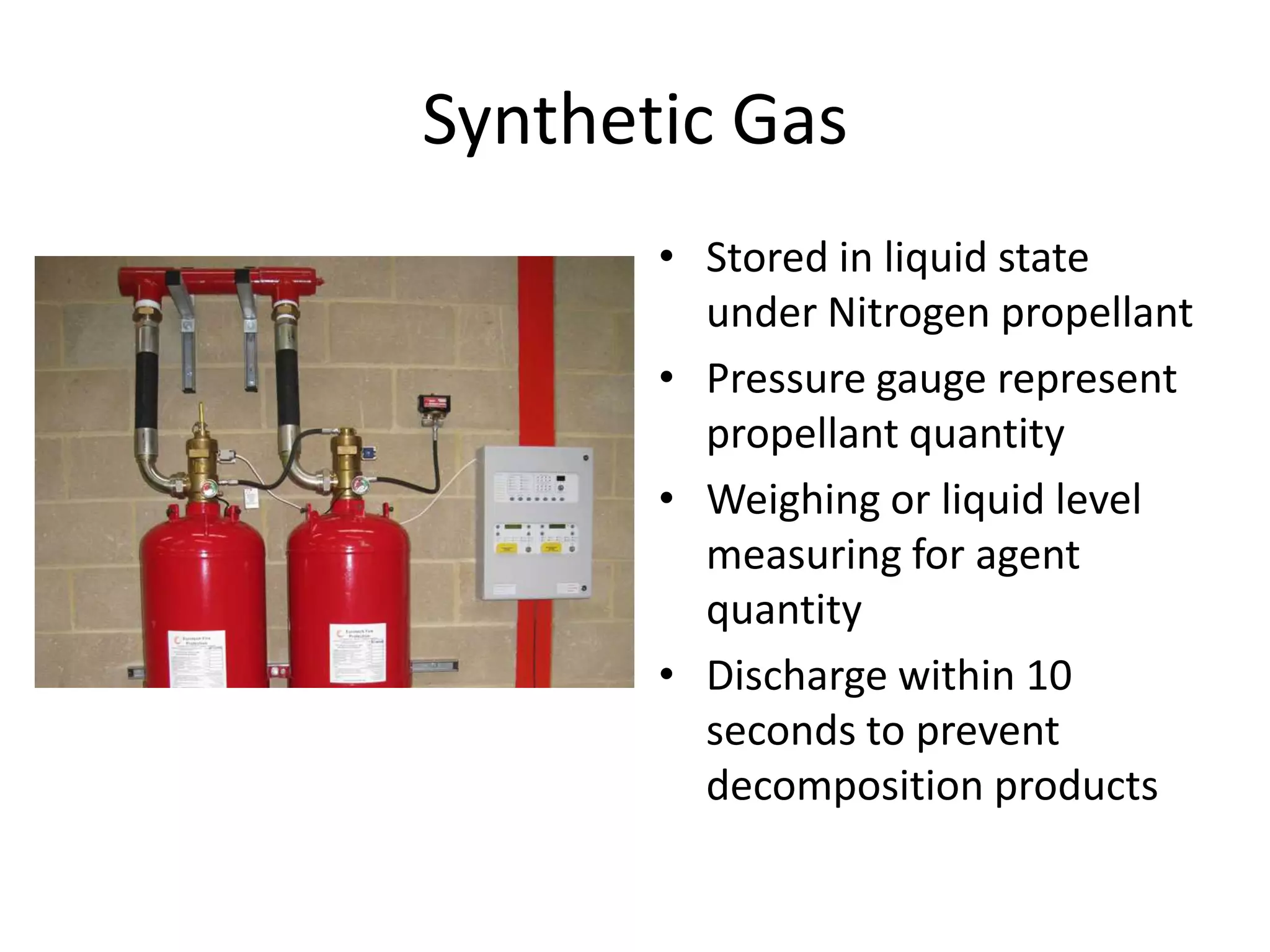
Synthetic Gas
       • Stored in liquid state
         under Nitrogen propellant
       • Pressure gauge represent
         propellant quantity
       • Weighing or liquid level
         measuring for agent
         quantity
       • Discharge within 10
         seconds to prevent
         decomposition products
Required Information
          • As-Built drawings
          • AHJ additional
            requirements
          • Calculation sheets
          • Data sheets
          • User Manual
          • Maintenance Manual
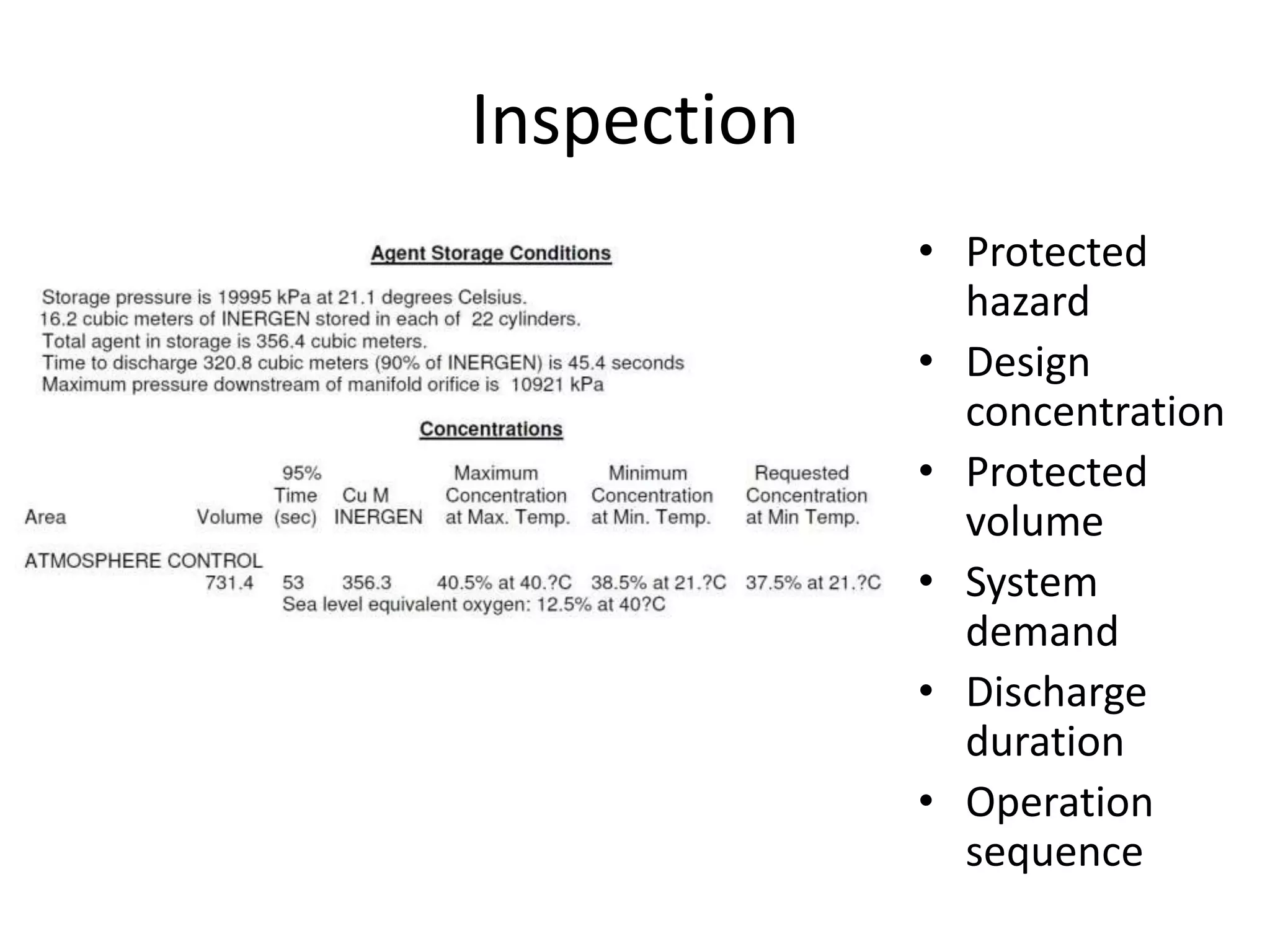
Inspection
             • Protected
               hazard
             • Design
               concentration
             • Protected
               volume
             • System
               demand
             • Discharge
               duration
             • Operation
               sequence
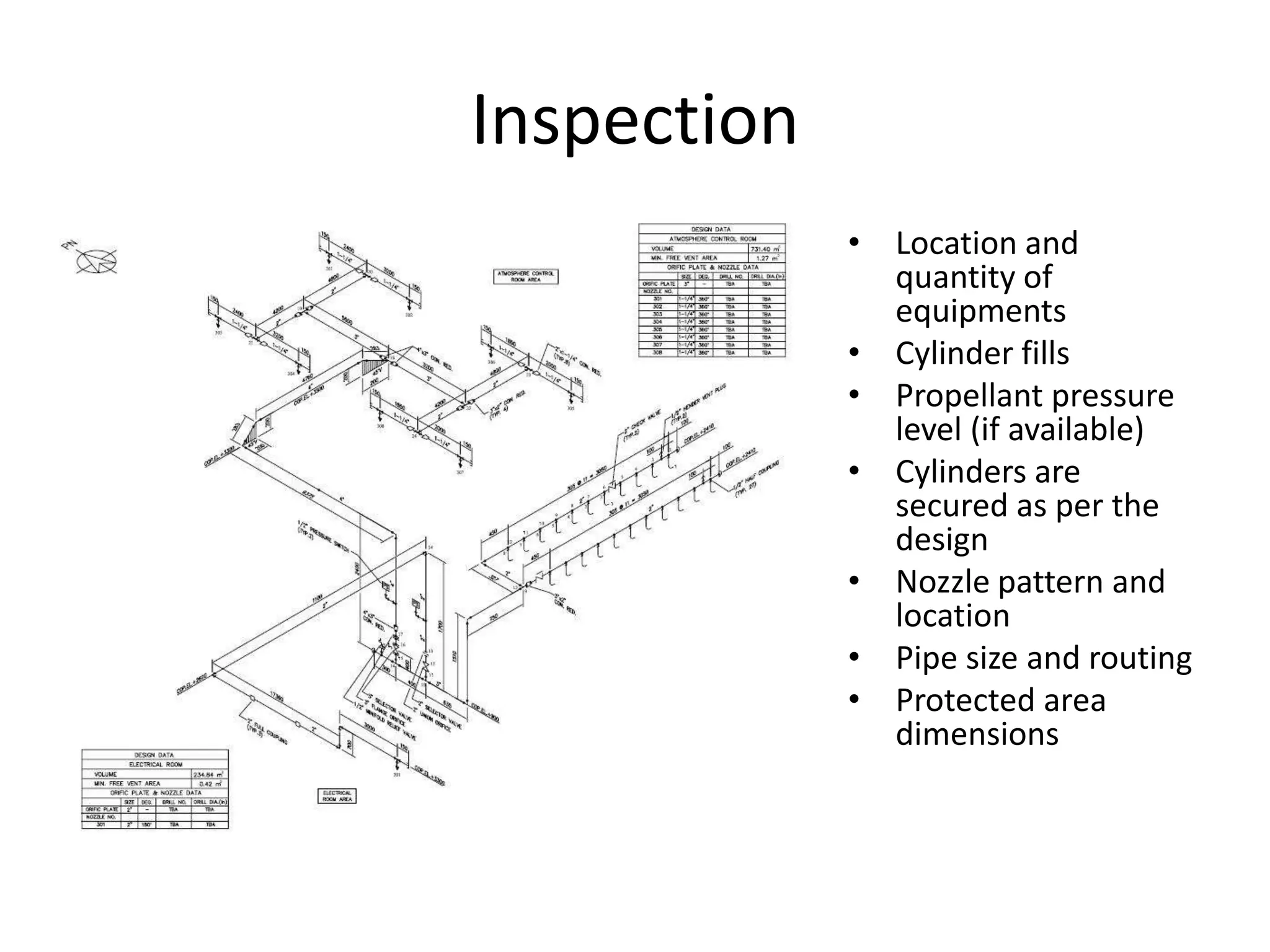
Inspection
             • Location and
               quantity of
               equipments
             • Cylinder fills
             • Propellant pressure
               level (if available)
             • Cylinders are
               secured as per the
               design
             • Nozzle pattern and
               location
             • Pipe size and routing
             • Protected area
               dimensions
Inspection
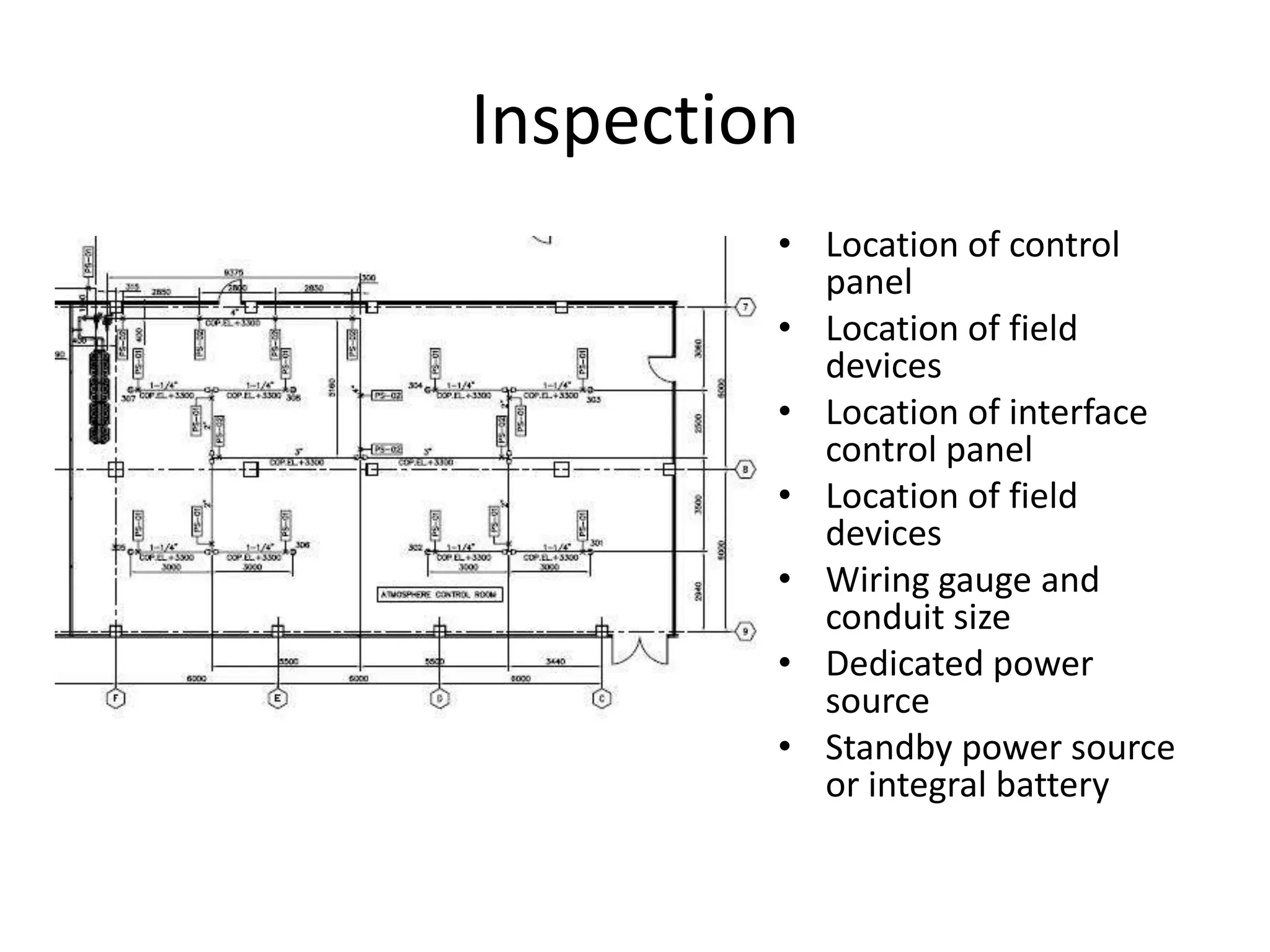
         • Location of control
           panel
         • Location of field
           devices
         • Location of interface
           control panel
         • Location of field
           devices
         • Wiring gauge and
           conduit size
         • Dedicated power
           source
         • Standby power source
           or integral battery
Inspection
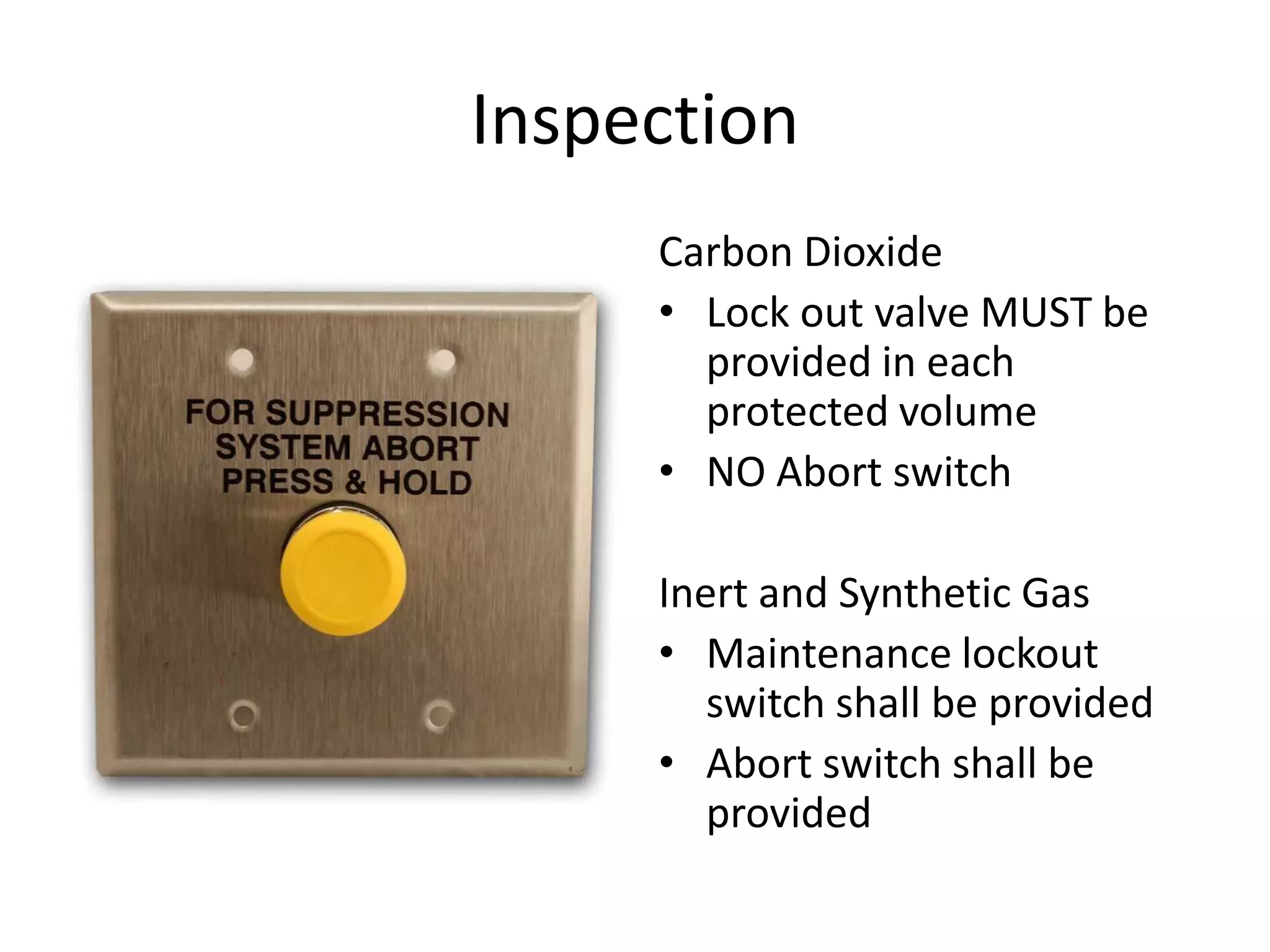
     Carbon Dioxide
     • Lock out valve MUST be
       provided in each
       protected volume
     • NO Abort switch

     Inert and Synthetic Gas
     • Maintenance lockout
        switch shall be provided
     • Abort switch shall be
        provided
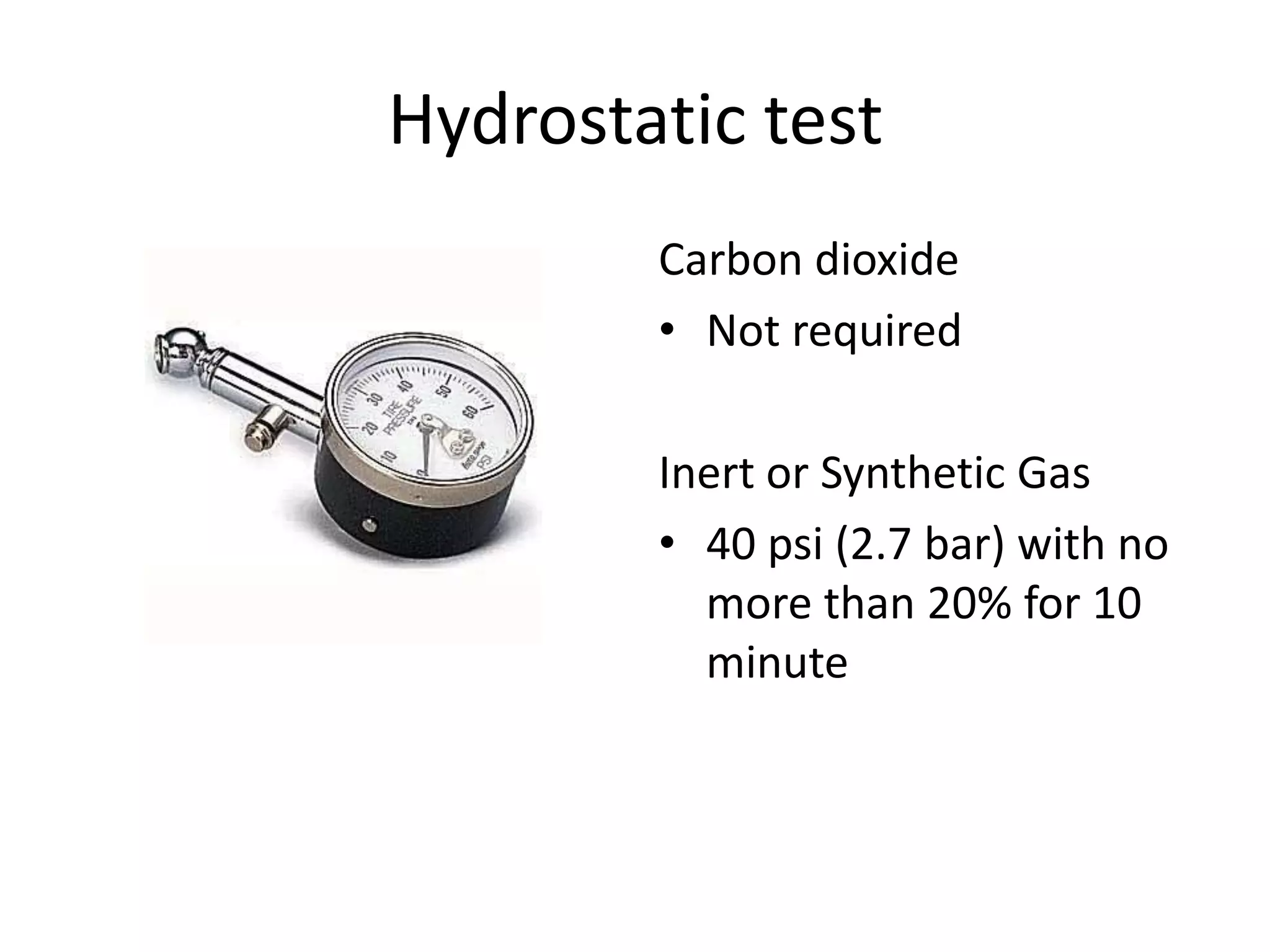
Hydrostatic test
        Carbon dioxide
        • Not required

        Inert or Synthetic Gas
        • 40 psi (2.7 bar) with no
          more than 20% for 10
          minute
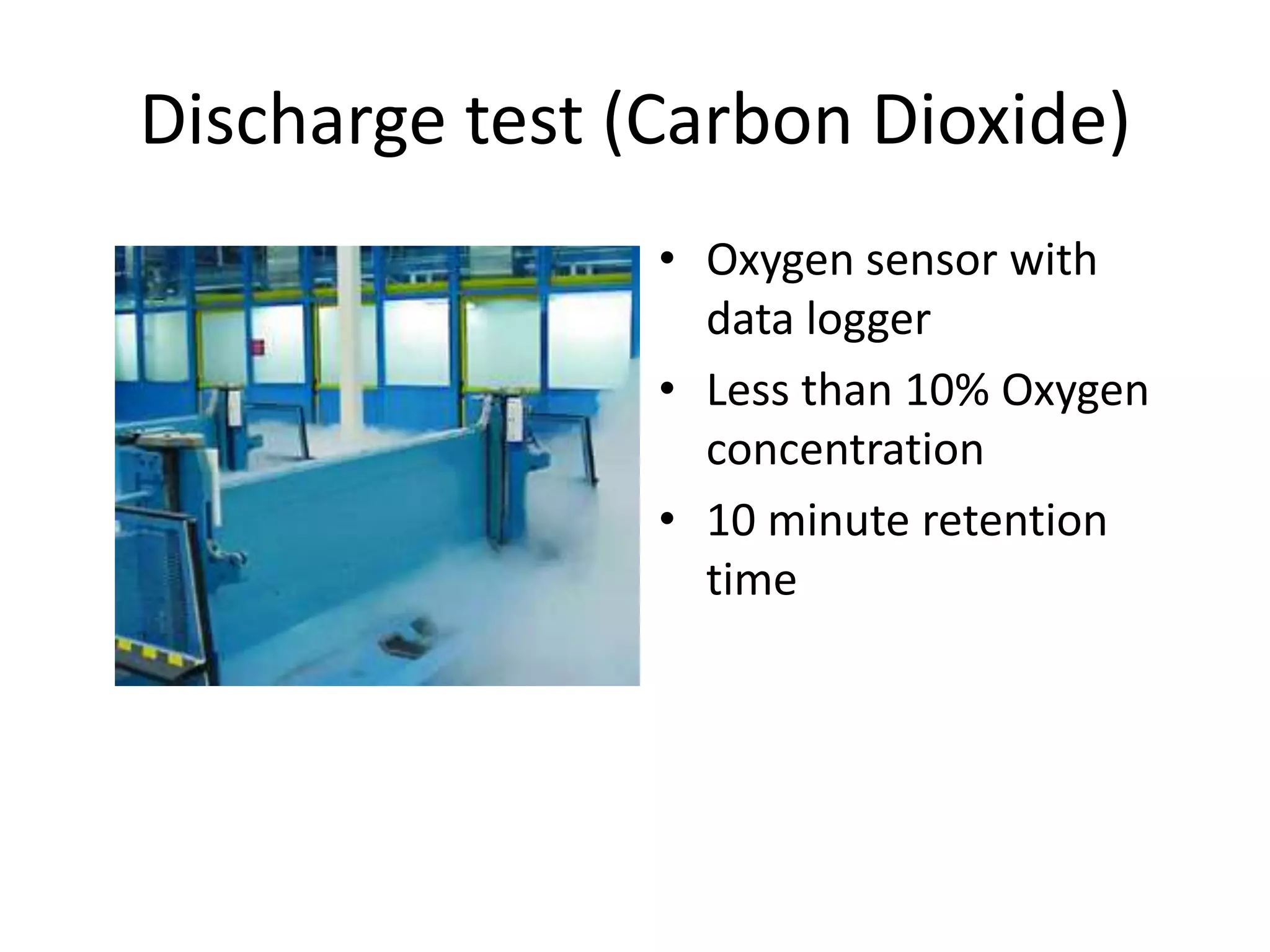
Discharge test (Carbon Dioxide)
                • Oxygen sensor with
                  data logger
                • Less than 10% Oxygen
                  concentration
                • 10 minute retention
                  time
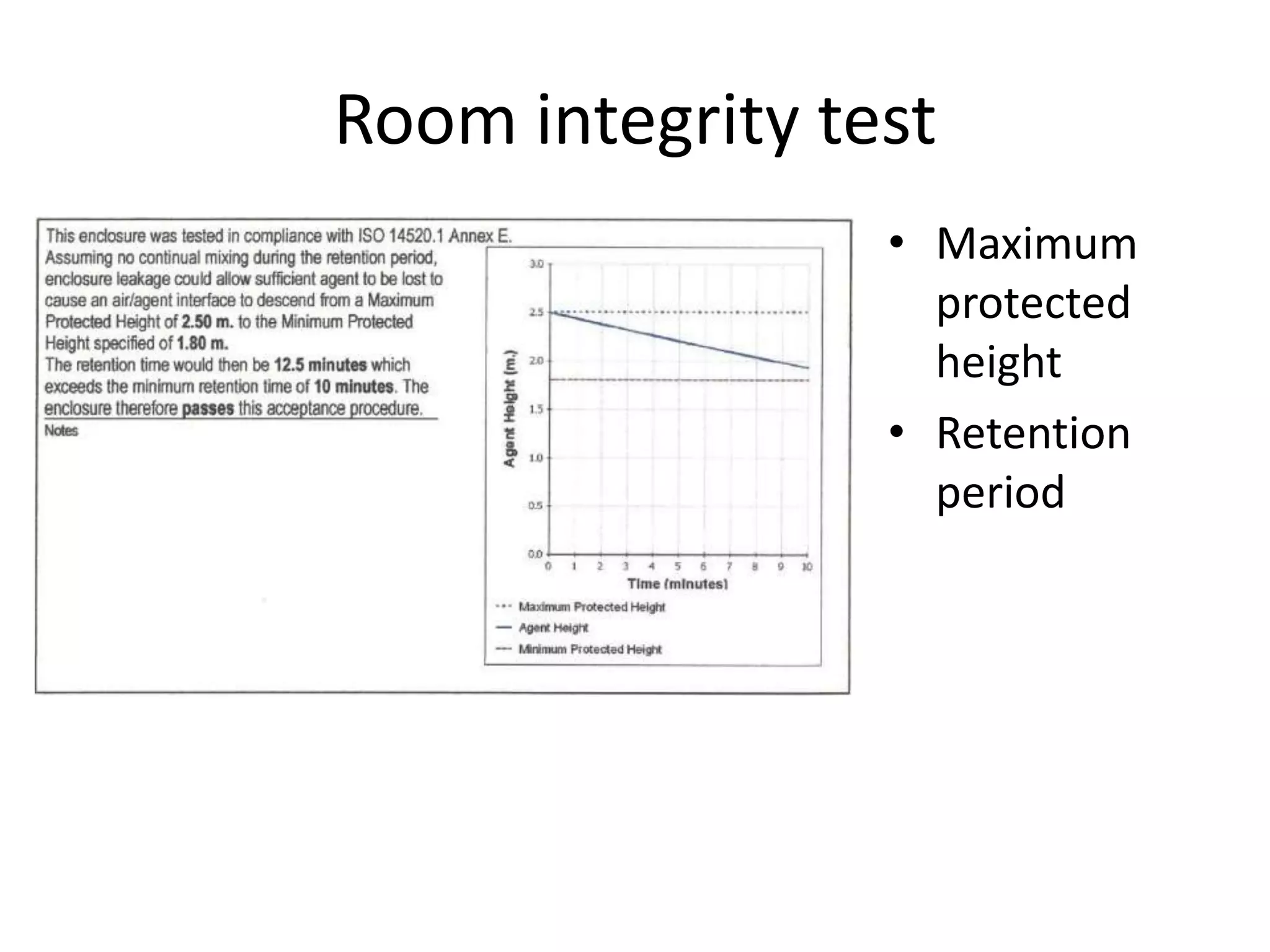
Room integrity test
                 • Maximum
                   protected
                   height
                 • Retention
                   period
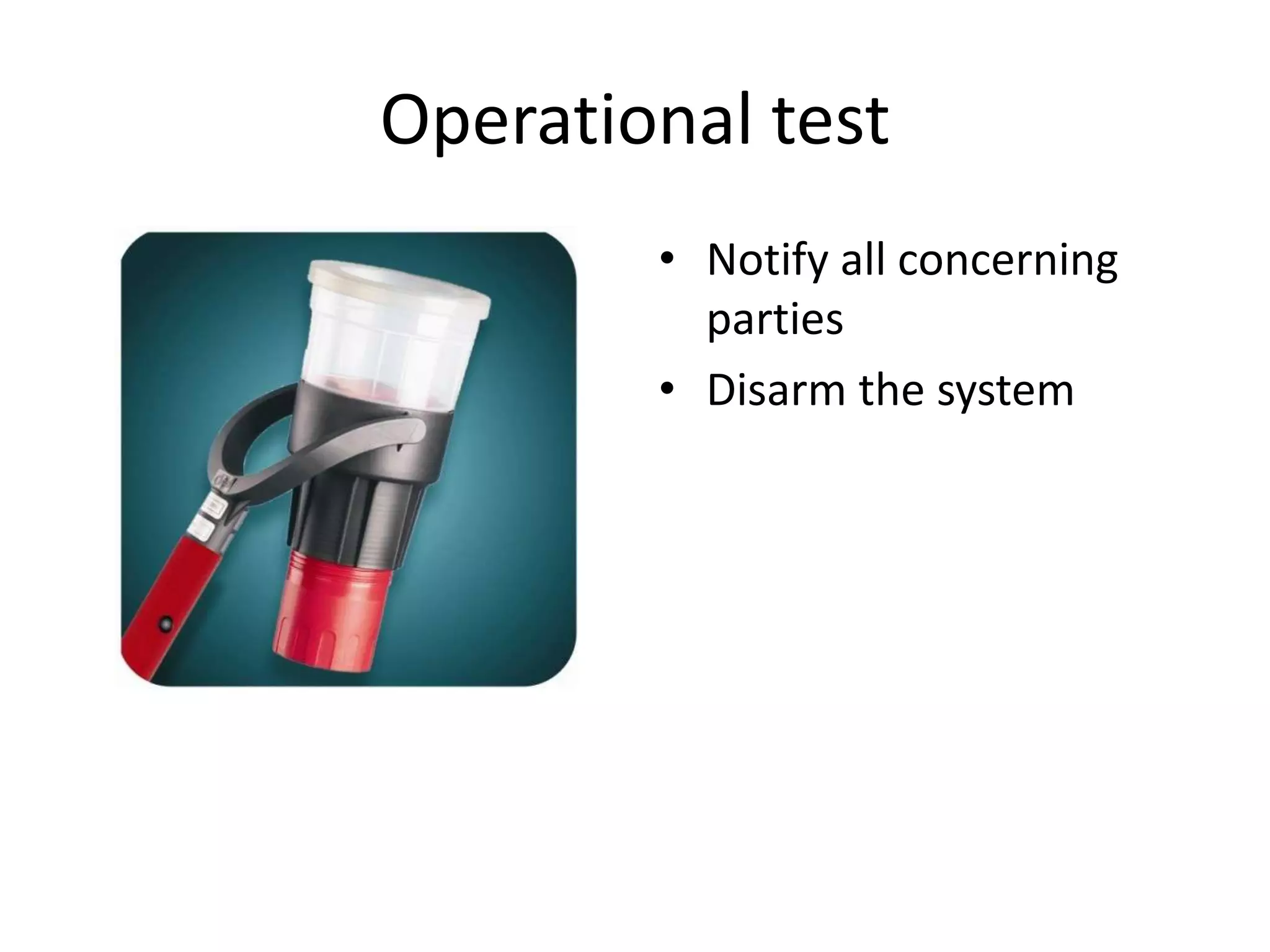
Operational test
        • Notify all concerning
          parties
        • Disarm the system
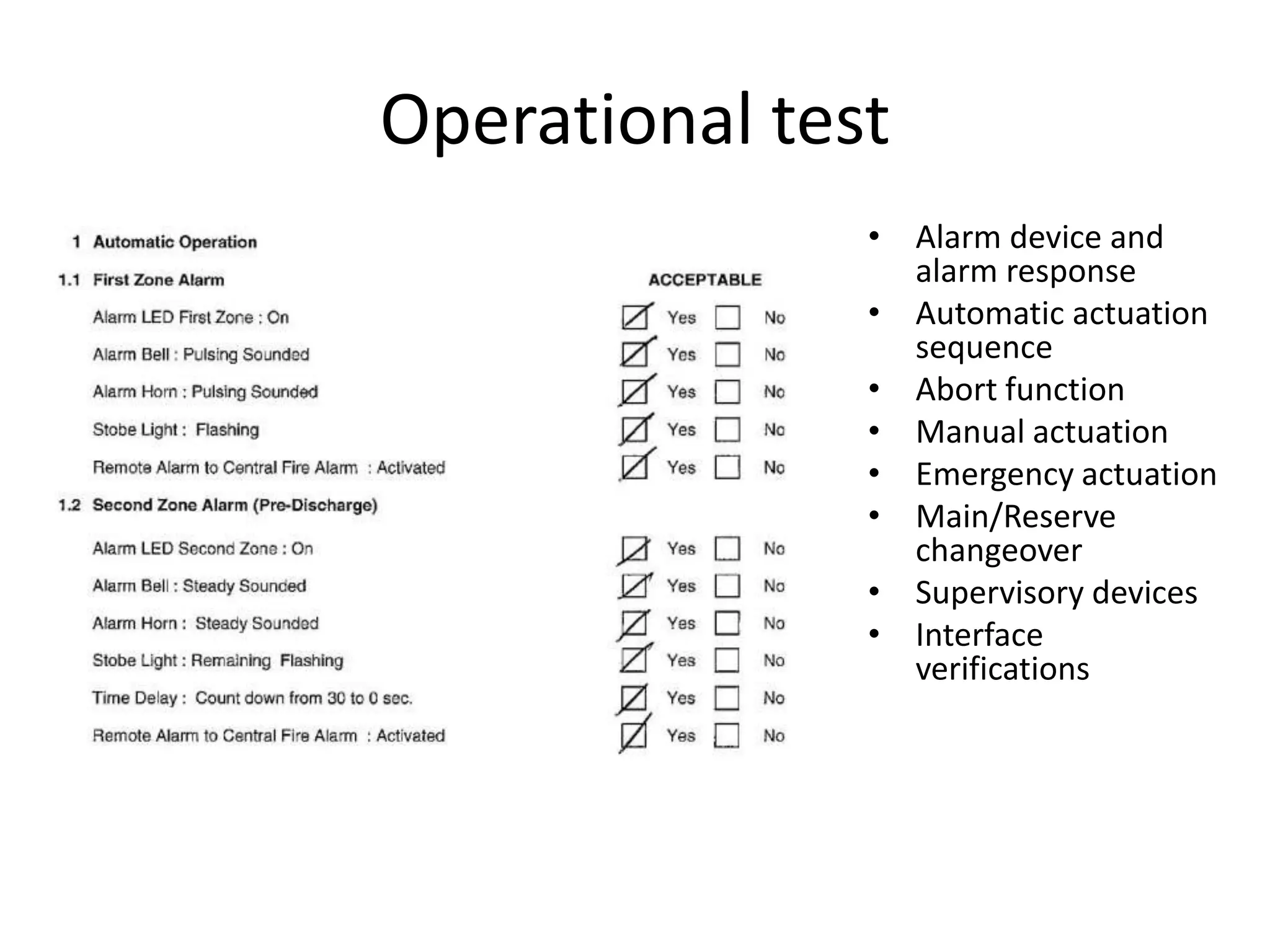
Operational test
               • Alarm device and
                 alarm response
               • Automatic actuation
                 sequence
               • Abort function
               • Manual actuation
               • Emergency actuation
               • Main/Reserve
                 changeover
               • Supervisory devices
               • Interface
                 verifications
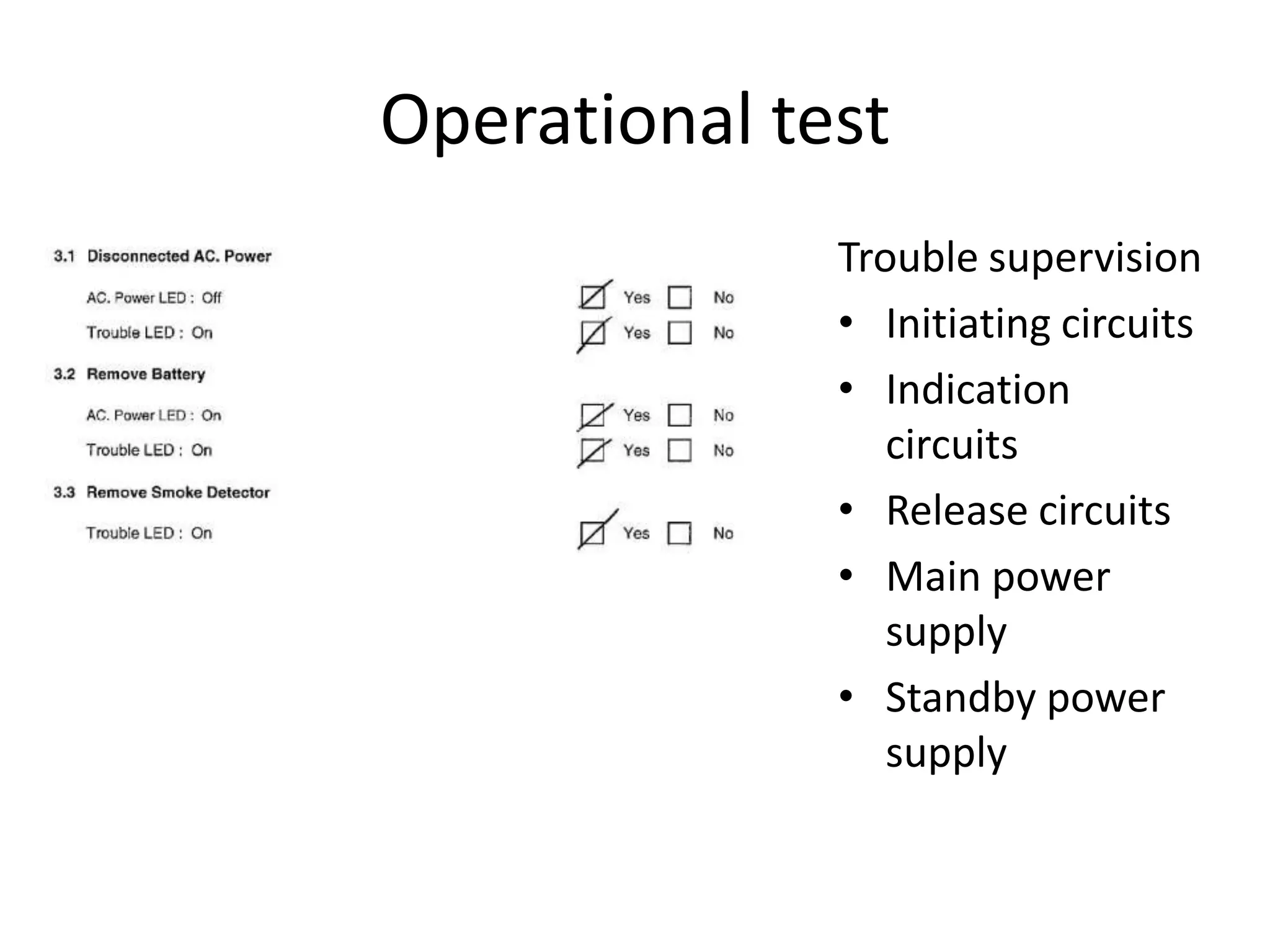
Operational test
              Trouble supervision
              • Initiating circuits
              • Indication
                 circuits
              • Release circuits
              • Main power
                 supply
              • Standby power
                 supply
http://www.slideshare.com
    User name: Angkut

Fire protection system, inspection and test

  • 1.
    Fire Protection System Inspection and Test
  • 2.
    Fire Protection Systems • • • •
  • 3.
    Inspection and Test • Inspection • Test – Periodic Test – Acceptance Test
  • 4.
    Fire Protection Systems • Sprinkler • Water Spray • Clean Agent
  • 5.
    Sprinkler System • Wet pipe • Preaction – Single Interlock – Double Interlock
  • 6.
    Sprinkler System • • Manual
  • 7.
    Automatic Sprinkler • Listed spray pattern • Sensitive to obstruction
  • 8.
    Automatic Sprinkler • Listed temperature rating • Listed discharge coefficient
  • 9.
    Wet Pipe • Continuously charged • Immediate discharge
  • 10.
    Preaction • Continuously monitored by compressed air • Require fire detection system
  • 11.
    Single Interlock • Water charge in system piping upon operation of alarm device
  • 12.
    Double Interlock • Water charge in system piping upon operation of alarm device and sprinkler opening
  • 13.
    Preaction sprinkler • Upright sprinkler • Dry sprinkler • Pendent sprinkler in return bends and branch lines are above 4C • Horizontal sidewall sprinkler installed so that water is not trapped
  • 14.
    Required Information • As-Built drawings • AHJ additional requirements • Calculation sheets • Data sheets • User Manual • Maintenance Manual
  • 15.
    Inspection • Occupancy classification • Protected area • Discharge area • System demand • Flow at most remote sprinkler • Flow at system riser
  • 16.
    Inspection • Location and quantity of equipments • Pipe size and routing • Sprinkler obstructions – Pattern development obstruction – Water distribution obstruction
  • 17.
    Inspection Sprinkler obstructions • Pattern development • Water distribution
  • 18.
  • 19.
  • 20.
  • 21.
    Hydrostatic test • 200 psi (13.8 bar) without loss for 2 hours • Test pressure shall be read from a gauge located at the low elevation point of the system
  • 22.
    Air test (Preaction) • 40 psi (2.8 bar) with less than 1-1/2 psi (0.1 bar) in 24 hours
  • 23.
    Operational test • Open Inspector’s test connection • Alarm expected within 5 minutes Preaction • Activate alarm device • Open Inspector’s test connection • Water discharge expected within 1 minute
  • 24.
    Operational test • Open main drain valve and leave open until pressure stabilized • Close and open each control valves under system water pressure • Open and flow test all pressure reducing valve
  • 25.
    Water Spray System • Open nozzle • Normally empty pipe
  • 26.
    Water Spray Nozzle • Predetermined pattern • Sensitive to wind draft
  • 27.
    Required Information • As-Built drawings • AHJ additional requirements • Calculation sheets • Data sheets • User Manual • Maintenance Manual
  • 28.
    Inspection • Protected hazard • Design density • Protected area • System demand
  • 29.
    Inspection • Location and quantity of equipments • Nozzle pattern and location • Pipe size and routing
  • 30.
    Hydrostatic test • 200 psi (13.8 bar) without loss for 2 hours • Test pressure shall be read from a gauge located at the low elevation point of the system
  • 31.
    Operational test • Test system actuation as per manufacturer’s manual • Discharge test (Automatic, Manual, Em ergency)
  • 32.
    Clean Agent System • Carbon Dioxide • Inert Gases • Synthetic Gases
  • 33.
    Clean Agent System • Normally empty pipe • 10 seconds – 60 seconds discharge • Require Automatic detection and control
  • 34.
    Carbon Dioxide • Stored in liquid or superheated gas state • No pressure gauge • Quantity check only by weighing • Flow in two phases • Very low temperature discharge • Nominal 60 seconds discharge
  • 35.
    Inert Gas • Stored in high pressure compressed gas state • Pressure gauge represent gas quantity • Flow in gas state • Nominal 60 seconds discharge
  • 36.
    Synthetic Gas • Stored in liquid state under Nitrogen propellant • Pressure gauge represent propellant quantity • Weighing or liquid level measuring for agent quantity • Discharge within 10 seconds to prevent decomposition products
  • 37.
    Required Information • As-Built drawings • AHJ additional requirements • Calculation sheets • Data sheets • User Manual • Maintenance Manual
  • 38.
    Inspection • Protected hazard • Design concentration • Protected volume • System demand • Discharge duration • Operation sequence
  • 39.
    Inspection • Location and quantity of equipments • Cylinder fills • Propellant pressure level (if available) • Cylinders are secured as per the design • Nozzle pattern and location • Pipe size and routing • Protected area dimensions
  • 40.
    Inspection • Location of control panel • Location of field devices • Location of interface control panel • Location of field devices • Wiring gauge and conduit size • Dedicated power source • Standby power source or integral battery
  • 41.
    Inspection Carbon Dioxide • Lock out valve MUST be provided in each protected volume • NO Abort switch Inert and Synthetic Gas • Maintenance lockout switch shall be provided • Abort switch shall be provided
  • 42.
    Hydrostatic test Carbon dioxide • Not required Inert or Synthetic Gas • 40 psi (2.7 bar) with no more than 20% for 10 minute
  • 43.
    Discharge test (CarbonDioxide) • Oxygen sensor with data logger • Less than 10% Oxygen concentration • 10 minute retention time
  • 44.
    Room integrity test • Maximum protected height • Retention period
  • 45.
    Operational test • Notify all concerning parties • Disarm the system
  • 46.
    Operational test • Alarm device and alarm response • Automatic actuation sequence • Abort function • Manual actuation • Emergency actuation • Main/Reserve changeover • Supervisory devices • Interface verifications
  • 47.
    Operational test Trouble supervision • Initiating circuits • Indication circuits • Release circuits • Main power supply • Standby power supply
  • 48.
    http://www.slideshare.com User name: Angkut

Editor's Notes

  • #3 ลักษณะเฉพาะของระบบป้องกันอัคคีภัย
  • #4 ความสำคัญ ความแตกต่างระหว่าง Inspection และ Test
  • #5 ขอบเขตของเนื้อหาที่จะบรรยาย
  • #6 ระบบหัวกระจายน้ำดับเพลิงแบบต่างๆที่คาดว่าจะพบเห็นได้ในบ้านเรา
  • #7 ลักษณะเฉพาะ และความแตกต่างจากระบบที่ใช้ในการผลิตCorrosion rateขีดจำกัดของการทดสอบ
  • #8 Deflector และ Spray pattern ที่กำหนดตามมาตรฐาน ไม่ต้องทดสอบ แต่ต้องออกแบบให้ตรงกับคู่มือ
  • #9 Temperature rating ขึ้นกับอุณหภูมิสภาพแวดล้อมDischarge coefficient ขึ้นกับอันตราย และ Temperature rating
  • #11 ต้องมีอุปกรณ์เพิ่มอย่างน้อยสองชนิดคือ Air maintenance และ Fire detectionFire detection ควรทำงานก่อน Sprinkler เล็กน้อย การใช้ Heat detector จึงเหมาะสมกับระบบมากกว่าการใช้ Smoke detector
  • #15 ตรวจสอบข้อกำหนดของ AHJ (เช่น ประกันภัย)ตรวจสอบความครบถ้วนของเอกสาร User manual และ Maintenance manuals
  • #16 ต้องใช้ Hydraulic calculations sheetsProtected area ดูจากมาตรฐาน วสท
  • #17 ต้องใช้ As-built drawings และ Equipment data sheets
  • #18 Pattern developmentObstruction less than 18 in (457 mm) below sprinkler deflectorWater distribution
  • #19 Upright or pendent only
  • #20 Upright or pendent only
  • #21 Upright or pendent only
  • #24 ทดสอบ Alarm และขั้นตอนการทำงานของPreaction ตามคู่มือของผู้ผลิต หากผู้ออกแบบกำหนดไว้ต่างจากผู้ผลิตให้ AHJ พิจารณาว่าเหมาะสมหรือไม่ด้วย
  • #25 บันทึก Static, Residual pressure เปรียบเทียบกับ Hydraulic calculationsบันทึก Inlet pressure, Outlet pressure ของ Pressure reducing valve เปรียบเทียบกับ Data sheet
  • #26 ลักษณะเฉพาะ และความแตกต่างจากระบบที่ใช้ในการผลิตTest pressure vs Working pressure
  • #28 ตรวจสอบข้อกำหนดของ AHJ (เช่น ประกันภัย)ตรวจสอบความครบถ้วนของเอกสาร User manual และ Maintenance manuals
  • #29 ต้องใช้ As-built drawings และ Hydraulic calculations sheets
  • #30 ต้องใช้ As-built drawings และ Equipment data sheetsพื้นที่ทั้งหมดจะต้องถูกน้ำฉีดโดยตรง ยกเว้นมีข้อกำหนดเป็นอย่างอื่น
  • #31 มักต้องถอด Nozzle ออกเพื่อใส่ปลั๊กอุด – จดตำแหน่งของ Nozzle และใส่ Nozzle ตาม Pattern และCdให้ตรงตำแหน่งเดิม
  • #32 ไม่ต้องพิจารณา Flushing เพราะเราทำ Discharge test อยู่แล้วFlushing เป็นเรื่องของ Contractor ที่ต้องทำไปก่อนเพื่อให้แน่ใจว่าฉีดน้ำได้ตาม Patternบันทึก Supply pressure เปรียบเทียบกับ Hydraulic calculations
  • #34 ลักษณะเฉพาะ และความแตกต่างจากระบบที่ใช้ในการผลิตWorking pressure vs test pressure แตกต่างจากระบบ Process อย่างเห็นได้ชัด
  • #38 ตรวจสอบข้อกำหนดของ AHJ (เช่น ประกันภัย)ตรวจสอบความครบถ้วนของเอกสาร User manual และ Maintenance manuals
  • #39 ต้องใช้ As-built drawings และ Hydraulic calculations sheets
  • #40 ต้องใช้ As-built drawings และ Equipment data sheetsห้องจะต้องมีลักษณะและปริมาตรตรงกับในแบบ
  • #41 Check against drawingsAll field devices shall be practically accessibleSmoke detector shall be properly installedManual release device shall not be covered or obstructed
  • #42 Safety reason for Carbon Dioxide. Environmental reason for Clean agent.Manual release shall be double action type.Abort switch shall be dead man type and located within the protected area.
  • #43 มักต้องถอด Nozzle ออกเพื่อใส่ปลั๊กอุด – จดตำแหน่งของ Nozzle และใส่ Nozzle ตาม Pattern และCdให้ตรงตำแหน่งเดิม
  • #44 ใช้ขั้นตอนนี้เป็นส่วนหนึ่งของ Operation test โดยเป็นการฉีดจริงข้อควรระวัง: สภาพอับอากาศในบริเวณทดสอบ
  • #46 การทดสอบจะมีสัญญาณเตือนภัย ต้องซักซ้อมกับผู้รับสัญญาณ รวมทั้งผู้ที่จะใช้สัญญาณในการควบคุมอื่นๆด้วย
  • #47 Check against operation sequenceInterface – HVAC, Main fire alarm