PRINCIPLE OF UTMOST
GOOD FAITH
N. SUBHASHINI
Pre Senior Year
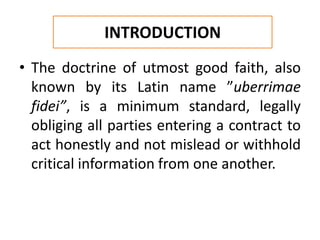
• The doctrine of utmost good faith, also
known by its Latin name ”uberrimae
fidei”, is a minimum standard, legally
obliging all parties entering a contract to
act honestly and not mislead or withhold
critical information from one another.
INTRODUCTION
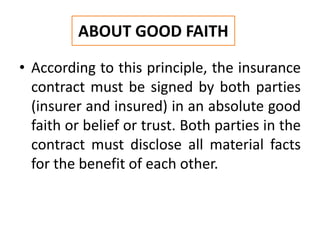
• According to this principle, the insurance
contract must be signed by both parties
(insurer and insured) in an absolute good
faith or belief or trust. Both parties in the
contract must disclose all material facts
for the benefit of each other.
ABOUT GOOD FAITH
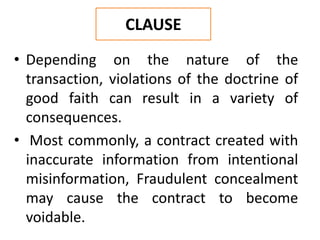
• Depending on the nature of the
transaction, violations of the doctrine of
good faith can result in a variety of
consequences.
• Most commonly, a contract created with
inaccurate information from intentional
misinformation, Fraudulent concealment
may cause the contract to become
voidable.
CLAUSE
The Regulation as per section 45 of Insurance
Act allows insurers for calling a policy in
question on the ground of misrepresentation or
suppression of a material fact not amounting to
fraud only within the initial three years of the
policy.
SEC.45 INSURANCE
ACT, 1938
• No Life Insurance can be called in question of
any reason after a period of 3 years from date
of commencement. Therefore a strict
interpretation of sec.45 would mean that even
if there was willful non-disclosure, the right of
denial of even death claim is not available
after 3 years
SECTION
EXPLANATION
• Insurance is uberrimae fidei: A contract
of marine insurance is a contract based
upon the utmost good faith, and if the
utmost good faith be not observed by
either party, the contract may be avoided
by the other party.
SECTION.19 THE
MARINE
INSURNACE ACT, 1963
• Unlike insurance contracts, most commercial
agreements do not subscribe to the doctrine of
utmost good faith. Instead, many are subject
to Caveat Emptor, or "buyer beware."
• This principle of contract law places the onus on
the buyer to perform due diligence before making
a purchase. In other words, a seller need only
disclose information requested by the buyer.
DOCTRINE OF UTMOST GOOD FAITH
VS
CAVEAT EMPTOR
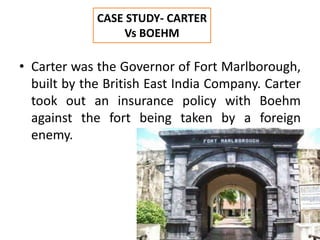
• Carter was the Governor of Fort Marlborough,
built by the British East India Company. Carter
took out an insurance policy with Boehm
against the fort being taken by a foreign
enemy.
CASE STUDY- CARTER
Vs BOEHM
• A witness, Captain Tryon, testified that Carter
was aware that the fort was built to resist
attacks from natives but would be unable to
repel European enemies, and he knew the
French were likely to attack.
• The French successfully attacked, but Boehm
refused to honor the indemnifier Carter, who
promptly sued.
CONTINUATION
• Lord Mansfield found in favor of the policyholder
on the grounds that the insurer knew or ought to
have known that the risk existed as the political
situation was public knowledge:
“There was not a word said to him, of the affairs of
India, or the state of the war there, or the
condition of Fort Marlborough. If he thought that
omission an objection at the time, he ought not to
have signed the policy with a secret reserve in his
own mind to make it void,” said the Judge.
CONTINUATION
FACTS:
Insurance policy was taken by the husband of
the respondent and the insured died with 1
and half year of taking the policy and the
claim was repudiated on the ground of Non-
Disclosure and withholding information
regarding the health of the insured.
LIFE INSURANCE CORPORATION
VS
ASHA GOEL
• Writ petition was filed under Article 226 in
High Court.
• Corporation stated that the claim was
repudiated on the ground that deceased gave
incorrect answers because he stated that his
health was good and he had no consulted a
medical practitioner within last 5 years, and
also not remained absent from work on
ground of health for 13 days few year back.
CONTINUATION
• The Division bench held that the
corporation should be allowed to lead
evidence because it would be useful for
their contention that policy was
obtained by fraud.
• Fresh trial started, in the High Court
CONTINUATION
Whether the judgment of the division bench is
right in cancelling the repudiating of the claim?
• That the claim was repudiated on the ground
Non-disclosure of medical history of the ailment
and the policy was repudiated after passing of
the limitation period of three years. Where Sec.
45 clearly states that claim cannot be brought in
to questioning after period of three years had
expired from the date of issuance of the policy.
ISSUE
• The corporation couldn’t prove that deceased
had made a false statement and such
statement was material in nature and was
made fraudulently, Hence the defense
couldn’t be supported.
• The petitioner wife stated medical report that
the deceased wasn’t affected and was healthy
prior to the policy.
• Hence, they were obliged to the claim.
CONTINUATION
THANK YOU

Utmost good faith ppt

  • 1.
    PRINCIPLE OF UTMOST GOODFAITH N. SUBHASHINI Pre Senior Year
  • 3.
    • The doctrineof utmost good faith, also known by its Latin name ”uberrimae fidei”, is a minimum standard, legally obliging all parties entering a contract to act honestly and not mislead or withhold critical information from one another. INTRODUCTION
  • 4.
    • According tothis principle, the insurance contract must be signed by both parties (insurer and insured) in an absolute good faith or belief or trust. Both parties in the contract must disclose all material facts for the benefit of each other. ABOUT GOOD FAITH
  • 5.
    • Depending onthe nature of the transaction, violations of the doctrine of good faith can result in a variety of consequences. • Most commonly, a contract created with inaccurate information from intentional misinformation, Fraudulent concealment may cause the contract to become voidable. CLAUSE
  • 6.
    The Regulation asper section 45 of Insurance Act allows insurers for calling a policy in question on the ground of misrepresentation or suppression of a material fact not amounting to fraud only within the initial three years of the policy. SEC.45 INSURANCE ACT, 1938
  • 7.
    • No LifeInsurance can be called in question of any reason after a period of 3 years from date of commencement. Therefore a strict interpretation of sec.45 would mean that even if there was willful non-disclosure, the right of denial of even death claim is not available after 3 years SECTION EXPLANATION
  • 8.
    • Insurance isuberrimae fidei: A contract of marine insurance is a contract based upon the utmost good faith, and if the utmost good faith be not observed by either party, the contract may be avoided by the other party. SECTION.19 THE MARINE INSURNACE ACT, 1963
  • 9.
    • Unlike insurancecontracts, most commercial agreements do not subscribe to the doctrine of utmost good faith. Instead, many are subject to Caveat Emptor, or "buyer beware." • This principle of contract law places the onus on the buyer to perform due diligence before making a purchase. In other words, a seller need only disclose information requested by the buyer. DOCTRINE OF UTMOST GOOD FAITH VS CAVEAT EMPTOR
  • 10.
    • Carter wasthe Governor of Fort Marlborough, built by the British East India Company. Carter took out an insurance policy with Boehm against the fort being taken by a foreign enemy. CASE STUDY- CARTER Vs BOEHM
  • 11.
    • A witness,Captain Tryon, testified that Carter was aware that the fort was built to resist attacks from natives but would be unable to repel European enemies, and he knew the French were likely to attack. • The French successfully attacked, but Boehm refused to honor the indemnifier Carter, who promptly sued. CONTINUATION
  • 12.
    • Lord Mansfieldfound in favor of the policyholder on the grounds that the insurer knew or ought to have known that the risk existed as the political situation was public knowledge: “There was not a word said to him, of the affairs of India, or the state of the war there, or the condition of Fort Marlborough. If he thought that omission an objection at the time, he ought not to have signed the policy with a secret reserve in his own mind to make it void,” said the Judge. CONTINUATION
  • 13.
    FACTS: Insurance policy wastaken by the husband of the respondent and the insured died with 1 and half year of taking the policy and the claim was repudiated on the ground of Non- Disclosure and withholding information regarding the health of the insured. LIFE INSURANCE CORPORATION VS ASHA GOEL
  • 14.
    • Writ petitionwas filed under Article 226 in High Court. • Corporation stated that the claim was repudiated on the ground that deceased gave incorrect answers because he stated that his health was good and he had no consulted a medical practitioner within last 5 years, and also not remained absent from work on ground of health for 13 days few year back. CONTINUATION
  • 15.
    • The Divisionbench held that the corporation should be allowed to lead evidence because it would be useful for their contention that policy was obtained by fraud. • Fresh trial started, in the High Court CONTINUATION
  • 16.
    Whether the judgmentof the division bench is right in cancelling the repudiating of the claim? • That the claim was repudiated on the ground Non-disclosure of medical history of the ailment and the policy was repudiated after passing of the limitation period of three years. Where Sec. 45 clearly states that claim cannot be brought in to questioning after period of three years had expired from the date of issuance of the policy. ISSUE
  • 17.
    • The corporationcouldn’t prove that deceased had made a false statement and such statement was material in nature and was made fraudulently, Hence the defense couldn’t be supported. • The petitioner wife stated medical report that the deceased wasn’t affected and was healthy prior to the policy. • Hence, they were obliged to the claim. CONTINUATION
  • 18.