FIRE SAFETY
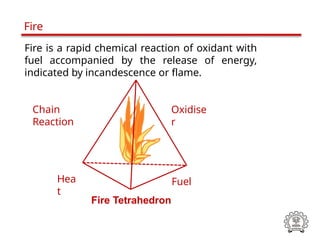
Fire is a rapid chemical reaction of oxidant with
fuel accompanied by the release of energy,
indicated by incandescence or flame.
Fire
Fuel
Fire Tetrahedron
Hea
t
Chain
Reaction
Oxidise
r
For a fire to happen, the following elements are
essential
• Oxidiser to sustain combustion.
• Heat to reach ignition temperature.
• Fuel or combustible material.
This results in a chemical chain reaction which starts a
fire. Removing any of these elements will extinguish
the fire.
Combustion Charactersitics
During a fire heat transfer occurs by
• Conduction - transfer of heat within the material itself.
• Convection - transfer of heat by the physical
movement of hot masses of air.
• Radiation - refers to the emission of heat in the form
of
electromagnetic waves.
Heat Transfer
• Ignition is the process of initiating self
sustained combustion.
• The ignition temperature of a substance is the
minimum temperature to which it must be
heated for it to ignite.
Ignition
Ignition can occur by
• Electrically powered equipment- Arcing, damaged
wiring, over heating of cables due to excess
loads, loose electrical connections, heat from
electric bulbs etc.
• Open flame
• Hot surfaces
• Sparks from welding operations
• Chemical reaction between incompatible chemicals
• Smoking
• Batteries
Sources of Ignition
In a flammable liquid fire, it is the vapours released
from the surface of the liquid that burns.
Flash point is the lowest temperature at which a
liquid produces enough vapor to form an ignitable
mixture.
E.g., Diethyl ether (-45 O C)
Methyl alcohol (11.1 O
C)
Lower the flash point of a flammable liquid, greater
the hazard.
Flash Point
On the basis of the type of fuel, fires
are classified into the following
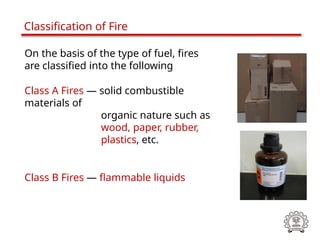
Class A Fires — solid combustible
materials of
organic nature such as
wood, paper, rubber,
plastics, etc.
Class B Fires — flammable liquids
Classification of Fire
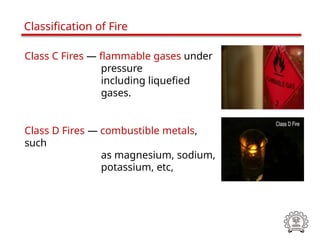
Class C Fires — flammable gases under
pressure
including liquefied
gases.
Class D Fires — combustible metals,
such
as magnesium, sodium,
potassium, etc,
Classification of Fire
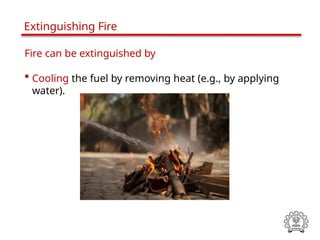
Fire can be extinguished by
• Cooling the fuel by removing heat (e.g., by applying
water).
Extinguishing Fire
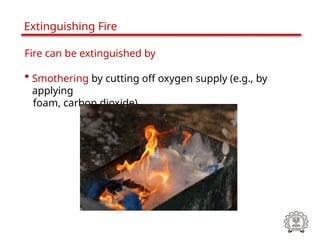
Fire can be extinguished by
• Smothering by cutting off oxygen supply (e.g., by
applying
foam, carbon dioxide).
Extinguishing Fire
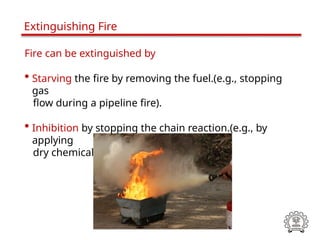
Fire can be extinguished by
• Starving the fire by removing the fuel.(e.g., stopping
gas
flow during a pipeline fire).
• Inhibition by stopping the chain reaction.(e.g., by
applying
dry chemical powder).
Extinguishing Fire
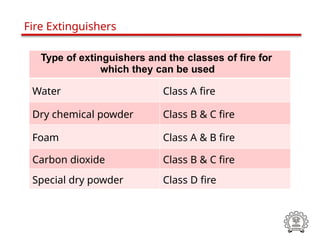
Fire Extinguishers
Type of extinguishers and the classes of fire for
which they can be used
Water Class A fire
Dry chemical powder Class B & C fire
Foam Class A & B fire
Carbon dioxide Class B & C fire
Special dry powder Class D fire
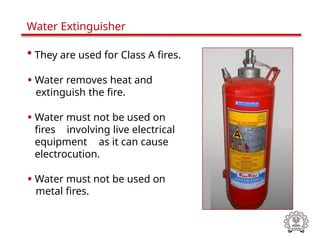
• They are used for Class A fires.
• Water removes heat and
extinguish the fire.
• Water must not be used on
fires involving live electrical
equipment as it can cause
electrocution.
• Water must not be used on
metal fires.
Water Extinguisher
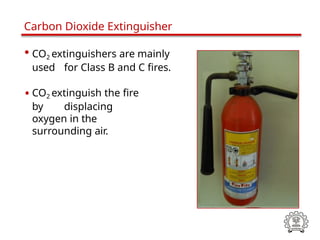
• CO2 extinguishers are mainly
used for Class B and C fires.
• CO2 extinguish the fire
by displacing
oxygen in the
surrounding air.
Carbon Dioxide Extinguisher
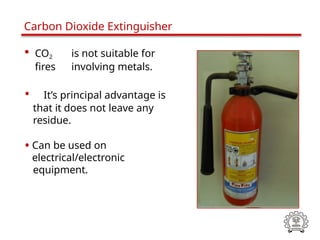
• CO2 is not suitable for
fires involving metals.
• It’s principal advantage is
that it does not leave any
residue.
• Can be used on
electrical/electronic
equipment.
Carbon Dioxide Extinguisher
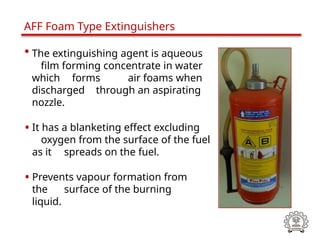
• The extinguishing agent is aqueous
film forming concentrate in water
which forms air foams when
discharged through an aspirating
nozzle.
• It has a blanketing effect excluding
oxygen from the surface of the fuel
as it spreads on the fuel.
• Prevents vapour formation from
the surface of the burning
liquid.
AFF Foam Type Extinguishers
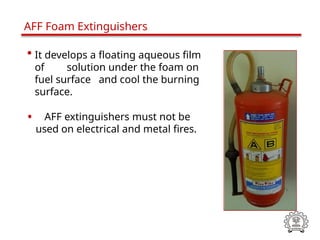
• It develops a floating aqueous film
of solution under the foam on
fuel surface and cool the burning
surface.
• AFF extinguishers must not be
used on electrical and metal fires.
AFF Foam Extinguishers
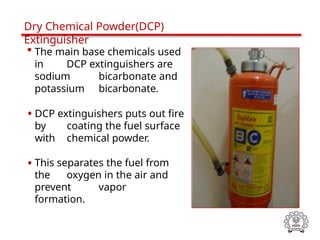
• The main base chemicals used
in DCP extinguishers are
sodium bicarbonate and
potassium bicarbonate.
• DCP extinguishers puts out fire
by coating the fuel surface
with chemical powder.
• This separates the fuel from
the oxygen in the air and
prevent vapor
formation.
Dry Chemical Powder(DCP)
Extinguisher
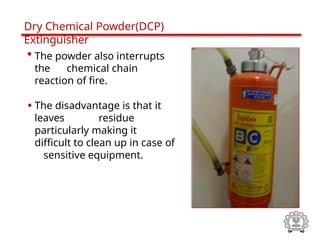
• The powder also interrupts
the chemical chain
reaction of fire.
• The disadvantage is that it
leaves residue
particularly making it
difficult to clean up in case of
sensitive equipment.
Dry Chemical Powder(DCP)
Extinguisher
• Special extinguishing agents are used for
extinguishing metallic fires.
• Dry powders extinguish the fire by forming a crust
on metal surface excluding
air and also absorbs heat from the metal surface.
• E.g., Blended sodium chloride based dry powder,
ternary eutectic chloride(TEC) powder, graphite
etc.
Special Dry Powder Extinguisher
• The extinguishing media is expelled from the
extinguisher by carbon dioxide gas contained
in a cartridge inside the extinguisher.
• CO2 extinguisher contains liquefied carbon dioxide.
The gas present in the vapour space above the
liquefied CO2 itself acts as the propellant. So no
separate cartridge is used in CO2 extinguisher.
Propellant for extinguishing media.
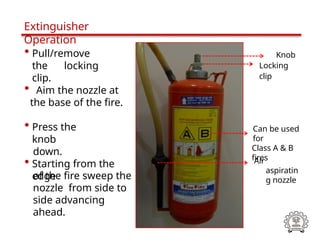
• Pull/remove
the locking
clip.
• Aim the nozzle at
the base of the fire.
• Press the
knob
down.
• Starting from the
edge
of the fire sweep the
nozzle from side to
side advancing
ahead.
Extinguisher
Operation
Knob
Locking
clip
Air
aspiratin
g nozzle
Can be used
for
Class A & B
fires
• When using AFFF on a container of burning liquid the
foam must be directed towards the back or side wall
of the container and allowed to spread over the
surface.
• Where the fire is in a liquid spill the foam must
be allowed to drop slightly ahead of the fire
and moved forward with a side to side
movement of the nozzle.
Operating Foam type Extinguisher
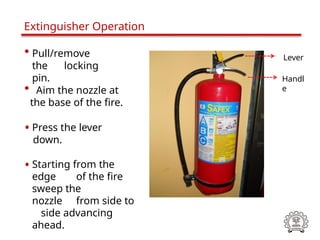
• Pull/remove
the locking
pin.
• Aim the nozzle at
the base of the fire.
• Press the lever
down.
• Starting from the
edge of the fire
sweep the
nozzle from side to
side advancing
ahead.
Extinguisher Operation
Lever
Handl
e
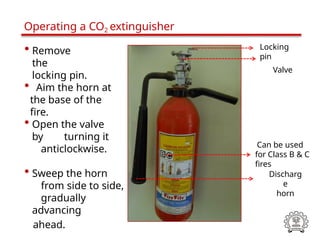
• Remove
the
locking pin.
• Aim the horn at
the base of the
fire.
• Open the valve
by turning it
anticlockwise.
• Sweep the horn
from side to side,
gradually
advancing
ahead.
Operating a CO2 extinguisher
Locking
pin
Valve
Discharg
e
horn
Can be used
for Class B & C
fires
The successful use of a fire extinguisher depends on
the following conditions:
• The extinguisher must be easily accessible and in
good working order.
• The extinguisher must be the right type for the fire.
• The fire must be discovered in its incipient stage for
the extinguisher to be effective.
Extinguishing Fire
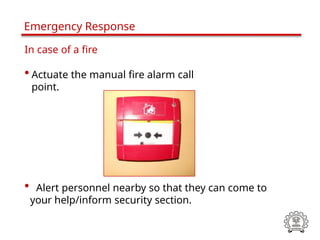
In case of a fire
• Actuate the manual fire alarm call
point.
• Alert personnel nearby so that they can come to
your help/inform security section.
Emergency Response
• Determine what is burning.
• Use the right type of extinguisher for fighting the fire.
Use the fire extinguisher only if you have attended
practical training.
• Always position yourself with an exit or means of
escape behind you before you attempt to use an
extinguisher to put out a fire.
Emergency Response
• If the person who notices the fire feels that it
cannot be tackled by extinguishers, he can directly
inform the fire station without delay.
• On hearing the alarm evacuate the building
and assemble at the designated assembly
point.
• As you evacuate close the doors of the rooms(do
not lock) as this will slow down the spread of
smoke and fire.
Emergency Response
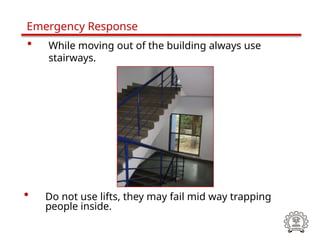
• Do not use lifts, they may fail mid way trapping
people inside.
Emergency Response
• While moving out of the building always use
stairways.
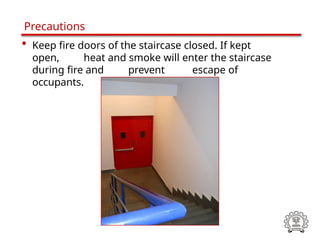
• Keep fire doors of the staircase closed. If kept
open, heat and smoke will enter the staircase
during fire and prevent escape of
occupants.
Precautions
• Do not obstruct emergency equipment. Fire
extinguishers must be easily accessible.
• Materials must not be stored in front of exits or
along stairways blocking them.
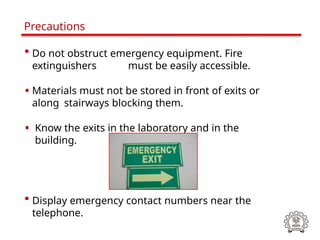
• Know the exits in the laboratory and in the
building.
• Display emergency contact numbers near the
telephone.
Precautions
THANK YOU

Basic Fire Safety Awareness Training as per IS.pptx

  • 1.
  • 2.
    Fire is arapid chemical reaction of oxidant with fuel accompanied by the release of energy, indicated by incandescence or flame. Fire Fuel Fire Tetrahedron Hea t Chain Reaction Oxidise r
  • 3.
    For a fireto happen, the following elements are essential • Oxidiser to sustain combustion. • Heat to reach ignition temperature. • Fuel or combustible material. This results in a chemical chain reaction which starts a fire. Removing any of these elements will extinguish the fire. Combustion Charactersitics
  • 4.
    During a fireheat transfer occurs by • Conduction - transfer of heat within the material itself. • Convection - transfer of heat by the physical movement of hot masses of air. • Radiation - refers to the emission of heat in the form of electromagnetic waves. Heat Transfer
  • 5.
    • Ignition isthe process of initiating self sustained combustion. • The ignition temperature of a substance is the minimum temperature to which it must be heated for it to ignite. Ignition
  • 6.
    Ignition can occurby • Electrically powered equipment- Arcing, damaged wiring, over heating of cables due to excess loads, loose electrical connections, heat from electric bulbs etc. • Open flame • Hot surfaces • Sparks from welding operations • Chemical reaction between incompatible chemicals • Smoking • Batteries Sources of Ignition
  • 7.
    In a flammableliquid fire, it is the vapours released from the surface of the liquid that burns. Flash point is the lowest temperature at which a liquid produces enough vapor to form an ignitable mixture. E.g., Diethyl ether (-45 O C) Methyl alcohol (11.1 O C) Lower the flash point of a flammable liquid, greater the hazard. Flash Point
  • 8.
    On the basisof the type of fuel, fires are classified into the following Class A Fires — solid combustible materials of organic nature such as wood, paper, rubber, plastics, etc. Class B Fires — flammable liquids Classification of Fire
  • 9.
    Class C Fires— flammable gases under pressure including liquefied gases. Class D Fires — combustible metals, such as magnesium, sodium, potassium, etc, Classification of Fire
  • 10.
    Fire can beextinguished by • Cooling the fuel by removing heat (e.g., by applying water). Extinguishing Fire
  • 11.
    Fire can beextinguished by • Smothering by cutting off oxygen supply (e.g., by applying foam, carbon dioxide). Extinguishing Fire
  • 12.
    Fire can beextinguished by • Starving the fire by removing the fuel.(e.g., stopping gas flow during a pipeline fire). • Inhibition by stopping the chain reaction.(e.g., by applying dry chemical powder). Extinguishing Fire
  • 13.
    Fire Extinguishers Type ofextinguishers and the classes of fire for which they can be used Water Class A fire Dry chemical powder Class B & C fire Foam Class A & B fire Carbon dioxide Class B & C fire Special dry powder Class D fire
  • 14.
    • They areused for Class A fires. • Water removes heat and extinguish the fire. • Water must not be used on fires involving live electrical equipment as it can cause electrocution. • Water must not be used on metal fires. Water Extinguisher
  • 15.
    • CO2 extinguishersare mainly used for Class B and C fires. • CO2 extinguish the fire by displacing oxygen in the surrounding air. Carbon Dioxide Extinguisher
  • 16.
    • CO2 isnot suitable for fires involving metals. • It’s principal advantage is that it does not leave any residue. • Can be used on electrical/electronic equipment. Carbon Dioxide Extinguisher
  • 17.
    • The extinguishingagent is aqueous film forming concentrate in water which forms air foams when discharged through an aspirating nozzle. • It has a blanketing effect excluding oxygen from the surface of the fuel as it spreads on the fuel. • Prevents vapour formation from the surface of the burning liquid. AFF Foam Type Extinguishers
  • 18.
    • It developsa floating aqueous film of solution under the foam on fuel surface and cool the burning surface. • AFF extinguishers must not be used on electrical and metal fires. AFF Foam Extinguishers
  • 19.
    • The mainbase chemicals used in DCP extinguishers are sodium bicarbonate and potassium bicarbonate. • DCP extinguishers puts out fire by coating the fuel surface with chemical powder. • This separates the fuel from the oxygen in the air and prevent vapor formation. Dry Chemical Powder(DCP) Extinguisher
  • 20.
    • The powderalso interrupts the chemical chain reaction of fire. • The disadvantage is that it leaves residue particularly making it difficult to clean up in case of sensitive equipment. Dry Chemical Powder(DCP) Extinguisher
  • 21.
    • Special extinguishingagents are used for extinguishing metallic fires. • Dry powders extinguish the fire by forming a crust on metal surface excluding air and also absorbs heat from the metal surface. • E.g., Blended sodium chloride based dry powder, ternary eutectic chloride(TEC) powder, graphite etc. Special Dry Powder Extinguisher
  • 22.
    • The extinguishingmedia is expelled from the extinguisher by carbon dioxide gas contained in a cartridge inside the extinguisher. • CO2 extinguisher contains liquefied carbon dioxide. The gas present in the vapour space above the liquefied CO2 itself acts as the propellant. So no separate cartridge is used in CO2 extinguisher. Propellant for extinguishing media.
  • 23.
    • Pull/remove the locking clip. •Aim the nozzle at the base of the fire. • Press the knob down. • Starting from the edge of the fire sweep the nozzle from side to side advancing ahead. Extinguisher Operation Knob Locking clip Air aspiratin g nozzle Can be used for Class A & B fires
  • 24.
    • When usingAFFF on a container of burning liquid the foam must be directed towards the back or side wall of the container and allowed to spread over the surface. • Where the fire is in a liquid spill the foam must be allowed to drop slightly ahead of the fire and moved forward with a side to side movement of the nozzle. Operating Foam type Extinguisher
  • 25.
    • Pull/remove the locking pin. •Aim the nozzle at the base of the fire. • Press the lever down. • Starting from the edge of the fire sweep the nozzle from side to side advancing ahead. Extinguisher Operation Lever Handl e
  • 26.
    • Remove the locking pin. •Aim the horn at the base of the fire. • Open the valve by turning it anticlockwise. • Sweep the horn from side to side, gradually advancing ahead. Operating a CO2 extinguisher Locking pin Valve Discharg e horn Can be used for Class B & C fires
  • 27.
    The successful useof a fire extinguisher depends on the following conditions: • The extinguisher must be easily accessible and in good working order. • The extinguisher must be the right type for the fire. • The fire must be discovered in its incipient stage for the extinguisher to be effective. Extinguishing Fire
  • 28.
    In case ofa fire • Actuate the manual fire alarm call point. • Alert personnel nearby so that they can come to your help/inform security section. Emergency Response
  • 29.
    • Determine whatis burning. • Use the right type of extinguisher for fighting the fire. Use the fire extinguisher only if you have attended practical training. • Always position yourself with an exit or means of escape behind you before you attempt to use an extinguisher to put out a fire. Emergency Response
  • 30.
    • If theperson who notices the fire feels that it cannot be tackled by extinguishers, he can directly inform the fire station without delay. • On hearing the alarm evacuate the building and assemble at the designated assembly point. • As you evacuate close the doors of the rooms(do not lock) as this will slow down the spread of smoke and fire. Emergency Response
  • 31.
    • Do notuse lifts, they may fail mid way trapping people inside. Emergency Response • While moving out of the building always use stairways.
  • 32.
    • Keep firedoors of the staircase closed. If kept open, heat and smoke will enter the staircase during fire and prevent escape of occupants. Precautions
  • 33.
    • Do notobstruct emergency equipment. Fire extinguishers must be easily accessible. • Materials must not be stored in front of exits or along stairways blocking them. • Know the exits in the laboratory and in the building. • Display emergency contact numbers near the telephone. Precautions
  • 34.