FIRE SAFETY TRAINING  THE LOSS PREVENTION UNIT OF THE  OFFICE OF RISK MANAGEMENT
COURSE OUTLINE I. FIRE SCIENCE II. FIRE SAFETY INSPECTIONS  III. EVACUATION PLAN IV. FIRE EXTINGUISHERS  V. OTHER FEATURES OF FIRE PROTECTION
FIRE SCIENCE
FIRE SCIENCE What elements are needed to start a fire?
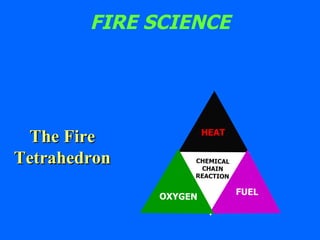
FIRE SCIENCE The Fire Tetrahedron HEAT CHEMICAL CHAIN REACTION FUEL OXYGEN
FIRE SCIENCE FUEL CAN BE LIQUID: Grease, Oil, Fuel;  SOLID: Wood, Paper, Metal; GAS:  Natural Gas, Propane,  Acetylene .
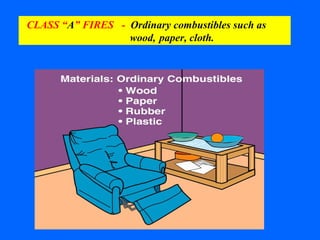
CLASS “ A ” FIRES  -  Ordinary combustibles such as   wood, paper, cloth.
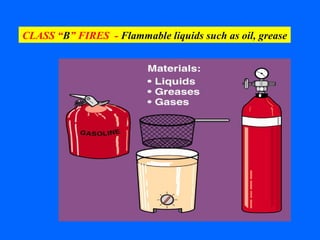
CLASS “ B ” FIRES  -  Flammable liquids such as oil, grease
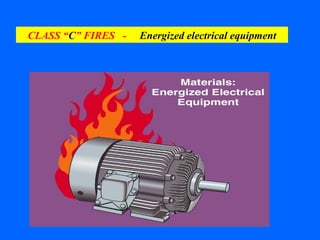
CLASS “ C ” FIRES  -  Energized electrical equipment
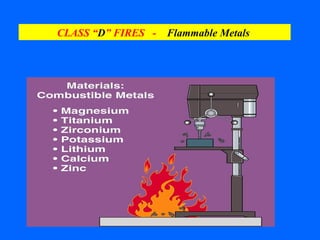
CLASS “ D ” FIRES  -  Flammable Metals
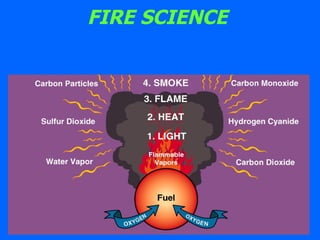
FIRE SCIENCE What is smoke?
FIRE SCIENCE WHAT IS THE DIFFERENCE BETWEEN  COMBUSTIBLE  AND  FLAMMABLE  MATERIAL? Combustible material  has  a flashpoint of 100 F   or above   Flammable material  has  a flashpoint below  100 F  [Ref. NFPA 96]
FIRE SCIENCE
FIRE SCIENCE
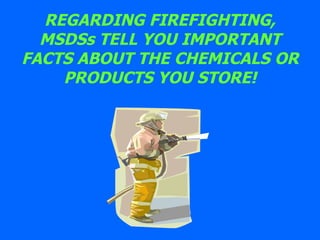
REGARDING FIREFIGHTING, MSDSs TELL YOU IMPORTANT FACTS ABOUT THE CHEMICALS OR PRODUCTS YOU STORE!
FIRE SAFETY INSPECTIONS YOUR ORM  LOSS PREVENTION OFFICER  IS AVAILABLE TO ASSIST
FIRE SAFETY INSPECTIONS SOME HAZARDS TO LOOK FOR IN YOUR WORKPLACE
EXAMPLES Locked or blocked exits (common hazard)  Trash or debris  Electrical hazards  Cooking hazards  Chemical, Gas Cylinders/ System, and Labs Smoking Areas Exit Signs Blocked exits/isles/hallways Fire extinguisher hazards  Emergency lighting hazards Emergency stairway doors blocked or propped open
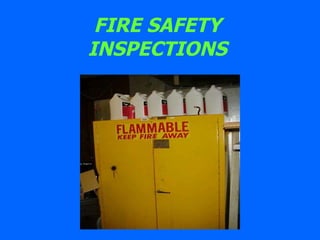
FIRE SAFETY INSPECTIONS
FIRE SAFETY INSPECTIONS REMEMBER The best way to fight fire is to prevent it
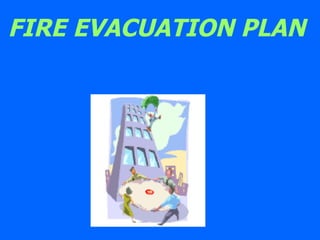
FIRE EVACUATION PLAN
EVACUATION PLAN COMPONENTS OF AN EVACUATION PLAN Emergency Control Committee - develops plan Emergency Crews - administer plan  Escape routes  - primary & secondary Maps - posted indicating escape routes, first aid  kits and extinguishers
FIRE EVACUATION PLAN WHAT TO DO IN CASE OF FIRE FOLLOW YOUR AGENCY’S FIRE  EVACUATION PLAN
FIRE EVACUATION PLAN Don’t panic Try to find a secondary exit Feel doors for heat with your hand If the door is hot, don’t open it! If you can’t find another exit, stay where you are WHAT TO DO IF YOU SHOULD BECOME TRAPPED IN A BUILDING
FIRE EVACUATION PLAN Seal doors and vents to prevent smoke  penetration. If possible call “911” and report your exact location. Stay low to avoid smoke and heat.
EVACUATION PLAN Fire officials (either State or Local officials) Office of State Buildings.   The plan should be reviewed and, if possible, approved by
EVACUATION PLAN … are conducted at least once each year, but some agencies may require them more frequently .   FIRE DRILLS…
EVACUATION PLAN FIRE DRILLS… cont. Remember to  DOCUMENT : Date & time Employees & visitors present Outside meeting location Headcount Time of entire drill
FIRE EXTINGUISHERS
FIRE EXTINGUISHERS KNOW WHERE FIRE EXTINGUISHERS  ARE LOCATED IN YOUR WORKPLACE LEARN HOW TO USE THEM FFECTIVELY NEVER LEAVE AN EXTINGUISHED FIRE UNATTENDED
FIRE EXTINGUISHERS INSPECTIONS The National Fire Protection Association  (NFPA)  defines an inspection as a “quick  check” that the extinguisher is available and  will function NFPA requires extinguishers be inspected  monthly, or more frequently if circumstances  require it
FIRE EXTINGUISHERS Anyone. NFPA says  “minimal knowledge required” WHO CAN INSPECT A FIRE EXTINGUISHER
FIRE EXTINGUISHERS Extinguisher located in designated  place? Obstructions to access or visibility? Operating Instructions on nameplate legible & facing  outward? Seals & tamper indicators in place & intact?   INSPECTION PROCEDURES
FIRE EXTINGUISHERS Determine fullness by weight or by  “hefting.”   Invert & shake it will help ensure  “caking”  or hardening of powder has not occurred. Visually examine for obvious  physical damage,  corrosion, leakage, or a clogged nozzle. Check to see if the pressure gauge is in operable range.
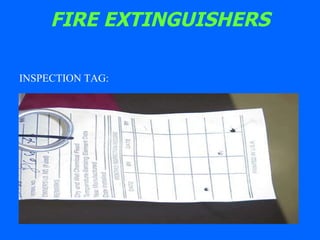
FIRE EXTINGUISHERS INSPECTION TAG:
FIRE EXTINGUISHERS NFPA defines  maintenance  as a  “thorough check ”   of the  extinguisher .  MAINTENANCE
FIRE EXTINGUISHERS FIRE EXTINGUISHER INSPECTOR CONTRACTOR In Louisiana, must be licensed & certified by the Office of the State Fire Marshal  (OSFM)  to perform such work .
FIRE EXTINGUISHERS The NFPA says that maintenance should be performed at least annually   HOW OFTEN SHOULD MAINTENANCE BE PERFORMED
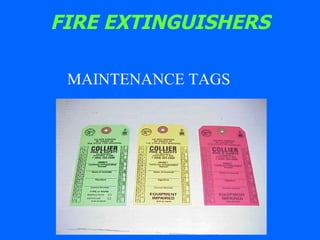
FIRE EXTINGUISHERS NFPA requires that a tag be attached to the  extinguisher indicating: The month & year the maintenance was performed, and Identification of the person & the company  performing the work.  MAINTENANCE RECORDKEEPING
FIRE EXTINGUISHERS MAINTENANCE TAGS
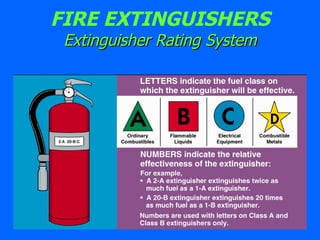
FIRE EXTINGUISHERS Extinguisher Rating System
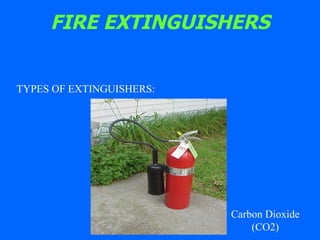
FIRE EXTINGUISHERS TYPES OF EXTINGUISHERS: Carbon Dioxide (CO2)
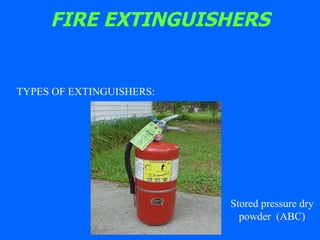
FIRE EXTINGUISHERS TYPES OF EXTINGUISHERS: Stored pressure dry powder  (ABC)
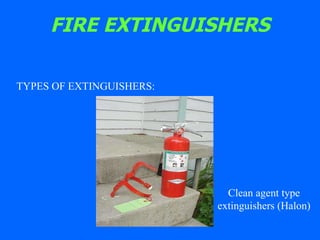
FIRE EXTINGUISHERS TYPES OF EXTINGUISHERS: Clean agent type extinguishers (Halon)
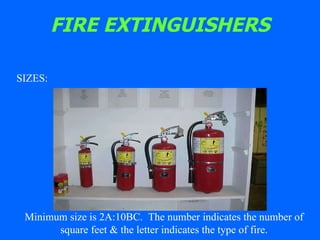
FIRE EXTINGUISHERS SIZES: Minimum size is 2A:10BC.  The number indicates the number of square feet & the letter indicates the type of fire.
FIRE EXTINGUISHERS IMPORTANT TO REMEMBER Ensure that each area has the proper type fire extinguisher!
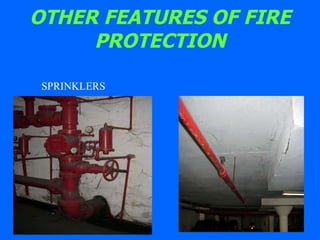
OTHER FEATURES OF FIRE PROTECTION SPRINKLERS
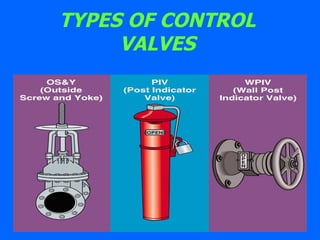
TYPES OF CONTROL VALVES
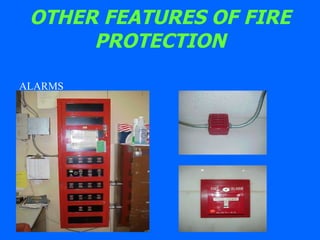
OTHER FEATURES OF FIRE PROTECTION ALARMS
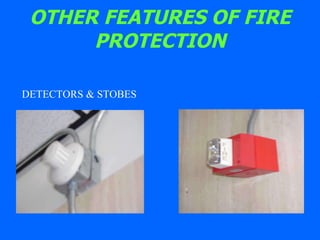
OTHER FEATURES OF FIRE PROTECTION DETECTORS & STOBES
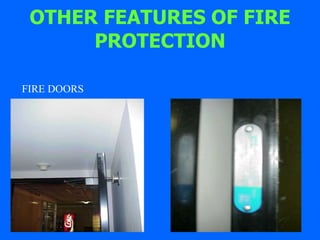
OTHER FEATURES OF FIRE PROTECTION FIRE DOORS
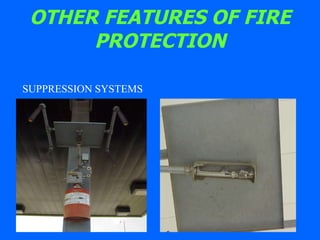
OTHER FEATURES OF FIRE PROTECTION SUPPRESSION SYSTEMS
THE END! THANK YOU FOR ATTENDING!

fire_safety

  • 1.
    FIRE SAFETY TRAINING THE LOSS PREVENTION UNIT OF THE OFFICE OF RISK MANAGEMENT
  • 2.
    COURSE OUTLINE I.FIRE SCIENCE II. FIRE SAFETY INSPECTIONS III. EVACUATION PLAN IV. FIRE EXTINGUISHERS V. OTHER FEATURES OF FIRE PROTECTION
  • 3.
  • 4.
    FIRE SCIENCE Whatelements are needed to start a fire?
  • 5.
    FIRE SCIENCE TheFire Tetrahedron HEAT CHEMICAL CHAIN REACTION FUEL OXYGEN
  • 6.
    FIRE SCIENCE FUELCAN BE LIQUID: Grease, Oil, Fuel; SOLID: Wood, Paper, Metal; GAS: Natural Gas, Propane, Acetylene .
  • 7.
    CLASS “ A” FIRES - Ordinary combustibles such as wood, paper, cloth.
  • 8.
    CLASS “ B” FIRES - Flammable liquids such as oil, grease
  • 9.
    CLASS “ C” FIRES - Energized electrical equipment
  • 10.
    CLASS “ D” FIRES - Flammable Metals
  • 11.
  • 12.
    FIRE SCIENCE WHATIS THE DIFFERENCE BETWEEN COMBUSTIBLE AND FLAMMABLE MATERIAL? Combustible material has a flashpoint of 100 F or above Flammable material has a flashpoint below 100 F [Ref. NFPA 96]
  • 13.
  • 14.
  • 15.
    REGARDING FIREFIGHTING, MSDSsTELL YOU IMPORTANT FACTS ABOUT THE CHEMICALS OR PRODUCTS YOU STORE!
  • 16.
    FIRE SAFETY INSPECTIONSYOUR ORM LOSS PREVENTION OFFICER IS AVAILABLE TO ASSIST
  • 17.
    FIRE SAFETY INSPECTIONSSOME HAZARDS TO LOOK FOR IN YOUR WORKPLACE
  • 18.
    EXAMPLES Locked orblocked exits (common hazard) Trash or debris Electrical hazards Cooking hazards Chemical, Gas Cylinders/ System, and Labs Smoking Areas Exit Signs Blocked exits/isles/hallways Fire extinguisher hazards Emergency lighting hazards Emergency stairway doors blocked or propped open
  • 19.
  • 20.
    FIRE SAFETY INSPECTIONSREMEMBER The best way to fight fire is to prevent it
  • 21.
  • 22.
    EVACUATION PLAN COMPONENTSOF AN EVACUATION PLAN Emergency Control Committee - develops plan Emergency Crews - administer plan Escape routes - primary & secondary Maps - posted indicating escape routes, first aid kits and extinguishers
  • 23.
    FIRE EVACUATION PLANWHAT TO DO IN CASE OF FIRE FOLLOW YOUR AGENCY’S FIRE EVACUATION PLAN
  • 24.
    FIRE EVACUATION PLANDon’t panic Try to find a secondary exit Feel doors for heat with your hand If the door is hot, don’t open it! If you can’t find another exit, stay where you are WHAT TO DO IF YOU SHOULD BECOME TRAPPED IN A BUILDING
  • 25.
    FIRE EVACUATION PLANSeal doors and vents to prevent smoke penetration. If possible call “911” and report your exact location. Stay low to avoid smoke and heat.
  • 26.
    EVACUATION PLAN Fireofficials (either State or Local officials) Office of State Buildings. The plan should be reviewed and, if possible, approved by
  • 27.
    EVACUATION PLAN …are conducted at least once each year, but some agencies may require them more frequently . FIRE DRILLS…
  • 28.
    EVACUATION PLAN FIREDRILLS… cont. Remember to DOCUMENT : Date & time Employees & visitors present Outside meeting location Headcount Time of entire drill
  • 29.
  • 30.
    FIRE EXTINGUISHERS KNOWWHERE FIRE EXTINGUISHERS ARE LOCATED IN YOUR WORKPLACE LEARN HOW TO USE THEM FFECTIVELY NEVER LEAVE AN EXTINGUISHED FIRE UNATTENDED
  • 31.
    FIRE EXTINGUISHERS INSPECTIONSThe National Fire Protection Association (NFPA) defines an inspection as a “quick check” that the extinguisher is available and will function NFPA requires extinguishers be inspected monthly, or more frequently if circumstances require it
  • 32.
    FIRE EXTINGUISHERS Anyone.NFPA says “minimal knowledge required” WHO CAN INSPECT A FIRE EXTINGUISHER
  • 33.
    FIRE EXTINGUISHERS Extinguisherlocated in designated place? Obstructions to access or visibility? Operating Instructions on nameplate legible & facing outward? Seals & tamper indicators in place & intact? INSPECTION PROCEDURES
  • 34.
    FIRE EXTINGUISHERS Determinefullness by weight or by “hefting.” Invert & shake it will help ensure “caking” or hardening of powder has not occurred. Visually examine for obvious physical damage, corrosion, leakage, or a clogged nozzle. Check to see if the pressure gauge is in operable range.
  • 35.
  • 36.
    FIRE EXTINGUISHERS NFPAdefines maintenance as a “thorough check ” of the extinguisher . MAINTENANCE
  • 37.
    FIRE EXTINGUISHERS FIREEXTINGUISHER INSPECTOR CONTRACTOR In Louisiana, must be licensed & certified by the Office of the State Fire Marshal (OSFM) to perform such work .
  • 38.
    FIRE EXTINGUISHERS TheNFPA says that maintenance should be performed at least annually HOW OFTEN SHOULD MAINTENANCE BE PERFORMED
  • 39.
    FIRE EXTINGUISHERS NFPArequires that a tag be attached to the extinguisher indicating: The month & year the maintenance was performed, and Identification of the person & the company performing the work. MAINTENANCE RECORDKEEPING
  • 40.
  • 41.
  • 42.
    FIRE EXTINGUISHERS TYPESOF EXTINGUISHERS: Carbon Dioxide (CO2)
  • 43.
    FIRE EXTINGUISHERS TYPESOF EXTINGUISHERS: Stored pressure dry powder (ABC)
  • 44.
    FIRE EXTINGUISHERS TYPESOF EXTINGUISHERS: Clean agent type extinguishers (Halon)
  • 45.
    FIRE EXTINGUISHERS SIZES:Minimum size is 2A:10BC. The number indicates the number of square feet & the letter indicates the type of fire.
  • 46.
    FIRE EXTINGUISHERS IMPORTANTTO REMEMBER Ensure that each area has the proper type fire extinguisher!
  • 47.
    OTHER FEATURES OFFIRE PROTECTION SPRINKLERS
  • 48.
  • 49.
    OTHER FEATURES OFFIRE PROTECTION ALARMS
  • 50.
    OTHER FEATURES OFFIRE PROTECTION DETECTORS & STOBES
  • 51.
    OTHER FEATURES OFFIRE PROTECTION FIRE DOORS
  • 52.
    OTHER FEATURES OFFIRE PROTECTION SUPPRESSION SYSTEMS
  • 53.
    THE END! THANKYOU FOR ATTENDING!

Editor's Notes

  • #5 Heat, oxygen, and fuel.
  • #8 ORDINARY COMBUSTIBLES: Wood Paper Rubber Plastic
  • #9 CLASS ‘B’ FIRES: Liquids Greases Gases
  • #10 CLASS ‘C’ FIRES: Electrical equipment
  • #11 CLASS ‘D’ FIRES: Magnesium Titanium Zironcium Potassium
  • #12 Smoke is simply combustible organic compounds.
  • #13 Flammable is a substance which under normal conditions has the ability to catch fire with a minimal ignition source (such as a spark). An example of this might be a substance such as propane. - Combustible materials would be any material that will burn. In this category we could also place propane and the like but it would also include materials that need more vigorous conditions to burn and are not likely to catch fire with a simple spark. An example of a combustible material of this sort would be wood or paper. In my opinion therefore, all flammable materials are combustible, but all combustible materials are not necessarily flammable. COMBUSTIBLE - BURNS ALL AT ONCE, AND MAY PRODUCE AN EXPLOSION FLAMMABLE - BURNS, BUT AT A STEADY RATE
  • #16 The proper extinguishing agent to use on the fire.
  • #20 Remember to include specific areas in your safety inspection forms. Ask for examples from your class: Open containers of chemicals Non-labeled containers Frayed electrical cords Etc.
  • #33 “ Minimal Knowledge” is needed to perform an inspection on an extinguisher, so almost anyone can perform this inspection.
  • #37 It is intended to give “maximum” assurance that an extinguisher will operate effectively and safely
  • #41 These are the different types of tags that appear on fire extinguishers. The 2 on the right are obviously ones that appear if something’s wrong with the extinguisher & needs repair or replacement.
  • #42 Classes of Fire: CLASS A – Fires in combustible materials – wood, clothe, paper, etc. CLASS B – Fires in flammable or combustible liquids – oils, greases, tars, oil, base paints, flammable gasses. CLASS C – Fires involving energized electrical equipment. CLASS D – fires in combustible metals, such as magnesium, titanium, sodium, etc.
  • #43 Carbon Dioxide (CO2)
  • #44 Dry Powder
  • #45 Clean Agent - Halon
  • #46 Minimum size is 2A & the largest above is 10BC Number indicates square feet coverage & letter indicates type of fire . 2 sq. ft for Class A (wood, paper, rubber, etc.) 10 sq ft. for Class B (grease, oil, paint) & C (electrical fire)
  • #49 These are not applicable to all agencies. Primarily apply to large agencies such as hospitals, perhaps some universities where fire hose systems are used.
  • #51 Examples of alarms systems and strobe lights.
  • #52 Fire doors are often located in newer buildings. They are either shut automatically when an alarm is engaged or are shut by employees. Their function is to keep the fire from spreading by keeping oxygen flow behind.
  • #53 These are used in CLASS K fires – that occur where agencies have large kitchens & require special fire suppression systems to prevent fires in cooking appliances that involve combustible cooking such as vegetable or animal oils & fats.