BASIC FIRE FIGHTING TRAINING
Presentation Outline
Introduction and training objectives
Fire Prevention
Prime Purposes of Fire Prevention
Elements of Fire Safety
Hazard Recognition & Analysis Definitions
Characteristics & Behavior of Fire
Fire Extinguishers
Terminal fixed fire fighting system
Hands-on training exercises
Introduction
Fire can be an enemy or a friend.
Fire Prevention
The best way to deal
with fire is to prevent
it from happening
Fire Prevention
Key Steps in Fire Prevention
Locate the hazard
Determine the potential cause
Predict the probable effect &
correct the fault.
Fire Prevention
Fire Prevention
Fire Safety Engineering
Good Housekeeping
Electrical Safety
Proper Storage
Safe Practices
Fire Protection
Detection
Alarm
Fire Locator
Extinguishme
nt
Evacuation
First Aid
Salvage
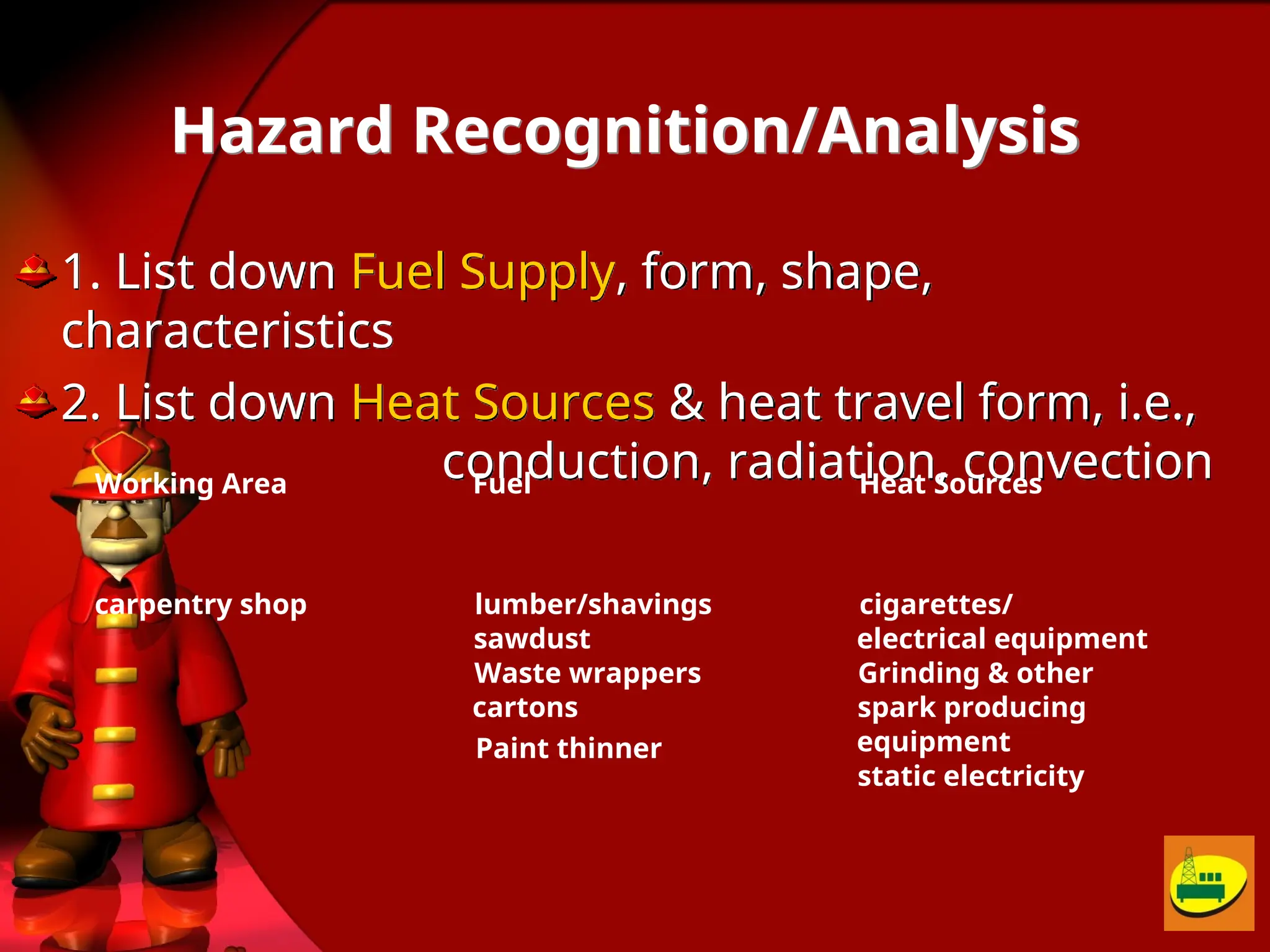
Hazard Recognition/Analysis
1. List down Fuel Supply, form, shape,
characteristics
2. List down Heat Sources & heat travel form, i.e.,
conduction, radiation, convection
Working Area Fuel Heat Sources
carpentry shop lumber/shavings
sawdust
Waste wrappers
cartons
cigarettes/
electrical equipment
Grinding & other
spark producing
equipment
static electricity
Paint thinner
Four Fundamental Rules
of Fire Fighting
1. Save Life
2. Locate Fire
3. Confine Fire / Isolate
4. Extinguish Fire
Upon Discovery of Fire...
DO NOT PANIC!
1
When you see a Fire
Call for Help!
Activate fire alarm
if one is nearby.
2
Leave the fire area
Go to designated
assembly area
3
Fire - Definitions
Fire - the rapid oxidation of
combustible material accompanied
by release of energy in the form of
heat and light.
Fire - Definitions
Flash Point - the lowest temperature at which a
substance will give off enough vapors to
support combustion
Fire Point - the temperature at which a fuel will
continue to burn after it has been ignited. This
is a few degrees hotter than the flash point
Fire - Definitions
Ignition Temperature - is the lowest
temperature when a substance auto-
ignites (without flame or spark)
Explosive or Flammable Range - is the
concentration of a flammable vapor
between the Lower Explosive Limit and
Upper Explosive Limit in a given quantity
of air that will readily burn.
Characteristics & Behavior
The Chemistry of Fire
The Fire Triangle - as shown in the
following illustration, oxygen and fuel in
proper proportion can be ignited by
heat to create a fire
if any one of the three elements is
removed a fire cannot exist.
Characteristics & Behavior
THE FIRE TRIANGLE
H
e
a
t
Fuel
O
x
y
g
e
n
Characteristics & Behavior
Fire Tetrahedron Theory –
simply adds a fourth component of
fire termed as the chain reaction
the tetrahedron is a transition from
the plane geometric triangle to a
four- sided pyramid
The chain reaction will rage until one
of the 3 elements is exhausted.
4 Classes of Fire
(illustrated in next slides)
Class A - fires involving ordinary combustible
materials, such as wood, cloth, paper, plastic,
rubber, etc
Class B - fires involving flammable or petroleum
products such as gasoline, oil, paints, thinners,
solvent, lubricating oils/greases , the crude oil
itself & LPG
Class C - fires involving electrical equipment
Class D - fires involving combustible metals
such as magnesium , titanium, zirconium,
sodium & potassium
4 Classes of Fire
Class A - fires involving ordinary
combustible materials, such as
wood, cloth, paper, plastic, rubber,
etc
•wood
•cloth
•paper
•rubber
•many plastics
4 Classes of Fire
Class B - fires involving flammable
or petroleum products such as
gasoline, oil, paints, thinners,
solvent, lubricating oils/greases ,
the crude oil itself & LPG
•gasoline
•oil
•grease
•tar
•oil-based paint
•lacquer
•flammable gases
4 Classes of Fire
Class C - fires involving electrical
equipment
•energized
electrical
equipment
4 Classes of Fire
Class D - fires involving
combustible metals such as
magnesium , titanium,
zirconium, sodium & potassium
D
•magnesium
•sodium
•potassium
•titanium
•zirconium
•other flammable metals
D
•wood
•cloth
•paper
•rubber
•many plastics
• gasoline
• oil
• grease
• tar
• oil-based paint
• lacquer
• flammable
gases
•energized
electrical
equipment
•magnesium
•sodium
•potassium
•titanium
•zirconium
•other
flammable
metals
A Ordinary
B Liquids Grease
C Electrical Equipment
D Combusutible Metals
Transmission of Fire/Heat
Conduction
Convection
Radiation
Transmission of Fire/Heat
Methods of Extinguishment
REMOVE HEAT - cooling a fire
calls for the application of
something w/c absorbs heat.
Although there are others, water
is the most common agent.
REMOVE FUEL - often removing
the fuel from a fire is difficult &
dangerous. Shutting or closing
off the valves.
Extinguishment Methods
REMOVE OXYGEN - oxygen can be removed from
a fire by displacing it with a heavier than air gas
like CO2 . O2 flowing into the fire can be also be
stopped by covering the fire with a wet blanket or
cover the burning surfaces with foam or sand.
STOP THE CHAIN REACTION - recent studies
indicate that the use of dry chemical on fire tends
to inactivate the intermediate processes of burning
resulting in a reduction of the combustion rate & in
the extinguishment of fire.
Fire Extinguishers
WATER EXTINGUISHERS - are effective for
Class A fires. Water serves as cooling,
quenching & displacing agent.
FOAM EXTINGUISHERS - are effective for
Class B fires where the foam forms a
cohesive floating blanket on the surface of
the burning liquid.
CO2 EXTINGUISHERS - are effective for Class
B & C fires. CO2 reduces the O2 content.
PRESSURE GAUGE
(not found on CO2
extinguishers)
DISCHARGE LEVER
DISCHARGE LOCKING PIN
DISCHARGE HOSE
DISCHARGE NOZZLE
DISCHARGE ORIFICE
CARRYING
HANDLE
DATA PLATE
BODY
Fire Extinguisher Anatomy
REMEMBER P.A.S.S.
Pull the pin.
This will allow you to discharge the extinguisher
Aim nozzle at the base of fire.
If you aim at the flames (which is frequently the temptation),
the extinguishing agent will fly right through and do no good.
You want to hit the fuel.
Squeeze the top handle or lever.
This depresses a button that releases the
pressurized extinguishing agent in the
extinguisher.
Sweep from side to side
until the fire is completely out. Start
using the extinguisher from a safe
distance away, then move forward.
Once the fire is out, keep an eye on
the area in case it re-ignites.
Fire extinguisher inspection
procedures
Ensure access to the unit is not blocked.
Pressure gauge needle should be in the green zone.
Locking pin and seal should be intact.
Hose should have no cracks, nozzle not obstructed
by any foreign item.
Rotate the unit to prevent powder/chemical packing.
Visually inspect the unit from dents, leaks, chemical
deposits and other signs of wear or abuse.
Fire extinguisher should be pressure tested every six
(6) years by a qualified service provider.
Terminal Fixed Fire fighting
equipment
Fire pump unit
Storage tank foam and sprinkler
system
Gantry sprinkler system
Fire hoses and related accessories
Fire pump unit
Storage tank foam and sprinkler
control system
Storage tank foam and sprinkler
system
Sprinkler line Foam line
Storage tank foam and sprinkler
system
Individual foam and cooling system
Gantry sprinkler system
Sprinkler system covering two (2) loading bays
Bay 4 Bay 3
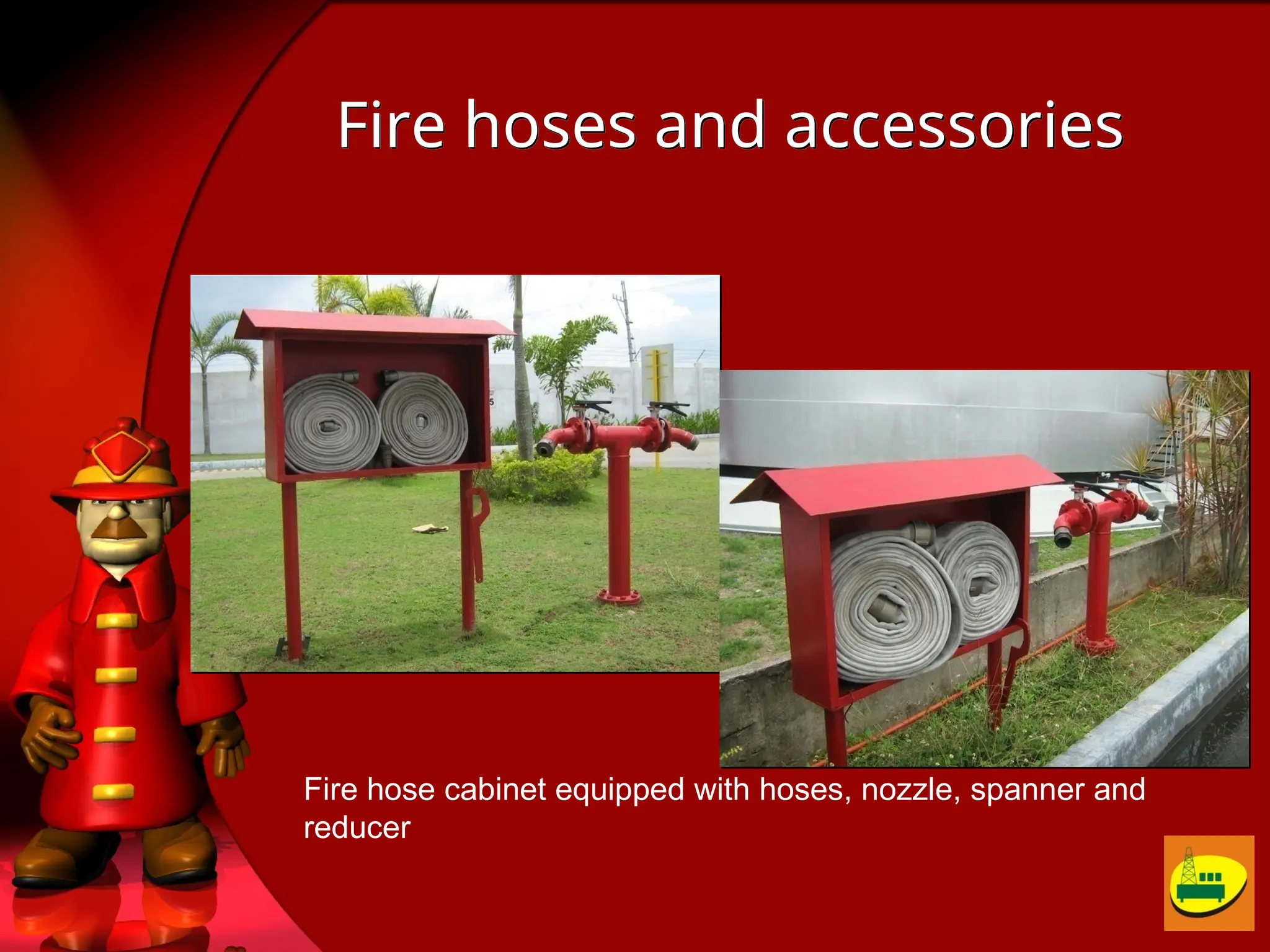
Fire hoses and accessories
Fire hose cabinet equipped with hoses, nozzle, spanner and
reducer
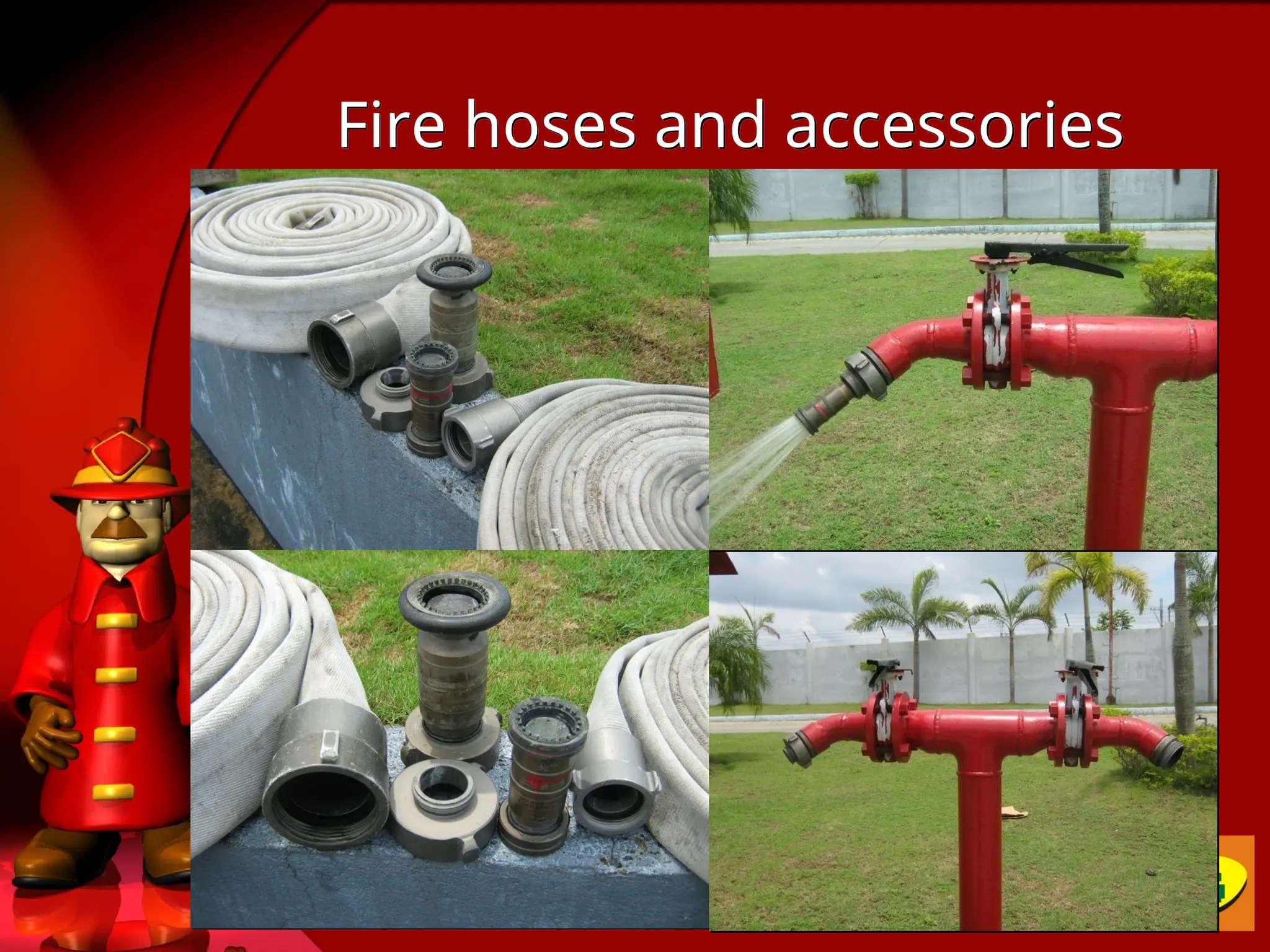
Fire hoses and accessories
Fire hose laying and rolling
Hose laying Hose rolling
Fire hoses and accessories
connection
Two (2) man connection
One (1) man connection
Water formations
Point the nozzle downward
before opening the valve
Gradually open nozzle
Water formations
Jet water formation
-Directly hits the fire from
a considerable distance
Fog or shield formation
-Protects the responders from
heat of fire
Intervention team composition
(main emergency responders)
Team Leader
Nozzle man
Hoseman
Hydrant man
Technical man
Sample Emergency Scenarios
Scenario:
Massive product spillage due to tank overfilling
Sample Emergency Scenarios
Scenario:
Gantry on fire due to lighting strike
Sample Emergency Scenarios
Scenario:
Tank truck on fire due to electrostatic ignition while
filling
Emergency Response procedures
Massive product spill/leakage without
fire:
Stop all terminal activities
Close all valves to stop flow of product
Isolate the area of any potential source/s
of ignition (do not start engine).
Disperse fumes/vapor using water sprays.
Recover released product
Emergency Response procedures
Massive product spill/leakage with
fire:
Stop all terminal activities.
Close all valves to stop flow of product
Open sprinkler system if needed
Combat the fire using water sprays or
foam compound
Hands-on training reminders
Take the exercises seriously as
possible.
Always approach the fire scene in
upwind direction.
Be keen to observe the flag signs
before combatting the fire.
Hands-on training reminders
Green flag- valve sign Red flag – fire scene
Dual flag – wind direction indicator
Thank you!

432943467-Basic-Fire-Fighting-Training.ppt

  • 1.
  • 2.
    Presentation Outline Introduction andtraining objectives Fire Prevention Prime Purposes of Fire Prevention Elements of Fire Safety Hazard Recognition & Analysis Definitions Characteristics & Behavior of Fire Fire Extinguishers Terminal fixed fire fighting system Hands-on training exercises
  • 3.
    Introduction Fire can bean enemy or a friend.
  • 4.
    Fire Prevention The bestway to deal with fire is to prevent it from happening
  • 5.
    Fire Prevention Key Stepsin Fire Prevention Locate the hazard Determine the potential cause Predict the probable effect & correct the fault.
  • 6.
    Fire Prevention Fire Prevention FireSafety Engineering Good Housekeeping Electrical Safety Proper Storage Safe Practices Fire Protection Detection Alarm Fire Locator Extinguishme nt Evacuation First Aid Salvage
  • 7.
    Hazard Recognition/Analysis 1. Listdown Fuel Supply, form, shape, characteristics 2. List down Heat Sources & heat travel form, i.e., conduction, radiation, convection Working Area Fuel Heat Sources carpentry shop lumber/shavings sawdust Waste wrappers cartons cigarettes/ electrical equipment Grinding & other spark producing equipment static electricity Paint thinner
  • 8.
    Four Fundamental Rules ofFire Fighting 1. Save Life 2. Locate Fire 3. Confine Fire / Isolate 4. Extinguish Fire
  • 9.
    Upon Discovery ofFire... DO NOT PANIC! 1 When you see a Fire Call for Help! Activate fire alarm if one is nearby. 2 Leave the fire area Go to designated assembly area 3
  • 10.
    Fire - Definitions Fire- the rapid oxidation of combustible material accompanied by release of energy in the form of heat and light.
  • 11.
    Fire - Definitions FlashPoint - the lowest temperature at which a substance will give off enough vapors to support combustion Fire Point - the temperature at which a fuel will continue to burn after it has been ignited. This is a few degrees hotter than the flash point
  • 12.
    Fire - Definitions IgnitionTemperature - is the lowest temperature when a substance auto- ignites (without flame or spark) Explosive or Flammable Range - is the concentration of a flammable vapor between the Lower Explosive Limit and Upper Explosive Limit in a given quantity of air that will readily burn.
  • 13.
    Characteristics & Behavior TheChemistry of Fire The Fire Triangle - as shown in the following illustration, oxygen and fuel in proper proportion can be ignited by heat to create a fire if any one of the three elements is removed a fire cannot exist.
  • 14.
    Characteristics & Behavior Characteristics& Behavior THE FIRE TRIANGLE H e a t Fuel O x y g e n
  • 15.
    Characteristics & Behavior FireTetrahedron Theory – simply adds a fourth component of fire termed as the chain reaction the tetrahedron is a transition from the plane geometric triangle to a four- sided pyramid The chain reaction will rage until one of the 3 elements is exhausted.
  • 16.
    4 Classes ofFire (illustrated in next slides) Class A - fires involving ordinary combustible materials, such as wood, cloth, paper, plastic, rubber, etc Class B - fires involving flammable or petroleum products such as gasoline, oil, paints, thinners, solvent, lubricating oils/greases , the crude oil itself & LPG Class C - fires involving electrical equipment Class D - fires involving combustible metals such as magnesium , titanium, zirconium, sodium & potassium
  • 17.
    4 Classes ofFire Class A - fires involving ordinary combustible materials, such as wood, cloth, paper, plastic, rubber, etc •wood •cloth •paper •rubber •many plastics
  • 18.
    4 Classes ofFire Class B - fires involving flammable or petroleum products such as gasoline, oil, paints, thinners, solvent, lubricating oils/greases , the crude oil itself & LPG •gasoline •oil •grease •tar •oil-based paint •lacquer •flammable gases
  • 19.
    4 Classes ofFire Class C - fires involving electrical equipment •energized electrical equipment
  • 20.
    4 Classes ofFire Class D - fires involving combustible metals such as magnesium , titanium, zirconium, sodium & potassium D •magnesium •sodium •potassium •titanium •zirconium •other flammable metals
  • 21.
    D •wood •cloth •paper •rubber •many plastics • gasoline •oil • grease • tar • oil-based paint • lacquer • flammable gases •energized electrical equipment •magnesium •sodium •potassium •titanium •zirconium •other flammable metals A Ordinary B Liquids Grease C Electrical Equipment D Combusutible Metals
  • 22.
  • 23.
  • 24.
    Methods of Extinguishment REMOVEHEAT - cooling a fire calls for the application of something w/c absorbs heat. Although there are others, water is the most common agent. REMOVE FUEL - often removing the fuel from a fire is difficult & dangerous. Shutting or closing off the valves.
  • 25.
    Extinguishment Methods REMOVE OXYGEN- oxygen can be removed from a fire by displacing it with a heavier than air gas like CO2 . O2 flowing into the fire can be also be stopped by covering the fire with a wet blanket or cover the burning surfaces with foam or sand. STOP THE CHAIN REACTION - recent studies indicate that the use of dry chemical on fire tends to inactivate the intermediate processes of burning resulting in a reduction of the combustion rate & in the extinguishment of fire.
  • 26.
    Fire Extinguishers WATER EXTINGUISHERS- are effective for Class A fires. Water serves as cooling, quenching & displacing agent. FOAM EXTINGUISHERS - are effective for Class B fires where the foam forms a cohesive floating blanket on the surface of the burning liquid. CO2 EXTINGUISHERS - are effective for Class B & C fires. CO2 reduces the O2 content.
  • 27.
    PRESSURE GAUGE (not foundon CO2 extinguishers) DISCHARGE LEVER DISCHARGE LOCKING PIN DISCHARGE HOSE DISCHARGE NOZZLE DISCHARGE ORIFICE CARRYING HANDLE DATA PLATE BODY Fire Extinguisher Anatomy
  • 28.
    REMEMBER P.A.S.S. Pull thepin. This will allow you to discharge the extinguisher Aim nozzle at the base of fire. If you aim at the flames (which is frequently the temptation), the extinguishing agent will fly right through and do no good. You want to hit the fuel.
  • 29.
    Squeeze the tophandle or lever. This depresses a button that releases the pressurized extinguishing agent in the extinguisher. Sweep from side to side until the fire is completely out. Start using the extinguisher from a safe distance away, then move forward. Once the fire is out, keep an eye on the area in case it re-ignites.
  • 30.
    Fire extinguisher inspection procedures Ensureaccess to the unit is not blocked. Pressure gauge needle should be in the green zone. Locking pin and seal should be intact. Hose should have no cracks, nozzle not obstructed by any foreign item. Rotate the unit to prevent powder/chemical packing. Visually inspect the unit from dents, leaks, chemical deposits and other signs of wear or abuse. Fire extinguisher should be pressure tested every six (6) years by a qualified service provider.
  • 31.
    Terminal Fixed Firefighting equipment Fire pump unit Storage tank foam and sprinkler system Gantry sprinkler system Fire hoses and related accessories
  • 32.
  • 33.
    Storage tank foamand sprinkler control system
  • 34.
    Storage tank foamand sprinkler system Sprinkler line Foam line
  • 35.
    Storage tank foamand sprinkler system Individual foam and cooling system
  • 36.
    Gantry sprinkler system Sprinklersystem covering two (2) loading bays Bay 4 Bay 3
  • 37.
    Fire hoses andaccessories Fire hose cabinet equipped with hoses, nozzle, spanner and reducer
  • 38.
    Fire hoses andaccessories
  • 39.
    Fire hose layingand rolling Hose laying Hose rolling
  • 40.
    Fire hoses andaccessories connection Two (2) man connection One (1) man connection
  • 41.
    Water formations Point thenozzle downward before opening the valve Gradually open nozzle
  • 42.
    Water formations Jet waterformation -Directly hits the fire from a considerable distance Fog or shield formation -Protects the responders from heat of fire
  • 43.
    Intervention team composition (mainemergency responders) Team Leader Nozzle man Hoseman Hydrant man Technical man
  • 44.
    Sample Emergency Scenarios Scenario: Massiveproduct spillage due to tank overfilling
  • 45.
    Sample Emergency Scenarios Scenario: Gantryon fire due to lighting strike
  • 46.
    Sample Emergency Scenarios Scenario: Tanktruck on fire due to electrostatic ignition while filling
  • 47.
    Emergency Response procedures Massiveproduct spill/leakage without fire: Stop all terminal activities Close all valves to stop flow of product Isolate the area of any potential source/s of ignition (do not start engine). Disperse fumes/vapor using water sprays. Recover released product
  • 48.
    Emergency Response procedures Massiveproduct spill/leakage with fire: Stop all terminal activities. Close all valves to stop flow of product Open sprinkler system if needed Combat the fire using water sprays or foam compound
  • 49.
    Hands-on training reminders Takethe exercises seriously as possible. Always approach the fire scene in upwind direction. Be keen to observe the flag signs before combatting the fire.
  • 50.
    Hands-on training reminders Greenflag- valve sign Red flag – fire scene Dual flag – wind direction indicator
  • 51.

Editor's Notes

  • #10 [Read slide] “Ask your safety Marshalls for your designated assembly area.” “Now, these are for localized fires. Should there be a company- wide emergency, these are the alarms you should be familiar with…”
  • #15  “Fire is composed of 3 elements, the presence of all 3 = FIRE!” “Heat could come from a short circuit, oxygen is present everywhere, fuel could be papers lying nearby, then you have fire.”