A holistic approach for integration of
sustainable development in education,
research, collaboration and operations
Göran Finnveden, Erica-Dawn Egan, Teresia Sandberg and
Emma Strömberg
KTH Royal Institute of Technology, Stockholm, Sweden
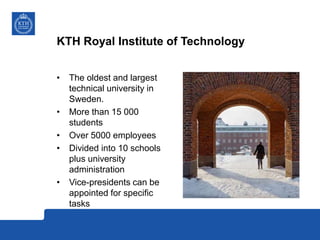
KTH Royal Institute of Technology
• The oldest and largest
technical university in
Sweden.
• More than 15 000
students
• Over 5000 employees
• Divided into 10 schools
plus university
administration
• Vice-presidents can be
appointed for specific
tasks
KTH’s sustainability initiative 2011
• Sustainable Campus – focus on campus activities and the
development of an Environmental Management System
led by the Environmental Manager
• KTH-Sustainability – focus on integrating sustainability in
education, research and cooperation led by the vice-
president for sustainable development.
• Two parts working together and since 2016 organised as
KTH Sustainability Office
KTH has ambitions regarding sustainable
development
• KTH shall be a leading technical universities also
regarding sustainable development and have an identity
and trademark that is associated with sustainable
development.
(KTH Development Plan, 2013-2017)
Some results 2012-2015
• A systematic work on integration of sustainable
development in all educational programs is giving results.
• Research on sustainable development is increasing
• KTH is climbing on the QS ranking in the category
”Environmental Science”
• KTH’s environmental management system is certified
according to ISO 14001 since 2015.
• KTH won ”The International Sustainable Campus
Network’s Excellence Award for Excellence in Campus
2015” för KTH Campus Plan 2014
• KTH has reduced energy use in buildings
• KTH has reduced CO2-emissions from air travels
Sustainable development in education:
Two complementary approaches
Evaluation of the progress of integration of sustainable
development on the program level
and
providing tools and support for Program directors and
teaching staff to achieve the goals set by the university
Integration of sustainable development at
the program level
2011 – Education Assessment Exercise and career surveys
pointed out the need for integration
2012 - all programs submitted self-assessments
2013 - follow-up through a dialogue with schools
2013 - all schools set up an action program for integration of
sustainable development into their educational programs
2014 - all schools followed the action programs
2015 - a follow-up
2016 - new action programs set up
Follow-up
Three-step process
- Survey containing courses that contribute to
fulfillment of the learning outcomes
- Interview with Program directors
- Summary for each educational program
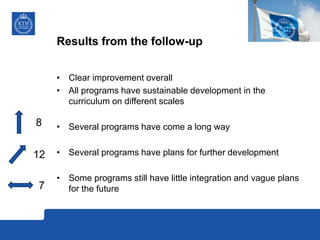
Results from the follow-up
• Clear improvement overall
• All programs have sustainable development in the
curriculum on different scales
• Several programs have come a long way
• Several programs have plans for further development
• Some programs still have little integration and vague plans
for the future
8
12
7
Tools for integration of sustainable
development in educational programs
• Clarification of the overall learning outcomes
• Mapping of courses and programs with ESD-relevance
• "Coaching" of teachers and Program directors, contact
information on teacher resources
• Pedagogical course - Learning for Sustainable
Development
• Development of a Toolbox for Teachers
• Development of course modules
• Seminars and networking
Learning for Sustainable development
The general aim of the course is that teachers, based on their
own subject, should be able to integrate questions on sustainable
development in their teaching so that the students, during and
after their education include their integrated knowledge and
reflections in the subject sustainable development.
• What is sustainable development?
• Integration and progression
• What is sustainable development for engineers?
• What is learning for sustainable development?
• Course goals, activities and examination
School of Education and Communication in Engineering Science
Anna-Karin Högfeldt, Organisation and Leadership
Monika Olsson, Industrial Ecology
Tools for integration of sustainable
development in educational programs
• Clarification of the overall learning outcomes
• Mapping of courses and programs with ESD-relevance
• "Coaching" of teachers and Program directors, contact
information on teacher resources
• Pedagogical course - Learning for Sustainable
Development
• Development of a Toolbox for Teachers
• Development of course modules
• Seminars and networking
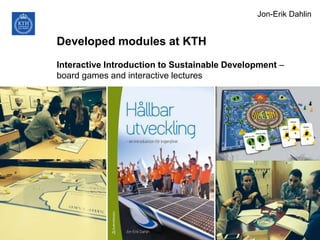
Developed modules at KTH
Interactive Introduction to Sustainable Development –
board games and interactive lectures
Jon-Erik Dahlin
Developed modules at KTH
Social sustainability in education at KTH
• Generic part – 4 lectures and 2 seminars
• Program specific part – developed in collaboration
with the course responsible teacher
(Elisabeth Ekener, Karin Edvardsson Björnberg,
Niccolas Albiz, Dominic Von Martens)
ÅF/KTH – Sustainable business development
• Social Responsibility: An organization's responsibility
towards society and the environment.
• Sustainable business: A business where sustainability
is a key driver of business strategy, process and
product development, and marketing.
Tools for integration of sustainable
development in educational programs
• Clarification of the overall learning outcomes
• Mapping of courses and programs with ESD-relevance
• "Coaching" of teachers and Program directors, contact
information on teacher resources
• Pedagogical course - Learning for Sustainable
Development
• Development of a Toolbox for Teachers
• Development of course modules
• Seminars and networking
• Seed funding for developing new courses etc.
Exemple of activities in research and
research education
• Seed funding for pilot projects, writing larger applications.
• Developing PhD courses
• Networks for PhD students
• Seminars, workshops, network meetings
• Information about research calls
• Funding for participation in networks
Collaboration with society, examples of
activities
• Established partner agreement with
• Akademiska Hus (our main landlord)
• IVL – Swedish Environmental Research Institute
• SEI – Stockholm Environment Institute
• Involvement in other partner agreements
• Active in national and international networks
• Internal and external newsletters
• Seminars and events, e.g.
• KTH-Sustainability Education Day
• KTH-Sustainability Research Day
Evaluation of KTH-Sustainability, winter
2015
• Self-evaluation, interview study, external experts.
• Conclusions:
• KTH has made progress
• KTH-Sustainability has played an important role
• Strong support for the vision that KTH should be a
leading actor
• We are not there yet.
• The initiative should continue
• Change of focus towards more cooperation with
society, students and faculty, e.g. ”Campus as a living
lab”, student engagement.
Role of the ISO 14001 certified
Environmental Management System
• Ensures a systematic approach for all areas included
• Ensures involvement with top management
• Regular internal and external audits
• A way of communicating our commitment
• An insurance towards a backlash
Areas for sustainable development
objectives 2016-2020
• Education
• Research
• Collaboration
• Work environment
• Campus
• Travels
• Procurement
• Hazardous chemicals
• Investement
• Organisation and management
Examples of objectives 2016-2020
• KTH's research for sustainable development shall increase.
• The integration of sustainable development in KTH's
research base shall increase.
• Achieve a 20% percent reduction in carbon emissions
resulting from business travel per full-time employee
equivalent.
• Funds of KTH’s affiliated foundations and donations shall be
invested so that they contribute to sustainable development.
• Environmental and sustainability issues shall be integrated
into regular activities and operations and be included in all
relevant processes, plans and decisions.
Thanks!
Comments?
Questions?
goranfi@kth.se
https://www.kth.se/en/om/miljo-hallbar-utveckling

Finnveden, Goran, Track 4

  • 1.
    A holistic approachfor integration of sustainable development in education, research, collaboration and operations Göran Finnveden, Erica-Dawn Egan, Teresia Sandberg and Emma Strömberg KTH Royal Institute of Technology, Stockholm, Sweden
  • 2.
    KTH Royal Instituteof Technology • The oldest and largest technical university in Sweden. • More than 15 000 students • Over 5000 employees • Divided into 10 schools plus university administration • Vice-presidents can be appointed for specific tasks
  • 3.
    KTH’s sustainability initiative2011 • Sustainable Campus – focus on campus activities and the development of an Environmental Management System led by the Environmental Manager • KTH-Sustainability – focus on integrating sustainability in education, research and cooperation led by the vice- president for sustainable development. • Two parts working together and since 2016 organised as KTH Sustainability Office
  • 4.
    KTH has ambitionsregarding sustainable development • KTH shall be a leading technical universities also regarding sustainable development and have an identity and trademark that is associated with sustainable development. (KTH Development Plan, 2013-2017)
  • 5.
    Some results 2012-2015 •A systematic work on integration of sustainable development in all educational programs is giving results. • Research on sustainable development is increasing • KTH is climbing on the QS ranking in the category ”Environmental Science” • KTH’s environmental management system is certified according to ISO 14001 since 2015. • KTH won ”The International Sustainable Campus Network’s Excellence Award for Excellence in Campus 2015” för KTH Campus Plan 2014 • KTH has reduced energy use in buildings • KTH has reduced CO2-emissions from air travels
  • 6.
    Sustainable development ineducation: Two complementary approaches Evaluation of the progress of integration of sustainable development on the program level and providing tools and support for Program directors and teaching staff to achieve the goals set by the university
  • 7.
    Integration of sustainabledevelopment at the program level 2011 – Education Assessment Exercise and career surveys pointed out the need for integration 2012 - all programs submitted self-assessments 2013 - follow-up through a dialogue with schools 2013 - all schools set up an action program for integration of sustainable development into their educational programs 2014 - all schools followed the action programs 2015 - a follow-up 2016 - new action programs set up
  • 8.
    Follow-up Three-step process - Surveycontaining courses that contribute to fulfillment of the learning outcomes - Interview with Program directors - Summary for each educational program
  • 9.
    Results from thefollow-up • Clear improvement overall • All programs have sustainable development in the curriculum on different scales • Several programs have come a long way • Several programs have plans for further development • Some programs still have little integration and vague plans for the future 8 12 7
  • 10.
    Tools for integrationof sustainable development in educational programs • Clarification of the overall learning outcomes • Mapping of courses and programs with ESD-relevance • "Coaching" of teachers and Program directors, contact information on teacher resources • Pedagogical course - Learning for Sustainable Development • Development of a Toolbox for Teachers • Development of course modules • Seminars and networking
  • 11.
    Learning for Sustainabledevelopment The general aim of the course is that teachers, based on their own subject, should be able to integrate questions on sustainable development in their teaching so that the students, during and after their education include their integrated knowledge and reflections in the subject sustainable development. • What is sustainable development? • Integration and progression • What is sustainable development for engineers? • What is learning for sustainable development? • Course goals, activities and examination School of Education and Communication in Engineering Science Anna-Karin Högfeldt, Organisation and Leadership Monika Olsson, Industrial Ecology
  • 12.
    Tools for integrationof sustainable development in educational programs • Clarification of the overall learning outcomes • Mapping of courses and programs with ESD-relevance • "Coaching" of teachers and Program directors, contact information on teacher resources • Pedagogical course - Learning for Sustainable Development • Development of a Toolbox for Teachers • Development of course modules • Seminars and networking
  • 13.
    Developed modules atKTH Interactive Introduction to Sustainable Development – board games and interactive lectures Jon-Erik Dahlin
  • 14.
    Developed modules atKTH Social sustainability in education at KTH • Generic part – 4 lectures and 2 seminars • Program specific part – developed in collaboration with the course responsible teacher (Elisabeth Ekener, Karin Edvardsson Björnberg, Niccolas Albiz, Dominic Von Martens) ÅF/KTH – Sustainable business development • Social Responsibility: An organization's responsibility towards society and the environment. • Sustainable business: A business where sustainability is a key driver of business strategy, process and product development, and marketing.
  • 15.
    Tools for integrationof sustainable development in educational programs • Clarification of the overall learning outcomes • Mapping of courses and programs with ESD-relevance • "Coaching" of teachers and Program directors, contact information on teacher resources • Pedagogical course - Learning for Sustainable Development • Development of a Toolbox for Teachers • Development of course modules • Seminars and networking • Seed funding for developing new courses etc.
  • 16.
    Exemple of activitiesin research and research education • Seed funding for pilot projects, writing larger applications. • Developing PhD courses • Networks for PhD students • Seminars, workshops, network meetings • Information about research calls • Funding for participation in networks
  • 17.
    Collaboration with society,examples of activities • Established partner agreement with • Akademiska Hus (our main landlord) • IVL – Swedish Environmental Research Institute • SEI – Stockholm Environment Institute • Involvement in other partner agreements • Active in national and international networks • Internal and external newsletters • Seminars and events, e.g. • KTH-Sustainability Education Day • KTH-Sustainability Research Day
  • 18.
    Evaluation of KTH-Sustainability,winter 2015 • Self-evaluation, interview study, external experts. • Conclusions: • KTH has made progress • KTH-Sustainability has played an important role • Strong support for the vision that KTH should be a leading actor • We are not there yet. • The initiative should continue • Change of focus towards more cooperation with society, students and faculty, e.g. ”Campus as a living lab”, student engagement.
  • 19.
    Role of theISO 14001 certified Environmental Management System • Ensures a systematic approach for all areas included • Ensures involvement with top management • Regular internal and external audits • A way of communicating our commitment • An insurance towards a backlash
  • 20.
    Areas for sustainabledevelopment objectives 2016-2020 • Education • Research • Collaboration • Work environment • Campus • Travels • Procurement • Hazardous chemicals • Investement • Organisation and management
  • 21.
    Examples of objectives2016-2020 • KTH's research for sustainable development shall increase. • The integration of sustainable development in KTH's research base shall increase. • Achieve a 20% percent reduction in carbon emissions resulting from business travel per full-time employee equivalent. • Funds of KTH’s affiliated foundations and donations shall be invested so that they contribute to sustainable development. • Environmental and sustainability issues shall be integrated into regular activities and operations and be included in all relevant processes, plans and decisions.
  • 22.

Editor's Notes

  • #3 KTH in Stockholm is the largest, oldest and most international technical university in Sweden. No less than one-third of Sweden’s technical research and engineering education capacity at university level is provided by KTH. Education and research spans from natural sciences to all the branches of engineering and includes architecture, industrial management and urban planning.