Becoming Sustainable In Our
Own Way: Sustainability at the
Flagship Massachusetts Public
University
9/15/16
Ludmilla Pavlova-Gillham, AIA, LEED BD+C
Dennis Swinford, ASLA
Campus Planning and Sustainable Development
Campus Planners “must focus as much on the
education and research being done in higher
education as on the physical, operational, and
external community functions of the university and
do so in an integrated, interdependent manner”
Anthony Cortese, “The critical role of higher education in creating a
sustainable future”. Society for College and University Planning: Planning for
Higher Education Journal 31, 2003
SecondNature.org
Methodology
• John P. Kotter’s Process for Leading Change
– Applies to grassroots as well as top-down approaches
– Useful for interdependent systems (HEIs)
• Higher Education Institutions (HEI) case studies
– Harvard (Sharp, 2009)
– University of Colorado Boulder (Krizek, et al 2011)
– Yale (Newman, 2012)
• Map Sustainable Development at UMass Amherst
& reflect on lessons learned
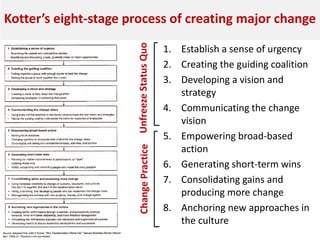
Kotter’s eight-stage process of creating major change
1. Establish a sense of urgency
2. Creating the guiding coalition
3. Developing a vision and
strategy
4. Communicating the change
vision
5. Empowering broad-based
action
6. Generating short-term wins
7. Consolidating gains and
producing more change
8. Anchoring new approaches in
the culture
UnfreezeStatusQuoChangePractice
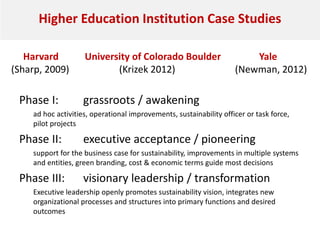
Higher Education Institution Case Studies
Phase I: grassroots / awakening
ad hoc activities, operational improvements, sustainability officer or task force,
pilot projects
Phase II: executive acceptance / pioneering
support for the business case for sustainability, improvements in multiple systems
and entities, green branding, cost & economic terms guide most decisions
Phase III: visionary leadership / transformation
Executive leadership openly promotes sustainability vision, integrates new
organizational processes and structures into primary functions and desired
outcomes
Harvard University of Colorado Boulder Yale
(Sharp, 2009) (Krizek 2012) (Newman, 2012)
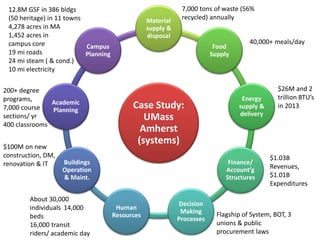
Case Study:
UMass
Amherst
(systems)
Material
supply &
disposal
Food
Supply
Energy
supply &
delivery
Finance/
Account’g
Structures
Decision
Making
Processes
Human
Resources
Buildings
Operation
& Maint.
Academic
Planning
Campus
Planning
7,000 tons of waste (56%
recycled) annually
40,000+ meals/day
$26M and 2
trillion BTU’s
in 2013
$1.03B
Revenues,
$1.01B
Expenditures
12.8M GSF in 386 bldgs
(50 heritage) in 11 towns
4,278 acres in MA
1,452 acres in
campus core
19 mi roads
24 mi steam ( & cond.)
10 mi electricity
200+ degree
programs,
7,000 course
sections/ yr
400 classrooms
$100M on new
construction, DM,
renovation & IT
Flagship of System, BOT, 3
unions & public
procurement laws
About 30,000
individuals 14,000
beds
16,000 transit
riders/ academic day
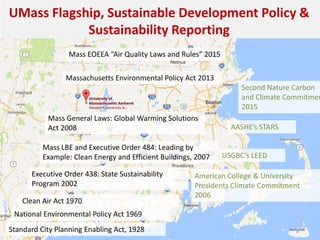
UMass Flagship, Sustainable Development Policy &
Sustainability Reporting
Standard City Planning Enabling Act, 1928
American College & University
Presidents Climate Commitment
2006
Executive Order 438: State Sustainability
Program 2002
Mass LBE and Executive Order 484: Leading by
Example: Clean Energy and Efficient Buildings, 2007
Massachusetts Environmental Policy Act 2013
National Environmental Policy Act 1969
Mass EOEEA “Air Quality Laws and Rules” 2015
Mass General Laws: Global Warming Solutions
Act 2008 AASHE’s STARS
USGBC’s LEED
Clean Air Act 1970
Second Nature Carbon
and Climate Commitmen
2015
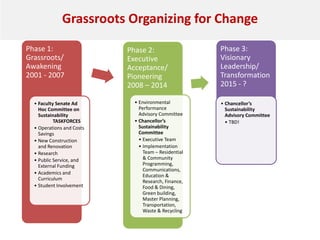
Grassroots Organizing for Change
Phase 1:
Grassroots/
Awakening
2001 - 2007
• Faculty Senate Ad
Hoc Committee on
Sustainability
TASKFORCES
• Operations and Costs
Savings
• New Construction
and Renovation
• Research
• Public Service, and
External Funding
• Academics and
Curriculum
• Student Involvement
Phase 2:
Executive
Acceptance/
Pioneering
2008 – 2014
• Environmental
Performance
Advisory Committee
• Chancellor’s
Sustainability
Committee
• Executive Team
• Implementation
Team – Residential
& Community
Programming,
Communications,
Education &
Research, Finance,
Food & Dining,
Green building,
Master Planning,
Transportation,
Waste & Recycling
Phase 3:
Visionary
Leadership/
Transformation
2015 - ?
• Chancellor’s
Sustainability
Advisory Committee
• TBD!
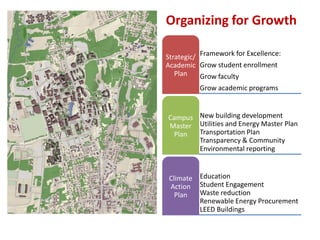
Organizing for Growth
Framework for Excellence:
Grow student enrollment
Grow faculty
Grow academic programs
Strategic/
Academic
Plan
New building development
Utilities and Energy Master Plan
Transportation Plan
Transparency & Community
Environmental reporting
Campus
Master
Plan
Education
Student Engagement
Waste reduction
Renewable Energy Procurement
LEED Buildings
Climate
Action
Plan
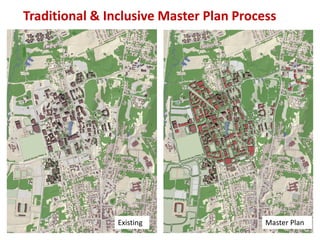
Existing Master Plan
Traditional & Inclusive Master Plan Process
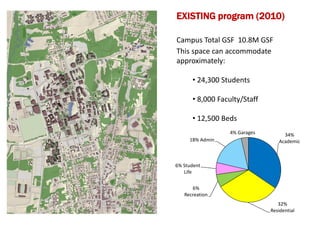
EXISTING program (2010)
34%
Academic
32%
Residential
6%
Recreation
6% Student
Life
18% Admin
4% Garages
Campus Total GSF 10.8M GSF
This space can accommodate
approximately:
• 24,300 Students
• 8,000 Faculty/Staff
• 12,500 Beds
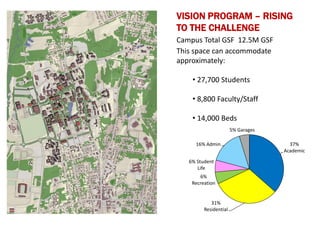
37%
Academic
31%
Residential
6%
Recreation
6% Student
Life
16% Admin
5% Garages
This space can accommodate
approximately:
• 27,700 Students
• 8,800 Faculty/Staff
• 14,000 Beds
VISION PROGRAM – RISING
TO THE CHALLENGE
Campus Total GSF 12.5M GSF
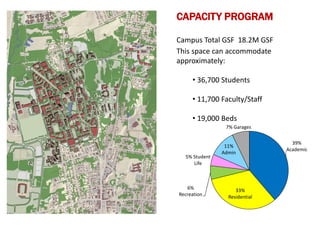
39%
Academic
33%
Residential
6%
Recreation
5% Student
Life
11%
Admin
7% Garages
This space can accommodate
approximately:
• 36,700 Students
• 11,700 Faculty/Staff
• 19,000 Beds
CAPACITY PROGRAM
Campus Total GSF 18.2M GSF
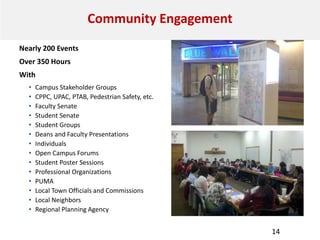
Nearly 200 Events
Over 350 Hours
With
• Campus Stakeholder Groups
• CPPC, UPAC, PTAB, Pedestrian Safety, etc.
• Faculty Senate
• Student Senate
• Student Groups
• Deans and Faculty Presentations
• Individuals
• Open Campus Forums
• Student Poster Sessions
• Professional Organizations
• PUMA
• Local Town Officials and Commissions
• Local Neighbors
• Regional Planning Agency
Community Engagement
14
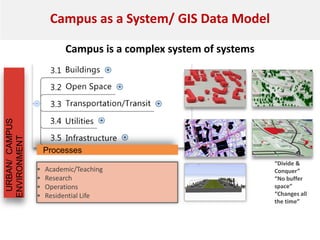
Campus as a System/ GIS Data Model
Campus is a complex system of systems
Processes
• Academic/Teaching
• Research
• Operations
• Residential Life
“Divide &
Conquer”
“No buffer
space”
“Changes all
the time”
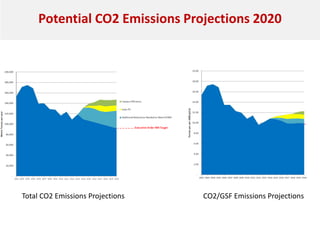
Potential CO2 Emissions Projections 2020
Total CO2 Emissions Projections CO2/GSF Emissions Projections
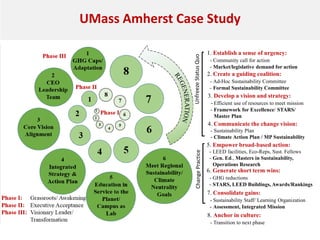
1. Establish a sense of urgency:
- Community call for action
- Market/legislative demand for action
2. Create a guiding coalition:
- Ad-Hoc Sustainability Committee
- Formal Sustainability Committee
3. Develop a vision and strategy:
- Efficient use of resources to meet mission
- Framework for Excellence/ STARS/
Master Plan
4. Communicate the change vision:
- Sustainability Plan
- Climate Action Plan / MP Sustainability
5. Empower broad-based action:
- LEED facilities, Eco-Reps, Sust. Fellows
- Gen. Ed., Masters in Sustainability,
Operations Research
6. Generate short term wins:
- GHG reductions
- STARS, LEED Buildings, Awards/Rankings
7. Consolidate gains:
- Sustainability Staff/ Learning Organization
- Assessment, Integrated Mission
8. Anchor in culture:
- Transition to next phase
UnfreezeStatusQuoChangePractice
UMass Amherst Case Study
Conclusions for University Sustainable Development
1. Process, Governance and Internal Leadership
• comprehensive and integrated strategic,
academic, financial & physical plans
• Inclusive and transparent process
• Integrated SR systems into planning efforts
• Continuity and consistency for SD decisions
• Incentive structures to support progress on
sustainability goals
Conclusions for University Sustainable Development
1. Research and Data
• Cross-departmental engagement in capital
project planning that identifies important SD
issues
• Develop and apply a carbon budget for
campus development
• Leverage academic curriculum for project-
based learning, operations research and the
campus as a living laboratory
Conclusions for University Sustainable Development
1. Leadership for Society
• Advocate for full commitment to SD and GHG
reduction goals
• Model governance/negotiation strategies to
resolve conflicts and pursue smart growth
• Place local/institutional decisions into a
regional/ global framework of resiliency activity
• Practice what is taught by leading change effort
to connect academic and physical planning
toward meeting the triple bottom line
Thank you!
lpavlova@umass.edu
swinford@mit.edu

Pavlova-Gillham, Ludmilla, Track 4

  • 1.
    Becoming Sustainable InOur Own Way: Sustainability at the Flagship Massachusetts Public University 9/15/16 Ludmilla Pavlova-Gillham, AIA, LEED BD+C Dennis Swinford, ASLA
  • 2.
    Campus Planning andSustainable Development Campus Planners “must focus as much on the education and research being done in higher education as on the physical, operational, and external community functions of the university and do so in an integrated, interdependent manner” Anthony Cortese, “The critical role of higher education in creating a sustainable future”. Society for College and University Planning: Planning for Higher Education Journal 31, 2003 SecondNature.org
  • 3.
    Methodology • John P.Kotter’s Process for Leading Change – Applies to grassroots as well as top-down approaches – Useful for interdependent systems (HEIs) • Higher Education Institutions (HEI) case studies – Harvard (Sharp, 2009) – University of Colorado Boulder (Krizek, et al 2011) – Yale (Newman, 2012) • Map Sustainable Development at UMass Amherst & reflect on lessons learned
  • 4.
    Kotter’s eight-stage processof creating major change 1. Establish a sense of urgency 2. Creating the guiding coalition 3. Developing a vision and strategy 4. Communicating the change vision 5. Empowering broad-based action 6. Generating short-term wins 7. Consolidating gains and producing more change 8. Anchoring new approaches in the culture UnfreezeStatusQuoChangePractice
  • 5.
    Higher Education InstitutionCase Studies Phase I: grassroots / awakening ad hoc activities, operational improvements, sustainability officer or task force, pilot projects Phase II: executive acceptance / pioneering support for the business case for sustainability, improvements in multiple systems and entities, green branding, cost & economic terms guide most decisions Phase III: visionary leadership / transformation Executive leadership openly promotes sustainability vision, integrates new organizational processes and structures into primary functions and desired outcomes Harvard University of Colorado Boulder Yale (Sharp, 2009) (Krizek 2012) (Newman, 2012)
  • 6.
    Case Study: UMass Amherst (systems) Material supply & disposal Food Supply Energy supply& delivery Finance/ Account’g Structures Decision Making Processes Human Resources Buildings Operation & Maint. Academic Planning Campus Planning 7,000 tons of waste (56% recycled) annually 40,000+ meals/day $26M and 2 trillion BTU’s in 2013 $1.03B Revenues, $1.01B Expenditures 12.8M GSF in 386 bldgs (50 heritage) in 11 towns 4,278 acres in MA 1,452 acres in campus core 19 mi roads 24 mi steam ( & cond.) 10 mi electricity 200+ degree programs, 7,000 course sections/ yr 400 classrooms $100M on new construction, DM, renovation & IT Flagship of System, BOT, 3 unions & public procurement laws About 30,000 individuals 14,000 beds 16,000 transit riders/ academic day
  • 7.
    UMass Flagship, SustainableDevelopment Policy & Sustainability Reporting Standard City Planning Enabling Act, 1928 American College & University Presidents Climate Commitment 2006 Executive Order 438: State Sustainability Program 2002 Mass LBE and Executive Order 484: Leading by Example: Clean Energy and Efficient Buildings, 2007 Massachusetts Environmental Policy Act 2013 National Environmental Policy Act 1969 Mass EOEEA “Air Quality Laws and Rules” 2015 Mass General Laws: Global Warming Solutions Act 2008 AASHE’s STARS USGBC’s LEED Clean Air Act 1970 Second Nature Carbon and Climate Commitmen 2015
  • 8.
    Grassroots Organizing forChange Phase 1: Grassroots/ Awakening 2001 - 2007 • Faculty Senate Ad Hoc Committee on Sustainability TASKFORCES • Operations and Costs Savings • New Construction and Renovation • Research • Public Service, and External Funding • Academics and Curriculum • Student Involvement Phase 2: Executive Acceptance/ Pioneering 2008 – 2014 • Environmental Performance Advisory Committee • Chancellor’s Sustainability Committee • Executive Team • Implementation Team – Residential & Community Programming, Communications, Education & Research, Finance, Food & Dining, Green building, Master Planning, Transportation, Waste & Recycling Phase 3: Visionary Leadership/ Transformation 2015 - ? • Chancellor’s Sustainability Advisory Committee • TBD!
  • 9.
    Organizing for Growth Frameworkfor Excellence: Grow student enrollment Grow faculty Grow academic programs Strategic/ Academic Plan New building development Utilities and Energy Master Plan Transportation Plan Transparency & Community Environmental reporting Campus Master Plan Education Student Engagement Waste reduction Renewable Energy Procurement LEED Buildings Climate Action Plan
  • 10.
    Existing Master Plan Traditional& Inclusive Master Plan Process
  • 11.
    EXISTING program (2010) 34% Academic 32% Residential 6% Recreation 6%Student Life 18% Admin 4% Garages Campus Total GSF 10.8M GSF This space can accommodate approximately: • 24,300 Students • 8,000 Faculty/Staff • 12,500 Beds
  • 12.
    37% Academic 31% Residential 6% Recreation 6% Student Life 16% Admin 5%Garages This space can accommodate approximately: • 27,700 Students • 8,800 Faculty/Staff • 14,000 Beds VISION PROGRAM – RISING TO THE CHALLENGE Campus Total GSF 12.5M GSF
  • 13.
    39% Academic 33% Residential 6% Recreation 5% Student Life 11% Admin 7% Garages Thisspace can accommodate approximately: • 36,700 Students • 11,700 Faculty/Staff • 19,000 Beds CAPACITY PROGRAM Campus Total GSF 18.2M GSF
  • 14.
    Nearly 200 Events Over350 Hours With • Campus Stakeholder Groups • CPPC, UPAC, PTAB, Pedestrian Safety, etc. • Faculty Senate • Student Senate • Student Groups • Deans and Faculty Presentations • Individuals • Open Campus Forums • Student Poster Sessions • Professional Organizations • PUMA • Local Town Officials and Commissions • Local Neighbors • Regional Planning Agency Community Engagement 14
  • 15.
    Campus as aSystem/ GIS Data Model Campus is a complex system of systems Processes • Academic/Teaching • Research • Operations • Residential Life “Divide & Conquer” “No buffer space” “Changes all the time”
  • 16.
    Potential CO2 EmissionsProjections 2020 Total CO2 Emissions Projections CO2/GSF Emissions Projections
  • 17.
    1. Establish asense of urgency: - Community call for action - Market/legislative demand for action 2. Create a guiding coalition: - Ad-Hoc Sustainability Committee - Formal Sustainability Committee 3. Develop a vision and strategy: - Efficient use of resources to meet mission - Framework for Excellence/ STARS/ Master Plan 4. Communicate the change vision: - Sustainability Plan - Climate Action Plan / MP Sustainability 5. Empower broad-based action: - LEED facilities, Eco-Reps, Sust. Fellows - Gen. Ed., Masters in Sustainability, Operations Research 6. Generate short term wins: - GHG reductions - STARS, LEED Buildings, Awards/Rankings 7. Consolidate gains: - Sustainability Staff/ Learning Organization - Assessment, Integrated Mission 8. Anchor in culture: - Transition to next phase UnfreezeStatusQuoChangePractice UMass Amherst Case Study
  • 18.
    Conclusions for UniversitySustainable Development 1. Process, Governance and Internal Leadership • comprehensive and integrated strategic, academic, financial & physical plans • Inclusive and transparent process • Integrated SR systems into planning efforts • Continuity and consistency for SD decisions • Incentive structures to support progress on sustainability goals
  • 19.
    Conclusions for UniversitySustainable Development 1. Research and Data • Cross-departmental engagement in capital project planning that identifies important SD issues • Develop and apply a carbon budget for campus development • Leverage academic curriculum for project- based learning, operations research and the campus as a living laboratory
  • 20.
    Conclusions for UniversitySustainable Development 1. Leadership for Society • Advocate for full commitment to SD and GHG reduction goals • Model governance/negotiation strategies to resolve conflicts and pursue smart growth • Place local/institutional decisions into a regional/ global framework of resiliency activity • Practice what is taught by leading change effort to connect academic and physical planning toward meeting the triple bottom line
  • 21.