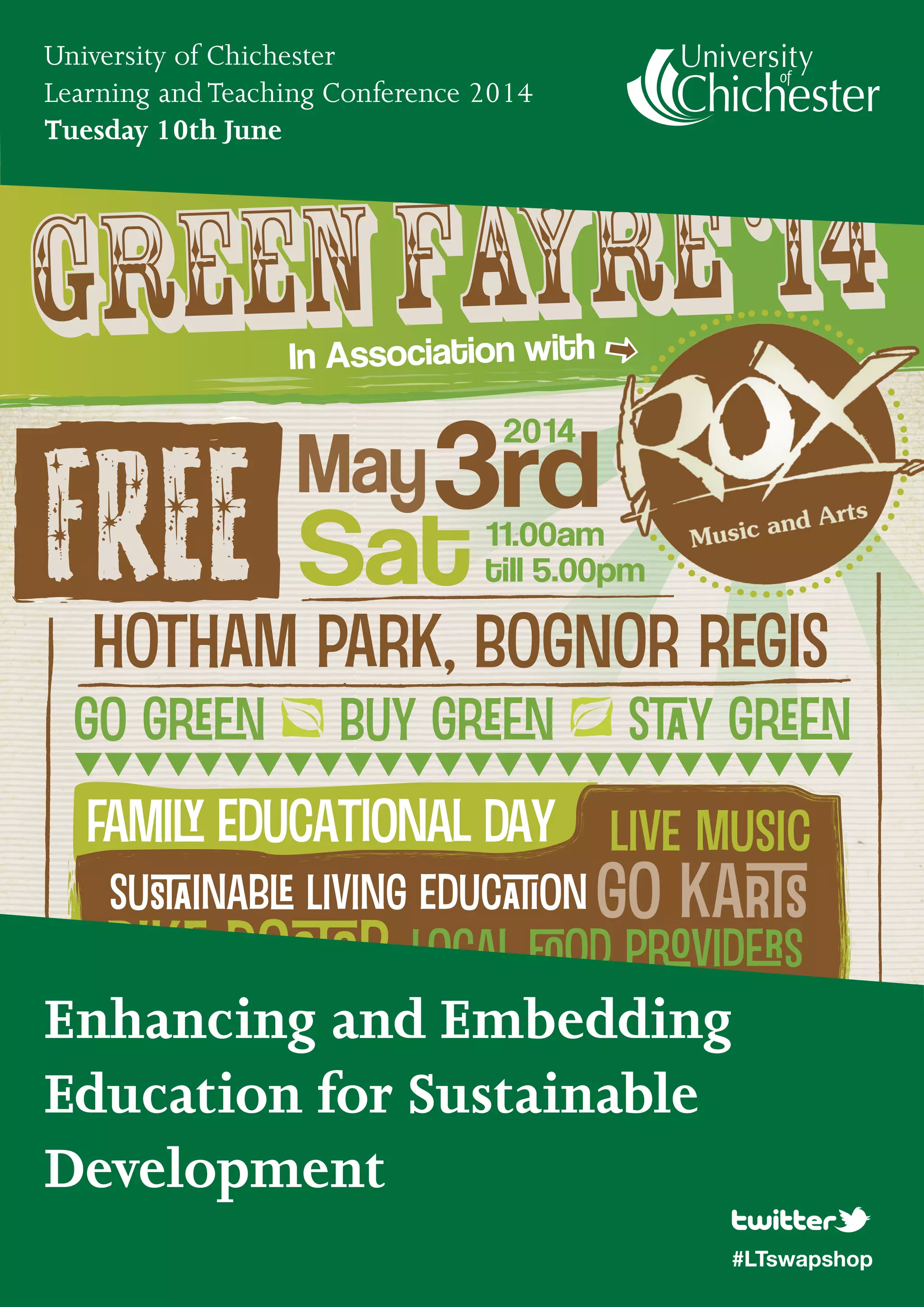
Family EducaTIonal Day
Go Green Buy Green Stay Green
tttttttttttttttttttttttttt
FREE Sat
3rdMay
2014
11.00am
till 5.00pm
ĘėĕDESIGN AND PRINT
Sustainable Living Education
Live Music
Creation Station
Local food ProvidersBike Doctor
Reuse, Reduce, Recycle
Hot Food & Drink
Climate ChangeNature Trails
Workshops
go Karts
greenfAyre‘14In Association with a
SPONSORED BY:
a
HOTHAM PARK, BOGNOR REGIS
Security
SolutionsSBI
Enhancing and Embedding
Education for Sustainable
Development
University of Chichester
Learning andTeaching Conference 2014
Tuesday 10th June
#LTswapshop
University of Chichester2 www.chiuni.ac.uk/swapshop
LearningandTeachingConference2014
Key Note Speaker
Professor Carolyn Roberts
The Knowledge Transfer Network, and Frank Jackson Professor,
Gresham College, London
Email: carolyn.roberts@earth.ox.ac.uk
Carolyn Roberts is an applied environmental scientist with specific interests in sustainability and
resource management. She is currently a senior scientist in the UKTechnology Strategy Board-
funded ‘Knowledge Transfer Network’, and prior to that was Director of the ‘Environmental
Sustainability Knowledge Transfer Network’ a similar national network based at the University
of Oxford.Both organisations link businesses with universities,securing technological innovation
to enable more environmentally-sensitive industry.
At the University of Gloucestershire she was Head of the School of Environment,and Director
of the national HEFCE-recognised Centre for Excellence in Teaching and Learning that
emerged from it – the Centre for Active Learning. Recognised for the quality of her teaching
through the award of a National Teaching Fellowship, and a Senior Fellowship of the Higher
Education Academy, she has also published books and papers on themes including innovation,
disability, employability, active styles of learning, and education for sustainable development.
She chaired the national advisory board for the Higher Education Academy’s Geography, Earth
and Environmental Sciences Subject Centre. Carolyn is currently the Chair of the national
chartering organisation Society for the Environment, and was formerly Chair of the national
professional body, the Institution of Environmental Sciences.
Welcome
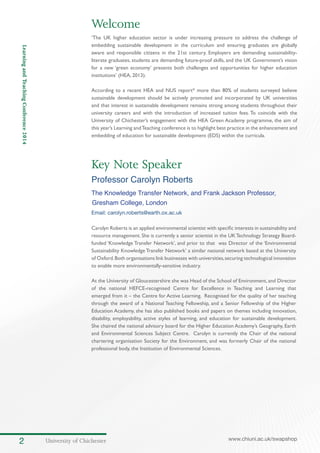
‘The UK higher education sector is under increasing pressure to address the challenge of
embedding sustainable development in the curriculum and ensuring graduates are globally
aware and responsible citizens in the 21st century. Employers are demanding sustainability-
literate graduates, students are demanding future-proof skills, and the UK Government’s vision
for a new ‘green economy’ presents both challenges and opportunities for higher education
institutions’ (HEA, 2013).
According to a recent HEA and NUS report* more than 80% of students surveyed believe
sustainable development should be actively promoted and incorporated by UK universities
and that interest in sustainable development remains strong among students throughout their
university careers and with the introduction of increased tuition fees. To coincide with the
University of Chichester’s engagement with the HEA Green Academy programme, the aim of
this year’s Learning andTeaching conference is to highlight best practice in the enhancement and
embedding of education for sustainable development (EDS) within the curricula.
University of Chichester 3www.chiuni.ac.uk/swapshop
LearningandTeachingConference2014
“Work on Education for Sustainable Development (ESD) helps
institutions and subject communities develop curricula and
pedagogy that will give students the skills and knowledge to live
and work sustainably’
	 [Drayson et al, 2013]
Fieldtrips are an important part of the pedagogy underpinning ESD
on the Tourism Management degree route - here students visit
Selsey to look at destination management issues
University of Chichester4 www.chiuni.ac.uk/swapshop
LearningandTeachingConference2014
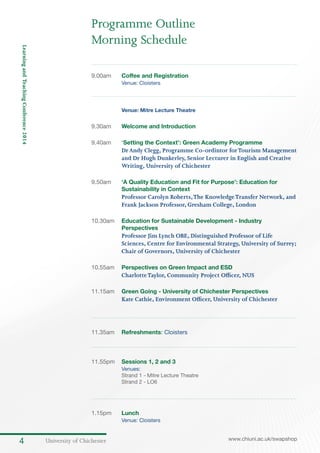
9.00am	 Coffee and Registration
Venue: Cloisters	
	 Venue: Mitre Lecture Theatre
9.30am	 Welcome and Introduction	
9.40am	 ‘Setting the Context’: Green Academy Programme
DrAndy Clegg, Programme Co-ordintor forTourism Management
and Dr Hugh Dunkerley, Senior Lecturer in English and Creative
Writing, University of Chichester
9.50am	 ‘A Quality Education and Fit for Purpose’: Education for
Sustainability in Context
Professor Carolyn Roberts,The KnowledgeTransfer Network, and
Frank Jackson Professor, Gresham College, London
10.30am	 Education for Sustainable Development - Industry
Perspectives
Professor Jim Lynch OBE, Distinguished Professor of Life
Sciences, Centre for Environmental Strategy, University of Surrey;
Chair of Governors, University of Chichester
10.55am	 Perspectives on Green Impact and ESD
CharlotteTaylor, Community Project Officer, NUS
11.15am	 Green Going - University of Chichester Perspectives
Kate Cathie, Environment Officer, University of Chichester
11.35am	 Refreshments: Cloisters
11.55pm	 Sessions 1, 2 and 3
	 Venues:
	 Strand 1 - Mitre Lecture Theatre
	 Strand 2 - LO6
1.15pm	 Lunch
	 Venue: Cloisters
Programme Outline
Morning Schedule
University of Chichester 5www.chiuni.ac.uk/swapshop
LearningandTeachingConference2014
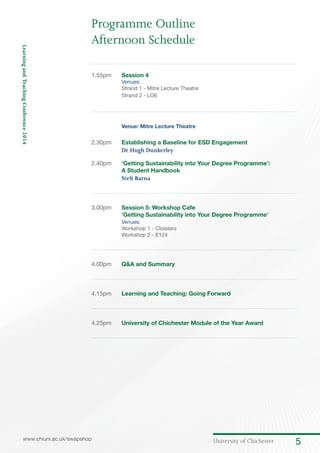
1.55pm	 Session 4
Venues:
	 Strand 1 - Mitre Lecture Theatre
	 Strand 2 - LO6
	 Venue: Mitre Lecture Theatre
2.30pm	 Establishing a Baseline for ESD Engagement
Dr Hugh Dunkerley
2.40pm	 ‘Getting Sustainability into Your Degree Programme’:
A Student Handbook
Stefi Barna	
3.00pm	 Session 5: Workshop Cafe
‘Getting Sustainability into Your Degree Programme’
	 Venues:
	 Workshop 1 - Cloisters
	 Workshop 2 - E124
4.00pm 	 Q&A and Summary
4.15pm 	 Learning and Teaching: Going Forward
4.25pm 	 University of Chichester Module of the Year Award
Programme Outline
Afternoon Schedule
University of Chichester6 www.chiuni.ac.uk/swapshop
LearningandTeachingConference2014
Presentations
	
‘Setting the Context’: Green Academy Programme
DrAndy Clegg, Programme Co-ordintor forTourism Management and
Dr Hugh Dunkerley, Senior Lecturer in English and CreativeWriting
University of Chichester
A brief introduction to the conference with reference to the University’s engagement
with the HEA Green Academy Programme, and the resultant inclusion of ESD as a
priority in the University’s new Learning and Teaching Strategy.
Keynote
‘A Quality Education and Fit for Purpose’: Education for Sustainability in
Context
Professor Carolyn Roberts,The KnowledgeTransfer Network, and Frank
Jackson Professor, Gresham College, London
The purpose of education, and particularly Higher Education, has been debated for
millennia.Popular opinion counterposes‘employability’ with high academic achievement,
the discovery of new principles with their application,and the growth of self-awareness
with the accumulation of knowledge. Given the uncertainty and speed of change of the
world with which students must engage after they leave university, the perplexity of
educators is perhaps understandable – in practice they need to embrace all of these
concepts simultaneously.Superimposed onto this complexity,many universities want to
be seen as distinctive in what they can offer to potential students, whilst also chasing
the elusive beast of ‘student satisfaction’.
The talk will invite you to participate in a stroll around the worlds of Education for
Sustainable Development, and active styles of learning, in the company of Alice.
Education for Sustainable Development - Industry Perspectives
Professor Jim Lynch OBE, Distinguished Professor of Life Sciences, Centre for
Environmental Strategy, University of Surrey; Chair of Governors, University
of Chichester
Sustainability is a characteristic of a process or state that can be maintained at a
certain level indefinitely. It influences all aspects of life, and can be analysed using
Participatory Social Analysis and at the process level by Life Cycle Assessment.
Industry has had a negative influence by carbon emissions generating climate change.
Bioenergy is an ameliorative option but needs to be viewed in the light of global food
security and the competition for land.The transdisciplinary nature of sustainability
means that it needs to be considered across all courses in arts and sciences. In
application it is vital to develop public private partnerships, especially at the regional
level.
University of Chichester 7www.chiuni.ac.uk/swapshop
LearningandTeachingConference2014
Perspectives on Green Impact and ESD
CharlotteTaylor, Community Project Officer, NUS
An overview from the NUS on initiatives designed to support student and staff
engagement in ESD.
	
Green Going - University of Chichester Perspectives
Kate Cathie, Environment Officer, University of Chichester
An overview of the work currently being undertaken in the University, reflecting
on the successes of the Green Impact Scheme, and projects being undertaken by
students.
Establishing a Baseline for ESD Engagement
Dr Hugh Dunkerley, Senior Lecturer in English and CreativeWriting,
University of Chichester
A report on research work being undertaken in the University to establish a baseline
for ESD and how many modules currently incorporate some element of ESD.
‘Getting Sustainability into Your Degree Programme’: A Student
Handbook
Stefi Barna, Lecturer in Global Public Health, University of EastAnglia
The University of East Anglia’s Future Skills Initiative aims to deepen employability
skills and ensure that graduates leave with the skills to become effective future lead-
ers and to help bring about a more just and sustainable world. The Handbook aims
to capture the unique perspectives and approaches inherent in each academic disci-
pline, and to serve as a forum for discussion and debate, via three questions:
•	 What are the links between your discipline and a more sustainable world?
•	 What knowledge and skills do your graduates need in order to bring that world
about, as professionals, citizens and leaders?
•	 How should those knowledge and skills be acquired?
Conceptual frameworks will be shared from Business and Management, English, Media
Studies, History, Maths, Social Work and the health professions.
This presentation will also provide the focus for the afternoon’s workshop cafe where
colleagues will be encouraged to think how they could embed ESD within their own
modules.
University of Chichester8 www.chiuni.ac.uk/swapshop
LearningandTeachingConference2014
Session 1:
Time:	 12.00pm to 12.20pm
Strand 1 (MLT):	 Embedding Critical Perspectives on Sustainable
Development into the Portsmouth Geography
Curriculum
Dr Julia Brown, University of Portsmouth
Strand 2 (LO6):	 Recycled, Re-seen - How andWhy Found, Recycled and
Appropriated Materials are Used in FineArt
Victoria Brown, University of Chichester
Session 2:
Time:	 12.25pm to 12.45pm
Strand 1 (MLT):	 PALWeek: Learning Sustainable Development in Design
and Engineering
Dr Nigel Garland and Dr Zulfiqar Khan, University of
Bournemouth
Strand 2 (LO6):	 Students as Producers of Sustainability
Hugh Dunkerley, University of Chichester
Session 3:
Time:	 12.50pm to 1.15pm
Strand 1 (MLT):	 	Good ManagementTheories for Good Management
Practice: Reflections from Students onTheir Business
School Curricula
Dr Denise Baden, University of Southampton
Strand 2 (LO6):	 Music and Sustainability
Dr Rod Paton, University of Chichester
Session Programme
University of Chichester 9www.chiuni.ac.uk/swapshop
LearningandTeachingConference2014
	
Session 4:
Time:	 2.00pm to 2.20pm
Strand 1 (MLT):	 Embedding Education for Sustainable Development -A
Case Study ofTourism and Events Management
Dr Andy Clegg, University of Chichester
Strand 2 (LO6):	 Thinking for Global Citizenship
Mary Young, University of Chichester
Session 5:	 Workshop Cafe
Time:	 3.00pm to 3.55pm
		 ‘Getting Sustainability intoYour Degree Programme’
Faciliator:	 Stefi Barna, Dr Hugh Dunkerley, Dr Andy Clegg, Dr
Duncan Reavey and Kate Cathie
Venue:	 Cloisters and E124
Session Programme
University of Chichester10 www.chiuni.ac.uk/swapshop
Venue: 	 Mitre Lecture Theatre
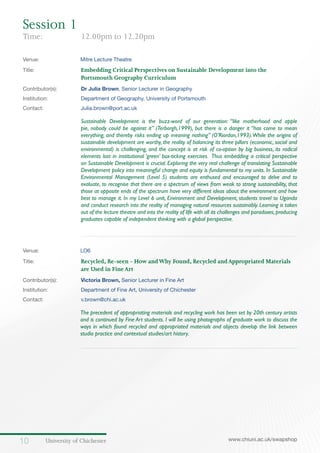
Title:		 	 Embedding Critical Perspectives on Sustainable Development into the 			
			Portsmouth Geography Curriculum
Contributor(s):		 Dr Julia Brown, Senior Lecturer in Geography
Institution:		 Department of Geography, University of Portsmouth
Contact:		 Julia.brown@port.ac.uk
Sustainable Development is the buzz-word of our generation: “like motherhood and apple
pie, nobody could be against it” (Terborgh,1999), but there is a danger it “has come to mean
everything, and thereby risks ending up meaning nothing” (O’Riordan,1993).While the origins of
sustainable development are worthy, the reality of balancing its three pillars (economic, social and
environmental) is challenging, and the concept is at risk of co-option by big business, its radical
elements lost in institutional ‘green’ box-ticking exercises. Thus embedding a critical perspective
on Sustainable Development is crucial. Exploring the very real challenge of translating Sustainable
Development policy into meaningful change and equity is fundamental to my units. In Sustainable
Environmental Management (Level 5) students are enthused and encouraged to delve and to
evaluate, to recognise that there are a spectrum of views from weak to strong sustainability, that
those at opposite ends of the spectrum have very different ideas about the environment and how
best to manage it. In my Level 6 unit, Environment and Development, students travel to Uganda
and conduct research into the reality of managing natural resources sustainably. Learning is taken
out of the lecture theatre and into the reality of life with all its challenges and paradoxes,producing
graduates capable of independent thinking with a global perspective.
Venue: 	 LO6
Title:			 Recycled, Re-seen - How andWhy Found, Recycled andAppropriated Materials 		
			 are Used in FineArt
Contributor(s):		 Victoria Brown, Senior Lecturer in Fine Art
Institution:		 Department of Fine Art, University of Chichester
Contact:		 v.brown@chi.ac.uk
	 The precedent of appropriating materials and recycling work has been set by 20th century artists
and is continued by Fine Art students. I will be using photographs of graduate work to discuss the
ways in which found recycled and appropriated materials and objects develop the link between
studio practice and contextual studies/art history.
Session 1	
Time: 		 12.00pm to 12.20pm
University of Chichester 11www.chiuni.ac.uk/swapshop
Venue: 	 Mitre Lecture Theatre
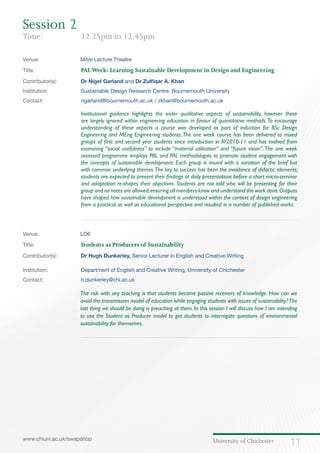
Title:		 	 PALWeek: Learning Sustainable Development in Design and Engineering
Contributor(s):		 Dr Nigel Garland and Dr Zulfiqar A. Khan
Institution:		 Sustainable Design Research Centre, Bournemouth University
Contact:		 ngarland@bournemouth.ac.uk / zkhan@bournemouth.ac.uk
Institutional guidance highlights the wider qualitative aspects of sustainability, however these
are largely ignored within engineering education in favour of quantitative methods.To encourage
understanding of these aspects a course was developed as part of induction for BSc Design
Engineering and MEng Engineering students.The one week course has been delivered to mixed
groups of first and second year students since introduction in AY2010-11 and has evolved from
examining “social usefulness” to include “material utilisation” and “future vision”.The one week
assessed programme employs PBL and PAL methodologies to promote student engagement with
the concepts of sustainable development. Each group is issued with a variation of the brief but
with common underlying themes.The key to success has been the avoidance of didactic elements;
students are expected to present their findings at daily presentations before a short micro-seminar
and adaptation re-shapes their objectives. Students are not told who will be presenting for their
group and no notes are allowed,ensuring all members know and understand the work done.Outputs
have shaped how sustainable development is understood within the context of design engineering
from a practical as well as educational perspective and resulted in a number of published works.
Venue: 	 LO6
Title:			 Students as Producers of Sustainability
Contributor(s):		 Dr Hugh Dunkerley, Senior Lecturer in English and Creative Writing
Institution:		 Department of English and Creative Writing, University of Chichester
Contact:		 h.dunkerley@chi.ac.uk
	 The risk with any teaching is that students become passive receivers of knowledge. How can we
avoid the transmission model of education while engaging students with issues of sustainability?The
last thing we should be doing is preaching at them. In this session I will discuss how I am intending
to use the Student as Producer model to get students to interrogate questions of environmental
sustainability for themselves.
Session 2
Time: 		 12.25pm to 12.45pm
University of Chichester12 www.chiuni.ac.uk/swapshop
Venue: 	 Mitre Lecture Theatre
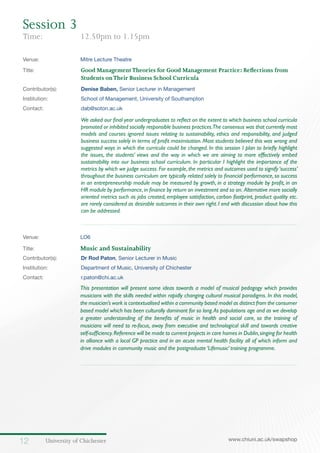
Title:			 Good ManagementTheories for Good Management Practice: Reflections from 		
			 Students onTheir Business School Curricula
Contributor(s):		 Denise Baben, Senior Lecturer in Management
Institution:		 School of Management, University of Southampton
Contact:		 dab@soton.ac.uk
We asked our final year undergraduates to reflect on the extent to which business school curricula
promoted or inhibited socially responsible business practices.The consensus was that currently most
models and courses ignored issues relating to sustainability, ethics and responsibility, and judged
business success solely in terms of profit maximisation. Most students believed this was wrong and
suggested ways in which the curricula could be changed. In this session I plan to briefly highlight
the issues, the students’ views and the way in which we are aiming to more effectively embed
sustainability into our business school curriculum. In particular I highlight the importance of the
metrics by which we judge success. For example, the metrics and outcomes used to signify ‘success’
throughout the business curriculum are typically related solely to financial performance, so success
in an entrepreneurship module may be measured by growth, in a strategy module by profit, in an
HR module by performance,in finance by return on investment and so on. Alternative more socially
oriented metrics such as jobs created, employee satisfaction, carbon footprint, product quality etc.
are rarely considered as desirable outcomes in their own right. I end with discussion about how this
can be addressed.
Venue: 	 LO6
Title:	 Music and Sustainability
Contributor(s):		 Dr Rod Paton, Senior Lecturer in Music
Institution:		 Department of Music, University of Chichester
Contact:		 r.paton@chi.ac.uk
	 This presentation will present some ideas towards a model of musical pedagogy which provides
musicians with the skills needed within rapidly changing cultural musical paradigms. In this model,
the musician’s work is contextualised within a community based model as distinct from the consumer
based model which has been culturally dominant for so long.As populations age and as we develop
a greater understanding of the benefits of music in health and social care, so the training of
musicians will need to re-focus, away from executive and technological skill and towards creative
self-sufficiency.Reference will be made to current projects in care homes in Dublin,singing for health
in alliance with a local GP practice and in an acute mental health facility all of which inform and
drive modules in community music and the postgraduate ‘Lifemusic’ training programme.
Session 3
Time:	 12.50pm to 1.15pm
University of Chichester 13www.chiuni.ac.uk/swapshop
Venue: 	 Mitre Lecture Theatre
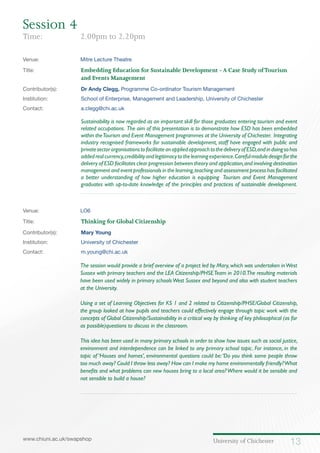
Title:			 Embedding Education for Sustainable Development -A Case Study ofTourism 		
			and Events Management
Contributor(s):		 Dr Andy Clegg, Programme Co-ordinator Tourism Management
Institution:		 School of Enterprise, Management and Leadership, University of Chichester
Contact:		 a.clegg@chi.ac.uk
Sustainability is now regarded as an important skill for those graduates entering tourism and event
related occupations. The aim of this presentation is to demonstrate how ESD has been embedded
within theTourism and Event Management programmes at the University of Chichester. Integrating
industry recognised frameworks for sustainable development, staff have engaged with public and
privatesectororganisationstofacilitateanappliedapproachtothedeliveryofESD,andindoingsohas
addedrealcurrency,credibilityandlegitimacytothelearningexperience.Carefulmoduledesignforthe
delivery of ESD facilitates clear progression between theory and application,and involving destination
management and event professionals in the learning,teaching and assessment process has facilitated
a better understanding of how higher education is equipping Tourism and Event Management
graduates with up-to-date knowledge of the principles and practices of sustainable development.
Venue: 	 LO6
Title:			 Thinking for Global Citizenship
Contributor(s):		 Mary Young
Institution:		 University of Chichester
Contact:		 m.young@chi.ac.uk
	 The session would provide a brief overview of a project led by Mary, which was undertaken inWest
Sussex with primary teachers and the LEA Citizenship/PHSETeam in 2010.The resulting materials
have been used widely in primary schoolsWest Sussex and beyond and also with student teachers
at the University.
	 Using a set of Learning Objectives for KS 1 and 2 related to Citizenship/PHSE/Global Citizenship,
the group looked at how pupils and teachers could effectively engage through topic work with the
concepts of Global Citizenship/Sustainability in a critical way by thinking of key philosophical (as far
as possible)questions to discuss in the classroom.
	 This idea has been used in many primary schools in order to show how issues such as social justice,
environment and interdependence can be linked to any primary school topic. For instance, in the
topic of ‘Houses and homes’, environmental questions could be:‘Do you think some people throw
too much away? Could I throw less away? How can I make my home environmentally friendly?What
benefits and what problems can new houses bring to a local area?Where would it be sensible and
not sensible to build a house?
Session 4
Time: 	 2.00pm to 2.20pm
University of Chichester14 www.chiuni.ac.uk/swapshop
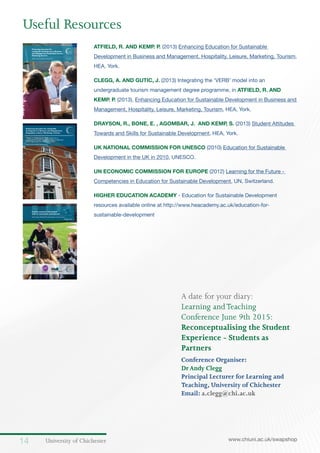
ATFIELD, R. AND KEMP. P. (2013) Enhancing Education for Sustainable
Development in Business and Management, Hospitality, Leisure, Marketing, Tourism,
HEA, York.
CLEGG, A. AND GUTIC, J. (2013) Integrating the ‘VERB’ model into an
undergraduate tourism management degree programme, in ATFIELD, R. AND
KEMP. P. (2013), Enhancing Education for Sustainable Development in Business and
Management, Hospitality, Leisure, Marketing, Tourism, HEA, York.
DRAYSON, R., BONE, E. , AGOMBAR, J. AND KEMP, S. (2013) Student Attitudes
Towards and Skills for Sustainable Development, HEA, York.
UK NATIONAL COMMISSION FOR UNESCO (2010) Education for Sustainable
Development in the UK in 2010, UNESCO.
UN ECONOMIC COMMISSION FOR EUROPE (2012) Learning for the Future -
Competencies in Education for Sustainable Development, UN, Switzerland.
HIGHER EDUCATION ACADEMY - Education for Sustainable Development
resources available online at http://www.heacademy.ac.uk/education-for-
sustainable-development
Useful Resources
A date for your diary:
Learning andTeaching
Conference June 9th 2015:
Reconceptualising the Student
Experience - Students as
Partners
Conference Organiser:
DrAndy Clegg
Principal Lecturer for Learning and
Teaching, University of Chichester
Email: a.clegg@chi.ac.uk
1
Enhancing education for
sustainable development in Business
and Management,Hospitality,Leisure,
Marketing,Tourism
Edited by Richard Atfield and Patsy Kemp March 2013
Enhancing education for sustainable
development in Business and Management,
Hospitality, Leisure, Marketing, Tourism
Chapter 11 Integrating the ‘VERB’ model into an
undergraduate tourism management degree programme
Andrew Clegg and Jorge Gutic, University of Chichester
Edited by Richard Atfield and Patsy Kemp
1
Student attitudes towards and
skills for sustainable development
Rachel Drayson, Elizabeth Bone, Jamie Agombar and Simon Kemp
September 2013

CONFERENCE PROGRAMME 2014

  • 1.
    Family EducaTIonal Day GoGreen Buy Green Stay Green tttttttttttttttttttttttttt FREE Sat 3rdMay 2014 11.00am till 5.00pm ĘėĕDESIGN AND PRINT Sustainable Living Education Live Music Creation Station Local food ProvidersBike Doctor Reuse, Reduce, Recycle Hot Food & Drink Climate ChangeNature Trails Workshops go Karts greenfAyre‘14In Association with a SPONSORED BY: a HOTHAM PARK, BOGNOR REGIS Security SolutionsSBI Enhancing and Embedding Education for Sustainable Development University of Chichester Learning andTeaching Conference 2014 Tuesday 10th June #LTswapshop
  • 2.
    University of Chichester2www.chiuni.ac.uk/swapshop LearningandTeachingConference2014 Key Note Speaker Professor Carolyn Roberts The Knowledge Transfer Network, and Frank Jackson Professor, Gresham College, London Email: carolyn.roberts@earth.ox.ac.uk Carolyn Roberts is an applied environmental scientist with specific interests in sustainability and resource management. She is currently a senior scientist in the UKTechnology Strategy Board- funded ‘Knowledge Transfer Network’, and prior to that was Director of the ‘Environmental Sustainability Knowledge Transfer Network’ a similar national network based at the University of Oxford.Both organisations link businesses with universities,securing technological innovation to enable more environmentally-sensitive industry. At the University of Gloucestershire she was Head of the School of Environment,and Director of the national HEFCE-recognised Centre for Excellence in Teaching and Learning that emerged from it – the Centre for Active Learning. Recognised for the quality of her teaching through the award of a National Teaching Fellowship, and a Senior Fellowship of the Higher Education Academy, she has also published books and papers on themes including innovation, disability, employability, active styles of learning, and education for sustainable development. She chaired the national advisory board for the Higher Education Academy’s Geography, Earth and Environmental Sciences Subject Centre. Carolyn is currently the Chair of the national chartering organisation Society for the Environment, and was formerly Chair of the national professional body, the Institution of Environmental Sciences. Welcome ‘The UK higher education sector is under increasing pressure to address the challenge of embedding sustainable development in the curriculum and ensuring graduates are globally aware and responsible citizens in the 21st century. Employers are demanding sustainability- literate graduates, students are demanding future-proof skills, and the UK Government’s vision for a new ‘green economy’ presents both challenges and opportunities for higher education institutions’ (HEA, 2013). According to a recent HEA and NUS report* more than 80% of students surveyed believe sustainable development should be actively promoted and incorporated by UK universities and that interest in sustainable development remains strong among students throughout their university careers and with the introduction of increased tuition fees. To coincide with the University of Chichester’s engagement with the HEA Green Academy programme, the aim of this year’s Learning andTeaching conference is to highlight best practice in the enhancement and embedding of education for sustainable development (EDS) within the curricula.
  • 3.
    University of Chichester3www.chiuni.ac.uk/swapshop LearningandTeachingConference2014 “Work on Education for Sustainable Development (ESD) helps institutions and subject communities develop curricula and pedagogy that will give students the skills and knowledge to live and work sustainably’ [Drayson et al, 2013] Fieldtrips are an important part of the pedagogy underpinning ESD on the Tourism Management degree route - here students visit Selsey to look at destination management issues
  • 4.
    University of Chichester4www.chiuni.ac.uk/swapshop LearningandTeachingConference2014 9.00am Coffee and Registration Venue: Cloisters Venue: Mitre Lecture Theatre 9.30am Welcome and Introduction 9.40am ‘Setting the Context’: Green Academy Programme DrAndy Clegg, Programme Co-ordintor forTourism Management and Dr Hugh Dunkerley, Senior Lecturer in English and Creative Writing, University of Chichester 9.50am ‘A Quality Education and Fit for Purpose’: Education for Sustainability in Context Professor Carolyn Roberts,The KnowledgeTransfer Network, and Frank Jackson Professor, Gresham College, London 10.30am Education for Sustainable Development - Industry Perspectives Professor Jim Lynch OBE, Distinguished Professor of Life Sciences, Centre for Environmental Strategy, University of Surrey; Chair of Governors, University of Chichester 10.55am Perspectives on Green Impact and ESD CharlotteTaylor, Community Project Officer, NUS 11.15am Green Going - University of Chichester Perspectives Kate Cathie, Environment Officer, University of Chichester 11.35am Refreshments: Cloisters 11.55pm Sessions 1, 2 and 3 Venues: Strand 1 - Mitre Lecture Theatre Strand 2 - LO6 1.15pm Lunch Venue: Cloisters Programme Outline Morning Schedule
  • 5.
    University of Chichester5www.chiuni.ac.uk/swapshop LearningandTeachingConference2014 1.55pm Session 4 Venues: Strand 1 - Mitre Lecture Theatre Strand 2 - LO6 Venue: Mitre Lecture Theatre 2.30pm Establishing a Baseline for ESD Engagement Dr Hugh Dunkerley 2.40pm ‘Getting Sustainability into Your Degree Programme’: A Student Handbook Stefi Barna 3.00pm Session 5: Workshop Cafe ‘Getting Sustainability into Your Degree Programme’ Venues: Workshop 1 - Cloisters Workshop 2 - E124 4.00pm Q&A and Summary 4.15pm Learning and Teaching: Going Forward 4.25pm University of Chichester Module of the Year Award Programme Outline Afternoon Schedule
  • 6.
    University of Chichester6www.chiuni.ac.uk/swapshop LearningandTeachingConference2014 Presentations ‘Setting the Context’: Green Academy Programme DrAndy Clegg, Programme Co-ordintor forTourism Management and Dr Hugh Dunkerley, Senior Lecturer in English and CreativeWriting University of Chichester A brief introduction to the conference with reference to the University’s engagement with the HEA Green Academy Programme, and the resultant inclusion of ESD as a priority in the University’s new Learning and Teaching Strategy. Keynote ‘A Quality Education and Fit for Purpose’: Education for Sustainability in Context Professor Carolyn Roberts,The KnowledgeTransfer Network, and Frank Jackson Professor, Gresham College, London The purpose of education, and particularly Higher Education, has been debated for millennia.Popular opinion counterposes‘employability’ with high academic achievement, the discovery of new principles with their application,and the growth of self-awareness with the accumulation of knowledge. Given the uncertainty and speed of change of the world with which students must engage after they leave university, the perplexity of educators is perhaps understandable – in practice they need to embrace all of these concepts simultaneously.Superimposed onto this complexity,many universities want to be seen as distinctive in what they can offer to potential students, whilst also chasing the elusive beast of ‘student satisfaction’. The talk will invite you to participate in a stroll around the worlds of Education for Sustainable Development, and active styles of learning, in the company of Alice. Education for Sustainable Development - Industry Perspectives Professor Jim Lynch OBE, Distinguished Professor of Life Sciences, Centre for Environmental Strategy, University of Surrey; Chair of Governors, University of Chichester Sustainability is a characteristic of a process or state that can be maintained at a certain level indefinitely. It influences all aspects of life, and can be analysed using Participatory Social Analysis and at the process level by Life Cycle Assessment. Industry has had a negative influence by carbon emissions generating climate change. Bioenergy is an ameliorative option but needs to be viewed in the light of global food security and the competition for land.The transdisciplinary nature of sustainability means that it needs to be considered across all courses in arts and sciences. In application it is vital to develop public private partnerships, especially at the regional level.
  • 7.
    University of Chichester7www.chiuni.ac.uk/swapshop LearningandTeachingConference2014 Perspectives on Green Impact and ESD CharlotteTaylor, Community Project Officer, NUS An overview from the NUS on initiatives designed to support student and staff engagement in ESD. Green Going - University of Chichester Perspectives Kate Cathie, Environment Officer, University of Chichester An overview of the work currently being undertaken in the University, reflecting on the successes of the Green Impact Scheme, and projects being undertaken by students. Establishing a Baseline for ESD Engagement Dr Hugh Dunkerley, Senior Lecturer in English and CreativeWriting, University of Chichester A report on research work being undertaken in the University to establish a baseline for ESD and how many modules currently incorporate some element of ESD. ‘Getting Sustainability into Your Degree Programme’: A Student Handbook Stefi Barna, Lecturer in Global Public Health, University of EastAnglia The University of East Anglia’s Future Skills Initiative aims to deepen employability skills and ensure that graduates leave with the skills to become effective future lead- ers and to help bring about a more just and sustainable world. The Handbook aims to capture the unique perspectives and approaches inherent in each academic disci- pline, and to serve as a forum for discussion and debate, via three questions: • What are the links between your discipline and a more sustainable world? • What knowledge and skills do your graduates need in order to bring that world about, as professionals, citizens and leaders? • How should those knowledge and skills be acquired? Conceptual frameworks will be shared from Business and Management, English, Media Studies, History, Maths, Social Work and the health professions. This presentation will also provide the focus for the afternoon’s workshop cafe where colleagues will be encouraged to think how they could embed ESD within their own modules.
  • 8.
    University of Chichester8www.chiuni.ac.uk/swapshop LearningandTeachingConference2014 Session 1: Time: 12.00pm to 12.20pm Strand 1 (MLT): Embedding Critical Perspectives on Sustainable Development into the Portsmouth Geography Curriculum Dr Julia Brown, University of Portsmouth Strand 2 (LO6): Recycled, Re-seen - How andWhy Found, Recycled and Appropriated Materials are Used in FineArt Victoria Brown, University of Chichester Session 2: Time: 12.25pm to 12.45pm Strand 1 (MLT): PALWeek: Learning Sustainable Development in Design and Engineering Dr Nigel Garland and Dr Zulfiqar Khan, University of Bournemouth Strand 2 (LO6): Students as Producers of Sustainability Hugh Dunkerley, University of Chichester Session 3: Time: 12.50pm to 1.15pm Strand 1 (MLT): Good ManagementTheories for Good Management Practice: Reflections from Students onTheir Business School Curricula Dr Denise Baden, University of Southampton Strand 2 (LO6): Music and Sustainability Dr Rod Paton, University of Chichester Session Programme
  • 9.
    University of Chichester9www.chiuni.ac.uk/swapshop LearningandTeachingConference2014 Session 4: Time: 2.00pm to 2.20pm Strand 1 (MLT): Embedding Education for Sustainable Development -A Case Study ofTourism and Events Management Dr Andy Clegg, University of Chichester Strand 2 (LO6): Thinking for Global Citizenship Mary Young, University of Chichester Session 5: Workshop Cafe Time: 3.00pm to 3.55pm ‘Getting Sustainability intoYour Degree Programme’ Faciliator: Stefi Barna, Dr Hugh Dunkerley, Dr Andy Clegg, Dr Duncan Reavey and Kate Cathie Venue: Cloisters and E124 Session Programme
  • 10.
    University of Chichester10www.chiuni.ac.uk/swapshop Venue: Mitre Lecture Theatre Title: Embedding Critical Perspectives on Sustainable Development into the Portsmouth Geography Curriculum Contributor(s): Dr Julia Brown, Senior Lecturer in Geography Institution: Department of Geography, University of Portsmouth Contact: Julia.brown@port.ac.uk Sustainable Development is the buzz-word of our generation: “like motherhood and apple pie, nobody could be against it” (Terborgh,1999), but there is a danger it “has come to mean everything, and thereby risks ending up meaning nothing” (O’Riordan,1993).While the origins of sustainable development are worthy, the reality of balancing its three pillars (economic, social and environmental) is challenging, and the concept is at risk of co-option by big business, its radical elements lost in institutional ‘green’ box-ticking exercises. Thus embedding a critical perspective on Sustainable Development is crucial. Exploring the very real challenge of translating Sustainable Development policy into meaningful change and equity is fundamental to my units. In Sustainable Environmental Management (Level 5) students are enthused and encouraged to delve and to evaluate, to recognise that there are a spectrum of views from weak to strong sustainability, that those at opposite ends of the spectrum have very different ideas about the environment and how best to manage it. In my Level 6 unit, Environment and Development, students travel to Uganda and conduct research into the reality of managing natural resources sustainably. Learning is taken out of the lecture theatre and into the reality of life with all its challenges and paradoxes,producing graduates capable of independent thinking with a global perspective. Venue: LO6 Title: Recycled, Re-seen - How andWhy Found, Recycled andAppropriated Materials are Used in FineArt Contributor(s): Victoria Brown, Senior Lecturer in Fine Art Institution: Department of Fine Art, University of Chichester Contact: v.brown@chi.ac.uk The precedent of appropriating materials and recycling work has been set by 20th century artists and is continued by Fine Art students. I will be using photographs of graduate work to discuss the ways in which found recycled and appropriated materials and objects develop the link between studio practice and contextual studies/art history. Session 1 Time: 12.00pm to 12.20pm
  • 11.
    University of Chichester11www.chiuni.ac.uk/swapshop Venue: Mitre Lecture Theatre Title: PALWeek: Learning Sustainable Development in Design and Engineering Contributor(s): Dr Nigel Garland and Dr Zulfiqar A. Khan Institution: Sustainable Design Research Centre, Bournemouth University Contact: ngarland@bournemouth.ac.uk / zkhan@bournemouth.ac.uk Institutional guidance highlights the wider qualitative aspects of sustainability, however these are largely ignored within engineering education in favour of quantitative methods.To encourage understanding of these aspects a course was developed as part of induction for BSc Design Engineering and MEng Engineering students.The one week course has been delivered to mixed groups of first and second year students since introduction in AY2010-11 and has evolved from examining “social usefulness” to include “material utilisation” and “future vision”.The one week assessed programme employs PBL and PAL methodologies to promote student engagement with the concepts of sustainable development. Each group is issued with a variation of the brief but with common underlying themes.The key to success has been the avoidance of didactic elements; students are expected to present their findings at daily presentations before a short micro-seminar and adaptation re-shapes their objectives. Students are not told who will be presenting for their group and no notes are allowed,ensuring all members know and understand the work done.Outputs have shaped how sustainable development is understood within the context of design engineering from a practical as well as educational perspective and resulted in a number of published works. Venue: LO6 Title: Students as Producers of Sustainability Contributor(s): Dr Hugh Dunkerley, Senior Lecturer in English and Creative Writing Institution: Department of English and Creative Writing, University of Chichester Contact: h.dunkerley@chi.ac.uk The risk with any teaching is that students become passive receivers of knowledge. How can we avoid the transmission model of education while engaging students with issues of sustainability?The last thing we should be doing is preaching at them. In this session I will discuss how I am intending to use the Student as Producer model to get students to interrogate questions of environmental sustainability for themselves. Session 2 Time: 12.25pm to 12.45pm
  • 12.
    University of Chichester12www.chiuni.ac.uk/swapshop Venue: Mitre Lecture Theatre Title: Good ManagementTheories for Good Management Practice: Reflections from Students onTheir Business School Curricula Contributor(s): Denise Baben, Senior Lecturer in Management Institution: School of Management, University of Southampton Contact: dab@soton.ac.uk We asked our final year undergraduates to reflect on the extent to which business school curricula promoted or inhibited socially responsible business practices.The consensus was that currently most models and courses ignored issues relating to sustainability, ethics and responsibility, and judged business success solely in terms of profit maximisation. Most students believed this was wrong and suggested ways in which the curricula could be changed. In this session I plan to briefly highlight the issues, the students’ views and the way in which we are aiming to more effectively embed sustainability into our business school curriculum. In particular I highlight the importance of the metrics by which we judge success. For example, the metrics and outcomes used to signify ‘success’ throughout the business curriculum are typically related solely to financial performance, so success in an entrepreneurship module may be measured by growth, in a strategy module by profit, in an HR module by performance,in finance by return on investment and so on. Alternative more socially oriented metrics such as jobs created, employee satisfaction, carbon footprint, product quality etc. are rarely considered as desirable outcomes in their own right. I end with discussion about how this can be addressed. Venue: LO6 Title: Music and Sustainability Contributor(s): Dr Rod Paton, Senior Lecturer in Music Institution: Department of Music, University of Chichester Contact: r.paton@chi.ac.uk This presentation will present some ideas towards a model of musical pedagogy which provides musicians with the skills needed within rapidly changing cultural musical paradigms. In this model, the musician’s work is contextualised within a community based model as distinct from the consumer based model which has been culturally dominant for so long.As populations age and as we develop a greater understanding of the benefits of music in health and social care, so the training of musicians will need to re-focus, away from executive and technological skill and towards creative self-sufficiency.Reference will be made to current projects in care homes in Dublin,singing for health in alliance with a local GP practice and in an acute mental health facility all of which inform and drive modules in community music and the postgraduate ‘Lifemusic’ training programme. Session 3 Time: 12.50pm to 1.15pm
  • 13.
    University of Chichester13www.chiuni.ac.uk/swapshop Venue: Mitre Lecture Theatre Title: Embedding Education for Sustainable Development -A Case Study ofTourism and Events Management Contributor(s): Dr Andy Clegg, Programme Co-ordinator Tourism Management Institution: School of Enterprise, Management and Leadership, University of Chichester Contact: a.clegg@chi.ac.uk Sustainability is now regarded as an important skill for those graduates entering tourism and event related occupations. The aim of this presentation is to demonstrate how ESD has been embedded within theTourism and Event Management programmes at the University of Chichester. Integrating industry recognised frameworks for sustainable development, staff have engaged with public and privatesectororganisationstofacilitateanappliedapproachtothedeliveryofESD,andindoingsohas addedrealcurrency,credibilityandlegitimacytothelearningexperience.Carefulmoduledesignforthe delivery of ESD facilitates clear progression between theory and application,and involving destination management and event professionals in the learning,teaching and assessment process has facilitated a better understanding of how higher education is equipping Tourism and Event Management graduates with up-to-date knowledge of the principles and practices of sustainable development. Venue: LO6 Title: Thinking for Global Citizenship Contributor(s): Mary Young Institution: University of Chichester Contact: m.young@chi.ac.uk The session would provide a brief overview of a project led by Mary, which was undertaken inWest Sussex with primary teachers and the LEA Citizenship/PHSETeam in 2010.The resulting materials have been used widely in primary schoolsWest Sussex and beyond and also with student teachers at the University. Using a set of Learning Objectives for KS 1 and 2 related to Citizenship/PHSE/Global Citizenship, the group looked at how pupils and teachers could effectively engage through topic work with the concepts of Global Citizenship/Sustainability in a critical way by thinking of key philosophical (as far as possible)questions to discuss in the classroom. This idea has been used in many primary schools in order to show how issues such as social justice, environment and interdependence can be linked to any primary school topic. For instance, in the topic of ‘Houses and homes’, environmental questions could be:‘Do you think some people throw too much away? Could I throw less away? How can I make my home environmentally friendly?What benefits and what problems can new houses bring to a local area?Where would it be sensible and not sensible to build a house? Session 4 Time: 2.00pm to 2.20pm
  • 14.
    University of Chichester14www.chiuni.ac.uk/swapshop ATFIELD, R. AND KEMP. P. (2013) Enhancing Education for Sustainable Development in Business and Management, Hospitality, Leisure, Marketing, Tourism, HEA, York. CLEGG, A. AND GUTIC, J. (2013) Integrating the ‘VERB’ model into an undergraduate tourism management degree programme, in ATFIELD, R. AND KEMP. P. (2013), Enhancing Education for Sustainable Development in Business and Management, Hospitality, Leisure, Marketing, Tourism, HEA, York. DRAYSON, R., BONE, E. , AGOMBAR, J. AND KEMP, S. (2013) Student Attitudes Towards and Skills for Sustainable Development, HEA, York. UK NATIONAL COMMISSION FOR UNESCO (2010) Education for Sustainable Development in the UK in 2010, UNESCO. UN ECONOMIC COMMISSION FOR EUROPE (2012) Learning for the Future - Competencies in Education for Sustainable Development, UN, Switzerland. HIGHER EDUCATION ACADEMY - Education for Sustainable Development resources available online at http://www.heacademy.ac.uk/education-for- sustainable-development Useful Resources A date for your diary: Learning andTeaching Conference June 9th 2015: Reconceptualising the Student Experience - Students as Partners Conference Organiser: DrAndy Clegg Principal Lecturer for Learning and Teaching, University of Chichester Email: a.clegg@chi.ac.uk 1 Enhancing education for sustainable development in Business and Management,Hospitality,Leisure, Marketing,Tourism Edited by Richard Atfield and Patsy Kemp March 2013 Enhancing education for sustainable development in Business and Management, Hospitality, Leisure, Marketing, Tourism Chapter 11 Integrating the ‘VERB’ model into an undergraduate tourism management degree programme Andrew Clegg and Jorge Gutic, University of Chichester Edited by Richard Atfield and Patsy Kemp 1 Student attitudes towards and skills for sustainable development Rachel Drayson, Elizabeth Bone, Jamie Agombar and Simon Kemp September 2013