Givers are happier: relational thinking and
education for sustainability : implications for
student experience in HE
Jim Longhurst, Billy Clayton, Georgina Gough, Kate Miller, Fiona Hyland,
Ash Tierney, Hannah Tweddell, Amy Walsh, Chris Willmore
Chris Willmore
Professor of Sustainability and Law, University of Bristol
 Bristol Green Capital 2015 – how does
it show it has succeeded?
 Metrics about carbon footprint?
Recycling? Fairtrade purchasing?
 What about attitudes and values?
 How do we show our sustainability
inputs
 are making a difference to values?
 setting life norms not short term
practices?
2
How do you measure
success in
sustainability work?
0%
5%
10%
15%
20%
25%
30%
35%
40%
45%
50%
Positive Greens Waste Watchers Concerned
Consumers
Sideline Supporters Cautious
Participants
Stalled Starters Honestly
Disengaged
DEFRA Segmentation Survey
of University of Bristol Students
2010 2013 2015
Attitude and conduct studies
So what has your project
achieved?
 Traditional outcome measures of success are financial,
or physical environment tangibles.
 The relationships forged are perceived as outputs, not
outcomes.
 Relational Thinking suggests we need to see
engagement as outcome.
 The creation of relationships is not merely a means to an
end. The evidence is that it is central to adaptive
capacity, resilience, wellbeing, belonging and
responsibility.
 Answer: Engagement is an outcome
28
October
2016
4
RT as an evidence based approach
 Theory - Me or we? Inserting we into modernity
 Quantative research evidence :
 those who engage are happier and more resilient
 the more remote decision makers are from others, the less they feel
responsible for them.
 Objectivity
 methods for measuring connectivity/ analysing drivers e.g Relational
Proximity Framework
 See
 Zischka (2013)
 Schluter (2016) – SDGs and Relational Thinking
 Relationalthinking.net
 Schluter M and Lee D, The R Factor
28
October
2016
5
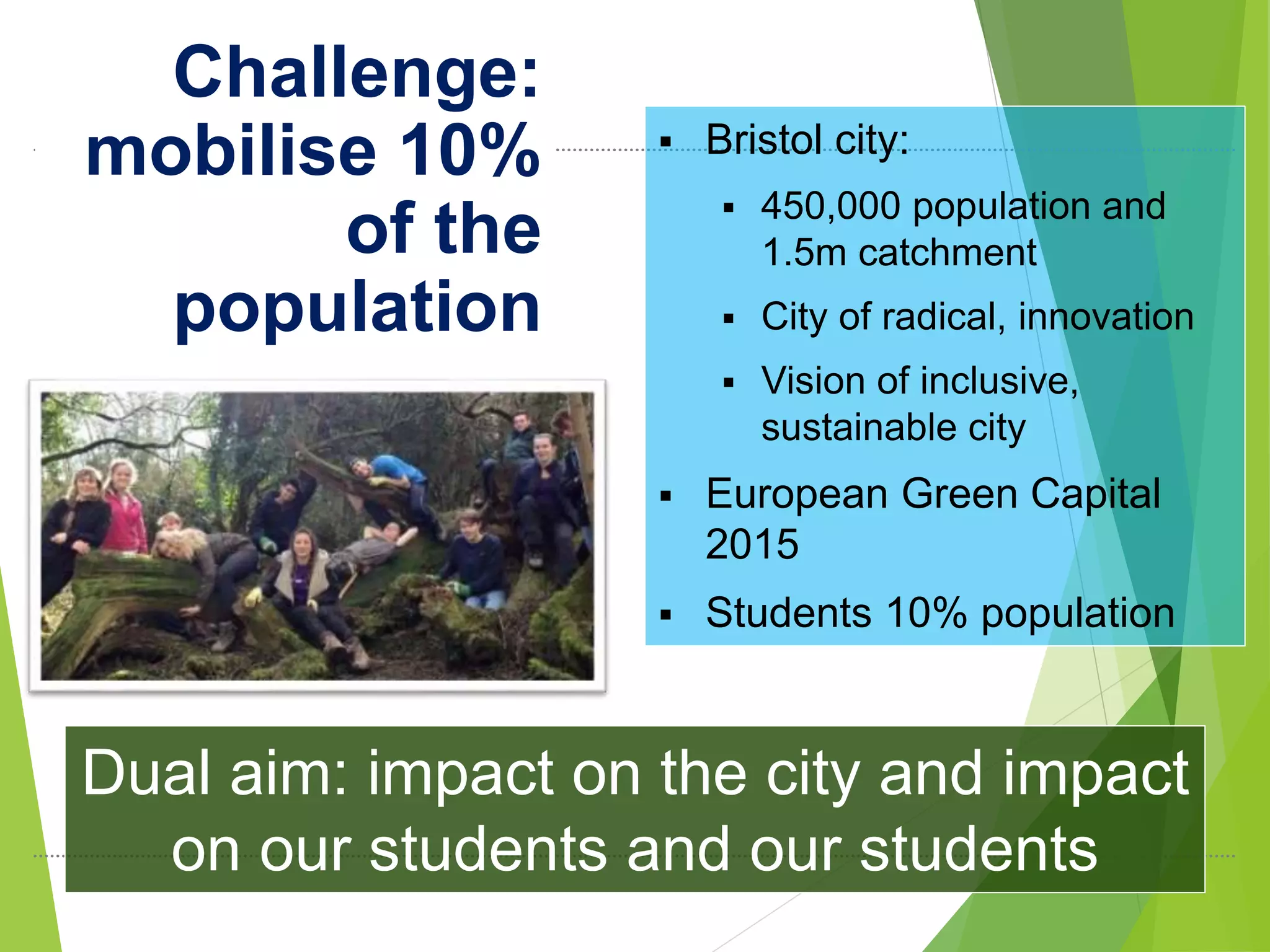
Challenge:
mobilise 10%
of the
population
Dual aim: impact on the city and impact
on our students and our students
 Bristol city:
 450,000 population and
1.5m catchment
 City of radical, innovation
 Vision of inclusive,
sustainable city
 European Green Capital
2015
 Students 10% population
How?
 Bristol European Green Capital 2015 as catalyst
 Unique university partnership
 Within: whole institution approach
 Between: all Universities and Student Unions
together
 Bristol Green Partnership: >850 organisations
 City Council and Mayor
 Funded by Higher Education Funding Council for
England Strategic Catalyst Fund as test bed
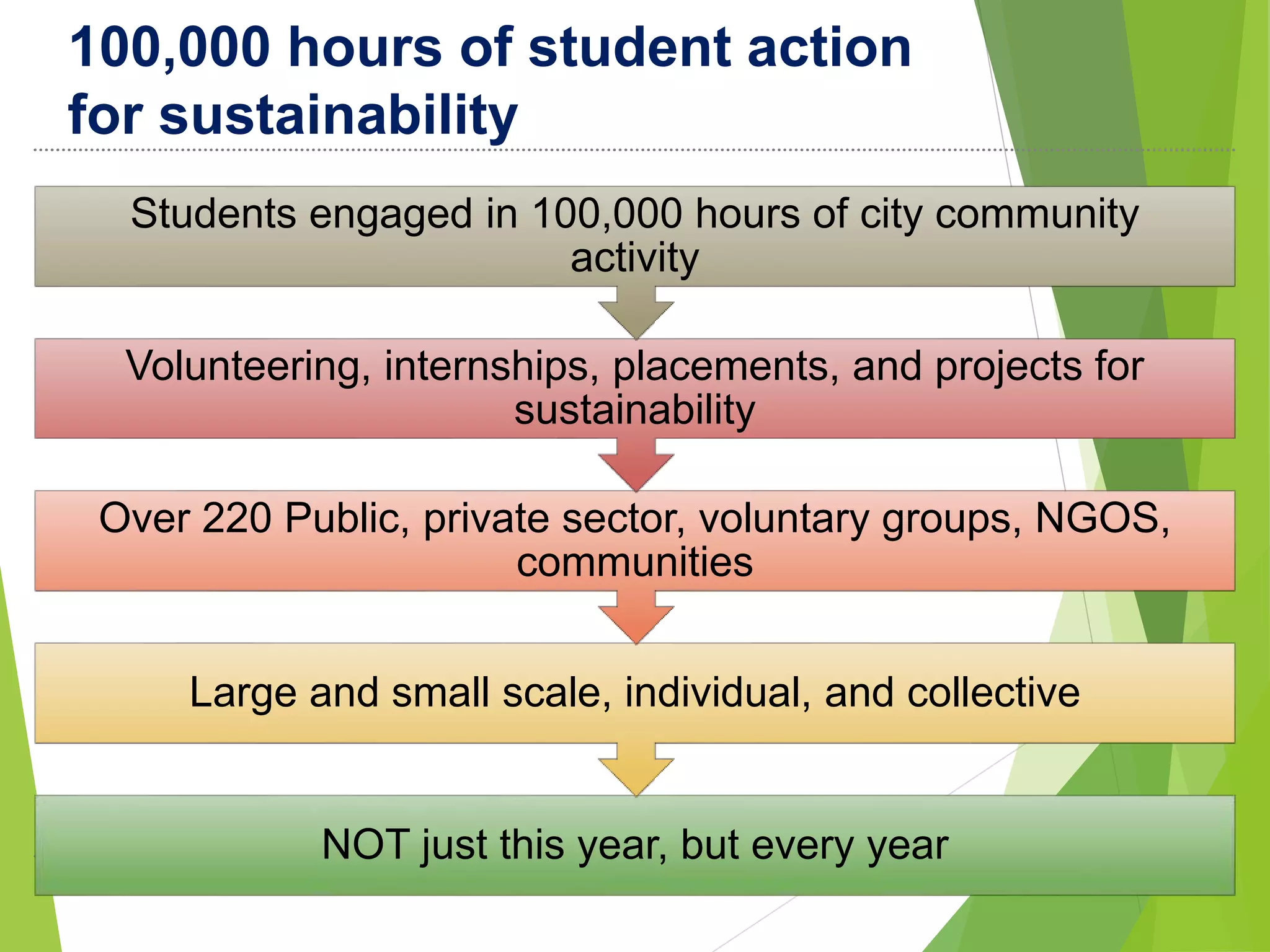
100,000 hours of student action
for sustainability
NOT just this year, but every year
Large and small scale, individual, and collective
Over 220 Public, private sector, voluntary groups, NGOS,
communities
Volunteering, internships, placements, and projects for
sustainability
Students engaged in 100,000 hours of city community
activity
The Bees and Hive
• Holistic -total
picture
• Light tough
management
• Accepting failure as
natural
• Surface & share
Enabling students
and community to
see Hive as well as
Bees
What have
students
been
doing?
• Cash: raising £300k for local charities through
recycling
• Education: delivering workshops to schools
• Conservation: Designing Wildlife Corridors
• Modern Day Slavery
• NGO Business planning
• Knitaversity
• Greening Business : waste and energy audits
and green business plans
 Online brokerage platform
 “Front of house” for local
organisations to engage with
students
 Maintained in partnership
between Universities
 Case Studies to inspire
The Change Makers
 New permanent award created
to celebrate and reward
students efforts
 Two public award
ceremonies a year – over 700
a year – civic and university
leaders – presented by civic
leaders.
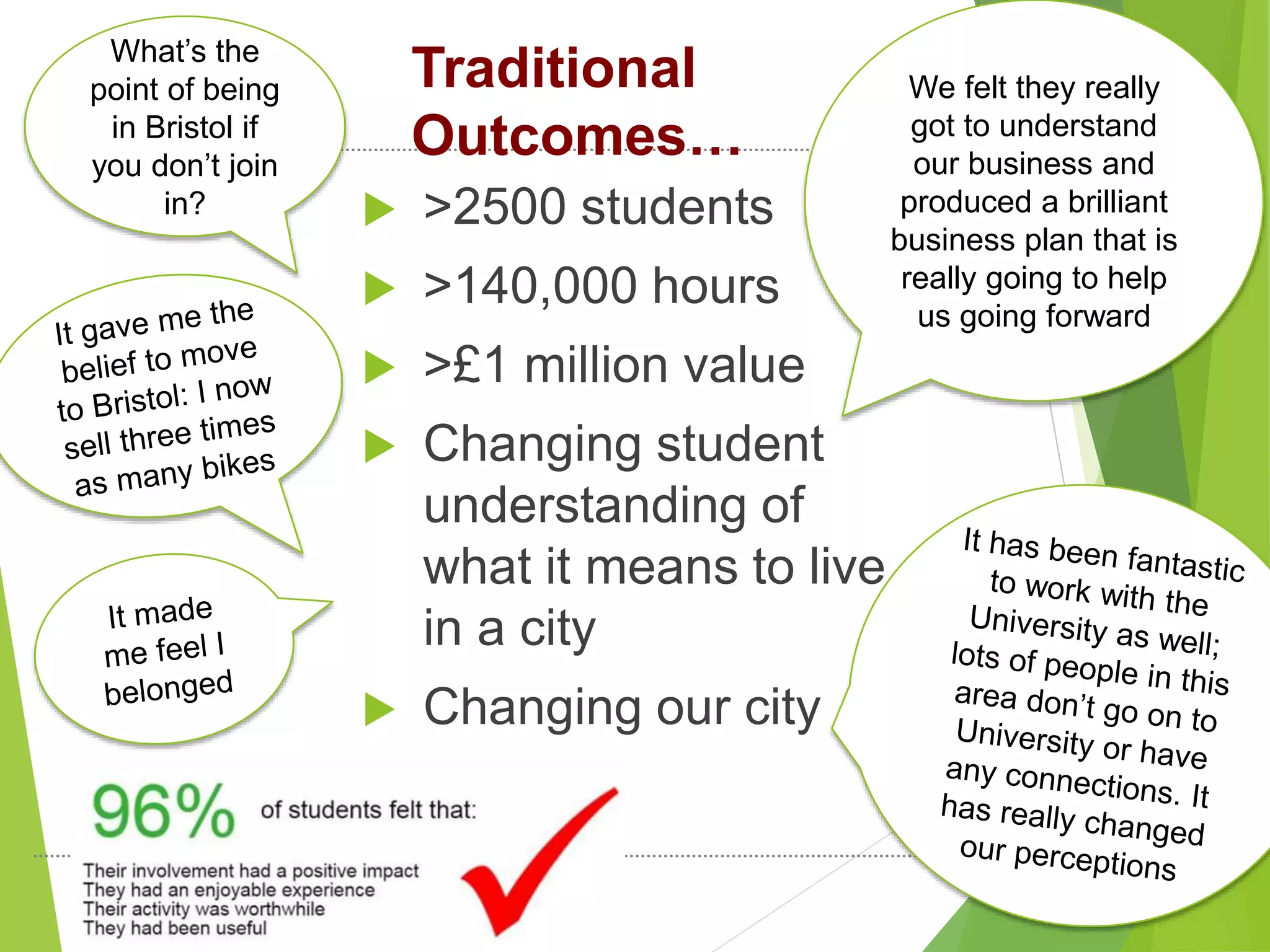
Traditional
Outcomes…
 >2500 students
 >140,000 hours
 >£1 million value
 Changing student
understanding of
what it means to live
in a city
 Changing our city
What’s the
point of being
in Bristol if
you don’t join
in?
We felt they really
got to understand
our business and
produced a brilliant
business plan that is
really going to help
us going forward
External Evaluation
 Carried out by NUS – using the Responsible Futures
Methodology
 What surprised them most through the evaluation was “the
overwhelmingly positive feedback from both students and
external community partners. It was really pleasing to see how
useful the students felt, and how much community partners
valued their impact and would recommend working with Bristol
students to other organisations”.
 “the effective networking opportunities and opportunities to
share academic and on the ground experiences of sustainability
within the city e.g. links with BGCP.”
 “The level and quality of student engagement over the past year
is absolutely incredible and offers an incredible platform upon
which to continue to strive towards creating graduates who are
ready to tackle the world’s greatest sustainability challenges –
during their degree and when they graduate.”
15
Students see RELATIONSHIPS as
key
 Why I joined
 Sustainability
experience
 Free ice cream
 Sounded fun
 Low
risk/commitment
 Sample and
choice
 What I got from it
 It make me feel I
belonged
 Experienced places
/people I wouldn’t have
 Skills of working with
different people
 Gave me a richer
understanding of the UK
But remember: participation in the project is largely voluntary so
those who value belonging / relationships might have
disproportionately engaged
Student perceived
outcomes
 Richer / nuanced understanding of UK
culture/society (28% international students vs
baseline of 15%)
 Self identification as belonging to University -
feel part of the ‘community’
 Stronger intercultural competencies
 Communication and working with different
people
And incidentally a more holistic understanding
of sustainability …..
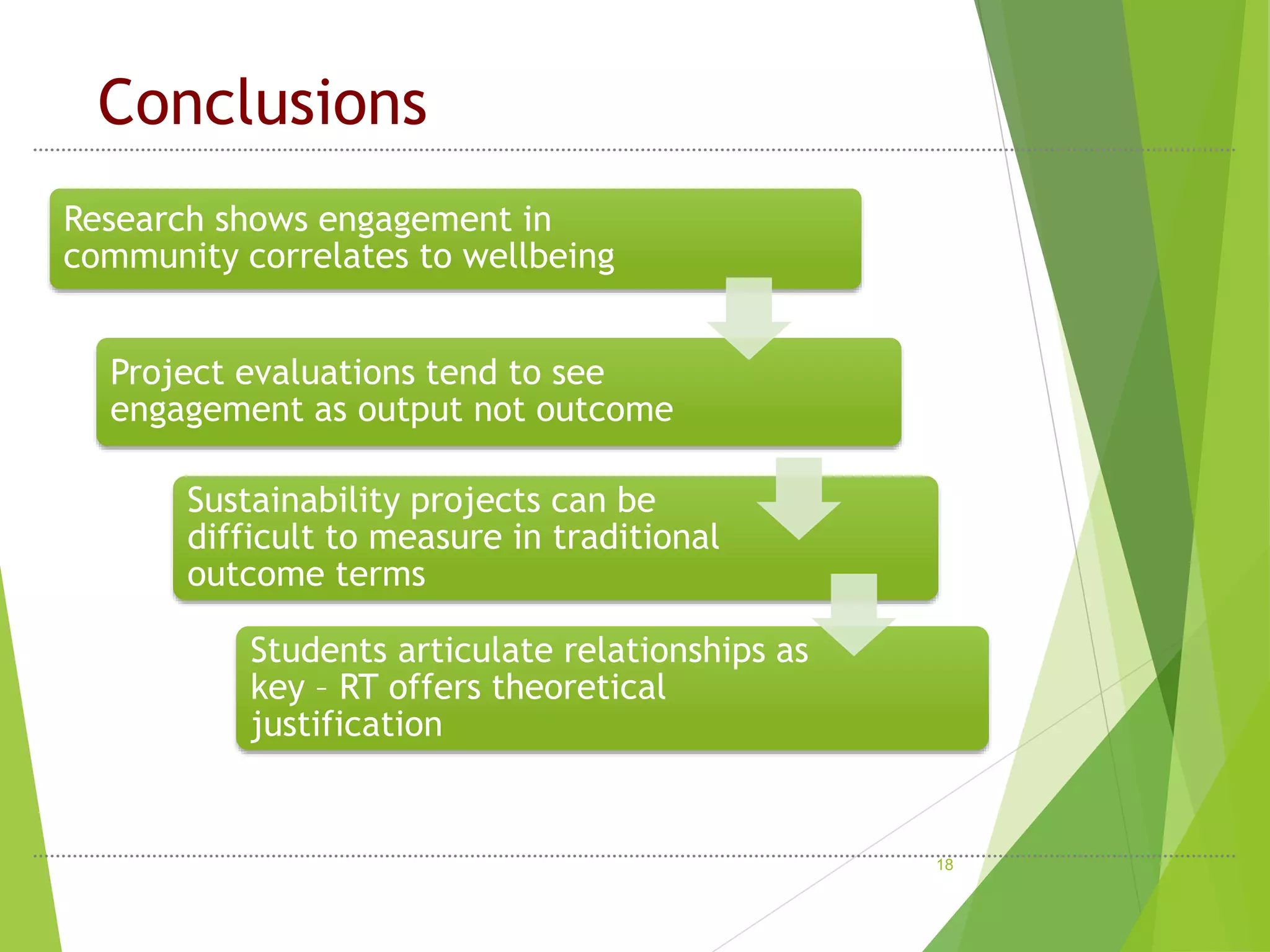
Conclusions
18
Research shows engagement in
community correlates to wellbeing
Project evaluations tend to see
engagement as output not outcome
Sustainability projects can be
difficult to measure in traditional
outcome terms
Students articulate relationships as
key – RT offers theoretical
justification
For more information please contact
James,Longhurst@uwe.ac.uk
Chris.Willmore@bris.ac.uk
Clayton, W., Longhurst, J. and Willmore, C. (2016) Review of the
contribution of Green Capital: Student Capital to Bristols year as European
Green Capital. Project Report. eprints.uwe.ac.uk/28311
Clayton, W., Longhurst, J. and Willmore, C. (2016) The Bristol Method,
Green Capital: Student Capital. The power of student sustainability
engagement www.bristol2015.co.uk/method/european-green-capital/
‘BEYOND ESD’
Implications for sustainability in Higher Education
International Symposium
7-8 September 2015 Bristol, UK
#ESDBristol15 https://sites.google.com/site/beyondesd/
30+ academic papers Workshops and roundtables Informal networking
Keynote speakers include: Jamie Agombar & Quinn Runkle (National Union of Students),
Simon Kemp (University of Southampton), James Longhurst ( UWE, Bristol), Sara Parkin
(Forum for the Future), Iain Patton (EAUC), Chris Willmore (University of Bristol)
REGISTRATION IS OPEN UNTIL 14 August 2015 BOOK NOW
The symposium focuses on new ideas to empower students to deliver a more sustainable future. It will
showcase the best international experience of engaging students with an emphasis upon holistic approach-
es linking student- led activities, the informal curriculum, the formal curriculum and the campus and city as
living laboratories. The Symposium will challenge participants to consider the merits of holistic approaches,
and explore not only what we are doing but what we are trying to achieve – the outcomes as well as inputs.
Which initiatives are making a difference? Why? What can we learn from them?What are the new projects
and partnerships that can take forward the agenda of engaged learning for sustainability.

Willmore, Chris, Track 2

  • 1.
    Givers are happier:relational thinking and education for sustainability : implications for student experience in HE Jim Longhurst, Billy Clayton, Georgina Gough, Kate Miller, Fiona Hyland, Ash Tierney, Hannah Tweddell, Amy Walsh, Chris Willmore Chris Willmore Professor of Sustainability and Law, University of Bristol
  • 2.
     Bristol GreenCapital 2015 – how does it show it has succeeded?  Metrics about carbon footprint? Recycling? Fairtrade purchasing?  What about attitudes and values?  How do we show our sustainability inputs  are making a difference to values?  setting life norms not short term practices? 2 How do you measure success in sustainability work?
  • 3.
    0% 5% 10% 15% 20% 25% 30% 35% 40% 45% 50% Positive Greens WasteWatchers Concerned Consumers Sideline Supporters Cautious Participants Stalled Starters Honestly Disengaged DEFRA Segmentation Survey of University of Bristol Students 2010 2013 2015 Attitude and conduct studies
  • 4.
    So what hasyour project achieved?  Traditional outcome measures of success are financial, or physical environment tangibles.  The relationships forged are perceived as outputs, not outcomes.  Relational Thinking suggests we need to see engagement as outcome.  The creation of relationships is not merely a means to an end. The evidence is that it is central to adaptive capacity, resilience, wellbeing, belonging and responsibility.  Answer: Engagement is an outcome 28 October 2016 4
  • 5.
    RT as anevidence based approach  Theory - Me or we? Inserting we into modernity  Quantative research evidence :  those who engage are happier and more resilient  the more remote decision makers are from others, the less they feel responsible for them.  Objectivity  methods for measuring connectivity/ analysing drivers e.g Relational Proximity Framework  See  Zischka (2013)  Schluter (2016) – SDGs and Relational Thinking  Relationalthinking.net  Schluter M and Lee D, The R Factor 28 October 2016 5
  • 6.
    Challenge: mobilise 10% of the population Dualaim: impact on the city and impact on our students and our students  Bristol city:  450,000 population and 1.5m catchment  City of radical, innovation  Vision of inclusive, sustainable city  European Green Capital 2015  Students 10% population
  • 7.
    How?  Bristol EuropeanGreen Capital 2015 as catalyst  Unique university partnership  Within: whole institution approach  Between: all Universities and Student Unions together  Bristol Green Partnership: >850 organisations  City Council and Mayor  Funded by Higher Education Funding Council for England Strategic Catalyst Fund as test bed
  • 8.
    100,000 hours ofstudent action for sustainability NOT just this year, but every year Large and small scale, individual, and collective Over 220 Public, private sector, voluntary groups, NGOS, communities Volunteering, internships, placements, and projects for sustainability Students engaged in 100,000 hours of city community activity
  • 9.
    The Bees andHive • Holistic -total picture • Light tough management • Accepting failure as natural • Surface & share Enabling students and community to see Hive as well as Bees
  • 10.
    What have students been doing? • Cash:raising £300k for local charities through recycling • Education: delivering workshops to schools • Conservation: Designing Wildlife Corridors • Modern Day Slavery • NGO Business planning • Knitaversity • Greening Business : waste and energy audits and green business plans
  • 11.
     Online brokerageplatform  “Front of house” for local organisations to engage with students  Maintained in partnership between Universities  Case Studies to inspire The Change Makers  New permanent award created to celebrate and reward students efforts  Two public award ceremonies a year – over 700 a year – civic and university leaders – presented by civic leaders.
  • 12.
    Traditional Outcomes…  >2500 students >140,000 hours  >£1 million value  Changing student understanding of what it means to live in a city  Changing our city What’s the point of being in Bristol if you don’t join in? We felt they really got to understand our business and produced a brilliant business plan that is really going to help us going forward
  • 13.
    External Evaluation  Carriedout by NUS – using the Responsible Futures Methodology  What surprised them most through the evaluation was “the overwhelmingly positive feedback from both students and external community partners. It was really pleasing to see how useful the students felt, and how much community partners valued their impact and would recommend working with Bristol students to other organisations”.  “the effective networking opportunities and opportunities to share academic and on the ground experiences of sustainability within the city e.g. links with BGCP.”  “The level and quality of student engagement over the past year is absolutely incredible and offers an incredible platform upon which to continue to strive towards creating graduates who are ready to tackle the world’s greatest sustainability challenges – during their degree and when they graduate.” 15
  • 14.
    Students see RELATIONSHIPSas key  Why I joined  Sustainability experience  Free ice cream  Sounded fun  Low risk/commitment  Sample and choice  What I got from it  It make me feel I belonged  Experienced places /people I wouldn’t have  Skills of working with different people  Gave me a richer understanding of the UK But remember: participation in the project is largely voluntary so those who value belonging / relationships might have disproportionately engaged
  • 15.
    Student perceived outcomes  Richer/ nuanced understanding of UK culture/society (28% international students vs baseline of 15%)  Self identification as belonging to University - feel part of the ‘community’  Stronger intercultural competencies  Communication and working with different people And incidentally a more holistic understanding of sustainability …..
  • 16.
    Conclusions 18 Research shows engagementin community correlates to wellbeing Project evaluations tend to see engagement as output not outcome Sustainability projects can be difficult to measure in traditional outcome terms Students articulate relationships as key – RT offers theoretical justification
  • 17.
    For more informationplease contact James,Longhurst@uwe.ac.uk Chris.Willmore@bris.ac.uk Clayton, W., Longhurst, J. and Willmore, C. (2016) Review of the contribution of Green Capital: Student Capital to Bristols year as European Green Capital. Project Report. eprints.uwe.ac.uk/28311 Clayton, W., Longhurst, J. and Willmore, C. (2016) The Bristol Method, Green Capital: Student Capital. The power of student sustainability engagement www.bristol2015.co.uk/method/european-green-capital/ ‘BEYOND ESD’ Implications for sustainability in Higher Education International Symposium 7-8 September 2015 Bristol, UK #ESDBristol15 https://sites.google.com/site/beyondesd/ 30+ academic papers Workshops and roundtables Informal networking Keynote speakers include: Jamie Agombar & Quinn Runkle (National Union of Students), Simon Kemp (University of Southampton), James Longhurst ( UWE, Bristol), Sara Parkin (Forum for the Future), Iain Patton (EAUC), Chris Willmore (University of Bristol) REGISTRATION IS OPEN UNTIL 14 August 2015 BOOK NOW The symposium focuses on new ideas to empower students to deliver a more sustainable future. It will showcase the best international experience of engaging students with an emphasis upon holistic approach- es linking student- led activities, the informal curriculum, the formal curriculum and the campus and city as living laboratories. The Symposium will challenge participants to consider the merits of holistic approaches, and explore not only what we are doing but what we are trying to achieve – the outcomes as well as inputs. Which initiatives are making a difference? Why? What can we learn from them?What are the new projects and partnerships that can take forward the agenda of engaged learning for sustainability.

Editor's Notes