Anybody Could be at Risk:
Food (In)Security within the
University of Northern British
Columbia
Annie L.Booth
Professor
Ecosystem Science and Management
Program
Melanie Anderson
Environmental Studies
University of Northern British Columbia
Canada
Food insecurity can affect
anyone, even those you may
think would never have to
deal with that life challenge.
Anyone can be food insecure,
depending on life
circumstances.
UNBC	Staff	Member
Food insecurity is defined as
“the inability to access and procure,
through conventional avenues,
nutritionally adequate foods
capable of supporting an active and
health life. ” (Micevski et al. 2014)
Recent research demonstrates
• a considerable range in the levels of
food insecurity among post-secondary
students across different institutions
and countries,
• ranging from an estimated 10.2% to a
high of 59% of students surveyed
No research considers food security
among post-secondary staff and
faculty
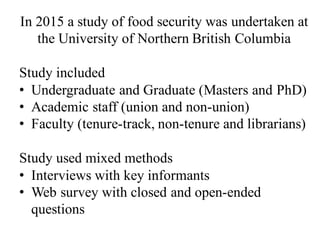
In 2015 a study of food security was undertaken at
the University of Northern British Columbia
Study included
• Undergraduate and Graduate (Masters and PhD)
• Academic staff (union and non-union)
• Faculty (tenure-track, non-tenure and librarians)
Study used mixed methods
• Interviews with key informants
• Web survey with closed and open-ended
questions
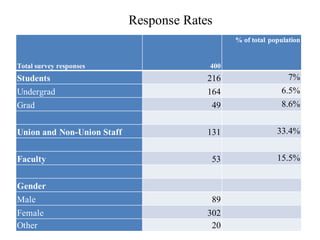
Response Rates
Total survey responses 400
% of total population
Students 216 7%
Undergrad 164 6.5%
Grad 49 8.6%
Union and Non-Union Staff 131 33.4%
Faculty 53 15.5%
Gender
Male 89
Female 302
Other 20
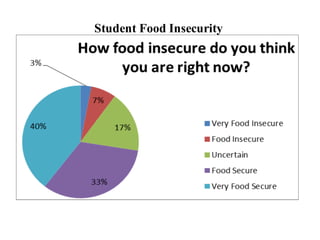
Student Food Insecurity
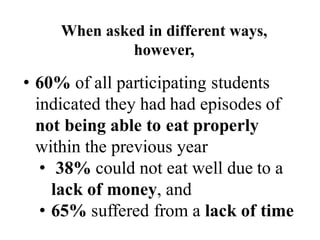
• 60% of all participating students
indicated they had had episodes of
not being able to eat properly
within the previous year
• 38% could not eat well due to a
lack of money, and
• 65% suffered from a lack of time
When asked in different ways,
however,
Impact of Food Insecurity on
Students
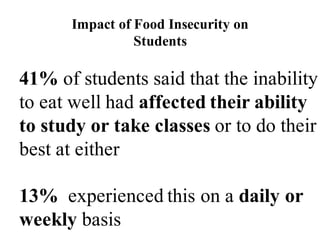
41% of students said that the inability
to eat well had affected their ability
to study or take classes or to do their
best at either
13% experienced this on a daily or
weekly basis
“Because of costs of living and tuition, I
have had go without eating myself in an
effort to make sure that my children have
had enough to eat at home and at school.”
“There are International students who come
early to residence. One girl didn't eat for
three days until her roommate moved in.
Thankfully a mom helped her out and
brought it to [the attention of Residence
staff].”
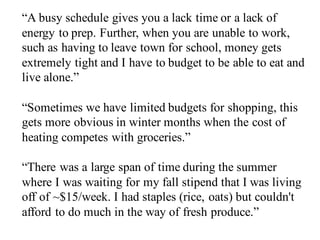
“A busy schedule gives you a lack time or a lack of
energy to prep. Further, when you are unable to work,
such as having to leave town for school, money gets
extremely tight and I have to budget to be able to eat and
live alone.”
“Sometimes we have limited budgets for shopping, this
gets more obvious in winter months when the cost of
heating competes with groceries.”
“There was a large span of time during the summer
where I was waiting for my fall stipend that I was living
off of ~$15/week. I had staples (rice, oats) but couldn't
afford to do much in the way of fresh produce.”
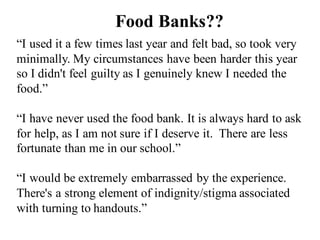
“I used it a few times last year and felt bad, so took very
minimally. My circumstances have been harder this year
so I didn't feel guilty as I genuinely knew I needed the
food.”
“I have never used the food bank. It is always hard to ask
for help, as I am not sure if I deserve it. There are less
fortunate than me in our school.”
“I would be extremely embarrassed by the experience.
There's a strong element of indignity/stigma associated
with turning to handouts.”
Food Banks??
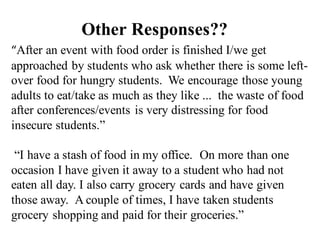
“After an event with food order is finished I/we get
approached by students who ask whether there is some left-
over food for hungry students. We encourage those young
adults to eat/take as much as they like ... the waste of food
after conferences/events is very distressing for food
insecure students.”
“I have a stash of food in my office. On more than one
occasion I have given it away to a student who had not
eaten all day. I also carry grocery cards and have given
those away. A couple of times, I have taken students
grocery shopping and paid for their groceries.”
Other Responses??
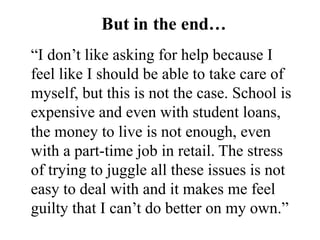
“I don’t like asking for help because I
feel like I should be able to take care of
myself, but this is not the case. School is
expensive and even with student loans,
the money to live is not enough, even
with a part-time job in retail. The stress
of trying to juggle all these issues is not
easy to deal with and it makes me feel
guilty that I can’t do better on my own.”
But in the end…
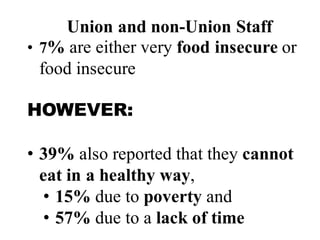
• 7% are either very food insecure or
food insecure
HOWEVER:
• 39% also reported that they cannot
eat in a healthy way,
• 15% due to poverty and
• 57% due to a lack of time
Union and non-Union Staff
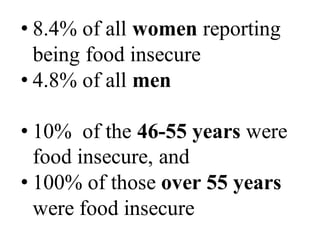
• 8.4% of all women reporting
being food insecure
• 4.8% of all men
• 10% of the 46-55 years were
food insecure, and
• 100% of those over 55 years
were food insecure
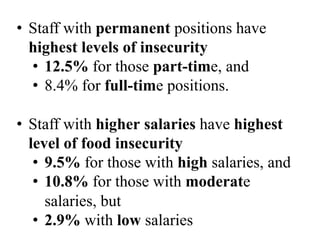
• Staff with permanent positions have
highest levels of insecurity
• 12.5% for those part-time, and
• 8.4% for full-time positions.
• Staff with higher salaries have highest
level of food insecurity
• 9.5% for those with high salaries, and
• 10.8% for those with moderate
salaries, but
• 2.9% with low salaries
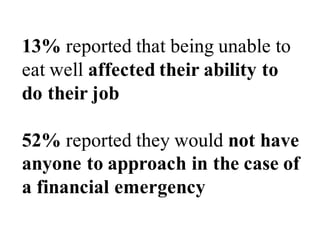
13% reported that being unable to
eat well affected their ability to
do their job
52% reported they would not have
anyone to approach in the case of
a financial emergency
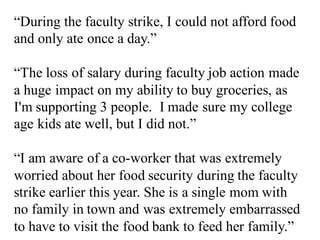
“During the faculty strike, I could not afford food
and only ate once a day.”
“The loss of salary during faculty job action made
a huge impact on my ability to buy groceries, as
I'm supporting 3 people. I made sure my college
age kids ate well, but I did not.”
“I am aware of a co-worker that was extremely
worried about her food security during the faculty
strike earlier this year. She is a single mom with
no family in town and was extremely embarrassed
to have to visit the food bank to feed her family.”
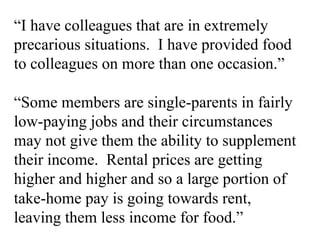
“I have colleagues that are in extremely
precarious situations. I have provided food
to colleagues on more than one occasion.”
“Some members are single-parents in fairly
low-paying jobs and their circumstances
may not give them the ability to supplement
their income. Rental prices are getting
higher and higher and so a large portion of
take-home pay is going towards rent,
leaving them less income for food.”
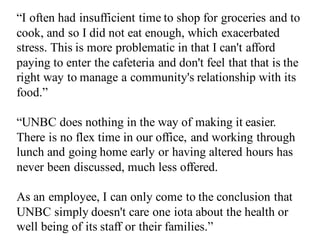
“I often had insufficient time to shop for groceries and to
cook, and so I did not eat enough, which exacerbated
stress. This is more problematic in that I can't afford
paying to enter the cafeteria and don't feel that that is the
right way to manage a community's relationship with its
food.”
“UNBC does nothing in the way of making it easier.
There is no flex time in our office, and working through
lunch and going home early or having altered hours has
never been discussed, much less offered.
As an employee, I can only come to the conclusion that
UNBC simply doesn't care one iota about the health or
well being of its staff or their families.”
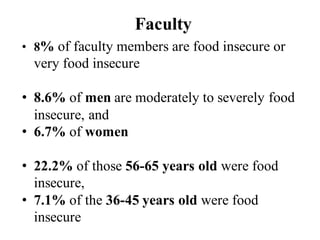
• 8% of faculty members are food insecure or
very food insecure
• 8.6% of men are moderately to severely food
insecure, and
• 6.7% of women
• 22.2% of those 56-65 years old were food
insecure,
• 7.1% of the 36-45 years old were food
insecure
Faculty
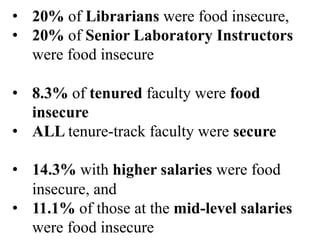
• 20% of Librarians were food insecure,
• 20% of Senior Laboratory Instructors
were food insecure
• 8.3% of tenured faculty were food
insecure
• ALL tenure-track faculty were secure
• 14.3% with higher salaries were food
insecure, and
• 11.1% of those at the mid-level salaries
were food insecure
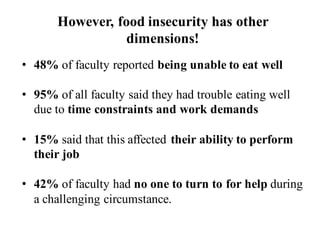
However, food insecurity has other
dimensions!
• 48% of faculty reported being unable to eat well
• 95% of all faculty said they had trouble eating well
due to time constraints and work demands
• 15% said that this affected their ability to perform
their job
• 42% of faculty had no one to turn to for help during
a challenging circumstance.
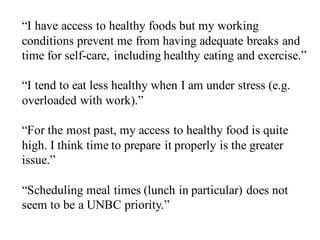
“I have access to healthy foods but my working
conditions prevent me from having adequate breaks and
time for self-care, including healthy eating and exercise.”
“I tend to eat less healthy when I am under stress (e.g.
overloaded with work).”
“For the most past, my access to healthy food is quite
high. I think time to prepare it properly is the greater
issue.”
“Scheduling meal times (lunch in particular) does not
seem to be a UNBC priority.”
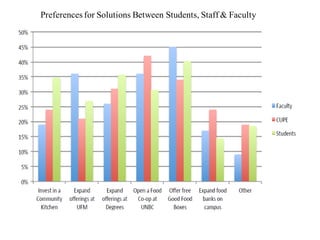
Preferences for Solutions Between Students, Staff & Faculty
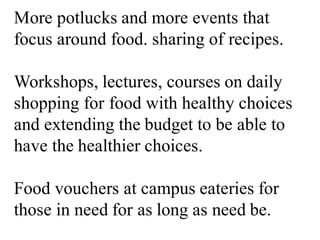
More potlucks and more events that
focus around food. sharing of recipes.
Workshops, lectures, courses on daily
shopping for food with healthy choices
and extending the budget to be able to
have the healthier choices.
Food vouchers at campus eateries for
those in need for as long as need be.
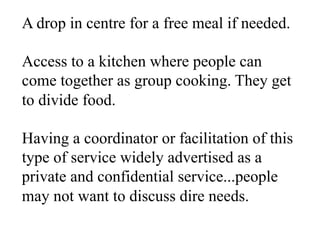
A drop in centre for a free meal if needed.
Access to a kitchen where people can
come together as group cooking. They get
to divide food.
Having a coordinator or facilitation of this
type of service widely advertised as a
private and confidential service...people
may not want to discuss dire needs.
“Treat food as the centre of our
community.”
“Food insecurity can affect anyone, even
those you may think would never have to
deal with that life challenge.
Anyone can be food insecure, depending
on life circumstances.”
In the end, remember two key concepts

Booth, Annie, Track 3

  • 1.
    Anybody Could beat Risk: Food (In)Security within the University of Northern British Columbia Annie L.Booth Professor Ecosystem Science and Management Program Melanie Anderson Environmental Studies University of Northern British Columbia Canada
  • 2.
    Food insecurity canaffect anyone, even those you may think would never have to deal with that life challenge. Anyone can be food insecure, depending on life circumstances. UNBC Staff Member
  • 3.
    Food insecurity isdefined as “the inability to access and procure, through conventional avenues, nutritionally adequate foods capable of supporting an active and health life. ” (Micevski et al. 2014)
  • 4.
    Recent research demonstrates •a considerable range in the levels of food insecurity among post-secondary students across different institutions and countries, • ranging from an estimated 10.2% to a high of 59% of students surveyed No research considers food security among post-secondary staff and faculty
  • 5.
    In 2015 astudy of food security was undertaken at the University of Northern British Columbia Study included • Undergraduate and Graduate (Masters and PhD) • Academic staff (union and non-union) • Faculty (tenure-track, non-tenure and librarians) Study used mixed methods • Interviews with key informants • Web survey with closed and open-ended questions
  • 6.
    Response Rates Total surveyresponses 400 % of total population Students 216 7% Undergrad 164 6.5% Grad 49 8.6% Union and Non-Union Staff 131 33.4% Faculty 53 15.5% Gender Male 89 Female 302 Other 20
  • 7.
  • 8.
    • 60% ofall participating students indicated they had had episodes of not being able to eat properly within the previous year • 38% could not eat well due to a lack of money, and • 65% suffered from a lack of time When asked in different ways, however,
  • 9.
    Impact of FoodInsecurity on Students 41% of students said that the inability to eat well had affected their ability to study or take classes or to do their best at either 13% experienced this on a daily or weekly basis
  • 10.
    “Because of costsof living and tuition, I have had go without eating myself in an effort to make sure that my children have had enough to eat at home and at school.” “There are International students who come early to residence. One girl didn't eat for three days until her roommate moved in. Thankfully a mom helped her out and brought it to [the attention of Residence staff].”
  • 11.
    “A busy schedulegives you a lack time or a lack of energy to prep. Further, when you are unable to work, such as having to leave town for school, money gets extremely tight and I have to budget to be able to eat and live alone.” “Sometimes we have limited budgets for shopping, this gets more obvious in winter months when the cost of heating competes with groceries.” “There was a large span of time during the summer where I was waiting for my fall stipend that I was living off of ~$15/week. I had staples (rice, oats) but couldn't afford to do much in the way of fresh produce.”
  • 12.
    “I used ita few times last year and felt bad, so took very minimally. My circumstances have been harder this year so I didn't feel guilty as I genuinely knew I needed the food.” “I have never used the food bank. It is always hard to ask for help, as I am not sure if I deserve it. There are less fortunate than me in our school.” “I would be extremely embarrassed by the experience. There's a strong element of indignity/stigma associated with turning to handouts.” Food Banks??
  • 13.
    “After an eventwith food order is finished I/we get approached by students who ask whether there is some left- over food for hungry students. We encourage those young adults to eat/take as much as they like ... the waste of food after conferences/events is very distressing for food insecure students.” “I have a stash of food in my office. On more than one occasion I have given it away to a student who had not eaten all day. I also carry grocery cards and have given those away. A couple of times, I have taken students grocery shopping and paid for their groceries.” Other Responses??
  • 14.
    “I don’t likeasking for help because I feel like I should be able to take care of myself, but this is not the case. School is expensive and even with student loans, the money to live is not enough, even with a part-time job in retail. The stress of trying to juggle all these issues is not easy to deal with and it makes me feel guilty that I can’t do better on my own.” But in the end…
  • 15.
    • 7% areeither very food insecure or food insecure HOWEVER: • 39% also reported that they cannot eat in a healthy way, • 15% due to poverty and • 57% due to a lack of time Union and non-Union Staff
  • 16.
    • 8.4% ofall women reporting being food insecure • 4.8% of all men • 10% of the 46-55 years were food insecure, and • 100% of those over 55 years were food insecure
  • 17.
    • Staff withpermanent positions have highest levels of insecurity • 12.5% for those part-time, and • 8.4% for full-time positions. • Staff with higher salaries have highest level of food insecurity • 9.5% for those with high salaries, and • 10.8% for those with moderate salaries, but • 2.9% with low salaries
  • 18.
    13% reported thatbeing unable to eat well affected their ability to do their job 52% reported they would not have anyone to approach in the case of a financial emergency
  • 19.
    “During the facultystrike, I could not afford food and only ate once a day.” “The loss of salary during faculty job action made a huge impact on my ability to buy groceries, as I'm supporting 3 people. I made sure my college age kids ate well, but I did not.” “I am aware of a co-worker that was extremely worried about her food security during the faculty strike earlier this year. She is a single mom with no family in town and was extremely embarrassed to have to visit the food bank to feed her family.”
  • 20.
    “I have colleaguesthat are in extremely precarious situations. I have provided food to colleagues on more than one occasion.” “Some members are single-parents in fairly low-paying jobs and their circumstances may not give them the ability to supplement their income. Rental prices are getting higher and higher and so a large portion of take-home pay is going towards rent, leaving them less income for food.”
  • 21.
    “I often hadinsufficient time to shop for groceries and to cook, and so I did not eat enough, which exacerbated stress. This is more problematic in that I can't afford paying to enter the cafeteria and don't feel that that is the right way to manage a community's relationship with its food.” “UNBC does nothing in the way of making it easier. There is no flex time in our office, and working through lunch and going home early or having altered hours has never been discussed, much less offered. As an employee, I can only come to the conclusion that UNBC simply doesn't care one iota about the health or well being of its staff or their families.”
  • 22.
    • 8% offaculty members are food insecure or very food insecure • 8.6% of men are moderately to severely food insecure, and • 6.7% of women • 22.2% of those 56-65 years old were food insecure, • 7.1% of the 36-45 years old were food insecure Faculty
  • 23.
    • 20% ofLibrarians were food insecure, • 20% of Senior Laboratory Instructors were food insecure • 8.3% of tenured faculty were food insecure • ALL tenure-track faculty were secure • 14.3% with higher salaries were food insecure, and • 11.1% of those at the mid-level salaries were food insecure
  • 24.
    However, food insecurityhas other dimensions! • 48% of faculty reported being unable to eat well • 95% of all faculty said they had trouble eating well due to time constraints and work demands • 15% said that this affected their ability to perform their job • 42% of faculty had no one to turn to for help during a challenging circumstance.
  • 25.
    “I have accessto healthy foods but my working conditions prevent me from having adequate breaks and time for self-care, including healthy eating and exercise.” “I tend to eat less healthy when I am under stress (e.g. overloaded with work).” “For the most past, my access to healthy food is quite high. I think time to prepare it properly is the greater issue.” “Scheduling meal times (lunch in particular) does not seem to be a UNBC priority.”
  • 26.
    Preferences for SolutionsBetween Students, Staff & Faculty
  • 27.
    More potlucks andmore events that focus around food. sharing of recipes. Workshops, lectures, courses on daily shopping for food with healthy choices and extending the budget to be able to have the healthier choices. Food vouchers at campus eateries for those in need for as long as need be.
  • 28.
    A drop incentre for a free meal if needed. Access to a kitchen where people can come together as group cooking. They get to divide food. Having a coordinator or facilitation of this type of service widely advertised as a private and confidential service...people may not want to discuss dire needs.
  • 29.
    “Treat food asthe centre of our community.” “Food insecurity can affect anyone, even those you may think would never have to deal with that life challenge. Anyone can be food insecure, depending on life circumstances.” In the end, remember two key concepts