Space for Interdisciplinary Collaboration:
One Mode of Achieving Social Sustainability at Universities
Assistant prof. Kristina Careva (MArch, PhD)
Prof. Bojan Baletic (MArch, PhD)
Faculty of Architecture, University of Zagreb, 26 Kaciceva Street, 10000 Zagreb, Croatia
E-Mail: kristina.careva@arhitekt.hr, bojan.baletic@arhitekt.hr
Space for Interdisciplinary Collaboration:
One Mode of Achieving Social Sustainability at Universities
Social sustainability
“Addressing the theme of sustainable development implementation, due to the
complex image of the environmental impact and interconnectedness of social
processes, requires a holistic approach where more disciplines combine their
knowledge through interdisciplinary process as a prerequisite for the development of
science.” (Pravdic 1993)
Space for Interdisciplinary Collaboration:
One Mode of Achieving Social Sustainability at Universities
Socialization at University Campuses
“A key aspect to achieving interdisciplinarity is through the design of physical and social
spaces. Creating spaces where people continuously come into contact with people
outside their discipline in natural, casual social settings over and over again, helps
develop social networks that eventually become the source of intellectual inspiration
and creativity.” (Dzeng 2013)
Space for Interdisciplinary Collaboration:
One Mode of Achieving Social Sustainability at Universities
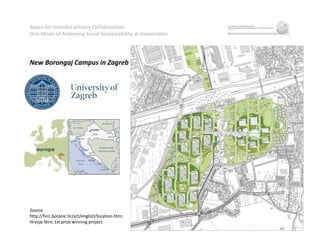
New Borongaj Campus in Zagreb
Source
http://hirc.botanic.hr/vrt/english/location.htm;
Hrvoje Niric 1st prize winning project
Space for Interdisciplinary Collaboration:
One Mode of Achieving Social Sustainability at Universities
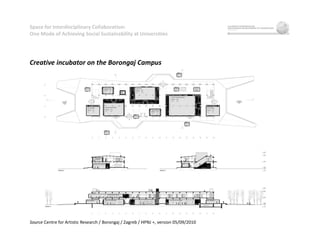
Creative incubator on the Borongaj Campus
Source Centre for Artistic Research / Borongaj / Zagreb / HPNJ +, version 05/09/2010
Space for Interdisciplinary Collaboration:
One Mode of Achieving Social Sustainability at Universities
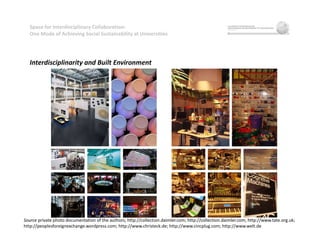
Interdisciplinarity and Built Environment
Source private photo documentation of the authors; http://collection.daimler.com; http://collection.daimler.com; http://www.tate.org.uk;
http://peoplesforeignexchange.wordpress.com; http://www.christeck.de; http://www.cincplug.com; http://www.welt.de
Space for Interdisciplinary Collaboration:
One Mode of Achieving Social Sustainability at Universities
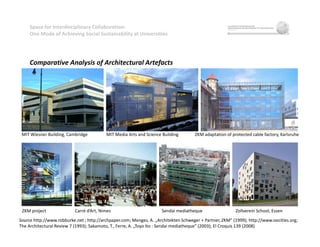
Comparative Analysis of Architectural Artefacts
ZKM project Carré d’Art, Nimes Sendai mediatheque Zollverein School, Essen
MIT Wiesner Building, Cambridge MIT Media Arts and Science Building ZKM adaptation of protected cable factory, Karlsruhe
Source http://www.robburke.net ; http://archpaper.com; Menges, A. „Architekten Schweger + Partner, ZKM” (1999); http://www.oocities.org;
The Architectural Review 7 (1993); Sakamoto, T., Ferre, A. „Toyo Ito : Sendai mediatheque” (2003); El Croquis 139 (2008)
Space for Interdisciplinary Collaboration:
One Mode of Achieving Social Sustainability at Universities
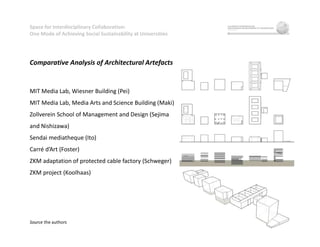
Comparative Analysis of Architectural Artefacts
Source the authors
MIT Media Lab, Wiesner Building (Pei)
MIT Media Lab, Media Arts and Science Building (Maki)
Zollverein School of Management and Design (Sejima
and Nishizawa)
Sendai mediatheque (Ito)
Carré d’Art (Foster)
ZKM adaptation of protected cable factory (Schweger)
ZKM project (Koolhaas)
Space for Interdisciplinary Collaboration:
One Mode of Achieving Social Sustainability at Universities
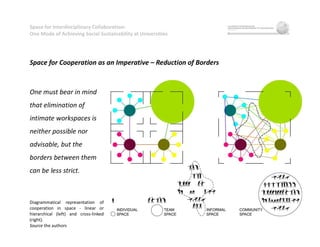
Space for Cooperation as an Imperative – Reduction of Borders
One must bear in mind
that elimination of
intimate workspaces is
neither possible nor
advisable, but the
borders between them
can be less strict.
Diagrammatical representation of
cooperation in space - linear or
hierarchical (left) and cross-linked
(right).
Source the authors
Space for Interdisciplinary Collaboration:
One Mode of Achieving Social Sustainability at Universities
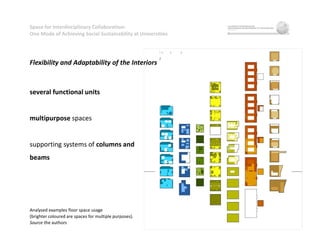
Flexibility and Adaptability of the Interiors
several functional units
multipurpose spaces
supporting systems of columns and
beams
Analysed examples floor space usage
(brighter coloured are spaces for multiple purposes).
Source the authors
Space for Interdisciplinary Collaboration:
One Mode of Achieving Social Sustainability at Universities
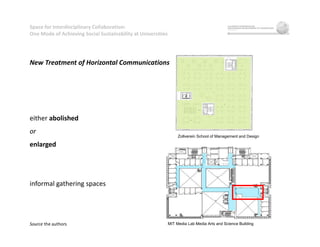
New Treatment of Horizontal Communications
either abolished
or
enlarged
informal gathering spaces
Source the authors MIT Media Lab Media Arts and Science Building
Zollverein School of Management and Design
Space for Interdisciplinary Collaboration:
One Mode of Achieving Social Sustainability at Universities
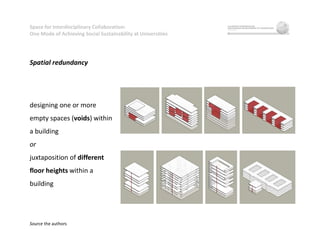
Spatial redundancy
designing one or more
empty spaces (voids) within
a building
or
juxtaposition of different
floor heights within a
building
Source the authors
Space for Interdisciplinary Collaboration:
One Mode of Achieving Social Sustainability at Universities
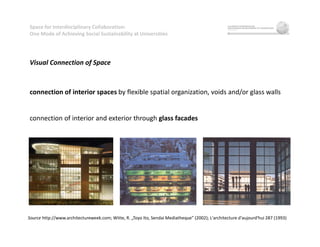
Visual Connection of Space
connection of interior spaces by flexible spatial organization, voids and/or glass walls
connection of interior and exterior through glass facades
Source http://www.architectureweek.com; Witte, R. „Toyo Ito, Sendai Mediatheque” (2002); L'architecture d'aujourd'hui 287 (1993)
Space for Interdisciplinary Collaboration:
One Mode of Achieving Social Sustainability at Universities
The Impact of New Technologies
Information Technology influences the spatial configuration of a building for
interdisciplinary research on three identified levels:
- the personal use of IT;
- the use of IT in the process that is going on inside the building;
- the process of architectural design.
Space for Interdisciplinary Collaboration:
One Mode of Achieving Social Sustainability at Universities
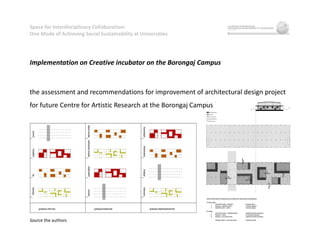
Implementation on Creative incubator on the Borongaj Campus
the assessment and recommendations for improvement of architectural design project
for future Centre for Artistic Research at the Borongaj Campus
Source the authors
Space for Interdisciplinary Collaboration:
One Mode of Achieving Social Sustainability at Universities
Conclusions
Creating a space suitable for interdisciplinary research in art and technology is
associated with creating a sustainable university campus space since some of the
detected spatial features have a positive impact on:
- reducing the energy consumption and usage of resources;
- improving safety, education and work process;
- spatial flexibility, the aesthetics of the environment and economic viability.
Space for Interdisciplinary Collaboration:
One Mode of Achieving Social Sustainability at Universities
Thank you for your attention!
e-mails:
kristina.careva@arhitekt.hr;
bojan.baletic@arhitekt.hr

Careva, Kristina, Track 2

  • 1.
    Space for InterdisciplinaryCollaboration: One Mode of Achieving Social Sustainability at Universities Assistant prof. Kristina Careva (MArch, PhD) Prof. Bojan Baletic (MArch, PhD) Faculty of Architecture, University of Zagreb, 26 Kaciceva Street, 10000 Zagreb, Croatia E-Mail: kristina.careva@arhitekt.hr, bojan.baletic@arhitekt.hr
  • 2.
    Space for InterdisciplinaryCollaboration: One Mode of Achieving Social Sustainability at Universities Social sustainability “Addressing the theme of sustainable development implementation, due to the complex image of the environmental impact and interconnectedness of social processes, requires a holistic approach where more disciplines combine their knowledge through interdisciplinary process as a prerequisite for the development of science.” (Pravdic 1993)
  • 3.
    Space for InterdisciplinaryCollaboration: One Mode of Achieving Social Sustainability at Universities Socialization at University Campuses “A key aspect to achieving interdisciplinarity is through the design of physical and social spaces. Creating spaces where people continuously come into contact with people outside their discipline in natural, casual social settings over and over again, helps develop social networks that eventually become the source of intellectual inspiration and creativity.” (Dzeng 2013)
  • 4.
    Space for InterdisciplinaryCollaboration: One Mode of Achieving Social Sustainability at Universities New Borongaj Campus in Zagreb Source http://hirc.botanic.hr/vrt/english/location.htm; Hrvoje Niric 1st prize winning project
  • 5.
    Space for InterdisciplinaryCollaboration: One Mode of Achieving Social Sustainability at Universities Creative incubator on the Borongaj Campus Source Centre for Artistic Research / Borongaj / Zagreb / HPNJ +, version 05/09/2010
  • 6.
    Space for InterdisciplinaryCollaboration: One Mode of Achieving Social Sustainability at Universities Interdisciplinarity and Built Environment Source private photo documentation of the authors; http://collection.daimler.com; http://collection.daimler.com; http://www.tate.org.uk; http://peoplesforeignexchange.wordpress.com; http://www.christeck.de; http://www.cincplug.com; http://www.welt.de
  • 7.
    Space for InterdisciplinaryCollaboration: One Mode of Achieving Social Sustainability at Universities Comparative Analysis of Architectural Artefacts ZKM project Carré d’Art, Nimes Sendai mediatheque Zollverein School, Essen MIT Wiesner Building, Cambridge MIT Media Arts and Science Building ZKM adaptation of protected cable factory, Karlsruhe Source http://www.robburke.net ; http://archpaper.com; Menges, A. „Architekten Schweger + Partner, ZKM” (1999); http://www.oocities.org; The Architectural Review 7 (1993); Sakamoto, T., Ferre, A. „Toyo Ito : Sendai mediatheque” (2003); El Croquis 139 (2008)
  • 8.
    Space for InterdisciplinaryCollaboration: One Mode of Achieving Social Sustainability at Universities Comparative Analysis of Architectural Artefacts Source the authors MIT Media Lab, Wiesner Building (Pei) MIT Media Lab, Media Arts and Science Building (Maki) Zollverein School of Management and Design (Sejima and Nishizawa) Sendai mediatheque (Ito) Carré d’Art (Foster) ZKM adaptation of protected cable factory (Schweger) ZKM project (Koolhaas)
  • 9.
    Space for InterdisciplinaryCollaboration: One Mode of Achieving Social Sustainability at Universities Space for Cooperation as an Imperative – Reduction of Borders One must bear in mind that elimination of intimate workspaces is neither possible nor advisable, but the borders between them can be less strict. Diagrammatical representation of cooperation in space - linear or hierarchical (left) and cross-linked (right). Source the authors
  • 10.
    Space for InterdisciplinaryCollaboration: One Mode of Achieving Social Sustainability at Universities Flexibility and Adaptability of the Interiors several functional units multipurpose spaces supporting systems of columns and beams Analysed examples floor space usage (brighter coloured are spaces for multiple purposes). Source the authors
  • 11.
    Space for InterdisciplinaryCollaboration: One Mode of Achieving Social Sustainability at Universities New Treatment of Horizontal Communications either abolished or enlarged informal gathering spaces Source the authors MIT Media Lab Media Arts and Science Building Zollverein School of Management and Design
  • 12.
    Space for InterdisciplinaryCollaboration: One Mode of Achieving Social Sustainability at Universities Spatial redundancy designing one or more empty spaces (voids) within a building or juxtaposition of different floor heights within a building Source the authors
  • 13.
    Space for InterdisciplinaryCollaboration: One Mode of Achieving Social Sustainability at Universities Visual Connection of Space connection of interior spaces by flexible spatial organization, voids and/or glass walls connection of interior and exterior through glass facades Source http://www.architectureweek.com; Witte, R. „Toyo Ito, Sendai Mediatheque” (2002); L'architecture d'aujourd'hui 287 (1993)
  • 14.
    Space for InterdisciplinaryCollaboration: One Mode of Achieving Social Sustainability at Universities The Impact of New Technologies Information Technology influences the spatial configuration of a building for interdisciplinary research on three identified levels: - the personal use of IT; - the use of IT in the process that is going on inside the building; - the process of architectural design.
  • 15.
    Space for InterdisciplinaryCollaboration: One Mode of Achieving Social Sustainability at Universities Implementation on Creative incubator on the Borongaj Campus the assessment and recommendations for improvement of architectural design project for future Centre for Artistic Research at the Borongaj Campus Source the authors
  • 16.
    Space for InterdisciplinaryCollaboration: One Mode of Achieving Social Sustainability at Universities Conclusions Creating a space suitable for interdisciplinary research in art and technology is associated with creating a sustainable university campus space since some of the detected spatial features have a positive impact on: - reducing the energy consumption and usage of resources; - improving safety, education and work process; - spatial flexibility, the aesthetics of the environment and economic viability.
  • 17.
    Space for InterdisciplinaryCollaboration: One Mode of Achieving Social Sustainability at Universities Thank you for your attention! e-mails: kristina.careva@arhitekt.hr; bojan.baletic@arhitekt.hr