Unipoli Green - Four Universities
Working Together for
Sustainability
Eveliina Asikainen & Saana Raatikainen
with
Sannamari Hellman, Lotta Parjanen and Marjut Schroderus
Sustainable Development in Finland
• Finland is one of the world´s leading countries in promoting sustainable
development
• Finnish National Commission on SD is chaired by the Prime Minister since
the 1990´s
• Promotes, monitors and evaluates the implementation of the global 2030 Agenda for
Sustainable Development and integrates it as part of national sustainable
development efforts
• Society´s Commitment to Sustainable Development was launched in 2014
• Finnish way of committing different stakeholders in society to promoting SD
• The SD challenges in Finland are social segregation, unemployment,
insufficient actions to prevent climate change and overuse of natural
resources
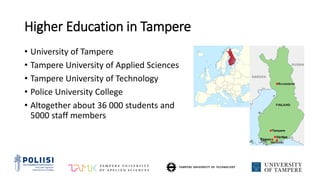
Higher Education in Tampere
• University of Tampere
• Tampere University of Applied Sciences
• Tampere University of Technology
• Police University College
• Altogether about 36 000 students and
5000 staff members
SD in Finnish Universities
• Universities in Finland have great autonomy even though they are
mostly financed by the Ministry of Education and Culture
• Universities are expected to be the forerunners of the society and
expectations for promoting sustainable development are rising but
the resources for sustainability work are still scarce
• Competition between higher education institutes -> does not easily
encourage co-operation
• Finnish Higher Education Forum on Sustainability -> network that
enables sharing information and experiences
Independent development vs. co-operation
• Co-operation of HEIs in SD is rarely reported
• Possible reasons based on our experiences
• Looking too far – it took almost 20 years SD work in each university before
systematic co-operation started
• "All wisdom lies in University – no need for co-operation"
• Resources allocated to SD and attitudes towards SD vary
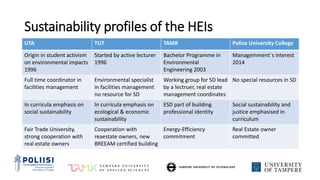
Sustainability profiles of the HEIs
UTA TUT TAMK Police University College
Origin in student activism
on environmental impacts
1996
Started by active lecturer
1996
Bachelor Programme in
Environmental
Engineering 2003
Managemment´s interest
2014
Full time coordinator in
facilities management
Environmental specialist
in facilities management
no resource for SD
Working group for SD lead
by a lectruer, real estate
management coordinates
No special resources in SD
In curricula emphasis on
social sustainability
In curricula emphasis on
ecological & economic
sustainability
ESD part of building
professional identity
Social sustainability and
justice emphasised in
curriculum
Fair Trade University,
strong cooperation with
real estate owners
Cooperation with
reaestate owners, new
BREEAM certified building
Energy-Efficiency
commitment
Real Estate owner
committed
UnipoliGreen at work
• Meetings of environmental coordinators and/or chairs of
sustainability working groups
• Support, peer group, brain storming
• Different backgrounds of the group members help in building firmer
understanding of SD
• E-mails, distributing initiatives and news
• Meeting top management – lobbying ideas
• Lobbying the national authorities –arranging a national meeting of SD
coordinators
• Arranging events collectively
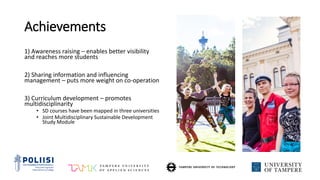
Achievements
1) Awareness raising – enables better visibility
and reaches more students
2) Sharing information and influencing
management – puts more weight on co-operation
3) Curriculum development – promotes
multidisciplinarity
• SD courses have been mapped in three universities
• Joint Multidisciplinary Sustainable Development
Study Module
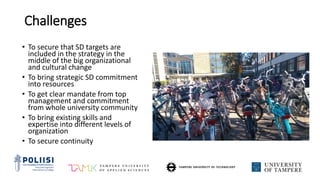
Challenges
• To secure that SD targets are
included in the strategy in the
middle of the big organizational
and cultural change
• To bring strategic SD commitment
into resources
• To get clear mandate from top
management and commitment
from whole university community
• To bring existing skills and
expertise into different levels of
organization
• To secure continuity
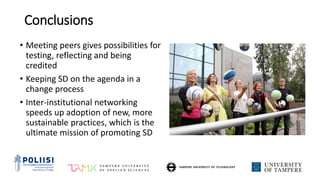
Conclusions
• Meeting peers gives possibilities for
testing, reflecting and being
credited
• Keeping SD on the agenda in a
change process
• Inter-institutional networking
speeds up adoption of new, more
sustainable practices, which is the
ultimate mission of promoting SD
Thank your for your attention!
Contact information
• Senior Lecturer Eveliina Asikainen,
eveliina.asikainen@tamk.fi
www.tamk.fi/
• Environmental coordinator Saana
Raatikainen,
saana.raatikainen@uta.fi
www.uta.fi/sustainability
• #Tampere3

Raatikainen, Saana, Track 4

  • 1.
    Unipoli Green -Four Universities Working Together for Sustainability Eveliina Asikainen & Saana Raatikainen with Sannamari Hellman, Lotta Parjanen and Marjut Schroderus
  • 2.
    Sustainable Development inFinland • Finland is one of the world´s leading countries in promoting sustainable development • Finnish National Commission on SD is chaired by the Prime Minister since the 1990´s • Promotes, monitors and evaluates the implementation of the global 2030 Agenda for Sustainable Development and integrates it as part of national sustainable development efforts • Society´s Commitment to Sustainable Development was launched in 2014 • Finnish way of committing different stakeholders in society to promoting SD • The SD challenges in Finland are social segregation, unemployment, insufficient actions to prevent climate change and overuse of natural resources
  • 3.
    Higher Education inTampere • University of Tampere • Tampere University of Applied Sciences • Tampere University of Technology • Police University College • Altogether about 36 000 students and 5000 staff members
  • 4.
    SD in FinnishUniversities • Universities in Finland have great autonomy even though they are mostly financed by the Ministry of Education and Culture • Universities are expected to be the forerunners of the society and expectations for promoting sustainable development are rising but the resources for sustainability work are still scarce • Competition between higher education institutes -> does not easily encourage co-operation • Finnish Higher Education Forum on Sustainability -> network that enables sharing information and experiences
  • 5.
    Independent development vs.co-operation • Co-operation of HEIs in SD is rarely reported • Possible reasons based on our experiences • Looking too far – it took almost 20 years SD work in each university before systematic co-operation started • "All wisdom lies in University – no need for co-operation" • Resources allocated to SD and attitudes towards SD vary
  • 6.
    Sustainability profiles ofthe HEIs UTA TUT TAMK Police University College Origin in student activism on environmental impacts 1996 Started by active lecturer 1996 Bachelor Programme in Environmental Engineering 2003 Managemment´s interest 2014 Full time coordinator in facilities management Environmental specialist in facilities management no resource for SD Working group for SD lead by a lectruer, real estate management coordinates No special resources in SD In curricula emphasis on social sustainability In curricula emphasis on ecological & economic sustainability ESD part of building professional identity Social sustainability and justice emphasised in curriculum Fair Trade University, strong cooperation with real estate owners Cooperation with reaestate owners, new BREEAM certified building Energy-Efficiency commitment Real Estate owner committed
  • 7.
    UnipoliGreen at work •Meetings of environmental coordinators and/or chairs of sustainability working groups • Support, peer group, brain storming • Different backgrounds of the group members help in building firmer understanding of SD • E-mails, distributing initiatives and news • Meeting top management – lobbying ideas • Lobbying the national authorities –arranging a national meeting of SD coordinators • Arranging events collectively
  • 8.
    Achievements 1) Awareness raising– enables better visibility and reaches more students 2) Sharing information and influencing management – puts more weight on co-operation 3) Curriculum development – promotes multidisciplinarity • SD courses have been mapped in three universities • Joint Multidisciplinary Sustainable Development Study Module
  • 9.
    Challenges • To securethat SD targets are included in the strategy in the middle of the big organizational and cultural change • To bring strategic SD commitment into resources • To get clear mandate from top management and commitment from whole university community • To bring existing skills and expertise into different levels of organization • To secure continuity
  • 10.
    Conclusions • Meeting peersgives possibilities for testing, reflecting and being credited • Keeping SD on the agenda in a change process • Inter-institutional networking speeds up adoption of new, more sustainable practices, which is the ultimate mission of promoting SD
  • 11.
    Thank your foryour attention! Contact information • Senior Lecturer Eveliina Asikainen, eveliina.asikainen@tamk.fi www.tamk.fi/ • Environmental coordinator Saana Raatikainen, saana.raatikainen@uta.fi www.uta.fi/sustainability • #Tampere3