MIT OFFICE OF SUSTAINABILITY
May	8,	2017
Cultivating the Test Bed:
Constructing the Campus Lab
Joe Higgins
Director, Infrastructure Business Ops, Office of EVPT
MIT OFFICE OF SUSTAINABILITY
May	8,	2017
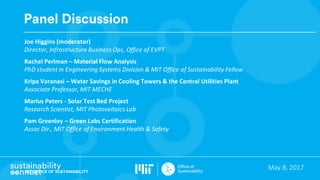
Panel Discussion
Joe	Higgins	(moderator)
Director,	Infrastructure	Business	Ops,	Office	of	EVPT
Rachel	Perlman	– Material	Flow	Analysis	
PhD	student	in	Engineering	Systems	Division	&	MIT	Office	of	Sustainability	Fellow	
Kripa Varanasi	– Water	Savings	in	Cooling	Towers	&	the	Central	Utilities	Plant
Associate	Professor,	MIT	MECHE
Marius	Peters	- Solar	Test	Bed	Project	
Research	Scientist,	MIT	Photovoltaics Lab
Pam	Greenley – Green	Labs	Certification	
Assoc Dir.,	MIT	Office	of	Environment	Health	&	Safety
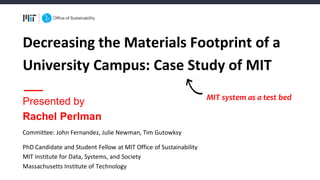
Decreasing	the	Materials	Footprint	of	a	
University	Campus:	Case	Study	of	MIT
Committee:	John	Fernandez,	Julie	Newman,	Tim	Gutowksy
PhD	Candidate	and	Student	Fellow	at	MIT	Office	of	Sustainability
MIT	Institute	for	Data,	Systems,	and	Society
Massachusetts	Institute	of	Technology
Presented by
Rachel Perlman
MIT system as a test bed
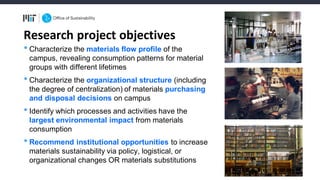
•Characterize the materials flow profile of the
campus, revealing consumption patterns for material
groups with different lifetimes
•Characterize the organizational structure (including
the degree of centralization) of materials purchasing
and disposal decisions on campus
•Identify which processes and activities have the
largest environmental impact from materials
consumption
•Recommend institutional opportunities to increase
materials sustainability via policy, logistical, or
organizational changes OR materials substitutions
Research	project	objectives
(among	others)
•Collaboration	with	the	Office	of	Procurement	on	material	
goods	purchases
•Material	Flow	Analysis
•Waste	audits	(academic	buildings,	dorms,	dining	halls)
•Collaboration	with	Facilities	on	trash,	recycling,	and	organic	
waste
Test	Bed	Components	of	Our	Work
MIT OFFICE OF SUSTAINABILITY
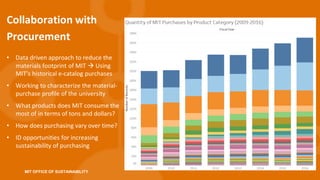
Collaboration	with	
Procurement
• Data	driven	approach	to	reduce	the	
materials	footprint	of	MIT	à Using	
MIT’s	historical	e-catalog	purchases
• Working	to	characterize	the	material-
purchase	profile	of	the	university
• What	products	does	MIT	consume	the	
most	of	in	terms	of	tons	and	dollars?
• How	does	purchasing	vary	over	time?
• ID	opportunities	for	increasing	
sustainability	of	purchasing
MIT OFFICE OF SUSTAINABILITY
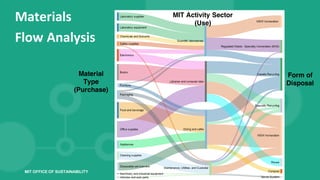
Materials	
Flow	Analysis
Material
Type
(Purchase)
Form of
Disposal
MIT Activity Sector
(Use)
MIT OFFICE OF SUSTAINABILITY
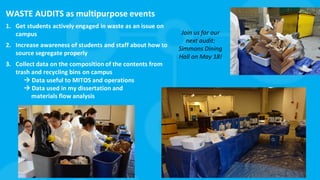
WASTE	AUDITS	as	multipurpose	events
1. Get	students	actively	engaged	in	waste	as	an	issue	on	
campus
2. Increase	awareness	of	students	and	staff	about	how	to	
source	segregate	properly
3. Collect	data	on	the	composition	of	the	contents	from	
trash	and	recycling	bins	on	campus
à Data	useful	to	MITOS	and	operations
à Data	used	in	my	dissertation	and
materials	flow	analysis
Join	us	for	our	
next	audit:	
Simmons	Dining	
Hall	on	May	18!
MIT OFFICE OF SUSTAINABILITY
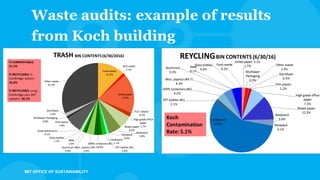
Waste audits: example of results
from Koch building
MIT OFFICE OF SUSTAINABILITY
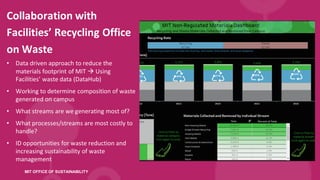
• Data	driven	approach	to	reduce	the	
materials	footprint	of	MIT	à Using	
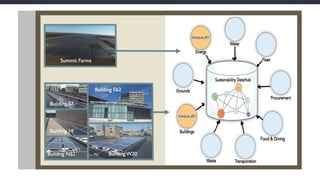
Facilities’	waste	data	(DataHub)
• Working	to	determine	composition	of	waste	
generated	on	campus
• What	streams	are	we	generating	most	of?
• What	processes/streams	are	most	costly	to	
handle?
• ID	opportunities	for	waste	reduction	and	
increasing	sustainability	of	waste	
management
Collaboration	with	
Facilities’	Recycling	Office	
on	Waste
MIT OFFICE OF SUSTAINABILITY
Thank	you	for	your	attention
Rperlman@mit.edu
Kripa Varanasi
Associate Professor, MIT MECHE
Water Savings in Cooling Towers
and the Central Utilities Plant
Marius Peters
Research Scientist, MIT Photovoltaics
Lab
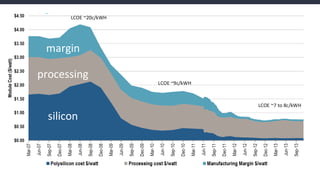
1990 2000 2010 2020
102
10
3
10
4
10
5
106
cumm.installation[MW]
year
1
10
2014 est 0.45 $/W
2015 est. 0.39 $/W
moduleprice[$/Wp
]
2016 est. 302 GW
2017 proj 368 GW
23%	reduction	
per	doubled	
capacity	over	35	
years
29%	growth	per	
year	over	25	years
margin
processing
silicon
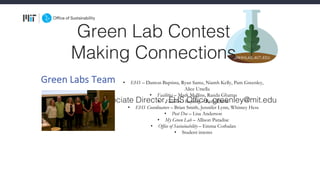
Green Lab Contest
Making Connections
Pam Greenley, Associate Director, EHS Office, greenley@mit.edu
• EHS – Damon Baptista, Ryan Samz, Niamh Kelly, Pam Greenley,
Alice Ursella
• Facilities – Mark Mullins, Randa Ghattas
• Facilities - Recycling – Ruth Davis
• EHS Coordinators – Brian Smith, Jennifer Lynn, Whitney Hess
• Post Doc – Lisa Anderson
• My Green Lab – Allison Paradise
• Office of Sustainability – Emma Corbalan
• Student interns
Green	Labs	Team
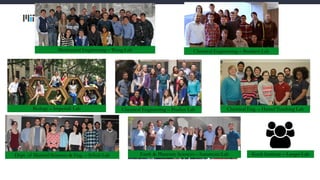
Mechanical Engineering – Wang Lab Chemical Engineering – Brushett Lab
Biology – Imperiali Lab Chemical Engineering – Prather Lab Chemical Eng. – Hamel Teaching Lab
Dept. of Material Sciences & Eng. – Schuh Lab Earth & Planetary Sciences – Summons Lab Koch Institute – Langer Lab
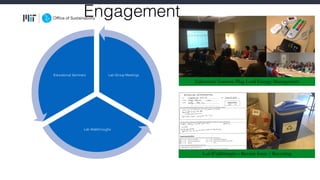
Engagement
Lab Group Meetings
Lab Walkthroughs
Educational Seminars
Educational Seminars: Plug Load Energy Management
Lab Walkthroughs – Review form | Recycling
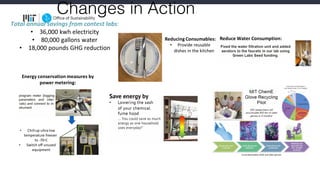
Changes in Action
Reducing	Consumables:	
• Provide	reusable	
dishes	in	the	kitchen
Energy	conservation	measures	by	
power	metering:		
• Chill	up	ultra	low	
temperature	freezers	
to	-70◦C
• Switch	off	unused	
equipment
Reduce	Water	Consumption:
Total	annual	savings	from	contest	labs:
• 36,000	kwh	electricity
• 80,000	gallons	water
• 18,000	pounds	GHG	reduction
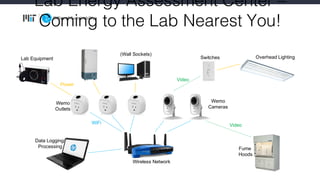
Lab Energy Assessment Center –
Coming to the Lab Nearest You!
Power
WiFi Video
Data Logging/
Processing
Wireless Network
Fume
Hoods
Overhead LightingSwitchesLab Equipment
(Wall Sockets)
Wemo
Outlets
Wemo
Cameras
Video
MIT OFFICE OF SUSTAINABILITY
Questions & discussion

Cultivating the Test Bed: Constructing the Campus Lab

  • 1.
    MIT OFFICE OFSUSTAINABILITY May 8, 2017 Cultivating the Test Bed: Constructing the Campus Lab Joe Higgins Director, Infrastructure Business Ops, Office of EVPT
  • 2.
    MIT OFFICE OFSUSTAINABILITY May 8, 2017 Panel Discussion Joe Higgins (moderator) Director, Infrastructure Business Ops, Office of EVPT Rachel Perlman – Material Flow Analysis PhD student in Engineering Systems Division & MIT Office of Sustainability Fellow Kripa Varanasi – Water Savings in Cooling Towers & the Central Utilities Plant Associate Professor, MIT MECHE Marius Peters - Solar Test Bed Project Research Scientist, MIT Photovoltaics Lab Pam Greenley – Green Labs Certification Assoc Dir., MIT Office of Environment Health & Safety
  • 3.
  • 4.
    •Characterize the materialsflow profile of the campus, revealing consumption patterns for material groups with different lifetimes •Characterize the organizational structure (including the degree of centralization) of materials purchasing and disposal decisions on campus •Identify which processes and activities have the largest environmental impact from materials consumption •Recommend institutional opportunities to increase materials sustainability via policy, logistical, or organizational changes OR materials substitutions Research project objectives
  • 5.
  • 6.
    MIT OFFICE OFSUSTAINABILITY Collaboration with Procurement • Data driven approach to reduce the materials footprint of MIT à Using MIT’s historical e-catalog purchases • Working to characterize the material- purchase profile of the university • What products does MIT consume the most of in terms of tons and dollars? • How does purchasing vary over time? • ID opportunities for increasing sustainability of purchasing
  • 7.
    MIT OFFICE OFSUSTAINABILITY Materials Flow Analysis Material Type (Purchase) Form of Disposal MIT Activity Sector (Use)
  • 8.
    MIT OFFICE OFSUSTAINABILITY WASTE AUDITS as multipurpose events 1. Get students actively engaged in waste as an issue on campus 2. Increase awareness of students and staff about how to source segregate properly 3. Collect data on the composition of the contents from trash and recycling bins on campus à Data useful to MITOS and operations à Data used in my dissertation and materials flow analysis Join us for our next audit: Simmons Dining Hall on May 18!
  • 9.
    MIT OFFICE OFSUSTAINABILITY Waste audits: example of results from Koch building
  • 10.
    MIT OFFICE OFSUSTAINABILITY • Data driven approach to reduce the materials footprint of MIT à Using Facilities’ waste data (DataHub) • Working to determine composition of waste generated on campus • What streams are we generating most of? • What processes/streams are most costly to handle? • ID opportunities for waste reduction and increasing sustainability of waste management Collaboration with Facilities’ Recycling Office on Waste
  • 11.
    MIT OFFICE OFSUSTAINABILITY Thank you for your attention Rperlman@mit.edu
  • 12.
    Kripa Varanasi Associate Professor,MIT MECHE Water Savings in Cooling Towers and the Central Utilities Plant
  • 13.
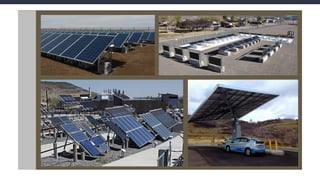
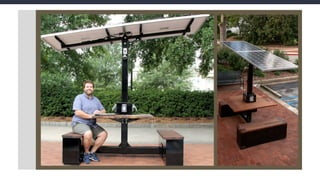
    Marius Peters Research Scientist,MIT Photovoltaics Lab
  • 14.
    1990 2000 20102020 102 10 3 10 4 10 5 106 cumm.installation[MW] year 1 10 2014 est 0.45 $/W 2015 est. 0.39 $/W moduleprice[$/Wp ] 2016 est. 302 GW 2017 proj 368 GW 23% reduction per doubled capacity over 35 years 29% growth per year over 25 years
  • 15.
  • 25.
    Green Lab Contest MakingConnections Pam Greenley, Associate Director, EHS Office, greenley@mit.edu • EHS – Damon Baptista, Ryan Samz, Niamh Kelly, Pam Greenley, Alice Ursella • Facilities – Mark Mullins, Randa Ghattas • Facilities - Recycling – Ruth Davis • EHS Coordinators – Brian Smith, Jennifer Lynn, Whitney Hess • Post Doc – Lisa Anderson • My Green Lab – Allison Paradise • Office of Sustainability – Emma Corbalan • Student interns Green Labs Team
  • 26.
    Mechanical Engineering –Wang Lab Chemical Engineering – Brushett Lab Biology – Imperiali Lab Chemical Engineering – Prather Lab Chemical Eng. – Hamel Teaching Lab Dept. of Material Sciences & Eng. – Schuh Lab Earth & Planetary Sciences – Summons Lab Koch Institute – Langer Lab
  • 27.
    Engagement Lab Group Meetings LabWalkthroughs Educational Seminars Educational Seminars: Plug Load Energy Management Lab Walkthroughs – Review form | Recycling
  • 28.
    Changes in Action Reducing Consumables: •Provide reusable dishes in the kitchen Energy conservation measures by power metering: • Chill up ultra low temperature freezers to -70◦C • Switch off unused equipment Reduce Water Consumption: Total annual savings from contest labs: • 36,000 kwh electricity • 80,000 gallons water • 18,000 pounds GHG reduction
  • 29.
    Lab Energy AssessmentCenter – Coming to the Lab Nearest You! Power WiFi Video Data Logging/ Processing Wireless Network Fume Hoods Overhead LightingSwitchesLab Equipment (Wall Sockets) Wemo Outlets Wemo Cameras Video
  • 30.
    MIT OFFICE OFSUSTAINABILITY Questions & discussion