Process, Technology & Challenges   A CMA and Q2C Webinar Program Presented by David Schmidt, Principal, A 2  Resources Tuesday, February 20, 2007
Agenda A Brief Overview of the Imperative for Improving FSCM Straight Through Processing: Myths and Reality Technology Components for Building Best in Class FSCM Comparison of Traditional Methods and Automated FSCM The Challenges Inherent in Automating FSCM
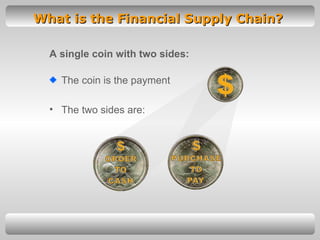
What is the Financial Supply Chain? A single coin with two sides: The coin is the payment The two sides are:
Other Challenges DSO is at or near historic highs Increasing transaction volumes Shorter cycle times Growing dispute volumes Compliance issues Shrinking staffs ERP system weaknesses Why Automate?
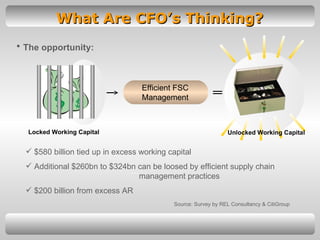
What Are CFO’s Thinking? $580 billion tied up in excess working capital Additional $260bn to $324bn can be loosed by efficient supply chain  ``` management practices $200 billion from excess AR Efficient FSC Management Locked Working Capital Unlocked Working Capital The opportunity: Source: Survey by REL Consultancy & CitiGroup
The Cost of Paper vs. Automated Systems Paper Invoice $5  Web Invoice $2 Web Invoicing & Payment Annual Savings $5.7 million Manual $55  Automated $27.5 Dispute Resolution $3.2 million In-house Cost $17  Online Cost $10 Post Billing Customer Service $1.36 million 198,000 calls per year for invoicing 13% of invoices are disputed in the B-to-B area Source: Equitant & Gartner
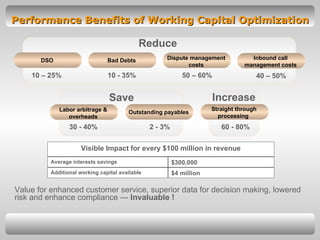
Performance Benefits of Working Capital Optimization Increase Value for enhanced customer service, superior data for decision making, lowered risk and enhance compliance ---  Invaluable ! 10 – 25% 10 - 35% 50 – 60% 40 – 50% Reduce Save 30 - 40% 2 - 3% 60 - 80% $4 million Additional working capital available $300,000 Average interests savings Visible Impact for every $100 million in revenue DSO Bad Debts Dispute management costs Inbound call management costs Labor arbitrage & overheads Outstanding payables Straight through processing
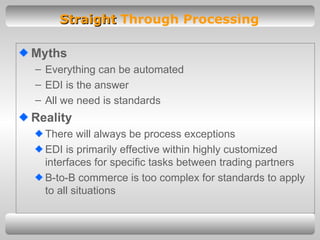
Straight  Through Processing Myths Everything can be automated EDI is the answer All we need is standards Reality There will always be process exceptions EDI is primarily effective within highly customized interfaces for specific tasks between trading partners B-to-B commerce is too complex for standards to apply to all situations
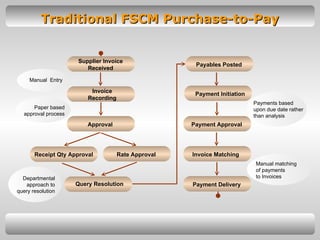
Traditional FSCM Purchase-to-Pay Supplier Invoice Received Invoice Recording Approval Rate Approval Payment Initiation Query Resolution Payment Approval Invoice Matching  Payment Delivery Receipt Qty Approval Manual  Entry  Paper based approval process Departmental approach to query resolution Payments based upon due date rather than analysis Manual matching of payments to Invoices Payables Posted
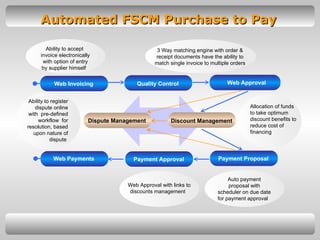
Automated FSCM Purchase to Pay Discount Management Dispute Management 3 Way matching engine with order & receipt documents have the ability to match single invoice to multiple orders Ability to register dispute online with  pre-defined workflow  for resolution, based upon nature of dispute  Web Approval with links to discounts management  Auto payment proposal with scheduler on due date for payment approval  Web Invoicing Quality Control Web Approval Payment Proposal Payment Approval Web Payments Allocation of funds to take optimum discount benefits to reduce cost of financing Ability to accept  invoice electronically with option of entry by supplier himself
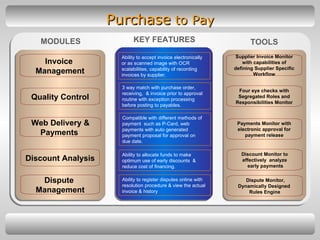
Invoice  Management Quality Control Web Delivery & Payments  Discount Analysis Dispute  Management MODULES Ability to accept invoice electronically or as scanned image with OCR scalabilities, capability of recording invoices by supplier.  3 way match with purchase order, receiving,  & invoice prior to approval routine with exception processing before posting to payables. Compatible with different methods of payment  such as P-Card, web payments with auto generated payment proposal for approval on  due date. Ability to allocate funds to make optimum use of early discounts  & reduce cost of financing. Ability to register disputes online with resolution procedure & view the actual invoice & history Supplier Invoice Monitor with capabilities of defining Supplier Specific Workflow Four eye checks with Segregated Roles and Responsibilities Monitor Payments Monitor with electronic approval for payment release Discount Monitor to effectively  analyze early payments Dispute Monitor, Dynamically Designed  Rules Engine KEY FEATURES TOOLS Purchase  to Pay
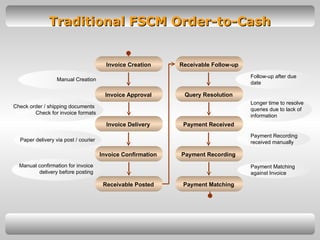
Traditional FSCM Order-to-Cash Invoice Creation Invoice Approval Invoice Delivery Invoice Confirmation Receivable Posted Receivable Follow-up Query Resolution Payment Received Payment Recording Payment Matching Manual Creation Check order / shipping documents  Check for invoice formats Paper delivery via post / courier Manual confirmation for invoice delivery before posting Follow-up after due date Longer time to resolve queries due to lack of information Payment Recording  received manually Payment Matching against Invoice
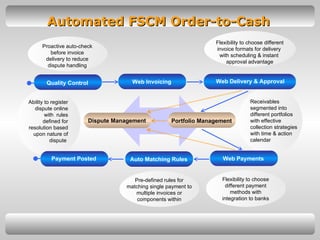
Automated FSCM Order-to-Cash Portfolio Management Web Invoicing Quality Control Web Delivery & Approval Web Payments Auto Matching Rules Payment Posted Dispute Management Receivables segmented into different portfolios with effective collection strategies with time & action calendar Proactive auto-check before invoice delivery to reduce dispute handling Flexibility to choose different invoice formats for delivery  with scheduling & instant  approval advantage Ability to register dispute online with  rules defined for resolution based upon nature of dispute  Pre-defined rules for matching single payment to multiple invoices or components within Flexibility to choose different payment methods with integration to banks
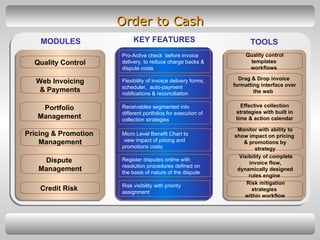
Order to Cash Quality Control Web Invoicing & Payments Portfolio  Management  Pricing & Promotion  Management Dispute  Management MODULES Credit Risk  Pro-Active check  before invoice delivery, to reduce charge backs & dispute costs Flexibility of invoice delivery forms, scheduler,  auto-payment notifications & reconciliation Receivables segmented into different portfolios for execution of collection strategies Micro Level Benefit Chart to view impact of pricing and promotions costs Register disputes online with  resolution procedures defined on the basis of nature of the dispute Risk visibility with priority assignment  Quality control templates  workflows  Drag & Drop invoice  formatting interface over the web  Effective collection strategies with built in time & action calendar Monitor with ability to show impact on pricing  & promotions by strategy Visibility of complete invoice flow, dynamically designed rules engine  Risk mitigation strategies  within workflow KEY FEATURES TOOLS
Gain Visibility to Risk Exposure  Strategically Drive Collection Activities Systematically Route Disputes Perform Root-cause Analysis Minimize Time Spent on Manual Tasks Embed Policy & Track Adherence   Receivables and Collections Management (RCM) Involves Gaining Efficiency & Control Over the  Order-to-Cash Process What is RCM?
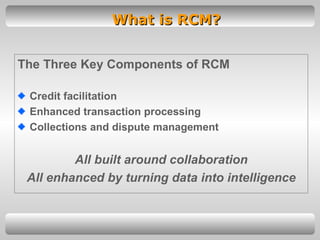
What is RCM? The Three Key Components of RCM Credit facilitation Enhanced transaction processing Collections and dispute management All built around collaboration All enhanced by turning data into intelligence
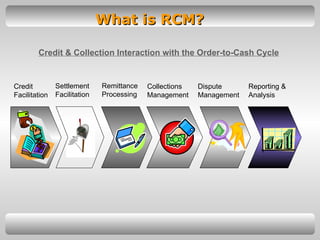
Credit & Collection Interaction with the Order-to-Cash Cycle Credit Facilitation Settlement Facilitation Remittance  Processing Dispute Management Reporting & Analysis Collections Management What is RCM?
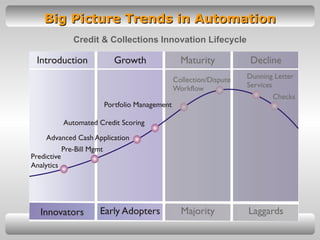
Big Picture Trends in Automation Credit & Collections Innovation Lifecycle
Traditional vs. Automated RCM Why Automate?
Where P-to-P & O-to-C Meet Customer Participation Inability to supply invoice information in customer formats Invoice Discrepancies Inability to supply supporting documentation Inability to accept remittance data in customer formats Inability to identify and pass along deductions and disputes Inability to schedule settlement Challenges to Electronic Settlement – Making Electronic Invoice Presentment & Payment (EIPP) Work
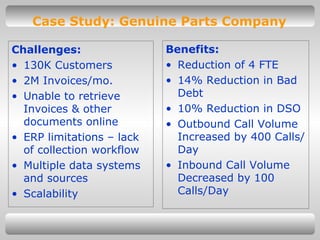
Case Study: Genuine Parts Company Challenges: 130K Customers 2M Invoices/mo. Unable to retrieve Invoices & other documents online ERP limitations – lack of collection workflow Multiple data systems and sources Scalability Benefits: Reduction of 4 FTE 14% Reduction in Bad Debt 10% Reduction in DSO Outbound Call Volume Increased by 400 Calls/Day Inbound Call Volume Decreased by 100 Calls/Day
FSCM Enterprise Features Rules based workflow Dashboard and metrics driven Workforce management capabilities Imaging enabled IVR/dialer integration Prioritization/Escalation/Routing Auditing and logging Personalization capabilities Quick integration (ERP/Legacy/Banks/Standards)
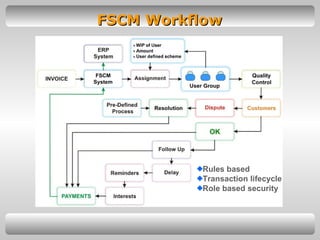
FSCM Workflow FSCM System Rules based Transaction lifecycle Role based security
Functional silos dominate But, I have my ERP system Management concerns over losing control of the data Management concerns over multiple solutions Management concerns over hosted solutions Adoption of best practices to replace traditional practices Measuring the benefits of a process based approach Challenges to Automated Systems and Processes
Questions & Answers Where are your bottlenecks? What are your biggest opportunities? What do I automate first? What if I don’t have the resources? How do I convince management? Who can I partner with?

Financial Supply Chain Management

  • 1.
    Process, Technology &Challenges A CMA and Q2C Webinar Program Presented by David Schmidt, Principal, A 2 Resources Tuesday, February 20, 2007
  • 2.
    Agenda A BriefOverview of the Imperative for Improving FSCM Straight Through Processing: Myths and Reality Technology Components for Building Best in Class FSCM Comparison of Traditional Methods and Automated FSCM The Challenges Inherent in Automating FSCM
  • 3.
    What is theFinancial Supply Chain? A single coin with two sides: The coin is the payment The two sides are:
  • 4.
    Other Challenges DSOis at or near historic highs Increasing transaction volumes Shorter cycle times Growing dispute volumes Compliance issues Shrinking staffs ERP system weaknesses Why Automate?
  • 5.
    What Are CFO’sThinking? $580 billion tied up in excess working capital Additional $260bn to $324bn can be loosed by efficient supply chain ``` management practices $200 billion from excess AR Efficient FSC Management Locked Working Capital Unlocked Working Capital The opportunity: Source: Survey by REL Consultancy & CitiGroup
  • 6.
    The Cost ofPaper vs. Automated Systems Paper Invoice $5 Web Invoice $2 Web Invoicing & Payment Annual Savings $5.7 million Manual $55 Automated $27.5 Dispute Resolution $3.2 million In-house Cost $17 Online Cost $10 Post Billing Customer Service $1.36 million 198,000 calls per year for invoicing 13% of invoices are disputed in the B-to-B area Source: Equitant & Gartner
  • 7.
    Performance Benefits ofWorking Capital Optimization Increase Value for enhanced customer service, superior data for decision making, lowered risk and enhance compliance --- Invaluable ! 10 – 25% 10 - 35% 50 – 60% 40 – 50% Reduce Save 30 - 40% 2 - 3% 60 - 80% $4 million Additional working capital available $300,000 Average interests savings Visible Impact for every $100 million in revenue DSO Bad Debts Dispute management costs Inbound call management costs Labor arbitrage & overheads Outstanding payables Straight through processing
  • 8.
    Straight ThroughProcessing Myths Everything can be automated EDI is the answer All we need is standards Reality There will always be process exceptions EDI is primarily effective within highly customized interfaces for specific tasks between trading partners B-to-B commerce is too complex for standards to apply to all situations
  • 9.
    Traditional FSCM Purchase-to-PaySupplier Invoice Received Invoice Recording Approval Rate Approval Payment Initiation Query Resolution Payment Approval Invoice Matching Payment Delivery Receipt Qty Approval Manual Entry Paper based approval process Departmental approach to query resolution Payments based upon due date rather than analysis Manual matching of payments to Invoices Payables Posted
  • 10.
    Automated FSCM Purchaseto Pay Discount Management Dispute Management 3 Way matching engine with order & receipt documents have the ability to match single invoice to multiple orders Ability to register dispute online with pre-defined workflow for resolution, based upon nature of dispute Web Approval with links to discounts management Auto payment proposal with scheduler on due date for payment approval Web Invoicing Quality Control Web Approval Payment Proposal Payment Approval Web Payments Allocation of funds to take optimum discount benefits to reduce cost of financing Ability to accept invoice electronically with option of entry by supplier himself
  • 11.
    Invoice ManagementQuality Control Web Delivery & Payments Discount Analysis Dispute Management MODULES Ability to accept invoice electronically or as scanned image with OCR scalabilities, capability of recording invoices by supplier. 3 way match with purchase order, receiving, & invoice prior to approval routine with exception processing before posting to payables. Compatible with different methods of payment such as P-Card, web payments with auto generated payment proposal for approval on due date. Ability to allocate funds to make optimum use of early discounts & reduce cost of financing. Ability to register disputes online with resolution procedure & view the actual invoice & history Supplier Invoice Monitor with capabilities of defining Supplier Specific Workflow Four eye checks with Segregated Roles and Responsibilities Monitor Payments Monitor with electronic approval for payment release Discount Monitor to effectively analyze early payments Dispute Monitor, Dynamically Designed Rules Engine KEY FEATURES TOOLS Purchase to Pay
  • 12.
    Traditional FSCM Order-to-CashInvoice Creation Invoice Approval Invoice Delivery Invoice Confirmation Receivable Posted Receivable Follow-up Query Resolution Payment Received Payment Recording Payment Matching Manual Creation Check order / shipping documents Check for invoice formats Paper delivery via post / courier Manual confirmation for invoice delivery before posting Follow-up after due date Longer time to resolve queries due to lack of information Payment Recording received manually Payment Matching against Invoice
  • 13.
    Automated FSCM Order-to-CashPortfolio Management Web Invoicing Quality Control Web Delivery & Approval Web Payments Auto Matching Rules Payment Posted Dispute Management Receivables segmented into different portfolios with effective collection strategies with time & action calendar Proactive auto-check before invoice delivery to reduce dispute handling Flexibility to choose different invoice formats for delivery with scheduling & instant approval advantage Ability to register dispute online with rules defined for resolution based upon nature of dispute Pre-defined rules for matching single payment to multiple invoices or components within Flexibility to choose different payment methods with integration to banks
  • 14.
    Order to CashQuality Control Web Invoicing & Payments Portfolio Management Pricing & Promotion Management Dispute Management MODULES Credit Risk Pro-Active check before invoice delivery, to reduce charge backs & dispute costs Flexibility of invoice delivery forms, scheduler, auto-payment notifications & reconciliation Receivables segmented into different portfolios for execution of collection strategies Micro Level Benefit Chart to view impact of pricing and promotions costs Register disputes online with resolution procedures defined on the basis of nature of the dispute Risk visibility with priority assignment Quality control templates workflows Drag & Drop invoice formatting interface over the web Effective collection strategies with built in time & action calendar Monitor with ability to show impact on pricing & promotions by strategy Visibility of complete invoice flow, dynamically designed rules engine Risk mitigation strategies within workflow KEY FEATURES TOOLS
  • 15.
    Gain Visibility toRisk Exposure Strategically Drive Collection Activities Systematically Route Disputes Perform Root-cause Analysis Minimize Time Spent on Manual Tasks Embed Policy & Track Adherence Receivables and Collections Management (RCM) Involves Gaining Efficiency & Control Over the Order-to-Cash Process What is RCM?
  • 16.
    What is RCM?The Three Key Components of RCM Credit facilitation Enhanced transaction processing Collections and dispute management All built around collaboration All enhanced by turning data into intelligence
  • 17.
    Credit & CollectionInteraction with the Order-to-Cash Cycle Credit Facilitation Settlement Facilitation Remittance Processing Dispute Management Reporting & Analysis Collections Management What is RCM?
  • 18.
    Big Picture Trendsin Automation Credit & Collections Innovation Lifecycle
  • 19.
    Traditional vs. AutomatedRCM Why Automate?
  • 20.
    Where P-to-P &O-to-C Meet Customer Participation Inability to supply invoice information in customer formats Invoice Discrepancies Inability to supply supporting documentation Inability to accept remittance data in customer formats Inability to identify and pass along deductions and disputes Inability to schedule settlement Challenges to Electronic Settlement – Making Electronic Invoice Presentment & Payment (EIPP) Work
  • 21.
    Case Study: GenuineParts Company Challenges: 130K Customers 2M Invoices/mo. Unable to retrieve Invoices & other documents online ERP limitations – lack of collection workflow Multiple data systems and sources Scalability Benefits: Reduction of 4 FTE 14% Reduction in Bad Debt 10% Reduction in DSO Outbound Call Volume Increased by 400 Calls/Day Inbound Call Volume Decreased by 100 Calls/Day
  • 22.
    FSCM Enterprise FeaturesRules based workflow Dashboard and metrics driven Workforce management capabilities Imaging enabled IVR/dialer integration Prioritization/Escalation/Routing Auditing and logging Personalization capabilities Quick integration (ERP/Legacy/Banks/Standards)
  • 23.
    FSCM Workflow FSCMSystem Rules based Transaction lifecycle Role based security
  • 24.
    Functional silos dominateBut, I have my ERP system Management concerns over losing control of the data Management concerns over multiple solutions Management concerns over hosted solutions Adoption of best practices to replace traditional practices Measuring the benefits of a process based approach Challenges to Automated Systems and Processes
  • 25.
    Questions & AnswersWhere are your bottlenecks? What are your biggest opportunities? What do I automate first? What if I don’t have the resources? How do I convince management? Who can I partner with?