Process Improvement  Understanding, Modelling and Improving the Software Process
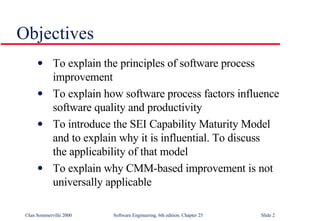
To explain the principles of software process improvement To explain how software process factors influence software quality and productivity To introduce the SEI Capability Maturity Model  and to explain why it is influential. To discuss  the applicability of that model To explain why CMM-based improvement is not universally applicable Objectives
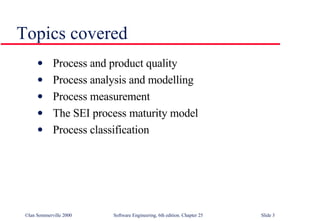
Process and product quality Process analysis and modelling Process measurement The SEI process maturity model Process classification Topics covered
Understanding existing processes Introducing process changes to achieve organisational objectives which are usually focused on quality improvement, cost reduction and schedule acceleration Most process improvement work so far has  focused on defect reduction. This reflects the increasing attention paid by industry to quality However, other process attributes can be the focus of improvement Process improvement
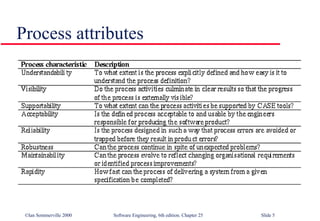
Process attributes
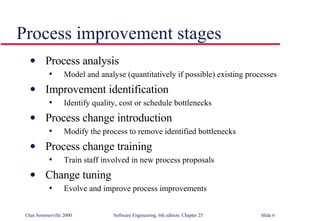
Process analysis Model and analyse (quantitatively if possible) existing processes Improvement identification Identify quality, cost or schedule bottlenecks Process change introduction Modify the process to remove identified bottlenecks Process change training Train staff involved in new process proposals Change tuning Evolve and improve process improvements Process improvement stages
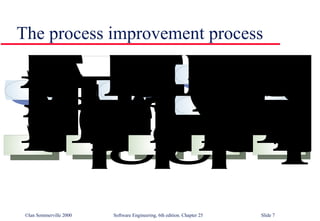
The process improvement process
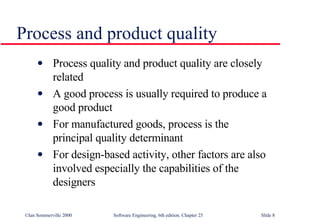
Process quality and product quality are closely  related A good process is usually required to produce a  good product For manufactured goods, process is the  principal quality determinant For design-based activity, other factors are also involved especially the capabilities of the designers Process and product quality
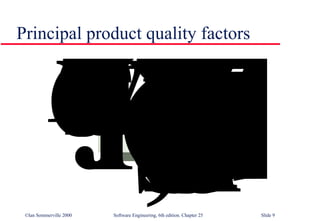
Principal product quality factors
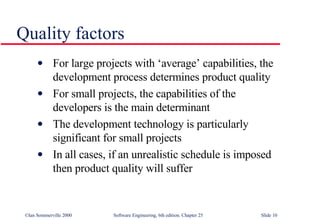
Quality factors For large projects with ‘average’ capabilities, the development process determines product quality For small projects, the capabilities of the developers is the main determinant The development technology is particularly significant for small projects In all cases, if an unrealistic schedule is imposed then product quality will suffer
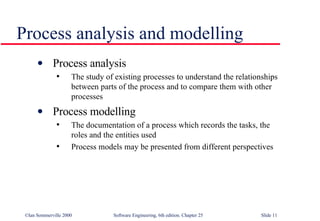
Process analysis and modelling Process analysis The study of existing processes to understand the relationships between parts of the process and to compare them with other processes Process modelling The documentation of a process which records the tasks, the roles and the entities used Process models may be presented from different perspectives
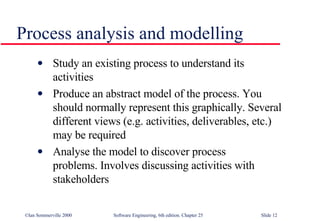
Study an existing process to understand its  activities Produce an abstract model of the process. You should normally represent this graphically. Several different views (e.g. activities, deliverables, etc.) may be required Analyse the model to discover process  problems. Involves discussing activities with stakeholders Process analysis and modelling
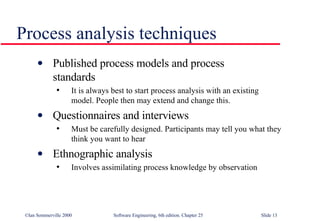
Published process models and process  standards It is always best to start process analysis with an existing model. People then may extend and change this. Questionnaires and interviews Must be carefully designed. Participants may tell you what they think you want to hear Ethnographic analysis Involves assimilating process knowledge by observation Process analysis techniques
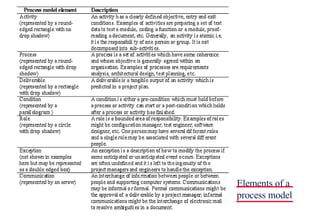
Elements of a process model
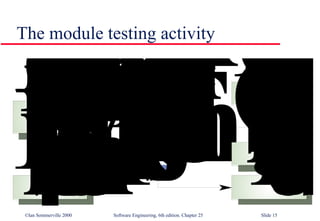
The module testing activity
Activities in module testing ©Ian Sommerville 1995  Software Engineering, 5th edition. Chapter 31.  Slide ##
Process exceptions Software processes are complex and process models cannot effectively represent how to handle exceptions Several key people becoming ill just before a critical review A complete failure of a communication processor so that no e-mail is available for several days Organisational reorganisation A need to respond to an unanticipated request for new proposals Under these circumstances, the model is suspended and managers use their initiative to deal with the exception
Wherever possible, quantitative process data  should be collected However, where organisations do not have clearly defined process standards this is very difficult as you don’t know what to measure. A process may have to be defined before any measurement is possible Process measurements should be used to  assess process improvements But this does not mean that measurements should drive the improvements. The improvement driver should be the organizational objectives Process measurement
Time taken for process activities to be  completed E.g. Calendar time or effort to complete an activity or  process Resources required for processes or activities E.g. Total effort in person-days Number of occurrences of a particular event E.g. Number of defects discovered Classes of process measurement
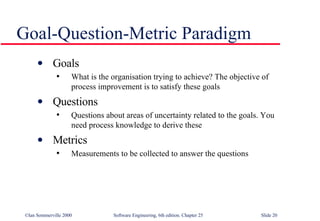
Goals What is the organisation trying to achieve? The objective of process improvement is to satisfy these goals Questions Questions about areas of uncertainty related to the goals. You need process knowledge to derive these Metrics Measurements to be collected to answer the questions Goal-Question-Metric Paradigm
US Defense Dept. funded institute associated  with Carnegie Mellon Mission is to promote software technology  transfer particularly to defense contractors Maturity model proposed in mid-1980s, refined  in early 1990s. Work has been very influential in process  improvement The Software Engineering Institute
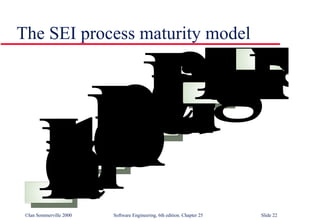
The SEI process maturity model
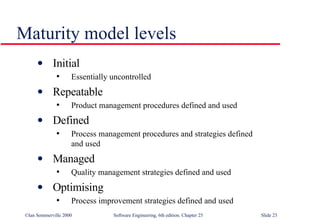
Initial Essentially uncontrolled Repeatable Product management procedures defined and used Defined Process management procedures and strategies defined  and used Managed Quality management strategies defined and used Optimising Process improvement strategies defined and used Maturity model levels
Key process areas
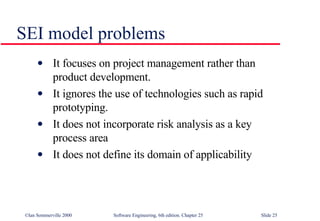
It focuses on project management rather than  product development.  It ignores the use of technologies such as rapid  prototyping. It does not incorporate risk analysis as a key  process area It does not define its domain of applicability SEI model problems
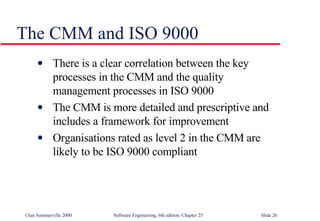
The CMM and ISO 9000 There is a clear correlation between the key processes in the CMM and the quality management processes in ISO 9000 The CMM is more detailed and prescriptive and includes a framework for improvement Organisations rated as level 2 in the CMM are likely to be ISO 9000 compliant
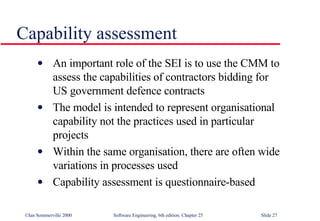
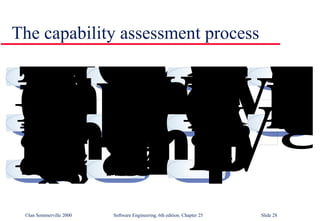
Capability assessment An important role of the SEI is to use the CMM to assess the capabilities of contractors bidding for US government defence contracts The model is intended to represent organisational capability not the practices used in particular projects Within the same organisation, there are often wide variations in processes used Capability assessment is questionnaire-based
The capability assessment process
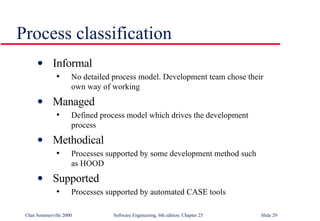
Informal No detailed process model. Development team chose their  own way of working Managed Defined process model which drives the development  process Methodical Processes supported by some development method such  as HOOD Supported Processes supported by automated CASE tools Process classification
Process applicability
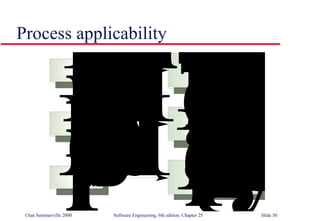
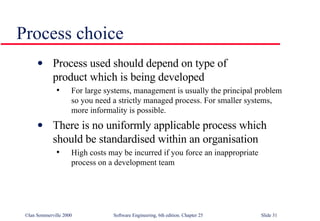
Process used should depend on type of  product which is being developed For large systems, management is usually the principal problem so you need a strictly managed process. For smaller systems, more informality is possible. There is no uniformly applicable process which  should be standardised within an organisation High costs may be incurred if you force an inappropriate process on a development team Process choice
Process tool support
Process improvement involves process analysis, standardisation, measurement and change Process models include descriptions of tasks, activities, roles, exceptions, communications, deliverables and other processes Measurement should be used to answer specific  questions about the software process used The three types of process metrics which can be collected are time metrics, resource utilisation metrics and event metrics Key points
The SEI model classifies software processes as initial, repeatable, defined, managed and optimising. It identifies key processes which should be used at each of these levels The SEI model is appropriate for large systems developed by large teams of engineers. It cannot be applied without modification in other situations Processes can be classified as informal, managed, methodical and improving. This classification can be used to identify process tool support Key points

Process Improvement in Software Engineering SE25

  • 1.
    Process Improvement Understanding, Modelling and Improving the Software Process
  • 2.
    To explain theprinciples of software process improvement To explain how software process factors influence software quality and productivity To introduce the SEI Capability Maturity Model and to explain why it is influential. To discuss the applicability of that model To explain why CMM-based improvement is not universally applicable Objectives
  • 3.
    Process and productquality Process analysis and modelling Process measurement The SEI process maturity model Process classification Topics covered
  • 4.
    Understanding existing processesIntroducing process changes to achieve organisational objectives which are usually focused on quality improvement, cost reduction and schedule acceleration Most process improvement work so far has focused on defect reduction. This reflects the increasing attention paid by industry to quality However, other process attributes can be the focus of improvement Process improvement
  • 5.
  • 6.
    Process analysis Modeland analyse (quantitatively if possible) existing processes Improvement identification Identify quality, cost or schedule bottlenecks Process change introduction Modify the process to remove identified bottlenecks Process change training Train staff involved in new process proposals Change tuning Evolve and improve process improvements Process improvement stages
  • 7.
  • 8.
    Process quality andproduct quality are closely related A good process is usually required to produce a good product For manufactured goods, process is the principal quality determinant For design-based activity, other factors are also involved especially the capabilities of the designers Process and product quality
  • 9.
  • 10.
    Quality factors Forlarge projects with ‘average’ capabilities, the development process determines product quality For small projects, the capabilities of the developers is the main determinant The development technology is particularly significant for small projects In all cases, if an unrealistic schedule is imposed then product quality will suffer
  • 11.
    Process analysis andmodelling Process analysis The study of existing processes to understand the relationships between parts of the process and to compare them with other processes Process modelling The documentation of a process which records the tasks, the roles and the entities used Process models may be presented from different perspectives
  • 12.
    Study an existingprocess to understand its activities Produce an abstract model of the process. You should normally represent this graphically. Several different views (e.g. activities, deliverables, etc.) may be required Analyse the model to discover process problems. Involves discussing activities with stakeholders Process analysis and modelling
  • 13.
    Published process modelsand process standards It is always best to start process analysis with an existing model. People then may extend and change this. Questionnaires and interviews Must be carefully designed. Participants may tell you what they think you want to hear Ethnographic analysis Involves assimilating process knowledge by observation Process analysis techniques
  • 14.
    Elements of aprocess model
  • 15.
  • 16.
    Activities in moduletesting ©Ian Sommerville 1995 Software Engineering, 5th edition. Chapter 31. Slide ##
  • 17.
    Process exceptions Softwareprocesses are complex and process models cannot effectively represent how to handle exceptions Several key people becoming ill just before a critical review A complete failure of a communication processor so that no e-mail is available for several days Organisational reorganisation A need to respond to an unanticipated request for new proposals Under these circumstances, the model is suspended and managers use their initiative to deal with the exception
  • 18.
    Wherever possible, quantitativeprocess data should be collected However, where organisations do not have clearly defined process standards this is very difficult as you don’t know what to measure. A process may have to be defined before any measurement is possible Process measurements should be used to assess process improvements But this does not mean that measurements should drive the improvements. The improvement driver should be the organizational objectives Process measurement
  • 19.
    Time taken forprocess activities to be completed E.g. Calendar time or effort to complete an activity or process Resources required for processes or activities E.g. Total effort in person-days Number of occurrences of a particular event E.g. Number of defects discovered Classes of process measurement
  • 20.
    Goals What isthe organisation trying to achieve? The objective of process improvement is to satisfy these goals Questions Questions about areas of uncertainty related to the goals. You need process knowledge to derive these Metrics Measurements to be collected to answer the questions Goal-Question-Metric Paradigm
  • 21.
    US Defense Dept.funded institute associated with Carnegie Mellon Mission is to promote software technology transfer particularly to defense contractors Maturity model proposed in mid-1980s, refined in early 1990s. Work has been very influential in process improvement The Software Engineering Institute
  • 22.
    The SEI processmaturity model
  • 23.
    Initial Essentially uncontrolledRepeatable Product management procedures defined and used Defined Process management procedures and strategies defined and used Managed Quality management strategies defined and used Optimising Process improvement strategies defined and used Maturity model levels
  • 24.
  • 25.
    It focuses onproject management rather than product development. It ignores the use of technologies such as rapid prototyping. It does not incorporate risk analysis as a key process area It does not define its domain of applicability SEI model problems
  • 26.
    The CMM andISO 9000 There is a clear correlation between the key processes in the CMM and the quality management processes in ISO 9000 The CMM is more detailed and prescriptive and includes a framework for improvement Organisations rated as level 2 in the CMM are likely to be ISO 9000 compliant
  • 27.
    Capability assessment Animportant role of the SEI is to use the CMM to assess the capabilities of contractors bidding for US government defence contracts The model is intended to represent organisational capability not the practices used in particular projects Within the same organisation, there are often wide variations in processes used Capability assessment is questionnaire-based
  • 28.
  • 29.
    Informal No detailedprocess model. Development team chose their own way of working Managed Defined process model which drives the development process Methodical Processes supported by some development method such as HOOD Supported Processes supported by automated CASE tools Process classification
  • 30.
  • 31.
    Process used shoulddepend on type of product which is being developed For large systems, management is usually the principal problem so you need a strictly managed process. For smaller systems, more informality is possible. There is no uniformly applicable process which should be standardised within an organisation High costs may be incurred if you force an inappropriate process on a development team Process choice
  • 32.
  • 33.
    Process improvement involvesprocess analysis, standardisation, measurement and change Process models include descriptions of tasks, activities, roles, exceptions, communications, deliverables and other processes Measurement should be used to answer specific questions about the software process used The three types of process metrics which can be collected are time metrics, resource utilisation metrics and event metrics Key points
  • 34.
    The SEI modelclassifies software processes as initial, repeatable, defined, managed and optimising. It identifies key processes which should be used at each of these levels The SEI model is appropriate for large systems developed by large teams of engineers. It cannot be applied without modification in other situations Processes can be classified as informal, managed, methodical and improving. This classification can be used to identify process tool support Key points