

The Healthcare CFO Perspective

Innovative Methods to Drive Compliance, Automation and
           Efficiency Across the Supply Chain
                        Featuring:

                     Rob DeMichiei
               SVP and Chief Financial Officer
                         UPMC
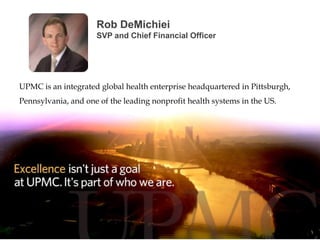
Rob DeMichiei
                            Presenter
                     SVP and Chief Financial Officer


UPMC is an integrated global health enterprise headquartered in Pittsburgh,
Pennsylvania, and one of the leading nonprofit health systems in the US.
Hosted by:


             Visit: prodigosolutions.com
Talking Points

• UPMC Overview

• UPMC Transformation

• Results

• Q&A


                              4
UPMC Snapshot

Revenues: $7.7 billion

 Employees: 50,000

    Hospitals: 20

  Physicians: 5,000
     Beds: 4,000         #330


                                5
Growth Through Innovation
       UPMC brings new concepts and emerging technologies to market
          through its International & Commercial Services Division.


Select Portfolio Companies


                                                                      6
UPMC’s Supply Chain Environment

Spend Managed: $1.8 billion

Team: 200 team members; centralized supply chain
  management organization

Suppliers: 12,000+ active suppliers

Volumes:
    Process 4,000+ purchase requisitions per week
    Receive 1.1M packages per year; central distribution center
    Manage over 600 point of consumption material carts (avg. 172
     items per cart)
    Process 70,000+ invoices per month
                                                                     7
State of Affairs (2006)

• 55%+ of Spend NOT through Purchasing
• Drowning in paper:
   • 220,000+ Paper Requisitions & Purchase Orders
   • 525,000 Vouchers
   • Average 367,000 Paper Checks per year
• Poor Vendor Management:
   • 58,000 Vendors
   • 8,650 Blanket Orders
• Tough negotiators, but poor follow-through:
   • 84% Orders with Price Variance


                                                     8
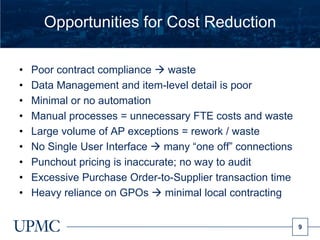
Opportunities for Cost Reduction

•   Poor contract compliance  waste
•   Data Management and item-level detail is poor
•   Minimal or no automation
•   Manual processes = unnecessary FTE costs and waste
•   Large volume of AP exceptions = rework / waste
•   No Single User Interface  many “one off” connections
•   Punchout pricing is inaccurate; no way to audit
•   Excessive Purchase Order-to-Supplier transaction time
•   Heavy reliance on GPOs  minimal local contracting


                                                            9
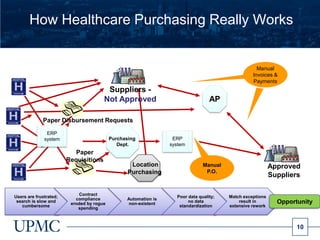
How Healthcare Purchasing Really Works


                                                                                                    Manual
                                                                                                  Invoices &
                                                                                                  Payments
                                        Suppliers -
                                       Not Approved                               AP

             Paper Disbursement Requests

               ERP
              system                       Purchasing             ERP
                                              Dept.              system
                           Paper
                        Requisitions
                                                   Location                    Manual                      Approved
                                                  Purchasing                    P.O.
                                                                                                           Suppliers

                             Contract
Users are frustrated;                                              Poor data quality;   Match exceptions
                           compliance            Automation is
 search is slow and
                         eroded by rogue          non-existent
                                                                        no data             result in        Opportunity
   cumbersome                                                       standardization     extensive rework
                            spending


                                                                                                                   10
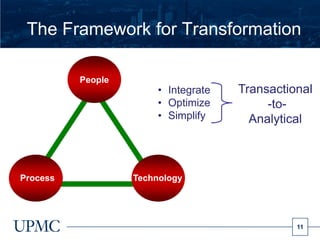
The Framework for Transformation

          People
                        • Integrate   Transactional
                        • Optimize         -to-
                        • Simplify      Analytical


Process            Technology


                                                11
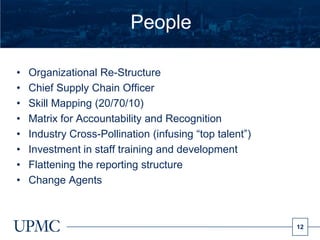
People

•   Organizational Re-Structure
•   Chief Supply Chain Officer
•   Skill Mapping (20/70/10)
•   Matrix for Accountability and Recognition
•   Industry Cross-Pollination (infusing “top talent”)
•   Investment in staff training and development
•   Flattening the reporting structure
•   Change Agents


                                                         12
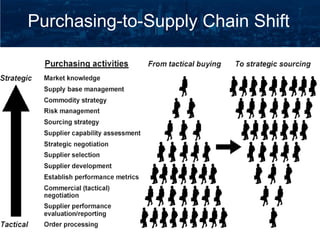
Purchasing-to-Supply Chain Shift


                                   13
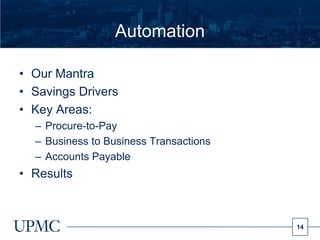
Automation

• Our Mantra
• Savings Drivers
• Key Areas:
  – Procure-to-Pay
  – Business to Business Transactions
  – Accounts Payable
• Results


                                        14
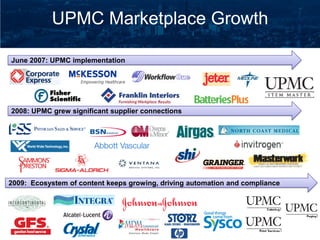
UPMC Marketplace Growth

June 2007: UPMC implementation


2008: UPMC grew significant supplier connections


2009: Ecosystem of content keeps growing, driving automation and compliance


                                                                              15
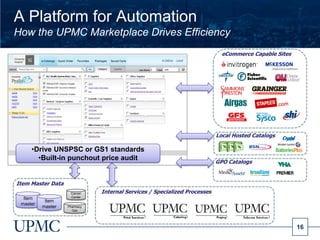
A Platform for Automation
How the UPMC Marketplace Drives Efficiency
                                                                            eCommerce Capable Sites


                                                                          Local Hosted Catalogs

     •Drive UNSPSC or GS1 standards
       •Built-in punchout price audit
                                                                          GPO Catalogs


Item Master Data
                    Cancer    Internal Services / Specialized Processes
                    Center
  Item
           Item
 master
          master   Pharmacy
                     Ops


                                                                                                      16
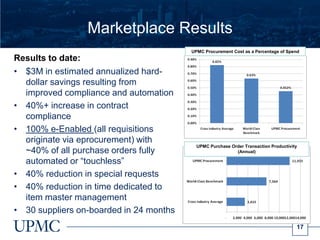
Marketplace Results
                                         UPMC Procurement Cost as a Percentage of Spend
Results to date:
• $3M in estimated annualized hard-
  dollar savings resulting from
  improved compliance and automation
• 40%+ increase in contract
  compliance
• 100% e-Enabled (all requisitions
  originate via eprocurement) with
                                           UPMC Purchase Order Transaction Productivity
  ~40% of all purchase orders fully                        (Annual)

  automated or “touchless”
• 40% reduction in special requests
• 40% reduction in time dedicated to
  item master management
• 30 suppliers on-boarded in 24 months
                                                                                      17
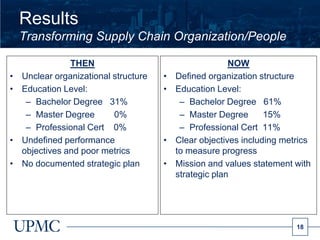
Results
    Transforming Supply Chain Organization/People

                THEN                                     NOW
•   Unclear organizational structure   •   Defined organization structure
•   Education Level:                   •   Education Level:
     – Bachelor Degree 31%                  – Bachelor Degree 61%
     – Master Degree       0%               – Master Degree       15%
     – Professional Cert 0%                 – Professional Cert 11%
•   Undefined performance              •   Clear objectives including metrics
    objectives and poor metrics            to measure progress
•   No documented strategic plan       •   Mission and values statement with
                                           strategic plan


                                                                         18
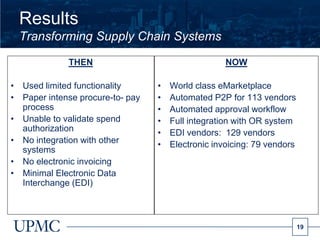
Results
  Transforming Supply Chain Systems
             THEN                                   NOW

• Used limited functionality      •   World class eMarketplace
• Paper intense procure-to- pay   •   Automated P2P for 113 vendors
  process                         •   Automated approval workflow
• Unable to validate spend        •   Full integration with OR system
  authorization                   •   EDI vendors: 129 vendors
• No integration with other       •   Electronic invoicing: 79 vendors
  systems
• No electronic invoicing
• Minimal Electronic Data
  Interchange (EDI)


                                                                         19
Q&A Session

CFO Webinar - Supply Chain Transformation at UPMC

  • 1.
    The Healthcare CFOPerspective Innovative Methods to Drive Compliance, Automation and Efficiency Across the Supply Chain Featuring: Rob DeMichiei SVP and Chief Financial Officer UPMC
  • 2.
    Rob DeMichiei Presenter SVP and Chief Financial Officer UPMC is an integrated global health enterprise headquartered in Pittsburgh, Pennsylvania, and one of the leading nonprofit health systems in the US.
  • 3.
    Hosted by: Visit: prodigosolutions.com
  • 4.
    Talking Points • UPMCOverview • UPMC Transformation • Results • Q&A 4
  • 5.
    UPMC Snapshot Revenues: $7.7billion Employees: 50,000 Hospitals: 20 Physicians: 5,000 Beds: 4,000 #330 5
  • 6.
    Growth Through Innovation UPMC brings new concepts and emerging technologies to market through its International & Commercial Services Division. Select Portfolio Companies 6
  • 7.
    UPMC’s Supply ChainEnvironment Spend Managed: $1.8 billion Team: 200 team members; centralized supply chain management organization Suppliers: 12,000+ active suppliers Volumes:  Process 4,000+ purchase requisitions per week  Receive 1.1M packages per year; central distribution center  Manage over 600 point of consumption material carts (avg. 172 items per cart)  Process 70,000+ invoices per month 7
  • 8.
    State of Affairs(2006) • 55%+ of Spend NOT through Purchasing • Drowning in paper: • 220,000+ Paper Requisitions & Purchase Orders • 525,000 Vouchers • Average 367,000 Paper Checks per year • Poor Vendor Management: • 58,000 Vendors • 8,650 Blanket Orders • Tough negotiators, but poor follow-through: • 84% Orders with Price Variance 8
  • 9.
    Opportunities for CostReduction • Poor contract compliance  waste • Data Management and item-level detail is poor • Minimal or no automation • Manual processes = unnecessary FTE costs and waste • Large volume of AP exceptions = rework / waste • No Single User Interface  many “one off” connections • Punchout pricing is inaccurate; no way to audit • Excessive Purchase Order-to-Supplier transaction time • Heavy reliance on GPOs  minimal local contracting 9
  • 10.
    How Healthcare PurchasingReally Works Manual Invoices & Payments Suppliers - Not Approved AP Paper Disbursement Requests ERP system Purchasing ERP Dept. system Paper Requisitions Location Manual Approved Purchasing P.O. Suppliers Contract Users are frustrated; Poor data quality; Match exceptions compliance Automation is search is slow and eroded by rogue non-existent no data result in Opportunity cumbersome standardization extensive rework spending 10
  • 11.
    The Framework forTransformation People • Integrate Transactional • Optimize -to- • Simplify Analytical Process Technology 11
  • 12.
    People • Organizational Re-Structure • Chief Supply Chain Officer • Skill Mapping (20/70/10) • Matrix for Accountability and Recognition • Industry Cross-Pollination (infusing “top talent”) • Investment in staff training and development • Flattening the reporting structure • Change Agents 12
  • 13.
  • 14.
    Automation • Our Mantra •Savings Drivers • Key Areas: – Procure-to-Pay – Business to Business Transactions – Accounts Payable • Results 14
  • 15.
    UPMC Marketplace Growth June2007: UPMC implementation 2008: UPMC grew significant supplier connections 2009: Ecosystem of content keeps growing, driving automation and compliance 15
  • 16.
    A Platform forAutomation How the UPMC Marketplace Drives Efficiency eCommerce Capable Sites Local Hosted Catalogs •Drive UNSPSC or GS1 standards •Built-in punchout price audit GPO Catalogs Item Master Data Cancer Internal Services / Specialized Processes Center Item Item master master Pharmacy Ops 16
  • 17.
    Marketplace Results UPMC Procurement Cost as a Percentage of Spend Results to date: • $3M in estimated annualized hard- dollar savings resulting from improved compliance and automation • 40%+ increase in contract compliance • 100% e-Enabled (all requisitions originate via eprocurement) with UPMC Purchase Order Transaction Productivity ~40% of all purchase orders fully (Annual) automated or “touchless” • 40% reduction in special requests • 40% reduction in time dedicated to item master management • 30 suppliers on-boarded in 24 months 17
  • 18.
    Results Transforming Supply Chain Organization/People THEN NOW • Unclear organizational structure • Defined organization structure • Education Level: • Education Level: – Bachelor Degree 31% – Bachelor Degree 61% – Master Degree 0% – Master Degree 15% – Professional Cert 0% – Professional Cert 11% • Undefined performance • Clear objectives including metrics objectives and poor metrics to measure progress • No documented strategic plan • Mission and values statement with strategic plan 18
  • 19.
    Results TransformingSupply Chain Systems THEN NOW • Used limited functionality • World class eMarketplace • Paper intense procure-to- pay • Automated P2P for 113 vendors process • Automated approval workflow • Unable to validate spend • Full integration with OR system authorization • EDI vendors: 129 vendors • No integration with other • Electronic invoicing: 79 vendors systems • No electronic invoicing • Minimal Electronic Data Interchange (EDI) 19
  • 20.