Financial statements
 Financial statements report the state of financial affairs of an enterprise
 These are made publicly available for widely held companies, usually
free of cost (www.bseindia.com and www.nseindia.com )
 For closely held public companies and private companies, the financial
statements are reported to the Ministry of Company Affairs
 Some of these are available for public viewing (both online as well as
physically) for a small fee. (http://www.mca.gov.in )
 Three key financial statements are
 Balance Sheet
 Profit & Loss Account and
 Cash flow statement
Construct of a Balance Sheet
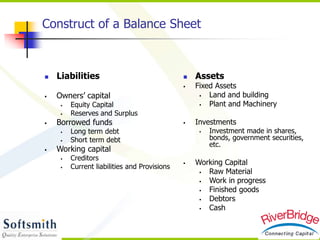
 Liabilities
 Owners’ capital
 Equity Capital
 Reserves and Surplus
 Borrowed funds
 Long term debt
 Short term debt
 Working capital
 Creditors
 Current liabilities and Provisions
 Assets
 Fixed Assets
 Land and building
 Plant and Machinery
 Investments
 Investment made in shares,
bonds, government securities,
etc.
 Working Capital
 Raw Material
 Work in progress
 Finished goods
 Debtors
 Cash
Some observations on Balance Sheet
 The Liability side represent the various sources of funds for an
enterprise
 These are the liability of the enterprise to the providers of these
funds
 The Asset side represent the various uses of funds by an
enterprise
 These are the assets held by the enterprise, that are needed to
operate the business (e.g. Office space, factory, raw material, etc.)
 The Assets and Liabilities should ALWAYS match.
 In the Liability side, the portfolio mix of the own funds and
borrowed funds is called the Capital Structure of the company
 Balance sheet is always presented as on a given day, say as at
March 31, 2008. It presents a static picture of the assets and
liabilities of the enterprise as on that date.
Some observations on Balance Sheet
 Another way to look at the balance sheet is to match the sources and
uses of funds, based on their tenure.
 In Liability side, long term sources are
 Equity capital
 Reserves and Surplus
 Long term borrowings
 In Asset side, long term uses are
 Fixed Assets
 Investments
 The rest are short term on both sides viz. Current assets, current liability
and short term debt
 Ideally, long term uses must always be funded with long term funds.
Financing long term assets with the short term funds creates risks
(mainly refinancing risk).
 Short term investments may be financed by a combination of long
term and short term funds, based on business managers’ preference.
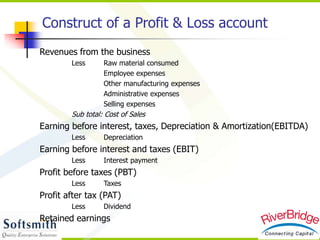
Construct of a Profit & Loss account
Revenues from the business
Less Raw material consumed
Employee expenses
Other manufacturing expenses
Administrative expenses
Selling expenses
Sub total: Cost of Sales
Earning before interest, taxes, Depreciation & Amortization(EBITDA)
Less Depreciation
Earning before interest and taxes (EBIT)
Less Interest payment
Profit before taxes (PBT)
Less Taxes
Profit after tax (PAT)
Less Dividend
Retained earnings
Inside the P&L Account
Typical items under ‘Revenue from business’
 Sales revenue
 Other related income
 Scrap sales, Duty drawback
 Non-operating income
 Dividends and interest
 Rent received
 Extra-ordinary income
 Profit on sale of assets / investments
 Prior-period items
Typical items under ‘Cost of Sales’
 Cost of goods sold
 Direct material
 Direct labor
 Direct manufacturing overheads
 Administrative costs
 Office rent
 Salaries
 Communication costs
 Other costs
 Selling and distribution costs
 Salaries of sales staff
 Commissions, promotional expenses
 Advertisement expenses etc.
Inside the P&L Account
 Depreciation
 Straight line method
 Written Down Value method
 Deferred revenue expenditure
 R&D expenses
 Advertisement expenses
 Product promotion expenses
(expenses are charged as capital expenses and
amortized over the period of time)
Inside the P&L Account
Some observations on P&L Account
 P&L Account presents a snapshot of the performance of an
enterprise over a given period (a year, half-year, quarter, etc.)
 Unlike Balance Sheet, which presents a static picture on a given date
 P&L Account can provide great insights into the functioning of an
enterprise. Let us look at a few:
 Variable costs Vs. Fixed costs
 Break even point is the point where there is ‘no profit, no loss’
 Cash expenses Vs. Non-cash expenses
 Raw material, salary and other administrative expenses are cash
expenses
 Depreciation is typically the only non-cash expense
 Recurring income Vs. one-time income
 Income from ordinary activities are typically recurring in nature
 Extraordinary income / expenses are typically one-time in nature
 Few examples: Sale of office space, disposal of a factory unit, VRS

Financial Statements

  • 1.
  • 2.
    Financial statements  Financialstatements report the state of financial affairs of an enterprise  These are made publicly available for widely held companies, usually free of cost (www.bseindia.com and www.nseindia.com )  For closely held public companies and private companies, the financial statements are reported to the Ministry of Company Affairs  Some of these are available for public viewing (both online as well as physically) for a small fee. (http://www.mca.gov.in )  Three key financial statements are  Balance Sheet  Profit & Loss Account and  Cash flow statement
  • 3.
    Construct of aBalance Sheet  Liabilities  Owners’ capital  Equity Capital  Reserves and Surplus  Borrowed funds  Long term debt  Short term debt  Working capital  Creditors  Current liabilities and Provisions  Assets  Fixed Assets  Land and building  Plant and Machinery  Investments  Investment made in shares, bonds, government securities, etc.  Working Capital  Raw Material  Work in progress  Finished goods  Debtors  Cash
  • 4.
    Some observations onBalance Sheet  The Liability side represent the various sources of funds for an enterprise  These are the liability of the enterprise to the providers of these funds  The Asset side represent the various uses of funds by an enterprise  These are the assets held by the enterprise, that are needed to operate the business (e.g. Office space, factory, raw material, etc.)  The Assets and Liabilities should ALWAYS match.  In the Liability side, the portfolio mix of the own funds and borrowed funds is called the Capital Structure of the company  Balance sheet is always presented as on a given day, say as at March 31, 2008. It presents a static picture of the assets and liabilities of the enterprise as on that date.
  • 5.
    Some observations onBalance Sheet  Another way to look at the balance sheet is to match the sources and uses of funds, based on their tenure.  In Liability side, long term sources are  Equity capital  Reserves and Surplus  Long term borrowings  In Asset side, long term uses are  Fixed Assets  Investments  The rest are short term on both sides viz. Current assets, current liability and short term debt  Ideally, long term uses must always be funded with long term funds. Financing long term assets with the short term funds creates risks (mainly refinancing risk).  Short term investments may be financed by a combination of long term and short term funds, based on business managers’ preference.
  • 6.
    Construct of aProfit & Loss account Revenues from the business Less Raw material consumed Employee expenses Other manufacturing expenses Administrative expenses Selling expenses Sub total: Cost of Sales Earning before interest, taxes, Depreciation & Amortization(EBITDA) Less Depreciation Earning before interest and taxes (EBIT) Less Interest payment Profit before taxes (PBT) Less Taxes Profit after tax (PAT) Less Dividend Retained earnings
  • 7.
    Inside the P&LAccount Typical items under ‘Revenue from business’  Sales revenue  Other related income  Scrap sales, Duty drawback  Non-operating income  Dividends and interest  Rent received  Extra-ordinary income  Profit on sale of assets / investments  Prior-period items
  • 8.
    Typical items under‘Cost of Sales’  Cost of goods sold  Direct material  Direct labor  Direct manufacturing overheads  Administrative costs  Office rent  Salaries  Communication costs  Other costs  Selling and distribution costs  Salaries of sales staff  Commissions, promotional expenses  Advertisement expenses etc. Inside the P&L Account
  • 9.
     Depreciation  Straightline method  Written Down Value method  Deferred revenue expenditure  R&D expenses  Advertisement expenses  Product promotion expenses (expenses are charged as capital expenses and amortized over the period of time) Inside the P&L Account
  • 10.
    Some observations onP&L Account  P&L Account presents a snapshot of the performance of an enterprise over a given period (a year, half-year, quarter, etc.)  Unlike Balance Sheet, which presents a static picture on a given date  P&L Account can provide great insights into the functioning of an enterprise. Let us look at a few:  Variable costs Vs. Fixed costs  Break even point is the point where there is ‘no profit, no loss’  Cash expenses Vs. Non-cash expenses  Raw material, salary and other administrative expenses are cash expenses  Depreciation is typically the only non-cash expense  Recurring income Vs. one-time income  Income from ordinary activities are typically recurring in nature  Extraordinary income / expenses are typically one-time in nature  Few examples: Sale of office space, disposal of a factory unit, VRS