Reading Financial
Statements
MADITSSIA BIC – ENTREPRENEURSHIP AWARENESS CAMP
JUNE 16, 2017
What is Accounting?
 Accounting is the process of identifying, measuring,
and communicating economic information to permit
informed judgments and decisions. Put more simply,
accounting is the “language of business.”
2
Example
 Imagine for a moment that you decided to start a business with your
mother, a housewife, to sew ladies garments and sell them in the
neighborhood. With mother's contribution of ₹9,000 and a bank loan
of ₹20,000 you purchased a peddle sewing machine for ₹21,000,
cloth lengths and the material for ₹8,000. During May and June, you
were able to sell finished goods amounting to ₹16,000. At the end of
June, you had raw material ₹1,500 in stock, cash balance ₹14,000,
interest due ₹500 and ₹2,000 to be received for garments sold on
credit.
Given this information, can you tell what happened to your business
in May and June? Were you profitable? What do you have to show
for your efforts? How can you tell? Getting answers to such questions
requires accounting.
3
Communicating Information
 A business communicates information to other parties through
Financial Statements
 The set of Financial Statements includes:
 The Profit and Loss Statement (or Income Statement)
 The Balance Sheet (or Statement of Financial Position)
 The Statement of Cash Flows
 Explanations of how some of the above was calculated – called Notes
(from Footnotes to the statements)
4
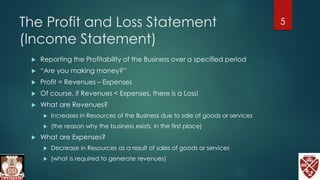
The Profit and Loss Statement
(Income Statement)
 Reporting the Profitability of the Business over a specified period
 “Are you making money?”
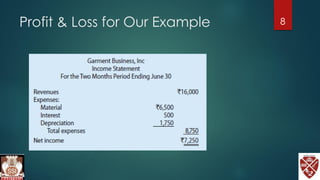
 Profit = Revenues – Expenses
 Of course, if Revenues < Expenses, there is a Loss!
 What are Revenues?
 Increases in Resources of the Business due to sale of goods or services
 (the reason why the business exists, in the first place)
 What are Expenses?
 Decrease in Resources as a result of sales of goods or services
 (what is required to generate revenues)
5
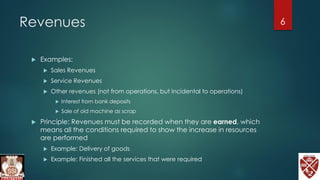
Revenues
 Examples:
 Sales Revenues
 Service Revenues
 Other revenues (not from operations, but incidental to operations)
 Interest from bank deposits
 Sale of old machine as scrap
 Principle: Revenues must be recorded when they are earned, which
means all the conditions required to show the increase in resources
are performed
 Example: Delivery of goods
 Example: Finished all the services that were required
6
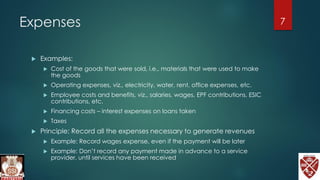
Expenses
 Examples:
 Cost of the goods that were sold, i.e., materials that were used to make
the goods
 Operating expenses, viz., electricity, water, rent, office expenses, etc.
 Employee costs and benefits, viz., salaries, wages, EPF contributions, ESIC
contributions, etc.
 Financing costs – interest expenses on loans taken
 Taxes
 Principle: Record all the expenses necessary to generate revenues
 Example: Record wages expense, even if the payment will be later
 Example: Don’t record any payment made in advance to a service
provider, until services have been received
7
Profit & Loss for Our Example 8
The Balance Sheet
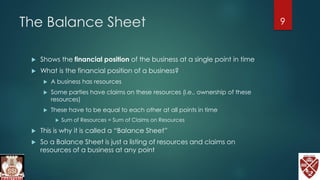
 Shows the financial position of the business at a single point in time
 What is the financial position of a business?
 A business has resources
 Some parties have claims on these resources (i.e., ownership of these
resources)
 These have to be equal to each other at all points in time
 Sum of Resources = Sum of Claims on Resources
 This is why it is called a “Balance Sheet”
 So a Balance Sheet is just a listing of resources and claims on
resources of a business at any point
9
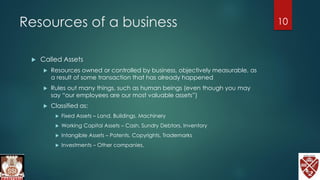
Resources of a business
 Called Assets
 Resources owned or controlled by business, objectively measurable, as
a result of some transaction that has already happened
 Rules out many things, such as human beings (even though you may
say “our employees are our most valuable assets”)
 Classified as:
 Fixed Assets – Land, Buildings, Machinery
 Working Capital Assets – Cash, Sundry Debtors, Inventory
 Intangible Assets – Patents, Copyrights, Trademarks
 Investments – Other companies,
10
Claims on Resources of a Business
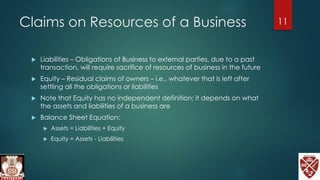
 Liabilities – Obligations of Business to external parties, due to a past
transaction, will require sacrifice of resources of business in the future
 Equity – Residual claims of owners – i.e., whatever that is left after
settling all the obligations or liabilities
 Note that Equity has no independent definition; it depends on what
the assets and liabilities of a business are
 Balance Sheet Equation:
 Assets = Liabilities + Equity
 Equity = Assets - Liabilities
11
Liabilities
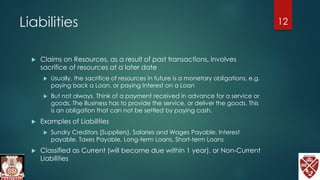
 Claims on Resources, as a result of past transactions, involves
sacrifice of resources at a later date
 Usually, the sacrifice of resources in future is a monetary obligations, e.g.
paying back a Loan, or paying Interest on a Loan
 But not always. Think of a payment received in advance for a service or
goods. The Business has to provide the service, or deliver the goods. This
is an obligation that can not be settled by paying cash.
 Examples of Liabilities
 Sundry Creditors (Suppliers), Salaries and Wages Payable, Interest
payable, Taxes Payable, Long-term Loans, Short-term Loans
 Classified as Current (will become due within 1 year), or Non-Current
Liabilities
12
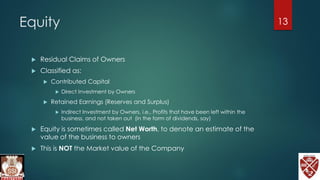
Equity
 Residual Claims of Owners
 Classified as:
 Contributed Capital
 Direct Investment by Owners
 Retained Earnings (Reserves and Surplus)
 Indirect Investment by Owners, i.e., Profits that have been left within the
business, and not taken out (in the form of dividends, say)
 Equity is sometimes called Net Worth, to denote an estimate of the
value of the business to owners
 This is NOT the Market value of the Company
13
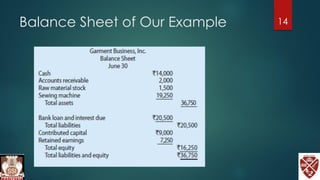
Balance Sheet of Our Example 14
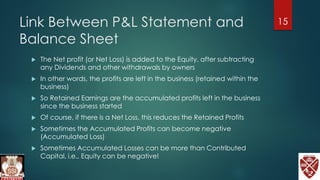
Link Between P&L Statement and
Balance Sheet
 The Net profit (or Net Loss) is added to the Equity, after subtracting
any Dividends and other withdrawals by owners
 In other words, the profits are left in the business (retained within the
business)
 So Retained Earnings are the accumulated profits left in the business
since the business started
 Of course, if there is a Net Loss, this reduces the Retained Profits
 Sometimes the Accumulated Profits can become negative
(Accumulated Loss)
 Sometimes Accumulated Losses can be more than Contributed
Capital, i.e., Equity can be negative!
15
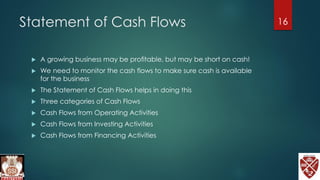
Statement of Cash Flows
 A growing business may be profitable, but may be short on cash!
 We need to monitor the cash flows to make sure cash is available
for the business
 The Statement of Cash Flows helps in doing this
 Three categories of Cash Flows
 Cash Flows from Operating Activities
 Cash Flows from Investing Activities
 Cash Flows from Financing Activities
16
Operating Activities – Net Cash
Flows
 All cash flows and cash outflows related to operations
 Cash collected from Customers
 Cash paid to Suppliers
17
Investing Activities – Net Cash Flows
 All Cash Inflows and Cash Outflows that are related to the
Investments made by business
 Cash paid to buy land, buildings, machinery
 Cash paid to buy other businesses (mergers and acquisitions)
 Cash paid to buy shares and deposits (other businesses)
 Cash received from sale of land, buildings, machinery
 Cash received when selling businesses
 Cash received when selling shares of other businesses
18
Financing Activities – Net Cash
Flows
 Cash Inflows and Cash Outflows due to any financing activity
 Cash received from loans taken
 Cash paid when loans are repaid
 Interest paid on loans taken
 Cash received as investment by owners (IPO, Seasoned Public Offering)
 Cash paid for dividends
 Cash paid for buying back own shares (treasury stock repurchase)
19
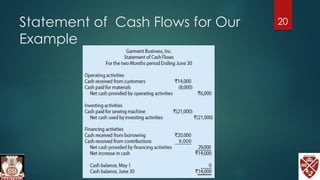
Statement of Cash Flows for Our
Example
20
Review
 Set of Financial Statements include Profit & Loss Statement, Balance
Sheet, and Statement of Cash Flows
 Should provide a complete picture of business
 Profitability – Profit & Loss Statement
 Financial position – Balance Sheet
 Ability to make cash payments – Statement of Cash Flow
 Important to understand that the Financial Statement are not just
keeping score (historical performance), but also indicators of future
performance
 Should be used as the basis of forecasts of future performance, but
not exclusively (can not disregard other factors)
21
How do lenders use financial
statements?
 Purpose of the loan?
 Working Capital purposes – short-term bridging loans
 Capital Investments – Fixed Assets such as land, buildings, machinery
and equipment
 Liquidity (ability to meet obligations in the short-term) and solvency
(ability to meet long-term obligations) are the two important factors
that lenders consider, and they price the loan (interest rate)
according to the riskiness they perceive
22
How do lenders assess liquidity and
solvency?
 Current Ratio
 Current Assets/Current Liabilities
 Times Interest Earned
 (Net profit + Interest Expense + Tax Expense)/Interest Expense
23
How do investors assess businesses
for investment?
 Growth Prospects
 Trend in growth of Revenues, Profits
 Profitability
 Measured as returns
 Return on Investment (ROI)
 Return on Invested Capital/ Return on Assets (ROA)
 Return on Equity (ROE)
24
What is a Business Plan
 A business plan is a written document prepared
by the entrepreneur that describes all the
relevant internal and external elements and
strategies for starting a new venture.
 It is a integration of functional plans such as
marketing, finance, manufacturing, sales and
human resources.
25
Who should write the plan?
 The business plan should be prepared by
the entrepreneur.
 The entrepreneur may consult with many
other sources in its preparation, such as
lawyers, accountants, marketing
consultants, and engineers.
26
Who Reads The Plans?
 The business plan may be read by
employees, investors, bankers, venture
capitalists, suppliers, customers, advisors,
and consultants.
 There are three perspectives should be
considered in preparing the plan :
Perspective of the entrepreneur
Marketing perspective
Investor’s perspective
27
Presenting The Plan
 It is often necessary for an entrepreneur to orally
present the business plan before an audience of
potential investors.
 In this typical forum the entrepreneur would be
expected to provide a short (perhaps 20-
minutes or half-hour) presentation of the business
plan.
Outline of a Business Plan
 Introductory Page
 Name and address of business
 Name(s) and address(es) of principal(s)
 Nature of business
 Statement of financing needed
 Statement of confidentially of report
Outline …
 Executive Summary – Three to four pages
summarizing the complete business plan
 What is the business concept or model?
 How is this business concept or model unique?
 Who are the individuals starting this business?
 How will they make money and how much?
Outline …
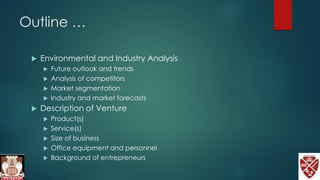
 Environmental and Industry Analysis
 Future outlook and trends
 Analysis of competitors
 Market segmentation
 Industry and market forecasts
 Description of Venture
 Product(s)
 Service(s)
 Size of business
 Office equipment and personnel
 Background of entrepreneurs
Outline …
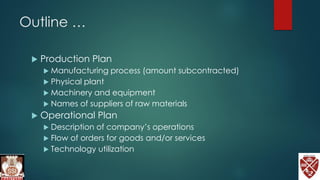
 Production Plan
 Manufacturing process (amount subcontracted)
 Physical plant
 Machinery and equipment
 Names of suppliers of raw materials
 Operational Plan
 Description of company’s operations
 Flow of orders for goods and/or services
 Technology utilization
Outline …
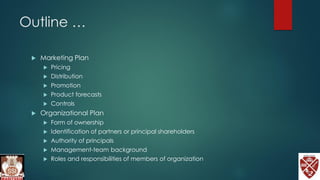
 Marketing Plan
 Pricing
 Distribution
 Promotion
 Product forecasts
 Controls
 Organizational Plan
 Form of ownership
 Identification of partners or principal shareholders
 Authority of principals
 Management-team background
 Roles and responsibilities of members of organization
Outline …
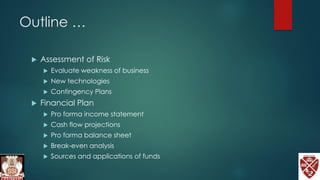
 Assessment of Risk
 Evaluate weakness of business
 New technologies
 Contingency Plans
 Financial Plan
 Pro forma income statement
 Cash flow projections
 Pro forma balance sheet
 Break-even analysis
 Sources and applications of funds
Outline …
 Appendix (contains backup material)
 Letters
 Market research data
 Leases or contracts
 Price lists from suppliers.
Business Plan
 Objectives of a Business Plan
 To develop a document that presents a picture of the business, where the
business is going, and how it will get there
 A document that conveys your organization’s
prospects and growth potential. It describes:
 You and your products and services
 The market and your role in it
 Shows you are committed to achieving a vision
 Good follow-up to developing a strategic plan
 Keeps focus on end product
36
Format of a Business Plan
1. Title Page
2. Executive Summary
3. Vision/Mission and Goals
4. Current Position
5. Strategic Analysis
6. Implementation
7. Projections
37
Executive Summary
Written last
Maximum of two pages
Major points of each section
38
Vision, Mission, and Goals
Where is the business headed?
What do you want the business to
achieve?
What time frame?
39
Current Position
 How do you describe the business?
 History: important milestones
 Products/services: What? How much?
 Resources: Who owns what? What is their reward?
 Management: Who? What do they do?
 Organizational Structure: Who’s the boss?
 Marketing: What tools? What customers?
 Ownership Structure: Legal form?
40
Strategic Analysis
 What opportunities and threats does the
business face?
 What are our strengths and weakness?
 What do we do better than others?
 What strategy will we use?
41
Implementation
 For each business unit
What size?
What resources will be needed?
How will the resources be acquired?
How will product/service be marketed?
What performance targets will be set?
42
Implementation (Continued)
 For the firm as a whole
 What is the scope of business?
 How will it be financed?
 How will the business be organized?
 What are our social responsibilities?
 How will we develop new management skills?
 When will it happen?
 How much will it cost/generate?
43
Projections
 What numbers can we put behind our plan?
 What assumptions have we made?
 What do we expect for our ROA and ROE?
 What is our contingency plan?
 What will we do in an emergency?
44
Please make sure that…
1. Your goals are tied to your vision
2. You can point to major opportunities
3. You’re prepared for threats
4. You’ve described your customers
5. You know your strengths/weaknesses
6. Your strategy makes sense
7. Your data is accurate
8. You’re really ready for change
9. Your plan is clear, concise, and current
45
Keep in mind that. . .
 This is an opportunity to work on the business
 This is important and difficult work but not urgent
 The value of the work will increase as you share,
review, and update the business plan
46

Reading financial statements

  • 1.
    Reading Financial Statements MADITSSIA BIC– ENTREPRENEURSHIP AWARENESS CAMP JUNE 16, 2017
  • 2.
    What is Accounting? Accounting is the process of identifying, measuring, and communicating economic information to permit informed judgments and decisions. Put more simply, accounting is the “language of business.” 2
  • 3.
    Example  Imagine fora moment that you decided to start a business with your mother, a housewife, to sew ladies garments and sell them in the neighborhood. With mother's contribution of ₹9,000 and a bank loan of ₹20,000 you purchased a peddle sewing machine for ₹21,000, cloth lengths and the material for ₹8,000. During May and June, you were able to sell finished goods amounting to ₹16,000. At the end of June, you had raw material ₹1,500 in stock, cash balance ₹14,000, interest due ₹500 and ₹2,000 to be received for garments sold on credit. Given this information, can you tell what happened to your business in May and June? Were you profitable? What do you have to show for your efforts? How can you tell? Getting answers to such questions requires accounting. 3
  • 4.
    Communicating Information  Abusiness communicates information to other parties through Financial Statements  The set of Financial Statements includes:  The Profit and Loss Statement (or Income Statement)  The Balance Sheet (or Statement of Financial Position)  The Statement of Cash Flows  Explanations of how some of the above was calculated – called Notes (from Footnotes to the statements) 4
  • 5.
    The Profit andLoss Statement (Income Statement)  Reporting the Profitability of the Business over a specified period  “Are you making money?”  Profit = Revenues – Expenses  Of course, if Revenues < Expenses, there is a Loss!  What are Revenues?  Increases in Resources of the Business due to sale of goods or services  (the reason why the business exists, in the first place)  What are Expenses?  Decrease in Resources as a result of sales of goods or services  (what is required to generate revenues) 5
  • 6.
    Revenues  Examples:  SalesRevenues  Service Revenues  Other revenues (not from operations, but incidental to operations)  Interest from bank deposits  Sale of old machine as scrap  Principle: Revenues must be recorded when they are earned, which means all the conditions required to show the increase in resources are performed  Example: Delivery of goods  Example: Finished all the services that were required 6
  • 7.
    Expenses  Examples:  Costof the goods that were sold, i.e., materials that were used to make the goods  Operating expenses, viz., electricity, water, rent, office expenses, etc.  Employee costs and benefits, viz., salaries, wages, EPF contributions, ESIC contributions, etc.  Financing costs – interest expenses on loans taken  Taxes  Principle: Record all the expenses necessary to generate revenues  Example: Record wages expense, even if the payment will be later  Example: Don’t record any payment made in advance to a service provider, until services have been received 7
  • 8.
    Profit & Lossfor Our Example 8
  • 9.
    The Balance Sheet Shows the financial position of the business at a single point in time  What is the financial position of a business?  A business has resources  Some parties have claims on these resources (i.e., ownership of these resources)  These have to be equal to each other at all points in time  Sum of Resources = Sum of Claims on Resources  This is why it is called a “Balance Sheet”  So a Balance Sheet is just a listing of resources and claims on resources of a business at any point 9
  • 10.
    Resources of abusiness  Called Assets  Resources owned or controlled by business, objectively measurable, as a result of some transaction that has already happened  Rules out many things, such as human beings (even though you may say “our employees are our most valuable assets”)  Classified as:  Fixed Assets – Land, Buildings, Machinery  Working Capital Assets – Cash, Sundry Debtors, Inventory  Intangible Assets – Patents, Copyrights, Trademarks  Investments – Other companies, 10
  • 11.
    Claims on Resourcesof a Business  Liabilities – Obligations of Business to external parties, due to a past transaction, will require sacrifice of resources of business in the future  Equity – Residual claims of owners – i.e., whatever that is left after settling all the obligations or liabilities  Note that Equity has no independent definition; it depends on what the assets and liabilities of a business are  Balance Sheet Equation:  Assets = Liabilities + Equity  Equity = Assets - Liabilities 11
  • 12.
    Liabilities  Claims onResources, as a result of past transactions, involves sacrifice of resources at a later date  Usually, the sacrifice of resources in future is a monetary obligations, e.g. paying back a Loan, or paying Interest on a Loan  But not always. Think of a payment received in advance for a service or goods. The Business has to provide the service, or deliver the goods. This is an obligation that can not be settled by paying cash.  Examples of Liabilities  Sundry Creditors (Suppliers), Salaries and Wages Payable, Interest payable, Taxes Payable, Long-term Loans, Short-term Loans  Classified as Current (will become due within 1 year), or Non-Current Liabilities 12
  • 13.
    Equity  Residual Claimsof Owners  Classified as:  Contributed Capital  Direct Investment by Owners  Retained Earnings (Reserves and Surplus)  Indirect Investment by Owners, i.e., Profits that have been left within the business, and not taken out (in the form of dividends, say)  Equity is sometimes called Net Worth, to denote an estimate of the value of the business to owners  This is NOT the Market value of the Company 13
  • 14.
    Balance Sheet ofOur Example 14
  • 15.
    Link Between P&LStatement and Balance Sheet  The Net profit (or Net Loss) is added to the Equity, after subtracting any Dividends and other withdrawals by owners  In other words, the profits are left in the business (retained within the business)  So Retained Earnings are the accumulated profits left in the business since the business started  Of course, if there is a Net Loss, this reduces the Retained Profits  Sometimes the Accumulated Profits can become negative (Accumulated Loss)  Sometimes Accumulated Losses can be more than Contributed Capital, i.e., Equity can be negative! 15
  • 16.
    Statement of CashFlows  A growing business may be profitable, but may be short on cash!  We need to monitor the cash flows to make sure cash is available for the business  The Statement of Cash Flows helps in doing this  Three categories of Cash Flows  Cash Flows from Operating Activities  Cash Flows from Investing Activities  Cash Flows from Financing Activities 16
  • 17.
    Operating Activities –Net Cash Flows  All cash flows and cash outflows related to operations  Cash collected from Customers  Cash paid to Suppliers 17
  • 18.
    Investing Activities –Net Cash Flows  All Cash Inflows and Cash Outflows that are related to the Investments made by business  Cash paid to buy land, buildings, machinery  Cash paid to buy other businesses (mergers and acquisitions)  Cash paid to buy shares and deposits (other businesses)  Cash received from sale of land, buildings, machinery  Cash received when selling businesses  Cash received when selling shares of other businesses 18
  • 19.
    Financing Activities –Net Cash Flows  Cash Inflows and Cash Outflows due to any financing activity  Cash received from loans taken  Cash paid when loans are repaid  Interest paid on loans taken  Cash received as investment by owners (IPO, Seasoned Public Offering)  Cash paid for dividends  Cash paid for buying back own shares (treasury stock repurchase) 19
  • 20.
    Statement of CashFlows for Our Example 20
  • 21.
    Review  Set ofFinancial Statements include Profit & Loss Statement, Balance Sheet, and Statement of Cash Flows  Should provide a complete picture of business  Profitability – Profit & Loss Statement  Financial position – Balance Sheet  Ability to make cash payments – Statement of Cash Flow  Important to understand that the Financial Statement are not just keeping score (historical performance), but also indicators of future performance  Should be used as the basis of forecasts of future performance, but not exclusively (can not disregard other factors) 21
  • 22.
    How do lendersuse financial statements?  Purpose of the loan?  Working Capital purposes – short-term bridging loans  Capital Investments – Fixed Assets such as land, buildings, machinery and equipment  Liquidity (ability to meet obligations in the short-term) and solvency (ability to meet long-term obligations) are the two important factors that lenders consider, and they price the loan (interest rate) according to the riskiness they perceive 22
  • 23.
    How do lendersassess liquidity and solvency?  Current Ratio  Current Assets/Current Liabilities  Times Interest Earned  (Net profit + Interest Expense + Tax Expense)/Interest Expense 23
  • 24.
    How do investorsassess businesses for investment?  Growth Prospects  Trend in growth of Revenues, Profits  Profitability  Measured as returns  Return on Investment (ROI)  Return on Invested Capital/ Return on Assets (ROA)  Return on Equity (ROE) 24
  • 25.
    What is aBusiness Plan  A business plan is a written document prepared by the entrepreneur that describes all the relevant internal and external elements and strategies for starting a new venture.  It is a integration of functional plans such as marketing, finance, manufacturing, sales and human resources. 25
  • 26.
    Who should writethe plan?  The business plan should be prepared by the entrepreneur.  The entrepreneur may consult with many other sources in its preparation, such as lawyers, accountants, marketing consultants, and engineers. 26
  • 27.
    Who Reads ThePlans?  The business plan may be read by employees, investors, bankers, venture capitalists, suppliers, customers, advisors, and consultants.  There are three perspectives should be considered in preparing the plan : Perspective of the entrepreneur Marketing perspective Investor’s perspective 27
  • 28.
    Presenting The Plan It is often necessary for an entrepreneur to orally present the business plan before an audience of potential investors.  In this typical forum the entrepreneur would be expected to provide a short (perhaps 20- minutes or half-hour) presentation of the business plan.
  • 29.
    Outline of aBusiness Plan  Introductory Page  Name and address of business  Name(s) and address(es) of principal(s)  Nature of business  Statement of financing needed  Statement of confidentially of report
  • 30.
    Outline …  ExecutiveSummary – Three to four pages summarizing the complete business plan  What is the business concept or model?  How is this business concept or model unique?  Who are the individuals starting this business?  How will they make money and how much?
  • 31.
    Outline …  Environmentaland Industry Analysis  Future outlook and trends  Analysis of competitors  Market segmentation  Industry and market forecasts  Description of Venture  Product(s)  Service(s)  Size of business  Office equipment and personnel  Background of entrepreneurs
  • 32.
    Outline …  ProductionPlan  Manufacturing process (amount subcontracted)  Physical plant  Machinery and equipment  Names of suppliers of raw materials  Operational Plan  Description of company’s operations  Flow of orders for goods and/or services  Technology utilization
  • 33.
    Outline …  MarketingPlan  Pricing  Distribution  Promotion  Product forecasts  Controls  Organizational Plan  Form of ownership  Identification of partners or principal shareholders  Authority of principals  Management-team background  Roles and responsibilities of members of organization
  • 34.
    Outline …  Assessmentof Risk  Evaluate weakness of business  New technologies  Contingency Plans  Financial Plan  Pro forma income statement  Cash flow projections  Pro forma balance sheet  Break-even analysis  Sources and applications of funds
  • 35.
    Outline …  Appendix(contains backup material)  Letters  Market research data  Leases or contracts  Price lists from suppliers.
  • 36.
    Business Plan  Objectivesof a Business Plan  To develop a document that presents a picture of the business, where the business is going, and how it will get there  A document that conveys your organization’s prospects and growth potential. It describes:  You and your products and services  The market and your role in it  Shows you are committed to achieving a vision  Good follow-up to developing a strategic plan  Keeps focus on end product 36
  • 37.
    Format of aBusiness Plan 1. Title Page 2. Executive Summary 3. Vision/Mission and Goals 4. Current Position 5. Strategic Analysis 6. Implementation 7. Projections 37
  • 38.
    Executive Summary Written last Maximumof two pages Major points of each section 38
  • 39.
    Vision, Mission, andGoals Where is the business headed? What do you want the business to achieve? What time frame? 39
  • 40.
    Current Position  Howdo you describe the business?  History: important milestones  Products/services: What? How much?  Resources: Who owns what? What is their reward?  Management: Who? What do they do?  Organizational Structure: Who’s the boss?  Marketing: What tools? What customers?  Ownership Structure: Legal form? 40
  • 41.
    Strategic Analysis  Whatopportunities and threats does the business face?  What are our strengths and weakness?  What do we do better than others?  What strategy will we use? 41
  • 42.
    Implementation  For eachbusiness unit What size? What resources will be needed? How will the resources be acquired? How will product/service be marketed? What performance targets will be set? 42
  • 43.
    Implementation (Continued)  Forthe firm as a whole  What is the scope of business?  How will it be financed?  How will the business be organized?  What are our social responsibilities?  How will we develop new management skills?  When will it happen?  How much will it cost/generate? 43
  • 44.
    Projections  What numberscan we put behind our plan?  What assumptions have we made?  What do we expect for our ROA and ROE?  What is our contingency plan?  What will we do in an emergency? 44
  • 45.
    Please make surethat… 1. Your goals are tied to your vision 2. You can point to major opportunities 3. You’re prepared for threats 4. You’ve described your customers 5. You know your strengths/weaknesses 6. Your strategy makes sense 7. Your data is accurate 8. You’re really ready for change 9. Your plan is clear, concise, and current 45
  • 46.
    Keep in mindthat. . .  This is an opportunity to work on the business  This is important and difficult work but not urgent  The value of the work will increase as you share, review, and update the business plan 46