
By-
Ashish Agrawal
Shri Ram Murti Smarak College Of Engineering &
Technology,Bareilly,
INDIA
FINANCIAL MGMT.
• A judicious use of capital & a careful selection
of sources of capital , in order to enable a
spending unit to move in the direction of
reaching its goals.
• Cost benefit analysis to achieve best quality.
• Ensures optimum fund utilization
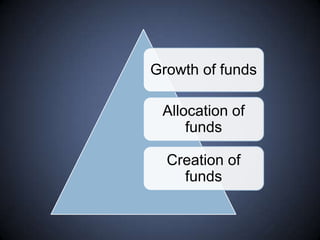
Growth of funds
Allocation of
funds
Creation of
funds
BUDGETING
• Planning & controlling the activities of an
organization.
• Financial plans for the objectives during the period
covered by budget
• Predicted on the base of historical data otherwise
market or assumptions.
Budgeting methods-
1.Incremental-last year figures are used as the basis
for new budget.
2.Zero base-starts with a blank piece of paper-zero
base. Every expense has to be evaluated & decided
if it should be made, as well as what the cost should
be.
Budgeting process-
• Sales and marketing budget
• Production budget
• Administrative budget
• Investment budget
ACCOUNTING
• Defining the cost elements
• Cost element structure should be compatible with the
methods adopted by business
• How the organization will spend the money
• Amount for particular activities
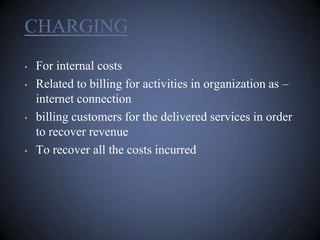
CHARGING
• For internal costs
• Related to billing for activities in organization as –
internet connection
• billing customers for the delivered services in order
to recover revenue
• To recover all the costs incurred
Charging policy-
• Communication of information
• Pricing flexibility
• Notional charging
Rates-(Setting of Rates)
• Determining market rates
• Analyzing demand for services
• Analyzing number of customers and the
competition
• Determining direct & indirect costs
REPORTING
Costs are addressed in the regular meetings with
the customer under the SLM . Hence , SLM is
provided with-
• IT services expenditure per customer.
• Charging & accounting methods used.
• Difference between estimated & actual charges.
• Charging disputes with causes & solutions.
THANK YOU

Financial management activities

  • 1.
    By- Ashish Agrawal Shri RamMurti Smarak College Of Engineering & Technology,Bareilly, INDIA
  • 2.
    FINANCIAL MGMT. • Ajudicious use of capital & a careful selection of sources of capital , in order to enable a spending unit to move in the direction of reaching its goals. • Cost benefit analysis to achieve best quality. • Ensures optimum fund utilization
  • 3.
    Growth of funds Allocationof funds Creation of funds
  • 4.
    BUDGETING • Planning &controlling the activities of an organization. • Financial plans for the objectives during the period covered by budget • Predicted on the base of historical data otherwise market or assumptions.
  • 5.
    Budgeting methods- 1.Incremental-last yearfigures are used as the basis for new budget. 2.Zero base-starts with a blank piece of paper-zero base. Every expense has to be evaluated & decided if it should be made, as well as what the cost should be.
  • 6.
    Budgeting process- • Salesand marketing budget • Production budget • Administrative budget • Investment budget
  • 7.
    ACCOUNTING • Defining thecost elements • Cost element structure should be compatible with the methods adopted by business • How the organization will spend the money • Amount for particular activities
  • 8.
    CHARGING • For internalcosts • Related to billing for activities in organization as – internet connection • billing customers for the delivered services in order to recover revenue • To recover all the costs incurred
  • 9.
    Charging policy- • Communicationof information • Pricing flexibility • Notional charging
  • 10.
    Rates-(Setting of Rates) •Determining market rates • Analyzing demand for services • Analyzing number of customers and the competition • Determining direct & indirect costs
  • 11.
    REPORTING Costs are addressedin the regular meetings with the customer under the SLM . Hence , SLM is provided with- • IT services expenditure per customer. • Charging & accounting methods used. • Difference between estimated & actual charges. • Charging disputes with causes & solutions.
  • 12.