Accounting for Corporations
Mrs. Paz Castro
Corporation
•
An artificial being created by
operation of law, having the right
of succession and the powers,
attributes and properties
expressly authorized by law or
incident of its existence (The
Corporation Code of the
Philippines, Sec. 2).
•
One way in corporations raise new
capital is by issuing stock.
–
Equity financing – the method of
obtaining funds by issuing ordinary or
preference shares – is less risky than
debt financing – issuance of bonds,
notes or mortgage, because
dividends on ordinary shares are not
paid unless declared by the board of
directors.
–
When a company does not declare
cash dividends, the cash from
profitable operating activities may be
invested to finance expanded
operations.
–
A corporation may need the proceeds
from an ordinary share issue to
improve the balance between
liabilities and shareholders’ equity.
Attributes of a corporation
•
A corporation is an artificial being
with a personality separate and
apart from its individual
shareholders and members.
•
It is created by operation of law. It
cannot come into existence by
mere agreement of the parties as
in the case of business
partnerships. Corporations
require special authority or grant
from the State, either by a special
incorporation law that directly
creates the corporation or by
means of a general corporation
law.
•
It enjoys the right to succession.
A corporation has the capacity of
continued existence subject to the
period stated in the Articles of
Incorporation. The death,
withdrawal, insolvency or
incapacity of the individual
shareholders or members will not
dissolve the corporation. The
transfer of ownership of shares of
stock does not dissolve the
partnership.
•
It has the power, attributes and
properties expressly authorized
by law or incident to its existence.
•
Ownership of a corporation is
divided into shares.
Proprietorship in a corporation is
divided into units known as
shares of stocks.
•
Management of the business is
vested in a board of directors
(BOD) elected by the
stockholders. The BOD is the
governing body or decision-
making body of the corporation.
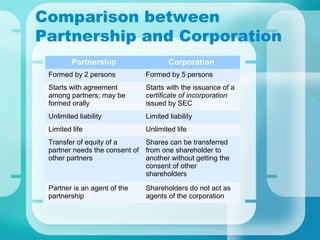
Comparison between
Partnership and Corporation
Partnership Corporation
Formed by 2 persons Formed by 5 persons
Starts with agreement
among partners; may be
formed orally
Starts with the issuance of a
certificate of incorporation
issued by SEC
Unlimited liability Limited liability
Limited life Unlimited life
Transfer of equity of a
partner needs the consent of
other partners
Shares can be transferred
from one shareholder to
another without getting the
consent of other
shareholders
Partner is an agent of the
partnership
Shareholders do not act as
agents of the corporation
Advantages of a corporation
•
The corporation has the legal
capacity to act as a legal entity.
•
Shareholders have limited liability.
•
It has the continuity of existence.
•
Shares of stock can be transferred
without the consent of the other
shareholders.
•
Its management is centralized in
the board of directors.
•
Shareholders are not general
agent of the business.
•
Greater ability to acquire funds.
Disadvantages of a
corporation
•
A corporation is relatively
complicated in formation and
management.
•
The greater degree of government
control and supervision.
•
It requires a relatively high cost of
formation and operation.
•
It is subject to heavier taxation
than other forms of business
organizations.
•
Minority shareholders are
subservient to the wishes of the
majority.
•
In large corporations,
management and control have
been separate from ownership.
•
Transferability of shares permits
the uniting of incompatible and
conflicting elements in one
venture.
Classes of corporations
Section 3 of the Corporation Code
classified private corporations
into:
•
Stock corporation. Corporations
which have share capital divided
into shares and are authorized to
distribute to the holders of such
shares dividends or allotments of
the surplus profits on the basis of
the shares held
•
Non-stock corporation. A non-
stock corporation is one where no
part of its income is distributable
as dividends to its members,
trustees or officers. Any profit that
a non-stock corporation may
obtain as an incident to its
operation shall, whenever
necessary or proper, be used for
the furtherance of the purpose/s
for which the corporation was
organized (The Corporation Code
of the Philippines, Sec. 87).
–
Non-stock corporations may be
formed or organized for charitable,
religious, educational, professional,
cultural, recreational, fraternal,
literary, scientific, social, civil service,
or similar purposes (Sec. 88).
Other classifications of
corporations
•
According to number of persons:
–
Corporation aggregate – consisting of
more than one corporator.
–
Corporation sole or a special form of
corporation usually associated with
the clergy – consists of only one
member or corporator and this
successors such as a bishop.
•
According to nationality:
–
Domestic corporation – organized
under Philippine laws.
–
Foreign corporation – organized
under foreign laws.
•
According to whether for public or
private purpose:
–
Public corporation – formed for the
government of a portion of the state
–
Private corporation – created for
private aim, benefit or purpose
•
According to whether for
charitable purpose or not:
–
Ecclesiastical corporation – organized
for religious purposes
–
Eleemosynary corporation –
established for public charity
–
Civil corporation – established for
business or profit
•
According to their legal right to
corporate existence:
–
De jure corporation – existing in fact
and in law.
–
De facto corporation – existing in fact
but not in law.
•
According to degree of public
participation with regard to their
share ownership:
–
Close corporation – share ownership
is limited to selected persons or
member of a family not exceeding 20
persons.
–
Open corporation – the share is
available for subscription or purchase
by any person.
•
According to their relation to
another corporation:
–
Parent or holding corporation – a
corporation that is related to another
corporation that it has the power to
either directly or indirectly elect the
majority of the directors of a
subsidiary corporation.
–
Subsidiary corporation – a
corporation controlled by another
corporation known as a parent
corporation.
Steps in the creation of a
corporation
•
Promotion – It is the process of
bringing together the
incorporators or the persons
interested in the business, of
procuring subscriptions or capital
for the corporation and of setting
in motion the machinery that leads
to the incorporation of the
corporation itself.
–
At least 25% of the authorized share
capital must be subscribed.
–
At least 25% of total subscriptions
must be paid.
–
Filing of the articles of incorporation
with the SEC together with treasurer’s
affidavit, statement of financial
position, certificate of bank deposit,
and certificate as to the name of the
corporation.
–
Payment of the filing and publication
fees; and
–
Issuance by the SEC of the certificate
of incorporation
•
Formal organization and
commencement of business
operations
–
Formal organization requires the
adoption of by-laws and the election
of the board of directors and of the
administrative officers.
•
Incorporation
–
Verification from the records of the
Securities and Exchange Commission
(SEC) that the proposed corporate
name is not the same or similar to an
existing corporation.
–
Drafting and execution of the articles
of incorporation by the incorporators.
The person elected as temporary
treasurer should execute an affidavit
regarding the share capital
subscribed and paid up. The treasurer
should submit a sworn statement of
assets and liabilities of the
corporation.
–
Deposit by the treasurer of the cash
paid for the shares subscribed in the
bank in the name of the treasurer in
trust for and to the credit of the
corporation. The bank is required to
issue a certificate of deposit.
–
It also includes the taking of such
other steps as are necessary to
enable the corporation to transact the
legitimate business or accomplish the
purpose for which it was created.
–
Sec. 22 of the Corporation Code
states that if a corporation does not
formally organize and commence the
transaction of its business within 2
years from the date of its
incorporation, its corporate powers
shall cease and the corporation shall
be deemed dissolved.
–
If a corporation has commenced
business but subsequently becomes
continuously inoperative for a period
of at least 5 years, the same shall be a
ground for the suspension or
revocation of its certificate of
incorporation.
Articles of incorporation
•
In the Philippines, the general law
which governs the creation of
private corporations is the
Corporation Code of the
Philippines. Sec. 14 provides that
all corporations organized under
this Code shall file with the SEC
articles of incorporation in any of
the official languages duly signed
and acknowledged by all of the
incorporators, containing
substantially the following matters
except as otherwise prescribed by
this Code or by special law:
–
The name of the corporation;
–
The specific purpose/s for which the
corporation is formed;
–
The principal place of business which
must be within the Philippines;
–
The term of existence;
–
The names, nationalities and
residences of the incorporators;
–
The number of directors or trustees,
which shall not be less than 5 nor
more than 15;
–
The names, nationalities and
residences of the persons who shall
act as directors or trustees until the
first regular directors or trustees are
elected and qualified.
–
if it be a stock corporation:
•
Amount of authorized share capital in
pesos,
•
Number of shares into which it is divided,
•
In case the shares are par value shares:
–
The par value of each share,
–
Names, nationalities and residences of the
original subscribers,
–
The amount subscribed and paid by each
subscriber on his subscription.
•
In case of no par value, the articles need
only state such fact, and the number of
shares into which said share capital is
divided.
–
If it be a non-stock corporation, the
amount of its capital, the names,
nationalities and residences of the
contributors and the amount
contributed.
By-laws
•
The rules of action adopted by the
corporation for its internal
government and for the
government of its officers,
shareholders or members.
•
The by-laws shall be adopted
within 1 month from the issuance
of the certificate of incorporation
by the SEC.
•
Failure to file a code of by-laws
shall render the corporation liable
for the revocation of its
registration.
•
A private corporation may provide
in its by-laws for:
–
The time, place and manner of calling
and conducting regular or special
meetings of the directors or trustees;
–
The time and manner of calling and
conducting regular or special
meetings of the shareholders or
members;
–
The required quorum in meetings of
shareholders or members and the
manner of voting therein;
–
The form for proxies of shareholders
and members and manner of voting
them;
–
The qualifications, duties and
compensation of directors or
trustees, officers and employees;
–
The time for holding the annual
election of directors or trustees and
the mode or manner of giving notice
thereof;
–
The manner of election or
appointment and the term of office of
all officers other than directors or
trustees;
–
The penalties for violation of the by-
laws;
–
In the case of stock corporation, the
manner of issuing stock certificates;
–
Such other matters as may be
necessary for the proper or
convenient transaction of its
corporate business and affairs.
Rights of a shareholder
•
Right to be issued certificate of
stock or other evidence of share
ownership and to transfer such
shares.
•
Right to attend and vote in person
or by proxy at shareholders’
meetings.
•
Right to elect and remove
directors.
•
Right to adopt, amend or repeal
the by-laws.
•
Right to purchase a portion of any
new shares issued to maintain the
same percentage of stock
percentage.
This is known as the pre-emptive
right. However, this right is not
absolute and may be denied.
•
Right to receive dividends when
declared.
•
Right to inspect corporate books
and records, and to receive
financial reports of the
corporation’s operations.
•
Right to participate in the
distribution of corporate assets
upon dissolution.
•
Incorporators are shareholders or
members mentioned in the articles
of incorporation as originally
forming and composing the
corporation and are signatories to
said articles of incorporation (Sec.
5). They must be natural persons
as distinguished from artificial
beings. An incorporator will
always retain his status as such
though no longer having an
interest in the corporation.
Components of a corporation
•
Corporators are those who
compose a corporation whether
as shareholders or members, at
any time. This term includes
incorporators, shareholders or
members (Sec. 5). Note: A
corporation or a partnership can
be a corporator, but cannot be an
incorporator. A partnership can be
a corporator in a corporation but a
corporation cannot be a general
partner in a partnership.
The Code specifies that 5 or more
persons, not exceeding 15, may
form a private corporation
provided that they are of legal age,
owners or subscribers to at least 1
share of capital stock and that the
majority are residents of the
Philippines. Note: all
incorporators are corporators of a
corporation, but not all
corporators are incorporators.
•
Shareholders or stockholders are
corporators in a stock corporation
(Sec. 5). Shareholders may be
natural or juridical persons.
•
Members are corporators of a
non-stock corporation (Sec. 5).
•
Subscribers are persons who
have agreed to take and pay for
original, unissued shares of a
corporation formed or to be
formed. Note: All incorporators
are subscribers but a subscriber
need not be an incorporator.
•
Promoters are persons who bring
about or cause to bring about the
formation and organization of a
corporation.
•
Underwriters are usually
investment bankers who have:
–
Agreed, alone or with others, to buy at
stated terms an entire or a substantial
part of an issue of securities; or
–
Guaranteed the sale of an issue by
agreement to buy from the issuing
corporation any unsold portion at a
stated price; or
–
Agreed to use his best efforts to
market all or part of an issue; or
–
Offered for sale shares he has
purchased from a controlling
stockholder.
Classes of shares in general
•
Par value shares. One in which a
specific amount is fixed in the
articles of incorporation and
appearing on the certificate of
stock. The par value is the
minimum issue price of the share.
–
Section 6 of the Code states that
preference (or preferred) shares of
stock may be issued only as par value
shares
•
However, the minimum stated
value of a no-par value share is 5
pesos (P5.00) per share (Sec. 6). In
addition, shares issued without
par value are deemed fully paid.
Banks, trust companies,
insurance companies. Public
utilities, and building and loan
associations are not permitted to
issue no-par value shares of
stock.
•
No-par value shares. One without
any value appearing on the face of
the certificate of stock. A no-par
value share may have a stated
value which may be fixed in the
articles of incorporation or by the
board of directors or the
shareholders. Thus, the issue
price may vary from time to time
as it is usually fixed based on the
book value of the corporation’s
shares.
•
Voting shares. Those issued with
the right to vote.
•
Non-voting shares. Those issued
without the right to vote.
•
Ordinary shares. These shares
entitle the holder to an equal pro-
rata division of profits without any
preference.
•
Preference shares. These shares
entitle the holder to certain
advantages or benefits over the
holders of ordinary shares.
•
Promotion shares. Those issued
to promoters as compensation in
promoting the incorporation of a
corporation, or for services
rendered in launching or
promoting the welfare of the
corporation.
•
Treasury shares. A stock that has
been issued by the corporation as
fully paid and later reacquired but
not retired.
•
Convertible shares. A stock which
is convertible or changeable from
one class to another class.
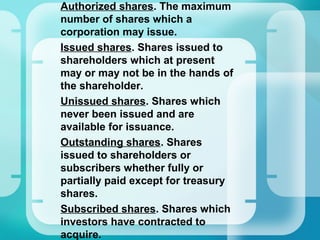
•
Authorized shares. The maximum
number of shares which a
corporation may issue.
•
Issued shares. Shares issued to
shareholders which at present
may or may not be in the hands of
the shareholder.
•
Unissued shares. Shares which
never been issued and are
available for issuance.
•
Outstanding shares. Shares
issued to shareholders or
subscribers whether fully or
partially paid except for treasury
shares.
•
Subscribed shares. Shares which
investors have contracted to
acquire.
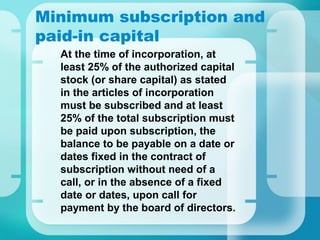
Minimum subscription and
paid-in capital
•
At the time of incorporation, at
least 25% of the authorized capital
stock (or share capital) as stated
in the articles of incorporation
must be subscribed and at least
25% of the total subscription must
be paid upon subscription, the
balance to be payable on a date or
dates fixed in the contract of
subscription without need of a
call, or in the absence of a fixed
date or dates, upon call for
payment by the board of directors.
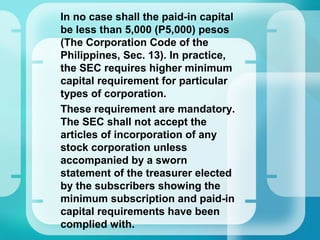
•
In no case shall the paid-in capital
be less than 5,000 (P5,000) pesos
(The Corporation Code of the
Philippines, Sec. 13). In practice,
the SEC requires higher minimum
capital requirement for particular
types of corporation.
•
These requirement are mandatory.
The SEC shall not accept the
articles of incorporation of any
stock corporation unless
accompanied by a sworn
statement of the treasurer elected
by the subscribers showing the
minimum subscription and paid-in
capital requirements have been
complied with.
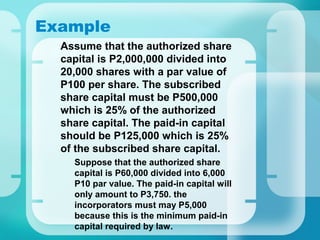
Example
•
Assume that the authorized share
capital is P2,000,000 divided into
20,000 shares with a par value of
P100 per share. The subscribed
share capital must be P500,000
which is 25% of the authorized
share capital. The paid-in capital
should be P125,000 which is 25%
of the subscribed share capital.
–
Suppose that the authorized share
capital is P60,000 divided into 6,000
P10 par value. The paid-in capital will
only amount to P3,750. the
incorporators must may P5,000
because this is the minimum paid-in
capital required by law.
–
In case of no-par value shares, the
25% requirement will be based on the
authorized number of shares. If the
authorized capital is pegged at 2,000
no-par value shares, then at least 500
no-par value shares must be
subscribed.
Basic corporate
organizational structure
•
The ultimate control of the
corporation rests with the
shareholders. They are the owners
of the corporation. The
shareholders elect the members
of the board of directors.
•
The board of directors is
responsible for the formulation of
the overall policies for the
corporation and for the exercise of
corporate powers. The board also
elects a chairman of the board.
•
The president must be a director
of the corporation, but he cannot
act as president and secretary or
as president and treasurer at the
same time. The president is the
only officer required by law to be a
director.
•
The corporate secretary must be a
resident and a citizen of the
Philippines. He need not be a
director unless required by the
corporate by-laws. It is his duty to
make and keep its records and to
make proper entries of the votes,
resolutions and proceedings of
the shareholders and directors in
the management of the
corporation.
•
The corporate treasurer is the
officer entrusted with the authority
to receive and keep the money of
the corporation and to disburse
them as he may be authorized. He
may or may not be a director.
•
There is no prohibition in the law
against a shareholder being a
director or officer of two or more
corporations. The Corporation
Code does not prohibit a
corporate officer from occupying
the same position in another
corporation organized for the
same purpose. However, such
situation may be prohibited by
special law, the articles of
incorporation or the by-laws.
•
The designation of the
professional management team or
the administrative officers is
entrusted to the board. These
officers implement the policies of
the board of directors and actively
manage the day-to-day affairs of
the corporation.
•
Annually, a corporation holds the
shareholders’ meeting during
which the shareholders elect their
directors and make other
decisions.
•
Subscription book. It is a book of
printed blank subscription.
•
Shareholders’ ledger. It is a ledger
which details the number of
shares issued to each
shareholder.
•
Subscribers’ ledger. It is a
subsidiary ledger for the
subscriptions receivable account;
it reports the individual
subscriptions of the subscribers.
•
Stock certificate book. It is a book
of printed blank certificates of
stock.
Seatwork 5 (True or False)
•
All incorporators are shareholders
but not all shareholders are
incorporators.
•
A corporation, like a partnership,
may be formed by the mere
agreement of 5 or more persons.
•
The authorized shares represent
the maximum number of shares
that a corporation may issue.
•
Unissued shares represent the
number of shares that may still be
subscribed.
•
It is legal to issue share capital at
par or at more than par but not at
less than par.
•
Share capital that has been sold
and issued to a shareholder is
called an outstanding share
capital.
•
The owners of a stock corporation
are called shareholders; the
owners of a non-stock corporation
are called members.
•
When a partnership is
incorporated, a new set of books
should always be opened for the
new corporation.
•
A stock certificate is issued to the
subscriber upon full payment of
his subscription.
•
Both the partnership’s owners and
a corporation’s owners have
limited liability for business debts.
Homework 5
•
A, B and C are partners operating a small
store for 2 years. The partners are
considering the possible incorporation of
the partnership. What are the advantages
and disadvantages offered by such a
change?
•
Differentiate: (a) stock from non-stock
corporation, (b) private from public
corporation, (c) de jure from de facto
corporation.
•
What are the basic right of a shareholder
or stockholder?
•
What are the considerations that may be
received in exchange for share capital or
capital stock? What is the basis for
measurement of such exchanges?
•
Differentiate an ordinary share capital
from a preference share capital.
•
When does a share capital become
outstanding?
•
The DEF Corporation was organized on
Oct. 1, 2009 with authorized ordinary
share capital of 1,000 shares, P5 par
value.
–
How many shares must be subscribed at the
time of incorporation?
–
Assuming that the minimum required
subscription was received at P8, how much
subscription must be paid up?
•
What are the steps to be followed in
incorporating a partnership?
Corporate books and records
•
Minutes book. It contains the
minutes of the meetings of the
directors and shareholders.
•
Stock and transfer book. It is the
record of the names of
shareholders installments paid
and unpaid by shareholders and
dates of payment, any transfer of
stock and dates thereof, by whom
and to whom made.
•
Books of accounts. These
represent the record of all
business transactions. These
normally include the journal and
the ledger.

Accounting for corporations

  • 1.
  • 2.
    Corporation • An artificial beingcreated by operation of law, having the right of succession and the powers, attributes and properties expressly authorized by law or incident of its existence (The Corporation Code of the Philippines, Sec. 2). • One way in corporations raise new capital is by issuing stock.
  • 3.
    – Equity financing –the method of obtaining funds by issuing ordinary or preference shares – is less risky than debt financing – issuance of bonds, notes or mortgage, because dividends on ordinary shares are not paid unless declared by the board of directors. – When a company does not declare cash dividends, the cash from profitable operating activities may be invested to finance expanded operations. – A corporation may need the proceeds from an ordinary share issue to improve the balance between liabilities and shareholders’ equity.
  • 4.
    Attributes of acorporation • A corporation is an artificial being with a personality separate and apart from its individual shareholders and members. • It is created by operation of law. It cannot come into existence by mere agreement of the parties as in the case of business partnerships. Corporations require special authority or grant from the State, either by a special incorporation law that directly creates the corporation or by means of a general corporation law.
  • 5.
    • It enjoys theright to succession. A corporation has the capacity of continued existence subject to the period stated in the Articles of Incorporation. The death, withdrawal, insolvency or incapacity of the individual shareholders or members will not dissolve the corporation. The transfer of ownership of shares of stock does not dissolve the partnership. • It has the power, attributes and properties expressly authorized by law or incident to its existence.
  • 6.
    • Ownership of acorporation is divided into shares. Proprietorship in a corporation is divided into units known as shares of stocks. • Management of the business is vested in a board of directors (BOD) elected by the stockholders. The BOD is the governing body or decision- making body of the corporation.
  • 7.
    Comparison between Partnership andCorporation Partnership Corporation Formed by 2 persons Formed by 5 persons Starts with agreement among partners; may be formed orally Starts with the issuance of a certificate of incorporation issued by SEC Unlimited liability Limited liability Limited life Unlimited life Transfer of equity of a partner needs the consent of other partners Shares can be transferred from one shareholder to another without getting the consent of other shareholders Partner is an agent of the partnership Shareholders do not act as agents of the corporation
  • 8.
    Advantages of acorporation • The corporation has the legal capacity to act as a legal entity. • Shareholders have limited liability. • It has the continuity of existence. • Shares of stock can be transferred without the consent of the other shareholders. • Its management is centralized in the board of directors. • Shareholders are not general agent of the business. • Greater ability to acquire funds.
  • 9.
    Disadvantages of a corporation • Acorporation is relatively complicated in formation and management. • The greater degree of government control and supervision. • It requires a relatively high cost of formation and operation. • It is subject to heavier taxation than other forms of business organizations. • Minority shareholders are subservient to the wishes of the majority.
  • 10.
    • In large corporations, managementand control have been separate from ownership. • Transferability of shares permits the uniting of incompatible and conflicting elements in one venture.
  • 11.
    Classes of corporations Section3 of the Corporation Code classified private corporations into: • Stock corporation. Corporations which have share capital divided into shares and are authorized to distribute to the holders of such shares dividends or allotments of the surplus profits on the basis of the shares held
  • 12.
    • Non-stock corporation. Anon- stock corporation is one where no part of its income is distributable as dividends to its members, trustees or officers. Any profit that a non-stock corporation may obtain as an incident to its operation shall, whenever necessary or proper, be used for the furtherance of the purpose/s for which the corporation was organized (The Corporation Code of the Philippines, Sec. 87).
  • 13.
    – Non-stock corporations maybe formed or organized for charitable, religious, educational, professional, cultural, recreational, fraternal, literary, scientific, social, civil service, or similar purposes (Sec. 88).
  • 14.
    Other classifications of corporations • Accordingto number of persons: – Corporation aggregate – consisting of more than one corporator. – Corporation sole or a special form of corporation usually associated with the clergy – consists of only one member or corporator and this successors such as a bishop. • According to nationality: – Domestic corporation – organized under Philippine laws. – Foreign corporation – organized under foreign laws.
  • 15.
    • According to whetherfor public or private purpose: – Public corporation – formed for the government of a portion of the state – Private corporation – created for private aim, benefit or purpose • According to whether for charitable purpose or not: – Ecclesiastical corporation – organized for religious purposes – Eleemosynary corporation – established for public charity – Civil corporation – established for business or profit
  • 16.
    • According to theirlegal right to corporate existence: – De jure corporation – existing in fact and in law. – De facto corporation – existing in fact but not in law. • According to degree of public participation with regard to their share ownership: – Close corporation – share ownership is limited to selected persons or member of a family not exceeding 20 persons.
  • 17.
    – Open corporation –the share is available for subscription or purchase by any person. • According to their relation to another corporation: – Parent or holding corporation – a corporation that is related to another corporation that it has the power to either directly or indirectly elect the majority of the directors of a subsidiary corporation. – Subsidiary corporation – a corporation controlled by another corporation known as a parent corporation.
  • 18.
    Steps in thecreation of a corporation • Promotion – It is the process of bringing together the incorporators or the persons interested in the business, of procuring subscriptions or capital for the corporation and of setting in motion the machinery that leads to the incorporation of the corporation itself. – At least 25% of the authorized share capital must be subscribed. – At least 25% of total subscriptions must be paid.
  • 19.
    – Filing of thearticles of incorporation with the SEC together with treasurer’s affidavit, statement of financial position, certificate of bank deposit, and certificate as to the name of the corporation. – Payment of the filing and publication fees; and – Issuance by the SEC of the certificate of incorporation • Formal organization and commencement of business operations – Formal organization requires the adoption of by-laws and the election of the board of directors and of the administrative officers.
  • 20.
    • Incorporation – Verification from therecords of the Securities and Exchange Commission (SEC) that the proposed corporate name is not the same or similar to an existing corporation. – Drafting and execution of the articles of incorporation by the incorporators. The person elected as temporary treasurer should execute an affidavit regarding the share capital subscribed and paid up. The treasurer should submit a sworn statement of assets and liabilities of the corporation. – Deposit by the treasurer of the cash paid for the shares subscribed in the bank in the name of the treasurer in trust for and to the credit of the corporation. The bank is required to issue a certificate of deposit.
  • 21.
    – It also includesthe taking of such other steps as are necessary to enable the corporation to transact the legitimate business or accomplish the purpose for which it was created. – Sec. 22 of the Corporation Code states that if a corporation does not formally organize and commence the transaction of its business within 2 years from the date of its incorporation, its corporate powers shall cease and the corporation shall be deemed dissolved. – If a corporation has commenced business but subsequently becomes continuously inoperative for a period of at least 5 years, the same shall be a ground for the suspension or revocation of its certificate of incorporation.
  • 22.
    Articles of incorporation • Inthe Philippines, the general law which governs the creation of private corporations is the Corporation Code of the Philippines. Sec. 14 provides that all corporations organized under this Code shall file with the SEC articles of incorporation in any of the official languages duly signed and acknowledged by all of the incorporators, containing substantially the following matters except as otherwise prescribed by this Code or by special law:
  • 23.
    – The name ofthe corporation; – The specific purpose/s for which the corporation is formed; – The principal place of business which must be within the Philippines; – The term of existence; – The names, nationalities and residences of the incorporators; – The number of directors or trustees, which shall not be less than 5 nor more than 15; – The names, nationalities and residences of the persons who shall act as directors or trustees until the first regular directors or trustees are elected and qualified.
  • 24.
    – if it bea stock corporation: • Amount of authorized share capital in pesos, • Number of shares into which it is divided, • In case the shares are par value shares: – The par value of each share, – Names, nationalities and residences of the original subscribers, – The amount subscribed and paid by each subscriber on his subscription. • In case of no par value, the articles need only state such fact, and the number of shares into which said share capital is divided. – If it be a non-stock corporation, the amount of its capital, the names, nationalities and residences of the contributors and the amount contributed.
  • 25.
    By-laws • The rules ofaction adopted by the corporation for its internal government and for the government of its officers, shareholders or members. • The by-laws shall be adopted within 1 month from the issuance of the certificate of incorporation by the SEC. • Failure to file a code of by-laws shall render the corporation liable for the revocation of its registration.
  • 26.
    • A private corporationmay provide in its by-laws for: – The time, place and manner of calling and conducting regular or special meetings of the directors or trustees; – The time and manner of calling and conducting regular or special meetings of the shareholders or members; – The required quorum in meetings of shareholders or members and the manner of voting therein; – The form for proxies of shareholders and members and manner of voting them;
  • 27.
    – The qualifications, dutiesand compensation of directors or trustees, officers and employees; – The time for holding the annual election of directors or trustees and the mode or manner of giving notice thereof; – The manner of election or appointment and the term of office of all officers other than directors or trustees; – The penalties for violation of the by- laws; – In the case of stock corporation, the manner of issuing stock certificates; – Such other matters as may be necessary for the proper or convenient transaction of its corporate business and affairs.
  • 28.
    Rights of ashareholder • Right to be issued certificate of stock or other evidence of share ownership and to transfer such shares. • Right to attend and vote in person or by proxy at shareholders’ meetings. • Right to elect and remove directors. • Right to adopt, amend or repeal the by-laws. • Right to purchase a portion of any new shares issued to maintain the same percentage of stock percentage.
  • 29.
    This is knownas the pre-emptive right. However, this right is not absolute and may be denied. • Right to receive dividends when declared. • Right to inspect corporate books and records, and to receive financial reports of the corporation’s operations. • Right to participate in the distribution of corporate assets upon dissolution.
  • 30.
    • Incorporators are shareholdersor members mentioned in the articles of incorporation as originally forming and composing the corporation and are signatories to said articles of incorporation (Sec. 5). They must be natural persons as distinguished from artificial beings. An incorporator will always retain his status as such though no longer having an interest in the corporation.
  • 31.
    Components of acorporation • Corporators are those who compose a corporation whether as shareholders or members, at any time. This term includes incorporators, shareholders or members (Sec. 5). Note: A corporation or a partnership can be a corporator, but cannot be an incorporator. A partnership can be a corporator in a corporation but a corporation cannot be a general partner in a partnership.
  • 32.
    The Code specifiesthat 5 or more persons, not exceeding 15, may form a private corporation provided that they are of legal age, owners or subscribers to at least 1 share of capital stock and that the majority are residents of the Philippines. Note: all incorporators are corporators of a corporation, but not all corporators are incorporators. • Shareholders or stockholders are corporators in a stock corporation (Sec. 5). Shareholders may be natural or juridical persons.
  • 33.
    • Members are corporatorsof a non-stock corporation (Sec. 5). • Subscribers are persons who have agreed to take and pay for original, unissued shares of a corporation formed or to be formed. Note: All incorporators are subscribers but a subscriber need not be an incorporator. • Promoters are persons who bring about or cause to bring about the formation and organization of a corporation.
  • 34.
    • Underwriters are usually investmentbankers who have: – Agreed, alone or with others, to buy at stated terms an entire or a substantial part of an issue of securities; or – Guaranteed the sale of an issue by agreement to buy from the issuing corporation any unsold portion at a stated price; or – Agreed to use his best efforts to market all or part of an issue; or – Offered for sale shares he has purchased from a controlling stockholder.
  • 35.
    Classes of sharesin general • Par value shares. One in which a specific amount is fixed in the articles of incorporation and appearing on the certificate of stock. The par value is the minimum issue price of the share. – Section 6 of the Code states that preference (or preferred) shares of stock may be issued only as par value shares
  • 36.
    • However, the minimumstated value of a no-par value share is 5 pesos (P5.00) per share (Sec. 6). In addition, shares issued without par value are deemed fully paid. Banks, trust companies, insurance companies. Public utilities, and building and loan associations are not permitted to issue no-par value shares of stock.
  • 37.
    • No-par value shares.One without any value appearing on the face of the certificate of stock. A no-par value share may have a stated value which may be fixed in the articles of incorporation or by the board of directors or the shareholders. Thus, the issue price may vary from time to time as it is usually fixed based on the book value of the corporation’s shares.
  • 38.
    • Voting shares. Thoseissued with the right to vote. • Non-voting shares. Those issued without the right to vote. • Ordinary shares. These shares entitle the holder to an equal pro- rata division of profits without any preference. • Preference shares. These shares entitle the holder to certain advantages or benefits over the holders of ordinary shares.
  • 39.
    • Promotion shares. Thoseissued to promoters as compensation in promoting the incorporation of a corporation, or for services rendered in launching or promoting the welfare of the corporation. • Treasury shares. A stock that has been issued by the corporation as fully paid and later reacquired but not retired. • Convertible shares. A stock which is convertible or changeable from one class to another class.
  • 40.
    • Authorized shares. Themaximum number of shares which a corporation may issue. • Issued shares. Shares issued to shareholders which at present may or may not be in the hands of the shareholder. • Unissued shares. Shares which never been issued and are available for issuance. • Outstanding shares. Shares issued to shareholders or subscribers whether fully or partially paid except for treasury shares. • Subscribed shares. Shares which investors have contracted to acquire.
  • 41.
    Minimum subscription and paid-incapital • At the time of incorporation, at least 25% of the authorized capital stock (or share capital) as stated in the articles of incorporation must be subscribed and at least 25% of the total subscription must be paid upon subscription, the balance to be payable on a date or dates fixed in the contract of subscription without need of a call, or in the absence of a fixed date or dates, upon call for payment by the board of directors.
  • 42.
    • In no caseshall the paid-in capital be less than 5,000 (P5,000) pesos (The Corporation Code of the Philippines, Sec. 13). In practice, the SEC requires higher minimum capital requirement for particular types of corporation. • These requirement are mandatory. The SEC shall not accept the articles of incorporation of any stock corporation unless accompanied by a sworn statement of the treasurer elected by the subscribers showing the minimum subscription and paid-in capital requirements have been complied with.
  • 43.
    Example • Assume that theauthorized share capital is P2,000,000 divided into 20,000 shares with a par value of P100 per share. The subscribed share capital must be P500,000 which is 25% of the authorized share capital. The paid-in capital should be P125,000 which is 25% of the subscribed share capital. – Suppose that the authorized share capital is P60,000 divided into 6,000 P10 par value. The paid-in capital will only amount to P3,750. the incorporators must may P5,000 because this is the minimum paid-in capital required by law.
  • 44.
    – In case ofno-par value shares, the 25% requirement will be based on the authorized number of shares. If the authorized capital is pegged at 2,000 no-par value shares, then at least 500 no-par value shares must be subscribed.
  • 45.
    Basic corporate organizational structure • Theultimate control of the corporation rests with the shareholders. They are the owners of the corporation. The shareholders elect the members of the board of directors. • The board of directors is responsible for the formulation of the overall policies for the corporation and for the exercise of corporate powers. The board also elects a chairman of the board.
  • 46.
    • The president mustbe a director of the corporation, but he cannot act as president and secretary or as president and treasurer at the same time. The president is the only officer required by law to be a director. • The corporate secretary must be a resident and a citizen of the Philippines. He need not be a director unless required by the corporate by-laws. It is his duty to make and keep its records and to make proper entries of the votes, resolutions and proceedings of the shareholders and directors in the management of the corporation.
  • 47.
    • The corporate treasureris the officer entrusted with the authority to receive and keep the money of the corporation and to disburse them as he may be authorized. He may or may not be a director. • There is no prohibition in the law against a shareholder being a director or officer of two or more corporations. The Corporation Code does not prohibit a corporate officer from occupying the same position in another corporation organized for the same purpose. However, such situation may be prohibited by special law, the articles of incorporation or the by-laws.
  • 48.
    • The designation ofthe professional management team or the administrative officers is entrusted to the board. These officers implement the policies of the board of directors and actively manage the day-to-day affairs of the corporation. • Annually, a corporation holds the shareholders’ meeting during which the shareholders elect their directors and make other decisions.
  • 49.
    • Subscription book. Itis a book of printed blank subscription. • Shareholders’ ledger. It is a ledger which details the number of shares issued to each shareholder. • Subscribers’ ledger. It is a subsidiary ledger for the subscriptions receivable account; it reports the individual subscriptions of the subscribers. • Stock certificate book. It is a book of printed blank certificates of stock.
  • 50.
    Seatwork 5 (Trueor False) • All incorporators are shareholders but not all shareholders are incorporators. • A corporation, like a partnership, may be formed by the mere agreement of 5 or more persons. • The authorized shares represent the maximum number of shares that a corporation may issue. • Unissued shares represent the number of shares that may still be subscribed.
  • 51.
    • It is legalto issue share capital at par or at more than par but not at less than par. • Share capital that has been sold and issued to a shareholder is called an outstanding share capital. • The owners of a stock corporation are called shareholders; the owners of a non-stock corporation are called members.
  • 52.
    • When a partnershipis incorporated, a new set of books should always be opened for the new corporation. • A stock certificate is issued to the subscriber upon full payment of his subscription. • Both the partnership’s owners and a corporation’s owners have limited liability for business debts.
  • 53.
    Homework 5 • A, Band C are partners operating a small store for 2 years. The partners are considering the possible incorporation of the partnership. What are the advantages and disadvantages offered by such a change? • Differentiate: (a) stock from non-stock corporation, (b) private from public corporation, (c) de jure from de facto corporation. • What are the basic right of a shareholder or stockholder? • What are the considerations that may be received in exchange for share capital or capital stock? What is the basis for measurement of such exchanges?
  • 54.
    • Differentiate an ordinaryshare capital from a preference share capital. • When does a share capital become outstanding? • The DEF Corporation was organized on Oct. 1, 2009 with authorized ordinary share capital of 1,000 shares, P5 par value. – How many shares must be subscribed at the time of incorporation? – Assuming that the minimum required subscription was received at P8, how much subscription must be paid up? • What are the steps to be followed in incorporating a partnership?
  • 55.
    Corporate books andrecords • Minutes book. It contains the minutes of the meetings of the directors and shareholders. • Stock and transfer book. It is the record of the names of shareholders installments paid and unpaid by shareholders and dates of payment, any transfer of stock and dates thereof, by whom and to whom made. • Books of accounts. These represent the record of all business transactions. These normally include the journal and the ledger.