Learning Objectives:
At theend of this lesson, you should be able to:
1. Discuss budgeting;
2. Identify the benefits of budgeting; and
3. Explain the budgeting process
4.
The Concept ofBudgeting
● Budgeting is the process or act of preparing a
financial budget.
● Budget refers to a plan which is expressed in
quantitative monetary value (Philippine peso).
In other words, a budget is the final output of
the whole budgeting process.
5.
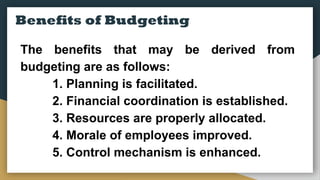
Benefits of Budgeting
Thebenefits that may be derived from
budgeting are as follows:
1. Planning is facilitated.
2. Financial coordination is established.
3. Resources are properly allocated.
4. Morale of employees improved.
5. Control mechanism is enhanced.
6.
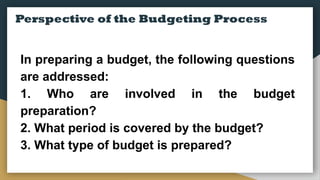
Perspective of theBudgeting Process
In preparing a budget, the following questions
are addressed:
1. Who are involved in the budget
preparation?
2. What period is covered by the budget?
3. What type of budget is prepared?
7.
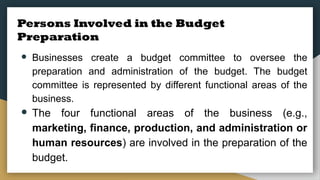
Persons Involved inthe Budget
Preparation
● Businesses create a budget committee to oversee the
preparation and administration of the budget. The budget
committee is represented by different functional areas of the
business.
● The four functional areas of the business (e.g.,
marketing, finance, production, and administration or
human resources) are involved in the preparation of the
budget.
8.
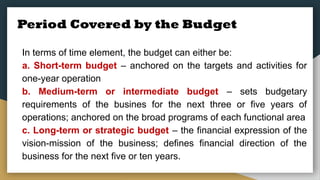
Period Covered bythe Budget
In terms of time element, the budget can either be:
a. Short-term budget – anchored on the targets and activities for
one-year operation
b. Medium-term or intermediate budget – sets budgetary
requirements of the busines for the next three or five years of
operations; anchored on the broad programs of each functional area
c. Long-term or strategic budget – the financial expression of the
vision-mission of the business; defines financial direction of the
business for the next five or ten years.
9.
Types of Budgetor Budgeting
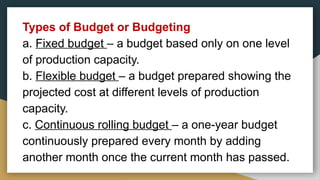
a. Fixed budget – a budget based only on one level
of production capacity.
b. Flexible budget – a budget prepared showing the
projected cost at different levels of production
capacity.
c. Continuous rolling budget – a one-year budget
continuously prepared every month by adding
another month once the current month has passed.
10.
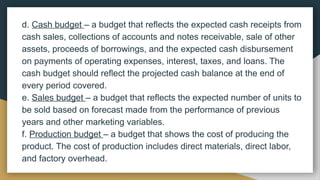
d. Cash budget– a budget that reflects the expected cash receipts from
cash sales, collections of accounts and notes receivable, sale of other
assets, proceeds of borrowings, and the expected cash disbursement
on payments of operating expenses, interest, taxes, and loans. The
cash budget should reflect the projected cash balance at the end of
every period covered.
e. Sales budget – a budget that reflects the expected number of units to
be sold based on forecast made from the performance of previous
years and other marketing variables.
f. Production budget – a budget that shows the cost of producing the
product. The cost of production includes direct materials, direct labor,
and factory overhead.
11.
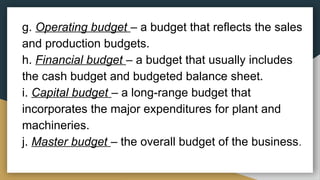
g. Operating budget– a budget that reflects the sales
and production budgets.
h. Financial budget – a budget that usually includes
the cash budget and budgeted balance sheet.
i. Capital budget – a long-range budget that
incorporates the major expenditures for plant and
machineries.
j. Master budget – the overall budget of the business.
12.
Procedure in Budgeting
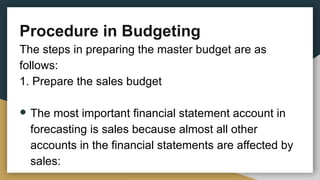
Thesteps in preparing the master budget are as
follows:
1. Prepare the sales budget
● The most important financial statement account in
forecasting is sales because almost all other
accounts in the financial statements are affected by
sales:
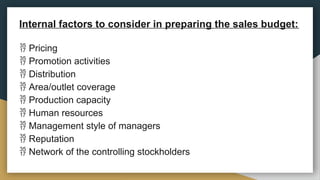
Internal factors toconsider in preparing the sales budget:
Pricing
Promotion activities
Distribution
Area/outlet coverage
Production capacity
Human resources
Management style of managers
Reputation
Network of the controlling stockholders
15.
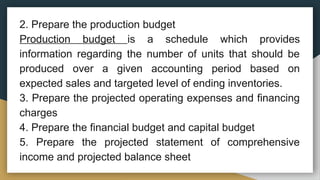
2. Prepare theproduction budget
Production budget is a schedule which provides
information regarding the number of units that should be
produced over a given accounting period based on
expected sales and targeted level of ending inventories.
3. Prepare the projected operating expenses and financing
charges
4. Prepare the financial budget and capital budget
5. Prepare the projected statement of comprehensive
income and projected balance sheet
16.
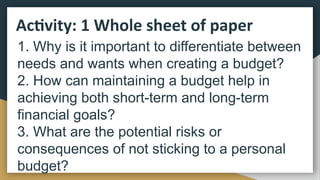
Activity: 1 Wholesheet of paper
1. Why is it important to differentiate between
needs and wants when creating a budget?
2. How can maintaining a budget help in
achieving both short-term and long-term
financial goals?
3. What are the potential risks or
consequences of not sticking to a personal
budget?