Chapter 1
Governmental and Not for profit
Accounting Environment and
Characteristics
Overview
• Governmental and NFP entities operate in an
environment different from business enterprises.
• The users of the financial reporting in government
and NFP organizations are different from business
entities.
• The financial activities in government are based on
legally adopted budget. Budget contains legal
restriction and resource provider restrictions on the
use of resources.
Overview
• As a result, both internal and accounting systems and
external financial reporting for governmental and
NFP entity users are designed to provide certain types
of data that differ from the data reported by business
enterprises.
Governmental and Not-For-Profit Organizations
1. Government Entities include the following:
• Federal Government.
• General purpose subdivision, like cities,
countries, towns.
• Special Purpose Subdivisions, such as school
district.
• Public Corporations.
Governmental and Not-For-Profit
Organizations
• Government Entities: Entities created by
governmental laws, if they have the following
characteristics:
• Their officer are popularly elected and controlled by
government body.
• They possess the power to enact and enforce a tax levy.
• Have a power to issue debts with interest exempted from
taxes.
• Faces a potential dissolve by government and assume all
assets and liabilities.
2. Not-For-Profit Organizations:
They have the following characteristics:
1. Receive contributions from recourse provider without
equivalent return.
2. Operate for purpose other than providing goods or
services for profit.
3. Lack of ownership interest. Ownership interests
different than business enterprises. No stock or dividend
transactions
Governmental and Not-For-Profit Entity
Environment:
1. Governmental and Not-For-Profit entities operate in
different legal, social, and political environment.
2. As a result, financial conditions, Accounting treatment,
and financial statement users will differ.
3. Financial reporting requirement will also differ.
4. Standard setter develop standards for governmental and
not for profit entities. Governmental Accounting Standard
Board. GASB
The Differences Between Governmental and NFP
Entities and Business Entities related to the
following:
• Purposes:
1. Governmental and not for profit entities exist to provide
services. While the business enterprise for profit and
earning components to maximize and increase the wealth
of owners.
2. Surplus from resources accumulated to cushion against
economic contractions.
3. Accountability and performance Concept, created for the
resources entrusted.
4. Preparation accountability reports to federal government.
The Differences Between Governmental and NFP
Entities and Business Entities
• Source of Revenue:
• Business:
– Voluntary exchanges between buyers, sellers
• Governments:
– Involuntary taxes
– For individual taxpayers, no direct relation
between taxes paid and services provided
• NFPs:
– Voluntary donations often significant
– Donors expect no pecuniary return
The Differences Between Governmental and NFP
Entities and Business Entities
• Relationship with Stakeholders:
• Businesses:
– Dissatisfied investors/customers may discontinue
investing/purchasing
• Governmental:
– Dissatisfied taxpayers must continue to pay
• NFPs:
– Donors may not see the results
The Differences Between Governmental and NFP
Entities and Business Entities
• Longevity
• Business:
– Risk of going out of business
– Risk of being bought out
• NFP: Similar risks
• Governmental:
– Rarely go “out of business”
– Not bought and sold
The Differences Between Governmental and NFP
Entities and Business Entities
• Legal Requirements & Role of Budget
• Business:
– May exit a market and cease providing goods and
services, if unprofitable
– Simple budgeting process, not legally binding
• NFPs:
– Legally bound to donor restrictions
The Differences Between Governmental and NFP
Entities and Business Entities
• Governmental
– Required by laws to provide services like police
and fire.
– Budgets are legally binding, All spending
according to predetermined budget should not
exceed without legal approval.
– Additional spending requires approval
– Use of resources highly restricted
• G & NFP accounting: Focus on legal compliance
with laws and donor restrictions
Users and Uses of Accounting Information
• Internal users (managers)
– Can specify kind of information needed from
accounting system
• External users
– Not directly involved in operations of entity
Users and Uses of Accounting Information
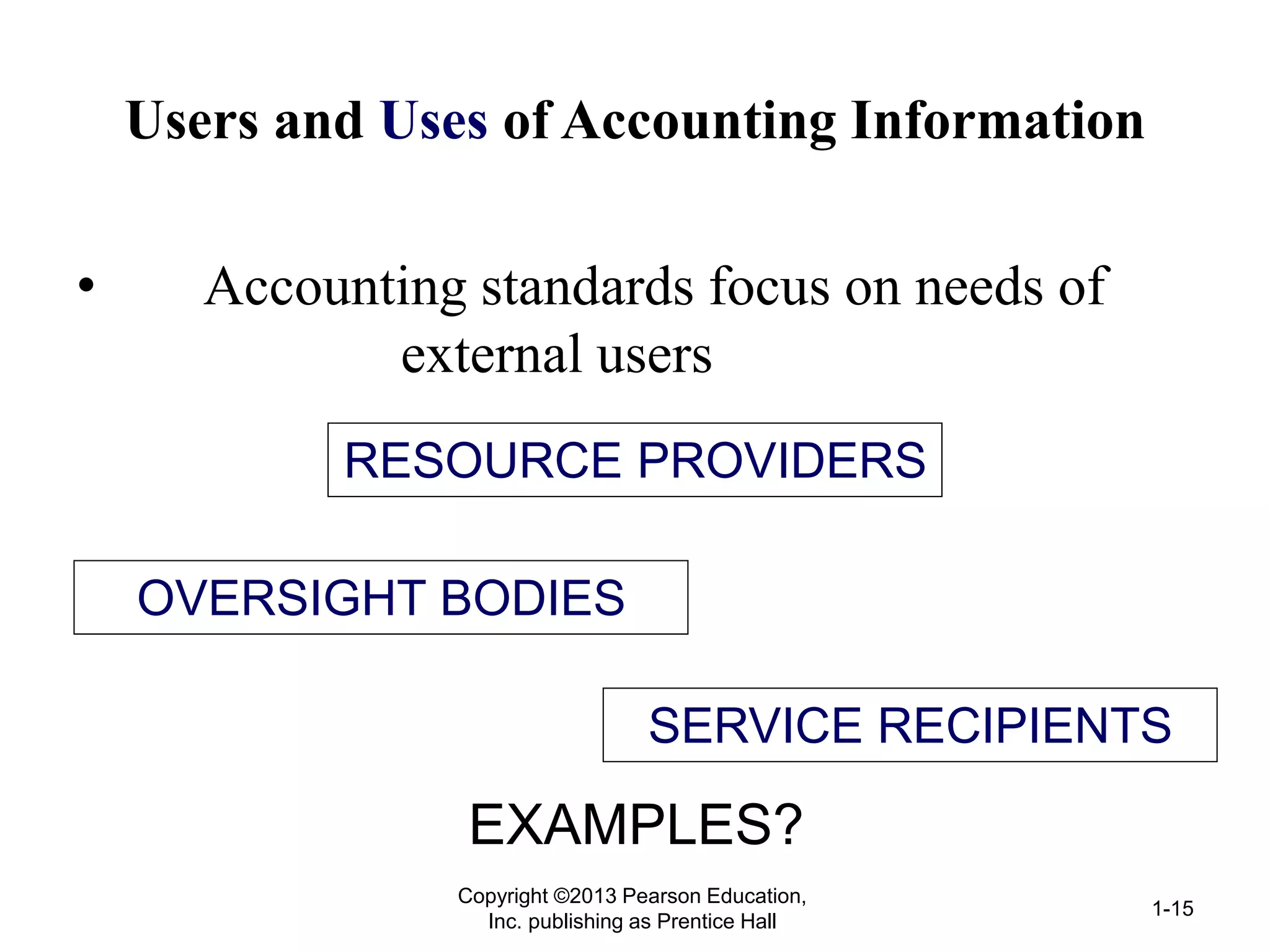
• Accounting standards focus on needs of
external users
Copyright ©2013 Pearson Education,
Inc. publishing as Prentice Hall
1-15
RESOURCE PROVIDERS
OVERSIGHT BODIES
SERVICE RECIPIENTS
EXAMPLES?
Accounting Standard Setters
• Governmental Accounting Standards Board (GASB)
– State and local governments
• Federal Accounting Standards Advisory Board
(FASAB)
– Federal government
• Financial Accounting Standards Board (FASB)
– Not-for-profit entities
Copyright ©2013 Pearson Education,
Inc. publishing as Prentice Hall
1-16
Objectives of Financial Reporting
• GASB’s State/Local Reporting Objectives:
– Help assess government’s duty of accountability
– Whether revenues pay for services
– Were resources obtained/used according to budget
– Measure of service efforts, costs, accomplishments
– Ability to meet obligations
Copyright ©2013 Pearson Education,
Inc. publishing as Prentice Hall
1-17
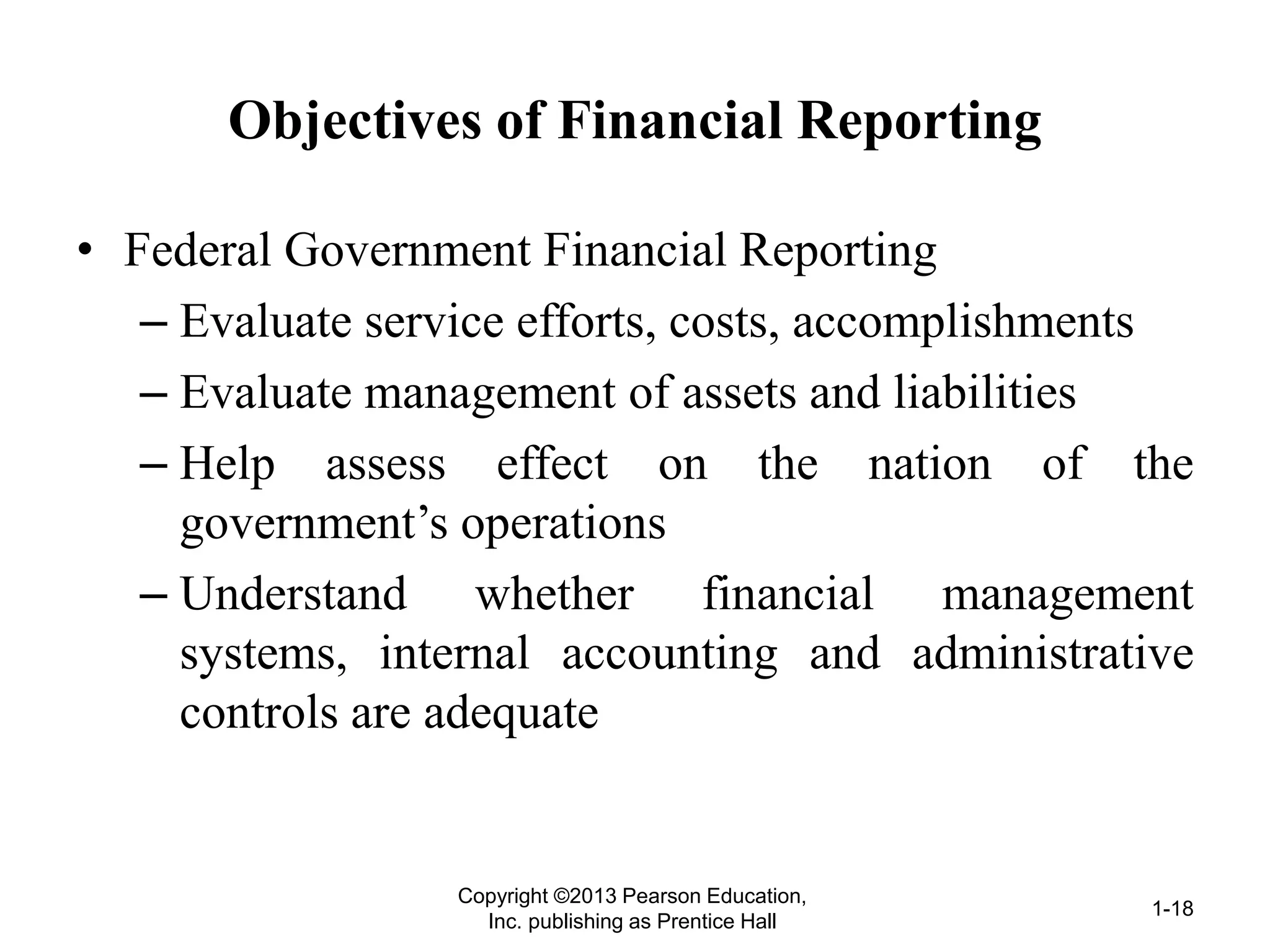
Objectives of Financial Reporting
• Federal Government Financial Reporting
– Evaluate service efforts, costs, accomplishments
– Evaluate management of assets and liabilities
– Help assess effect on the nation of the
government’s operations
– Understand whether financial management
systems, internal accounting and administrative
controls are adequate
Copyright ©2013 Pearson Education,
Inc. publishing as Prentice Hall
1-18
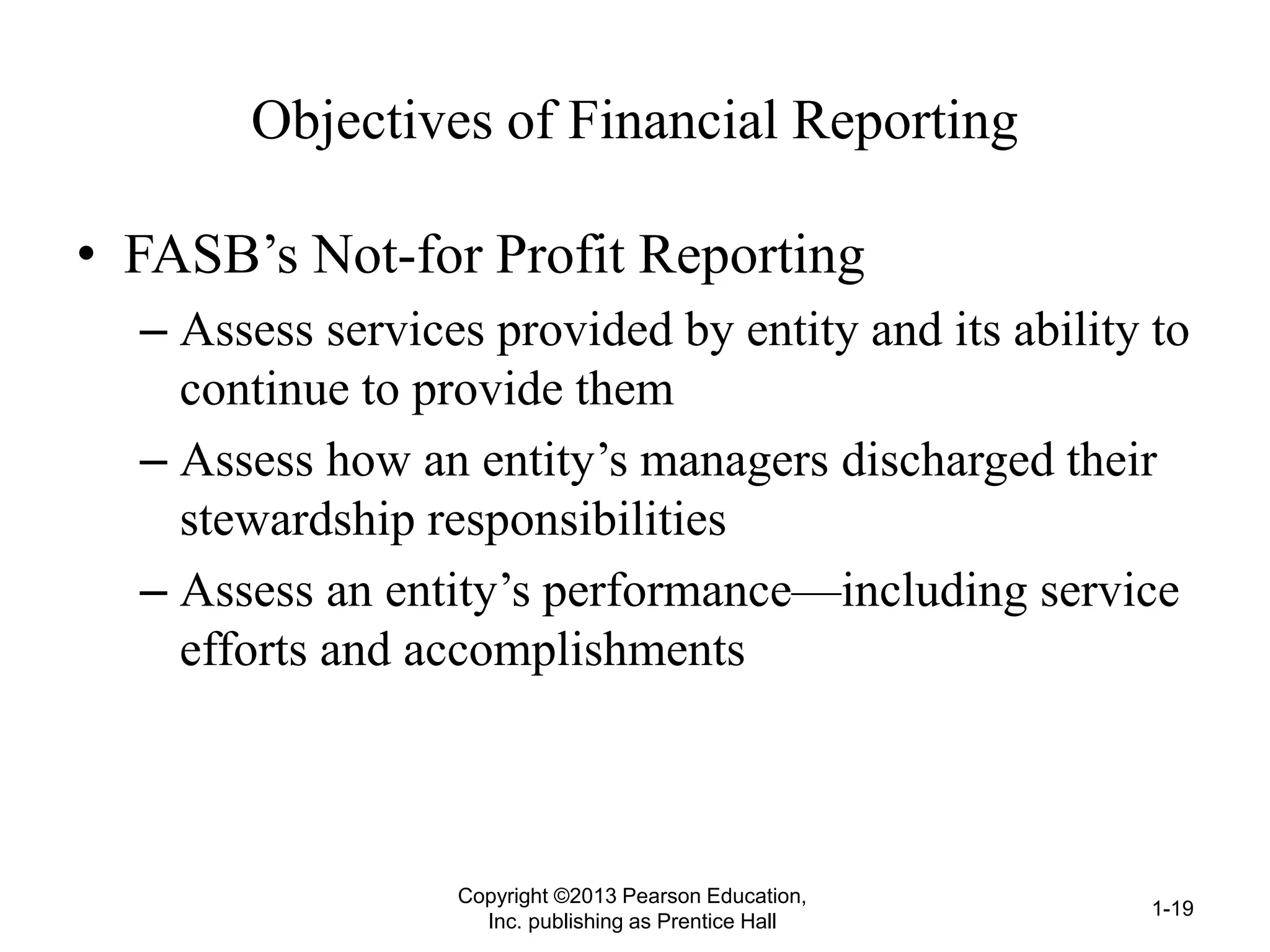
Objectives of Financial Reporting
• FASB’s Not-for Profit Reporting
– Assess services provided by entity and its ability to
continue to provide them
– Assess how an entity’s managers discharged their
stewardship responsibilities
– Assess an entity’s performance—including service
efforts and accomplishments
Copyright ©2013 Pearson Education,
Inc. publishing as Prentice Hall
1-19
Distinctive Reporting Characteristics:
Fund Accounting
• Fund Accounting segregates an entity's assets,
liabilities, and net assets into separate accounting
entities based on legal requirements, donor imposed
restrictions or special regulations.
• “Help ensure” resources spent as intended
• Set of self-balancing accounts (Like: Assets =
Liabilities + Equity).
• Entities usually maintain a general/unrestricted fund
for any purpose
• Not required for NFPs
Distinctive Reporting Characteristics:
Incorporation of Budgets
• The requirement of incorporating budgetary
accounting into governmental fund accounting
system highlights the importance of ensuring
that legally adopted budgets are not exceeded.
Distinctive Reporting Characteristics:
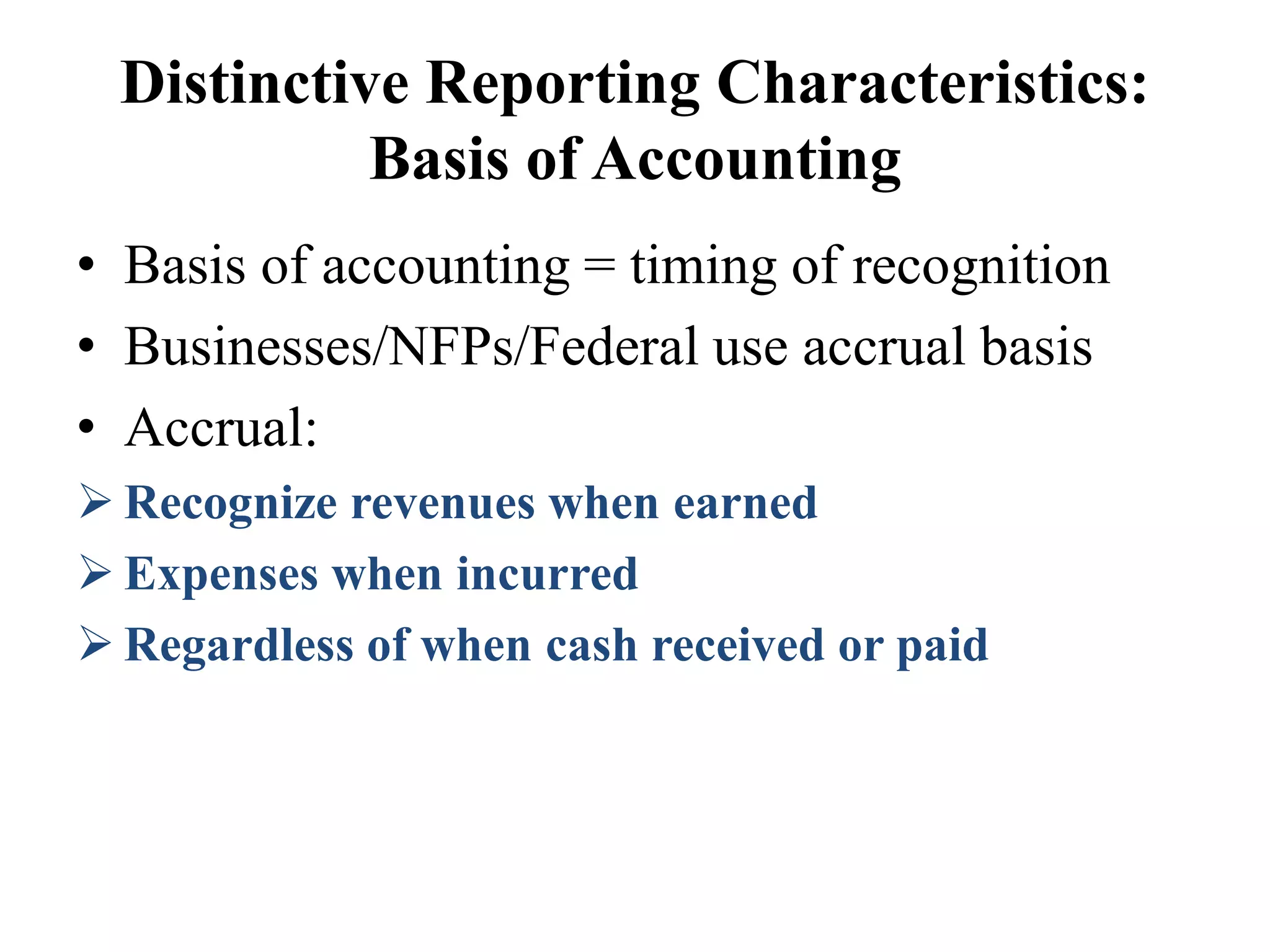
Basis of Accounting
• Basis of accounting = timing of recognition
• Businesses/NFPs/Federal use accrual basis
• Accrual:
 Recognize revenues when earned
 Expenses when incurred
 Regardless of when cash received or paid
Distinctive Reporting Characteristics: Basis of
Accounting
• State/local: Modified accrual basis of accounting
– Hybrid-type basis of accounting
– Inflows/outflows of current financial resources
only
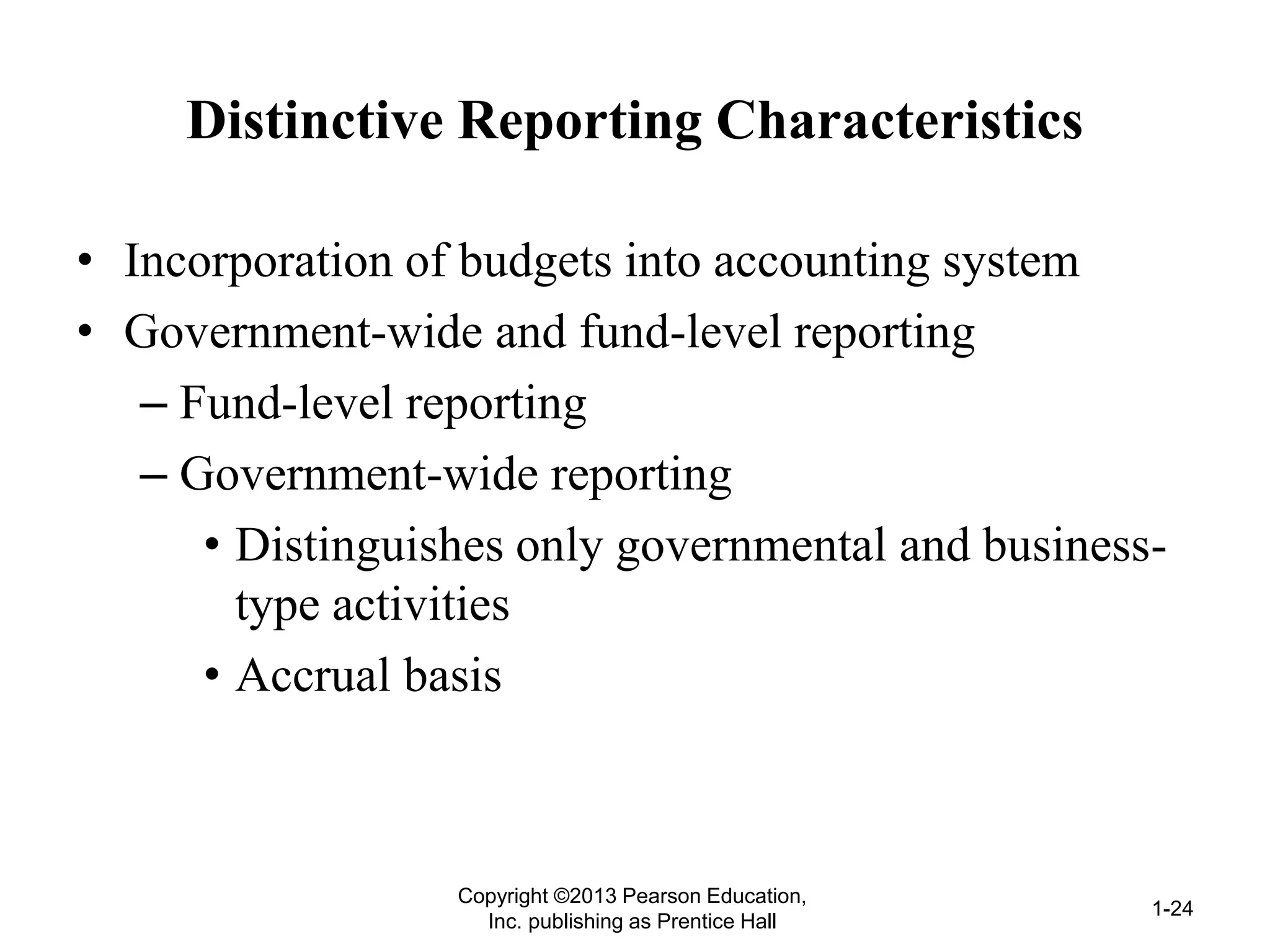
Distinctive Reporting Characteristics
• Incorporation of budgets into accounting system
• Government-wide and fund-level reporting
– Fund-level reporting
– Government-wide reporting
• Distinguishes only governmental and business-
type activities
• Accrual basis
Copyright ©2013 Pearson Education,
Inc. publishing as Prentice Hall
1-24

governmental and Non profit Accounting chapter 1

  • 1.
    Chapter 1 Governmental andNot for profit Accounting Environment and Characteristics
  • 2.
    Overview • Governmental andNFP entities operate in an environment different from business enterprises. • The users of the financial reporting in government and NFP organizations are different from business entities. • The financial activities in government are based on legally adopted budget. Budget contains legal restriction and resource provider restrictions on the use of resources.
  • 3.
    Overview • As aresult, both internal and accounting systems and external financial reporting for governmental and NFP entity users are designed to provide certain types of data that differ from the data reported by business enterprises.
  • 4.
    Governmental and Not-For-ProfitOrganizations 1. Government Entities include the following: • Federal Government. • General purpose subdivision, like cities, countries, towns. • Special Purpose Subdivisions, such as school district. • Public Corporations.
  • 5.
    Governmental and Not-For-Profit Organizations •Government Entities: Entities created by governmental laws, if they have the following characteristics: • Their officer are popularly elected and controlled by government body. • They possess the power to enact and enforce a tax levy. • Have a power to issue debts with interest exempted from taxes. • Faces a potential dissolve by government and assume all assets and liabilities.
  • 6.
    2. Not-For-Profit Organizations: Theyhave the following characteristics: 1. Receive contributions from recourse provider without equivalent return. 2. Operate for purpose other than providing goods or services for profit. 3. Lack of ownership interest. Ownership interests different than business enterprises. No stock or dividend transactions
  • 7.
    Governmental and Not-For-ProfitEntity Environment: 1. Governmental and Not-For-Profit entities operate in different legal, social, and political environment. 2. As a result, financial conditions, Accounting treatment, and financial statement users will differ. 3. Financial reporting requirement will also differ. 4. Standard setter develop standards for governmental and not for profit entities. Governmental Accounting Standard Board. GASB
  • 8.
    The Differences BetweenGovernmental and NFP Entities and Business Entities related to the following: • Purposes: 1. Governmental and not for profit entities exist to provide services. While the business enterprise for profit and earning components to maximize and increase the wealth of owners. 2. Surplus from resources accumulated to cushion against economic contractions. 3. Accountability and performance Concept, created for the resources entrusted. 4. Preparation accountability reports to federal government.
  • 9.
    The Differences BetweenGovernmental and NFP Entities and Business Entities • Source of Revenue: • Business: – Voluntary exchanges between buyers, sellers • Governments: – Involuntary taxes – For individual taxpayers, no direct relation between taxes paid and services provided • NFPs: – Voluntary donations often significant – Donors expect no pecuniary return
  • 10.
    The Differences BetweenGovernmental and NFP Entities and Business Entities • Relationship with Stakeholders: • Businesses: – Dissatisfied investors/customers may discontinue investing/purchasing • Governmental: – Dissatisfied taxpayers must continue to pay • NFPs: – Donors may not see the results
  • 11.
    The Differences BetweenGovernmental and NFP Entities and Business Entities • Longevity • Business: – Risk of going out of business – Risk of being bought out • NFP: Similar risks • Governmental: – Rarely go “out of business” – Not bought and sold
  • 12.
    The Differences BetweenGovernmental and NFP Entities and Business Entities • Legal Requirements & Role of Budget • Business: – May exit a market and cease providing goods and services, if unprofitable – Simple budgeting process, not legally binding • NFPs: – Legally bound to donor restrictions
  • 13.
    The Differences BetweenGovernmental and NFP Entities and Business Entities • Governmental – Required by laws to provide services like police and fire. – Budgets are legally binding, All spending according to predetermined budget should not exceed without legal approval. – Additional spending requires approval – Use of resources highly restricted • G & NFP accounting: Focus on legal compliance with laws and donor restrictions
  • 14.
    Users and Usesof Accounting Information • Internal users (managers) – Can specify kind of information needed from accounting system • External users – Not directly involved in operations of entity
  • 15.
    Users and Usesof Accounting Information • Accounting standards focus on needs of external users Copyright ©2013 Pearson Education, Inc. publishing as Prentice Hall 1-15 RESOURCE PROVIDERS OVERSIGHT BODIES SERVICE RECIPIENTS EXAMPLES?
  • 16.
    Accounting Standard Setters •Governmental Accounting Standards Board (GASB) – State and local governments • Federal Accounting Standards Advisory Board (FASAB) – Federal government • Financial Accounting Standards Board (FASB) – Not-for-profit entities Copyright ©2013 Pearson Education, Inc. publishing as Prentice Hall 1-16
  • 17.
    Objectives of FinancialReporting • GASB’s State/Local Reporting Objectives: – Help assess government’s duty of accountability – Whether revenues pay for services – Were resources obtained/used according to budget – Measure of service efforts, costs, accomplishments – Ability to meet obligations Copyright ©2013 Pearson Education, Inc. publishing as Prentice Hall 1-17
  • 18.
    Objectives of FinancialReporting • Federal Government Financial Reporting – Evaluate service efforts, costs, accomplishments – Evaluate management of assets and liabilities – Help assess effect on the nation of the government’s operations – Understand whether financial management systems, internal accounting and administrative controls are adequate Copyright ©2013 Pearson Education, Inc. publishing as Prentice Hall 1-18
  • 19.
    Objectives of FinancialReporting • FASB’s Not-for Profit Reporting – Assess services provided by entity and its ability to continue to provide them – Assess how an entity’s managers discharged their stewardship responsibilities – Assess an entity’s performance—including service efforts and accomplishments Copyright ©2013 Pearson Education, Inc. publishing as Prentice Hall 1-19
  • 20.
    Distinctive Reporting Characteristics: FundAccounting • Fund Accounting segregates an entity's assets, liabilities, and net assets into separate accounting entities based on legal requirements, donor imposed restrictions or special regulations. • “Help ensure” resources spent as intended • Set of self-balancing accounts (Like: Assets = Liabilities + Equity). • Entities usually maintain a general/unrestricted fund for any purpose • Not required for NFPs
  • 21.
    Distinctive Reporting Characteristics: Incorporationof Budgets • The requirement of incorporating budgetary accounting into governmental fund accounting system highlights the importance of ensuring that legally adopted budgets are not exceeded.
  • 22.
    Distinctive Reporting Characteristics: Basisof Accounting • Basis of accounting = timing of recognition • Businesses/NFPs/Federal use accrual basis • Accrual:  Recognize revenues when earned  Expenses when incurred  Regardless of when cash received or paid
  • 23.
    Distinctive Reporting Characteristics:Basis of Accounting • State/local: Modified accrual basis of accounting – Hybrid-type basis of accounting – Inflows/outflows of current financial resources only
  • 24.
    Distinctive Reporting Characteristics •Incorporation of budgets into accounting system • Government-wide and fund-level reporting – Fund-level reporting – Government-wide reporting • Distinguishes only governmental and business- type activities • Accrual basis Copyright ©2013 Pearson Education, Inc. publishing as Prentice Hall 1-24