Financial Discipline
2
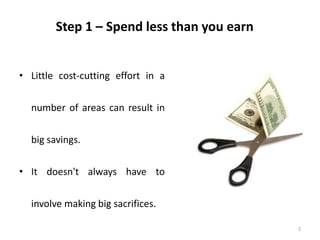
Step 1 – Spend less than you earn
• Little cost-cutting effort in a
number of areas can result in
big savings.
• It doesn't always have to
involve making big sacrifices.
3
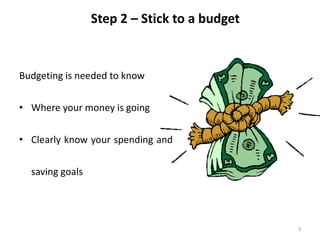
Step 2 – Stick to a budget
Budgeting is needed to know
• Where your money is going
• Clearly know your spending and
saving goals
4
Step 3 – Contributed to a retirement plan
Retirement is
• Long term investment
• Relaxed old age.
• Self reliance at old age.
5
Step 4 – Have a savings plan
• Resolve to set aside a minimum
of 5% to 10% of your salary for
savings.
• Identifying and eliminating
some discretionary spending.
6
Step 5 - Don’t finance anything for longer than its useful life
• Why continue to pay for
something- a car, a vacation, a
television- that you are no longer
able to use and enjoy?
• Purchase on credit only when
buying a long-lasting asset with
short-lasting financing.
7
Step 6 – Consider Purchasing Used items
• The opportunity cost of
saving for tomorrow is
spending (and enjoying!)
today.
• It might give the same
service as a brand new
item.
8
Step 7 – Diversify
• Don’t put all of your
eggs in one basket.
• Diversification is the
practice of holding a
large number of
unrelated assets.
• Invest your money is
many areas.
9
Step 8 – Invest Wisely
• Beware of investment
schemes promising high
returns with little or no risk.
• Do not allow yourself to be
forced into a quick decision.
• Beware of investment
frauds.
10
Step 9 – Teach your children
• Teach children money is earned.
• Teach your children how to earn
money and spend it wisely.
• Money both helps us get what we
want, AND helps others get what
they want.
11
Step 10 – Save For Your Child's Education Now
• To prevent future stress on family
finances.
• The earlier you start, the more
chances you have to save.
12
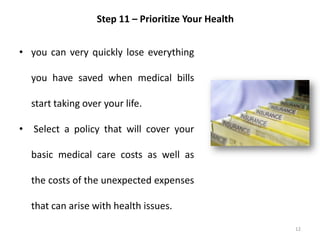
Step 11 – Prioritize Your Health
• you can very quickly lose everything
you have saved when medical bills
start taking over your life.
• Select a policy that will cover your
basic medical care costs as well as
the costs of the unexpected expenses
that can arise with health issues.
Prepared by
Manu Melwin Joy
Research Scholar
SMS, CUSAT, Kerala
Phone – 9744551114
Mail – manu_melwinjoy@yahoo.com

Financial discipline

  • 1.
  • 2.
    2 Step 1 –Spend less than you earn • Little cost-cutting effort in a number of areas can result in big savings. • It doesn't always have to involve making big sacrifices.
  • 3.
    3 Step 2 –Stick to a budget Budgeting is needed to know • Where your money is going • Clearly know your spending and saving goals
  • 4.
    4 Step 3 –Contributed to a retirement plan Retirement is • Long term investment • Relaxed old age. • Self reliance at old age.
  • 5.
    5 Step 4 –Have a savings plan • Resolve to set aside a minimum of 5% to 10% of your salary for savings. • Identifying and eliminating some discretionary spending.
  • 6.
    6 Step 5 -Don’t finance anything for longer than its useful life • Why continue to pay for something- a car, a vacation, a television- that you are no longer able to use and enjoy? • Purchase on credit only when buying a long-lasting asset with short-lasting financing.
  • 7.
    7 Step 6 –Consider Purchasing Used items • The opportunity cost of saving for tomorrow is spending (and enjoying!) today. • It might give the same service as a brand new item.
  • 8.
    8 Step 7 –Diversify • Don’t put all of your eggs in one basket. • Diversification is the practice of holding a large number of unrelated assets. • Invest your money is many areas.
  • 9.
    9 Step 8 –Invest Wisely • Beware of investment schemes promising high returns with little or no risk. • Do not allow yourself to be forced into a quick decision. • Beware of investment frauds.
  • 10.
    10 Step 9 –Teach your children • Teach children money is earned. • Teach your children how to earn money and spend it wisely. • Money both helps us get what we want, AND helps others get what they want.
  • 11.
    11 Step 10 –Save For Your Child's Education Now • To prevent future stress on family finances. • The earlier you start, the more chances you have to save.
  • 12.
    12 Step 11 –Prioritize Your Health • you can very quickly lose everything you have saved when medical bills start taking over your life. • Select a policy that will cover your basic medical care costs as well as the costs of the unexpected expenses that can arise with health issues.
  • 13.
    Prepared by Manu MelwinJoy Research Scholar SMS, CUSAT, Kerala Phone – 9744551114 Mail – manu_melwinjoy@yahoo.com