"FINANCIAL LITERACY;
THE IMPORTANCE OF
SAVINGS“
(FINANCIAL MANAGEMENT: SAVINGS AND INVESTMENT)
Laja Shoniran
Project Director
Financial Literacy for All (Teach To Save
Initiative)
Background
 ‘Train a child the way he should go, and when
he is old he will not depart from it’ Proverbs 22;6
 ‘Go to the ant … consider her ways and be
wise Which, having no chief, Officer or ruler,
Prepares her food in the summer.
And gathers her provision in the harvest. ’
Proverbs 6;6-8
Objective
 The concept of money
What is Money?
The three aspects of money
The importance of money
Money Management
 The concept of savings
What is savings?
Why, How and Where do we save?
 The concept of investment
What is investment?
Why should we invest?
The Road map
 Opening Thoughts
 Some Definition
 Why do you save?
 Misconceptions about savings
 How to Save
WHY SHOULD I LEARN MONEY
SKILLS?
 If you invest as little as N1000 per month,
you could become a millionaire.
 This works according to the principle of
compounding interest.
 Compounding interest will help you grow
your money without having to work for
every dollar.
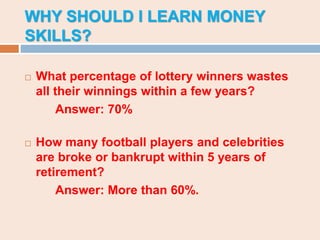
WHY SHOULD I LEARN MONEY
SKILLS?
 What percentage of lottery winners wastes
all their winnings within a few years?
Answer: 70%
 How many football players and celebrities
are broke or bankrupt within 5 years of
retirement?
Answer: More than 60%.
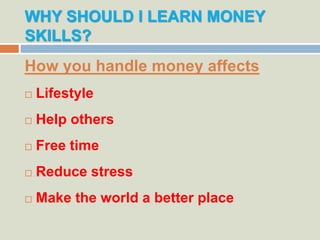
WHY SHOULD I LEARN MONEY
SKILLS?
How you handle money affects
 Lifestyle
 Help others
 Free time
 Reduce stress
 Make the world a better place
How you handle money
Managing your money
Opening Thoughts
 “ A penny saved is a penny earned” Benjamin
Franklin
 “You are not rich by how much you spend but by
how much you save” Laja Shoniran
 “If you earn three pence and you did not save,
even if you earn one shilling you will not save”
African proverb
 Precious treasure and oil are in a wise man's
dwelling, but a foolish man devours it. Proverbs 21;20
Opening Thoughts
 “Through wisdom a house is built, and by
understanding it is established; and by
knowledge the rooms shall be filled with all
precious and pleasant riches” Proverbs 24; 3-4
 “Poor is he who works with a negligent hand,
but the hand of the diligent makes rich” Proverbs
10;4
 The greatest of all diseases in life is the
absence of money where and when it is
needed
Dream Time (A Dream is the wish your heart makes)
 Write down three important things you want to
accomplish in life
Education
Career
Family
Business
Travel
Politics
Others – philanthropy, social cause,
What is money?
Goods
Services
Desires
Expectations
Achievements
Accomplishment
Relaxation
Bible says – Eccl 10;19
‘..Money answers/facilitates/finances all
things’
What is Financial Literacy
 Understanding how money works
 The ability to make appropriate decisions in
managing your personal finances.
 being able to understand and analyze financial
products in order to make smart decisions
about what to do with your money
 The ability to make informed decisions about
your money
Three aspects of money
 Earn Money
Income generation – passive or active
 Manage Money
Saving, Spending, Budgeting, Planning
 Multiply Money
Investments, Business, Real estate
What is Saving?
 Rescue from harm, danger, or loss.
 Avoidance of excess expenditure;.
 A reduction in expenditure or cost.
 Saving is income not spent, or deferred
consumption.
What is Savings?
 The portion of income/money not spent on
consumption of consumer goods but
accumulated for investment in income
generating ventures – business or real estate,
or purchase of shares.
Investment
Reserve
Funds
Capital
Money
Saving money is difficult
 Why?
Human wants are insatiable
I don’t earn enough
Too many responsibilities – extended family
No job – no income
Business is slow
School fees are too high
I spend the bulk of my money on Transportation
Why do you need to save
money?
 There is always a tomorrow
 For Retirement age
 Emergency
 To buy or build your own house
 To start a business or grow an existing one
 For leisure goods/vacation
 Education for children
 To give to charity
 To grow or multiply money
Secondary school students
 To develop the habit of saving
 To store up money
 To create a brighter future for tomorrow
 To be prepared for important life events like
university, wedding, buying a house, start a
business, etc
 To keep money safe
 To earn interest and help your money grow
 To reduce the temptation of spending
irresponsibly
 To help you access loan to help you in future
Misconceptions about Savings
 My income is too small for me to save
 When you save you are worried about the future
 God will always take care of me financially
 Money is for spending
 Saving is hoarding
 You are stingy or penny-pinching when you save
 Whatever will be will be – God will have mercy on
who He will have mercy
 If you are destined to be rich, you will even if you
don’t save
What do you benefit by
saving?
 Peace of Mind
 When a person saves money continuously, it
gives them a "peace of mind". An individual will
sleep better at night knowing they have
additional money put aside
 More Income
 Saving money means an individual will have
more of it at the end of the year. This is what
saving money does.
What do you benefit by
saving?
 Monetary Safety Net
 Saving money provides a person with a
financial net of safety just in case they lose
their job, become disabled or can no longer
work. Life is uncertain, but money does not
have to be
 Saving Earns Interest
 Allocating money in a certain savings account
will allow it to earn interest.
What do you benefit by
saving?
 More Options
 When a person decides to save money and make
it a lifestyle, a plethora of choices is available.
One could invest or purchase something they
want. It is nice to have some wiggle room.
 Attitudinal Change
More Disciplined,
Can delay gratification easily
Can sacrifice and give more easily
Values people and values things more
How do we save – money?
 There are three basic ways to save money
1. Making specific deductions from
income regularly
2. Shopping smart to reduce your
expenditure on goods and services
3. Reducing your consumption rate for
goods and services
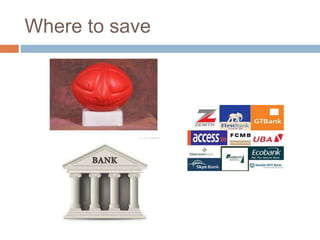
Where to save
Conclusion
There are more than
So get a copy of this book and Start Saving Today!
Thank You
 Laja Shoniran
Managing Consultant
Infinite Intel Consult
HR Training, Recruiting & Business Consultants
Project Director
Financial Literacy for All (Teach Children to Save
Initiative)
Tel: 08023005235
E-mail: lajashoniran@yahoo.com
Facebook:
www.facebook.com/TeachChildrenToSaveInitiativ
e

Financial Literacy Seminar for Secondary School Students

  • 1.
    "FINANCIAL LITERACY; THE IMPORTANCEOF SAVINGS“ (FINANCIAL MANAGEMENT: SAVINGS AND INVESTMENT) Laja Shoniran Project Director Financial Literacy for All (Teach To Save Initiative)
  • 2.
    Background  ‘Train achild the way he should go, and when he is old he will not depart from it’ Proverbs 22;6  ‘Go to the ant … consider her ways and be wise Which, having no chief, Officer or ruler, Prepares her food in the summer. And gathers her provision in the harvest. ’ Proverbs 6;6-8
  • 3.
    Objective  The conceptof money What is Money? The three aspects of money The importance of money Money Management  The concept of savings What is savings? Why, How and Where do we save?  The concept of investment What is investment? Why should we invest?
  • 4.
    The Road map Opening Thoughts  Some Definition  Why do you save?  Misconceptions about savings  How to Save
  • 5.
    WHY SHOULD ILEARN MONEY SKILLS?  If you invest as little as N1000 per month, you could become a millionaire.  This works according to the principle of compounding interest.  Compounding interest will help you grow your money without having to work for every dollar.
  • 6.
    WHY SHOULD ILEARN MONEY SKILLS?  What percentage of lottery winners wastes all their winnings within a few years? Answer: 70%  How many football players and celebrities are broke or bankrupt within 5 years of retirement? Answer: More than 60%.
  • 7.
    WHY SHOULD ILEARN MONEY SKILLS? How you handle money affects  Lifestyle  Help others  Free time  Reduce stress  Make the world a better place
  • 8.
  • 9.
  • 10.
    Opening Thoughts  “A penny saved is a penny earned” Benjamin Franklin  “You are not rich by how much you spend but by how much you save” Laja Shoniran  “If you earn three pence and you did not save, even if you earn one shilling you will not save” African proverb  Precious treasure and oil are in a wise man's dwelling, but a foolish man devours it. Proverbs 21;20
  • 11.
    Opening Thoughts  “Throughwisdom a house is built, and by understanding it is established; and by knowledge the rooms shall be filled with all precious and pleasant riches” Proverbs 24; 3-4  “Poor is he who works with a negligent hand, but the hand of the diligent makes rich” Proverbs 10;4  The greatest of all diseases in life is the absence of money where and when it is needed
  • 12.
    Dream Time (ADream is the wish your heart makes)  Write down three important things you want to accomplish in life Education Career Family Business Travel Politics Others – philanthropy, social cause,
  • 13.
  • 14.
    What is FinancialLiteracy  Understanding how money works  The ability to make appropriate decisions in managing your personal finances.  being able to understand and analyze financial products in order to make smart decisions about what to do with your money  The ability to make informed decisions about your money
  • 15.
    Three aspects ofmoney  Earn Money Income generation – passive or active  Manage Money Saving, Spending, Budgeting, Planning  Multiply Money Investments, Business, Real estate
  • 16.
    What is Saving? Rescue from harm, danger, or loss.  Avoidance of excess expenditure;.  A reduction in expenditure or cost.  Saving is income not spent, or deferred consumption.
  • 17.
    What is Savings? The portion of income/money not spent on consumption of consumer goods but accumulated for investment in income generating ventures – business or real estate, or purchase of shares. Investment Reserve Funds Capital Money
  • 18.
    Saving money isdifficult  Why? Human wants are insatiable I don’t earn enough Too many responsibilities – extended family No job – no income Business is slow School fees are too high I spend the bulk of my money on Transportation
  • 19.
    Why do youneed to save money?  There is always a tomorrow  For Retirement age  Emergency  To buy or build your own house  To start a business or grow an existing one  For leisure goods/vacation  Education for children  To give to charity  To grow or multiply money
  • 20.
    Secondary school students To develop the habit of saving  To store up money  To create a brighter future for tomorrow  To be prepared for important life events like university, wedding, buying a house, start a business, etc  To keep money safe  To earn interest and help your money grow  To reduce the temptation of spending irresponsibly  To help you access loan to help you in future
  • 21.
    Misconceptions about Savings My income is too small for me to save  When you save you are worried about the future  God will always take care of me financially  Money is for spending  Saving is hoarding  You are stingy or penny-pinching when you save  Whatever will be will be – God will have mercy on who He will have mercy  If you are destined to be rich, you will even if you don’t save
  • 22.
    What do youbenefit by saving?  Peace of Mind  When a person saves money continuously, it gives them a "peace of mind". An individual will sleep better at night knowing they have additional money put aside  More Income  Saving money means an individual will have more of it at the end of the year. This is what saving money does.
  • 23.
    What do youbenefit by saving?  Monetary Safety Net  Saving money provides a person with a financial net of safety just in case they lose their job, become disabled or can no longer work. Life is uncertain, but money does not have to be  Saving Earns Interest  Allocating money in a certain savings account will allow it to earn interest.
  • 24.
    What do youbenefit by saving?  More Options  When a person decides to save money and make it a lifestyle, a plethora of choices is available. One could invest or purchase something they want. It is nice to have some wiggle room.  Attitudinal Change More Disciplined, Can delay gratification easily Can sacrifice and give more easily Values people and values things more
  • 25.
    How do wesave – money?  There are three basic ways to save money 1. Making specific deductions from income regularly 2. Shopping smart to reduce your expenditure on goods and services 3. Reducing your consumption rate for goods and services
  • 26.
  • 27.
    Conclusion There are morethan So get a copy of this book and Start Saving Today!
  • 28.
    Thank You  LajaShoniran Managing Consultant Infinite Intel Consult HR Training, Recruiting & Business Consultants Project Director Financial Literacy for All (Teach Children to Save Initiative) Tel: 08023005235 E-mail: lajashoniran@yahoo.com Facebook: www.facebook.com/TeachChildrenToSaveInitiativ e

Editor's Notes

  • #14 What shall it profit a man – God was not equating man to the whole of his creation rather He was referring to His abilities in man that is capable of replecating or creating the earth