FINANCIAL LITERACY
Financial Literacy is: Understanding and knowing how you can build your personal wealth based on your present income.
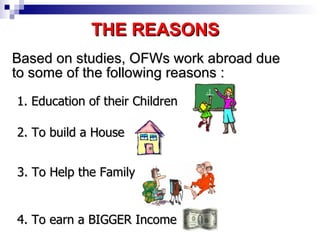
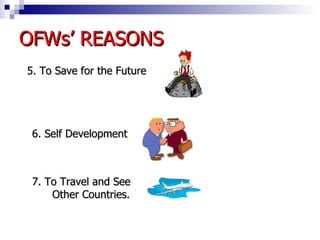
THE REASONS Based on studies, OFWs work abroad due to some of the following reasons : 1. Education of their Children 2. To build a House 3. To Help the Family 4. To earn a BIGGER Income
OFWs’ REASONS 7. To Travel and See  Other Countries. 5. To Save for the Future 6. Self Development
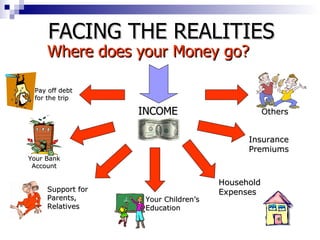
INCOME Your Bank Account Support for Parents, Relatives Your Children’s Education Household Expenses Insurance Premiums Where does your Money go? FACING THE REALITIES Others Pay off debt for the trip
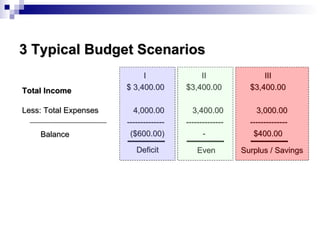
3 Typical Budget Scenarios Total Income Less: Total Expenses Balance I $ 3,400.00 4,000.00 -------------- ($600.00) II $3,400.00 3,400.00 -------------- - III $3,400.00 3,000.00 -------------- $400.00 Deficit Surplus / Savings Even
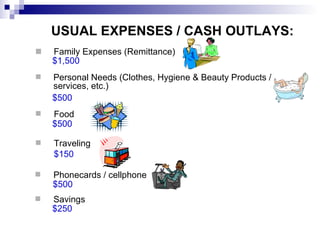
USUAL EXPENSES / CASH OUTLAYS: Family Expenses (Remittance) Personal Needs (Clothes, Hygiene & Beauty Products / services, etc.) Food Traveling Phonecards / cellphone Savings $1,500 $500 $500 $500 $150 $250
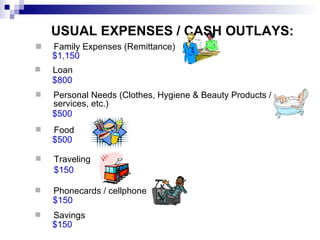
USUAL EXPENSES / CASH OUTLAYS: Family Expenses (Remittance) Personal Needs (Clothes, Hygiene & Beauty Products / services, etc.) Food Traveling Phonecards / cellphone Savings $1,150 $500 $500 $150 $150 $150 Loan $800
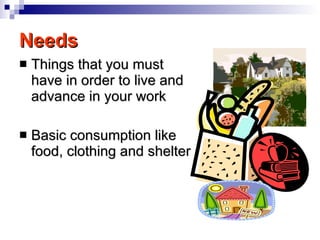
Needs Things that you must have in order to live and advance in your work Basic consumption like food, clothing and shelter
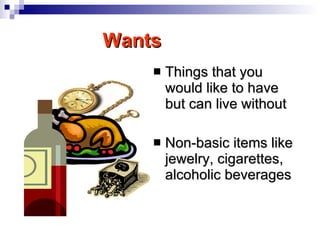
Wants Things that you would like to have but can live without Non-basic items like jewelry, cigarettes, alcoholic beverages
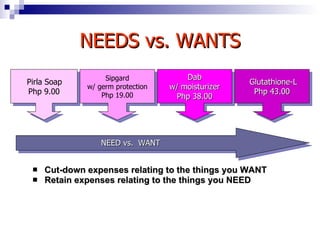
Cut-down expenses relating to the things you WANT Retain expenses relating to the things you NEED Pirla Soap  Php 9.00 Sipgard w/ germ protection  Php 19.00 Dab w/ moisturizer  Php 38.00 Glutathione-L  Php 43.00 NEEDS vs. WANTS NEED vs.  WANT
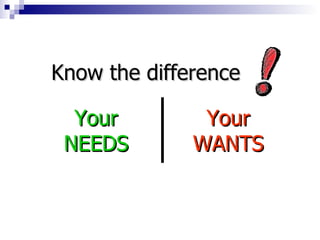
Know the difference Your NEEDS Your WANTS
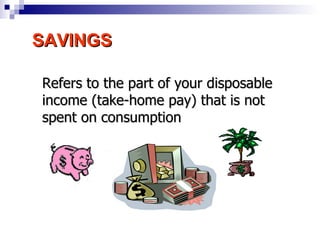
SAVINGS Refers to the part of your disposable income (take-home pay) that is not spent on consumption
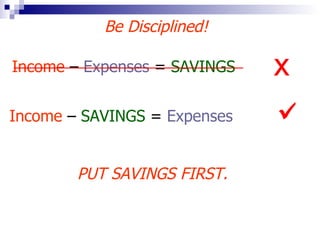
Be Disciplined! Income  –  Expenses  =  SAVINGS  Income  –  SAVINGS  =  Expenses   PUT SAVINGS FIRST.  x
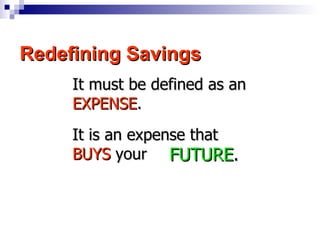
Redefining Savings It must be defined as an  EXPENSE .  It is an expense that  BUYS  your FUTURE .
FINANCIAL STAGES
Where does your Money come from?
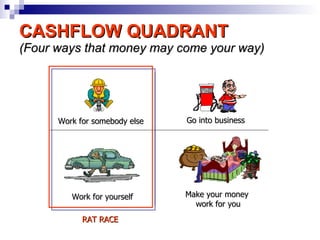
CASHFLOW QUADRANT (Four ways that money may come your way) Work for yourself Work for somebody else Go into business Make your money  work for you RAT RACE
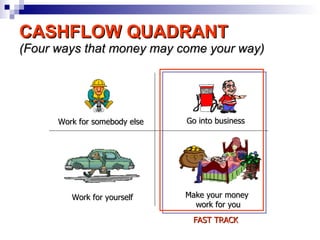
CASHFLOW QUADRANT (Four ways that money may come your way) Work for yourself Work for somebody else Go into business Make your money  work for you FAST TRACK
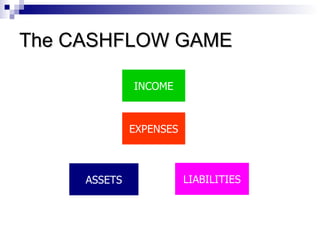
The CASHFLOW GAME INCOME EXPENSES ASSETS LIABILITIES
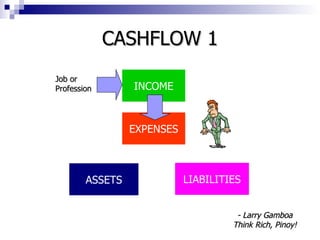
CASHFLOW 1 INCOME EXPENSES ASSETS LIABILITIES Job or Profession - Larry Gamboa Think Rich, Pinoy!
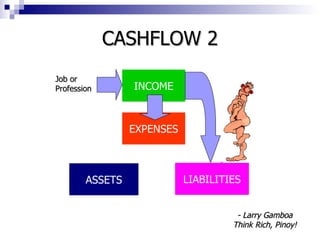
CASHFLOW 2 INCOME EXPENSES ASSETS LIABILITIES Job or Profession - Larry Gamboa Think Rich, Pinoy!
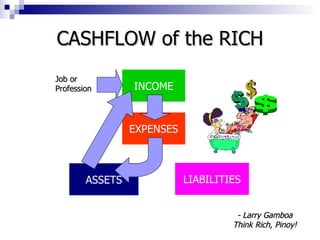
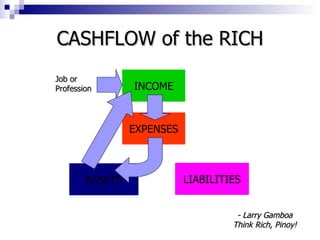
CASHFLOW of the RICH INCOME EXPENSES ASSETS LIABILITIES Job or Profession - Larry Gamboa Think Rich, Pinoy!
Negative Mindsets “ I do not have enough money” “ I do not have good enough ideas” Distrust of people – “mandaraya silang lahat” Fear of failure
In fact, we can be RICH!!! We can attain FINANCIAL FREEDOM!
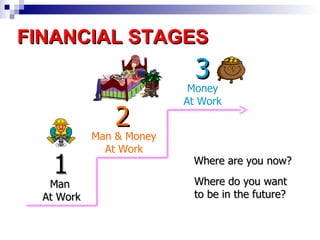
FINANCIAL STAGES   Where do you want to be in the future? Where are you now? Man  At Work 1 Man & Money At Work 2 Money At Work 3
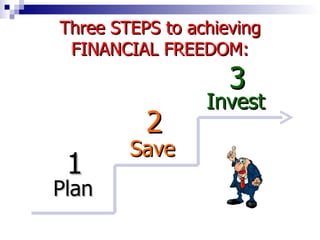
Three STEPS to achieving FINANCIAL FREEDOM: Plan 1 2 Save Invest 3
PLAN The FIRST STEP to achieving FINANCIAL FREEDOM:
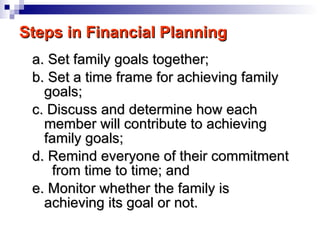
Steps in Financial Planning a. Set family goals together; b. Set a time frame for achieving family goals; c. Discuss and determine how each member will contribute to achieving family goals; d. Remind everyone of their commitment  from time to time; and e. Monitor whether the family is achieving its goal or not.
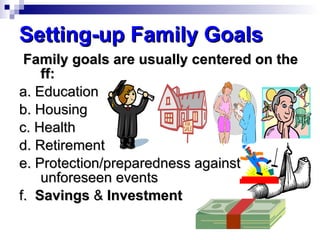
Family goals are usually centered on the ff: a. Education b. Housing c. Health d. Retirement e. Protection/preparedness against unforeseen events f.  Savings  &  Investment Setting-up Family Goals
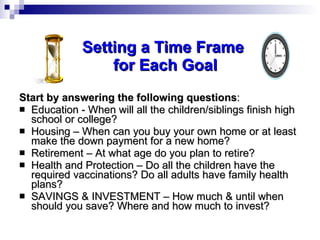
Setting a Time Frame  for Each Goal Start by answering the following questions : Education - When will all the children/siblings finish high school or college? Housing – When can you buy your own home or at least make the down payment for a new home? Retirement – At what age do you plan to retire? Health and Protection – Do all the children have the required vaccinations? Do all adults have family health plans? SAVINGS & INVESTMENT – How much & until when should you save? Where and how much to invest?
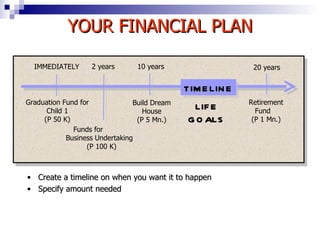
LIFE GOALS TIMELINE 2 years 10 years Retirement Fund  (P 1 Mn.) 20 years IMMEDIATELY Graduation Fund for Child 1 (P 50 K) Funds for  Business Undertaking  (P 100 K) Build Dream House (P 5 Mn.) Create a timeline on when you want it to happen Specify amount needed YOUR FINANCIAL PLAN
The SECOND STEP to achieving FINANCIAL FREEDOM: SAVE!!!
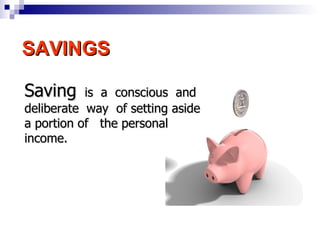
SAVINGS Saving   is  a  conscious  and deliberate  way  of setting aside a portion of  the personal income.
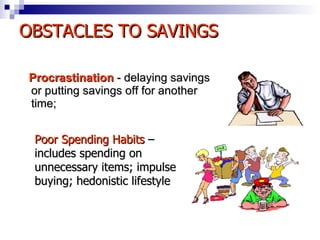
Procrastination   - delaying savings or putting savings off for another time; Poor Spending Habits  – includes spending on unnecessary items; impulse buying; hedonistic lifestyle OBSTACLES TO SAVINGS
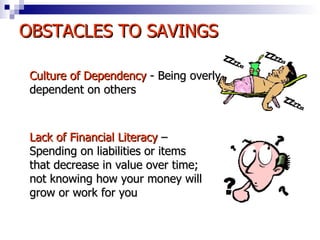
OBSTACLES TO SAVINGS Lack of Financial Literacy  – Spending on liabilities or items that decrease in value over time; not knowing how your money will grow or work for you Culture of Dependency  -   Being overly dependent on others
MAKE YOUR  MONEY GROW Invest your savings in money-making assets. MAKE YOUR MONEY WORK FOR YOU. INVEST The THIRD STEP to achieving FINANCIAL FREEDOM:
KEEPING MORE of the money you earn MAKING MORE with the money you keep SAVE TO INVEST $MART MONEY MECHANIC$
CASHFLOW of the RICH INCOME EXPENSES ASSETS LIABILITIES Job or Profession - Larry Gamboa Think Rich, Pinoy!
INVESTMENTS Investment  is the  commitment of funds  made in expectation of some  positive rate of return .  If the investment is properly undertaken, the return will be commensurate with the risk it assumes.

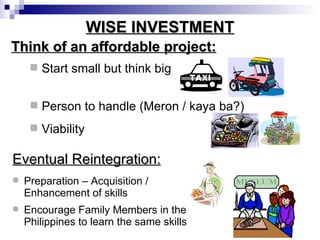
WISE INVESTMENT Think of an affordable project: Start small but think big Person to handle (Meron / kaya ba?) Viability Preparation – Acquisition / Enhancement of skills Encourage Family Members in the Philippines to learn the same skills Eventual Reintegration:
INVESTING IN YOUR OWN BUSINESS Remember that not everyone has what it takes to run a successful business; If you think that you have what it takes to become a successful business person,  then its time to plan your business; Think about what business you can engage in; Look around you and identify business opportunities and evaluate each options; Do a situational analysis; identify the strengths, weaknesses, opportunities and threats to your proposed business.
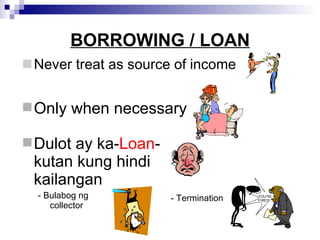
BORROWING / LOAN Never treat as source of income Only when necessary Dulot ay ka- Loan -kutan kung hindi kailangan - Bulabog ng collector - Termination YOU’RE FIRED!
THANK YOU AND GOOD LUCK

Financial literacy my edit 012710

  • 1.
  • 2.
    Financial Literacy is:Understanding and knowing how you can build your personal wealth based on your present income.
  • 3.
    THE REASONS Basedon studies, OFWs work abroad due to some of the following reasons : 1. Education of their Children 2. To build a House 3. To Help the Family 4. To earn a BIGGER Income
  • 4.
    OFWs’ REASONS 7.To Travel and See Other Countries. 5. To Save for the Future 6. Self Development
  • 5.
    INCOME Your BankAccount Support for Parents, Relatives Your Children’s Education Household Expenses Insurance Premiums Where does your Money go? FACING THE REALITIES Others Pay off debt for the trip
  • 6.
    3 Typical BudgetScenarios Total Income Less: Total Expenses Balance I $ 3,400.00 4,000.00 -------------- ($600.00) II $3,400.00 3,400.00 -------------- - III $3,400.00 3,000.00 -------------- $400.00 Deficit Surplus / Savings Even
  • 7.
    USUAL EXPENSES /CASH OUTLAYS: Family Expenses (Remittance) Personal Needs (Clothes, Hygiene & Beauty Products / services, etc.) Food Traveling Phonecards / cellphone Savings $1,500 $500 $500 $500 $150 $250
  • 8.
    USUAL EXPENSES /CASH OUTLAYS: Family Expenses (Remittance) Personal Needs (Clothes, Hygiene & Beauty Products / services, etc.) Food Traveling Phonecards / cellphone Savings $1,150 $500 $500 $150 $150 $150 Loan $800
  • 9.
    Needs Things thatyou must have in order to live and advance in your work Basic consumption like food, clothing and shelter
  • 10.
    Wants Things thatyou would like to have but can live without Non-basic items like jewelry, cigarettes, alcoholic beverages
  • 11.
    Cut-down expenses relatingto the things you WANT Retain expenses relating to the things you NEED Pirla Soap Php 9.00 Sipgard w/ germ protection Php 19.00 Dab w/ moisturizer Php 38.00 Glutathione-L Php 43.00 NEEDS vs. WANTS NEED vs. WANT
  • 12.
    Know the differenceYour NEEDS Your WANTS
  • 13.
    SAVINGS Refers tothe part of your disposable income (take-home pay) that is not spent on consumption
  • 14.
    Be Disciplined! Income – Expenses = SAVINGS  Income – SAVINGS = Expenses PUT SAVINGS FIRST. x
  • 15.
    Redefining Savings Itmust be defined as an EXPENSE . It is an expense that BUYS your FUTURE .
  • 16.
  • 17.
    Where does yourMoney come from?
  • 18.
    CASHFLOW QUADRANT (Fourways that money may come your way) Work for yourself Work for somebody else Go into business Make your money work for you RAT RACE
  • 19.
    CASHFLOW QUADRANT (Fourways that money may come your way) Work for yourself Work for somebody else Go into business Make your money work for you FAST TRACK
  • 20.
    The CASHFLOW GAMEINCOME EXPENSES ASSETS LIABILITIES
  • 21.
    CASHFLOW 1 INCOMEEXPENSES ASSETS LIABILITIES Job or Profession - Larry Gamboa Think Rich, Pinoy!
  • 22.
    CASHFLOW 2 INCOMEEXPENSES ASSETS LIABILITIES Job or Profession - Larry Gamboa Think Rich, Pinoy!
  • 23.
    CASHFLOW of theRICH INCOME EXPENSES ASSETS LIABILITIES Job or Profession - Larry Gamboa Think Rich, Pinoy!
  • 24.
    Negative Mindsets “I do not have enough money” “ I do not have good enough ideas” Distrust of people – “mandaraya silang lahat” Fear of failure
  • 25.
    In fact, wecan be RICH!!! We can attain FINANCIAL FREEDOM!
  • 26.
    FINANCIAL STAGES Where do you want to be in the future? Where are you now? Man At Work 1 Man & Money At Work 2 Money At Work 3
  • 27.
    Three STEPS toachieving FINANCIAL FREEDOM: Plan 1 2 Save Invest 3
  • 28.
    PLAN The FIRSTSTEP to achieving FINANCIAL FREEDOM:
  • 29.
    Steps in FinancialPlanning a. Set family goals together; b. Set a time frame for achieving family goals; c. Discuss and determine how each member will contribute to achieving family goals; d. Remind everyone of their commitment from time to time; and e. Monitor whether the family is achieving its goal or not.
  • 30.
    Family goals areusually centered on the ff: a. Education b. Housing c. Health d. Retirement e. Protection/preparedness against unforeseen events f. Savings & Investment Setting-up Family Goals
  • 31.
    Setting a TimeFrame for Each Goal Start by answering the following questions : Education - When will all the children/siblings finish high school or college? Housing – When can you buy your own home or at least make the down payment for a new home? Retirement – At what age do you plan to retire? Health and Protection – Do all the children have the required vaccinations? Do all adults have family health plans? SAVINGS & INVESTMENT – How much & until when should you save? Where and how much to invest?
  • 32.
    LIFE GOALS TIMELINE2 years 10 years Retirement Fund (P 1 Mn.) 20 years IMMEDIATELY Graduation Fund for Child 1 (P 50 K) Funds for Business Undertaking (P 100 K) Build Dream House (P 5 Mn.) Create a timeline on when you want it to happen Specify amount needed YOUR FINANCIAL PLAN
  • 33.
    The SECOND STEPto achieving FINANCIAL FREEDOM: SAVE!!!
  • 34.
    SAVINGS Saving is a conscious and deliberate way of setting aside a portion of the personal income.
  • 35.
    Procrastination - delaying savings or putting savings off for another time; Poor Spending Habits – includes spending on unnecessary items; impulse buying; hedonistic lifestyle OBSTACLES TO SAVINGS
  • 36.
    OBSTACLES TO SAVINGSLack of Financial Literacy – Spending on liabilities or items that decrease in value over time; not knowing how your money will grow or work for you Culture of Dependency - Being overly dependent on others
  • 37.
    MAKE YOUR MONEY GROW Invest your savings in money-making assets. MAKE YOUR MONEY WORK FOR YOU. INVEST The THIRD STEP to achieving FINANCIAL FREEDOM:
  • 38.
    KEEPING MORE ofthe money you earn MAKING MORE with the money you keep SAVE TO INVEST $MART MONEY MECHANIC$
  • 39.
    CASHFLOW of theRICH INCOME EXPENSES ASSETS LIABILITIES Job or Profession - Larry Gamboa Think Rich, Pinoy!
  • 40.
    INVESTMENTS Investment is the commitment of funds made in expectation of some positive rate of return . If the investment is properly undertaken, the return will be commensurate with the risk it assumes.
  • 41.
    WISE INVESTMENT Thinkof an affordable project: Start small but think big Person to handle (Meron / kaya ba?) Viability Preparation – Acquisition / Enhancement of skills Encourage Family Members in the Philippines to learn the same skills Eventual Reintegration:
  • 42.
    INVESTING IN YOUROWN BUSINESS Remember that not everyone has what it takes to run a successful business; If you think that you have what it takes to become a successful business person, then its time to plan your business; Think about what business you can engage in; Look around you and identify business opportunities and evaluate each options; Do a situational analysis; identify the strengths, weaknesses, opportunities and threats to your proposed business.
  • 43.
    BORROWING / LOANNever treat as source of income Only when necessary Dulot ay ka- Loan -kutan kung hindi kailangan - Bulabog ng collector - Termination YOU’RE FIRED!
  • 44.
    THANK YOU ANDGOOD LUCK

Editor's Notes

  • #33 A financial plan need not be as complicated as how it sounds. One can have a simple (not perfect) financial plan that is realistic and attainable.
  • #41 Reason for investing: 1. To achieve financial goals 2. Beat Inflation