Identity Theft  PROTECTING and RESTORING YOUR GOOD NAME
About Springboard Springboard is a non-profit organization founded in 1974.  We offer personal financial education and assistance with money, credit, and debt management through educational programs and confidential counseling.
About Springboard Accredited by the (COA)  Council on Accreditation Member of the (NFCC)  National Foundation for Credit Counseling Certified by (HUD) The Department of Housing and Urban Development Member of the (BBB) Better Business Bureau
Our Services Include Credit and Debt Counseling Financial Education Programs  Seminars and Materials Debt Management Plans Homeowner Assistance (Foreclosure Prevention) First Time Home Buyer Education Seminars Reverse Mortgage Counseling Pre-Bankruptcy Budget and Credit Counseling Pre-Discharge Financial Management Instructional Course
Identity theft has been called the fastest growing crime in the U.S. with over 11 Million victims in 2009. Identity theft is also the number one complaint filed with the Federal Trade Commission for the past several years. In 2008 9.9 million Americans became victims In 2009, more than 11 million adult were victimized  Total fraud amount $48 billion New account fraud avg. cost to consumer $4,849 Young adults (18-24) highest rates of id fraud than any other age group Javelin Identity Fraud Survey Report: Consumer Version Introduction
When your personal information is stolen, and name, address, social security number, date of birth, PIN, password, etc. are used by the thief to access your accounts or open new accounts to obtain goods and services. What is Identity Theft?
Stealing wallets and purses  Stealing your mail Rummaging through your trash “ Dumpster diving”  Getting personal information in your home Housekeeping services Construction Home repair What is Identity Theft? An identity theft may
Fraudulently obtain your credit report by posing as someone else Landlord Employer Getting your business or personal records at work. Through data breaches from otherwise reputable companies  (creditors, social security, etc.) What is Identity Theft? Outside Your Home:
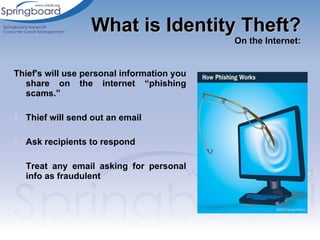
Thief's will use personal information you share on the internet “phishing scams.” Thief will send out an email Ask recipients to respond Treat any email asking for personal info as fraudulent What is Identity Theft? On the Internet:
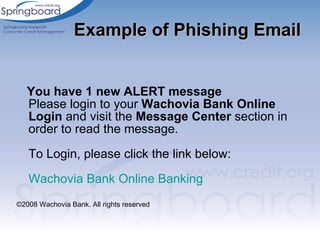
Example of Phishing Email You have 1 new ALERT message Please login to your  Wachovia Bank Online Login  and visit the  Message Center  section in order to read the message. To Login, please click the link below: Wachovia Bank Online Banking ©2008 Wachovia Bank. All rights reserved
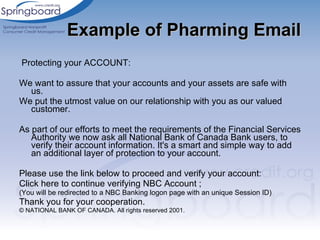
Example of Pharming Email Protecting your ACCOUNT: We want to assure that your accounts and your assets are safe with us. We put the utmost value on our relationship with you as our valued customer. As part of our efforts to meet the requirements of the Financial Services Authority we now ask all National Bank of Canada Bank users, to verify their account information. It's a smart and simple way to add an additional layer of protection to your account. Please use the link below to proceed and verify your account: Click here to continue verifying NBC Account ; (You will be redirected to a NBC Banking logon page with an unique Session ID) Thank you for your cooperation. © NATIONAL BANK OF CANADA. All rights reserved 2001.
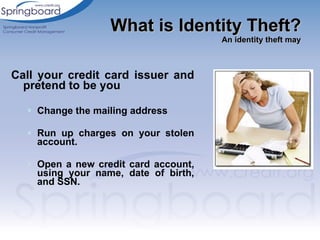
Call your credit card issuer and pretend to be you Change the mailing address Run up charges on your stolen account.  Open a new credit card account, using your name, date of birth, and SSN.  What is Identity Theft? An identity theft may
Often, the thief may sell your personal information to others over and over, making it harder to trace the source of the crime Jury duty scam –  someone pretending to work for the local court calls you and claims you’ve failed to report for jury duty. You are told  that a warrant has been issued for your arrest.  The scammer then asks the victim for confidential  information for “verification” purposes.  What is Identity Theft? Jury Duty Scam
Avoiding identity theft is not simple, but there are several common sense things that consumers can do. Keep personal information in a safe place – like a safe or locked box.  Don’t give your social security or account numbers over the phone to anyone who has called you Don’t keep sensitive personal information in your wallet or purse. Identity Theft Prevention Tips
Shred documents that contain personal information (Bank statements, credit solicitations, tax notices etc. Keep highly sensitive financial information away from others including family members Do not place outgoing mail in your mailbox. Deposit mail in a U.S. mailbox or at the post office to reduce the chance of mail theft. Identity Theft Prevention Tips
Cancel and cut up unused credit cards – or keep in a fireproof lock box or safe Do not sign the back of your credit cards Instead put “Photo ID Required” Cancel your paper bills and statements Have them sent to you online Identity Theft Prevention Tips
If you must use paper statements and receive them in the mail, pay attention to your billing cycles. Follow up with your creditors when your bills don’t arrive on time  Monitor your statements for unauthorized charges Do not carry unnecessary information such as PINS, passwords, or social security numbers in your wallets or purses Identity Theft Prevention Tips
Use and regularly update firewall, anti-spyware, and anti-virus software. Don’t register while visiting websites or participate in phone surveys, marketing surveys, or contests.  This creates one more source for identity thieves to appropriate your personal information through sale of your information.  Opt out of prescreened or pre-approved credit offers www.Optoutprescreen.com   1888-5OPT-OUT or 1888-567-8688 Remove name from telemarketing lists www.dmachoice.org/consumerassistance.php   Phone: 212-768-7277, ext. 1500  Identity Theft Prevention Tips
Your Rights Under the Law Victims As their own investigators In 2001, a California law was passed that gave identity theft victims who have a police report access to applications and other records on fraudulently opened accounts. An identity thief who remains at large can continue to use the victim’s information, requiring the victim to go through the process of clearing up records over and over again. The time and expenses necessary to deal with the situation are significant
Your Rights Under the Law The worst case scenario: Criminal Identity Theft Criminal identity theft occurs when an imposter gives another person’s name and personal information to a law enforcement officer upon arrest or during an investigation. In some cases, the imposter may provide a counterfeit driver’s license or other identification card. Can loose his/her drivers license Be arrested mistakenly Unable to get work, sometimes for years
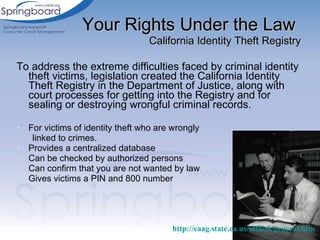
To address the extreme difficulties faced by criminal identity theft victims, legislation created the California Identity Theft Registry in the Department of Justice, along with court processes for getting into the Registry and for sealing or destroying wrongful criminal records.  For victims of identity theft who are wrongly  linked to crimes.  Provides a centralized database Can be checked by authorized persons Can confirm that you are not wanted by law Gives victims a PIN and 800 number Your Rights Under the Law   California Identity Theft Registry http://caag.state.ca.us/idtheft/general.htm
A key defensive tool that has been available to identity theft victims for several years is the fraud alert. It is a message that an identity theft victim can place on his or her credit file, which alerts credit issuers who are doing a credit check in response to an application for new credit in the victim’s name to fraud associated with the account. The initial Fraud Alert (90 days) Intended to prompt creditor to call a given number or ask additional info Entitled to one free credit report from each of the three companies The Extended Fraud Alert (7 Years) Similar to initial fraud alert The Active Duty Alert (1 Year) Opt Out automatically from Prescreened Offers for Two Years New Tools for Victims  Fraud Alerts Page. 8
Your Rights Under (FACTA)   Fair and Accurate Credit Transactions Act The Fair and Accurate Credit Transaction Act of 2003, (FACTA) amended the federal Fair Credit Reporting Act, (FCRA) by adding new sections intended primarily to help consumers fight the growing crime of identity theft. Accuracy, privacy, limits on information sharing, and new consumer rights to disclosure are included in FACTA. Below are a few of the new consumer rights: Free Credit Reports www.annualcreditreport.com 877-322-8228 Placing Fraud Alerts on your Credit File Page 9
Active Duty Alerts  for Military Personnel When you place an active duty alert, you’ll be removed from the credit reporting companies’ marketing list for prescreened credit card offers for two years - unless you ask to go back on the list before then. Prescreened offers – sometimes called “pre-approved” offers – are based on information in your credit report that indicates you meet certain criteria set by the offer. Alerts affective for 1 year, unless requested to be removed sooner Will be removed from credit reporting companies marketing list 2 years
Previously, disputes about the accuracy of information in a consumer report had to be made directly to the consumer reporting agency. Under new FACTA provisions, a consumer may dispute inaccurate information directly with a “furnisher,” that is, a creditor that is a financial institution. Upon notice of disputed information, the furnisher must investigate and cannot report negative information while the investigation is pending. Disputing Inaccurate Information
Disputing Inaccurate Information Notice of negative Information The number one tip for detecting identity theft is to check your credit report. Erroneous information about late payments and collection actions is what you don’t want to see. Like a lot of people, ordering your credit report is probably high on your “to do” list, but it never seems to get to the top of that list. FACTA Requires creditors to give you an early warning notice – this is not a substitute for your own monitoring
Disputing Inaccurate Information Nationwide Specialty Consumer Reporting Agencies Consumer reports are generally thought to mean “credit” reports issued by one of the three national credit bureaus: Experian, TransUnion, or Equifax.  However, consumer reports may also be issued for purposes other than credit applications. The FCRA also covers reports for insurance, employment, check writing and housing rental history. Such reports are quite common and a number of companies now specialize in providing reports for these specific purposes. FACTA defines companies that issue non-credit reports as a “nationwide specialty consumer reporting agency” when reports relate to:
Specialty Consumer Agencies Medical Records or payments (MIB) Residential or Tenant History (First Advantage SafeRent) Check writing history (CheckSystems/SCAN/Telecheck) Employment History Report (Choicepoint) Insurance Claims – Home/Auto insurance (Choicepoint) Disputing Inaccurate Information
Specialty Consumer Agencies MIB  Maintains a database for Members to exchange confidential info. of underwriting significance when an individual applies for life, health, disability income, long-term care or critical illness insurance. This information is maintained and safeguarded in a coded format that is accessible only to authorized personnel of a Member company to which you have applied for insurance and have authorized the company to use MIB as an information source. Address MIB, Inc. 50 Braintree Hill Park Suite 400 Braintree, MA 02184-8734   Phone (866) 692-6901 Online www.mib.com
Specialty Consumer Agencies CoreLogic SafeRent  A consumer reporting agency that assembles and evaluates consumer information and provides consumer reports to third parties for the purpose of residential screening, employment screening, and/or other purposes as permitted under federal, state, and local laws. If you have recently been denied housing, employment, or had any other adverse action taken against you based on information provided by SafeRent, use this info below obtain a free copy of your consumer file. Internet: www.annualcreditreport.com   Phone: 877-322-8228 (toll-free) Mail: Annual Credit Report Request Service PO Box 105281 Atlanta, GA 30348-5281
Specialty Consumer Agencies The Chex Systems, Inc.  Network is comprised of member Financial Institutions that regularly contribute information on mishandled checking and savings accounts to a central location. ChexSystems shares this information among member institutions to help them assess the risk of opening new accounts. ChexSystems only shares information with the member institutions and does not decide on new account openings  Denied an account from a bank or credit union, & used ChexSystems Help you understand what may have contributed to your denial Mail: Chex Systems, Inc. Attn: Consumer Relations 7805 Hudson Road, Suite 100 Woodbury, MN 55125 Fax: 602.659.2197 Telephone: 800.428.9623
Specialty Consumer Agencies LexisNexis Risk Solutions  Not a credit reporting agency and does not create credit reports. Your LexisNexis file will include your personal credit report only if one was ordered by a LexisNexis customer in connection with a background report (for example, if an employer requested your credit report as part of a background check).  Has no healthcare or medical information about you, no banking records, nor any information about the goods and services you purchase with credit cards. Internet https://personalreports.lexisnexis.com/index.jsp   Office: Sacramento, CA San Francisco Examen  LexisNexis 3831 North Freeway Blvd.  201 Mission Street, 26th Floor  Sacramento, CA 95834  San Francisco, CA 94105 Tel: 415-781-1707 800-523-8168
Credit Security Freeze Law Since November 1, 2007, the security freeze has been be offered voluntarily by Equifax, Experian, and TransUnion to consumers living in the states that have not yet adopted security freeze laws  (Alabama, Michigan, and Missouri).  It give victims & consumers the ability to control access to their credit files. Can help prevent identity theft Stops essentially all access to a credit file  Lasts until the consumer removes it or “thaws” it temporarily. Free to identity theft victims who have a police report of identity theft.  $10 to place a freeze with each of the three credit bureaus Provided a PIN to “Thaw” credit files For specific creditor or lender $12 For specific time period $10 Victims Free Page. 12
Opting Out The official Consumer Credit Reporting INdustry website to accept and process requests from consumers to Opt-In or Opt-Out of firm  (preapproved / prescreened)  offers of credit or insurance.  "Opt-Out" for 5 years or permanently They can stop the selling of your personal information to creditors.  Internet: www.outoutprescreen.com Phone: 1-888-5OPT-OUT or 1-888-567-8688.
Opting Out Remove your name from marketing lists. The Direct Marketing Association (DMA) is responsible for notifying its members that they must remove your name from lists they sell.   Your name and address remain in the DMA’s consumer exclusion files for 5 years   www.dmachoice.org/consumerassistance.php
What To Do if You Are a Victim If any of your personal identifying information (social security number, financial account numbers, and/ or password; birth date; name; address and telephone number) has been lost or stolen, or if you suspect that your personal information has been used to commit fraud or identity theft, take immediate action. Reporting this identity theft immediately and keeping detailed records of your actions are very important and can reduce the time it takes to resolve this crime. Keep Accurate Records Accurate and complete records will greatly improve your chances of resolving your identity theft case Report Your Identity Theft There are procedures under the federal laws for correcting credit report and billing errors, and stopping debt collectors from contacting you about debts you don’t owe.
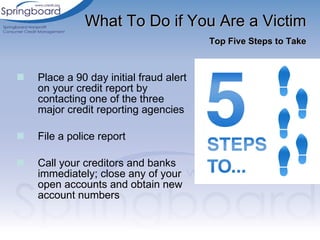
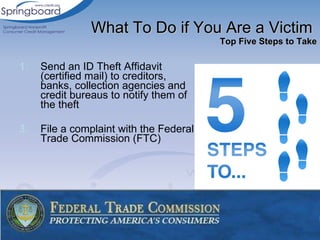
Place a 90 day initial fraud alert on your credit report by contacting one of the three major credit reporting agencies File a police report Call your creditors and banks immediately; close any of your open accounts and obtain new account numbers What To Do if You Are a Victim   Top Five Steps to Take
Send an ID Theft Affidavit (certified mail) to creditors, banks, collection agencies and credit bureaus to notify them of the theft File a complaint with the Federal Trade Commission (FTC) What To Do if You Are a Victim  Top Five Steps to Take
Use the checklist provided in Springboards boo to help you clear up your records. It lists the  actions most identity theft victims should take to limit the damage done by the thief.  Federal Trade Commission  www.consumer.gov/idtheft ,  The Identity Theft Resource Center at  www.idtheftcenter.org ,  The Privacy Rights Clearinghouse www.privacyrights.org Identity Theft Checklist
Thank You! Springboard  Nonprofit Consumer Credit Management 800-WISE-PLAN www.credit.org

Identity Theft Prevention

  • 1.
    Identity Theft PROTECTING and RESTORING YOUR GOOD NAME
  • 2.
    About Springboard Springboardis a non-profit organization founded in 1974. We offer personal financial education and assistance with money, credit, and debt management through educational programs and confidential counseling.
  • 3.
    About Springboard Accreditedby the (COA) Council on Accreditation Member of the (NFCC) National Foundation for Credit Counseling Certified by (HUD) The Department of Housing and Urban Development Member of the (BBB) Better Business Bureau
  • 4.
    Our Services IncludeCredit and Debt Counseling Financial Education Programs Seminars and Materials Debt Management Plans Homeowner Assistance (Foreclosure Prevention) First Time Home Buyer Education Seminars Reverse Mortgage Counseling Pre-Bankruptcy Budget and Credit Counseling Pre-Discharge Financial Management Instructional Course
  • 5.
    Identity theft hasbeen called the fastest growing crime in the U.S. with over 11 Million victims in 2009. Identity theft is also the number one complaint filed with the Federal Trade Commission for the past several years. In 2008 9.9 million Americans became victims In 2009, more than 11 million adult were victimized Total fraud amount $48 billion New account fraud avg. cost to consumer $4,849 Young adults (18-24) highest rates of id fraud than any other age group Javelin Identity Fraud Survey Report: Consumer Version Introduction
  • 6.
    When your personalinformation is stolen, and name, address, social security number, date of birth, PIN, password, etc. are used by the thief to access your accounts or open new accounts to obtain goods and services. What is Identity Theft?
  • 7.
    Stealing wallets andpurses Stealing your mail Rummaging through your trash “ Dumpster diving” Getting personal information in your home Housekeeping services Construction Home repair What is Identity Theft? An identity theft may
  • 8.
    Fraudulently obtain yourcredit report by posing as someone else Landlord Employer Getting your business or personal records at work. Through data breaches from otherwise reputable companies (creditors, social security, etc.) What is Identity Theft? Outside Your Home:
  • 9.
    Thief's will usepersonal information you share on the internet “phishing scams.” Thief will send out an email Ask recipients to respond Treat any email asking for personal info as fraudulent What is Identity Theft? On the Internet:
  • 10.
    Example of PhishingEmail You have 1 new ALERT message Please login to your Wachovia Bank Online Login and visit the Message Center section in order to read the message. To Login, please click the link below: Wachovia Bank Online Banking ©2008 Wachovia Bank. All rights reserved
  • 11.
    Example of PharmingEmail Protecting your ACCOUNT: We want to assure that your accounts and your assets are safe with us. We put the utmost value on our relationship with you as our valued customer. As part of our efforts to meet the requirements of the Financial Services Authority we now ask all National Bank of Canada Bank users, to verify their account information. It's a smart and simple way to add an additional layer of protection to your account. Please use the link below to proceed and verify your account: Click here to continue verifying NBC Account ; (You will be redirected to a NBC Banking logon page with an unique Session ID) Thank you for your cooperation. © NATIONAL BANK OF CANADA. All rights reserved 2001.
  • 12.
    Call your creditcard issuer and pretend to be you Change the mailing address Run up charges on your stolen account. Open a new credit card account, using your name, date of birth, and SSN. What is Identity Theft? An identity theft may
  • 13.
    Often, the thiefmay sell your personal information to others over and over, making it harder to trace the source of the crime Jury duty scam – someone pretending to work for the local court calls you and claims you’ve failed to report for jury duty. You are told that a warrant has been issued for your arrest. The scammer then asks the victim for confidential information for “verification” purposes. What is Identity Theft? Jury Duty Scam
  • 14.
    Avoiding identity theftis not simple, but there are several common sense things that consumers can do. Keep personal information in a safe place – like a safe or locked box. Don’t give your social security or account numbers over the phone to anyone who has called you Don’t keep sensitive personal information in your wallet or purse. Identity Theft Prevention Tips
  • 15.
    Shred documents thatcontain personal information (Bank statements, credit solicitations, tax notices etc. Keep highly sensitive financial information away from others including family members Do not place outgoing mail in your mailbox. Deposit mail in a U.S. mailbox or at the post office to reduce the chance of mail theft. Identity Theft Prevention Tips
  • 16.
    Cancel and cutup unused credit cards – or keep in a fireproof lock box or safe Do not sign the back of your credit cards Instead put “Photo ID Required” Cancel your paper bills and statements Have them sent to you online Identity Theft Prevention Tips
  • 17.
    If you mustuse paper statements and receive them in the mail, pay attention to your billing cycles. Follow up with your creditors when your bills don’t arrive on time Monitor your statements for unauthorized charges Do not carry unnecessary information such as PINS, passwords, or social security numbers in your wallets or purses Identity Theft Prevention Tips
  • 18.
    Use and regularlyupdate firewall, anti-spyware, and anti-virus software. Don’t register while visiting websites or participate in phone surveys, marketing surveys, or contests. This creates one more source for identity thieves to appropriate your personal information through sale of your information. Opt out of prescreened or pre-approved credit offers www.Optoutprescreen.com 1888-5OPT-OUT or 1888-567-8688 Remove name from telemarketing lists www.dmachoice.org/consumerassistance.php Phone: 212-768-7277, ext. 1500 Identity Theft Prevention Tips
  • 19.
    Your Rights Underthe Law Victims As their own investigators In 2001, a California law was passed that gave identity theft victims who have a police report access to applications and other records on fraudulently opened accounts. An identity thief who remains at large can continue to use the victim’s information, requiring the victim to go through the process of clearing up records over and over again. The time and expenses necessary to deal with the situation are significant
  • 20.
    Your Rights Underthe Law The worst case scenario: Criminal Identity Theft Criminal identity theft occurs when an imposter gives another person’s name and personal information to a law enforcement officer upon arrest or during an investigation. In some cases, the imposter may provide a counterfeit driver’s license or other identification card. Can loose his/her drivers license Be arrested mistakenly Unable to get work, sometimes for years
  • 21.
    To address theextreme difficulties faced by criminal identity theft victims, legislation created the California Identity Theft Registry in the Department of Justice, along with court processes for getting into the Registry and for sealing or destroying wrongful criminal records. For victims of identity theft who are wrongly linked to crimes. Provides a centralized database Can be checked by authorized persons Can confirm that you are not wanted by law Gives victims a PIN and 800 number Your Rights Under the Law California Identity Theft Registry http://caag.state.ca.us/idtheft/general.htm
  • 22.
    A key defensivetool that has been available to identity theft victims for several years is the fraud alert. It is a message that an identity theft victim can place on his or her credit file, which alerts credit issuers who are doing a credit check in response to an application for new credit in the victim’s name to fraud associated with the account. The initial Fraud Alert (90 days) Intended to prompt creditor to call a given number or ask additional info Entitled to one free credit report from each of the three companies The Extended Fraud Alert (7 Years) Similar to initial fraud alert The Active Duty Alert (1 Year) Opt Out automatically from Prescreened Offers for Two Years New Tools for Victims Fraud Alerts Page. 8
  • 23.
    Your Rights Under(FACTA) Fair and Accurate Credit Transactions Act The Fair and Accurate Credit Transaction Act of 2003, (FACTA) amended the federal Fair Credit Reporting Act, (FCRA) by adding new sections intended primarily to help consumers fight the growing crime of identity theft. Accuracy, privacy, limits on information sharing, and new consumer rights to disclosure are included in FACTA. Below are a few of the new consumer rights: Free Credit Reports www.annualcreditreport.com 877-322-8228 Placing Fraud Alerts on your Credit File Page 9
  • 24.
    Active Duty Alerts for Military Personnel When you place an active duty alert, you’ll be removed from the credit reporting companies’ marketing list for prescreened credit card offers for two years - unless you ask to go back on the list before then. Prescreened offers – sometimes called “pre-approved” offers – are based on information in your credit report that indicates you meet certain criteria set by the offer. Alerts affective for 1 year, unless requested to be removed sooner Will be removed from credit reporting companies marketing list 2 years
  • 25.
    Previously, disputes aboutthe accuracy of information in a consumer report had to be made directly to the consumer reporting agency. Under new FACTA provisions, a consumer may dispute inaccurate information directly with a “furnisher,” that is, a creditor that is a financial institution. Upon notice of disputed information, the furnisher must investigate and cannot report negative information while the investigation is pending. Disputing Inaccurate Information
  • 26.
    Disputing Inaccurate InformationNotice of negative Information The number one tip for detecting identity theft is to check your credit report. Erroneous information about late payments and collection actions is what you don’t want to see. Like a lot of people, ordering your credit report is probably high on your “to do” list, but it never seems to get to the top of that list. FACTA Requires creditors to give you an early warning notice – this is not a substitute for your own monitoring
  • 27.
    Disputing Inaccurate InformationNationwide Specialty Consumer Reporting Agencies Consumer reports are generally thought to mean “credit” reports issued by one of the three national credit bureaus: Experian, TransUnion, or Equifax. However, consumer reports may also be issued for purposes other than credit applications. The FCRA also covers reports for insurance, employment, check writing and housing rental history. Such reports are quite common and a number of companies now specialize in providing reports for these specific purposes. FACTA defines companies that issue non-credit reports as a “nationwide specialty consumer reporting agency” when reports relate to:
  • 28.
    Specialty Consumer AgenciesMedical Records or payments (MIB) Residential or Tenant History (First Advantage SafeRent) Check writing history (CheckSystems/SCAN/Telecheck) Employment History Report (Choicepoint) Insurance Claims – Home/Auto insurance (Choicepoint) Disputing Inaccurate Information
  • 29.
    Specialty Consumer AgenciesMIB Maintains a database for Members to exchange confidential info. of underwriting significance when an individual applies for life, health, disability income, long-term care or critical illness insurance. This information is maintained and safeguarded in a coded format that is accessible only to authorized personnel of a Member company to which you have applied for insurance and have authorized the company to use MIB as an information source. Address MIB, Inc. 50 Braintree Hill Park Suite 400 Braintree, MA 02184-8734 Phone (866) 692-6901 Online www.mib.com
  • 30.
    Specialty Consumer AgenciesCoreLogic SafeRent A consumer reporting agency that assembles and evaluates consumer information and provides consumer reports to third parties for the purpose of residential screening, employment screening, and/or other purposes as permitted under federal, state, and local laws. If you have recently been denied housing, employment, or had any other adverse action taken against you based on information provided by SafeRent, use this info below obtain a free copy of your consumer file. Internet: www.annualcreditreport.com Phone: 877-322-8228 (toll-free) Mail: Annual Credit Report Request Service PO Box 105281 Atlanta, GA 30348-5281
  • 31.
    Specialty Consumer AgenciesThe Chex Systems, Inc. Network is comprised of member Financial Institutions that regularly contribute information on mishandled checking and savings accounts to a central location. ChexSystems shares this information among member institutions to help them assess the risk of opening new accounts. ChexSystems only shares information with the member institutions and does not decide on new account openings Denied an account from a bank or credit union, & used ChexSystems Help you understand what may have contributed to your denial Mail: Chex Systems, Inc. Attn: Consumer Relations 7805 Hudson Road, Suite 100 Woodbury, MN 55125 Fax: 602.659.2197 Telephone: 800.428.9623
  • 32.
    Specialty Consumer AgenciesLexisNexis Risk Solutions Not a credit reporting agency and does not create credit reports. Your LexisNexis file will include your personal credit report only if one was ordered by a LexisNexis customer in connection with a background report (for example, if an employer requested your credit report as part of a background check). Has no healthcare or medical information about you, no banking records, nor any information about the goods and services you purchase with credit cards. Internet https://personalreports.lexisnexis.com/index.jsp Office: Sacramento, CA San Francisco Examen LexisNexis 3831 North Freeway Blvd. 201 Mission Street, 26th Floor Sacramento, CA 95834 San Francisco, CA 94105 Tel: 415-781-1707 800-523-8168
  • 33.
    Credit Security FreezeLaw Since November 1, 2007, the security freeze has been be offered voluntarily by Equifax, Experian, and TransUnion to consumers living in the states that have not yet adopted security freeze laws (Alabama, Michigan, and Missouri). It give victims & consumers the ability to control access to their credit files. Can help prevent identity theft Stops essentially all access to a credit file Lasts until the consumer removes it or “thaws” it temporarily. Free to identity theft victims who have a police report of identity theft. $10 to place a freeze with each of the three credit bureaus Provided a PIN to “Thaw” credit files For specific creditor or lender $12 For specific time period $10 Victims Free Page. 12
  • 34.
    Opting Out Theofficial Consumer Credit Reporting INdustry website to accept and process requests from consumers to Opt-In or Opt-Out of firm (preapproved / prescreened) offers of credit or insurance. "Opt-Out" for 5 years or permanently They can stop the selling of your personal information to creditors. Internet: www.outoutprescreen.com Phone: 1-888-5OPT-OUT or 1-888-567-8688.
  • 35.
    Opting Out Removeyour name from marketing lists. The Direct Marketing Association (DMA) is responsible for notifying its members that they must remove your name from lists they sell. Your name and address remain in the DMA’s consumer exclusion files for 5 years www.dmachoice.org/consumerassistance.php
  • 36.
    What To Doif You Are a Victim If any of your personal identifying information (social security number, financial account numbers, and/ or password; birth date; name; address and telephone number) has been lost or stolen, or if you suspect that your personal information has been used to commit fraud or identity theft, take immediate action. Reporting this identity theft immediately and keeping detailed records of your actions are very important and can reduce the time it takes to resolve this crime. Keep Accurate Records Accurate and complete records will greatly improve your chances of resolving your identity theft case Report Your Identity Theft There are procedures under the federal laws for correcting credit report and billing errors, and stopping debt collectors from contacting you about debts you don’t owe.
  • 37.
    Place a 90day initial fraud alert on your credit report by contacting one of the three major credit reporting agencies File a police report Call your creditors and banks immediately; close any of your open accounts and obtain new account numbers What To Do if You Are a Victim Top Five Steps to Take
  • 38.
    Send an IDTheft Affidavit (certified mail) to creditors, banks, collection agencies and credit bureaus to notify them of the theft File a complaint with the Federal Trade Commission (FTC) What To Do if You Are a Victim Top Five Steps to Take
  • 39.
    Use the checklistprovided in Springboards boo to help you clear up your records. It lists the actions most identity theft victims should take to limit the damage done by the thief. Federal Trade Commission www.consumer.gov/idtheft , The Identity Theft Resource Center at www.idtheftcenter.org , The Privacy Rights Clearinghouse www.privacyrights.org Identity Theft Checklist
  • 40.
    Thank You! Springboard Nonprofit Consumer Credit Management 800-WISE-PLAN www.credit.org

Editor's Notes

  • #5 DMP info page 8