Financial
Literacy
The Importance of
Understanding and Managing
Your Personal Finances
LEARNING
OUTCOMES
• Define financial literacy
• Present ways on how to avoid financial crises and
scams
• Demonstrate understanding of insurance and
taxes
• Describe a financially stable person
• Determine ways on how to integrate financial
literacy in the curriculum
• Draw relevant life lessons and significant values
from personal experiences on financial crises and
scams
• Make a personal financial plan based on short-
term and long-term goals
CONCEPT
EXPLORATION
In some instances, teachers are confronted with
issues and concerns on financial debt, being
victimized by fraud and other related scams, both
personal and electronic ways. More so, some
teachers are drowned by emergent financial needs
and unexpected debt, especially in difficult times,
sickness and inevitable circumstances and
calamities.
Definition
What is Financial
Literacy?
Financial literacy is a core life skill in an increasingly
complex world where people need to take charge of
their own finances, budget, financial choices, managing
risks, saving, credit, and financial transactions.
Poor financial decisions can have a long-lasting
impact on individuals, their families and the
society caused by lack of financial literacy. Low
levels of financial literacy are linked with low
standards of living, decreased psychological and
physical well-being and greater reliance on
government support. However, when put into
correct practice, financial literacy can strengthen
savings behavior, eliminate maxed-out credit
cards and enhance timely debt.
Financial literacy is the ability to make
informed judgments and make effective
decisions regarding the use and
management of money. Hence, teaching
financial literacy yields better financial
management skills.
The importance of starting financial literacy
while still young.
National surveys show that young adults have
the lowest levels of financial literacy as
reflected in their inability to choose the right
financial products and lack of interest in
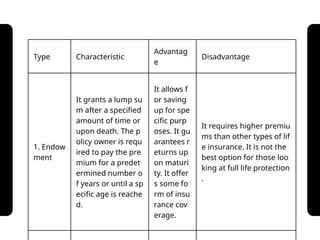
undertaking sound financial planning.
Therefore, financial education should begin
as early as possible and be taught in schools.
Likewise, financial literacy is the
capability of a person to handle his/her
assets, especially cash more efficiently
while understanding how money works
in the real world.
1. Calculating the net worth. Net worth is the amount by which
assets exceed liabilities. In so doing, consider
(1) assets that entail one’s cash, property, investments, savings,
jewelry, and wealth; and
(2) liabilities that include credit card debt, loans, and mortgage.
Formula: total assets - minus total liabilities = current net worth.
FINANCIAL PLAN
Teachers need to have a deeper understanding and capacity to
formulate their own financial plan. It is wise to consider starting
bonuses and extra remunerations that they receive, including the
incentives, bonuses, and extra remuneration that they receive.
The following are steps in creating a financial plan.
2. Determining cash flow. A financial plan is knowing where money
goes every month. Documenting it will help to see how much is
needed every month for necessities, and the amount for savings
and investment.
3. Considering the priorities. The core of a financial plan is the person’s
clearly defined goals that may include:
(1) Retirement strategy for accumulating retirement income;
(2) Comprehensive risk management plan including a review of life and
disability insurance, personal liability coverage, property and casualty
coverage, and catastrophic coverage;
(3) Long-term investment plan based on specific investment objectives
and a personal risk tolerance profile; and
(4) Tax reduction strategy for minimizing taxes on personal income
allowed by the tax code.
Five Financial
Improvement
Strategies
1.Identify your starting point. Calculating
the net worth is the best way to
determine both current financial status
and progress over time to avoid financial
trouble by spending too much on wants
and nothing enough for the needs.
• Automate savings transfers.
• Prioritize saving before spending.
Five Financial
Improvement
Strategies
2. Set your priorities. Making a list of rated
needs and wants can help set financial
priorities. Needs are things one must have in
order to survive (i.e., food, shelter, clothing,
healthcare, and transportation); while wants
are things one would like to have but are not
necessary for survival. • Automate savings transfers.
• Prioritize saving before spending.
Five Financial
Improvement
Strategies
3. Document your spending. One of the best
ways to figure out cash flow or what comes in
and what goes out is to create a budget or a
personal spending plan. A budget lists down
all income and expenses to help meet
financial obligations.
• Automate savings transfers.
• Prioritize saving before spending.
Five Financial
Improvement
Strategies
4. Lay down your debt. Living with debt is
costly not just because of interest and fees,
but it can also prevent people from getting
ahead with their financial goals.
• Automate savings transfers.
• Prioritize saving before spending.
Five Financial
Improvement
Strategies
5. Secure your financial future/Retirement is
an uncontrollable stage in a worker’s life, of
which counterpart are losing the job,
suffering from an illness or injury, or be
forced to care for a loved one that may lead
to an unplanned retirement.
• Automate savings transfers.
• Prioritize saving before spending.
Key Concepts of
Financial Literacy
Budgeting:
Creating a plan for how you
will spend and save your
money.
Saving:
Setting aside money for
future needs and
emergencies.
Investing:
Using money to generate
additional income or growth
over time.
Debt Management:
Understanding how to
handle and repay debt
responsibly.
FINANCIAL GOAL
PLANNING AND SETTING
Setting goals is a very important part
of life, especially in financial planning.
Before investing money, consider
setting personal financial goals.
Financial goals are targets, usually
driven by specific future financial
needs, such as saving for a
comfortable retirement, sending
children to college, or enabling a
home purchase.
There are three key areas in setting
investment goals for consideration.
A. Time horizon. It indicates the
time when the money will be
needed. To note, the longer the
time horizon, the more risky
(and potentially more lucrative)
investments can be made.
There are three key areas in setting
investment goals for consideration.
B. Risk tolerance. Investors may
let go of the possibility of a large
gain if they knew there was also
a possibility of a large loss (they
are called risk averse); while
others are more willing to take
the chance of a large loss if there
were also a possibility of a large
gain (they are called risk
seekers). The time horizon can
affect risk tolerance.
There are three key areas in setting
investment goals for consideration.
C. Liquidity needs. Liquidity
refers to how quickly an
investment can be converted
into cash (or the equivalent of
cash). The liquidity needs usually
affect the type of chosen
investment to meet the goals.
There are three key areas in setting
investment goals for consideration.
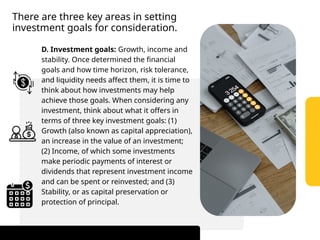
D. Investment goals: Growth, income and
stability. Once determined the financial
goals and how time horizon, risk tolerance,
and liquidity needs affect them, it is time to
think about how investments may help
achieve those goals. When considering any
investment, think about what it offers in
terms of three key investment goals: (1)
Growth (also known as capital appreciation),
an increase in the value of an investment;
(2) Income, of which some investments
make periodic payments of interest or
dividends that represent investment income
and can be spent or reinvested; and (3)
Stability, or as capital preservation or
protection of principal.
Budget and
Budgeting
1.A budget is an estimation of revenue and expenses over a
specified future period of time and is usually compiled and re-
evaluated on a periodic basis. Budgets can be made for a
variety of individual or business needs. Budgeting, on the other
hand, is the process of creating a plan to spend money.
Budgeting, on the other hand, is the process of creating a plan
to determine in advance whether he/she will have enough
money to do the things he/she needs or likes to do.
• Automate savings transfers.
• Prioritize saving before spending.
Seven Steps to Good
Budgeting
Step 1: Set realistic goals. Goals for the money will help make smart
spending choices upon deciding on what is important.
Step 2: Identify income and expenses. Upon knowing how much is
earned each month and where it all goes, start tracking the
expenses by recording every single cent.
Step 3: Separate needs from wants. Set clear priorities and the
decisions become easier to make by identifying wisely those that
are really needed or just wanted.
• Automate savings transfers.
• Prioritize saving before spending.
Step 4: Design your budget. Make sure to avoid spending more
than what is earned. Balance budget to accommodate everything
needed to be paid for.
Step 5: Put your plan into action. Match spending with income
payday. Non-reliance to credit for the living expenses will protect
one from debt.
Step 6: Plan for seasonal expenses. Set money aside to pay for
unplanned expenses so to avoid going into debt.
Step 7: Look ahead. Having a stable budget can take a month or
two, so, ask for help if things are not getting well.
• Automate savings transfers.
• Prioritize saving before spending.
Spending
1.If budget goals serve as a financial wish list, a spending
plan is a way to make those wishes a reality. Turn them
into an action budget goals and spending plan. The
following are practical strategies in setting and
prioritizing budget goals and spending plan:
• Automate savings transfers.
• Prioritize saving before spending.
Savings
1.In order to get out of debt, it is important to set some
money aside and put it into a savings account on a
regular basis. Savings will also help in buying things that
are needed or wanted without borrowing.
• Automate savings transfers.
• Prioritize saving before spending.
EMERGENCY
SAVINGS FUND.
1.Start as early, setting aside a little money for emergency
savings fund. If you receive a bonus from work, an
income tax refund or earnings from additional or side
jobs, use them as an emergency fund.
• Automate savings transfers.
• Prioritize saving before spending.
10 Reasons Why Save MoneyWith credit so easy to get, here
are ten practical reasons why it is important to save money
that everyone, including teachers, must know.
1. To become financially
independent. Financial
independence is not having to
depend on receiving a certain
pay but setting aside an amount
to have savings that can be relied
on.
2. To save on everything you buy.
With savings, you can buy things
when they are on sale and can
make better spending choices,
without being compromised on
credit card interest charges.
3. To buy a home or a car. Savings
can be used in buying a home in
full or down payment, especially
in times of promo deals, bids and
inevitable sale and at a
reasonable interest rate.
10 Reasons Why Save MoneyWith credit so easy to get, here
are ten practical reasons why it is important to save money
that everyone, including teachers, must know.
4. To prepare for the
future. Through savings,
you can be confident to
face the future without
worrying on how you will
survive.
6. To augment annual
expenses. In order to
attain a good, stress-
free financial life, there
is a need to save for
annual expenses in
advance.
5. To get out of
debt. If you want
to get out of debt,
you have to save
money.
10 Reasons Why Save MoneyWith credit so easy to get, here
are ten practical reasons why it is important to save money
that everyone, including teachers, must know.
7. To settle unforeseen
expenses. Savings can
respond to unforeseen
expenses in times of
need.
9. To mitigate losing your job
or getting hurt. Bad things
can happen to anyone, such
as losing a job, business
bankruptcy, or crisis, being
injured or becoming too sick
to work.
8. To respond to emergencies.
Emergencies may happen
anytime and these can be
expensive so, there is a need to
get prepared rather than
potentially become another
victim of an emergency.
10 Reasons Why Save MoneyWith credit so easy to get, here
are ten practical reasons why it is important to save money
that everyone, including teachers, must know.
10. To have a good life. Putting
aside some money to spend
when needed can bring about
quality and worry-free life at all
times.
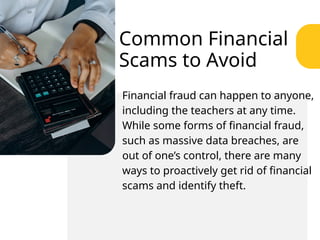
Common Financial
Scams to Avoid
Financial fraud can happen to anyone,
including the teachers at any time.
While some forms of financial fraud,
such as massive data breaches, are
out of one’s control, there are many
ways to proactively get rid of financial
scams and identify theft.
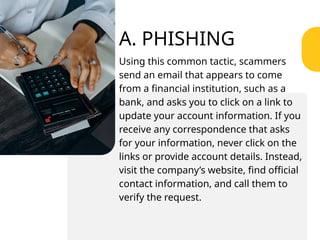
A. PHISHING
Using this common tactic, scammers
send an email that appears to come
from a financial institution, such as a
bank, and asks you to click on a link to
update your account information. If you
receive any correspondence that asks
for your information, never click on the
links or provide account details. Instead,
visit the company’s website, find official
contact information, and call them to
verify the request.
B. Social Media
Scams.
Scammers are adept at using social
media to gather information about the
traveling habits of potential victims.
They also have phishing tactics,
including posts seeking charity
donations with bogus links that allow
them to keep your money.
C. Phone Scams.
Another prevalent tactic is scamming
phone calls. The scammers post as a
government agency, such as the Bureau
of Internal Revenue or local law
enforcement agencies, and use scare
tactics to acquire your personal
information and account numbers.
Never provide your account information
over the phone. Look for the agency’s
contact information, and call them to
verify any request.
D. Stolen Credit
Card Numbers.
There are numerous ways that
scammers can obtain your credit card
information, including hacking,
phishing, and the use of skimming
devices, such as small card readers
attached to unmanned credit card
readers (i.e. ATMs, gas pumps, and
more). These small devices pull data
from your card when you swipe it.
Before you use an ATM or swipe your
card, look for suspicious devices that
may be attached to the card reader.
E. Identify Theft
Depending on the amount of
information a scammer is able to obtain,
identity may extend beyond
unauthorized charges on a debit or
credit card. If scammers are able to
obtain your Social Security number, date
of birth, and other personal information,
they may be able to open new accounts
in your name without your knowledge.
Be aware of an information you share
and with whom, and be sensitive
information before disposing it.
10 Tips to Avoid
Common Financial
Scams
Prioritize high-interest debt
repayment.
Every year, fraud cases are getting worse, leaving countless
victims in trouble and danger through online scams.
Unfortunately, new data breaches, identity theft and fraudsters
are on edge, making it easier than ever for scam artists to nab
financial data from unsuspecting consumers (Bell, 2019).
1. Never wire money to a stranger. Although it is one of the
oldest Internet scams, there are still consumers who fall for this
rip-off or some variations of it.
2. Don’t give out financial information. Never reveal sensitive
personal financial information to a person or business you don’t
know, thru phone, text or email.
3. Never click on hyperlinks in emails. If you receive an email
from a stranger or company asking you to click on a hyperlink
or open an attachment and then, enter your financial
information, delete the email immediately.
4. Use difficult passwords. Hackers can easily find passwords
that are simple number combinations. Create passwords that
have eight characters long and that include some lower and
upper case letters, numbers and special characters. You should
also use a different password for every website you visit.
5. Never give your social security number. If you receive an
email or visit a website that asks for your Social Security
number, ignore it.
6. Install Antivirus and Spyware protection. Protect the sensitive
information stored on your computer by installing the antivirus,
firewall and spyware protection. Once you make the program,
turn on the auto-updating feature to make sure the software is
always up-to-date.
7. Don’t shop with unfamiliar online retailers. When it comes to
online shopping, only do business with familiar companies, to
online product from an unfamiliar retailer, do some research to
ensure the business is legit and reputable.
8. Don’t download software from pop-up windows. When you
claim are online, do not trust pop-up windows that appear and
are unsafe. If you click on the link in the pop-up, your computer
is scan or some other programs, malicious to start the “system”
as “malware” could damage your operating system.
9. Make sure the websites you visit are safe. Before you enter
your financial information on any website, double-check the
website’s privacy rules. Also, make sure the website uses
encryption, which is usually symbolized by a lock to the left of
the web address which means it is safe and protected against
hackers.
10. Donate to known charities only. If you receive a call or an
email for solicitation of charity donations, critically examine it.
Some scammers create bogus charities to steal credit card
information.
(https://www.investopedia.com/articles/
Financial Scams among Students. Students can also be
susceptible to different financial scams and fraud. Learning how
to manage finances and being aware of financial scams are
skills that every student should master.
The following are common financial scams that students should
watch out for, and learn to protect one’s identity and finances.
A. Fake scholarships. While it is beneficial for students to apply
for as many scholarships, it is important to become aware of
related scams and frauds. Students should thoroughly check
scholarship sources before applying to verify legitimacy. Never
apply for a scholarship that asks for money in return.
B. Diploma mills. There are schools that offer fake degrees and
diplomas in exchange for a fee. Check from government
education agencies the prospective school to enroll in if it is
government-recognized, legitimate or accredited.
C. Online book scams. While students often go for the best
deals on textbooks online, scammers can use this opportunity
to get students’ credit card information. When buying anything
online, be sure to do it on a credible site.
D. Credit card scams. Oftentimes, credit card companies go to
school campuses to convince students to fill out card
applications. Scammers may also grab this chance to steal
students’ information. It is important to visit a local credit union
or bank for credit card application. Also, regularly check the
credit card statement and once there are any unrecognized
charges, contact your banking institution immediately.
(https://www.ecl.org/resources/financial-scam-safety/)
Insurance and
Taxes
Insurance is a contract (in the form of a policy)
between the policyholder and the insurance
company, whereby the company agrees to
compensate for any financial loss from specific
insured events. In exchange for the financial
protection offered, policyholder agrees to pay a
certain sum of money, known as premiums to the
insurance company. There are various types of risks
management against uncertain loss, insurance,
health insurance, motor insurance, such as life
insurance entails tax benefit claim on the paid
premiums.
1. Employer-Sponsored Insurance.
Ideal if working in a company with 50
or more full-time employees, the
employer is required to provide
employee-only insurance that meets
minimum guidelines.
2.Marketplace plans are available
based on an area of residence and
income upon meeting minimum
coverage requirements. Marketplace
plans come in three tiers: bronze, silver
and gold. Generally, bronze plans offer
the least coverage at the lowest
premiums, while gold plans provide the
most coverage at the highest price.
2.Marketplace plans are available
based on an area of residence and
income upon meeting minimum
coverage requirements. Marketplace
plans come in three tiers: bronze, silver
and gold. Generally, bronze plans offer
the least coverage at the lowest
premiums, while gold plans provide the
most coverage at the highest price.
Life Insurance
Life insurance is a type of
insurance that compensates
beneficiaries upon the death
of the policyholder. The
company will guarantee a
payout for the beneficiaries in
exchange of premiums. This
compensation is called “death
benefit”
Depending on the type of
insurance one may have, these
events can be anything from
retirement, to major injuries,
to critical illness or even to
death.
The following are
common risk
categories:
1. Preferred Plus – The policyholder is in excellent
health, with normal weight, no history of smoking,
chronic illnesses, or life-threatening disease.
2. Preferred – The policyholder is in excellent health
but may have minor issues on cholesterol or blood
pressure but under control.
3. Standard Plus – The policyholder is in very good
health but some factors, like high blood pressure or
being overweight impede a better rating
4. Standard – Most policyholders belong to this
category, as they are deemed to be in healthy and
have a normal life expectancy although, they may
have a family history of life-threatening diseases or
few minor health issues.
5. Substandard – Those with serious health issues,
like diabetes or heart disease are placed on a table
rating system, from highest to lowest. On average,
the premiums will be similar to Standard with an
additional 25% lower claim on table ratings.
6. Smokers – Due to an added risk of smoking, the
policyholders in this category are guaranteed to pay
more. Aside from health class, age is also a critical
factor in determining premiums. Therefore, older
people pay more expensive premiums.
Benefits of Life
Insurance
The following are the
benefits of life
insurance.
1. It pays for medical and funeral costs. Life
insurance helps solve the incurred expenses for
medical and funeral services to lessen the grief
among family and relatives for being unprepared.
2. For financial support. Life insurance can become a
source of temporary income during the difficult
period of adjusting and coping with the loss of a
loved one, especially if he/she is the breadwinner.
3. For funding various financial goals. Life insurance
offers additional benefits through the form of fund
accumulation for specific future financial goals.
4. Acts as a retirement secured conform. Modern life
insurance also serves as a tool that principal holders
can use to get in a better financial position in the
future.
5. It covers costs incurred from taxes and debt. Life
insurance can serve as protection since the premium
can be used to pay for unsettled debts and taxes.
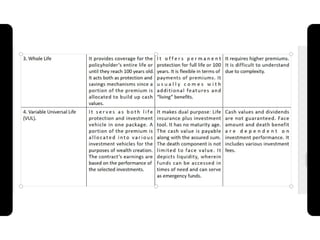
Types of Life
Insurance
The table below shows a comparative analysis of different
types of life insurance along characteristics, advantages and
disadvantages that may serve as a reference.
Type Characteristic
Advantag
e
Disadvantage
1. Endow
ment
It grants a lump su
m after a specified
amount of time or
upon death. The p
olicy owner is requ
ired to pay the pre
mium for a predet
ermined number o
f years or until a sp
ecific age is reache
d.
It allows f
or saving
up for spe
cific purp
oses. It gu
arantees r
eturns up
on maturi
ty. It offer
s some fo
rm of insu
rance cov
erage.
It requires higher premiu
ms than other types of lif
e insurance. It is not the
best option for those loo
king at full life protection
.
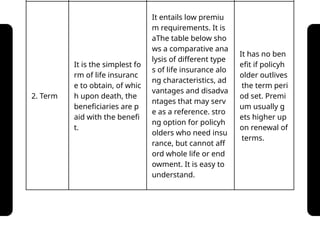
2. Term
It is the simplest fo
rm of life insuranc
e to obtain, of whic
h upon death, the
beneficiaries are p
aid with the benefi
t.
It entails low premiu
m requirements. It is
aThe table below sho
ws a comparative ana
lysis of different type
s of life insurance alo
ng characteristics, ad
vantages and disadva
ntages that may serv
e as a reference. stro
ng option for policyh
olders who need insu
rance, but cannot aff
ord whole life or end
owment. It is easy to
understand.
It has no ben
efit if policyh
older outlives
the term peri
od set. Premi
um usually g
ets higher up
on renewal of
terms.
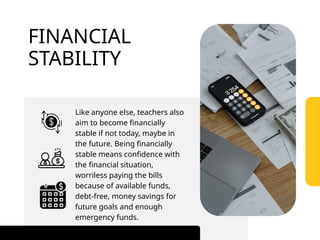
Like anyone else, teachers also
aim to become financially
stable if not today, maybe in
the future. Being financially
stable means confidence with
the financial situation,
worriless paying the bills
because of available funds,
debt-free, money savings for
future goals and enough
emergency funds.
FINANCIAL
STABILITY
Just like any goal, getting the
finances stable and becoming
financially successful requires
the development of good
financial habits. Babauta (2007)
suggests 10 habits toward
financial stability and success
10 Strategies in
Reaching Financial
Stability
1. Make savings automagical. Savings should be
made a top priority, especially as an emergency fund
and a bill payment from the account, like an online
savings.
2. Control your impulsive spending. Control your self
from impulsive spending on eating out, shopping
and online purchases that may ruin your finances
and budget.
3. Evaluate your expenses and live frugally. Analyze
how you spend your money, see what you can
reduce and determine expenses that are necessary
and eliminate the unnecessary.
4. Invest in your future. Start preparing and
investing for your future retirement while still young
in your career field.
5. Keep your family secure. Save for an emergency
fund, so that you have some to spend if anything
happens with the family emergency.
6. Eliminate and avoid debt. Eliminate credit cards,
personal loans, or other debt forms as it does not
work on you but even pull you down and make you
drowned with obligations that may even resort to
surrendering your properties, jewelry and
investments as payment.
7. Use the envelope system. Set aside three amounts
in your budget each payday, withdraw those
amounts and put them in three separate envelopes.
In that way, you can easily track how much remains
for each of the expenses or if you already run out of
money.
8. Pay bills immediately. One good habit is to pay
bills as soon as they come in and try to get your bills
to be paid through automatic deduction.
9. Read about personal finances. The more you
educate yourself, the better the finances will be.
10. Look to grow your net worth. Do whatever you
can to improve your net worth, either by reducing
your debt, increasing your savings, or increasing
your income, or all of the above.
(https://zenhabits.net/10-habits-to-develop-for-
financial/)
Signs of Being Financially
StableTeachers, like any one
else, often work to the extent
to earn more even through
additional jobs on the side just
for their desire for financial
stability.Rose (2019) presents
some signs of a financially
stable person.
You never overdraw your
checking account.
Signs of Being
Financially
StableTeachers,
1. you never overdraw your
checking account.
2. You don’t lose sleep over
finances.
3. You use credit cards for
convenience and rewards but
never out of necessity.
4. You don’t worry about losing
your job.
Signs of Being
Financially
StableTeachers,
5. You pay your bills ahead of
time.
6. People ask your opinion
about financial matters and
you inspire them.
7. You’re generally happy with
your financial situation.
8. You finance your cars over
five years or less if you take
loans at all.
Signs of Being
Financially
StableTeachers,
9. You contribute more to your
retirement.
10. You don’t feel guilty when
you’re out for special
occasions.
11. You can afford to buy the
things you really want.
Signs of Being
Financially
StableTeachers,
12. Recreation spending
doesn’t appeal to you.
13. You’re a natural saver.
14. You’re generous with
money when it comes to
charities or helping others.
15. You’re confident about your
future.
16. Your net worth grows
Signs of Being
Financially
StableTeachers,
16. Your net worth grows
significantly from year to year.
17. You have substantial equity in
your home.
18. You consistently live beneath
your means.
19. You could survive for months
without a paycheck.
20. You feel in control of your
finances and never dominated by
them.
Signs of Being
Financially
StableTeachers,
Integrating Financial Literacy into the Curriculum
FINANCIAL EDUCATION in schools should be part of a collaborative
national strategy to ensure relevance and long-term sustainability.
The education system and profession should be involved in the
development of the strategy.
IN SUPPORT, BARRY (2013) underscored that financial literacy has a
wide repercussion outside the family circle and more precisely, the
school. Hence, administrators and professors need to develop a
curriculum that would provide students insights on having the
value of financial literacy including the effect it can bring them.
FINANCIAL EDUCATION should ideally be a core part of the school
curriculum. It can be integrated into other subjects like
mathematics, technology and home economics, values, economics,
social studies, technology.
TEACHERS should be adequately trained and resourced, made
aware of the importance of financial literacy and relevant
pedagogical methods and they should receive continuous support
to teach it or integrate in their lesson. MORE so, there should be
easily accessible, objective, high-quality and effective learning tools
and pedagogical resources available to the level of study.
STUDENTS’ SCHOOLS AND TEACHERS that are assessed through
various high impact modes. PROGRESS should also be assessed
through various high impact modes.
THAT’S ALL THANK YOU

Financial-Literacyyyyyyyyyyyyyyyyyyyyyyy

  • 1.
    Financial Literacy The Importance of Understandingand Managing Your Personal Finances
  • 2.
    LEARNING OUTCOMES • Define financialliteracy • Present ways on how to avoid financial crises and scams • Demonstrate understanding of insurance and taxes • Describe a financially stable person • Determine ways on how to integrate financial literacy in the curriculum • Draw relevant life lessons and significant values from personal experiences on financial crises and scams • Make a personal financial plan based on short- term and long-term goals
  • 3.
    CONCEPT EXPLORATION In some instances,teachers are confronted with issues and concerns on financial debt, being victimized by fraud and other related scams, both personal and electronic ways. More so, some teachers are drowned by emergent financial needs and unexpected debt, especially in difficult times, sickness and inevitable circumstances and calamities.
  • 4.
    Definition What is Financial Literacy? Financialliteracy is a core life skill in an increasingly complex world where people need to take charge of their own finances, budget, financial choices, managing risks, saving, credit, and financial transactions.
  • 5.
    Poor financial decisionscan have a long-lasting impact on individuals, their families and the society caused by lack of financial literacy. Low levels of financial literacy are linked with low standards of living, decreased psychological and physical well-being and greater reliance on government support. However, when put into correct practice, financial literacy can strengthen savings behavior, eliminate maxed-out credit cards and enhance timely debt.
  • 6.
    Financial literacy isthe ability to make informed judgments and make effective decisions regarding the use and management of money. Hence, teaching financial literacy yields better financial management skills.
  • 7.
    The importance ofstarting financial literacy while still young. National surveys show that young adults have the lowest levels of financial literacy as reflected in their inability to choose the right financial products and lack of interest in undertaking sound financial planning. Therefore, financial education should begin as early as possible and be taught in schools.
  • 8.
    Likewise, financial literacyis the capability of a person to handle his/her assets, especially cash more efficiently while understanding how money works in the real world.
  • 9.
    1. Calculating thenet worth. Net worth is the amount by which assets exceed liabilities. In so doing, consider (1) assets that entail one’s cash, property, investments, savings, jewelry, and wealth; and (2) liabilities that include credit card debt, loans, and mortgage. Formula: total assets - minus total liabilities = current net worth. FINANCIAL PLAN Teachers need to have a deeper understanding and capacity to formulate their own financial plan. It is wise to consider starting bonuses and extra remunerations that they receive, including the incentives, bonuses, and extra remuneration that they receive. The following are steps in creating a financial plan.
  • 10.
    2. Determining cashflow. A financial plan is knowing where money goes every month. Documenting it will help to see how much is needed every month for necessities, and the amount for savings and investment. 3. Considering the priorities. The core of a financial plan is the person’s clearly defined goals that may include: (1) Retirement strategy for accumulating retirement income; (2) Comprehensive risk management plan including a review of life and disability insurance, personal liability coverage, property and casualty coverage, and catastrophic coverage; (3) Long-term investment plan based on specific investment objectives and a personal risk tolerance profile; and (4) Tax reduction strategy for minimizing taxes on personal income allowed by the tax code.
  • 11.
    Five Financial Improvement Strategies 1.Identify yourstarting point. Calculating the net worth is the best way to determine both current financial status and progress over time to avoid financial trouble by spending too much on wants and nothing enough for the needs. • Automate savings transfers. • Prioritize saving before spending.
  • 12.
    Five Financial Improvement Strategies 2. Setyour priorities. Making a list of rated needs and wants can help set financial priorities. Needs are things one must have in order to survive (i.e., food, shelter, clothing, healthcare, and transportation); while wants are things one would like to have but are not necessary for survival. • Automate savings transfers. • Prioritize saving before spending.
  • 13.
    Five Financial Improvement Strategies 3. Documentyour spending. One of the best ways to figure out cash flow or what comes in and what goes out is to create a budget or a personal spending plan. A budget lists down all income and expenses to help meet financial obligations. • Automate savings transfers. • Prioritize saving before spending.
  • 14.
    Five Financial Improvement Strategies 4. Laydown your debt. Living with debt is costly not just because of interest and fees, but it can also prevent people from getting ahead with their financial goals. • Automate savings transfers. • Prioritize saving before spending.
  • 15.
    Five Financial Improvement Strategies 5. Secureyour financial future/Retirement is an uncontrollable stage in a worker’s life, of which counterpart are losing the job, suffering from an illness or injury, or be forced to care for a loved one that may lead to an unplanned retirement. • Automate savings transfers. • Prioritize saving before spending.
  • 16.
    Key Concepts of FinancialLiteracy Budgeting: Creating a plan for how you will spend and save your money. Saving: Setting aside money for future needs and emergencies. Investing: Using money to generate additional income or growth over time. Debt Management: Understanding how to handle and repay debt responsibly.
  • 17.
    FINANCIAL GOAL PLANNING ANDSETTING Setting goals is a very important part of life, especially in financial planning. Before investing money, consider setting personal financial goals. Financial goals are targets, usually driven by specific future financial needs, such as saving for a comfortable retirement, sending children to college, or enabling a home purchase.
  • 18.
    There are threekey areas in setting investment goals for consideration. A. Time horizon. It indicates the time when the money will be needed. To note, the longer the time horizon, the more risky (and potentially more lucrative) investments can be made.
  • 19.
    There are threekey areas in setting investment goals for consideration. B. Risk tolerance. Investors may let go of the possibility of a large gain if they knew there was also a possibility of a large loss (they are called risk averse); while others are more willing to take the chance of a large loss if there were also a possibility of a large gain (they are called risk seekers). The time horizon can affect risk tolerance.
  • 20.
    There are threekey areas in setting investment goals for consideration. C. Liquidity needs. Liquidity refers to how quickly an investment can be converted into cash (or the equivalent of cash). The liquidity needs usually affect the type of chosen investment to meet the goals.
  • 21.
    There are threekey areas in setting investment goals for consideration. D. Investment goals: Growth, income and stability. Once determined the financial goals and how time horizon, risk tolerance, and liquidity needs affect them, it is time to think about how investments may help achieve those goals. When considering any investment, think about what it offers in terms of three key investment goals: (1) Growth (also known as capital appreciation), an increase in the value of an investment; (2) Income, of which some investments make periodic payments of interest or dividends that represent investment income and can be spent or reinvested; and (3) Stability, or as capital preservation or protection of principal.
  • 22.
    Budget and Budgeting 1.A budgetis an estimation of revenue and expenses over a specified future period of time and is usually compiled and re- evaluated on a periodic basis. Budgets can be made for a variety of individual or business needs. Budgeting, on the other hand, is the process of creating a plan to spend money. Budgeting, on the other hand, is the process of creating a plan to determine in advance whether he/she will have enough money to do the things he/she needs or likes to do. • Automate savings transfers. • Prioritize saving before spending.
  • 23.
    Seven Steps toGood Budgeting Step 1: Set realistic goals. Goals for the money will help make smart spending choices upon deciding on what is important. Step 2: Identify income and expenses. Upon knowing how much is earned each month and where it all goes, start tracking the expenses by recording every single cent. Step 3: Separate needs from wants. Set clear priorities and the decisions become easier to make by identifying wisely those that are really needed or just wanted. • Automate savings transfers. • Prioritize saving before spending.
  • 24.
    Step 4: Designyour budget. Make sure to avoid spending more than what is earned. Balance budget to accommodate everything needed to be paid for. Step 5: Put your plan into action. Match spending with income payday. Non-reliance to credit for the living expenses will protect one from debt. Step 6: Plan for seasonal expenses. Set money aside to pay for unplanned expenses so to avoid going into debt. Step 7: Look ahead. Having a stable budget can take a month or two, so, ask for help if things are not getting well. • Automate savings transfers. • Prioritize saving before spending.
  • 25.
    Spending 1.If budget goalsserve as a financial wish list, a spending plan is a way to make those wishes a reality. Turn them into an action budget goals and spending plan. The following are practical strategies in setting and prioritizing budget goals and spending plan: • Automate savings transfers. • Prioritize saving before spending.
  • 26.
    Savings 1.In order toget out of debt, it is important to set some money aside and put it into a savings account on a regular basis. Savings will also help in buying things that are needed or wanted without borrowing. • Automate savings transfers. • Prioritize saving before spending.
  • 27.
    EMERGENCY SAVINGS FUND. 1.Start asearly, setting aside a little money for emergency savings fund. If you receive a bonus from work, an income tax refund or earnings from additional or side jobs, use them as an emergency fund. • Automate savings transfers. • Prioritize saving before spending.
  • 28.
    10 Reasons WhySave MoneyWith credit so easy to get, here are ten practical reasons why it is important to save money that everyone, including teachers, must know. 1. To become financially independent. Financial independence is not having to depend on receiving a certain pay but setting aside an amount to have savings that can be relied on. 2. To save on everything you buy. With savings, you can buy things when they are on sale and can make better spending choices, without being compromised on credit card interest charges. 3. To buy a home or a car. Savings can be used in buying a home in full or down payment, especially in times of promo deals, bids and inevitable sale and at a reasonable interest rate.
  • 29.
    10 Reasons WhySave MoneyWith credit so easy to get, here are ten practical reasons why it is important to save money that everyone, including teachers, must know. 4. To prepare for the future. Through savings, you can be confident to face the future without worrying on how you will survive. 6. To augment annual expenses. In order to attain a good, stress- free financial life, there is a need to save for annual expenses in advance. 5. To get out of debt. If you want to get out of debt, you have to save money.
  • 30.
    10 Reasons WhySave MoneyWith credit so easy to get, here are ten practical reasons why it is important to save money that everyone, including teachers, must know. 7. To settle unforeseen expenses. Savings can respond to unforeseen expenses in times of need. 9. To mitigate losing your job or getting hurt. Bad things can happen to anyone, such as losing a job, business bankruptcy, or crisis, being injured or becoming too sick to work. 8. To respond to emergencies. Emergencies may happen anytime and these can be expensive so, there is a need to get prepared rather than potentially become another victim of an emergency.
  • 31.
    10 Reasons WhySave MoneyWith credit so easy to get, here are ten practical reasons why it is important to save money that everyone, including teachers, must know. 10. To have a good life. Putting aside some money to spend when needed can bring about quality and worry-free life at all times.
  • 32.
    Common Financial Scams toAvoid Financial fraud can happen to anyone, including the teachers at any time. While some forms of financial fraud, such as massive data breaches, are out of one’s control, there are many ways to proactively get rid of financial scams and identify theft.
  • 33.
    A. PHISHING Using thiscommon tactic, scammers send an email that appears to come from a financial institution, such as a bank, and asks you to click on a link to update your account information. If you receive any correspondence that asks for your information, never click on the links or provide account details. Instead, visit the company’s website, find official contact information, and call them to verify the request.
  • 34.
    B. Social Media Scams. Scammersare adept at using social media to gather information about the traveling habits of potential victims. They also have phishing tactics, including posts seeking charity donations with bogus links that allow them to keep your money.
  • 35.
    C. Phone Scams. Anotherprevalent tactic is scamming phone calls. The scammers post as a government agency, such as the Bureau of Internal Revenue or local law enforcement agencies, and use scare tactics to acquire your personal information and account numbers. Never provide your account information over the phone. Look for the agency’s contact information, and call them to verify any request.
  • 36.
    D. Stolen Credit CardNumbers. There are numerous ways that scammers can obtain your credit card information, including hacking, phishing, and the use of skimming devices, such as small card readers attached to unmanned credit card readers (i.e. ATMs, gas pumps, and more). These small devices pull data from your card when you swipe it. Before you use an ATM or swipe your card, look for suspicious devices that may be attached to the card reader.
  • 37.
    E. Identify Theft Dependingon the amount of information a scammer is able to obtain, identity may extend beyond unauthorized charges on a debit or credit card. If scammers are able to obtain your Social Security number, date of birth, and other personal information, they may be able to open new accounts in your name without your knowledge. Be aware of an information you share and with whom, and be sensitive information before disposing it.
  • 38.
    10 Tips toAvoid Common Financial Scams Prioritize high-interest debt repayment. Every year, fraud cases are getting worse, leaving countless victims in trouble and danger through online scams. Unfortunately, new data breaches, identity theft and fraudsters are on edge, making it easier than ever for scam artists to nab financial data from unsuspecting consumers (Bell, 2019).
  • 39.
    1. Never wiremoney to a stranger. Although it is one of the oldest Internet scams, there are still consumers who fall for this rip-off or some variations of it. 2. Don’t give out financial information. Never reveal sensitive personal financial information to a person or business you don’t know, thru phone, text or email. 3. Never click on hyperlinks in emails. If you receive an email from a stranger or company asking you to click on a hyperlink or open an attachment and then, enter your financial information, delete the email immediately.
  • 40.
    4. Use difficultpasswords. Hackers can easily find passwords that are simple number combinations. Create passwords that have eight characters long and that include some lower and upper case letters, numbers and special characters. You should also use a different password for every website you visit. 5. Never give your social security number. If you receive an email or visit a website that asks for your Social Security number, ignore it.
  • 41.
    6. Install Antivirusand Spyware protection. Protect the sensitive information stored on your computer by installing the antivirus, firewall and spyware protection. Once you make the program, turn on the auto-updating feature to make sure the software is always up-to-date. 7. Don’t shop with unfamiliar online retailers. When it comes to online shopping, only do business with familiar companies, to online product from an unfamiliar retailer, do some research to ensure the business is legit and reputable.
  • 42.
    8. Don’t downloadsoftware from pop-up windows. When you claim are online, do not trust pop-up windows that appear and are unsafe. If you click on the link in the pop-up, your computer is scan or some other programs, malicious to start the “system” as “malware” could damage your operating system. 9. Make sure the websites you visit are safe. Before you enter your financial information on any website, double-check the website’s privacy rules. Also, make sure the website uses encryption, which is usually symbolized by a lock to the left of the web address which means it is safe and protected against hackers.
  • 43.
    10. Donate toknown charities only. If you receive a call or an email for solicitation of charity donations, critically examine it. Some scammers create bogus charities to steal credit card information. (https://www.investopedia.com/articles/
  • 44.
    Financial Scams amongStudents. Students can also be susceptible to different financial scams and fraud. Learning how to manage finances and being aware of financial scams are skills that every student should master. The following are common financial scams that students should watch out for, and learn to protect one’s identity and finances.
  • 45.
    A. Fake scholarships.While it is beneficial for students to apply for as many scholarships, it is important to become aware of related scams and frauds. Students should thoroughly check scholarship sources before applying to verify legitimacy. Never apply for a scholarship that asks for money in return. B. Diploma mills. There are schools that offer fake degrees and diplomas in exchange for a fee. Check from government education agencies the prospective school to enroll in if it is government-recognized, legitimate or accredited. C. Online book scams. While students often go for the best deals on textbooks online, scammers can use this opportunity to get students’ credit card information. When buying anything online, be sure to do it on a credible site.
  • 46.
    D. Credit cardscams. Oftentimes, credit card companies go to school campuses to convince students to fill out card applications. Scammers may also grab this chance to steal students’ information. It is important to visit a local credit union or bank for credit card application. Also, regularly check the credit card statement and once there are any unrecognized charges, contact your banking institution immediately. (https://www.ecl.org/resources/financial-scam-safety/)
  • 47.
    Insurance and Taxes Insurance isa contract (in the form of a policy) between the policyholder and the insurance company, whereby the company agrees to compensate for any financial loss from specific insured events. In exchange for the financial protection offered, policyholder agrees to pay a certain sum of money, known as premiums to the insurance company. There are various types of risks management against uncertain loss, insurance, health insurance, motor insurance, such as life insurance entails tax benefit claim on the paid premiums.
  • 48.
    1. Employer-Sponsored Insurance. Idealif working in a company with 50 or more full-time employees, the employer is required to provide employee-only insurance that meets minimum guidelines.
  • 49.
    2.Marketplace plans areavailable based on an area of residence and income upon meeting minimum coverage requirements. Marketplace plans come in three tiers: bronze, silver and gold. Generally, bronze plans offer the least coverage at the lowest premiums, while gold plans provide the most coverage at the highest price.
  • 50.
    2.Marketplace plans areavailable based on an area of residence and income upon meeting minimum coverage requirements. Marketplace plans come in three tiers: bronze, silver and gold. Generally, bronze plans offer the least coverage at the lowest premiums, while gold plans provide the most coverage at the highest price.
  • 51.
    Life Insurance Life insuranceis a type of insurance that compensates beneficiaries upon the death of the policyholder. The company will guarantee a payout for the beneficiaries in exchange of premiums. This compensation is called “death benefit”
  • 52.
    Depending on thetype of insurance one may have, these events can be anything from retirement, to major injuries, to critical illness or even to death.
  • 53.
    The following are commonrisk categories:
  • 54.
    1. Preferred Plus– The policyholder is in excellent health, with normal weight, no history of smoking, chronic illnesses, or life-threatening disease. 2. Preferred – The policyholder is in excellent health but may have minor issues on cholesterol or blood pressure but under control. 3. Standard Plus – The policyholder is in very good health but some factors, like high blood pressure or being overweight impede a better rating
  • 55.
    4. Standard –Most policyholders belong to this category, as they are deemed to be in healthy and have a normal life expectancy although, they may have a family history of life-threatening diseases or few minor health issues. 5. Substandard – Those with serious health issues, like diabetes or heart disease are placed on a table rating system, from highest to lowest. On average, the premiums will be similar to Standard with an additional 25% lower claim on table ratings. 6. Smokers – Due to an added risk of smoking, the policyholders in this category are guaranteed to pay more. Aside from health class, age is also a critical factor in determining premiums. Therefore, older people pay more expensive premiums.
  • 56.
    Benefits of Life Insurance Thefollowing are the benefits of life insurance.
  • 57.
    1. It paysfor medical and funeral costs. Life insurance helps solve the incurred expenses for medical and funeral services to lessen the grief among family and relatives for being unprepared. 2. For financial support. Life insurance can become a source of temporary income during the difficult period of adjusting and coping with the loss of a loved one, especially if he/she is the breadwinner.
  • 58.
    3. For fundingvarious financial goals. Life insurance offers additional benefits through the form of fund accumulation for specific future financial goals. 4. Acts as a retirement secured conform. Modern life insurance also serves as a tool that principal holders can use to get in a better financial position in the future. 5. It covers costs incurred from taxes and debt. Life insurance can serve as protection since the premium can be used to pay for unsettled debts and taxes.
  • 59.
    Types of Life Insurance Thetable below shows a comparative analysis of different types of life insurance along characteristics, advantages and disadvantages that may serve as a reference.
  • 60.
    Type Characteristic Advantag e Disadvantage 1. Endow ment Itgrants a lump su m after a specified amount of time or upon death. The p olicy owner is requ ired to pay the pre mium for a predet ermined number o f years or until a sp ecific age is reache d. It allows f or saving up for spe cific purp oses. It gu arantees r eturns up on maturi ty. It offer s some fo rm of insu rance cov erage. It requires higher premiu ms than other types of lif e insurance. It is not the best option for those loo king at full life protection .
  • 61.
    2. Term It isthe simplest fo rm of life insuranc e to obtain, of whic h upon death, the beneficiaries are p aid with the benefi t. It entails low premiu m requirements. It is aThe table below sho ws a comparative ana lysis of different type s of life insurance alo ng characteristics, ad vantages and disadva ntages that may serv e as a reference. stro ng option for policyh olders who need insu rance, but cannot aff ord whole life or end owment. It is easy to understand. It has no ben efit if policyh older outlives the term peri od set. Premi um usually g ets higher up on renewal of terms.
  • 63.
    Like anyone else,teachers also aim to become financially stable if not today, maybe in the future. Being financially stable means confidence with the financial situation, worriless paying the bills because of available funds, debt-free, money savings for future goals and enough emergency funds. FINANCIAL STABILITY
  • 64.
    Just like anygoal, getting the finances stable and becoming financially successful requires the development of good financial habits. Babauta (2007) suggests 10 habits toward financial stability and success 10 Strategies in Reaching Financial Stability
  • 65.
    1. Make savingsautomagical. Savings should be made a top priority, especially as an emergency fund and a bill payment from the account, like an online savings. 2. Control your impulsive spending. Control your self from impulsive spending on eating out, shopping and online purchases that may ruin your finances and budget.
  • 66.
    3. Evaluate yourexpenses and live frugally. Analyze how you spend your money, see what you can reduce and determine expenses that are necessary and eliminate the unnecessary. 4. Invest in your future. Start preparing and investing for your future retirement while still young in your career field. 5. Keep your family secure. Save for an emergency fund, so that you have some to spend if anything happens with the family emergency.
  • 67.
    6. Eliminate andavoid debt. Eliminate credit cards, personal loans, or other debt forms as it does not work on you but even pull you down and make you drowned with obligations that may even resort to surrendering your properties, jewelry and investments as payment.
  • 68.
    7. Use theenvelope system. Set aside three amounts in your budget each payday, withdraw those amounts and put them in three separate envelopes. In that way, you can easily track how much remains for each of the expenses or if you already run out of money. 8. Pay bills immediately. One good habit is to pay bills as soon as they come in and try to get your bills to be paid through automatic deduction. 9. Read about personal finances. The more you educate yourself, the better the finances will be.
  • 69.
    10. Look togrow your net worth. Do whatever you can to improve your net worth, either by reducing your debt, increasing your savings, or increasing your income, or all of the above. (https://zenhabits.net/10-habits-to-develop-for- financial/)
  • 70.
    Signs of BeingFinancially StableTeachers, like any one else, often work to the extent to earn more even through additional jobs on the side just for their desire for financial stability.Rose (2019) presents some signs of a financially stable person. You never overdraw your checking account. Signs of Being Financially StableTeachers,
  • 71.
    1. you neveroverdraw your checking account. 2. You don’t lose sleep over finances. 3. You use credit cards for convenience and rewards but never out of necessity. 4. You don’t worry about losing your job. Signs of Being Financially StableTeachers,
  • 72.
    5. You payyour bills ahead of time. 6. People ask your opinion about financial matters and you inspire them. 7. You’re generally happy with your financial situation. 8. You finance your cars over five years or less if you take loans at all. Signs of Being Financially StableTeachers,
  • 73.
    9. You contributemore to your retirement. 10. You don’t feel guilty when you’re out for special occasions. 11. You can afford to buy the things you really want. Signs of Being Financially StableTeachers,
  • 74.
    12. Recreation spending doesn’tappeal to you. 13. You’re a natural saver. 14. You’re generous with money when it comes to charities or helping others. 15. You’re confident about your future. 16. Your net worth grows Signs of Being Financially StableTeachers,
  • 75.
    16. Your networth grows significantly from year to year. 17. You have substantial equity in your home. 18. You consistently live beneath your means. 19. You could survive for months without a paycheck. 20. You feel in control of your finances and never dominated by them. Signs of Being Financially StableTeachers,
  • 76.
    Integrating Financial Literacyinto the Curriculum FINANCIAL EDUCATION in schools should be part of a collaborative national strategy to ensure relevance and long-term sustainability. The education system and profession should be involved in the development of the strategy. IN SUPPORT, BARRY (2013) underscored that financial literacy has a wide repercussion outside the family circle and more precisely, the school. Hence, administrators and professors need to develop a curriculum that would provide students insights on having the value of financial literacy including the effect it can bring them.
  • 77.
    FINANCIAL EDUCATION shouldideally be a core part of the school curriculum. It can be integrated into other subjects like mathematics, technology and home economics, values, economics, social studies, technology. TEACHERS should be adequately trained and resourced, made aware of the importance of financial literacy and relevant pedagogical methods and they should receive continuous support to teach it or integrate in their lesson. MORE so, there should be easily accessible, objective, high-quality and effective learning tools and pedagogical resources available to the level of study. STUDENTS’ SCHOOLS AND TEACHERS that are assessed through various high impact modes. PROGRESS should also be assessed through various high impact modes.
  • 78.