THE HIDDEN SECRET
TO RICHES…
FINANCIAL LITERACY
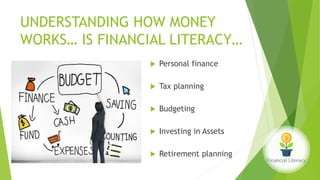
UNDERSTANDING HOW MONEY
WORKS… IS FINANCIAL LITERACY…
 Personal finance
 Tax planning
 Budgeting
 Investing in Assets
 Retirement planning
WHY DO WE NEED IT ???
To achieve financial FREEDOM
For young adults :to control expenses & debts
 For families :to save for home & children’s education
 For older workers :to ensure comfortable retirement
 For low income groups :to make most of their savings
I WANT FINANCIAL FREEDOM …
 Create budget
 Track spending's
 Pay off debts
 Investments in Assets
 Plan for retirement
 Counselling from a financial expert
THEY DON’T WANT
US TO KNOW THE
SECRET …
THEY WANT US TO
BE POOR …
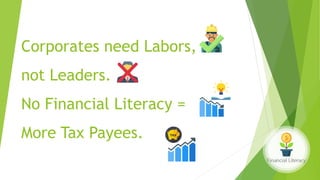
Corporates need Labors,
not Leaders.
No Financial Literacy =
More Tax Payees.
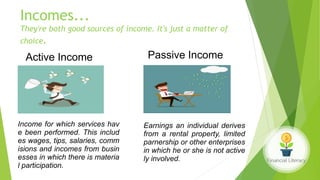
Incomes...
They're both good sources of income. It's just a matter of
choice.
Active Income Passive Income
Income for which services hav
e been performed. This includ
es wages, tips, salaries, comm
isions and incomes from busin
esses in which there is materia
l participation.
Earnings an individual derives
from a rental property, limited
parnership or other enterprises
in which he or she is not active
ly involved.
An elementary differentiation
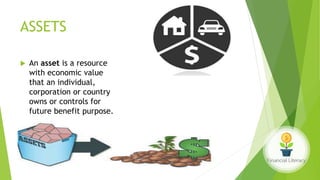
ASSETS
 An asset is a resource
with economic value
that an individual,
corporation or country
owns or controls for
future benefit purpose.
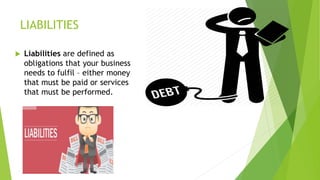
LIABILITIES
 Liabilities are defined as
obligations that your business
needs to fulfil – either money
that must be paid or services
that must be performed.
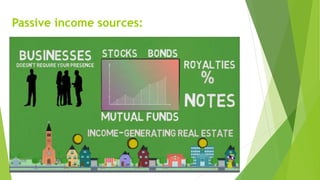
Passive income sources:
The Ramdev of Financial literacy
Net worth: $80 million
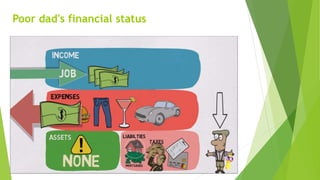
The driving agents of a poor man
Poor dad's financial status
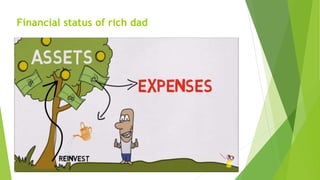
Financial status of rich dad
The comparative thought process of rich and
poor
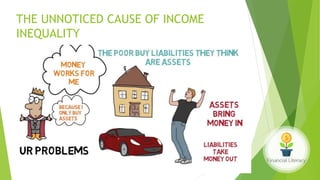
THE UNNOTICED CAUSE OF INCOME
INEQUALITY
IT’S NOT AN ASSET !
Your car,
your house,
your credit cards
are NOT your
assets!
Unless they
generate income for
you.
Millennials and finance
 Only 24% of millennials are financially literate in India,
while 72% in advanced economies like Germany
 Most millennials struggle with basic finance term.
 Millennial women are twice as likely to not have any
retirement savings.
 “Rich kids are financially literate” is a myth.
 Causes
 The least amount of financial responsibilities given to the
young generation.
 The collective hate towards math.
The Tax Liability
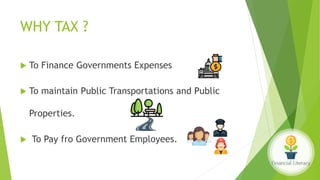
WHY TAX ?
 To Finance Governments Expenses
 To maintain Public Transportations and Public
Properties.
 To Pay fro Government Employees.
DOING THAT…
YOU WILL BE TAXED…
 Buying Groceries ?
 Living in a House ?
 Spending on your Necessities ?
 Earning Money ?
 You will be taxed for all of it
THEY PAY “$0” TAX,
YET ITS LEAGAL
YOU GIVE AWAY
30% OF YOUR INCOME…
AND…
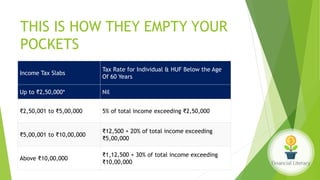
THIS IS HOW THEY EMPTY YOUR
POCKETS
Income Tax Slabs
Tax Rate for Individual & HUF Below the Age
Of 60 Years
Up to ₹2,50,000* Nil
₹2,50,001 to ₹5,00,000 5% of total income exceeding ₹2,50,000
₹5,00,001 to ₹10,00,000
₹12,500 + 20% of total income exceeding
₹5,00,000
Above ₹10,00,000
₹1,12,500 + 30% of total income exceeding
₹10,00,000
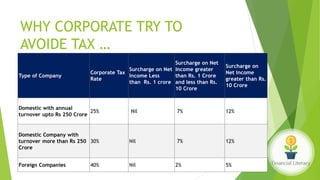
WHY CORPORATE TRY TO
AVOIDE TAX …
Type of Company
Corporate Tax
Rate
Surcharge on Net
Income Less
than Rs. 1 crore
Surcharge on Net
Income greater
than Rs. 1 Crore
and less than Rs.
10 Crore
Surcharge on
Net Income
greater than Rs.
10 Crore
Domestic with annual
turnover upto Rs 250 Crore
25% Nil 7% 12%
Domestic Company with
turnover more than Rs 250
Crore
30% Nil 7% 12%
Foreign Companies 40% Nil 2% 5%
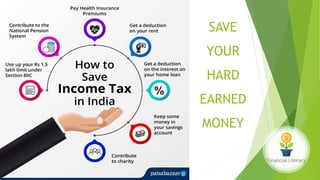
SAVE
YOUR
HARD
EARNED
MONEY
ROMANCING
WITH
BALANCE SHEET
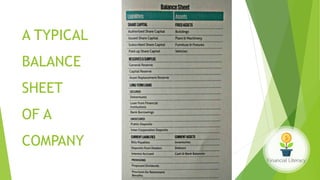
A TYPICAL
BALANCE
SHEET
OF A
COMPANY
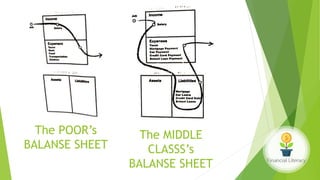
The POOR’s
BALANSE SHEET
The MIDDLE
CLASSS’s
BALANSE SHEET
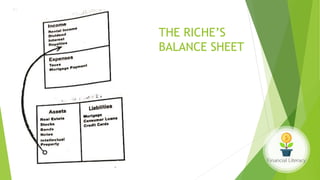
THE RICHE’S
BALANCE SHEET
Financial management
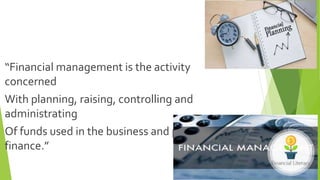
“Financial management is the activity
concerned
With planning, raising, controlling and
administrating
Of funds used in the business and personal
finance.”
Why is financial management is
required?
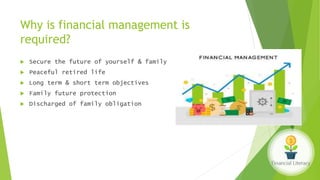
 Secure the future of yourself & family
 Peaceful retired life
 Long term & short term objectives
 Family future protection
 Discharged of family obligation
SAVING
SAVING HABITS
 A proverb says “Money saved is the money earned”. So we have to save our
money which increases our income.
 Its not only how much money you make, it’s how much you keep.
 As cash flow comes in, you have to be watchful not to spend it as fast or
faster than you make it. Track and control your finances.
SAVING HABITS: MONEY SAVING TIPS
 Everybody in the world wants to earn and enjoy good money. but most of the
people may not know how to save money for future.
 Always try to save 30% or more of your earnings.
 First try to satisfy yourself that you have not earned that 30% money. Then
only you are able to save money.
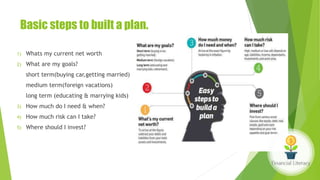
Basic steps to built a plan.
1) Whats my current net worth
2) What are my goals?
short term(buying car,getting married)
medium term(foreign vacations)
long term (educating & marrying kids)
3) How much do I need & when?
4) How much risk can I take?
5) Where should I invest?
Investment
An investment is an asset or item acquired with the goal of generating income or
appreciation. In an economic sense, an investment is the purchase of goods that
are not consumed today but are used in the future to create wealth.
 Where to invest?
 Why to invest?
 How to invest?
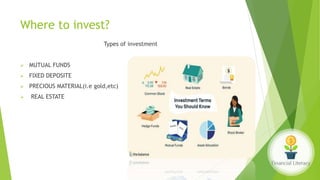
Where to invest?
Types of investment
 MUTUAL FUNDS
 FIXED DEPOSITE
 PRECIOUS MATERIAL(i.e gold,etc)
 REAL ESTATE
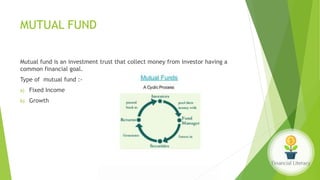
MUTUAL FUND
Mutual fund is an investment trust that collect money from investor having a
common financial goal.
Type of mutual fund :-
a) Fixed Income
b) Growth
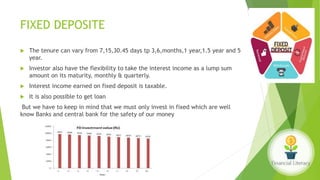
FIXED DEPOSITE
 The tenure can vary from 7,15,30.45 days tp 3,6,months,1 year,1.5 year and 5
year.
 Investor also have the flexibility to take the interest income as a lump sum
amount on its maturity, monthly & quarterly.
 Interest income earned on fixed deposit is taxable.
 It is also possible to get loan
But we have to keep in mind that we must only invest in fixed which are well
know Banks and central bank for the safety of our money
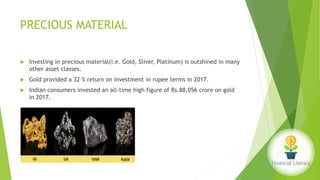
PRECIOUS MATERIAL
 Investing in precious material(i.e. Gold, Sliver, Platinum) is outshined in many
other asset classes.
 Gold provided a 32 % return on investment in rupee terms in 2017.
 Indian consumers invested an all-time high figure of Rs.88,056 crore on gold
in 2017.
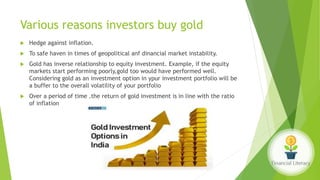
Various reasons investors buy gold
 Hedge against inflation.
 To safe haven in times of geopolitical anf dinancial market instability.
 Gold has inverse relationship to equity investment. Example, if the equity
markets start performing poorly,gold too would have performed well.
Considering gold as an investment option in ypur investment portfolio will be
a buffer to the overall volatility of your portfolio
 Over a period of time .the return of gold investment is in line with the ratio
of inflation
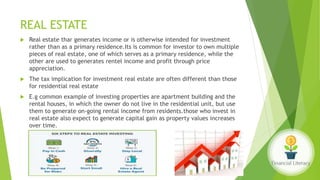
REAL ESTATE
 Real estate thar generates income or is otherwise intended for investment
rather than as a primary residence.Its is common for investor to own multiple
pieces of real estate, one of which serves as a primary residence, while the
other are used to generates rentel income and profit through price
appreciation.
 The tax implication for investment real estate are often different than those
for residential real estate
 E.g common example of investing properties are apartment building and the
rental houses, in which the owner do not live in the residential unit, but use
them to generate on-going rental income from residents.those who invest in
real estate also expect to generate capital gain as property values increases
over time.
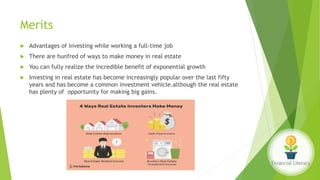
Merits
 Advantages of investing while working a full-time job
 There are hunfred of ways to make money in real estate
 You can fully realize the incredible benefit of exponential growth
 Investing in real estate has become increasingly popular over the last fifty
years and has become a common investment vehicle.although the real estate
has plenty of opportunity for making big gains.
Some more schemes from government
specially for poor
 Pradhan mantri jan dhan yojana
 Pradhan mantri Jeevan jyoti bima yojana
 Atal pension yojana
 Pradhan mantri mudra yojana
 Pradhan mantri vaya Vandana yojana
Insurance
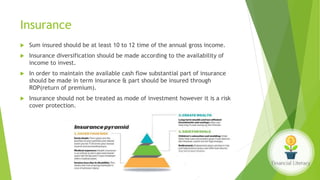
 Sum insured should be at least 10 to 12 time of the annual gross income.
 Insurance diversification should be made according to the availability of
income to invest.
 In order to maintain the available cash flow substantial part of insurance
should be made in term insurance & part should be insured through
ROP(return of premium).
 Insurance should not be treated as mode of investment however it is a risk
cover protection.
Why to invest?
 Main to Aim to invest money is to admire financial freedom
Road to financial freedom
“having enough money
To make decision or choices
That you want to make”
Advantages of financial freedom
1. Overcome you fear:- people are afraid to talk about their personal financial
because there don’t know where to begin
2. Reaching your goals:- short term >> specific event
long term >> retirement planning.
Protecting your wealth
 Auto
 Health
 Home
 Life
Asset allocation
THE END
THANK YOU

Financial Literacy

  • 2.
    THE HIDDEN SECRET TORICHES… FINANCIAL LITERACY
  • 3.
    UNDERSTANDING HOW MONEY WORKS…IS FINANCIAL LITERACY…  Personal finance  Tax planning  Budgeting  Investing in Assets  Retirement planning
  • 4.
    WHY DO WENEED IT ??? To achieve financial FREEDOM For young adults :to control expenses & debts  For families :to save for home & children’s education  For older workers :to ensure comfortable retirement  For low income groups :to make most of their savings
  • 5.
    I WANT FINANCIALFREEDOM …  Create budget  Track spending's  Pay off debts  Investments in Assets  Plan for retirement  Counselling from a financial expert
  • 6.
    THEY DON’T WANT USTO KNOW THE SECRET … THEY WANT US TO BE POOR …
  • 7.
    Corporates need Labors, notLeaders. No Financial Literacy = More Tax Payees.
  • 9.
    Incomes... They're both goodsources of income. It's just a matter of choice. Active Income Passive Income Income for which services hav e been performed. This includ es wages, tips, salaries, comm isions and incomes from busin esses in which there is materia l participation. Earnings an individual derives from a rental property, limited parnership or other enterprises in which he or she is not active ly involved.
  • 10.
  • 11.
    ASSETS  An assetis a resource with economic value that an individual, corporation or country owns or controls for future benefit purpose.
  • 12.
    LIABILITIES  Liabilities aredefined as obligations that your business needs to fulfil – either money that must be paid or services that must be performed.
  • 13.
  • 14.
    The Ramdev ofFinancial literacy Net worth: $80 million
  • 16.
    The driving agentsof a poor man
  • 17.
  • 20.
  • 21.
    The comparative thoughtprocess of rich and poor
  • 22.
    THE UNNOTICED CAUSEOF INCOME INEQUALITY
  • 23.
    IT’S NOT ANASSET ! Your car, your house, your credit cards are NOT your assets! Unless they generate income for you.
  • 24.
    Millennials and finance Only 24% of millennials are financially literate in India, while 72% in advanced economies like Germany  Most millennials struggle with basic finance term.  Millennial women are twice as likely to not have any retirement savings.  “Rich kids are financially literate” is a myth.  Causes  The least amount of financial responsibilities given to the young generation.  The collective hate towards math.
  • 25.
  • 26.
    WHY TAX ? To Finance Governments Expenses  To maintain Public Transportations and Public Properties.  To Pay fro Government Employees.
  • 27.
    DOING THAT… YOU WILLBE TAXED…  Buying Groceries ?  Living in a House ?  Spending on your Necessities ?  Earning Money ?  You will be taxed for all of it
  • 28.
    THEY PAY “$0”TAX, YET ITS LEAGAL YOU GIVE AWAY 30% OF YOUR INCOME… AND…
  • 29.
    THIS IS HOWTHEY EMPTY YOUR POCKETS Income Tax Slabs Tax Rate for Individual & HUF Below the Age Of 60 Years Up to ₹2,50,000* Nil ₹2,50,001 to ₹5,00,000 5% of total income exceeding ₹2,50,000 ₹5,00,001 to ₹10,00,000 ₹12,500 + 20% of total income exceeding ₹5,00,000 Above ₹10,00,000 ₹1,12,500 + 30% of total income exceeding ₹10,00,000
  • 30.
    WHY CORPORATE TRYTO AVOIDE TAX … Type of Company Corporate Tax Rate Surcharge on Net Income Less than Rs. 1 crore Surcharge on Net Income greater than Rs. 1 Crore and less than Rs. 10 Crore Surcharge on Net Income greater than Rs. 10 Crore Domestic with annual turnover upto Rs 250 Crore 25% Nil 7% 12% Domestic Company with turnover more than Rs 250 Crore 30% Nil 7% 12% Foreign Companies 40% Nil 2% 5%
  • 31.
  • 32.
  • 33.
  • 34.
    The POOR’s BALANSE SHEET TheMIDDLE CLASSS’s BALANSE SHEET
  • 35.
  • 37.
  • 38.
    “Financial management isthe activity concerned With planning, raising, controlling and administrating Of funds used in the business and personal finance.”
  • 39.
    Why is financialmanagement is required?  Secure the future of yourself & family  Peaceful retired life  Long term & short term objectives  Family future protection  Discharged of family obligation
  • 40.
    SAVING SAVING HABITS  Aproverb says “Money saved is the money earned”. So we have to save our money which increases our income.  Its not only how much money you make, it’s how much you keep.  As cash flow comes in, you have to be watchful not to spend it as fast or faster than you make it. Track and control your finances.
  • 41.
    SAVING HABITS: MONEYSAVING TIPS  Everybody in the world wants to earn and enjoy good money. but most of the people may not know how to save money for future.  Always try to save 30% or more of your earnings.  First try to satisfy yourself that you have not earned that 30% money. Then only you are able to save money.
  • 42.
    Basic steps tobuilt a plan. 1) Whats my current net worth 2) What are my goals? short term(buying car,getting married) medium term(foreign vacations) long term (educating & marrying kids) 3) How much do I need & when? 4) How much risk can I take? 5) Where should I invest?
  • 43.
    Investment An investment isan asset or item acquired with the goal of generating income or appreciation. In an economic sense, an investment is the purchase of goods that are not consumed today but are used in the future to create wealth.  Where to invest?  Why to invest?  How to invest?
  • 44.
    Where to invest? Typesof investment  MUTUAL FUNDS  FIXED DEPOSITE  PRECIOUS MATERIAL(i.e gold,etc)  REAL ESTATE
  • 45.
    MUTUAL FUND Mutual fundis an investment trust that collect money from investor having a common financial goal. Type of mutual fund :- a) Fixed Income b) Growth
  • 46.
    FIXED DEPOSITE  Thetenure can vary from 7,15,30.45 days tp 3,6,months,1 year,1.5 year and 5 year.  Investor also have the flexibility to take the interest income as a lump sum amount on its maturity, monthly & quarterly.  Interest income earned on fixed deposit is taxable.  It is also possible to get loan But we have to keep in mind that we must only invest in fixed which are well know Banks and central bank for the safety of our money
  • 47.
    PRECIOUS MATERIAL  Investingin precious material(i.e. Gold, Sliver, Platinum) is outshined in many other asset classes.  Gold provided a 32 % return on investment in rupee terms in 2017.  Indian consumers invested an all-time high figure of Rs.88,056 crore on gold in 2017.
  • 48.
    Various reasons investorsbuy gold  Hedge against inflation.  To safe haven in times of geopolitical anf dinancial market instability.  Gold has inverse relationship to equity investment. Example, if the equity markets start performing poorly,gold too would have performed well. Considering gold as an investment option in ypur investment portfolio will be a buffer to the overall volatility of your portfolio  Over a period of time .the return of gold investment is in line with the ratio of inflation
  • 49.
    REAL ESTATE  Realestate thar generates income or is otherwise intended for investment rather than as a primary residence.Its is common for investor to own multiple pieces of real estate, one of which serves as a primary residence, while the other are used to generates rentel income and profit through price appreciation.  The tax implication for investment real estate are often different than those for residential real estate  E.g common example of investing properties are apartment building and the rental houses, in which the owner do not live in the residential unit, but use them to generate on-going rental income from residents.those who invest in real estate also expect to generate capital gain as property values increases over time.
  • 50.
    Merits  Advantages ofinvesting while working a full-time job  There are hunfred of ways to make money in real estate  You can fully realize the incredible benefit of exponential growth  Investing in real estate has become increasingly popular over the last fifty years and has become a common investment vehicle.although the real estate has plenty of opportunity for making big gains.
  • 51.
    Some more schemesfrom government specially for poor  Pradhan mantri jan dhan yojana  Pradhan mantri Jeevan jyoti bima yojana  Atal pension yojana  Pradhan mantri mudra yojana  Pradhan mantri vaya Vandana yojana
  • 52.
    Insurance  Sum insuredshould be at least 10 to 12 time of the annual gross income.  Insurance diversification should be made according to the availability of income to invest.  In order to maintain the available cash flow substantial part of insurance should be made in term insurance & part should be insured through ROP(return of premium).  Insurance should not be treated as mode of investment however it is a risk cover protection.
  • 53.
    Why to invest? Main to Aim to invest money is to admire financial freedom Road to financial freedom “having enough money To make decision or choices That you want to make”
  • 54.
    Advantages of financialfreedom 1. Overcome you fear:- people are afraid to talk about their personal financial because there don’t know where to begin 2. Reaching your goals:- short term >> specific event long term >> retirement planning. Protecting your wealth  Auto  Health  Home  Life Asset allocation
  • 55.