LEARNING
OBJECTIVES
To understand the outline of the course
To begin to understand key concept and
terminology
A Level Film Studies
What will I study this term?
■ Textual Analysis
■ Genre
■ Narrative
■ Representation
How will I be
assessed?
■ 2 Examinations:
– Film History – 2 hours (35%)
– Critical perspectives – 2 hours (35%)
■ Non-examined assessment (NEA):
– the production of a 5 minute short film or a 10
minute screenplay for a short film
(incorporating a digitally photographed
storyboard)
– an evaluative analysis of the production in
relation to professionally produced set short films.
Examinationtopics
Macro and Micro elements
■ All media texts are constructed and
made up of elements
■ It is your job as media students to
recognise, analyse and then discuss the
range of elements used in a text
■ Use the following as a guide and you
cant go wrong!
FilmText
Micro Elements Macro elements
Camerawork Narrative Structure
Mise-en-scene Narrative themes
Sound Character alignment
Editing Perceived realism
(verisimilitude)
Performance
Micro Elements:The 3 Codes
1.Technical Codes
– Camera shots, movement and angles
– Editing – pace and type
– Use of lighting
2. Audio Codes
– Diegetic and non diegetic sound
– Dialogue
– Sound effects
– Music
– Voice over
3.Visual Codes
– Mise en scene e.g:
■ Clothing
■ Props/Setting
■ Expression/Gesture
– Use of colour
– Iconography – objects, setting and backgrounds
which have become symbolic of a genre
– Graphics
1.Technical Codes
■ Camera shots, angles and movement
■ We are going to make brief notes on the different camera
shots, angles and movements and then discuss these in relation
to an opening sequence.
Establishing Shot (EST)
■ This ESTABLISHES where
the action takes place -
sets the scene
■ Often an exterior shot
Wide Shot (WS) or Extreme Long
shot
■ Often (but not always) used as an establishing
shot
■ The point of this shot is to show the subject's
surroundings
Long Shot (LS)
■ A shot which shows all or most of a fairly large subject (for example,
a person) and usually much of the surroundings
Medium Long Shot (MLS)
■ Knees to head with some background
Medium Shot (MS)
■ Waist to
head
MediumTwo Shot (M2S)
■ Similar to a MS, but with two people
Medium Close Up (MCU)
■ Head and shoulders
Close Up (CU)
■ Shows a character's face
■ Used to show emotion
Big Close Up (BCU)
■ Forehead to chin
■ Used to show extreme emotion
Extreme Close Up (ECU)
■ A very tight shot, for example someone’s eye or a door handle
OverThe Shoulder (OTS)
■ Used during a conversation
■ MCU + the other person’s shoulder/head/back etc
Deep Shot (DS)
■ When something is in the foreground and something else is in the
background
Camera Angles
■ CameraAngle: position of the camera
■ High Angle: looking down
■ Low Angle: looking up
■ Canted Framing: frame is not levelled, appearing tipped
Overhead Shot (OH) or Bird’s eye
View
■ Camera will be directly over the objects/actors
High Angle (H/A)
■ Could be used to make the object/person look powerless
Low Angle (L/A)
■ Could be used to make the object/person powerful
Canted angle
• Used for dramatic effect and helps portray unease,
disorientation, frantic or desperate action, intoxication,
madness, etc.
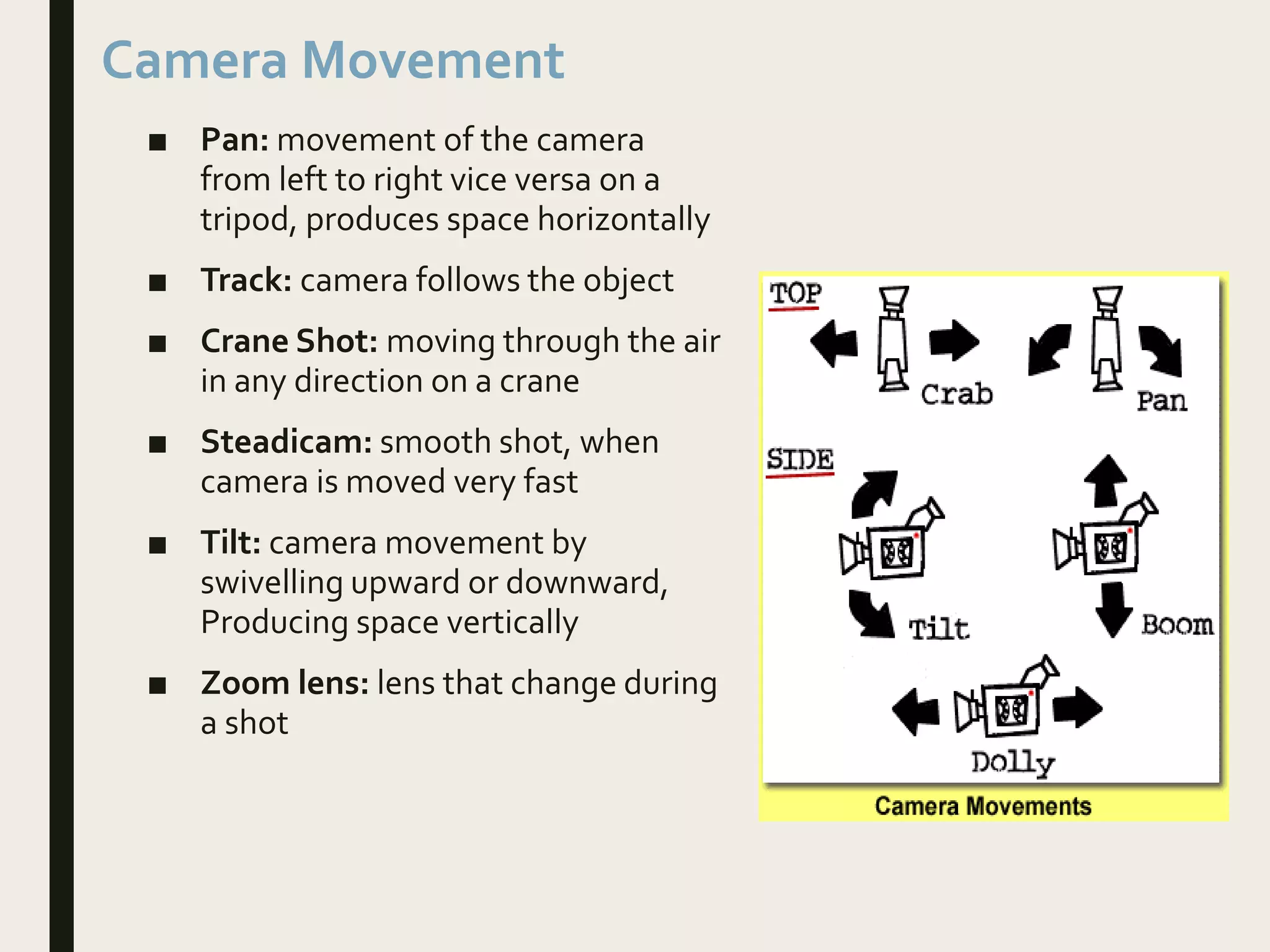
Camera Movement
■ Pan: movement of the camera
from left to right vice versa on a
tripod, produces space horizontally
■ Track: camera follows the object
■ Crane Shot: moving through the air
in any direction on a crane
■ Steadicam: smooth shot, when
camera is moved very fast
■ Tilt: camera movement by
swivelling upward or downward,
Producing space vertically
■ Zoom lens: lens that change during
a shot
Camera movement
■ Tracking – the camera follows the action by moving along with the
characters along a small track
Hand held/ steadicam
■ Steadicam - a camera is fixed to cameraman so that
it can move around and mimic the actors movement
Point of view shot
High angle shot
Low angle shot
Over the shoulder shot
Big close up shot
Low angle shot/wide
shot
Medium close up
Bird’s eye view
Establishing shot
POV shot/close up
Point of view shot
POV shot/
close up
Over the shoulder
shot
Bird’s eye view
Big close up
Low angle shot
High-angle shot
Medium close up
Establishing shot
Low angle/ wide
shot
Opening Sequence

Film Studies. - Lesson 1 intro and camera shots

  • 1.
    LEARNING OBJECTIVES To understand theoutline of the course To begin to understand key concept and terminology
  • 2.
    A Level FilmStudies What will I study this term? ■ Textual Analysis ■ Genre ■ Narrative ■ Representation
  • 3.
    How will Ibe assessed? ■ 2 Examinations: – Film History – 2 hours (35%) – Critical perspectives – 2 hours (35%) ■ Non-examined assessment (NEA): – the production of a 5 minute short film or a 10 minute screenplay for a short film (incorporating a digitally photographed storyboard) – an evaluative analysis of the production in relation to professionally produced set short films.
  • 4.
  • 5.
    Macro and Microelements ■ All media texts are constructed and made up of elements ■ It is your job as media students to recognise, analyse and then discuss the range of elements used in a text ■ Use the following as a guide and you cant go wrong!
  • 6.
    FilmText Micro Elements Macroelements Camerawork Narrative Structure Mise-en-scene Narrative themes Sound Character alignment Editing Perceived realism (verisimilitude) Performance
  • 7.
    Micro Elements:The 3Codes 1.Technical Codes – Camera shots, movement and angles – Editing – pace and type – Use of lighting 2. Audio Codes – Diegetic and non diegetic sound – Dialogue – Sound effects – Music – Voice over
  • 8.
    3.Visual Codes – Miseen scene e.g: ■ Clothing ■ Props/Setting ■ Expression/Gesture – Use of colour – Iconography – objects, setting and backgrounds which have become symbolic of a genre – Graphics
  • 9.
    1.Technical Codes ■ Camerashots, angles and movement ■ We are going to make brief notes on the different camera shots, angles and movements and then discuss these in relation to an opening sequence.
  • 10.
    Establishing Shot (EST) ■This ESTABLISHES where the action takes place - sets the scene ■ Often an exterior shot
  • 11.
    Wide Shot (WS)or Extreme Long shot ■ Often (but not always) used as an establishing shot ■ The point of this shot is to show the subject's surroundings
  • 12.
    Long Shot (LS) ■A shot which shows all or most of a fairly large subject (for example, a person) and usually much of the surroundings
  • 13.
    Medium Long Shot(MLS) ■ Knees to head with some background
  • 14.
    Medium Shot (MS) ■Waist to head
  • 15.
    MediumTwo Shot (M2S) ■Similar to a MS, but with two people
  • 16.
    Medium Close Up(MCU) ■ Head and shoulders
  • 17.
    Close Up (CU) ■Shows a character's face ■ Used to show emotion
  • 18.
    Big Close Up(BCU) ■ Forehead to chin ■ Used to show extreme emotion
  • 19.
    Extreme Close Up(ECU) ■ A very tight shot, for example someone’s eye or a door handle
  • 20.
    OverThe Shoulder (OTS) ■Used during a conversation ■ MCU + the other person’s shoulder/head/back etc
  • 21.
    Deep Shot (DS) ■When something is in the foreground and something else is in the background
  • 22.
    Camera Angles ■ CameraAngle:position of the camera ■ High Angle: looking down ■ Low Angle: looking up ■ Canted Framing: frame is not levelled, appearing tipped
  • 23.
    Overhead Shot (OH)or Bird’s eye View ■ Camera will be directly over the objects/actors
  • 24.
    High Angle (H/A) ■Could be used to make the object/person look powerless
  • 25.
    Low Angle (L/A) ■Could be used to make the object/person powerful
  • 26.
    Canted angle • Usedfor dramatic effect and helps portray unease, disorientation, frantic or desperate action, intoxication, madness, etc.
  • 27.
    Camera Movement ■ Pan:movement of the camera from left to right vice versa on a tripod, produces space horizontally ■ Track: camera follows the object ■ Crane Shot: moving through the air in any direction on a crane ■ Steadicam: smooth shot, when camera is moved very fast ■ Tilt: camera movement by swivelling upward or downward, Producing space vertically ■ Zoom lens: lens that change during a shot
  • 28.
    Camera movement ■ Tracking– the camera follows the action by moving along with the characters along a small track
  • 29.
    Hand held/ steadicam ■Steadicam - a camera is fixed to cameraman so that it can move around and mimic the actors movement
  • 30.
    Point of viewshot High angle shot Low angle shot Over the shoulder shot Big close up shot Low angle shot/wide shot Medium close up Bird’s eye view Establishing shot POV shot/close up
  • 31.
    Point of viewshot POV shot/ close up Over the shoulder shot Bird’s eye view Big close up Low angle shot High-angle shot Medium close up Establishing shot Low angle/ wide shot
  • 32.