CAMERA
ANGLES,SHOTS AND
TECHNIQUES
PREPARED BY,
FAIQA J DABIR
(STUDENT OF BMM.)
2014
WHAT IS A SHOT?
 A shot is a series of frames, that runs for an
uninterrupted period of time.
 Film shots are an essential aspect of a movie
where angles, transitions and cuts are used to
further express emotion, ideas and movement.
 In production, a shot is the moment that the camera
starts rolling until the moment it stops.
 In film editing, a shot is the continuous footage or
sequence between two edits or cuts
CAMERA SHOTS TO DISCUSS
 Extreme Long shot
 Long shot
 Wide Shot
 Establishing shot
 Mid / Medium Shot
 Medium Close-up
 Close up shot
 Extreme Close Up
 Birds eye view shot
 Over the shoulder shot
 Point of view shot
 Two Shot
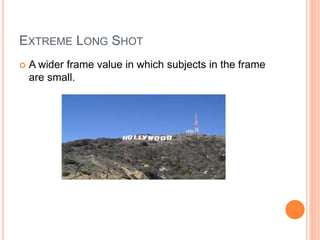
EXTREME LONG SHOT
 A wider frame value in which subjects in the frame
are small.
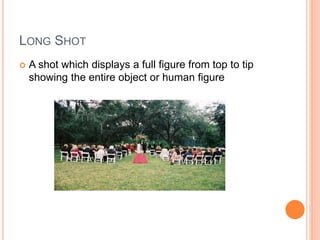
LONG SHOT
 A shot which displays a full figure from top to tip
showing the entire object or human figure
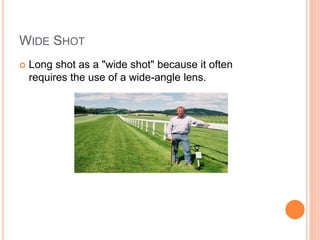
WIDE SHOT
 Long shot as a "wide shot" because it often
requires the use of a wide-angle lens.
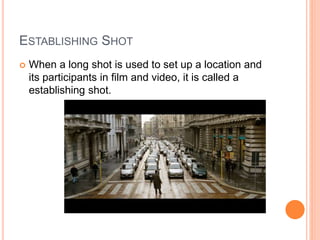
ESTABLISHING SHOT
 When a long shot is used to set up a location and
its participants in film and video, it is called a
establishing shot.
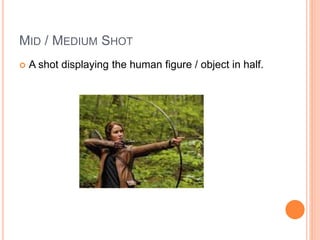
MID / MEDIUM SHOT
 A shot displaying the human figure / object in half.
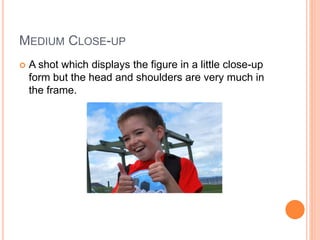
MEDIUM CLOSE-UP
 A shot which displays the figure in a little close-up
form but the head and shoulders are very much in
the frame.
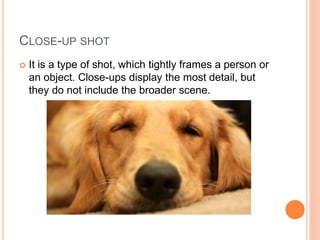
CLOSE-UP SHOT
 It is a type of shot, which tightly frames a person or
an object. Close-ups display the most detail, but
they do not include the broader scene.
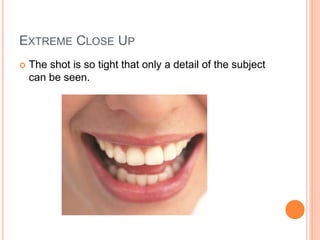
EXTREME CLOSE UP
 The shot is so tight that only a detail of the subject
can be seen.
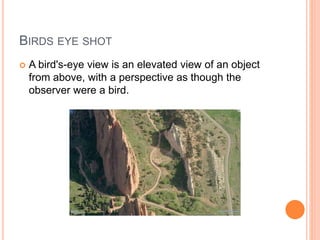
BIRDS EYE SHOT
 A bird's-eye view is an elevated view of an object
from above, with a perspective as though the
observer were a bird.
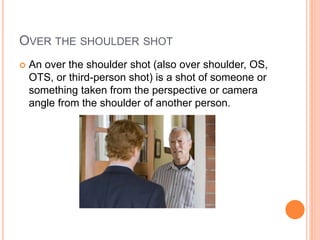
OVER THE SHOULDER SHOT
 An over the shoulder shot (also over shoulder, OS,
OTS, or third-person shot) is a shot of someone or
something taken from the perspective or camera
angle from the shoulder of another person.
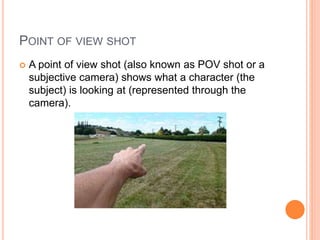
POINT OF VIEW SHOT
 A point of view shot (also known as POV shot or a
subjective camera) shows what a character (the
subject) is looking at (represented through the
camera).
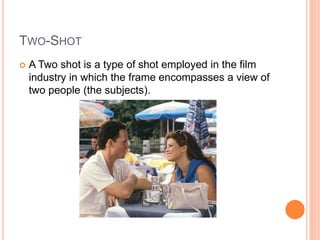
TWO-SHOT
 A Two shot is a type of shot employed in the film
industry in which the frame encompasses a view of
two people (the subjects).
WHAT IS A CAMERA ANGLE?
 The camera angle marks the specific location at
which a camera is placed to take a shot.
 A scene may be shot from several camera angles
simultaneously
CAMERA ANGLE CATEGORIES
 High Angle shot
 Low Angle shot
 Eye-level camera angle
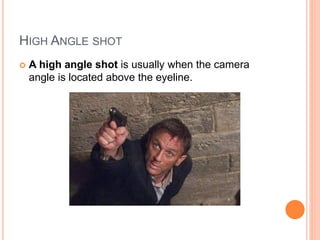
HIGH ANGLE SHOT
 A high angle shot is usually when the camera
angle is located above the eyeline.
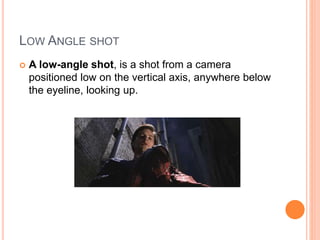
LOW ANGLE SHOT
 A low-angle shot, is a shot from a camera
positioned low on the vertical axis, anywhere below
the eyeline, looking up.
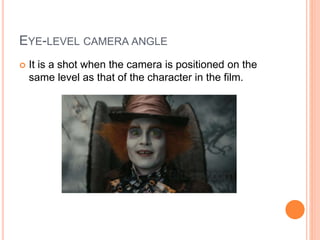
EYE-LEVEL CAMERA ANGLE
 It is a shot when the camera is positioned on the
same level as that of the character in the film.
WHAT ARE CAMERA
MOVEMENTS/TECHNIQUES?
 Camera movements are often implemented to add
dynamism to shots, their best appearances are
when new information is revealed.
 At the beginning level, budding filmmakers
sometimes tilt and pan without the proper
motivation.
 Camera movements can be distracting and even
annoying when overused or used without a reason.
CAMERA MOVEMENT/TECHNIQUES
CATEGORIES
 Panning
 Tilt
 Zoom
 Tracking / Dolly
PANNING
 Panning refers to the rotation in a horizontal plane
of a camera.
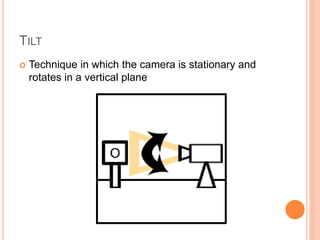
TILT
 Technique in which the camera is stationary and
rotates in a vertical plane
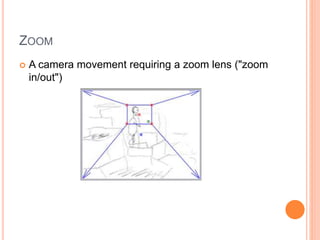
ZOOM
 A camera movement requiring a zoom lens ("zoom
in/out")
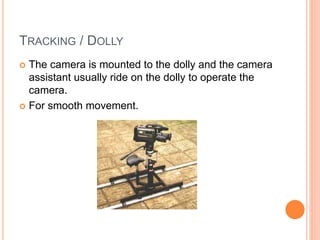
TRACKING / DOLLY
 The camera is mounted to the dolly and the camera
assistant usually ride on the dolly to operate the
camera.
 For smooth movement.
There is a lot more to Camera that is used in films.I
have tried my best to present as many I could.
Thank You.

Camera:shots, angles and techniques

  • 1.
  • 2.
    WHAT IS ASHOT?  A shot is a series of frames, that runs for an uninterrupted period of time.  Film shots are an essential aspect of a movie where angles, transitions and cuts are used to further express emotion, ideas and movement.  In production, a shot is the moment that the camera starts rolling until the moment it stops.  In film editing, a shot is the continuous footage or sequence between two edits or cuts
  • 3.
    CAMERA SHOTS TODISCUSS  Extreme Long shot  Long shot  Wide Shot  Establishing shot  Mid / Medium Shot  Medium Close-up  Close up shot  Extreme Close Up  Birds eye view shot  Over the shoulder shot  Point of view shot  Two Shot
  • 4.
    EXTREME LONG SHOT A wider frame value in which subjects in the frame are small.
  • 5.
    LONG SHOT  Ashot which displays a full figure from top to tip showing the entire object or human figure
  • 6.
    WIDE SHOT  Longshot as a "wide shot" because it often requires the use of a wide-angle lens.
  • 7.
    ESTABLISHING SHOT  Whena long shot is used to set up a location and its participants in film and video, it is called a establishing shot.
  • 8.
    MID / MEDIUMSHOT  A shot displaying the human figure / object in half.
  • 9.
    MEDIUM CLOSE-UP  Ashot which displays the figure in a little close-up form but the head and shoulders are very much in the frame.
  • 10.
    CLOSE-UP SHOT  Itis a type of shot, which tightly frames a person or an object. Close-ups display the most detail, but they do not include the broader scene.
  • 11.
    EXTREME CLOSE UP The shot is so tight that only a detail of the subject can be seen.
  • 12.
    BIRDS EYE SHOT A bird's-eye view is an elevated view of an object from above, with a perspective as though the observer were a bird.
  • 13.
    OVER THE SHOULDERSHOT  An over the shoulder shot (also over shoulder, OS, OTS, or third-person shot) is a shot of someone or something taken from the perspective or camera angle from the shoulder of another person.
  • 14.
    POINT OF VIEWSHOT  A point of view shot (also known as POV shot or a subjective camera) shows what a character (the subject) is looking at (represented through the camera).
  • 15.
    TWO-SHOT  A Twoshot is a type of shot employed in the film industry in which the frame encompasses a view of two people (the subjects).
  • 16.
    WHAT IS ACAMERA ANGLE?  The camera angle marks the specific location at which a camera is placed to take a shot.  A scene may be shot from several camera angles simultaneously
  • 17.
    CAMERA ANGLE CATEGORIES High Angle shot  Low Angle shot  Eye-level camera angle
  • 18.
    HIGH ANGLE SHOT A high angle shot is usually when the camera angle is located above the eyeline.
  • 19.
    LOW ANGLE SHOT A low-angle shot, is a shot from a camera positioned low on the vertical axis, anywhere below the eyeline, looking up.
  • 20.
    EYE-LEVEL CAMERA ANGLE It is a shot when the camera is positioned on the same level as that of the character in the film.
  • 21.
    WHAT ARE CAMERA MOVEMENTS/TECHNIQUES? Camera movements are often implemented to add dynamism to shots, their best appearances are when new information is revealed.  At the beginning level, budding filmmakers sometimes tilt and pan without the proper motivation.  Camera movements can be distracting and even annoying when overused or used without a reason.
  • 22.
  • 23.
    PANNING  Panning refersto the rotation in a horizontal plane of a camera.
  • 24.
    TILT  Technique inwhich the camera is stationary and rotates in a vertical plane
  • 25.
    ZOOM  A cameramovement requiring a zoom lens ("zoom in/out")
  • 26.
    TRACKING / DOLLY The camera is mounted to the dolly and the camera assistant usually ride on the dolly to operate the camera.  For smooth movement.
  • 27.
    There is alot more to Camera that is used in films.I have tried my best to present as many I could. Thank You.