What comedies have you selected
and what channel/day/time are they
scheduled?
LO: To develop understanding of
the mark scheme for Q4a
TITLE: Question 4a Thursday, 03 May 2018
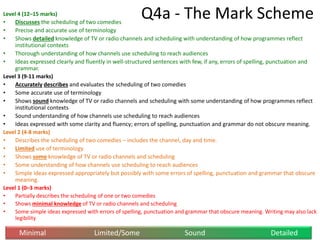
Q4a - The Mark SchemeLevel 4 (12–15 marks)
• Discusses the scheduling of two comedies
• Precise and accurate use of terminology
• Shows detailed knowledge of TV or radio channels and scheduling with understanding of how programmes reflect
institutional contexts
• Thorough understanding of how channels use scheduling to reach audiences
• Ideas expressed clearly and fluently in well-structured sentences with few, if any, errors of spelling, punctuation and
grammar.
Level 3 (9-11 marks)
• Accurately describes and evaluates the scheduling of two comedies
• Some accurate use of terminology
• Shows sound knowledge of TV or radio channels and scheduling with some understanding of how programmes reflect
institutional contexts
• Sound understanding of how channels use scheduling to reach audiences
• Ideas expressed with some clarity and fluency; errors of spelling, punctuation and grammar do not obscure meaning.
Level 2 (4-8 marks)
• Describes the scheduling of two comedies – includes the channel, day and time.
• Limited use of terminology
• Shows some knowledge of TV or radio channels and scheduling
• Some understanding of how channels use scheduling to reach audiences
• Simple ideas expressed appropriately but possibly with some errors of spelling, punctuation and grammar that obscure
meaning.
Level 1 (0–3 marks)
• Partially describes the scheduling of one or two comedies
• Shows minimal knowledge of TV or radio channels and scheduling
• Some simple ideas expressed with errors of spelling, punctuation and grammar that obscure meaning. Writing may also lack
legibility
Minimal Limited/Some Sound Detailed
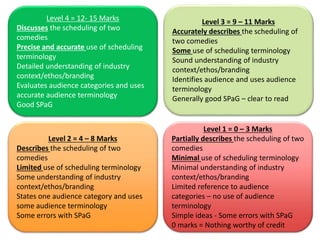
Level 4 = 12- 15 Marks
Discusses the scheduling of two
comedies
Precise and accurate use of scheduling
terminology
Detailed understanding of industry
context/ethos/branding
Evaluates audience categories and uses
accurate audience terminology
Good SPaG
Level 3 = 9 – 11 Marks
Accurately describes the scheduling of
two comedies
Some use of scheduling terminology
Sound understanding of industry
context/ethos/branding
Identifies audience and uses audience
terminology
Generally good SPaG – clear to read
Level 2 = 4 – 8 Marks
Describes the scheduling of two
comedies
Limited use of scheduling terminology
Some understanding of industry
context/ethos/branding
States one audience category and uses
some audience terminology
Some errors with SPaG
Level 1 = 0 – 3 Marks
Partially describes the scheduling of two
comedies
Minimal use of scheduling terminology
Minimal understanding of industry
context/ethos/branding
Limited reference to audience
categories – no use of audience
terminology
Simple ideas - Some errors with SPaG
0 marks = Nothing worthy of credit
The Examiners Comments
• How do your responses compare to the
‘experts’?
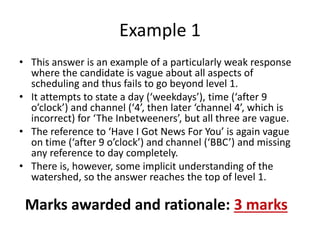
• This answer is an example of a particularly weak response
where the candidate is vague about all aspects of
scheduling and thus fails to go beyond level 1.
• It attempts to state a day (‘weekdays’), time (‘after 9
o’clock’) and channel (‘4’, then later ‘channel 4’, which is
incorrect) for ‘The Inbetweeners’, but all three are vague.
• The reference to ‘Have I Got News For You’ is again vague
on time (‘after 9 o’clock’) and channel (‘BBC’) and missing
any reference to day completely.
• There is, however, some implicit understanding of the
watershed, so the answer reaches the top of level 1.
Example 1
Marks awarded and rationale: 3 marks
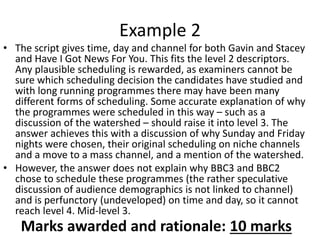
• The script gives time, day and channel for both Gavin and Stacey
and Have I Got News For You. This fits the level 2 descriptors.
Any plausible scheduling is rewarded, as examiners cannot be
sure which scheduling decision the candidates have studied and
with long running programmes there may have been many
different forms of scheduling. Some accurate explanation of why
the programmes were scheduled in this way – such as a
discussion of the watershed – should raise it into level 3. The
answer achieves this with a discussion of why Sunday and Friday
nights were chosen, their original scheduling on niche channels
and a move to a mass channel, and a mention of the watershed.
• However, the answer does not explain why BBC3 and BBC2
chose to schedule these programmes (the rather speculative
discussion of audience demographics is not linked to channel)
and is perfunctory (undeveloped) on time and day, so it cannot
reach level 4. Mid-level 3.
Example 2
Marks awarded and rationale: 10 marks
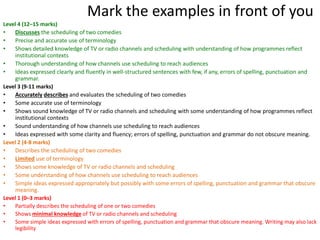
Level 4 (12–15 marks)
• Discusses the scheduling of two comedies
• Precise and accurate use of terminology
• Shows detailed knowledge of TV or radio channels and scheduling with understanding of how programmes reflect
institutional contexts
• Thorough understanding of how channels use scheduling to reach audiences
• Ideas expressed clearly and fluently in well-structured sentences with few, if any, errors of spelling, punctuation and
grammar.
Level 3 (9-11 marks)
• Accurately describes and evaluates the scheduling of two comedies
• Some accurate use of terminology
• Shows sound knowledge of TV or radio channels and scheduling with some understanding of how programmes reflect
institutional contexts
• Sound understanding of how channels use scheduling to reach audiences
• Ideas expressed with some clarity and fluency; errors of spelling, punctuation and grammar do not obscure meaning.
Level 2 (4-8 marks)
• Describes the scheduling of two comedies
• Limited use of terminology
• Shows some knowledge of TV or radio channels and scheduling
• Some understanding of how channels use scheduling to reach audiences
• Simple ideas expressed appropriately but possibly with some errors of spelling, punctuation and grammar that obscure
meaning.
Level 1 (0–3 marks)
• Partially describes the scheduling of one or two comedies
• Shows minimal knowledge of TV or radio channels and scheduling
• Some simple ideas expressed with errors of spelling, punctuation and grammar that obscure meaning. Writing may also lack
legibility
Mark the examples in front of you
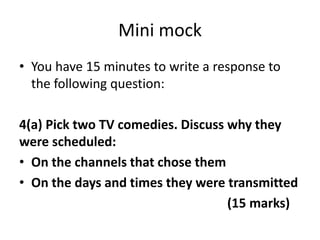
Mini mock
• You have 15 minutes to write a response to
the following question:
4(a) Pick two TV comedies. Discuss why they
were scheduled:
• On the channels that chose them
• On the days and times they were transmitted
(15 marks)

Lesson 8 - TV Comedy Q4a mark scheme

  • 1.
    What comedies haveyou selected and what channel/day/time are they scheduled?
  • 2.
    LO: To developunderstanding of the mark scheme for Q4a TITLE: Question 4a Thursday, 03 May 2018
  • 3.
    Q4a - TheMark SchemeLevel 4 (12–15 marks) • Discusses the scheduling of two comedies • Precise and accurate use of terminology • Shows detailed knowledge of TV or radio channels and scheduling with understanding of how programmes reflect institutional contexts • Thorough understanding of how channels use scheduling to reach audiences • Ideas expressed clearly and fluently in well-structured sentences with few, if any, errors of spelling, punctuation and grammar. Level 3 (9-11 marks) • Accurately describes and evaluates the scheduling of two comedies • Some accurate use of terminology • Shows sound knowledge of TV or radio channels and scheduling with some understanding of how programmes reflect institutional contexts • Sound understanding of how channels use scheduling to reach audiences • Ideas expressed with some clarity and fluency; errors of spelling, punctuation and grammar do not obscure meaning. Level 2 (4-8 marks) • Describes the scheduling of two comedies – includes the channel, day and time. • Limited use of terminology • Shows some knowledge of TV or radio channels and scheduling • Some understanding of how channels use scheduling to reach audiences • Simple ideas expressed appropriately but possibly with some errors of spelling, punctuation and grammar that obscure meaning. Level 1 (0–3 marks) • Partially describes the scheduling of one or two comedies • Shows minimal knowledge of TV or radio channels and scheduling • Some simple ideas expressed with errors of spelling, punctuation and grammar that obscure meaning. Writing may also lack legibility Minimal Limited/Some Sound Detailed
  • 4.
    Level 4 =12- 15 Marks Discusses the scheduling of two comedies Precise and accurate use of scheduling terminology Detailed understanding of industry context/ethos/branding Evaluates audience categories and uses accurate audience terminology Good SPaG Level 3 = 9 – 11 Marks Accurately describes the scheduling of two comedies Some use of scheduling terminology Sound understanding of industry context/ethos/branding Identifies audience and uses audience terminology Generally good SPaG – clear to read Level 2 = 4 – 8 Marks Describes the scheduling of two comedies Limited use of scheduling terminology Some understanding of industry context/ethos/branding States one audience category and uses some audience terminology Some errors with SPaG Level 1 = 0 – 3 Marks Partially describes the scheduling of two comedies Minimal use of scheduling terminology Minimal understanding of industry context/ethos/branding Limited reference to audience categories – no use of audience terminology Simple ideas - Some errors with SPaG 0 marks = Nothing worthy of credit
  • 5.
    The Examiners Comments •How do your responses compare to the ‘experts’?
  • 6.
    • This answeris an example of a particularly weak response where the candidate is vague about all aspects of scheduling and thus fails to go beyond level 1. • It attempts to state a day (‘weekdays’), time (‘after 9 o’clock’) and channel (‘4’, then later ‘channel 4’, which is incorrect) for ‘The Inbetweeners’, but all three are vague. • The reference to ‘Have I Got News For You’ is again vague on time (‘after 9 o’clock’) and channel (‘BBC’) and missing any reference to day completely. • There is, however, some implicit understanding of the watershed, so the answer reaches the top of level 1. Example 1 Marks awarded and rationale: 3 marks
  • 7.
    • The scriptgives time, day and channel for both Gavin and Stacey and Have I Got News For You. This fits the level 2 descriptors. Any plausible scheduling is rewarded, as examiners cannot be sure which scheduling decision the candidates have studied and with long running programmes there may have been many different forms of scheduling. Some accurate explanation of why the programmes were scheduled in this way – such as a discussion of the watershed – should raise it into level 3. The answer achieves this with a discussion of why Sunday and Friday nights were chosen, their original scheduling on niche channels and a move to a mass channel, and a mention of the watershed. • However, the answer does not explain why BBC3 and BBC2 chose to schedule these programmes (the rather speculative discussion of audience demographics is not linked to channel) and is perfunctory (undeveloped) on time and day, so it cannot reach level 4. Mid-level 3. Example 2 Marks awarded and rationale: 10 marks
  • 8.
    Level 4 (12–15marks) • Discusses the scheduling of two comedies • Precise and accurate use of terminology • Shows detailed knowledge of TV or radio channels and scheduling with understanding of how programmes reflect institutional contexts • Thorough understanding of how channels use scheduling to reach audiences • Ideas expressed clearly and fluently in well-structured sentences with few, if any, errors of spelling, punctuation and grammar. Level 3 (9-11 marks) • Accurately describes and evaluates the scheduling of two comedies • Some accurate use of terminology • Shows sound knowledge of TV or radio channels and scheduling with some understanding of how programmes reflect institutional contexts • Sound understanding of how channels use scheduling to reach audiences • Ideas expressed with some clarity and fluency; errors of spelling, punctuation and grammar do not obscure meaning. Level 2 (4-8 marks) • Describes the scheduling of two comedies • Limited use of terminology • Shows some knowledge of TV or radio channels and scheduling • Some understanding of how channels use scheduling to reach audiences • Simple ideas expressed appropriately but possibly with some errors of spelling, punctuation and grammar that obscure meaning. Level 1 (0–3 marks) • Partially describes the scheduling of one or two comedies • Shows minimal knowledge of TV or radio channels and scheduling • Some simple ideas expressed with errors of spelling, punctuation and grammar that obscure meaning. Writing may also lack legibility Mark the examples in front of you
  • 9.
    Mini mock • Youhave 15 minutes to write a response to the following question: 4(a) Pick two TV comedies. Discuss why they were scheduled: • On the channels that chose them • On the days and times they were transmitted (15 marks)