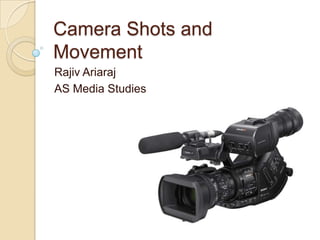
Camera Shots and
Movement
Rajiv Ariaraj
AS Media Studies
The two elements of
Representation


Conducting a good textual analysis
(analysing a media product) takes part
in two areas.

1.
2.

Macro
Micro
Micro


Micro can be seen as analysing the
“little bits” of a media text. This could
be:

The Mise-en-Scene (CLAMPS)
 The Camera Shots and Movements
 The Editing
 The Sound

Macro


Macro analyses the bigger themes
and areas that arise from a textual
analysis. For example:

The representation of social groups.
 Whether the text supports ideology or
not.
 The general meaning behind the text.

Aim


To define and understand how
different camera angles are used in
media products.



By the end of this session you
should...

Be able to list at least 7 camera shots.
 Be able to identify camera shots from
a media text.

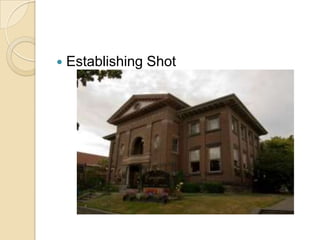
Establishing Shot


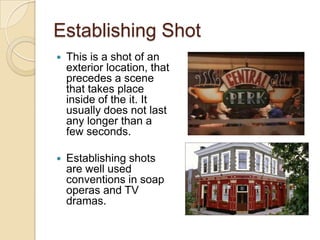
This is a shot of an
exterior location, that
precedes a scene
that takes place
inside of the it. It
usually does not last
any longer than a
few seconds.



Establishing shots
are well used
conventions in soap
operas and TV
dramas.
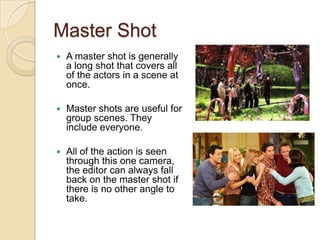
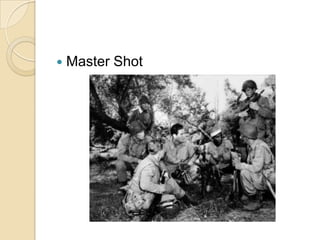
Master Shot


A master shot is generally
a long shot that covers all
of the actors in a scene at
once.



Master shots are useful for
group scenes. They
include everyone.



All of the action is seen
through this one camera,
the editor can always fall
back on the master shot if
there is no other angle to
take.
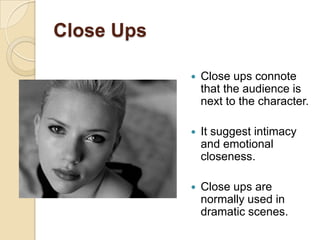
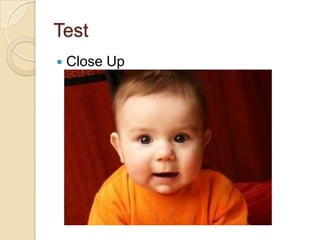
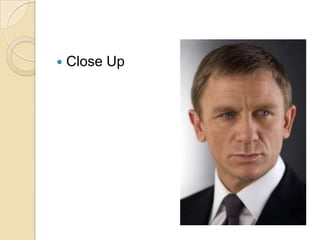
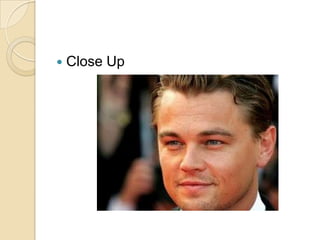
Close Ups


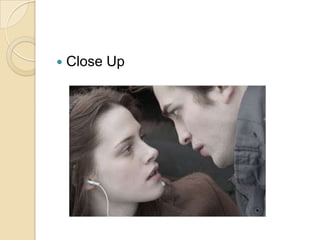
Close ups connote
that the audience is
next to the character.



It suggest intimacy
and emotional
closeness.



Close ups are
normally used in
dramatic scenes.
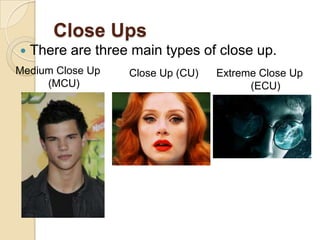
Close Ups


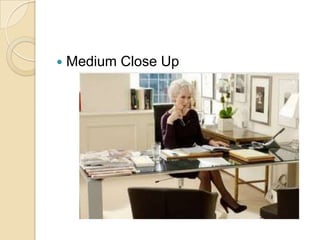
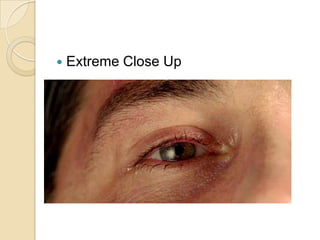
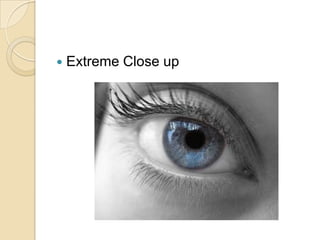
There are three main types of close up.

Medium Close Up
(MCU)

Close Up (CU)

Extreme Close Up
(ECU)
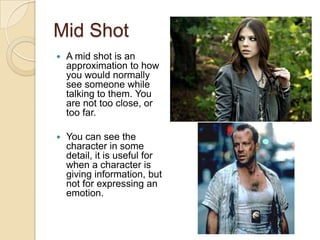
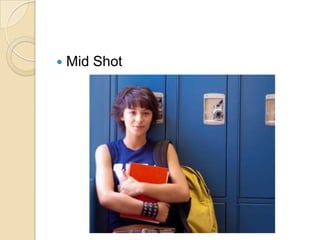
Mid Shot


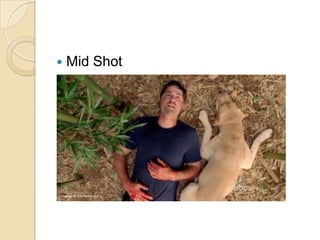
A mid shot is an
approximation to how
you would normally
see someone while
talking to them. You
are not too close, or
too far.



You can see the
character in some
detail, it is useful for
when a character is
giving information, but
not for expressing an
emotion.
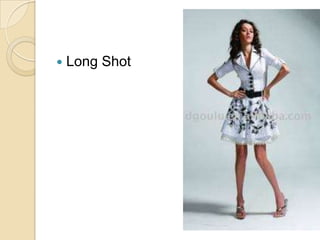
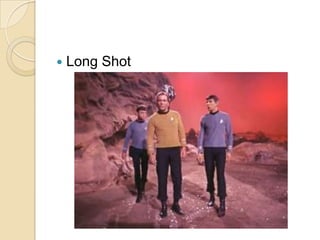
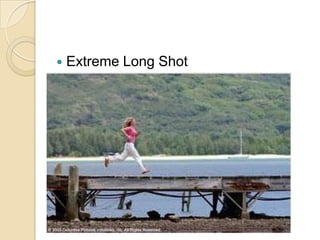
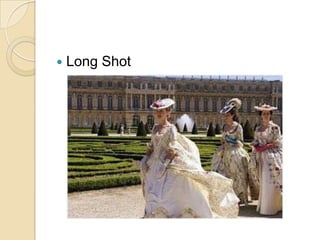
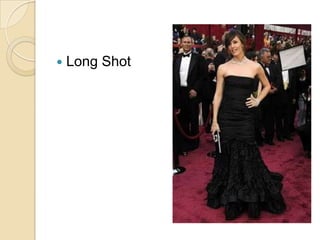
Long Shot


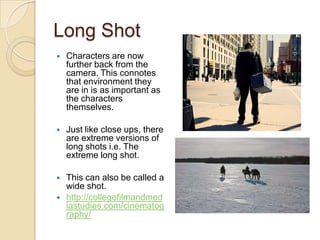
Characters are now
further back from the
camera. This connotes
that environment they
are in is as important as
the characters
themselves.



Just like close ups, there
are extreme versions of
long shots i.e. The
extreme long shot.



This can also be called a
wide shot.
http://collegefilmandmed
iastudies.com/cinematog
raphy/


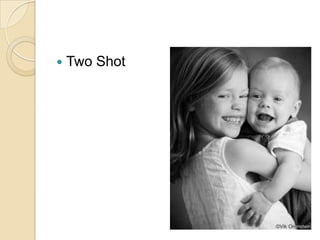
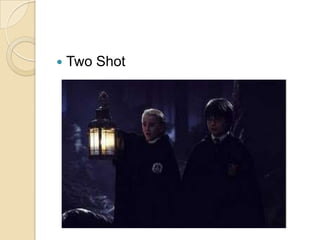
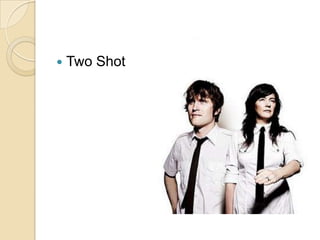
Two Shot


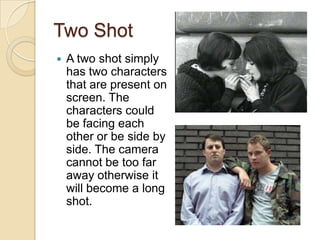
A two shot simply
has two characters
that are present on
screen. The
characters could
be facing each
other or be side by
side. The camera
cannot be too far
away otherwise it
will become a long
shot.
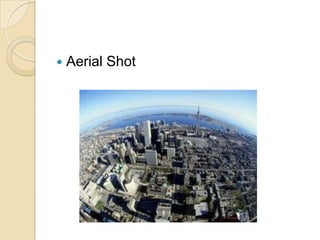
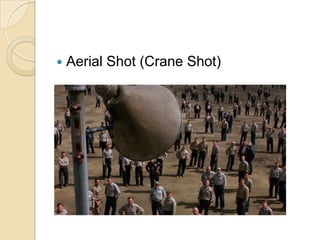
Aerial Shot
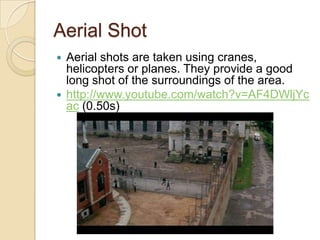
Aerial shots are taken using cranes,
helicopters or planes. They provide a good
long shot of the surroundings of the area.
 http://www.youtube.com/watch?v=AF4DWljYc
ac (0.50s)

POV Shot
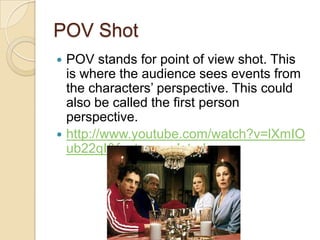
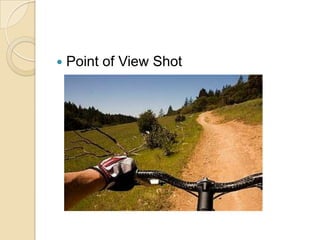
POV stands for point of view shot. This
is where the audience sees events from
the characters’ perspective. This could
also be called the first person
perspective.
 http://www.youtube.com/watch?v=lXmIO
ub22qI&feature=related

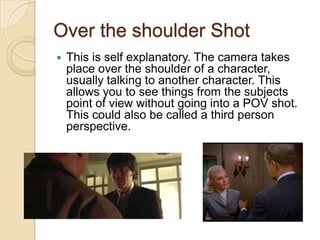
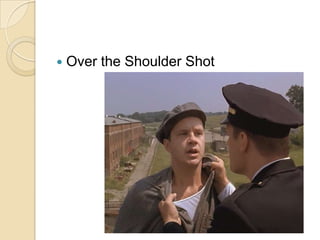
Over the shoulder Shot


This is self explanatory. The camera takes
place over the shoulder of a character,
usually talking to another character. This
allows you to see things from the subjects
point of view without going into a POV shot.
This could also be called a third person
perspective.
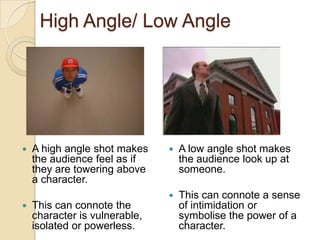
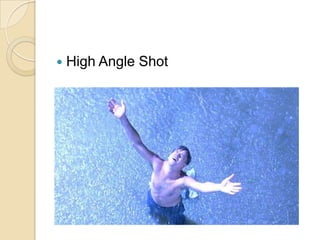
High Angle/ Low Angle



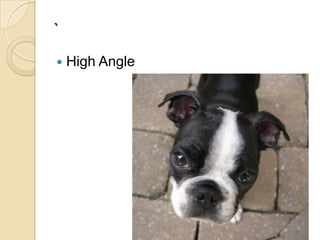
A high angle shot makes
the audience feel as if
they are towering above
a character.
This can connote the
character is vulnerable,
isolated or powerless.



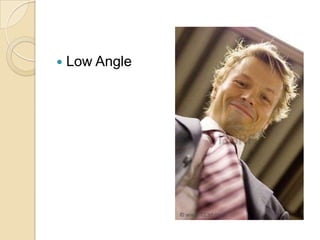
A low angle shot makes
the audience look up at
someone.





This can connote a sense
of intimidation or
symbolise the power of a
character.
Test


Close Up


Mid Shot


Long Shot


Establishing Shot
`


High Angle


Low Angle


Master Shot


Two Shot


Aerial Shot


Long Shot


Close Up


Two Shot


Extreme Long Shot


Long Shot


Medium Close Up


Close Up


Mid Shot


Extreme Close Up


Over the Shoulder Shot


High Angle Shot


Aerial Shot (Crane Shot)


Two Shot


Long Shot


Close Up


Extreme Close up


Point of View Shot
TASK


1.
2.

Watch the following clip answer the
two questions:
List the camera shots being used
through the clip.
Why do you some of the camera
shots have been used? How does
this work with the Mise-En-Scene
(CLAMPS)? What meaning do they
create?
Camera Movement


Just as important as the camera shots, is the
way that the camera moves in a media text.



By moving the camera draws the audiences’
attention to whatever the producers want the
audience to look at.



Camera movement can draw attention to,
reveal and lead the audience. So
understanding what each movement is called
is vital to conducting a good textual analysis.
Panning


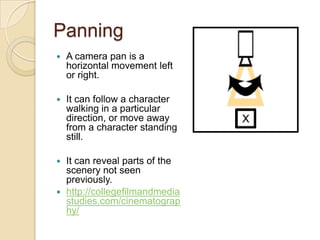
A camera pan is a
horizontal movement left
or right.



It can follow a character
walking in a particular
direction, or move away
from a character standing
still.

It can reveal parts of the
scenery not seen
previously.
 http://collegefilmandmedia
studies.com/cinematograp
hy/

Tilting
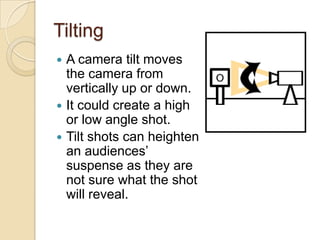
A camera tilt moves
the camera from
vertically up or down.
 It could create a high
or low angle shot.
 Tilt shots can heighten
an audiences’
suspense as they are
not sure what the shot
will reveal.

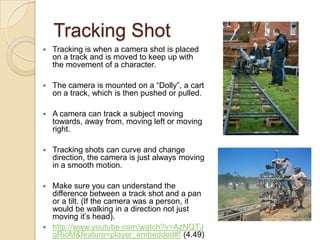
Tracking Shot


Tracking is when a camera shot is placed
on a track and is moved to keep up with
the movement of a character.



The camera is mounted on a “Dolly”, a cart
on a track, which is then pushed or pulled.



A camera can track a subject moving
towards, away from, moving left or moving
right.



Tracking shots can curve and change
direction, the camera is just always moving
in a smooth motion.

Make sure you can understand the
difference between a track shot and a pan
or a tilt. (If the camera was a person, it
would be walking in a direction not just
moving it’s head).
 http://www.youtube.com/watch?v=AzNQTJ
gRioM&feature=player_embedded#! (4.49)

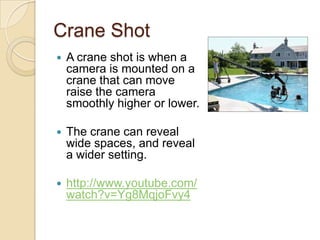
Crane Shot


A crane shot is when a
camera is mounted on a
crane that can move
raise the camera
smoothly higher or lower.



The crane can reveal
wide spaces, and reveal
a wider setting.



http://www.youtube.com/
watch?v=Yg8MqjoFvy4
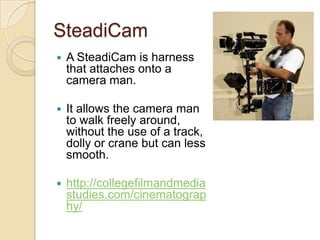
SteadiCam


A SteadiCam is harness
that attaches onto a
camera man.



It allows the camera man
to walk freely around,
without the use of a track,
dolly or crane but can less
smooth.



http://collegefilmandmedia
studies.com/cinematograp
hy/
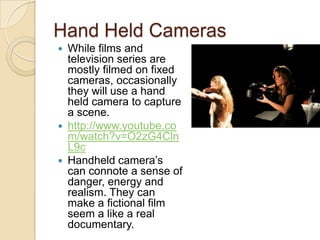
Hand Held Cameras
While films and
television series are
mostly filmed on fixed
cameras, occasionally
they will use a hand
held camera to capture
a scene.
 http://www.youtube.co
m/watch?v=O2zG4Cln
L9c
 Handheld camera’s
can connote a sense of
danger, energy and
realism. They can
make a fictional film
seem a like a real
documentary.

Zoom/ Reverse Zoom


A zoom is when the camera stays fixed in
position but zooms in on a object, location or
character.



Zooming from a mid shot to a close up could
connote that the meaning of the scene is
changing to a more emotional tone or to reveal a
character’s reaction.



A reverse zoom moves the shot from a close up
to a mid or long shot. Connoting that the
surroundings are becoming more a focus in the
story.



http://www.youtube.com/watch?v=bB9cLr7ORA&feature=related
TASK


Write down all of the camera shots,
and movements you see in this scene
from “Lost In Translation”.



What sense is the filmmaker trying to
get across?



http://www.youtube.com/watch?v=7xfb
5vYxYk4
HOMEWORK
Watch this clip:
 http://www.youtube.com/watch?v=FiQ
nH450hPM


Identify the Mise-En-Scene using
CLAMPS.
 Identify the Camera shots and
movements used.


Camerashots

  • 1.
    Camera Shots and Movement RajivAriaraj AS Media Studies
  • 2.
    The two elementsof Representation  Conducting a good textual analysis (analysing a media product) takes part in two areas. 1. 2. Macro Micro
  • 3.
    Micro  Micro can beseen as analysing the “little bits” of a media text. This could be: The Mise-en-Scene (CLAMPS)  The Camera Shots and Movements  The Editing  The Sound 
  • 4.
    Macro  Macro analyses thebigger themes and areas that arise from a textual analysis. For example: The representation of social groups.  Whether the text supports ideology or not.  The general meaning behind the text. 
  • 6.
    Aim  To define andunderstand how different camera angles are used in media products.  By the end of this session you should... Be able to list at least 7 camera shots.  Be able to identify camera shots from a media text. 
  • 7.
    Establishing Shot  This isa shot of an exterior location, that precedes a scene that takes place inside of the it. It usually does not last any longer than a few seconds.  Establishing shots are well used conventions in soap operas and TV dramas.
  • 8.
    Master Shot  A mastershot is generally a long shot that covers all of the actors in a scene at once.  Master shots are useful for group scenes. They include everyone.  All of the action is seen through this one camera, the editor can always fall back on the master shot if there is no other angle to take.
  • 9.
    Close Ups  Close upsconnote that the audience is next to the character.  It suggest intimacy and emotional closeness.  Close ups are normally used in dramatic scenes.
  • 10.
    Close Ups  There arethree main types of close up. Medium Close Up (MCU) Close Up (CU) Extreme Close Up (ECU)
  • 11.
    Mid Shot  A midshot is an approximation to how you would normally see someone while talking to them. You are not too close, or too far.  You can see the character in some detail, it is useful for when a character is giving information, but not for expressing an emotion.
  • 12.
    Long Shot  Characters arenow further back from the camera. This connotes that environment they are in is as important as the characters themselves.  Just like close ups, there are extreme versions of long shots i.e. The extreme long shot.  This can also be called a wide shot. http://collegefilmandmed iastudies.com/cinematog raphy/ 
  • 13.
    Two Shot  A twoshot simply has two characters that are present on screen. The characters could be facing each other or be side by side. The camera cannot be too far away otherwise it will become a long shot.
  • 14.
    Aerial Shot Aerial shotsare taken using cranes, helicopters or planes. They provide a good long shot of the surroundings of the area.  http://www.youtube.com/watch?v=AF4DWljYc ac (0.50s) 
  • 15.
    POV Shot POV standsfor point of view shot. This is where the audience sees events from the characters’ perspective. This could also be called the first person perspective.  http://www.youtube.com/watch?v=lXmIO ub22qI&feature=related 
  • 16.
    Over the shoulderShot  This is self explanatory. The camera takes place over the shoulder of a character, usually talking to another character. This allows you to see things from the subjects point of view without going into a POV shot. This could also be called a third person perspective.
  • 17.
    High Angle/ LowAngle  A high angle shot makes the audience feel as if they are towering above a character. This can connote the character is vulnerable, isolated or powerless.  A low angle shot makes the audience look up at someone.   This can connote a sense of intimidation or symbolise the power of a character.
  • 18.
  • 19.
  • 20.
  • 21.
  • 22.
  • 23.
  • 24.
  • 25.
  • 26.
  • 27.
  • 28.
  • 29.
  • 30.
  • 31.
  • 32.
  • 33.
  • 34.
  • 35.
  • 36.
  • 37.
  • 38.
  • 39.
  • 40.
  • 41.
  • 42.
  • 43.
  • 44.
    TASK  1. 2. Watch the followingclip answer the two questions: List the camera shots being used through the clip. Why do you some of the camera shots have been used? How does this work with the Mise-En-Scene (CLAMPS)? What meaning do they create?
  • 45.
    Camera Movement  Just asimportant as the camera shots, is the way that the camera moves in a media text.  By moving the camera draws the audiences’ attention to whatever the producers want the audience to look at.  Camera movement can draw attention to, reveal and lead the audience. So understanding what each movement is called is vital to conducting a good textual analysis.
  • 46.
    Panning  A camera panis a horizontal movement left or right.  It can follow a character walking in a particular direction, or move away from a character standing still. It can reveal parts of the scenery not seen previously.  http://collegefilmandmedia studies.com/cinematograp hy/ 
  • 47.
    Tilting A camera tiltmoves the camera from vertically up or down.  It could create a high or low angle shot.  Tilt shots can heighten an audiences’ suspense as they are not sure what the shot will reveal. 
  • 48.
    Tracking Shot  Tracking iswhen a camera shot is placed on a track and is moved to keep up with the movement of a character.  The camera is mounted on a “Dolly”, a cart on a track, which is then pushed or pulled.  A camera can track a subject moving towards, away from, moving left or moving right.  Tracking shots can curve and change direction, the camera is just always moving in a smooth motion. Make sure you can understand the difference between a track shot and a pan or a tilt. (If the camera was a person, it would be walking in a direction not just moving it’s head).  http://www.youtube.com/watch?v=AzNQTJ gRioM&feature=player_embedded#! (4.49) 
  • 49.
    Crane Shot  A craneshot is when a camera is mounted on a crane that can move raise the camera smoothly higher or lower.  The crane can reveal wide spaces, and reveal a wider setting.  http://www.youtube.com/ watch?v=Yg8MqjoFvy4
  • 50.
    SteadiCam  A SteadiCam isharness that attaches onto a camera man.  It allows the camera man to walk freely around, without the use of a track, dolly or crane but can less smooth.  http://collegefilmandmedia studies.com/cinematograp hy/
  • 51.
    Hand Held Cameras Whilefilms and television series are mostly filmed on fixed cameras, occasionally they will use a hand held camera to capture a scene.  http://www.youtube.co m/watch?v=O2zG4Cln L9c  Handheld camera’s can connote a sense of danger, energy and realism. They can make a fictional film seem a like a real documentary. 
  • 52.
    Zoom/ Reverse Zoom  Azoom is when the camera stays fixed in position but zooms in on a object, location or character.  Zooming from a mid shot to a close up could connote that the meaning of the scene is changing to a more emotional tone or to reveal a character’s reaction.  A reverse zoom moves the shot from a close up to a mid or long shot. Connoting that the surroundings are becoming more a focus in the story.  http://www.youtube.com/watch?v=bB9cLr7ORA&feature=related
  • 53.
    TASK  Write down allof the camera shots, and movements you see in this scene from “Lost In Translation”.  What sense is the filmmaker trying to get across?  http://www.youtube.com/watch?v=7xfb 5vYxYk4
  • 54.
    HOMEWORK Watch this clip: http://www.youtube.com/watch?v=FiQ nH450hPM  Identify the Mise-En-Scene using CLAMPS.  Identify the Camera shots and movements used. 