 fopen() to open a file
 fclose() to close a file
 fflush () to flush out the buffer associated with a file
 freopen() to change the file associated with a stream
 remove() to remove a file
 rename() to rename a file
 tempfile() to create a temporary binary file
 tmpnam() to generate a unique filename
1
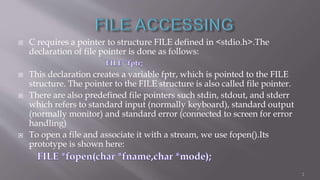
 C requires a pointer to structure FILE defined in <stdio.h>.The
declaration of file pointer is done as follows:
 This declaration creates a variable fptr, which is pointed to the FILE
structure. The pointer to the FILE structure is also called file pointer.
 There are also predefined file pointers such stdin, stdout, and stderr
which refers to standard input (normally keyboard), standard output
(normally monitor) and standard error (connected to screen for error
handling)
 To open a file and associate it with a stream, we use fopen().Its
prototype is shown here:
2
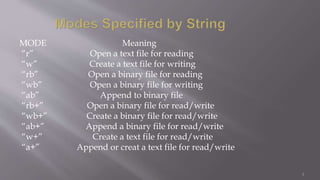
MODE Meaning
“r” Open a text file for reading
“w” Create a text file for writing
“rb” Open a binary file for reading
“wb” Open a binary file for writing
“ab” Append to binary file
“rb+” Open a binary file for read/write
“wb+” Create a binary file for read/write
“ab+” Append a binary file for read/write
“w+” Create a text file for read/write
“a+” Append or creat a text file for read/write
3
struct rna{
char name[20];
int age;
float x;
};
struct rna e;
fp = fopen("EMP.DAT","wb");
if(fp == NULL){
puts("Cannot open file");
}
printf("Enter name, age and basic salary");
scanf("%s%d%f",e.name,&e.age,&e.x);
fwrite(&e,sizeof(e),1,fp);
fclose(fp); 4
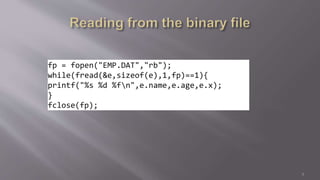
fp = fopen("EMP.DAT","rb");
while(fread(&e,sizeof(e),1,fp)==1){
printf("%s %d %fn",e.name,e.age,e.x);
}
fclose(fp);
5
#include<stdio.h>
#include<stdlib.h>
int main(){
FILE *fp;
struct rna{
char name[40];
int age;
float x;
};
struct rna e;
fp = fopen("employ.dat","w");
if(fp == NULL){ //if file is not opened
puts("Cannot open file");
exit(1);
}
printf("nEnter name, age and basic salary: ");
scanf("%s %d %f", e.name, &e.age, &e.bs);
//writes name age and basic salary to the file
fprintf(fp, "%s %d %fn", e.name, e.age, e.x);
fclose(fp); //close the file
return 0;
} 6
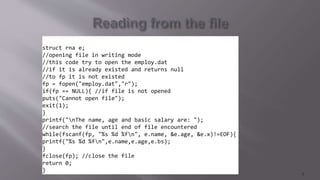
struct rna e;
//opening file in writing mode
//this code try to open the employ.dat
//if it is already existed and returns null
//to fp it is not existed
fp = fopen("employ.dat","r");
if(fp == NULL){ //if file is not opened
puts("Cannot open file");
exit(1);
}
printf("nThe name, age and basic salary are: ");
//search the file until end of file encountered
while(fscanf(fp, "%s %d %fn", e.name, &e.age, &e.x)!=EOF){
printf("%s %d %fn",e.name,e.age,e.bs);
}
fclose(fp); //close the file
return 0;
}
7

File in C programming

  • 1.
     fopen() toopen a file  fclose() to close a file  fflush () to flush out the buffer associated with a file  freopen() to change the file associated with a stream  remove() to remove a file  rename() to rename a file  tempfile() to create a temporary binary file  tmpnam() to generate a unique filename 1
  • 2.
     C requiresa pointer to structure FILE defined in <stdio.h>.The declaration of file pointer is done as follows:  This declaration creates a variable fptr, which is pointed to the FILE structure. The pointer to the FILE structure is also called file pointer.  There are also predefined file pointers such stdin, stdout, and stderr which refers to standard input (normally keyboard), standard output (normally monitor) and standard error (connected to screen for error handling)  To open a file and associate it with a stream, we use fopen().Its prototype is shown here: 2
  • 3.
    MODE Meaning “r” Opena text file for reading “w” Create a text file for writing “rb” Open a binary file for reading “wb” Open a binary file for writing “ab” Append to binary file “rb+” Open a binary file for read/write “wb+” Create a binary file for read/write “ab+” Append a binary file for read/write “w+” Create a text file for read/write “a+” Append or creat a text file for read/write 3
  • 4.
    struct rna{ char name[20]; intage; float x; }; struct rna e; fp = fopen("EMP.DAT","wb"); if(fp == NULL){ puts("Cannot open file"); } printf("Enter name, age and basic salary"); scanf("%s%d%f",e.name,&e.age,&e.x); fwrite(&e,sizeof(e),1,fp); fclose(fp); 4
  • 5.
  • 6.
    #include<stdio.h> #include<stdlib.h> int main(){ FILE *fp; structrna{ char name[40]; int age; float x; }; struct rna e; fp = fopen("employ.dat","w"); if(fp == NULL){ //if file is not opened puts("Cannot open file"); exit(1); } printf("nEnter name, age and basic salary: "); scanf("%s %d %f", e.name, &e.age, &e.bs); //writes name age and basic salary to the file fprintf(fp, "%s %d %fn", e.name, e.age, e.x); fclose(fp); //close the file return 0; } 6
  • 7.
    struct rna e; //openingfile in writing mode //this code try to open the employ.dat //if it is already existed and returns null //to fp it is not existed fp = fopen("employ.dat","r"); if(fp == NULL){ //if file is not opened puts("Cannot open file"); exit(1); } printf("nThe name, age and basic salary are: "); //search the file until end of file encountered while(fscanf(fp, "%s %d %fn", e.name, &e.age, &e.x)!=EOF){ printf("%s %d %fn",e.name,e.age,e.bs); } fclose(fp); //close the file return 0; } 7