Data Structure 1
Pointer,
Function, structure, array,
recursive function call
Pointers
Introduction
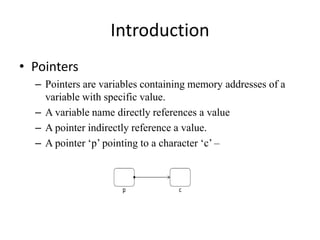
• Pointers
– Pointers are variables containing memory addresses of a
variable with specific value.
– A variable name directly references a value
– A pointer indirectly reference a value.
– A pointer ‘p’ pointing to a character ‘c’ –
Pointer Variable Declarations and
Initialization
• Pointer variables
– Contain memory address as their value
– Normal variables contain a specific value (direct reference)
– Pointers contain address of a variable that has a specific
value (indirect reference)
– Indirection – referencing a pointer value
• Pointer declarations
– * used with pointer variables: e.g., int *myPtr;
– Declares a pointer to an int (pointer of type int *)
– Multiple pointers require using a * before each variable declaration:
int *myPtr1, *myPtr2;
– Can declare pointers to any data type
– Initialize pointers to 0, NULL, or an address
• 0 or NULL –points to nothing (NULL preferred)
Calling Functions by Reference
• Call by reference with pointer arguments
– Pass address of argument using & operator
– Allows you to change actual location in memory
– Arrays are not passed with & because the array
name is already a pointer.
Pointer Expressions and Pointer
Arithmetic
• Arithmetic operations can be performed on
Pointers
– Increment/decrement pointer (++ or --)
– Add an integer to a pointer( + or += , - or -=)
– Pointers may be subtracted from each other
• 5 element int array on machine with 4 byte int
– vPtr points to first element v[ 0 ]
– at location 3000 (vPtr = 3000)
– vPtr += 2; sets vPtr to 3008
– vPtr points to v[ 2 ] (incremented by 2),
but the machine has 4 byte int, so it points to address 3008
sizeof Operator
• Sizeof
– Returns size of operand in bytes
– For arrays: size of 1 element *number of elements
– sizeof can be used with
• Variable names
• Type name
• Constant values
Relationship Between Pointers and
Arrays
• Arrays and pointers closely related
– Array name like a constant pointer
– Pointers can do array subscripting operations
Pointer-to-pointers
• We can have pointers to – int, char, float, any
structure….
• Declaration of a pointer-to-pointer:
• int
**ipp; where two * indicates two level of
pointers.
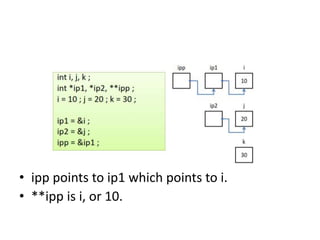
• ipp points to ip1 which points to i.
• **ipp is i, or 10.
Pointers to Functions
• Pointer to function
– Contains address of function
– Similar to how array name is address of first element
– Function name is starting address of code that defines
Function
• Function pointers can be
– Passed to functions
– Stored in arrays
– Assigned to other function pointers
Data Structure Books
• Text Books:
• Mark Allen Weiss - Data Structures and Algorithm Analysis in
C, 2nd Edition, Addison-Wesley, 1997
• P.S. Deshpande and O.G. Kakde - C and Data Structures,
Charles Rive Media, 2004
• Reference Books:
• Data structures and problem solving using C++, By Mark Allen
Weiss - Addison-Wesley (2000)

Data structure lecture 1

  • 1.
    Data Structure 1 Pointer, Function,structure, array, recursive function call
  • 2.
  • 3.
    Introduction • Pointers – Pointersare variables containing memory addresses of a variable with specific value. – A variable name directly references a value – A pointer indirectly reference a value. – A pointer ‘p’ pointing to a character ‘c’ –
  • 4.
    Pointer Variable Declarationsand Initialization • Pointer variables – Contain memory address as their value – Normal variables contain a specific value (direct reference) – Pointers contain address of a variable that has a specific value (indirect reference) – Indirection – referencing a pointer value • Pointer declarations – * used with pointer variables: e.g., int *myPtr; – Declares a pointer to an int (pointer of type int *) – Multiple pointers require using a * before each variable declaration: int *myPtr1, *myPtr2;
  • 5.
    – Can declarepointers to any data type – Initialize pointers to 0, NULL, or an address • 0 or NULL –points to nothing (NULL preferred)
  • 6.
    Calling Functions byReference • Call by reference with pointer arguments – Pass address of argument using & operator – Allows you to change actual location in memory – Arrays are not passed with & because the array name is already a pointer.
  • 7.
    Pointer Expressions andPointer Arithmetic • Arithmetic operations can be performed on Pointers – Increment/decrement pointer (++ or --) – Add an integer to a pointer( + or += , - or -=) – Pointers may be subtracted from each other
  • 8.
    • 5 elementint array on machine with 4 byte int – vPtr points to first element v[ 0 ] – at location 3000 (vPtr = 3000) – vPtr += 2; sets vPtr to 3008 – vPtr points to v[ 2 ] (incremented by 2), but the machine has 4 byte int, so it points to address 3008
  • 9.
    sizeof Operator • Sizeof –Returns size of operand in bytes – For arrays: size of 1 element *number of elements – sizeof can be used with • Variable names • Type name • Constant values
  • 10.
    Relationship Between Pointersand Arrays • Arrays and pointers closely related – Array name like a constant pointer – Pointers can do array subscripting operations
  • 11.
    Pointer-to-pointers • We canhave pointers to – int, char, float, any structure…. • Declaration of a pointer-to-pointer: • int **ipp; where two * indicates two level of pointers.
  • 12.
    • ipp pointsto ip1 which points to i. • **ipp is i, or 10.
  • 13.
    Pointers to Functions •Pointer to function – Contains address of function – Similar to how array name is address of first element – Function name is starting address of code that defines Function • Function pointers can be – Passed to functions – Stored in arrays – Assigned to other function pointers
  • 14.
    Data Structure Books •Text Books: • Mark Allen Weiss - Data Structures and Algorithm Analysis in C, 2nd Edition, Addison-Wesley, 1997 • P.S. Deshpande and O.G. Kakde - C and Data Structures, Charles Rive Media, 2004 • Reference Books: • Data structures and problem solving using C++, By Mark Allen Weiss - Addison-Wesley (2000)