Program: B.Sc Nursing, Second Year
BNSG-201 Nutrition & Biochemistry
Unit No.1. Introduction
Topic- :Calorie
Lecture No. 8
Dr. Sudharani B Banappagoudar
Professor, SONS/OBG
1
BNSG 201
NUTRITION - UNIT I
INTRODUCTION
2
BNSG 201
Outline
• Introduction
• Calorie
• BMR
• Learning outcomes
• Exercise
• References
3
BNSG 201
INTRODUCTION
4
BNSG 201
<SELO: 1,4,9,13>
<Reference No.: R1,R3>
What are Nutrients?
The foods we eat contain nutrients. Nutrients are substances required by the body to perform
its basic functions. Nutrients must be obtained from our diet, since the human body does not
synthesize or produce them. Nutrients have one or more of three basic functions: they
provide energy, contribute to body structure, and/or regulate chemical processes in the body.
These basic functions allow us to detect and respond to environmental surroundings, move,
excrete wastes, respire (breathe), grow, and reproduce. There are six classes of nutrients
required for the body to function and maintain overall health. These are carbohydrates,
lipids, proteins, water, vitamins, and minerals. Foods also contain non-nutrients that may be
harmful (such as natural toxins common in plant foods and additives like some dyes and
preservatives) or beneficial (such as antioxidants).
INTRODUCTION
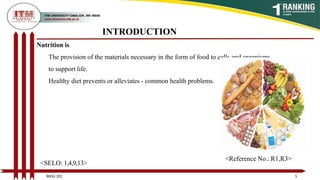
Nutrition is
The provision of the materials necessary in the form of food to cells and organisms
to support life.
Healthy diet prevents or alleviates - common health problems.
5
BNSG 201
<SELO: 1,4,9,13>
<Reference No.: R1,R3>
Objectives
<SELO: 1,4,9,13> <Reference No.: R1,R2>
6
BNSG 201
By the end of this chapter, you will be able to:
• Describe Calorie and BMR
CALORIE
A calorie is a unit of energy.
In nutrition and everyday language, calories refer to energy consumption through eating and
drinking and energy usage through physical activity.
For example, an apple may have 80 calories, while a mile walk may use up about 100 calories.
7
BNSG 201
<SELO: 1,4,9,13>
<Reference No.: R1,R3>
CALORIE
Symbols: kcal, Cal or C
The international unit of energy is Joule (J)
Fat 1 gram = 9 kcal/g
Protein 1 gram = 4 kcal/g
Carbohydrates 1 gram = 4 kcal/g
8
BNSG 201
<SELO: 1,4,9,13>
<Reference No.: R1,R3>
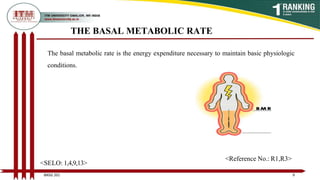
THE BASAL METABOLIC RATE
The basal metabolic rate is the energy expenditure necessary to maintain basic physiologic
conditions.
9
BNSG 201
<SELO: 1,4,9,13>
<Reference No.: R1,R3>
BASIC PHYSIOLOGIC CONDITIONS
The activity of the heart
Respiration
Conduction of nerve impulses
Ion transport across membranes
Reabsorption in the kidney
Metabolic activity.
About 60% of the energy - supports the ongoing metabolic work of the body cells, the basic metabolism.
This is the work that goes on all the time, without conscious awareness.
10
BNSG 201
<SELO: 1,4,9,13>
<Reference No.: R1,R3>
A person whose energy expenditure amounts to 2,000 cal/day spends as much as 1200 – 1400
calories to support usual metabolism.
BASIC PHYSIOLOGIC CONDITIONS
11
BNSG 201
<SELO: 1,4,9,13>
<Reference No.: R1,R3>
Basal metabolic energy required to support the basic processes of life - circulation,
respiration, temperature maintenance, etc. It excludes digestion and voluntary activities.
BMR constitutes the largest proportion (2/3) of a person’s daily expenditure.
BASIC PHYSIOLOGIC CONDITIONS
12
BNSG 201
<SELO: 1,4,9,13>
<Reference No.: R1,R3>
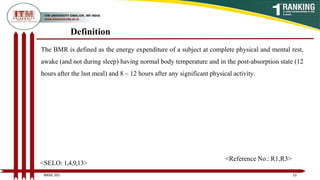
Definition
The BMR is defined as the energy expenditure of a subject at complete physical and mental rest,
awake (and not during sleep) having normal body temperature and in the post-absorption state (12
hours after the last meal) and 8 – 12 hours after any significant physical activity.
13
BNSG 201
<SELO: 1,4,9,13>
<Reference No.: R1,R3>
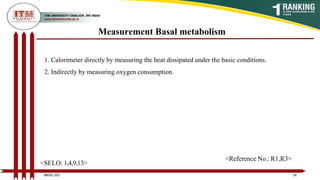
Measurement Basal metabolism
1. Calorimeter directly by measuring the heat dissipated under the basic conditions.
2. Indirectly by measuring oxygen consumption.
14
BNSG 201
<SELO: 1,4,9,13>
<Reference No.: R1,R3>
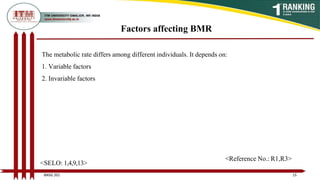
Factors affecting BMR
The metabolic rate differs among different individuals. It depends on:
1. Variable factors
2. Invariable factors
15
BNSG 201
<SELO: 1,4,9,13>
<Reference No.: R1,R3>
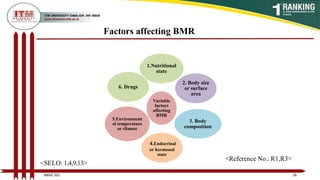
Variable
factors
affecting
BMR
1.Nutritional
state
2. Body size
or surface
area
3. Body
composition
4.Endocrinal
or hormonal
state
5.Environment
al temperature
or climate
6. Drugs
Factors affecting BMR
16
BNSG 201
<SELO: 1,4,9,13>
<Reference No.: R1,R3>
Lean Body Mass is a component of body composition, calculated by subtracting body fat weight
from total body weight: total body weight is lean plus fat.
In equations: LBM = BW − BF Lean Body Mass equals Body Weight minus Body Fat
Factors affecting BMR
17
BNSG 201
<SELO: 1,4,9,13>
<Reference No.: R1,R3>
LBM + BF = BW. Lean Body Mass plus Body Fat equals Body Weight.
Eg A man with 165 cm height should have 65 kg as per normal BMI
Suppose consider he is 85 kg. then the lean body mass = 85 - 20 = 65 kg
Factors affecting BMR
18
BNSG 201
<SELO: 1,4,9,13>
<Reference No.: R1,R3>
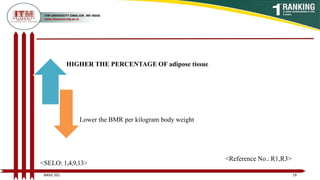
HIGHER THE PERCENTAGE OF adipose tissue
Lower the BMR per kilogram body weight
19
BNSG 201
<SELO: 1,4,9,13>
<Reference No.: R1,R3>
Invariable factors affecting BMR
Gender or Sex
• Women
• Sex hormone
Age
20
BNSG 201
<SELO: 1,4,9,13>
<Reference No.: R1,R3>
Normal Value
BMR values are expressed as ‘kcal or KJ/m2’ of body surface per hour.
In adults, BMR for healthy males is 40 kcal (168kJ) per hour and
Healthy females is 37 kcal (155kJ) per hour.
21
BNSG 201
<SELO: 1,4,9,13>
<Reference No.: R1,R3>
Clinical Applications
BMR estimation is used to diagnose thyroid disorders
BMR is used in calculating food and drugs.
22
BNSG 201
<SELO: 1,4,9,13>
<Reference No.: R1,R3>
EXERCISE
23
BNSG 201
Explain BMR
LEARNING OUTCOMES
BNSG 201 24
The student explained about
• Calorie and BMR
Student effective learning outcome
1.Application of concepts of topic & it’s technological application.
2.Ability to interpret and analyze data into information and to design and conduct experiments.
3.Understanding available tools and products and ability to use it effectively.
4.Adaptive Thinking Skills
BNSG 201 25
Reference
1.Essentials of nutrition and biochemistry for basic B sc nursing I clement
2. Food & nutrition for nurses (B sc nursing) by Ruma Singh
3. A textbook of nutrition B.Sc(n) first year Darshan Soni
26
BNSG 201
BNSG 201 27

Calorie

  • 1.
    Program: B.Sc Nursing,Second Year BNSG-201 Nutrition & Biochemistry Unit No.1. Introduction Topic- :Calorie Lecture No. 8 Dr. Sudharani B Banappagoudar Professor, SONS/OBG 1 BNSG 201
  • 2.
    NUTRITION - UNITI INTRODUCTION 2 BNSG 201
  • 3.
    Outline • Introduction • Calorie •BMR • Learning outcomes • Exercise • References 3 BNSG 201
  • 4.
    INTRODUCTION 4 BNSG 201 <SELO: 1,4,9,13> <ReferenceNo.: R1,R3> What are Nutrients? The foods we eat contain nutrients. Nutrients are substances required by the body to perform its basic functions. Nutrients must be obtained from our diet, since the human body does not synthesize or produce them. Nutrients have one or more of three basic functions: they provide energy, contribute to body structure, and/or regulate chemical processes in the body. These basic functions allow us to detect and respond to environmental surroundings, move, excrete wastes, respire (breathe), grow, and reproduce. There are six classes of nutrients required for the body to function and maintain overall health. These are carbohydrates, lipids, proteins, water, vitamins, and minerals. Foods also contain non-nutrients that may be harmful (such as natural toxins common in plant foods and additives like some dyes and preservatives) or beneficial (such as antioxidants).
  • 5.
    INTRODUCTION Nutrition is The provisionof the materials necessary in the form of food to cells and organisms to support life. Healthy diet prevents or alleviates - common health problems. 5 BNSG 201 <SELO: 1,4,9,13> <Reference No.: R1,R3>
  • 6.
    Objectives <SELO: 1,4,9,13> <ReferenceNo.: R1,R2> 6 BNSG 201 By the end of this chapter, you will be able to: • Describe Calorie and BMR
  • 7.
    CALORIE A calorie isa unit of energy. In nutrition and everyday language, calories refer to energy consumption through eating and drinking and energy usage through physical activity. For example, an apple may have 80 calories, while a mile walk may use up about 100 calories. 7 BNSG 201 <SELO: 1,4,9,13> <Reference No.: R1,R3>
  • 8.
    CALORIE Symbols: kcal, Calor C The international unit of energy is Joule (J) Fat 1 gram = 9 kcal/g Protein 1 gram = 4 kcal/g Carbohydrates 1 gram = 4 kcal/g 8 BNSG 201 <SELO: 1,4,9,13> <Reference No.: R1,R3>
  • 9.
    THE BASAL METABOLICRATE The basal metabolic rate is the energy expenditure necessary to maintain basic physiologic conditions. 9 BNSG 201 <SELO: 1,4,9,13> <Reference No.: R1,R3>
  • 10.
    BASIC PHYSIOLOGIC CONDITIONS Theactivity of the heart Respiration Conduction of nerve impulses Ion transport across membranes Reabsorption in the kidney Metabolic activity. About 60% of the energy - supports the ongoing metabolic work of the body cells, the basic metabolism. This is the work that goes on all the time, without conscious awareness. 10 BNSG 201 <SELO: 1,4,9,13> <Reference No.: R1,R3>
  • 11.
    A person whoseenergy expenditure amounts to 2,000 cal/day spends as much as 1200 – 1400 calories to support usual metabolism. BASIC PHYSIOLOGIC CONDITIONS 11 BNSG 201 <SELO: 1,4,9,13> <Reference No.: R1,R3>
  • 12.
    Basal metabolic energyrequired to support the basic processes of life - circulation, respiration, temperature maintenance, etc. It excludes digestion and voluntary activities. BMR constitutes the largest proportion (2/3) of a person’s daily expenditure. BASIC PHYSIOLOGIC CONDITIONS 12 BNSG 201 <SELO: 1,4,9,13> <Reference No.: R1,R3>
  • 13.
    Definition The BMR isdefined as the energy expenditure of a subject at complete physical and mental rest, awake (and not during sleep) having normal body temperature and in the post-absorption state (12 hours after the last meal) and 8 – 12 hours after any significant physical activity. 13 BNSG 201 <SELO: 1,4,9,13> <Reference No.: R1,R3>
  • 14.
    Measurement Basal metabolism 1.Calorimeter directly by measuring the heat dissipated under the basic conditions. 2. Indirectly by measuring oxygen consumption. 14 BNSG 201 <SELO: 1,4,9,13> <Reference No.: R1,R3>
  • 15.
    Factors affecting BMR Themetabolic rate differs among different individuals. It depends on: 1. Variable factors 2. Invariable factors 15 BNSG 201 <SELO: 1,4,9,13> <Reference No.: R1,R3>
  • 16.
    Variable factors affecting BMR 1.Nutritional state 2. Body size orsurface area 3. Body composition 4.Endocrinal or hormonal state 5.Environment al temperature or climate 6. Drugs Factors affecting BMR 16 BNSG 201 <SELO: 1,4,9,13> <Reference No.: R1,R3>
  • 17.
    Lean Body Massis a component of body composition, calculated by subtracting body fat weight from total body weight: total body weight is lean plus fat. In equations: LBM = BW − BF Lean Body Mass equals Body Weight minus Body Fat Factors affecting BMR 17 BNSG 201 <SELO: 1,4,9,13> <Reference No.: R1,R3>
  • 18.
    LBM + BF= BW. Lean Body Mass plus Body Fat equals Body Weight. Eg A man with 165 cm height should have 65 kg as per normal BMI Suppose consider he is 85 kg. then the lean body mass = 85 - 20 = 65 kg Factors affecting BMR 18 BNSG 201 <SELO: 1,4,9,13> <Reference No.: R1,R3>
  • 19.
    HIGHER THE PERCENTAGEOF adipose tissue Lower the BMR per kilogram body weight 19 BNSG 201 <SELO: 1,4,9,13> <Reference No.: R1,R3>
  • 20.
    Invariable factors affectingBMR Gender or Sex • Women • Sex hormone Age 20 BNSG 201 <SELO: 1,4,9,13> <Reference No.: R1,R3>
  • 21.
    Normal Value BMR valuesare expressed as ‘kcal or KJ/m2’ of body surface per hour. In adults, BMR for healthy males is 40 kcal (168kJ) per hour and Healthy females is 37 kcal (155kJ) per hour. 21 BNSG 201 <SELO: 1,4,9,13> <Reference No.: R1,R3>
  • 22.
    Clinical Applications BMR estimationis used to diagnose thyroid disorders BMR is used in calculating food and drugs. 22 BNSG 201 <SELO: 1,4,9,13> <Reference No.: R1,R3>
  • 23.
  • 24.
    LEARNING OUTCOMES BNSG 20124 The student explained about • Calorie and BMR
  • 25.
    Student effective learningoutcome 1.Application of concepts of topic & it’s technological application. 2.Ability to interpret and analyze data into information and to design and conduct experiments. 3.Understanding available tools and products and ability to use it effectively. 4.Adaptive Thinking Skills BNSG 201 25
  • 26.
    Reference 1.Essentials of nutritionand biochemistry for basic B sc nursing I clement 2. Food & nutrition for nurses (B sc nursing) by Ruma Singh 3. A textbook of nutrition B.Sc(n) first year Darshan Soni 26 BNSG 201
  • 27.